Contents · About 6 min read
📱 View as card news
Scrolling through football industry news on the morning of the 8th, I came across word that a familiar name was about to disappear from a shirt.
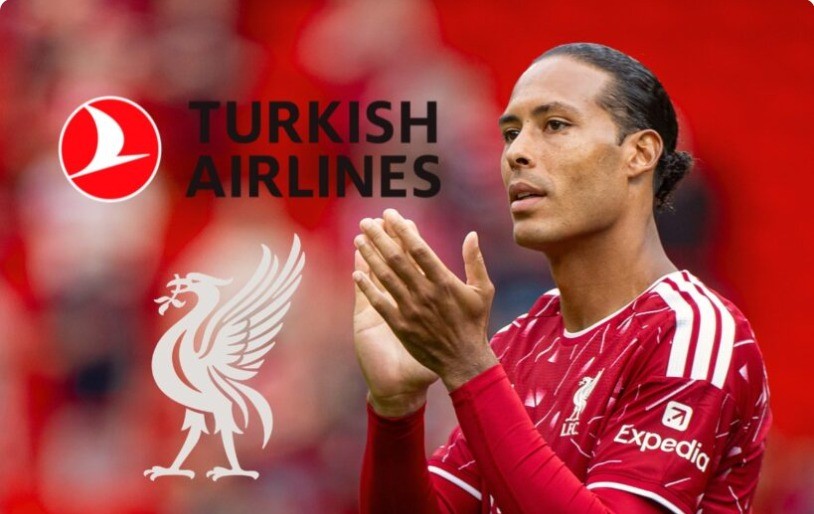
Liverpool FC had officially announced it would switch its main shirt sponsor to Turkish Airlines starting with the 2027-28 season. It marked the moment Standard Chartered, which had held that spot on Liverpool’s chest for 17 years since 2010, would step aside.
When I covered Anfield last month, I briefly mentioned reports that the club was “shopping for a new main sponsor ahead of its 2027 contract expiry.” Less than a month later, the actual deal landed, so as a marketer I wanted to dig into it.
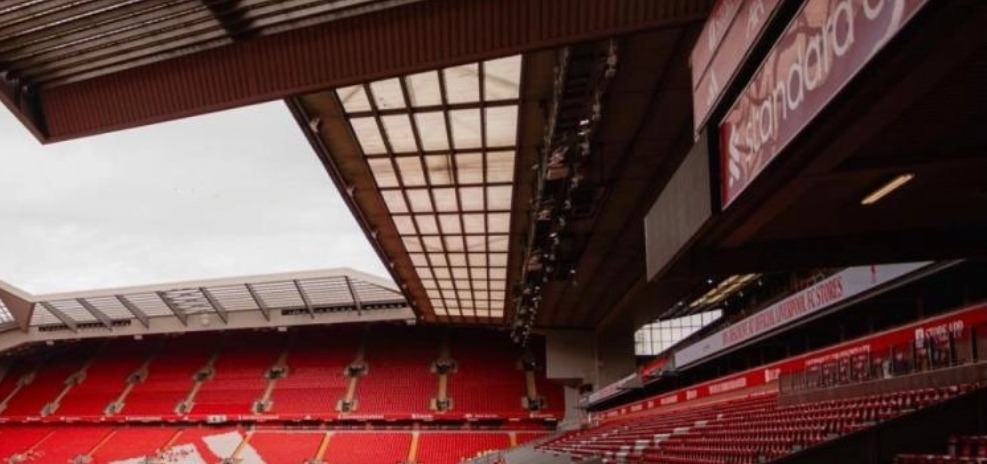
Source: Liverpool FC’s official announcement article (September 8, 2026) · liverpoolfc.com official announcement · Official club image
The New Deal — Why It’s Worth £300 Million
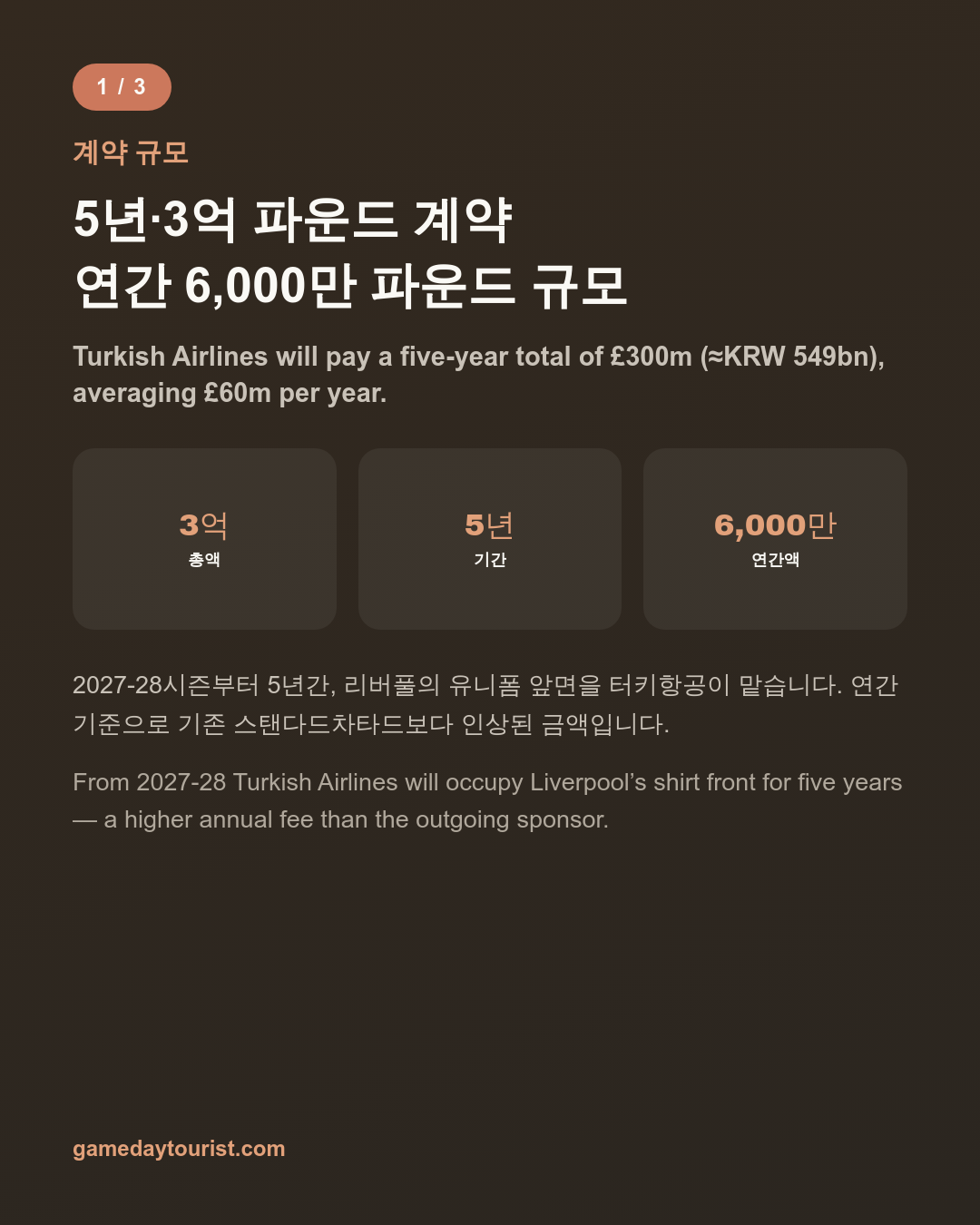
The new deal runs for five years starting June 1, 2027, for a total of £300 million (about ₩549 billion), which works out to roughly £60 million a year (about ₩109.8 billion).
The club has billed this as the biggest front-of-shirt sponsorship in Premier League history (per ESPN’s report).
The existing Standard Chartered deal, extended in 2022 through the 2026-27 season, was worth around £50 million a year (about ₩91.5 billion) — meaning the new deal adds roughly £10 million, or about ₩18.3 billion, a year.
Standard Chartered isn’t disappearing entirely, though. It’s stepping down from the shirt front, but the club says it will continue the relationship as a “global partner” from the 2027-28 season.
The Biggest “Pure” Shirt Deal — How It Differs from Emirates and Etihad
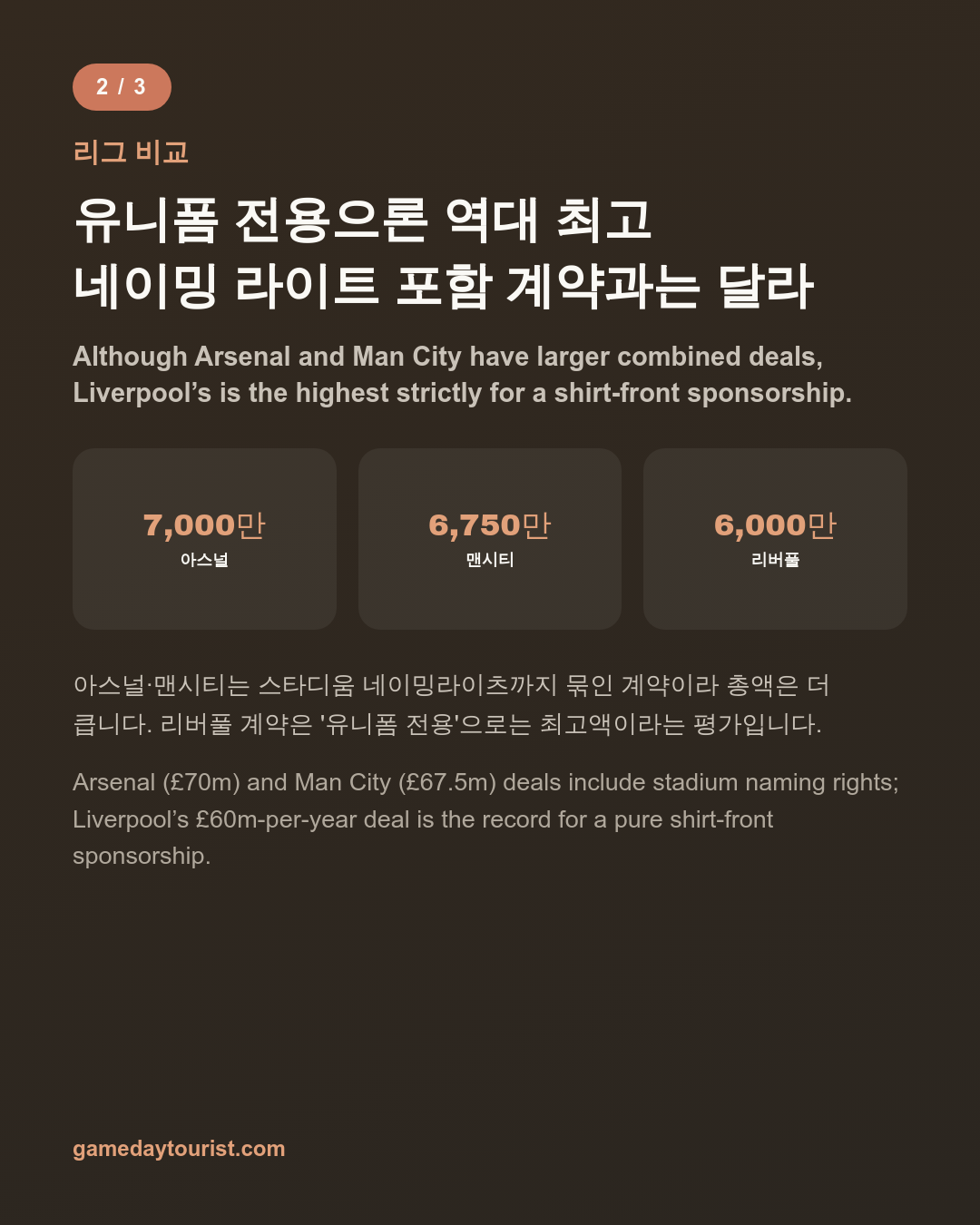
Here’s what’s interesting: by raw numbers, Liverpool isn’t actually No. 1 in the Premier League. Arsenal’s deal with Emirates runs about £70 million a year (about ₩128.1 billion), and Manchester City’s with Etihad about £67.5 million (about ₩123.5 billion) — both bigger than Liverpool’s £60 million.
But those two deals bundle in stadium naming rights (the right to attach a company name to a venue) on top of the shirt sponsorship. The names Emirates Stadium and Etihad Stadium are themselves part of those contracts.
Liverpool’s deal with Turkish Airlines, by contrast, covers just one piece of advertising inventory — the shirt front — which is why SI.com and other sports-business outlets call it the biggest “shirt-only” sponsorship on record.
Manchester United’s deal with Snapdragon is also reportedly around £60 million a year, and since that’s a shirt-only deal too, it puts United in roughly the same weight class as Liverpool.
As I noted in last month’s post (August 18), Liverpool kept the Anfield name itself off the table both when it sold a 30% stake in August and again in this sponsorship switch.
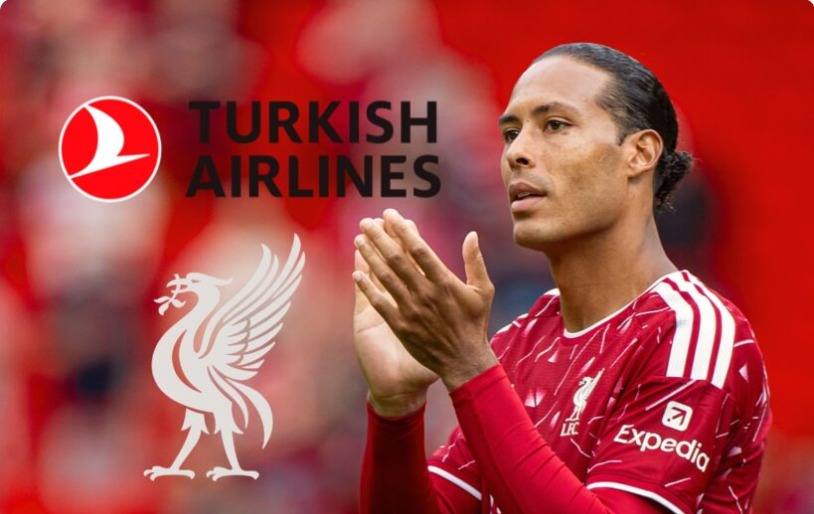
Source: thisisanfield.com report image (September 8, 2026)
Why Turkish Airlines Picked Liverpool — A 2005 Istanbul Connection
Curious why Turkish Airlines specifically, I looked into it further. The airline hubs out of Istanbul and markets itself on flying to more countries than any other carrier.
In the official announcement, chief commercial officer Ben Latty said the partnership was already built on “a special 2005 memory” — a reference to the fact that Liverpool’s dramatic comeback win over AC Milan in the 2005 UEFA Champions League final, after trailing 3-0, happened in Istanbul of all places.
Turkish Airlines CEO Ahmet Olmuştur also stressed, in the same announcement, the overlap between Liverpool’s global fanbase and the airline’s international route network.
The airline has previously sponsored clubs like Manchester United, FC Barcelona, and Borussia Dortmund, and served as an official UEFA Champions League sponsor in 2022-23 — which World Football Summit’s analysis frames as an extension of a broader global marketing strategy built around football.
From the airline’s side, the appeal seems obvious: one deal gives it access to Liverpool’s fanbase scattered across the globe, without having to run separate campaigns market by market.
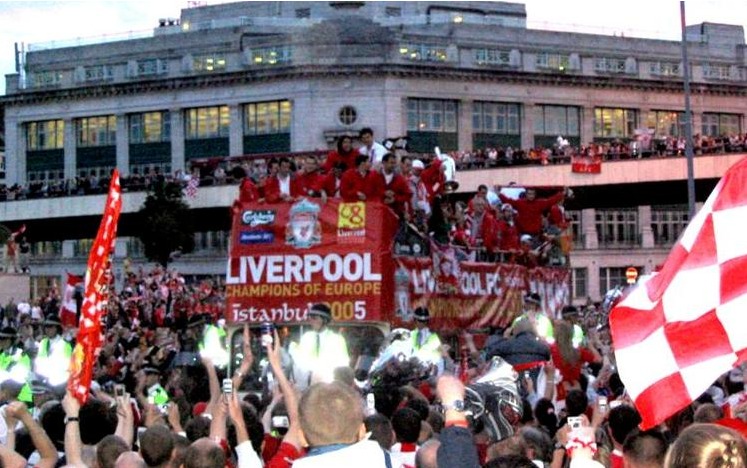
Source: Liverpool’s open-top bus parade through the city on May 26, 2005, with the Champions League trophy from Istanbul — the shirt on the parade banner still carries Carlsberg, the club’s sponsor at the time · Wikimedia Commons (photo by Jprw) · License: CC BY-SA 3.0
The Sixth Name — 47 Years of Liverpool Shirt Sponsors
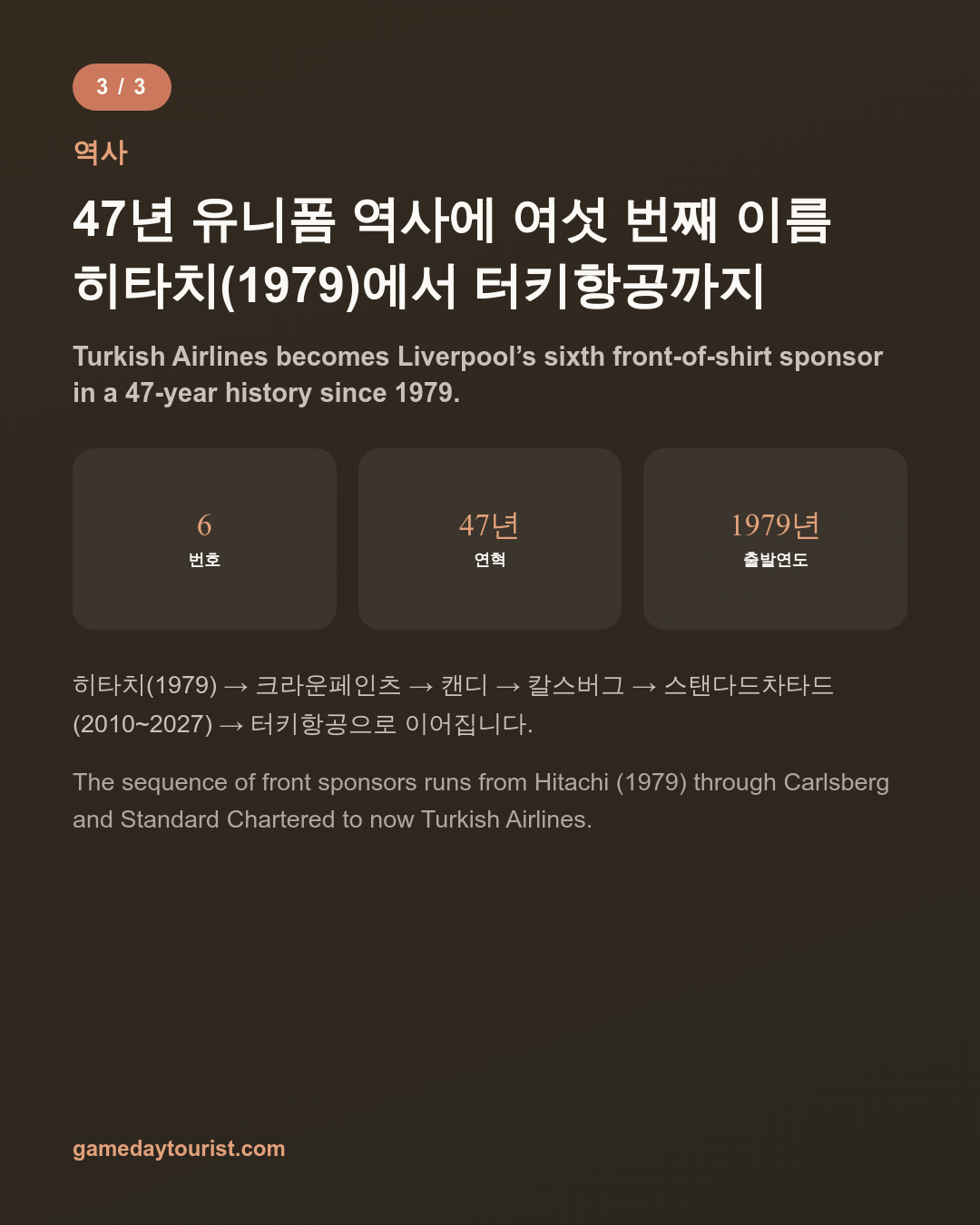
With this switch, Turkish Airlines becomes the sixth company to have its name on the front of Liverpool’s shirt. It’s a 47-year lineage starting with Hitachi in 1979, followed by Crown Paints (1982-1988), Candy (1988-1992), Carlsberg (1992-2010), and Standard Chartered (2010-2027).
Here’s the interesting part: Liverpool actually wasn’t the first shirt sponsorship in English football history. According to Bleacher Report’s rundown, Everton announced its deal with Danish meat producer Hafnia a few days earlier, making the Liverpool-Hitachi deal the second such case, not the first.
What’s more, back then a sponsor logo on a shirt couldn’t even be shown on TV. The FA and Football League ban on broadcasting sponsor logos wasn’t lifted until the 1983-84 season — a striking reminder that a market now worth hundreds of billions of won a season started out as a logo that wasn’t even allowed on screen.
Crowds and Tickets
Separate from the sponsor switch, Anfield’s own numbers remain strong. Since the 2024 expansion of the Anfield Road Stand, capacity has grown to 61,276, and the 2024-25 season saw one match draw a crowd of 60,420.
Rather than open sales, Liverpool still allocates season-ticket eligibility for home matches through tiered “All Red” membership ballots. For 2026-27, season ticket prices range from £931 (about ₩1.7 million) for the best Main Stand seats down to £734.50 (about ₩1.34 million) for the cheapest seats at the edge of the Kop.
More seats, but tickets are apparently just as hard to come by — that’s the common take from people who’ve visited Anfield recently.
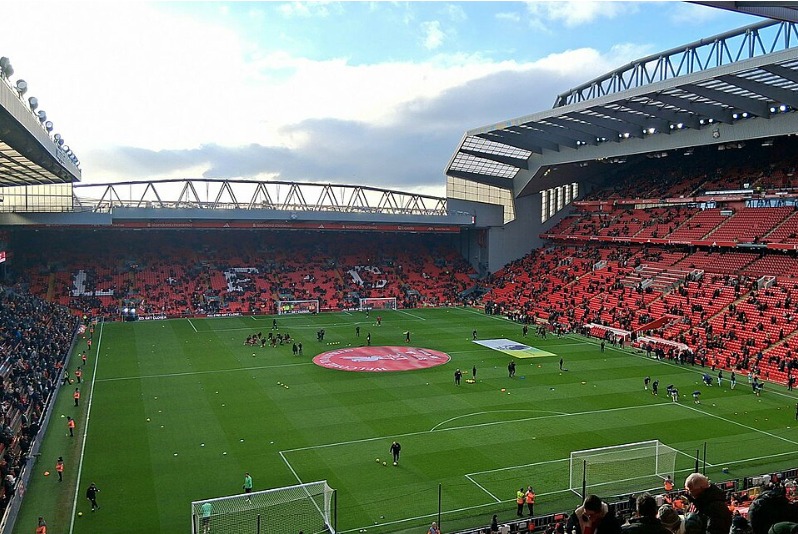
Source: Anfield on matchday, shot in January 2026, with players warming up in front of a full house · Wikimedia Commons (photo by Alan Murray-Rust, geograph.org.uk) · License: CC BY-SA 2.0
Compared with the KBO and K League
Comparing this to Korean domestic leagues, what stood out most was the simple question of whether a “shirt sponsor market” exists at all.
At most top KBO and K League clubs, even the front-of-shirt sponsor slot ends up going to a brand under the parent company that owns the club — Pohang Steelers wear a POSCO-affiliated brand, Jeonbuk Hyundai Motors wears a Hyundai Motor-affiliated brand, and so on.
A genuine market for shirt sponsorship — where outside companies with no ownership stake compete for the spot, and the price climbs every few years as contracts renew — the way it works at Liverpool, is still a rare sight in Korean football.
Granted, the overall revenue scale of the leagues is so different that a direct comparison is difficult. Still, it was striking to see just how far apart the two markets are in maturity, even for the exact same piece of advertising real estate — the shirt front.
What struck me most was that even as a 17-year sponsor stepped aside, the club went out of its way to frame it as continuity rather than a clean break.
Standard Chartered wasn’t shown the door entirely — it stays on as a global partner — while the new partner opened its relationship by invoking a bond that goes back more than 20 years, to 2005. The bigger the money on the table, the more it pays to sell the deal with a story and a history attached — that’s the lesson this case reconfirmed for me.
Leave a Reply