Contents · About 10 min read
- Dean Court, a Wasteland Lease That Survived a 17-Point Deduction and Reached Europe
- Who Bournemouth Are Now: Rose After Iraola, and Five Winless League Games
- Crowds and Tickets: A Structure Where the Seats Are the Ceiling
- Space and Expansion: The 20,200-Seat Plan That Keeps Building
- Kits and Naming Rights: One Company Holds the Ground’s Name and the Chest
- Broadcasting and Local Roots: Reliance on Distributions, and Jobs From the Build
- Comparing With the KBO: The Ceiling That the Number of Games Creates
📱 View as card news
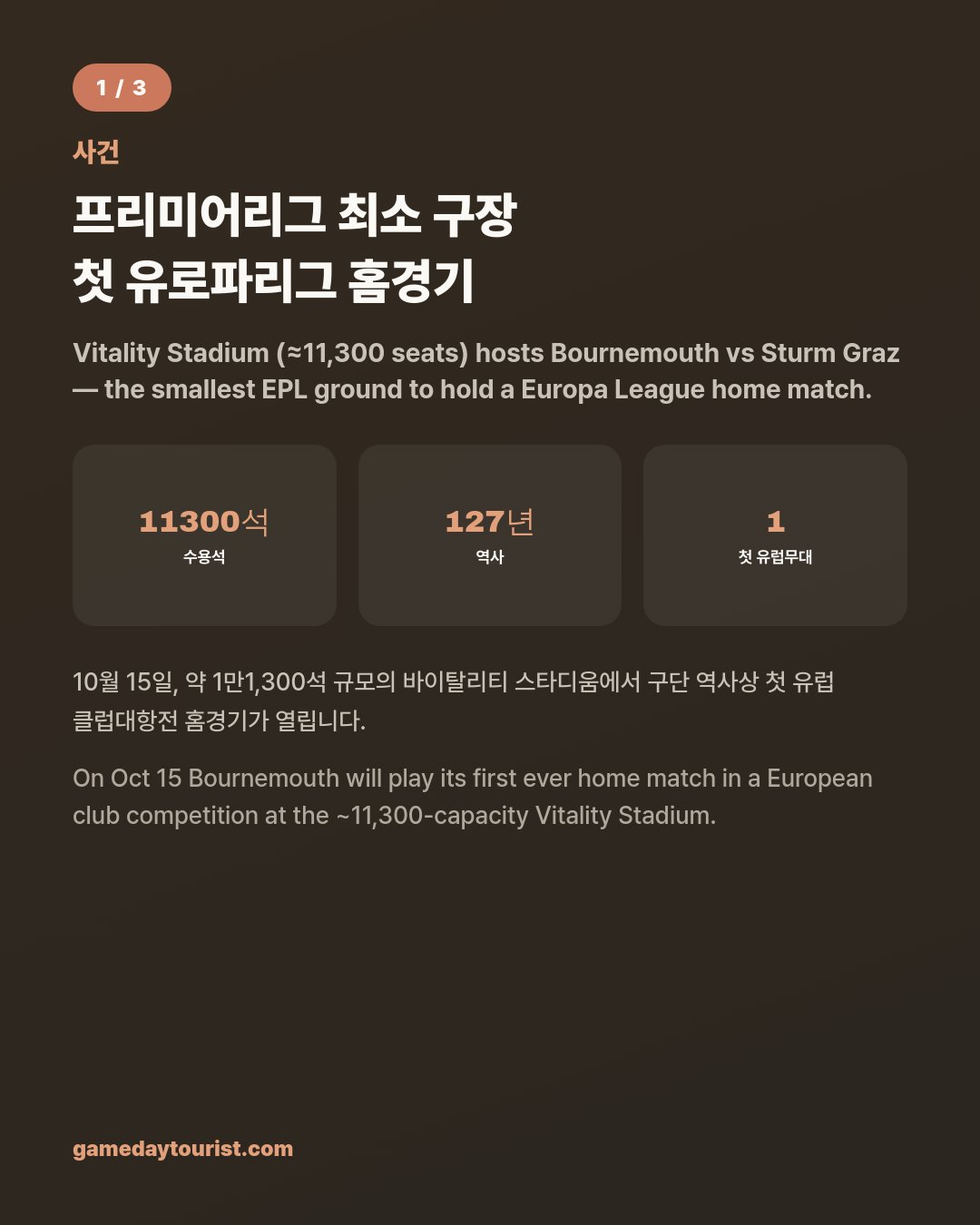

On Thursday night, October 15, the Premier League’s smallest ground will host its first-ever home match in a European club competition. It is Bournemouth’s first stage like this in 127 years of history: a Europa League league-phase game against Sturm Graz (UEFA’s official fixture list).
Yet the Vitality Stadium, where it will be played, holds only about 11,300 seats (sources give anywhere from 11,286 to 11,307). As a working marketer, that was the number that snagged me first.
A club has just finished sixth in the league, and the seats it can sell are exactly what they were. In this piece I cross-checked club announcements, local reports and financial analysis to lay out why the ground is so small, how fast it is growing now, and how a small ground makes its money.
Dean Court, a Wasteland Lease That Survived a 17-Point Deduction and Reached Europe
The ground’s story starts in 1910. According to a local history page compiled by Bournemouth, Christchurch and Poole Council (BCP), a local landowner, J. E. Cooper Dean, gave Boscombe FC a long lease on waste ground beside Kings Park, and the ground was named Dean Court after its benefactor.
The Cooper Dean side reportedly added a covenant putting building plans under the estate’s prior approval. The current name, Vitality Stadium, has been in use since July 2015 (Wikipedia’s stadium entry).
The origin of the club’s nickname, the Cherries, does not come down to a single answer. Wikipedia considers the cherry-red striped shirts the likelier source while also presenting the theory of cherry trees on the Cooper Dean estate, and NBC Sports lists both as reasons.
Either way, the kit colour and the ground’s site meet inside one name, which strikes me as a fairly solid starting point from a branding standpoint.
This small club has also come close to disappearing. In February 2008 it entered administration with debts of about £4 million and took a 10-point deduction, then failed to meet the league’s insolvency rules and lost 17 more points, as a retrospective in SI recounts.
Eddie Howe, a former player, took over mid-season, and a win in the last home game of 2008-09 secured survival. Over the next six years the club won three promotions to reach the Premier League in 2015, and a sixth-place finish in 2025-26 earned it its first-ever European place (Wikipedia’s club entry).
Once you think of those deductions as leading to this European stage, the number 11,300 reads differently.
Who Bournemouth Are Now: Rose After Iraola, and Five Winless League Games
Bournemouth were founded as Boscombe FC in 1899, have used their current name since 1971, and were bought in December 2022 by Black Knight Football Club, led by the American businessman Bill Foley.
Under Andoni Iraola they finished sixth in 2025-26 (57 points, per VAVEL’s season preview), and Iraola left when his contract expired.
His successor is the German coach Marco Rose, who was 49 at his appointment and has worked at Salzburg, Borussia Mönchengladbach, Borussia Dortmund and RB Leipzig. He signed a three-year deal (Express & Star, April 20 report).
The start of this season has been heavy going. The first five league games, as shown in Fantasy Football Scout’s October 2 analysis, were a 2-1 loss at Manchester City, a 1-1 draw with Everton, 2-2 draws at Newcastle and at home to Brentford, and a 1-0 home loss to Liverpool: no wins, and 17th place.
In the first Europa League game on September 17, by contrast, they won 2-1 away at Real Sociedad (Justin Kluivert in the 11th minute and Rayan in the 20th, per 11v11’s match record). The home games follow: Sturm Graz on October 15 and AC Milan on October 22.
If you are planning to go, the ticketing system is worth knowing. Adult tickets for Europa League home games run from £43 in the family stand to £61 in the centre of the main stand (Football Ground Guide’s guide).
They were issued only as digital tickets in the club app, and sales windows opened in turn for season ticket holders and then for fans with accumulated home points. The away section, Blocks 24 and 24C, was sold through Sturm Graz themselves.
Crowds and Tickets: A Structure Where the Seats Are the Ceiling
The club’s central constraint is simple. With about 11,300 seats, even a sellout means that is all the tickets there are to sell for a match.
When he outlined the plan to buy the ground in 2025, chairman Bill Foley said the waiting list had reached 15,000 people (Inside World Football report).
StadiumDB’s report, quoting a club investor presentation, says season-ticket renewals for 2025-26 passed 98% and premium products were about 95% sold of the available inventory. That is a market where demand far outstrips supply.
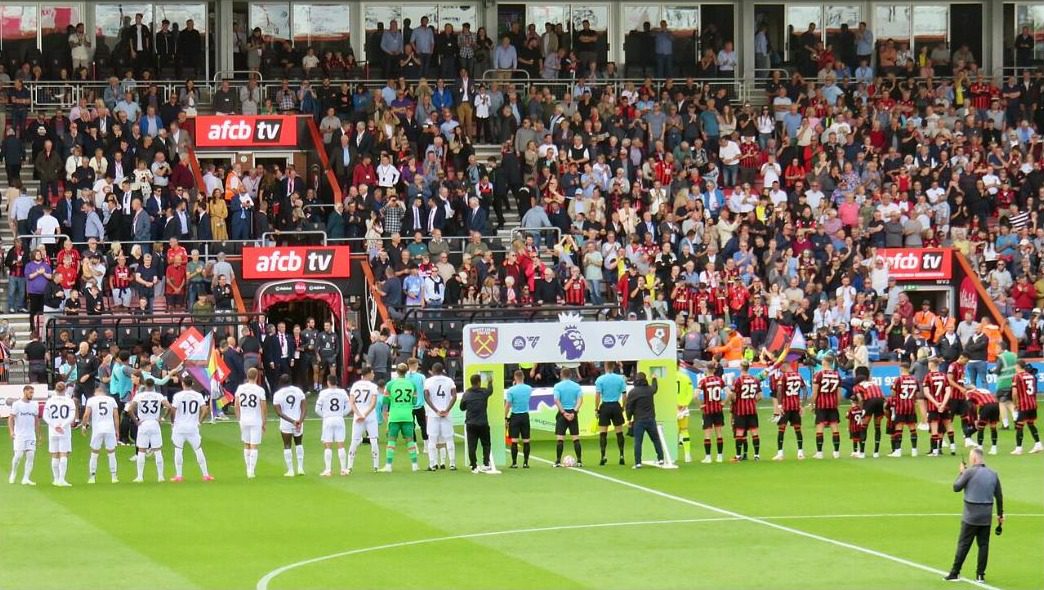
Photo: Egghead06 · Source: Wikimedia Commons · License: CC BY-SA 4.0 · Taken August 12, 2023 (before the expansion work), players lining up before kickoff against West Ham
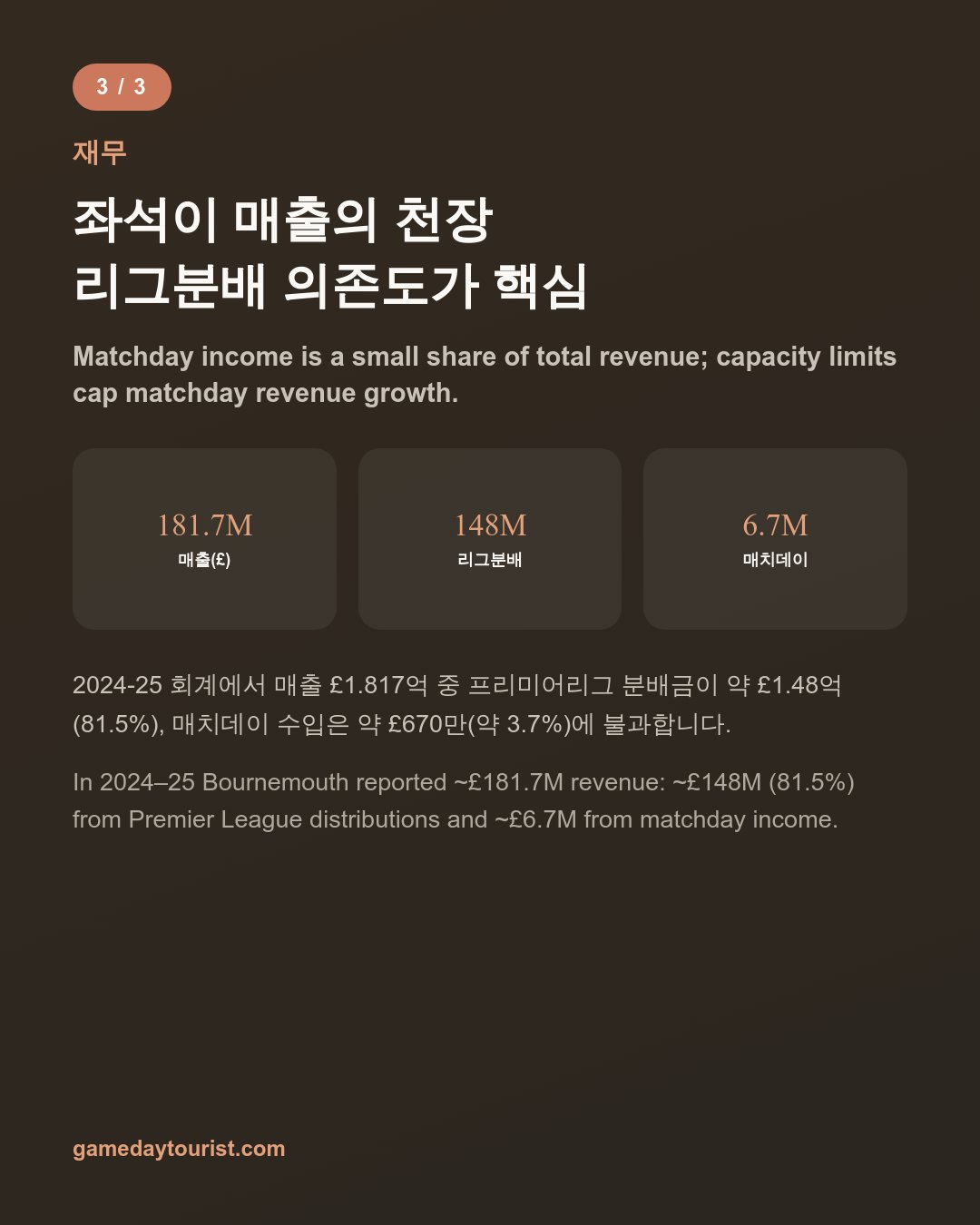
The financial numbers show that structure. In the club’s 2024-25 financial year (to June 30), revenue was about £181.7 million, and ESK’s analysis of the accounts puts Premier League distributions at £148.0 million, about 81.5%, with matchday income at £6.7 million (about 3.7% by my own calculation).
Swiss Ramble’s analysis gives the same matchday figure (£6.7 million, up from £6.5 million the year before). Some reports citing the investor presentation put 2024-25 revenue at about £199 million, but I use the figure from the accounts here.
With the overwhelming majority of revenue resting on league position and broadcast distributions, and ticket sales stuck at roughly 3%, expansion reads to a marketer less like a choice than a structural fix.
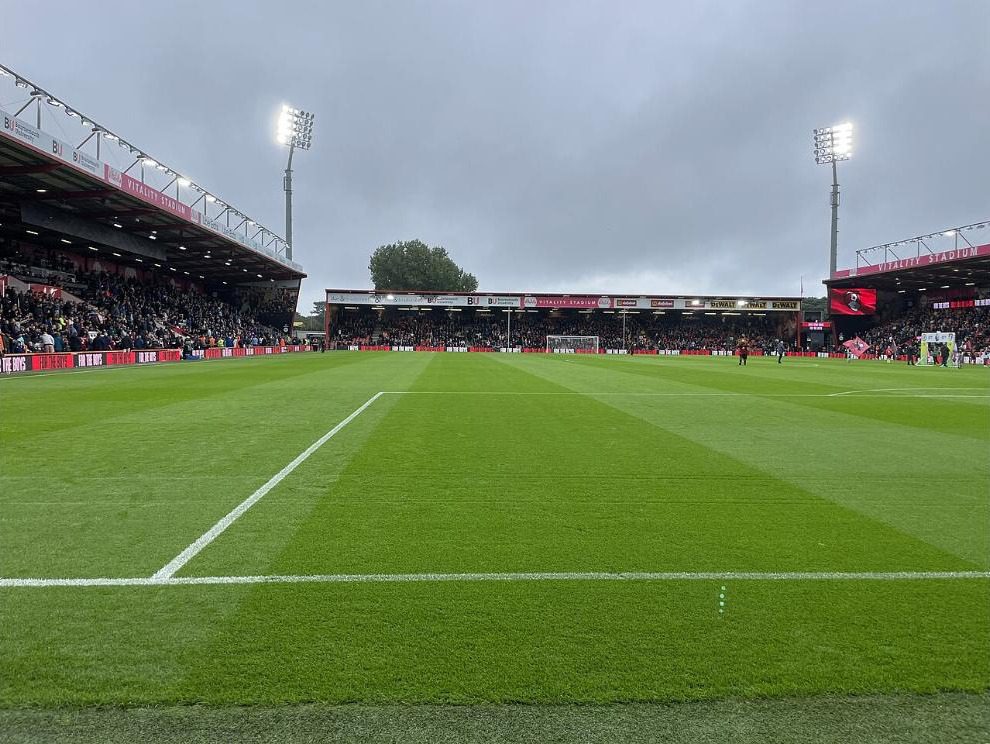
Photo: Mr Ignavy · Source: Wikimedia Commons · License: CC BY-SA 2.0 · Taken September 17, 2023 (before the expansion work), a view of the ground from pitch level
Going only by the photos I could check, this ground has stands close to the touchline and a low roof that comes down over them, which creates the density small grounds have. Whether the expansion can protect that density is probably the club’s biggest homework.
That is only an inference from photos and reports, and I think the real matchday experience after completion will have to wait for local fans’ accounts.
Space and Expansion: The 20,200-Seat Plan That Keeps Building
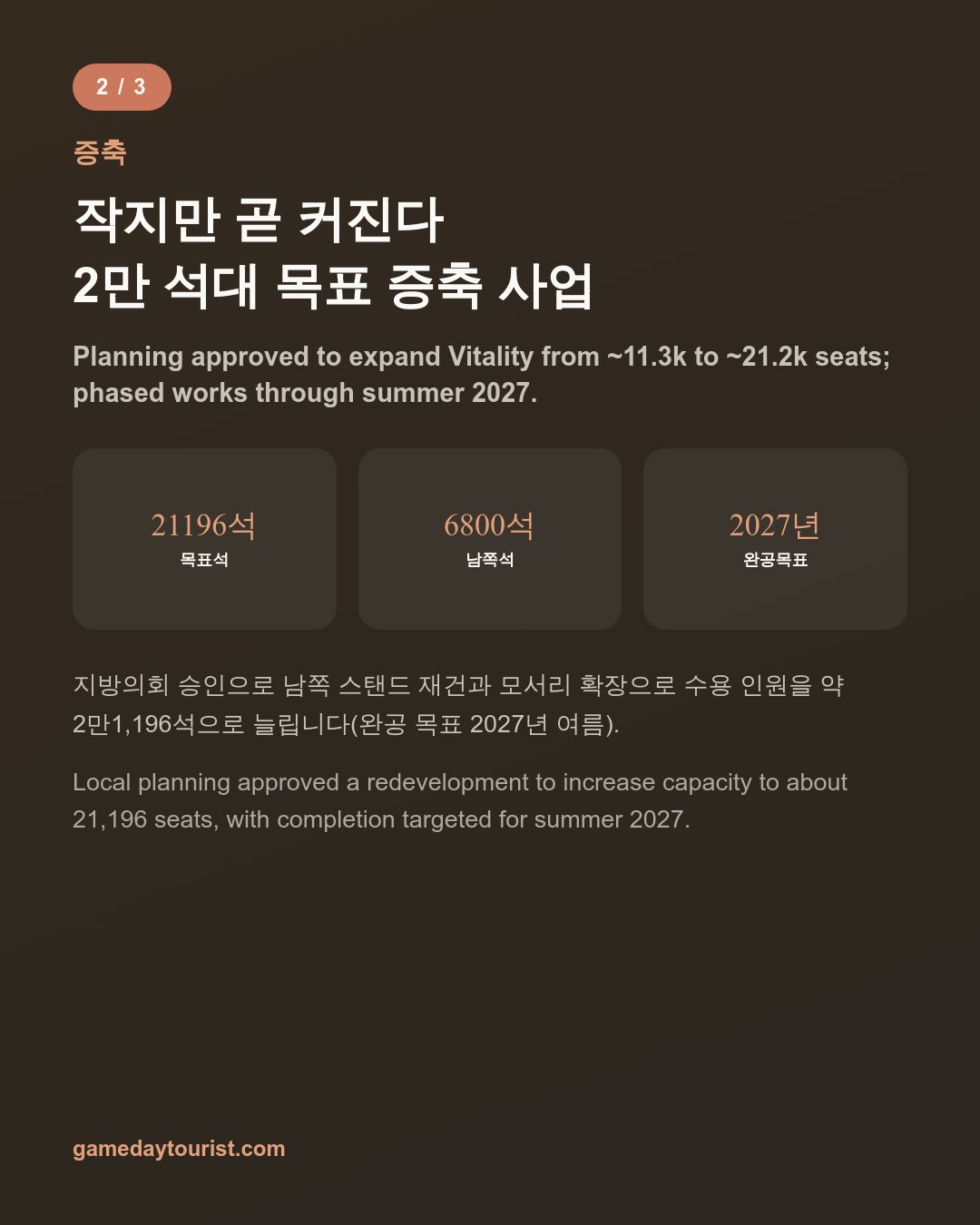
The plan was approved unanimously by the council’s planning committee in late May 2026 (reported May 26, The Stadium Business). The South Stand is to be demolished and rebuilt, while the other three stands are to be filled in at the corners and grown.
StadiumDB’s July report gave the target capacity as 20,196, with the new South Stand at about 6,800 seats (another report says about 7,000) and the two first-phase corners adding 800 to 900.
That is roughly 8,900 more than today, close to 1.8 times the current size. An official start of works was reported in early July, and the target for full completion is summer 2027.
Total cost varies by source. A report based on the club’s investor presentation says about £50 million, while Construction Enquirer, after the contractor was chosen, reported £85 million, citing an estimate from the data firm Glenigan.
The gap seems to come from differing scopes, but I could not confirm the basis, so I record both figures.
Ownership of the ground is also notable. In December 2005 it passed from the club to the property investor Structadene (reportedly for £3.5 million, in a sale-and-leaseback structure), and in 2025 the club’s side bought it back.
No official price was announced, and StadiumDB put it at about £10 million. Foley explained that he chose to rework the current ground because building a new one would take five to six years.
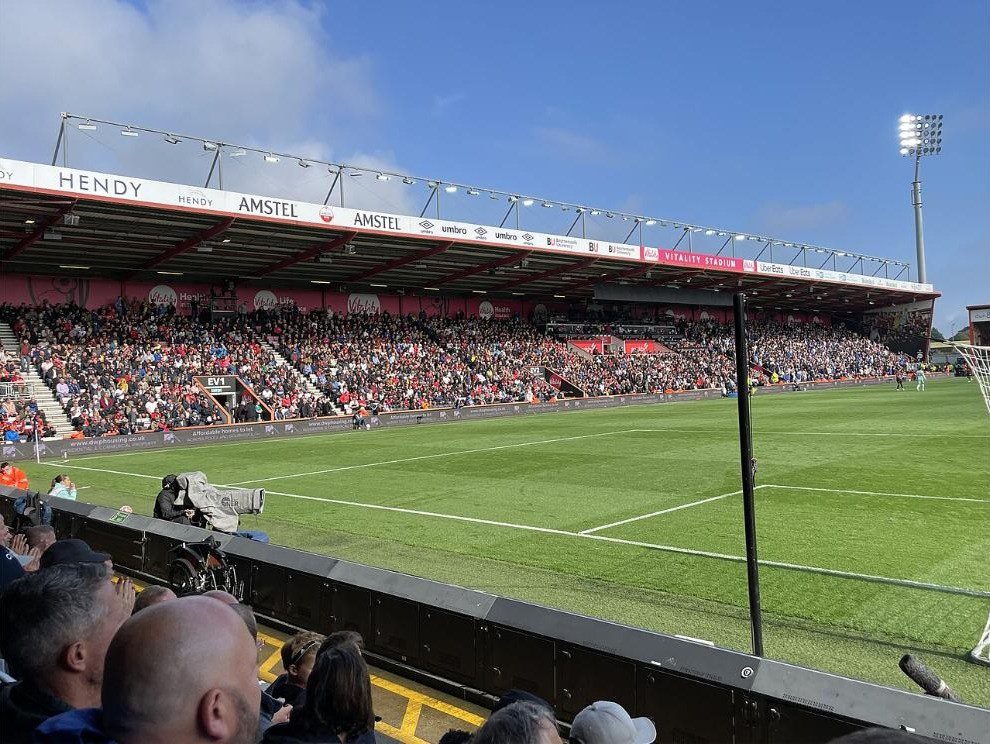
Photo: Mr Ignavy · Source: Wikimedia Commons · License: CC BY-SA 2.0 · Taken September 17, 2023 (before the expansion work)
Games still have to be played during construction, so the schedule is tight. Ahead of the August 29 home opener (1-1 with Everton), Football Ground Guide reported that work was running day and night and that the two 800-seat corners would not be open for that match.
A report from the same outlet in late September said the south-east corner, expected to hold away fans, should open before the first Europa League home game, and that the club hopes the South Stand’s upper tier can open late in the season.
After the opener, Rose praised the dressing room and joked that his small office here is bigger than his office at Leipzig (the same outlet’s August 29 report).
That seems to be why the club chose to expand while operating rather than move to a new ground. I read it as a decision not to let the demand of a 15,000-person waiting list scatter because of a temporary relocation.
Kits and Naming Rights: One Company Holds the Ground’s Name and the Chest
The ground’s naming rights, the right to attach a company’s name to a facility, are held by the health and life insurer Vitality. They began in 2015, the year Bournemouth were promoted to the Premier League, and a June 2023 Vitality press release extended them by three years.
That deal bundled the East Stand and Main Stand names, men’s and women’s first-team sponsorship and official wellness partner status, and it ran to summer 2026. I could not find the terms of any renewal in public sources.
But Inside World Football, reporting the December 14, 2025 announcement, said Vitality will take the front-of-shirt sponsorship from 2026-27 as well (value undisclosed), and the July groundbreaking coverage still used the ground’s name unchanged.
The announcement came just before the season in which the Premier League bans betting sponsors from the front of the shirt, and Inside World Football noted that other clubs are struggling to find replacements of similar value.
For a marketer this structure cuts both ways. When one company holds both the ground’s exterior and the front of the shirt, brand association becomes simple and strong, but commercial income also concentrates on a single sponsor.
According to ESK, 2024-25 sponsorship and advertising income was £18.1 million, up 49% on the year before, though the report alone cannot tell which contract that increase came from.
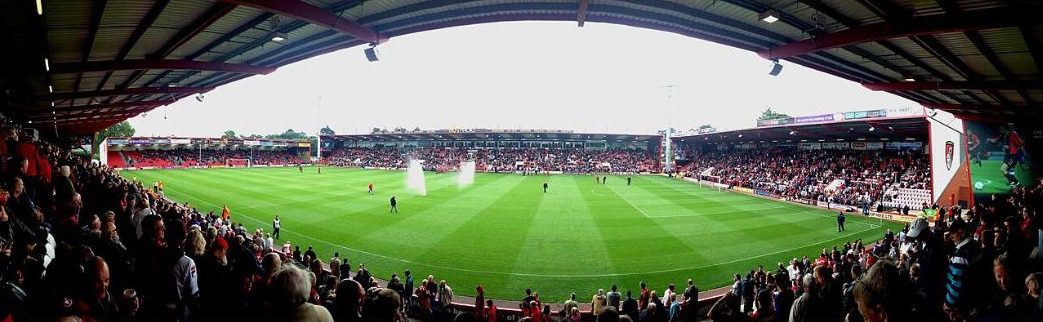
Photo: Matthew Jackson · Source: Wikimedia Commons · License: CC BY-SA 3.0 · Taken September 14, 2013 (an older photo, from before the current expansion work and different from today)
Broadcasting and Local Roots: Reliance on Distributions, and Jobs From the Build
Premier League distributions are about 81.5% of revenue, so broadcast rights are effectively the club’s lifeline. Taking part in the Europa League will add UEFA distributions, but I could not confirm their size for this piece.
Locally, BCP Council leader Millie Earl said at the approval that the redevelopment would create local jobs and spread its benefits beyond matchdays, and the approval conditions include a £1 million package for parking, public transport, improvements to Kings Park and more (The Stadium Business, May 26 report).
StadiumDB reported that about 100 people are on site in the early weeks of construction. The number is not large, but putting contribution beyond matchdays up front like an approval condition looks like a case study in how the club designs its relationship with the area.
Comparing With the KBO: The Ceiling That the Number of Games Creates
After the expansion, Bournemouth’s ground (about 20,200 seats) will be bigger than KT Wiz Park in Suwon (18,700 seats). As of September 18, KT had drawn 848,673 fans in 61 home games and was chasing the first 1 million season in its history (Money Today).
League-wide, the KBO stood at 12,069,596 as of October 1, an average of 17,646 per game and 85% stadium occupancy, with 319 of 684 games (46.6%) sold out (Ilgan Sports). The KBO average is about 1.6 times Bournemouth’s current seat count.
The biggest difference between the two models is the number of games. A Premier League club plays just 19 home league games, while a KBO club plays 72.
A KBO club builds up its total through the number of games even when seats do not fill, whereas Bournemouth, even sold out every time, have a fixed number of dates, so the seat count is the revenue ceiling.
Because pricing systems differ, I did not compare matchday income head to head. The reason Bournemouth are spending £50 million to £85 million on expansion makes sense in this structure.
More seats let them raise unit prices, and the sponsorship inventory that has grown to £18.1 million widens along with them.
I end up summarising this club in one line: it has proven its demand with full houses but has not yet converted all of it into revenue, and the expansion is the work of enlarging that translator.
What voice fills the 11,300 seats on the night of October 15, and how a small ground handles its first big stage, should hint at what comes after the expansion.
Leave a Reply