Contents · About 5 min read
📱 View as card news
That Thursday morning of August 6, my sports-marketing industry newsletters were dominated by a single story.
Arsenal and Emirates had announced they were extending their partnership — covering the shirt, training kit, and stadium naming rights — through 2033.
It struck me as an odd coincidence, since I had just written about Arsenal’s Emirates Stadium on August 2, and I hadn’t expected to revisit the same ground so soon — but once I looked at the numbers, it was too good a story to skip.
So today I want to focus on the partnership deal itself.
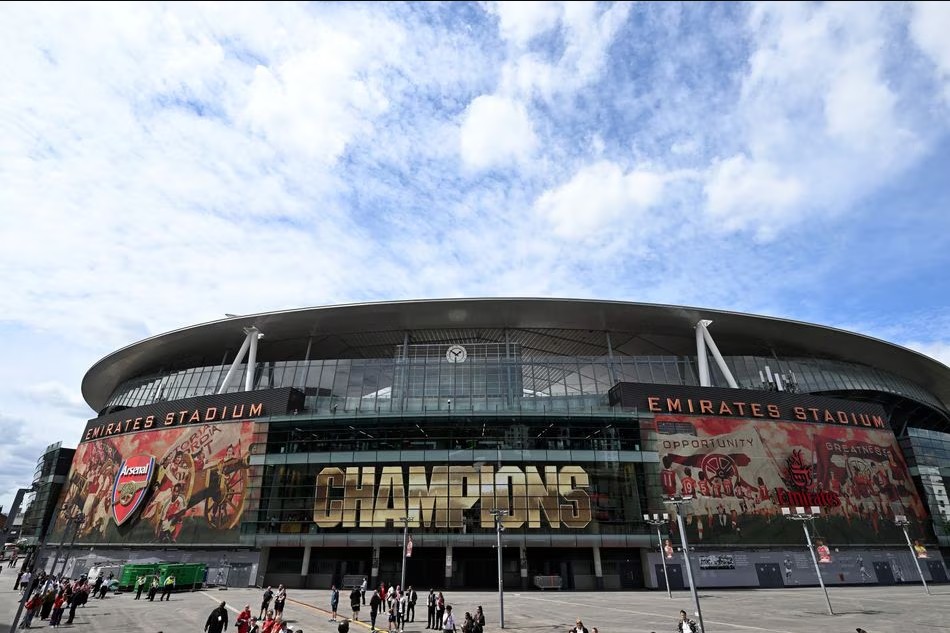
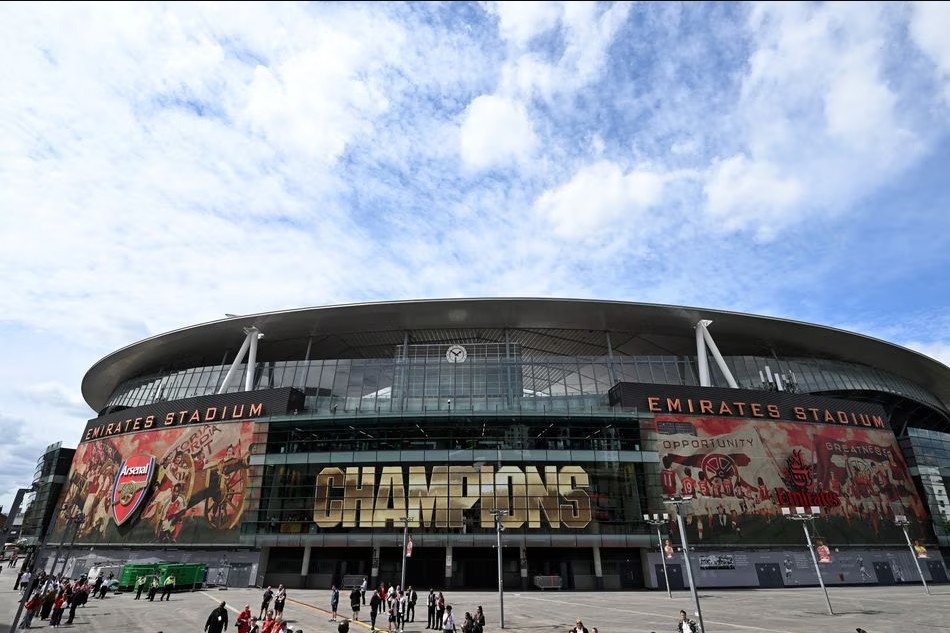
Source: official Arsenal.com press image, the club’s own photo used for the August 6, 2026 partnership-renewal announcement, used here for editorial/reference purposes.
Advertising Inventory and Naming Rights
Arsenal’s relationship with Emirates began in 2006 as a shirt sponsorship and expanded to stadium naming rights in 2012, with the original deal set to expire in 2028.
This renewal extends the contract by seven years, through 2033.
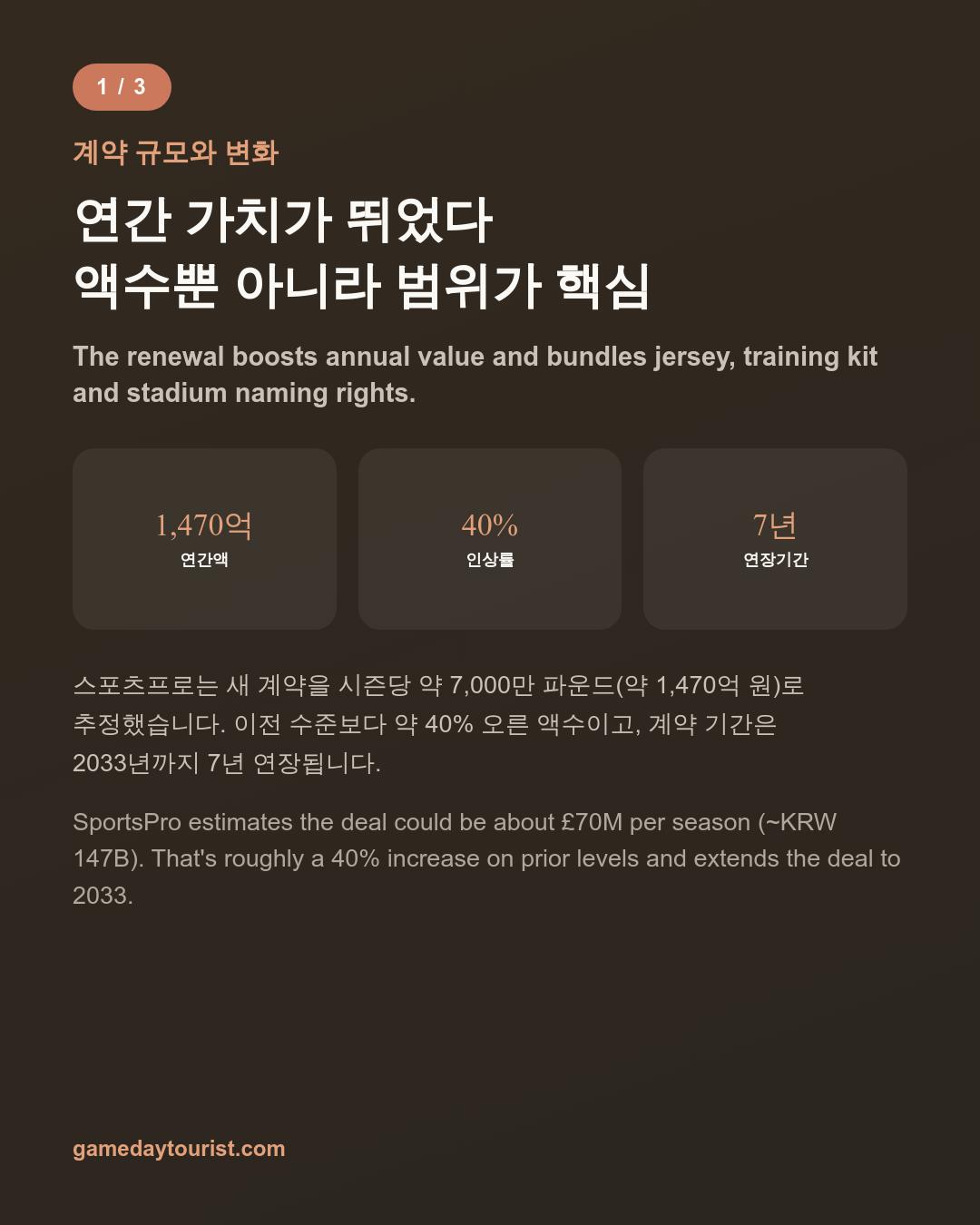
Sports-business outlet SportsPro reported that the new deal could be worth as much as £70 million a season (roughly ₩147 billion at August 2026 exchange rates).
That’s about 40% higher than the previous deal, reported at up to £50 million a season.
TheStadiumBusiness didn’t disclose an exact figure either, but cited the prior deal at around £45 million a year — the two outlets’ estimates of the old contract differ slightly, a reminder that neither club nor sponsor has ever confirmed the real number, so all of this remains in the range of industry estimates.
Package Width
What stands out in this deal isn’t the amount so much as how much it bundles together.
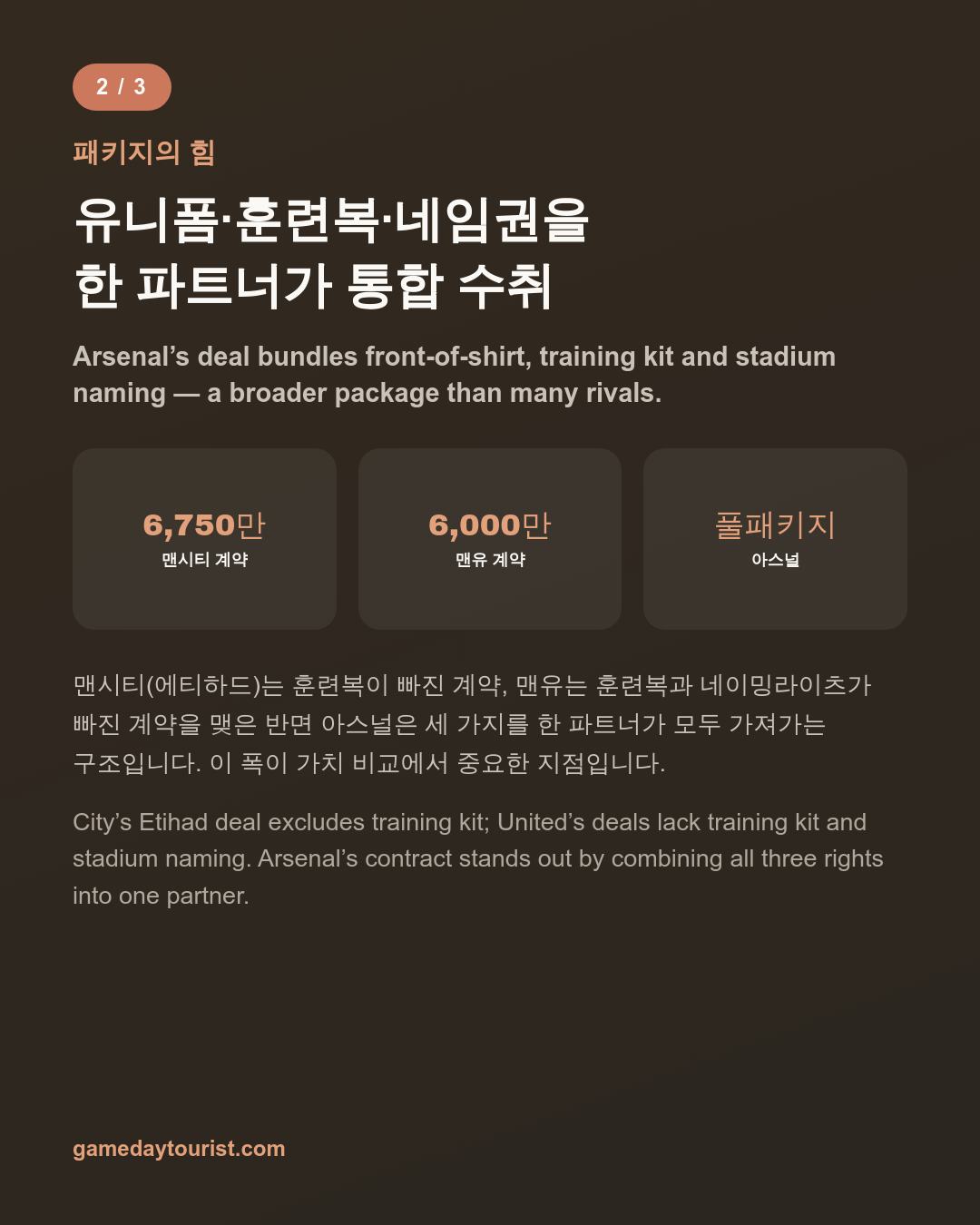
It’s a single sponsor taking the full shirt front, training kit, and stadium naming rights as one package — by comparison, Manchester City’s roughly £67.5 million deal with Etihad doesn’t include training kit, and Manchester United’s roughly £60 million deal with Qualcomm includes neither training kit nor stadium naming (United recently signed a separate training-kit deal with Betway).
SportsPro‘s take is that the Arsenal-Emirates deal is so much broader in scope that it shouldn’t be judged on raw value alone.
Stephan Beauzon, a former Manchester City financial adviser, told Football Insider that finding a partner big enough to take on both the stadium and the full shirt front at once “is genuinely difficult these days,” calling the renewal a way to “take the biggest partnership problem off the table seven years early.”
Fans and Attendance
To me, the timing of the announcement felt well chosen.
Arsenal won the Premier League last season for the first time in 22 years, and the women’s team lifted the UEFA Women’s Champions League.
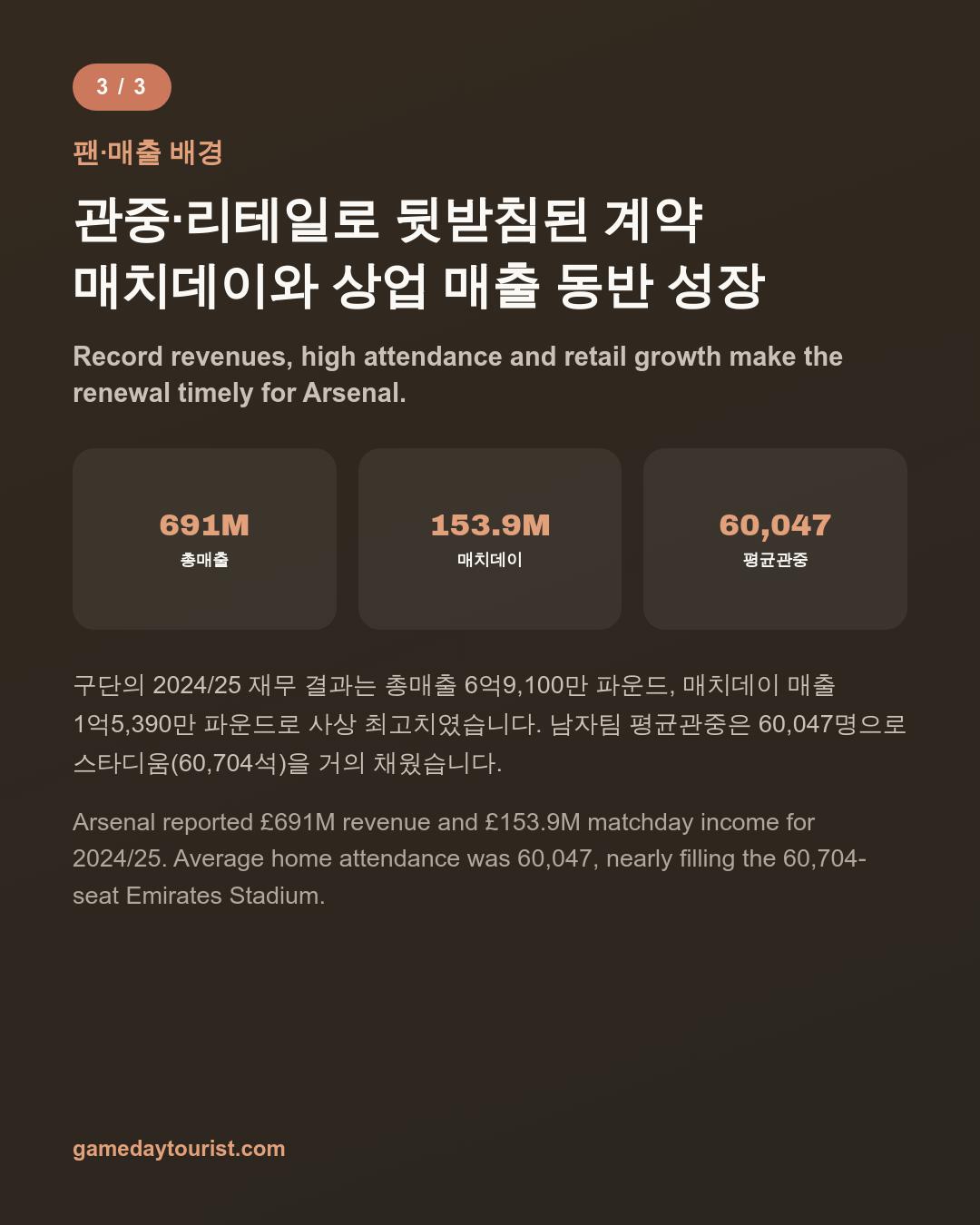
According to the 2024/25 financial results (for the year ended May 31, 2025) released in early August, total revenue hit a record £691 million, and matchday revenue also set a new high at £153.9 million (up from £131.7 million the year before).
The men’s team averaged 60,047 fans per home game, filling the 60,704-seat Emirates Stadium almost to capacity.
A change to the UEFA Champions League group-stage format, which increased the number of home matches to 30, also played a role.
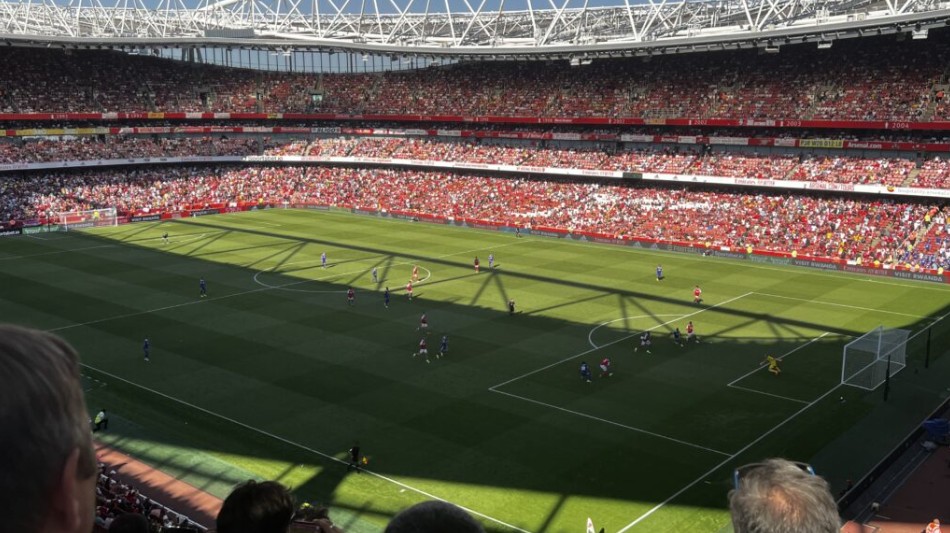
Source: photo from Itinerant Fan, a U.S. sports-travel guide site’s Emirates Stadium guide page.
Merchandise (MD) and Commercial Revenue
The merchandise side also stands out.
Per the club’s own figures, retail revenue grew 27% on top of an already record-setting prior year.
The club credited a renewed adidas partnership and support from real-estate brand Sobha Realty (a Dubai-based developer and one of Arsenal’s retail sponsors) for driving that growth.
Overall commercial revenue jumped to £263.2 million, up sharply from £218.3 million the year before, and this new Emirates deal looks like fuel to push that commercial curve up another notch.
The club’s official store on the west side of the stadium, “The Armoury,” doubles as both the start and end point of the stadium tour, so visitor flow is designed to naturally route fans through the shop a second time.
The Stadium’s Own Trademark
Another interesting thing about Emirates Stadium is that it’s one of the few large stadiums that hasn’t changed its name once since opening in 2006.
Elsewhere in London, West Ham’s London Stadium and Tottenham Hotspur Stadium were both deliberately given generic names with a future naming-rights deal in mind, yet neither has found the right partner.
The worry is that once a name sticks too firmly, there’s less room left for a brand to move in — but Emirates Stadium went the other way, becoming one of the rare cases where a sponsor’s name became the ground’s de facto proper noun, to the point that “The Emirates” is now used as a nickname in its own right.
The simple fact that the name hasn’t changed in 20 years looks like part of why the club had leverage in this renewal.
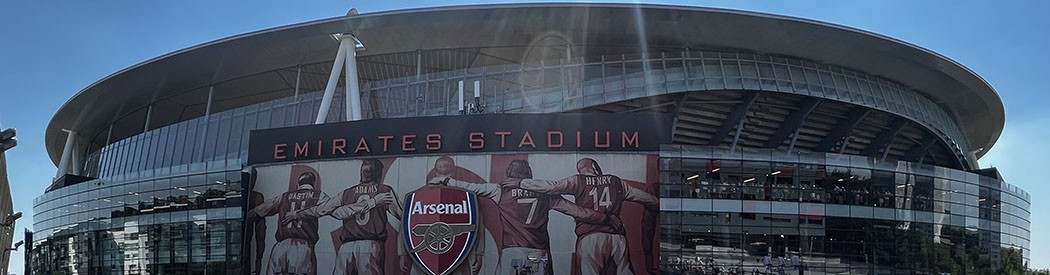
Source: Itinerant Fan‘s Emirates Stadium guide page hero image.
Compared to the KBO and K League
Looking at Korea, this kind of all-in-one naming-rights package is still unfamiliar territory.
Most K League stadiums are public facilities owned by local governments, which makes it structurally difficult for a club to sell naming rights on its own.
The KBO, by contrast, has been moving faster on this in recent years, centered on newly built stadiums.
Cases like Daejeon Hanwha Life Ballpark or kt wiz Park, which I’ve covered on this blog before, show that baking a company’s name into a stadium from the moment it’s built is starting to take hold domestically too.
But there’s still no domestic case of one partner holding the shirt, training kit, and stadium together for 20-plus years the way Arsenal and Emirates have — which also means it takes a long time for both sides to build the kind of trust that can survive the ups and downs of results.
As a working marketer, what caught my eye most in this story wasn’t the amount itself but the “width of the package.”
A structure where a single sponsor takes the shirt, training kit, and stadium name all at once saves the club the trouble of coordinating multiple partners — but it also means that if the relationship with that one sponsor wobbles, several assets wobble at once.
Even so, Arsenal’s choice to lean into stability — using a stadium name that hasn’t changed in 20 years as leverage — feels pretty persuasive given how shaky the Premier League sponsorship market looks right now (Chelsea, Nottingham Forest, Sunderland, and a few others still don’t seem to have a front-of-shirt sponsor).
Leave a Reply