Contents · About 8 min read
- An Ownership Shake-Up — A £150 Million Takeover Battle, Two Months After Relegation
- Crowds and Tickets — Attendance That Didn’t Blink Despite Relegation
- Space, F&B, and Merchandise — Ahead on Tech, Not Necessarily on Satisfaction
- Ad Inventory and Naming Rights — A Decade-Plus Without a Buyer
- Broadcast Rights and Local Economic Impact
- How This Compares to the KBO and K League
📱 View as card news
The biggest Premier League story this summer wasn’t a title race or a blockbuster transfer. It was the return of the man who brokered Newcastle United’s Saudi sovereign wealth fund takeover — this time circling a stake in relegated West Ham United.
As a marketer, my first reaction was “a club relegated two months ago is worth that much?” Digging into the numbers turned up an even better story: this club’s own stadium hasn’t been able to sell its naming rights in over a decade.
An Ownership Shake-Up — A £150 Million Takeover Battle, Two Months After Relegation
West Ham finished the 2025-26 season in 18th place, two points behind 17th-placed Tottenham, and went down. It’s their first relegation from the Premier League since promotion in 2012-13 — 14 seasons on top-flight football, gone in one campaign.
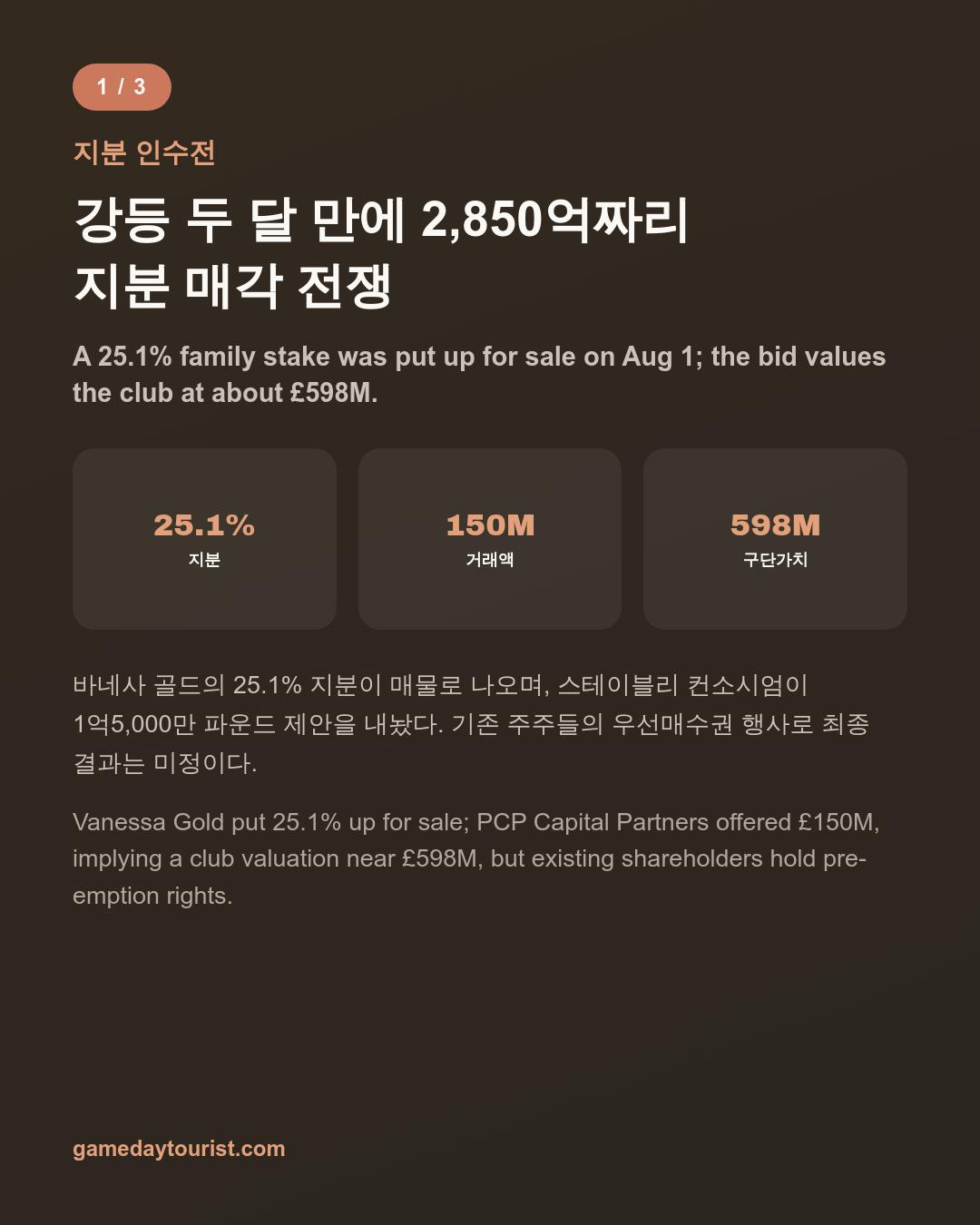
Yet just two months after relegation was confirmed, on August 1st, joint-chairman Vanessa Gold — daughter of the late co-owner David Gold, who inherited his stake after his passing in 2023 — announced she was putting her family’s 25.1% stake up for sale.
The buyer is PCP Capital Partners, led by Amanda Staveley and her husband Mehrdad Ghodoussi, in a consortium with Ashland Forest Capital Partners. Staveley is best known for brokering Saudi Arabia’s PIF-led takeover of Newcastle United in 2021 (worth £305 million); she later sold down her Newcastle stake to PIF and RB Sports & Media and stepped away in 2024, before turning her attention to another football investment. This deal is valued at £150 million, which puts the whole club at roughly £598 million.
The deal isn’t done yet, though. Existing shareholders hold pre-emption rights, so majority owner David Sullivan (38.8%) and Czech investor Daniel Křetínský of EP Group (previously 27%) could still match the offer and block the Staveley consortium. Notably, Křetínský recently transferred about 2% of his stake to fellow businessman Jakub Havrlant, dropping his own holding below 25%. That looks like a deliberate move — even if he exercises pre-emption on the Gold family’s stake, staying under the 50% threshold means he avoids triggering a mandatory offer for the rest of the club’s shares.
The club itself has said the pre-emption process could take around two months, and as of this writing (August 20th) there’s still no final word. It’s a good reminder that even when results collapse, the Premier League as a platform keeps its brand value intact.
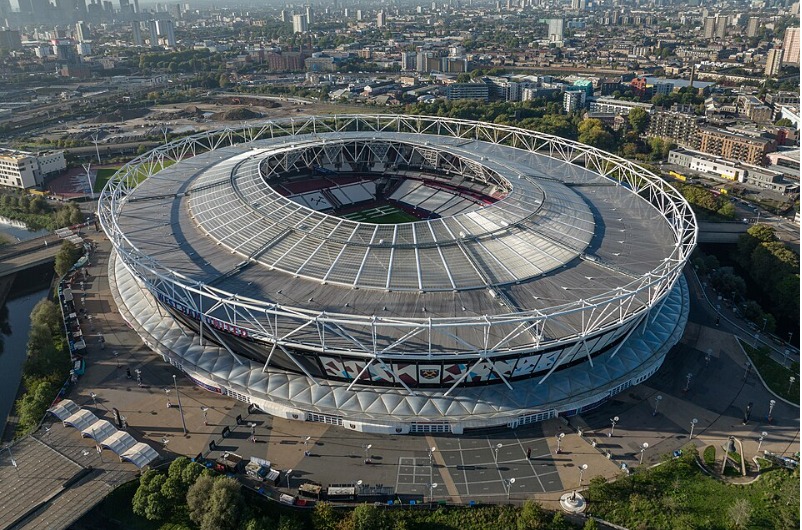
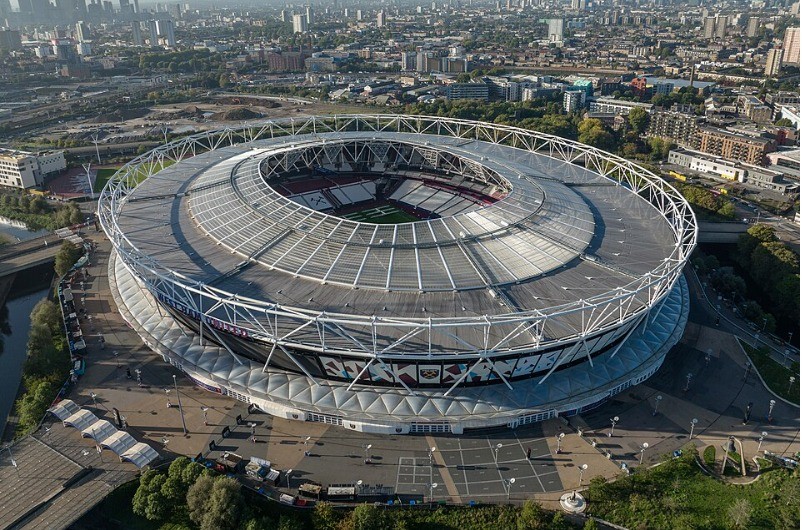
Aerial view of London Stadium, West Ham United’s home ground · Source: Arne Müseler (arne-mueseler.com), CC BY-SA 3.0 DE
Crowds and Tickets — Attendance That Didn’t Blink Despite Relegation
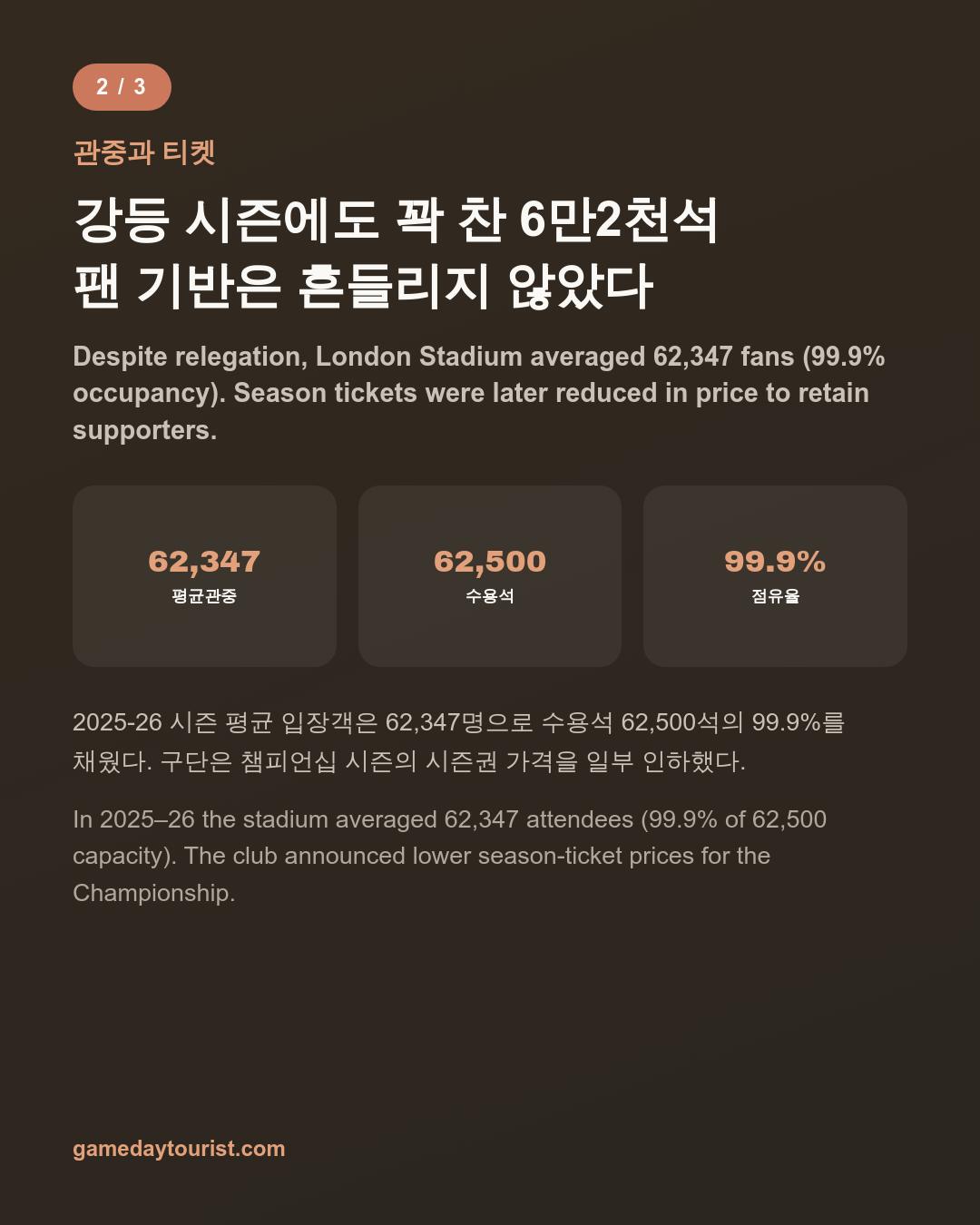
Results aside, West Ham’s attendance numbers actually rank near the top of the Premier League. The 62,500-capacity London Stadium averaged 62,347 fans through the relegation-confirming 2025-26 season — a 99.9% capacity utilization rate, second-highest in the entire league.
Heading into the post-relegation 2026-27 season, the club actually announced season ticket prices would drop. Prices by band range from a low of £310 (excluding the under-18 band at £99) up to £1,200 for Band 1 — a clear signal the club wants to protect its fan base even while dropping a division.
Space, F&B, and Merchandise — Ahead on Tech, Not Necessarily on Satisfaction
Catering at London Stadium is run by Delaware North, which has rolled out EBar, a self-pour beer machine that fills a pint in about 10 seconds, and Bar Tap, a till-free checkout system built on Amazon’s “Just Walk Out” technology. Even so, complaints keep surfacing — some sections don’t have enough kiosks, queues get long, and a handful of kiosks reportedly don’t take card payments at all.
Pricing draws its share of criticism too, with a pint running £6 and a hot dog £7.50.
As a marketer, this is a useful reminder that rolling out the latest technology doesn’t automatically translate into a better matchday experience.
Just off the concourse sits the club’s Stadium Store, the flagship shop selling replica kits and fan gear, which also houses a café branded as the West Ham United Coffee Company. Beyond the stadium, the club runs three more shops across east London — in Romford, Thurrock (Lakeside), and Basildon — extending its merchandise footprint well past matchday.
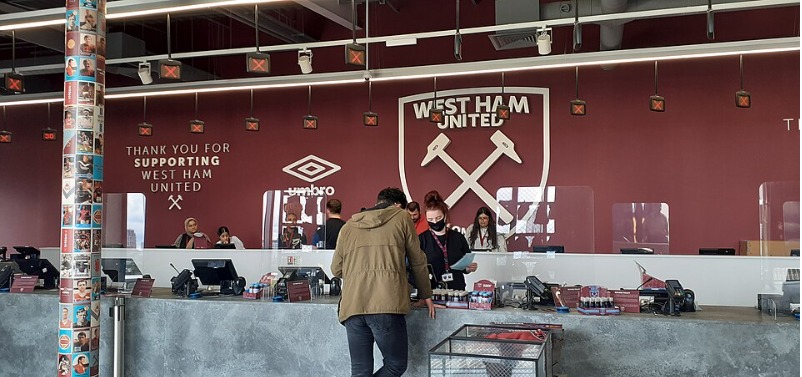
Interior of the West Ham United Stadium Store next to London Stadium (photographed July 2021) · Source: CybJubal, CC BY-SA 4.0
Ad Inventory and Naming Rights — A Decade-Plus Without a Buyer
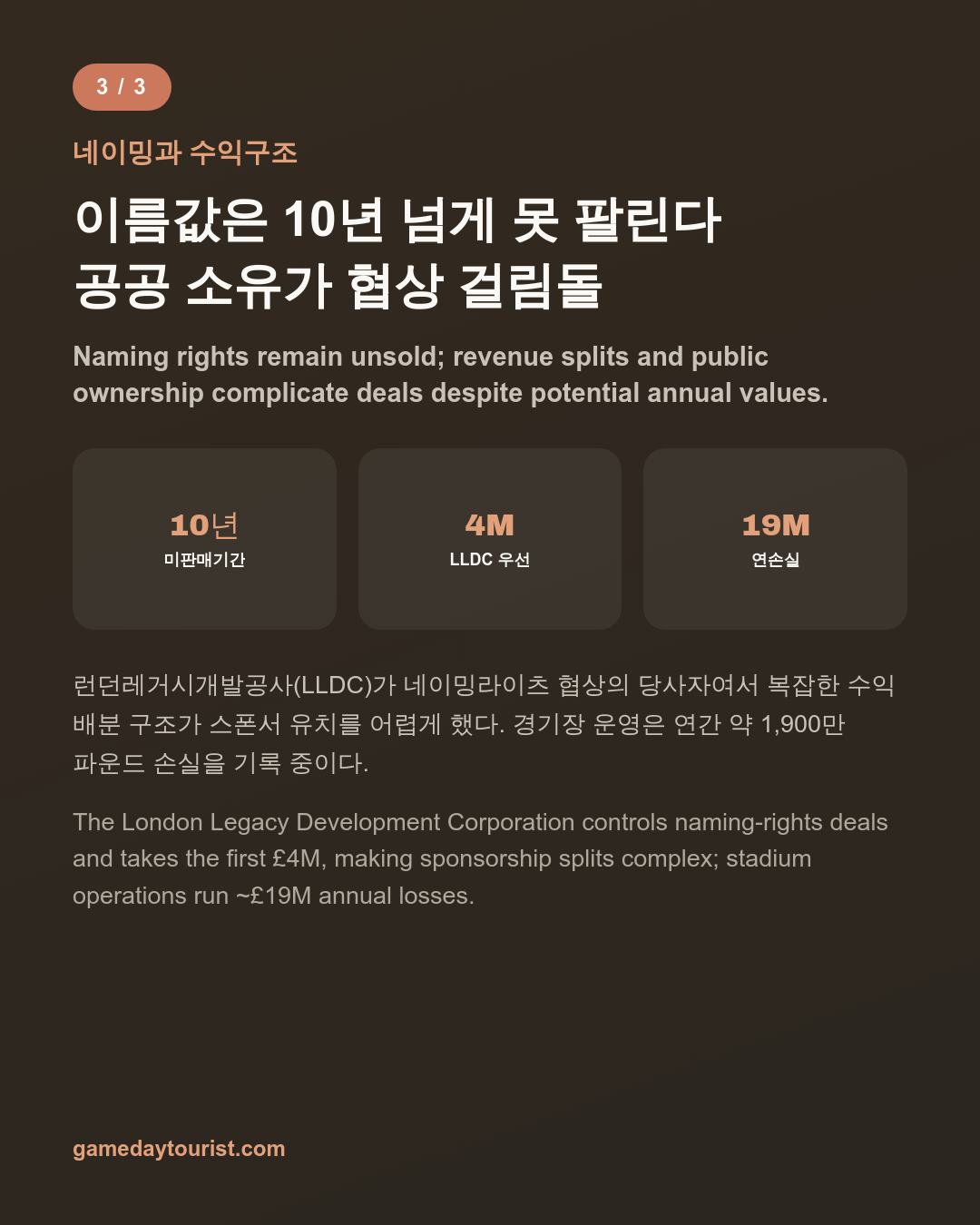
London Stadium is a converted version of the 2012 Olympic Stadium, owned by a public body under the City of London. West Ham has only been a tenant since 2016, on a 99-year lease — not the owner. That’s why naming rights negotiations aren’t even the club’s call; they belong to the London Legacy Development Corporation (LLDC), the public agency that owns the venue.
Vodafone reportedly walked away from talks over a £20 million deal, and Allianz — long seen as the frontrunner — ultimately signed with Twickenham, home of the England rugby team, instead. Industry estimates put the naming rights value at £5-15 million a year — but the first £4 million goes straight to the LLDC, with only the remainder split with the club. That’s a complicated split for any prospective sponsor to stomach.
Stadium operations themselves are reportedly running an annual loss of around £19 million, and West Ham’s relegation is expected to shrink the rent the club pays under its lease terms (currently around £2.5 million a year plus an initial £15 million lump sum) — which means those losses are likely to widen further.
Revenue from non-football events like concerts flows to the LLDC too, not the club — and local Newham council rules cap non-football events at 10 a year (compare that to Tottenham Hotspur Stadium across town, which is allowed up to 50), so there isn’t much room to grow that revenue stream either.
Being tied to a publicly owned venue guarantees a stable, long-term lease — but it can just as easily cap how much freedom a club has to design its own sponsorship and ancillary revenue.
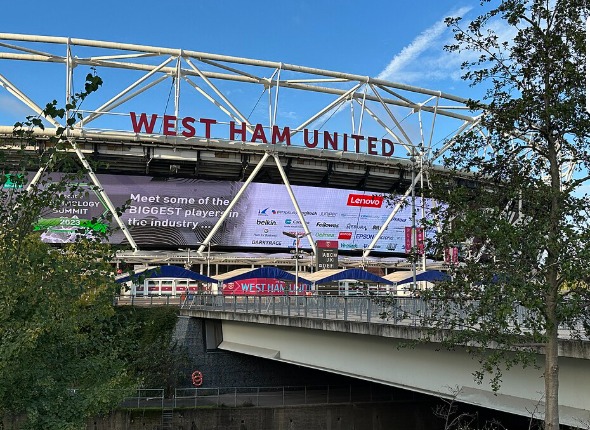
Large WEST HAM UNITED signage and sponsor advertising boards on the bridge approach to London Stadium (photographed November 2023) · Source: Matt Brown, CC BY 2.0
Broadcast Rights and Local Economic Impact
Relegation means West Ham now receives parachute payments instead of a full share of Premier League broadcast revenue. For 2026-27, their first year down, that’s set at roughly £55 million — 55% of what they’d have earned in the top flight. Championship matches themselves are covered under a deal that puts over 1,000 games a season on Sky Sports, while fans abroad can follow along on the club’s own channel, West Ham TV.
The local economic impact numbers, though, are genuinely substantial.
A 2023 survey found matchgoers, including away fans, spend an average of £27 outside the stadium per visit, and factoring in the season’s total attendance, that adds up to roughly £50 million flowing into the Stratford area each year.
The London Legacy Development Corporation has reported a cumulative economic impact of £1.2 billion across the Olympic Park area since 2016, alongside 5,000 jobs created. Worth noting: that figure reflects the whole Olympic Park regeneration project, not West Ham’s contribution alone. Still, Stratford — once considered one of London’s most deprived areas — is now a transport hub and a genuine regeneration success story, and this stadium and club have played a real part in that shift.
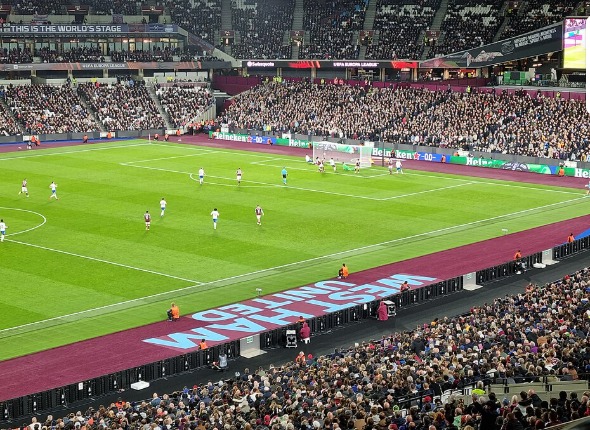
Inside London Stadium during a 2021 UEFA Europa League match against Sevilla — note the red athletics track ringing the pitch · Source: Sustain Health Magazine, CC BY-SA 4.0
How This Compares to the KBO and K League
Looking into this story, Seoul World Cup Stadium kept coming to mind. It’s FC Seoul’s home ground, but ownership and management sit with a public corporation, Seoul Facilities Corporation, not the club. The club plays its matches there and has to lease out ancillary facilities like concessions separately — a structure that mirrors West Ham’s relationship with London Stadium almost bone for bone. And, as it happens, Seoul took a swing at something similar just last December.
Last December, the Seoul city government announced it would sell naming rights to municipal sports venues for the first time, including World Cup Stadium and Gocheok Sky Dome. For Gocheok Sky Dome, the naming rights were valued at around 19.7 billion won over a five-year deal — so Seoul is really just getting started on the idea of selling the names of public facilities.
The real takeaway from West Ham’s situation is that selling a name isn’t the hard part — designing the revenue split between the public owner and the club is what actually determines whether a sponsor bites.
That’s worth watching as Seoul moves forward with its own negotiations. There’s also a structural difference worth noting: Korea doesn’t yet have a market where private equity or foreign investors buy and sell stakes in professional football clubs, so a takeover battle like the Staveley consortium’s would be an unfamiliar sight in Korean football right now.
Watching a takeover battle play out and a club get valued above £500 million in the middle of what should be its worst-case scenario — relegation — drove home for me that ownership structure and real estate contract details can shape brand value even more than results on the pitch. And with four Premier League clubs — Manchester United, Tottenham, West Ham, and Liverpool — all seeing ownership-stake stories break in the span of ten weeks, this doesn’t look like a story that ends with West Ham alone.
Leave a Reply