Contents · About 10 min read
- Attendance and Tickets
- Making the Most of Space: The Museum, the Megastore, and a Tired Concourse
- Ad Inventory and Naming Rights: A Decision 116 Years in the Making
- Ownership and Finances: INEOS and a Slide Down the Money League
- The New-Stadium Project and Local Economic Impact: ‘New Trafford’
- What Makes the Ballpark: The ‘Theatre of Dreams’ Nickname, and the Memory of Munich
- A Comparison With the KBO and K League
📱 View as card news
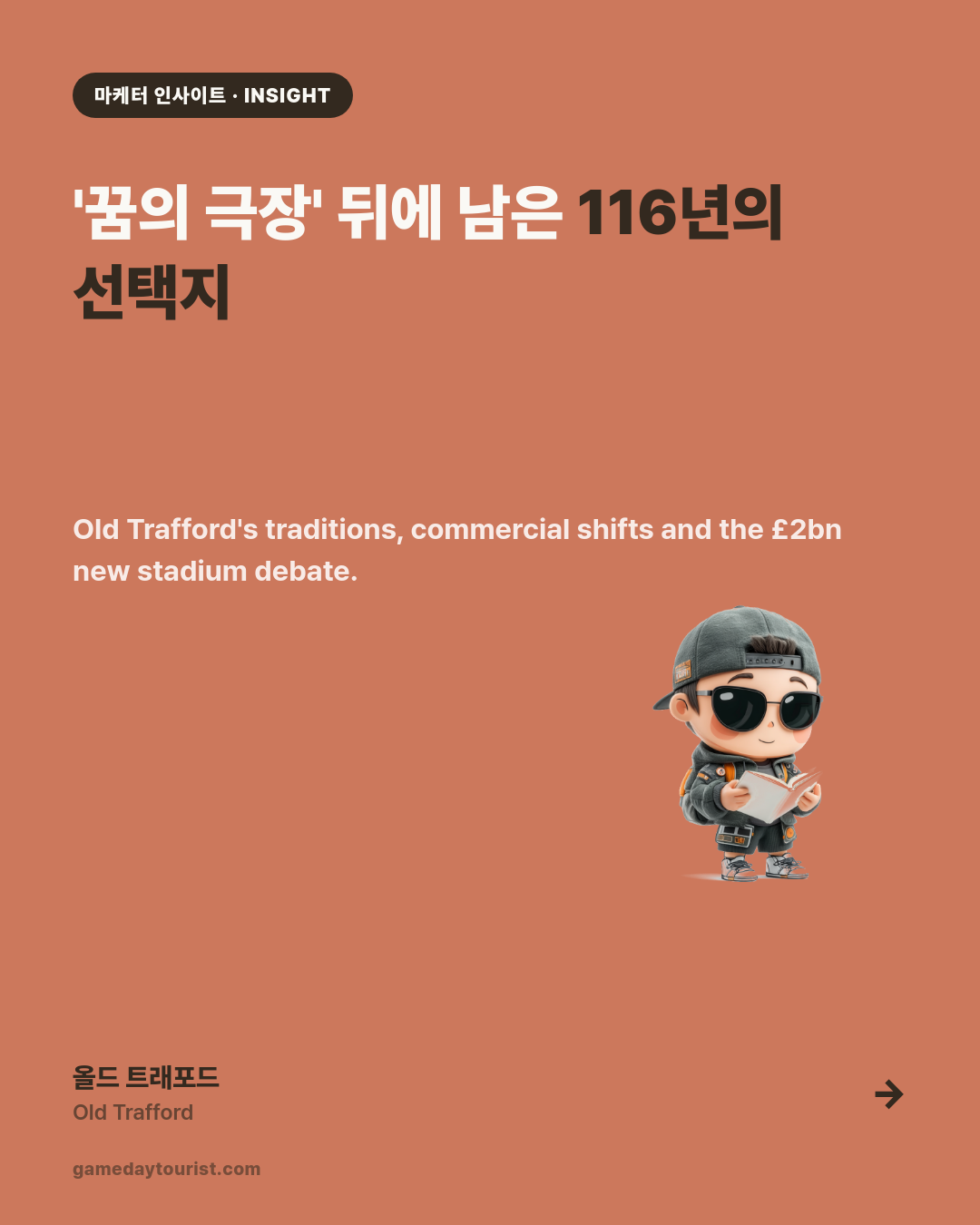
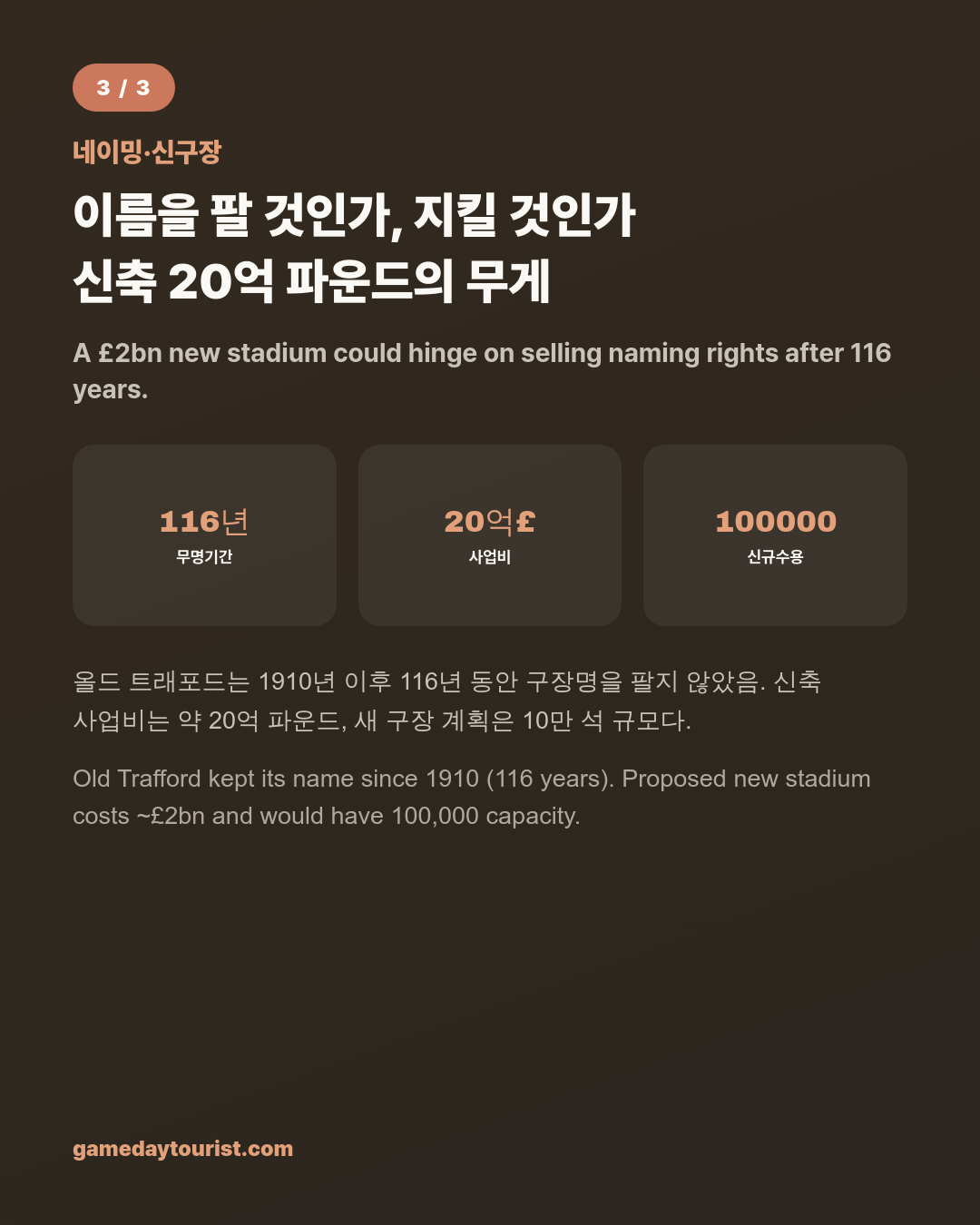
Something caught my eye while going through Premier League materials this summer.
Of all things, it was news that the club was reconsidering a principle it had held for over a century around the three words “Old Trafford.”
As a marketer, it wasn’t a story I could just scroll past.
The question was simple: why is a stadium name that’s never once been sold in 116 years since it opened now leaning toward being sold?
Manchester United is such a famous club that it hardly needs an introduction, but the changes of the past few years are worth a closer look.
On-field results have slipped, yet commercial revenue keeps climbing; the new owner has announced a roughly £2 billion new stadium next door to the current one; and to help fund it, a 116-year-old tradition of never selling the stadium’s name is now being shaken.
Today I want to walk through Old Trafford’s numbers around those three shifts, from a working marketer’s perspective.
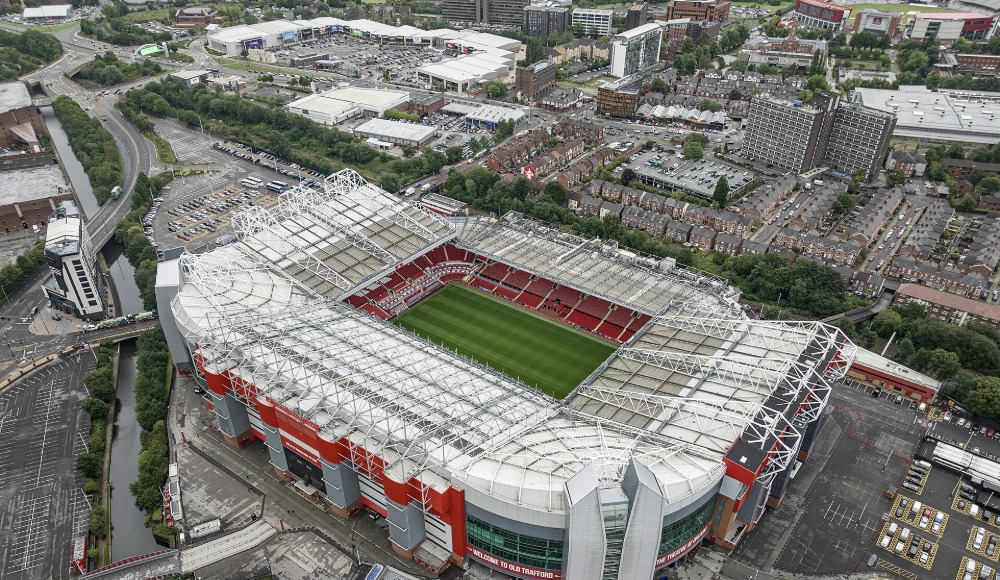
Aerial view of Old Trafford. Source: Wikimedia Commons (Arne Müseler, CC BY-SA 3.0 DE)
Attendance and Tickets
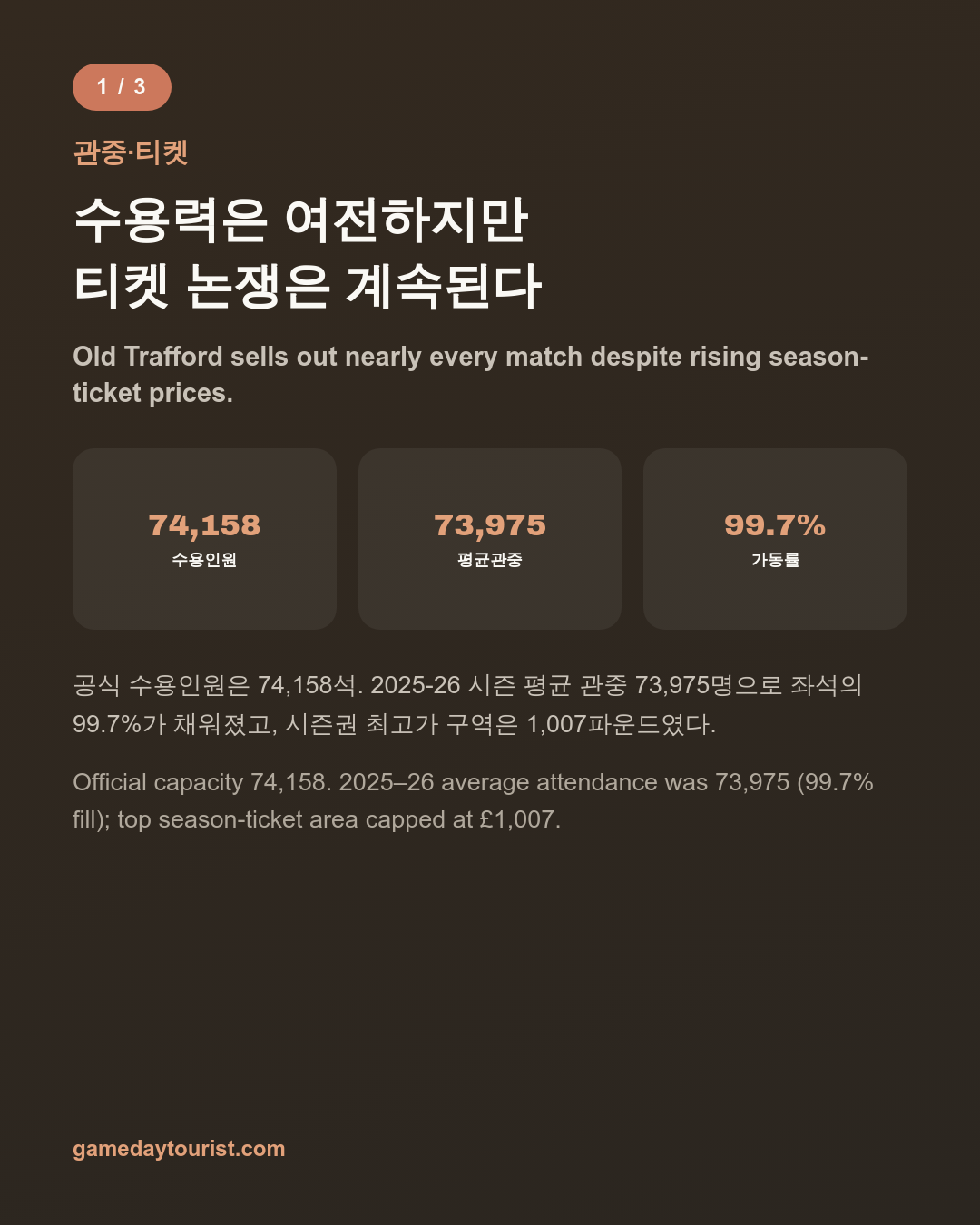
Old Trafford’s official capacity is 74,158, the largest club stadium in England and the 11th-largest in Europe.
Actual average attendance for 2025-26 came in at 73,975, the highest of all 20 Premier League clubs.
That means roughly 99.7% of seats were filled at essentially every match.
For reference, the stadium’s own all-time attendance record wasn’t set by a United match at all — it’s 76,962, from the 1939 FA Cup semifinal (Wolverhampton Wanderers vs Grimsby Town), back when all seating was removed and the ground was filled with standing spectators.
Ticket prices are a source of controversy every year.
The 2025-26 season ticket prices rose 5% year over year and drew fan backlash, with the top season-ticket price — in the priciest sections, the South Stand and North Stand — reaching £1,007.
The fact that ticket demand hasn’t dipped even through a rough run of results struck me as the real foundation of this club’s commercial power.
Making the Most of Space: The Museum, the Megastore, and a Tired Concourse
Old Trafford makes money from tourism content even on non-matchdays.
The club museum and stadium tour rank among Manchester’s most popular tourist attractions.
The 80-minute tour covers the players’ tunnel, both team dressing rooms, and even the manager’s seat, and multiple reviews describe even non-fans getting drawn into the narrative — from the Munich air disaster through the Ferguson era — and the trophy displays.
The in-stadium megastore is likewise one of the largest club shops in world football, spanning two floors from kits to limited-edition merchandise.
Merchandise revenue in particular has jumped sharply of late.
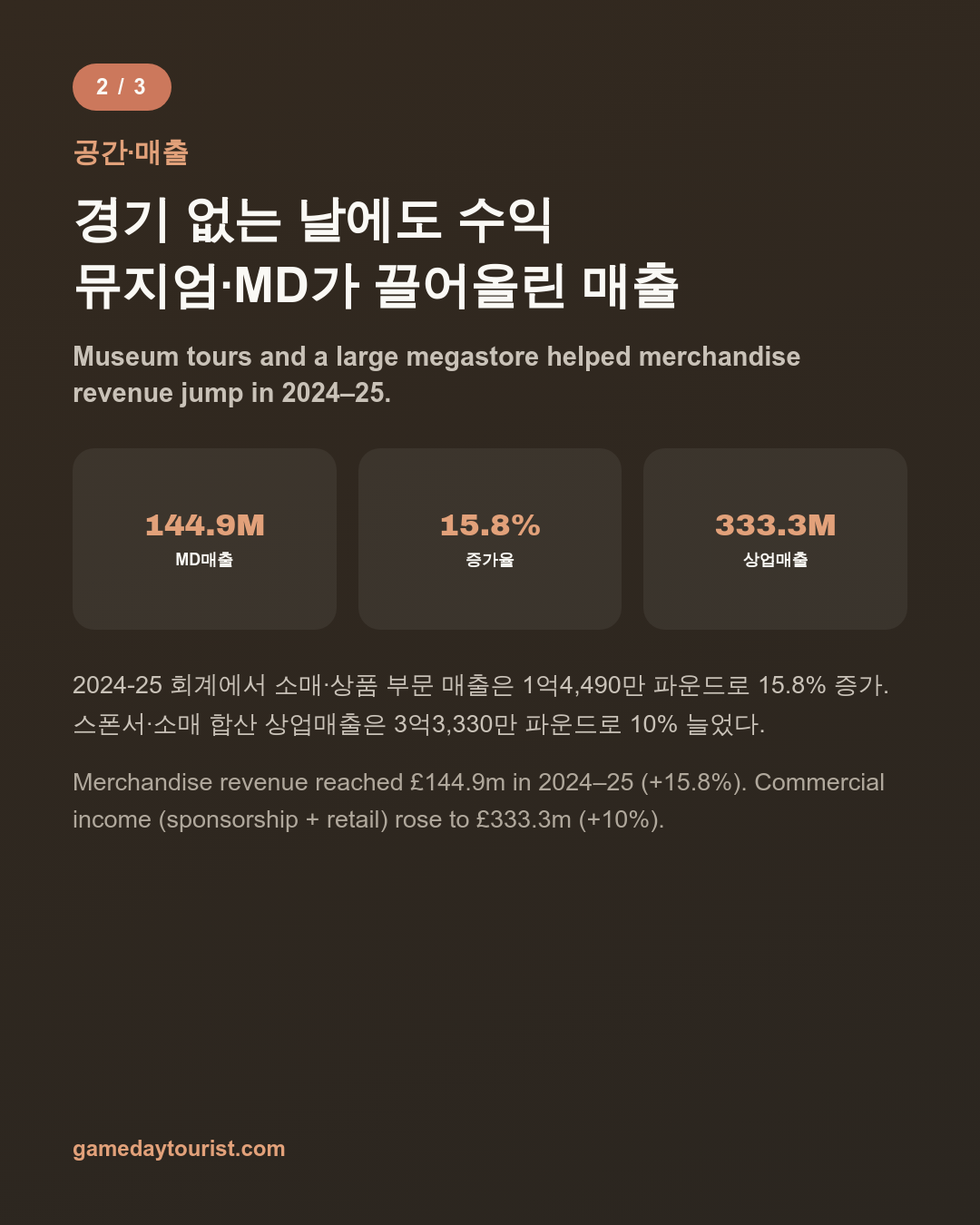
According to the club’s disclosed 2024-25 fiscal results, retail, merchandising, apparel, and licensing revenue rose 15.8% year over year to £144.9 million, and given that royalty income from Adidas actually fell by £2.2 million over the same period, that growth was essentially all down to the club’s own e-commerce overhaul.
Combined commercial revenue — sponsorship plus retail — also rose 10% to £333.3 million.
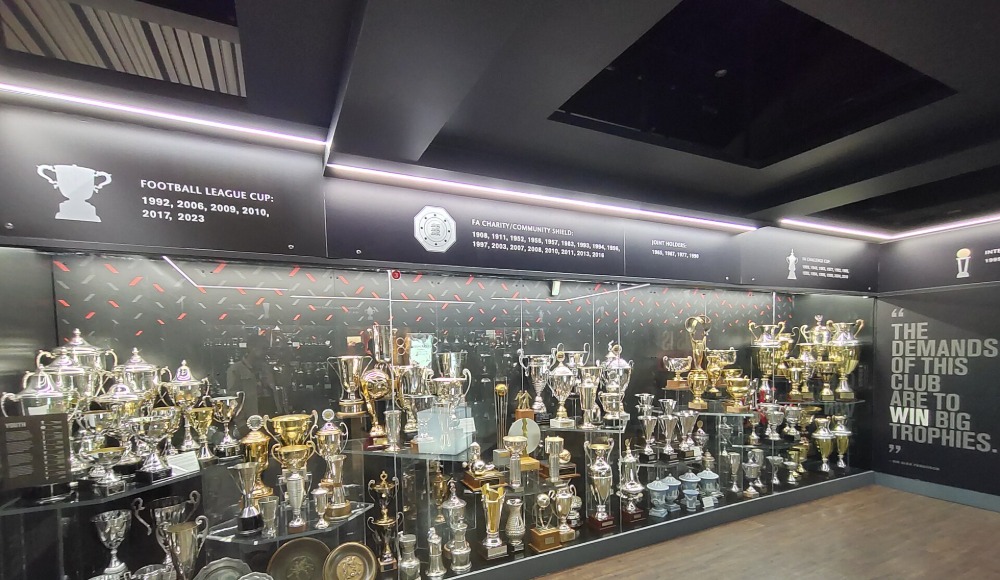
The trophy cabinet on display at the club museum. Source: Wikimedia Commons (Kskhh, CC BY-SA 4.0)
That said, the matchday experience itself is regularly criticized for falling short of the club’s reputation.
Away-fan reviews repeatedly complain that the away-end concourse is narrow, leading to concession and toilet queues colliding at halftime, and that legroom is tight enough that plenty of fans end up standing through the whole match.
Roof leaks are a chronic problem too.
In 2024, footage of water gushing into the stands during a downpour went viral, and in 2025, water leaking from the ceiling of the manager’s press-conference room during the Bournemouth match aired live on broadcast.
One fun twist: even amid all this aging infrastructure, a pint here is among the cheapest in the Premier League.
A pint of Carling runs around £3, which made me wonder if that’s its own kind of crowd-management strategy.
Chewing over these secondhand reviews as a marketer, it struck me that even the most commercially successful club in the world can’t simply buy its way past the physical limits of a 116-year-old building.
In Korea, newer ballparks like Gwangju-Kia Champions Field or Daegu Samsung Lions Park were designed from the ground up with wide concourses and varied seating tiers, sidestepping this exact problem — and, as we’ll get to, United’s new-stadium project ultimately comes from the same underlying concern.
Ad Inventory and Naming Rights: A Decision 116 Years in the Making
The main shirt sponsor slot belongs to Snapdragon, the brand of US chipmaker Qualcomm.
The deal replaced TeamViewer ahead of the 2024-25 season at £176 million over three years, and in August 2024 it was extended through 2028-29 with rights to the number-plate advertising below the squad numbers added on.
The club also signed a new kit deal with Adidas — 10 years, from 2025 to 2035, worth £900 million — which works out to about £90 million a year.
What stood out, though, is that the deal cuts £10 million if United miss the Champions League, and halves the payout — or lets Adidas walk away entirely — if the club is relegated, tying the commercial contract’s terms directly to on-field performance.
The training-kit sponsor slot sat empty for nearly a season after the deal with Tezos ended in June 2025, before recently being filled by a £20 million-a-year deal with Betway.
I covered the Premier League’s ban on gambling-company front-of-shirt advertising, effective from 2026-27, in this series’ Crystal Palace piece — and this confirmed again that because that rule applies strictly to front-of-shirt logos, gambling money can still flow in through training kits or stadium signage.
What caught my attention most, though, was the stadium’s name itself.
Old Trafford has never sold its name once in the 116 years since it opened in 1910.
That stands in contrast to crosstown rival Manchester City (Etihad Stadium) or Arsenal (Emirates Stadium), already covered in this series, both of which commercialized their stadium names long ago.
But that principle has started to wobble as INEOS, which acquired a stake in the club, pushes forward a roughly £2 billion new-stadium project.
Collette Roche, the club’s chief operating officer and the executive leading the new-stadium project, has publicly confirmed that naming rights could be a key funding source for the £2 billion project, and reports say the club has already discussed the matter with the fan advisory board.
Interestingly, the leading candidate being floated is none other than the current main sponsor, Snapdragon.
The brand already holds naming rights to a stadium in San Diego, raising the possibility that this could become the first case of a shirt sponsor buying up an entire stadium’s name too.
Forecasts suggesting the deal could fetch a record-setting figure only reinforced for me just how powerful a single name can be as a negotiating chip.
Ownership and Finances: INEOS and a Slide Down the Money League
INEOS chairman Sir Jim Ratcliffe agreed to acquire a stake in December 2023, with the deal closing in February 2024.
United has a dual-class share structure — high-voting Class B shares and publicly tradable Class A shares — and INEOS secured 25% of Class B and up to 25% of Class A, putting its effective stake at 27.7%; alongside the deal, valued at $1.3 billion, INEOS also committed a separate $300 million infrastructure investment fund, and in exchange took over full control of football operations.
Results haven’t exactly sparkled since the new ownership arrived.
United slipped to 8th in Deloitte’s annual 2026 Football Money League, its lowest ranking since the list began.
Total 2024-25 fiscal-year revenue rose year over year to €793 million, but broadcasting revenue fell from €258 million to €206 million after the club missed out on European competition, which was the main drag.
In other words, unlike the growth in merchandise and commercial revenue covered above, the broadcasting losses from a disappointing season weren’t fully offset.
The New-Stadium Project and Local Economic Impact: ‘New Trafford’
In March 2026, the club unveiled plans for a new 100,000-seat stadium roughly 350 meters northwest of the current Old Trafford.
Once complete, it would be the largest football-only stadium in Europe after Camp Nou (Barcelona), at an estimated cost of £2 billion or more.
Jim Ratcliffe is reported to favor building new over renovating, and building alongside the existing stadium rather than demolishing and rebuilding on the same site is seen as the likely approach.
An early impact report commissioned by the club from Oxford Economics projects that, if the project proceeds as planned, it could add £7.3 billion in gross value added to the UK economy annually and support around 92,000 jobs nationwide.
Within Trafford borough alone, the forecasts point to roughly 48,000 new jobs, more than 17,000 new homes, and 1.8 million additional annual visitors.
It’s worth noting these figures are early-stage projections, and there are already warnings that the path from groundbreaking to completion won’t necessarily be smooth.
This naturally brought a domestic comparison to mind.
Seoul’s planned domed stadium at the Jamsil Sports Complex site (30,000 seats, targeting a 2026 groundbreaking and 2032 completion, at a total cost of roughly ₩2.49 trillion) is no small project by scale either, but it’s being built on city-owned land through a public-private partnership.
United’s new stadium, by contrast, is a purely private-sector project — built on the club’s own land, with its own capital and financing.
It reminded me once again that no Korean pro sports club has yet taken on a stadium project of this scale entirely on its own.
What Makes the Ballpark: The ‘Theatre of Dreams’ Nickname, and the Memory of Munich
Old Trafford carries the nickname “Theatre of Dreams.”
The phrase originally came from club legend Sir Bobby Charlton, and once you know the backstory, it stops reading as just a marketing line.
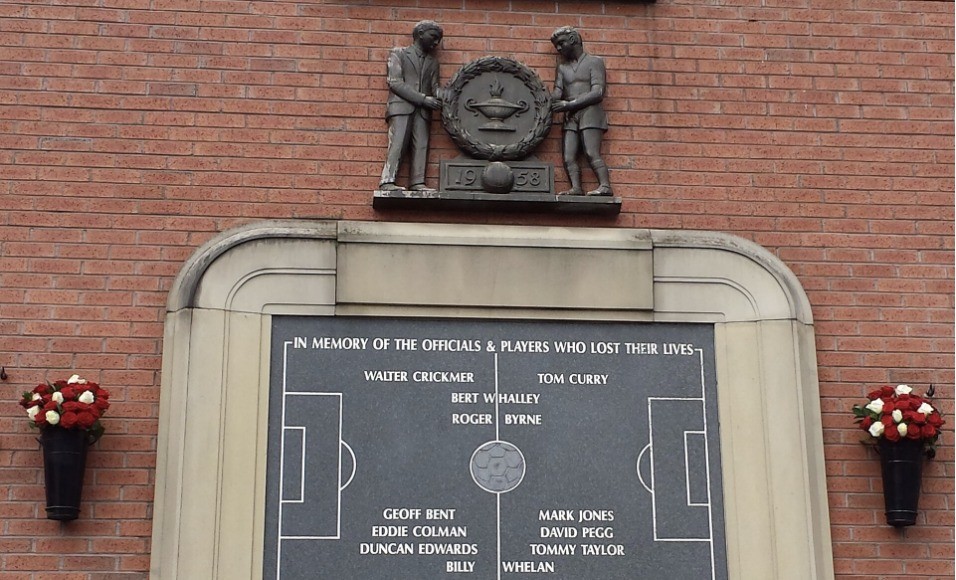
In February 1958, the plane carrying United’s squad home from a European Cup away match crashed on takeoff at Munich Airport, killing 23 people.
Eight players from the young squad known as the “Busby Babes” died that day, and Charlton, who survived the crash, later called the stadium the “Theatre of Dreams” — a name that stuck.
In 2016, the entire South Stand was renamed the “Sir Bobby Charlton Stand” in his honor.
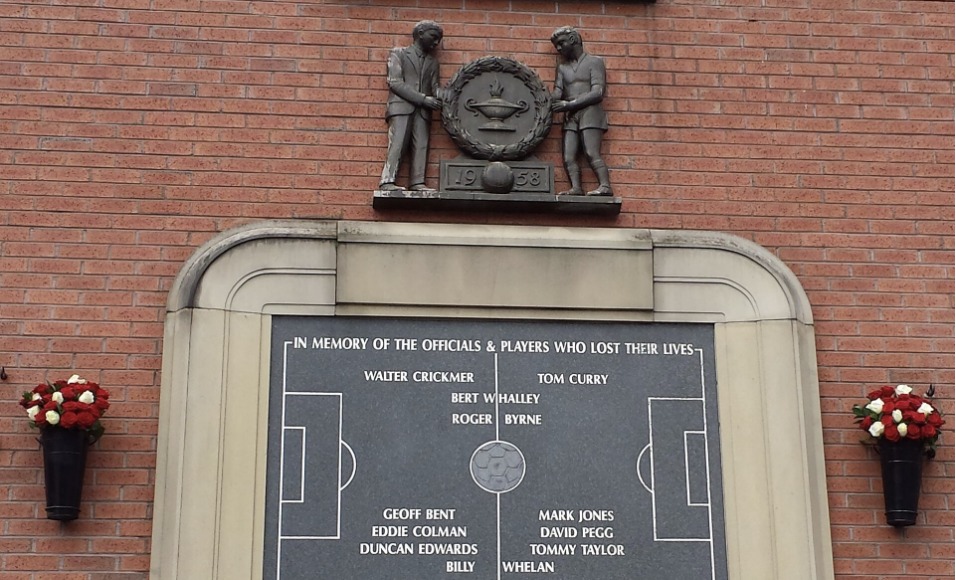
A memorial plaque honoring the victims of the Munich air disaster. Source: Wikimedia Commons (HonorTheKing, CC BY-SA 4.0)
On the supporter-culture side, the West Stand — better known as the “Stretford End” — holds symbolic status.
It’s famous as the loudest section of the ground, and its nickname is spelled out at the top of the concourse in a seat mosaic.
Legendary striker Denis Law earned the nickname “King of the Stretford End” after the section, and his statue still stands in that stand’s concourse today.
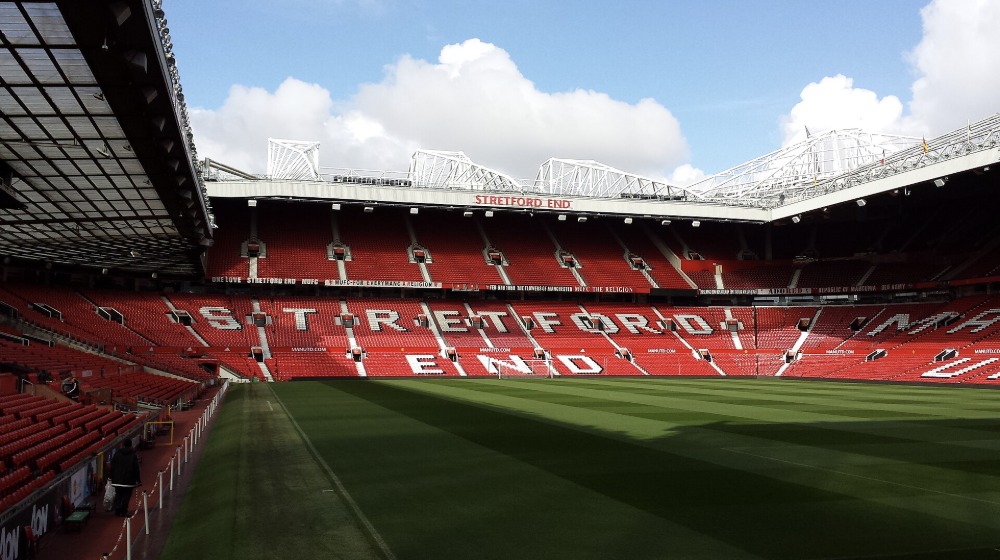
The Stretford End spelled out in a seat mosaic. Source: Wikimedia Commons (HonorTheKing, CC BY-SA 4.0)
With 116 years of emotional weight tied up in a single name, this naming-rights decision isn’t going to come down to a spreadsheet alone.
I finished this research thinking that the deeper a club’s brand equity runs, the more carefully a decision to change its name has to be made.
A Comparison With the KBO and K League
As I’ve noted elsewhere in this series, most Korean pro-sports venue names come from the parent company that owns the club putting its own brand on the building.
Think Daegu Samsung Lions Park, Incheon SSG Landers Field, or Daejeon Hanwha Life Ballpark — while the closest domestic equivalent to true American- or European-style naming rights, where an unrelated third party pays market rate purely for the name, isn’t a venue at all, but a team name: the Kiwoom Heroes.
The setup United is now weighing — an outside company with no equity stake in the club buying the name of a newly built stadium — has no real precedent in Korea yet.
As it happens, Anfield (Liverpool), also covered in this series, has kept its name even after a major ownership sale.
It’s an interesting contrast: two great English clubs that have both maintained a “we don’t sell the name” tradition, with one (Old Trafford) now preparing to break from it, and the other (Anfield) still holding firm.
Compared with Seoul’s Jamsil domed-stadium project, the texture here is different too.
The Jamsil dome is being built on city-owned land through a public-private partnership, while United’s new stadium is a purely private project built on the club’s own land with its own capital — and to help fund it, the club is prepared to sell off a 116-year-old name.
In the end, the takeaway from this case is fairly simple.
The bigger a club’s brand equity, the harder a decision to sell its name becomes — but that same equity also gives it that much more leverage to sell it for a far higher price.
Whether the name Old Trafford disappears, or survives in some form, is still undecided — but it’s already clear that the fate of a £2 billion stadium project hinges on that one decision.
Leave a Reply