Contents · About 8 min read
📱 View as card news
Something stopped me cold while I was scrolling through football-industry news the other day.
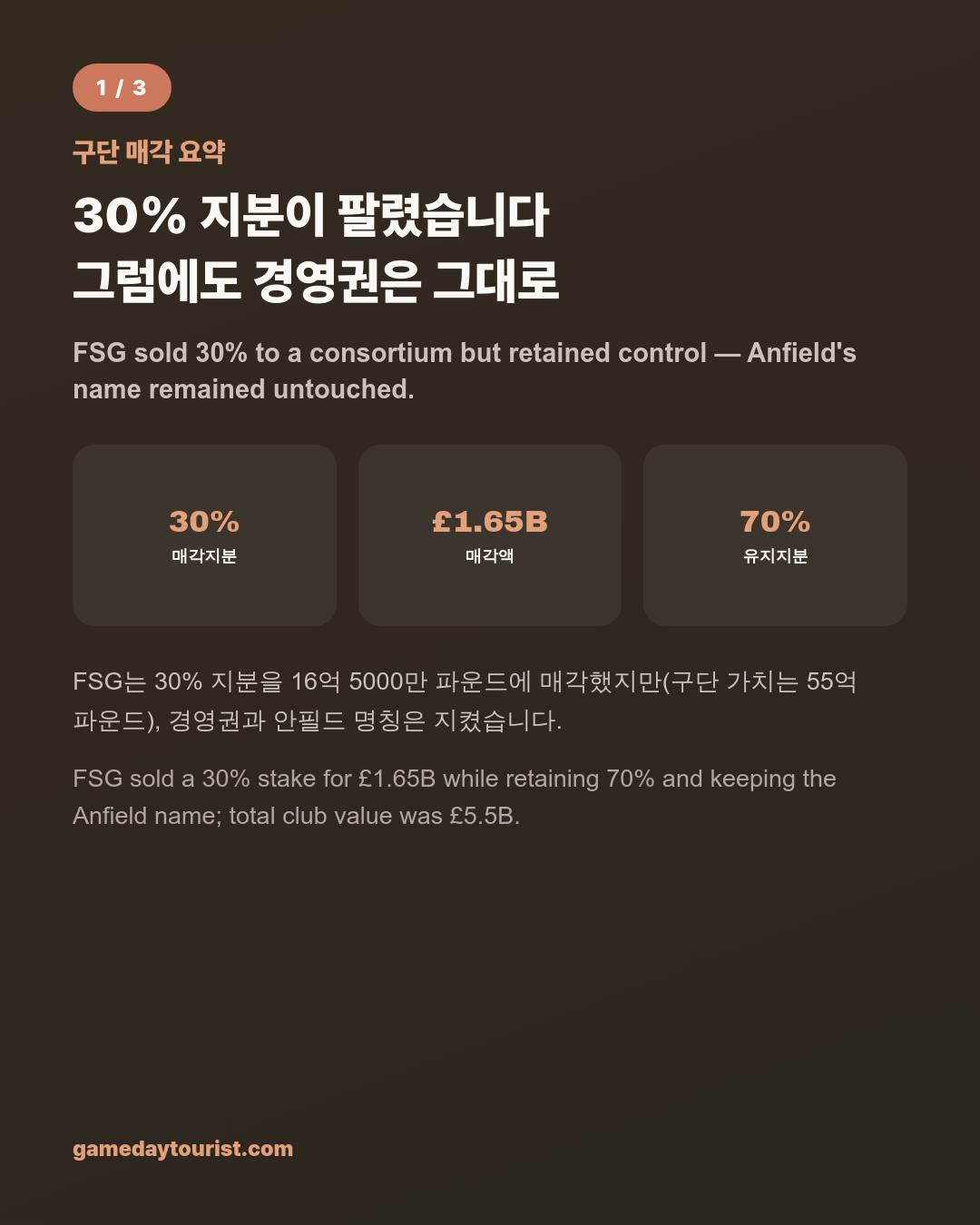
Liverpool FC’s owner, Fenway Sports Group (FSG), had sold a 30% stake to a consortium that includes Amazon founder Jeff Bezos.
One of the world’s richest men buying into a football club was newsworthy on its own, but as a working marketer, something else caught my attention even more.
Even with a deal this size on the table, the name “Anfield” itself never once came up for negotiation.
Here’s how the deal breaks down.
On August 14, FSG agreed to sell a 30% stake in Liverpool to the “1892 Holdings” consortium led by Amit Bhatia for £1.65 billion (roughly 3.2 trillion won).
According to CNBC’s reporting, the consortium also includes K5 Sports (the venture capital firm where Bezos is the largest investor) and a family investment vehicle tied to Facebook co-founder Eduardo Saverin.
The deal values the entire club at £5.5 billion.
FSG, though, keeps its 70% stake and continues to run the club — this is a stake sale, not a handover of control.
Bhatia is joining the board as a new vice chairman, while Bezos himself notably isn’t taking a board seat — one of the more interesting wrinkles in the deal.
Digging into where the name “Anfield” actually came from helped me understand why the club guards it so closely.
Anfield isn’t named after a person or a company — it’s the name of a district in north Liverpool.
According to Wikipedia, the name combines Old English and Middle English words meaning roughly “sloping field,” and it’s been used for the area since at least 1642 (one theory even traces it to 19th-century Irish immigrants naming it after a place back home).
The stadium’s story starts in 1884, when Everton FC leased the land from a landowner named John Orrell and built a ground there.
A falling-out over club management between the Everton committee and landowner John Houlding in 1892 sent Everton packing to a new ground (Goodison Park), and Houlding, left with an empty stadium, started a new club to keep using it.
That new club became today’s Liverpool FC.
In other words, Anfield was a neighborhood name long before Liverpool FC existed — the club moved in as a tenant on that land, so it was never really anyone’s name to sell in the first place.
That history probably explains why fans react so strongly whenever a sponsor-name swap is even hinted at.
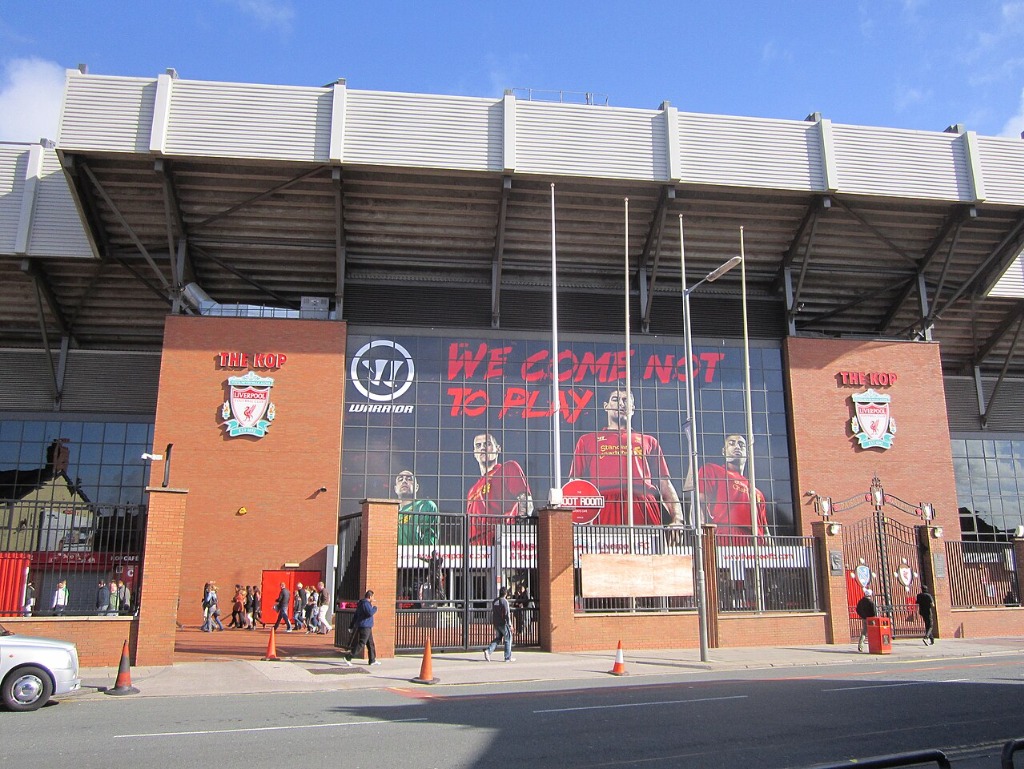
The Kop stand exterior · Source: Wikimedia Commons (photo by Rept0n1x), CC BY-SA 3.0
Attendance and Tickets
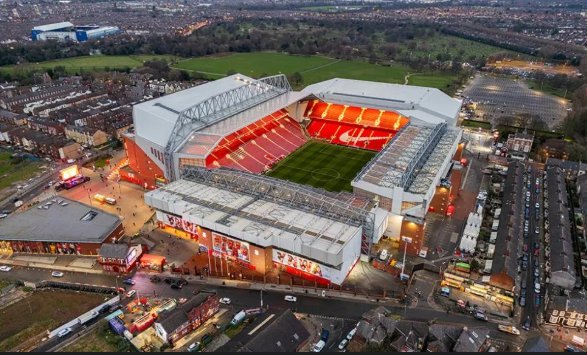
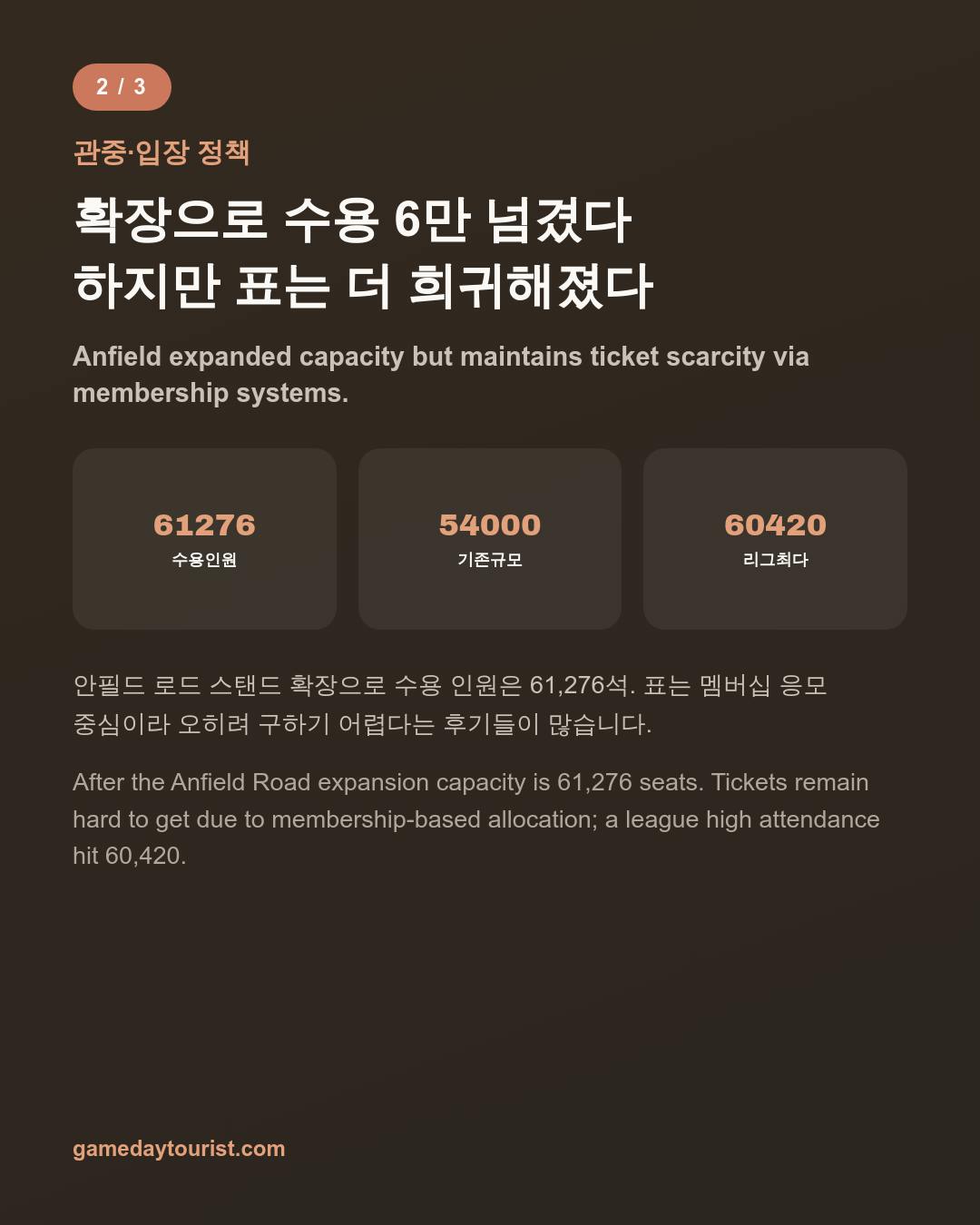
Anfield’s capacity grew to 61,276 after the 2024 expansion of the Anfield Road Stand.
Before the expansion, the ground held around 54,000 — meaning nearly 7,000 seats were added.
That extra capacity set a new Premier League home attendance record, with 60,420 fans packing in for a single match during the 2024-25 season.
That’s still short of the all-time record of 61,905, set at an FA Cup match back in 1952.
Can you imagine a domestic sports venue here drawing 60,000 for a single game? It’s genuinely staggering.
What’s interesting is that even with more seats available, getting a ticket has actually gotten harder.
Instead of general sale, Liverpool only makes season-ticket applications available through its “All Red Membership” (Full, Light, and Junior tiers).
Starting in 2026-27, the youth-discount age range widened from 21 to 24, but according to overseas football-travel accounts, getting a ticket through the official route without a membership is still essentially impossible.
Season ticket prices range from £931 at the top for the Main Stand down to £734.50 for the outer sections of the Kop, while single-match tickets run from £31 up to £62.75.
It struck me as a deliberate strategy — constraining supply to manage scarcity as a brand asset in itself.
Advertising Inventory and Sponsorship
Liverpool’s main sponsor is still Standard Chartered.
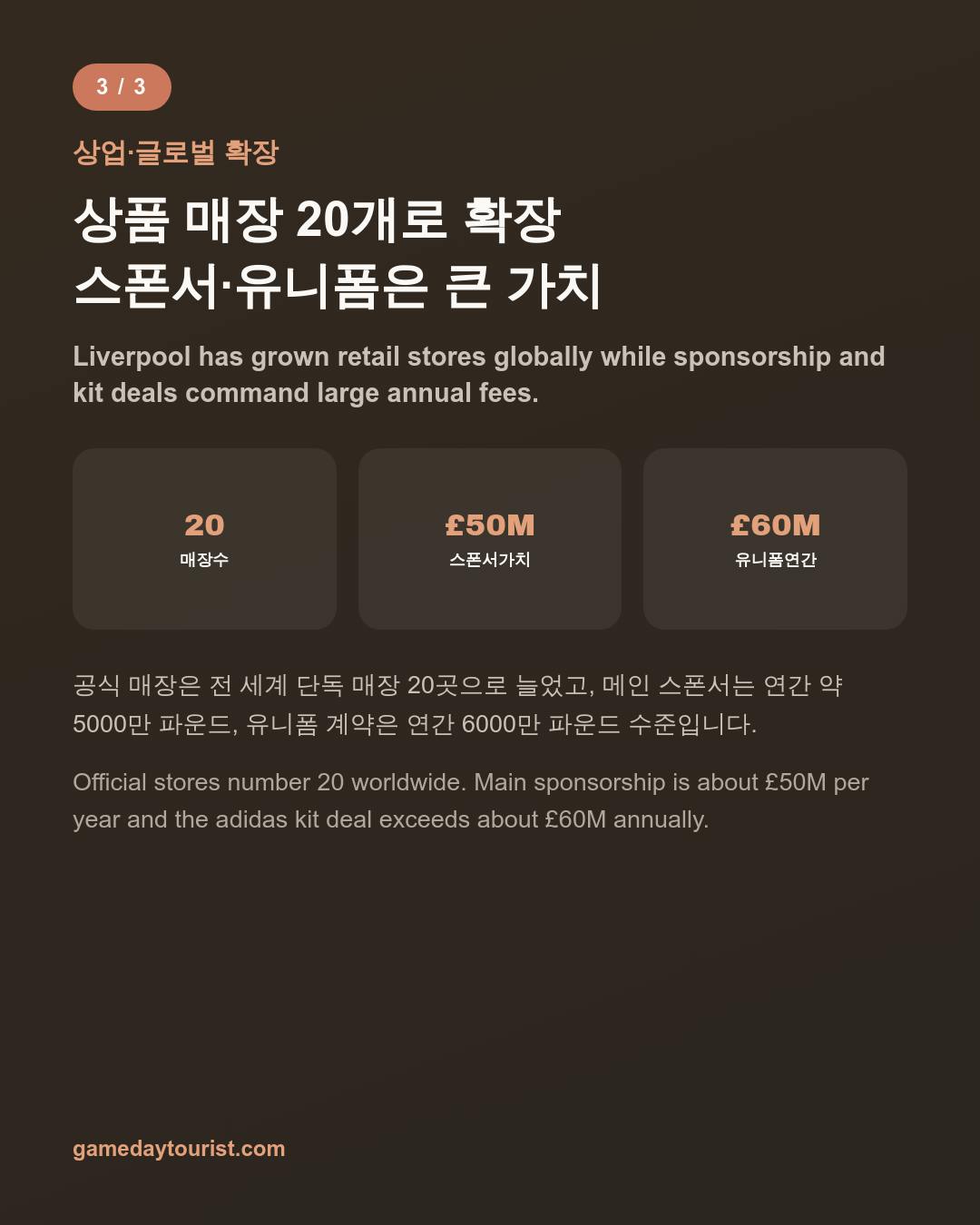
The current deal, extended in 2022, runs through the 2026-27 season at a reported value of roughly £50 million a year.
With that contract set to expire in 2027, recent reports say the club is already shopping for a new main sponsor, with the market rate estimated around £66 million a year.
The retail sponsor, Expedia, has been on board since 2023 at roughly £12 million a year.
The kit supplier switched from Nike to Adidas starting with the 2025-26 season, in a five-year deal reportedly worth more than £60 million annually.
Given Adidas also supplied Liverpool’s kits from 1985-1996 and 2006-2012, this marks a reunion 13 years in the making.
Yet the stadium’s own name still isn’t for sale, in any form.
A club commercial executive has said that naming rights (the right to attach a company’s name to a facility) were considered along with every other option when the new Anfield Road Stand was built, but the conclusion that actually emerged was limited to partial naming — a lounge or a specific section — rather than the stand as a whole.
Within a Premier League where Tottenham’s home operates as “Tottenham Hotspur Stadium” under its own brand without a sponsor name, and Manchester City’s Etihad or Arsenal’s Emirates carry a sponsor’s name outright, Anfield has effectively chosen to sit apart from both approaches.
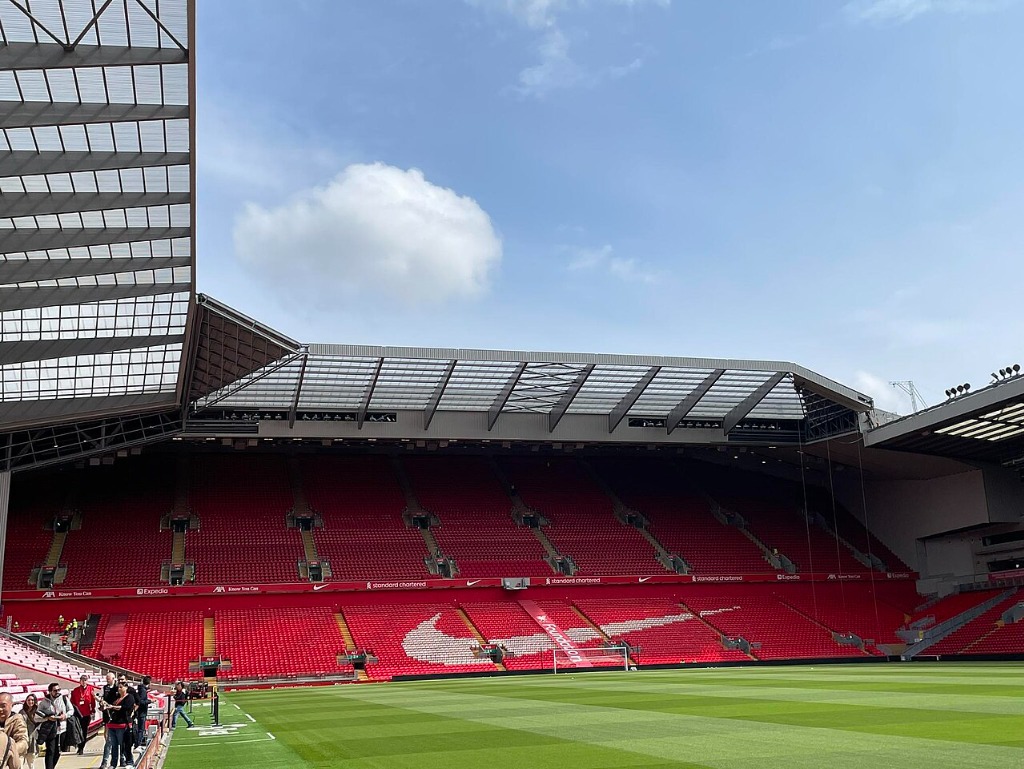
The newly expanded Anfield Road Stand · Source: Wikimedia Commons (photo by FYI2023), CC0 (public domain)
Merchandise and Global Retail
Near Anfield sits the official Liverpool FC store, selling kits and merchandise and open 9 a.m. to 5 p.m. even on non-matchdays.
A personalization service — adding names and numbers to shirts — is available year-round.
What stands out is that the club keeps expanding this retail business overseas.
It recently opened a new store in Hong Kong, bringing its total number of standalone stores worldwide to 20.
This goes well beyond running a single shop inside the stadium — it’s exporting the brand itself as an overseas retail channel.
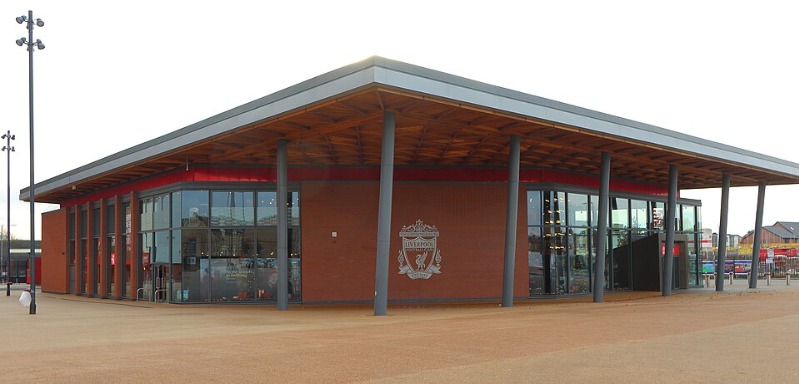
The official Liverpool FC store near Anfield · Source: Wikimedia Commons (photo by Phil Nash), CC BY-SA 4.0
Broadcast Rights and Local Economic Impact
Under the Premier League’s new 2025-2029 broadcast cycle, domestic (UK) rights alone sold for £6.7 billion over four years (Sky Sports and TNT Sports), while international rights climbed to £2.17 billion per season.
Combined domestic and international broadcast and commercial revenue for the league is up 17% over the previous cycle, reaching £12.25 billion.
Since that money gets distributed across all 20 clubs, teams with stronger recent results naturally take a bigger cut.
Liverpool itself posted record revenue of £703 million in the 2024-25 season, with media revenue (including broadcast rights) alone up £60 million year-over-year to £264 million.
The local economic-impact figures are a bit dated, but still worth citing.
A 2017-18 season study found that fans traveling in from outside Liverpool spent £102 million directly in the local economy that season alone, with a further £108 million generated through related industry spillover effects.
With capacity up nearly 7,000 seats since then, these numbers are presumably higher today, though I haven’t been able to confirm more recent figures.
What Makes Anfield Anfield — The Kop and YNWA
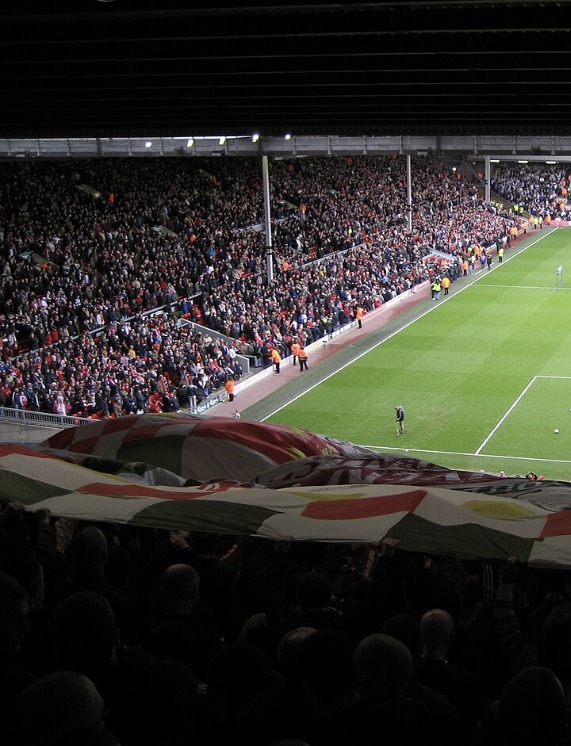
Fans unfurling a flag in The Kop · Source: Wikimedia Commons (photo by Tobias Barkskog), CC BY 3.0
No conversation about Anfield is complete without “The Kop.”
Built in 1906 and named after Spion Kop, a hill in South Africa where a famous battle took place, the stand has become the very symbol of Liverpool’s fan culture.
“You’ll Never Walk Alone,” sung by nearly 60,000 voices as one, has long since outgrown being just an anthem to become part of the club’s identity — and Anfield has actually been voted the Premier League’s best atmosphere for three years running in a Sky Bet fan survey.
Match-day accounts from visiting fans often describe the streets around the stadium turning red hours before kickoff, with the songs pouring out of pubs, the smell of street food, and the crowds all blending into a spectacle nearly as memorable as the match itself.
Those same accounts also note that Anfield runs fully cashless — card or contactless only — and the food is mostly traditional matchday fare like meat pies, so don’t expect a gourmet spread.
As a marketer, what strikes me is the contrast: the club keeps expanding aggressively on merchandising and sponsorship, yet deliberately leaves the in-stadium “experience” itself unpolished — and that restraint might be exactly what’s kept the Anfield brand’s identity intact all these years.
A Comparison With the KBO and K League
What stands out most about this stake sale is that, even in a deal this large involving 30% of the club, everything tied to the stadium name and club identity was left untouched.
Most Korean pro clubs are directly branded by a parent company, both club and stadium (think Samsung Lions Park in Daegu or SSG Landers Field in Incheon), so an option like Anfield’s — simply refusing to sell the name at all — doesn’t really exist as a possibility here.
The closest domestic parallel might be the Kiwoom Heroes, where an outside sponsor pays for naming rights without a parent-company brand attached — but even that’s a sponsorship of the club’s name, not the stadium’s, so it’s a fundamentally different situation from Anfield’s.
Ticketing philosophy is a study in contrasts too.
The KBO and K League tend to prioritize accessibility to grow their fan base, while Liverpool has gone the opposite direction — using membership as an entry barrier to manage scarcity and protect brand value.
Neither approach is inherently right — it’s a natural outcome of a club with an established global fan base versus one still working to grow its fan base domestically, each taking the strategy that fits.
That said, the way Anfield’s nearby store has expanded to 20 locations worldwide suggests domestic clubs, too, have room to push their existing fan bases further into merchandising and licensing.
Leave a Reply