Contents · About 11 min read
- 16 years as a frozen concrete skeleton: how Nou Mestalla became a “ghost stadium”
- What kind of club is Valencia? Back-to-back Champions League finals, now in the relegation zone
- What to know before visiting Mestalla
- Attendance and tickets
- Naming rights and sponsors: the TM group, and a new stadium still without a name
- Selling off the old site, and the club’s finances
- How Mestalla’s last season is being sold
- A comparison with the KBO
📱 View as card news

Valencia CF’s September has been a heavy one. In mid-September, manager Carlos Corberán and the club’s football CEO both left at the same time, and seven La Liga games in, the club sits 19th of 20 teams on 4 points.
Yet at exactly the same time, a completely different kind of news has been pouring out of the club’s finance side: developers looking to buy the land under Mestalla, the home ground the club will leave after the 2026-27 season, have submitted non-binding bids worth around €150 million.
That mismatch — rock-bottom results alongside a major deal brewing over the stadium site — is what made me want to lay out Valencia’s final Mestalla season from a marketing angle in this piece.
I already covered this stadium in a piece on September 5 (“The Last Season, and Negotiating the Name for a New 70,000-Seat Ground”). That piece covered attendance and season-ticket structure, sponsors and advertising, finances and new-stadium funding, and the naming-rights talks.
Writing again less than a month later is because three things that piece didn’t cover have since happened. First, the sale of the old stadium site has entered a stage where non-binding bid figures are actually circulating.
Second, the manager and football CEO both left in mid-September, and a new manager was appointed on September 22. Third, three of the new stadium’s premium products sold out, and a new one launched on September 16.
On top of those three things, this piece also covers why the new stadium sat frozen for 16 years, practical visitor information, and where the team stands right now. I haven’t re-covered the attendance figures, season-ticket discounts, sponsor overview, or funding structure from the earlier piece, so it’s worth reading alongside this one if you want that context.
The name “Mestalla” comes from an irrigation canal built during the Moorish era, in the 10th or 11th century. Wikipedia notes that the canal used to run outside the south stand, and spectators once had to jump over it to get into the ground.
The stadium also hosted matches at the 1982 World Cup and the 1992 Barcelona Olympics.
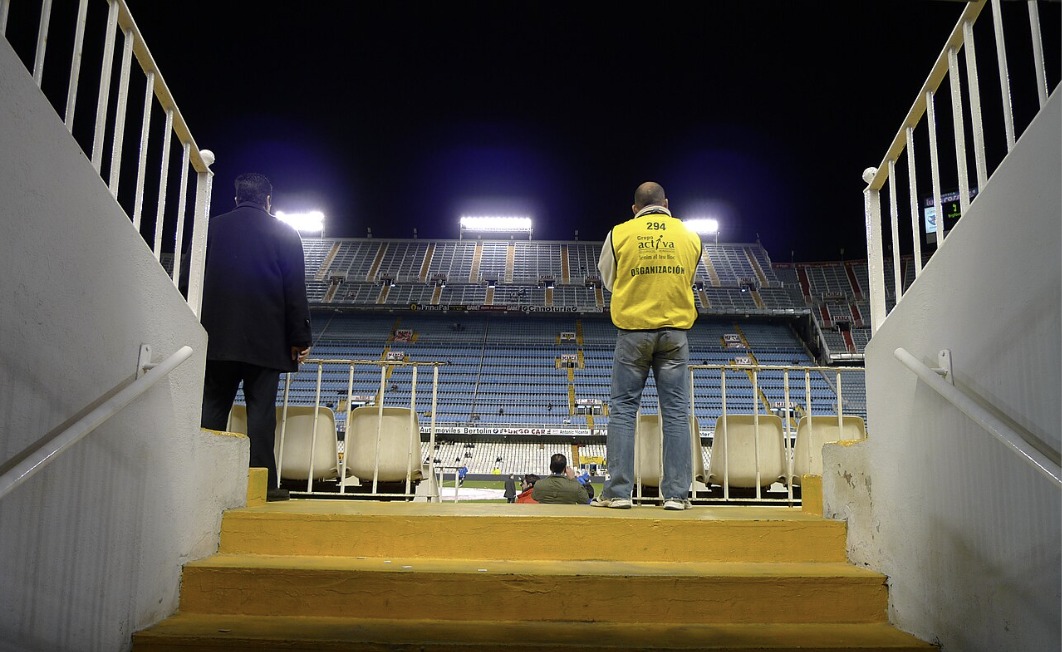
Photo: slayer from Hsin Chu, Taiwan · Wikimedia Commons · CC BY 2.0 · Taken December 2008, Mestalla as seen from the vomitory (spectator entrance tunnel)
16 years as a frozen concrete skeleton: how Nou Mestalla became a “ghost stadium”
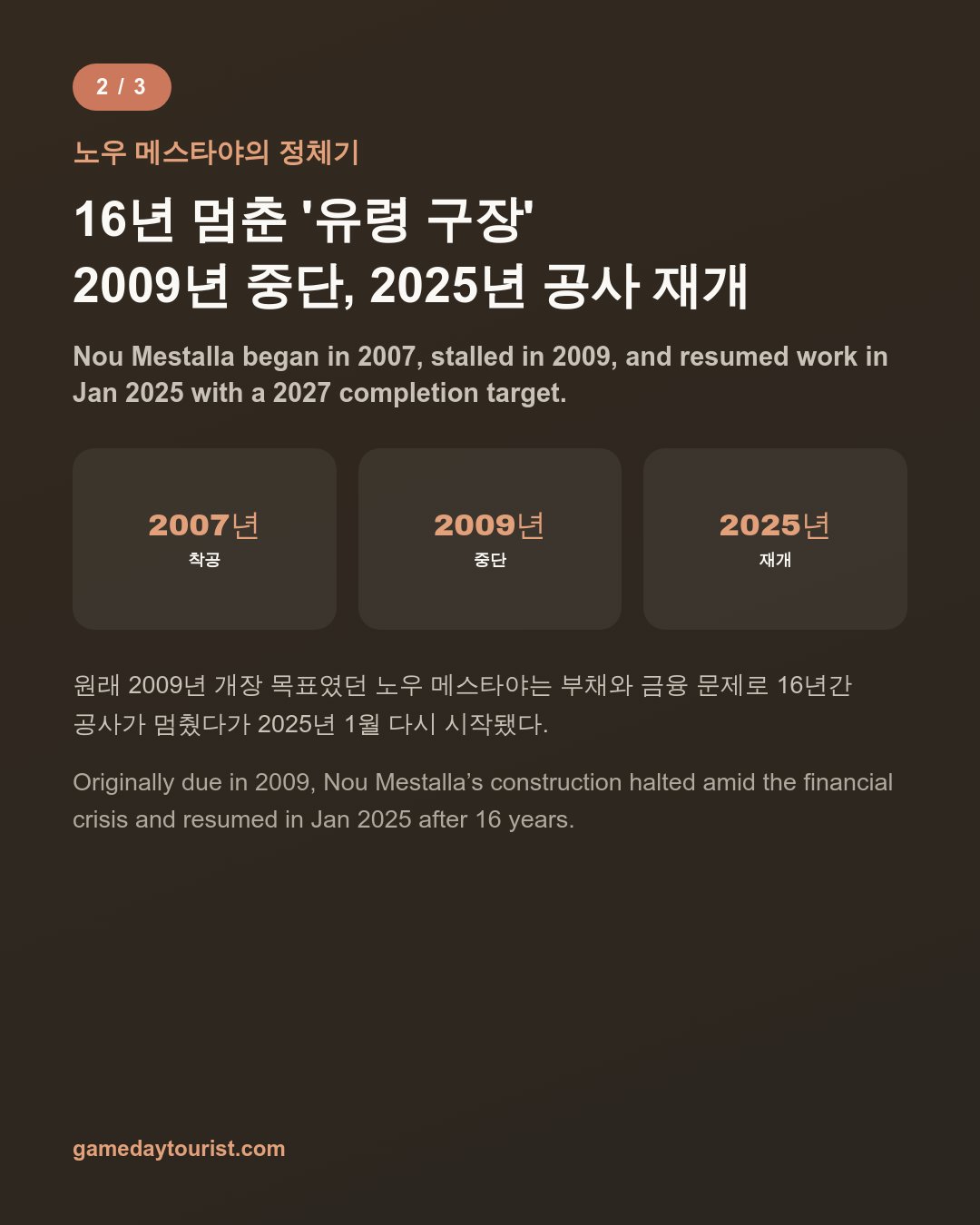
The story of the new stadium, Nou Mestalla, goes back to groundbreaking on August 1, 2007. The original target was a 2009 opening.
But as Spain’s real estate bubble burst and a banking crisis hit, the club’s debt ballooned to around €550 million, and construction stopped in February 2009.
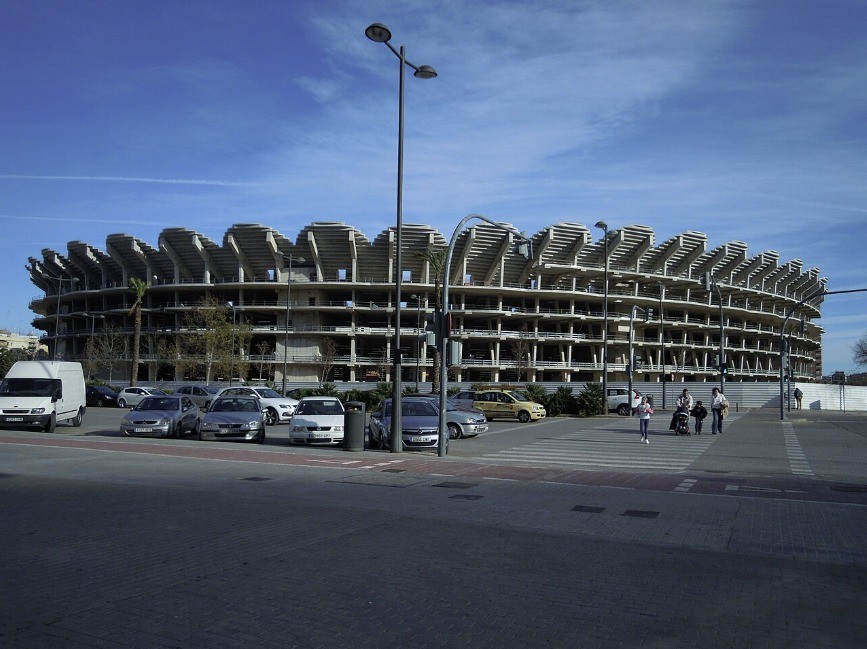
By then around €100 million had already gone into the project, leaving nothing but a bare concrete frame with no cladding — English-language outlets nicknamed the structure a “ghost stadium”. Several new plans were announced between 2011 and 2020, but none of them were carried out.
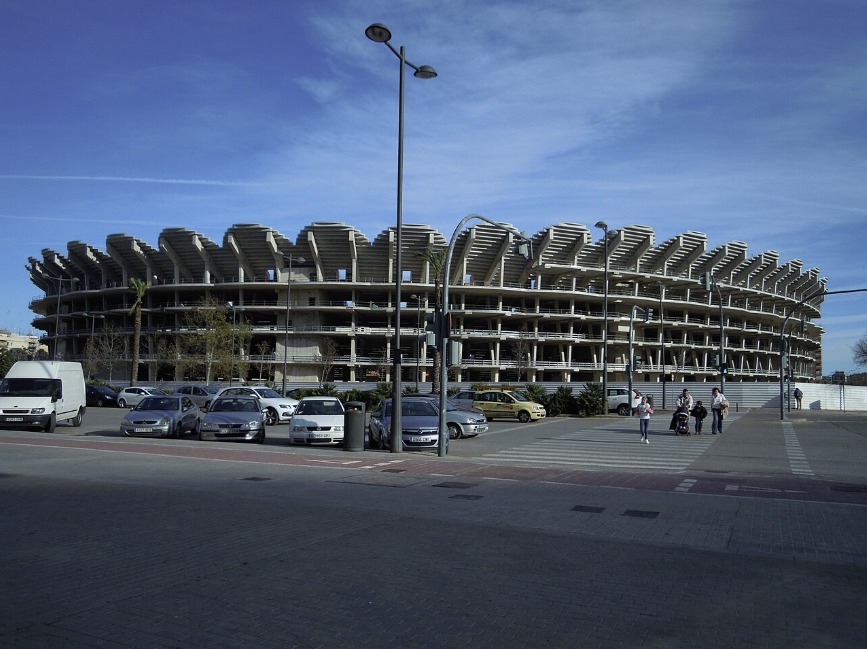
Photo: Ravave · Wikimedia Commons · CC BY-SA 3.0 · Taken March 18, 2013, the frozen skeleton of Nou Mestalla mid-construction-halt
Construction only resumed on January 10, 2025, 16 years later, and the club set a completion target of July 11, 2027.
Recent progress has gotten fairly concrete. On September 4, the club officially announced it had begun the “Big Lift,” raising the roof’s main structure — hydraulic jacks mounted on the compression ring (the circular structure that holds the roof’s edge in shape) lift the entire roof simultaneously, and the work is expected to continue over several weeks.
After that, what remains is installing the secondary roof structure and the outer membrane.
What kind of club is Valencia? Back-to-back Champions League finals, now in the relegation zone
Valencia was founded on March 18, 1919, and has won La Liga six times (most recently in 2003-04) and the Copa del Rey eight times.
The club reached back-to-back Champions League finals in 2000 and 2001, losing 0-3 to Real Madrid and then on penalties to Bayern Munich. Since Singaporean billionaire Peter Lim acquired a 70.4% stake in 2014, the club has dealt with ongoing debt and frequent managerial changes.
This season began without European competition after finishing ninth last season. After taking just one point from the first five matches, manager Corberán and football CEO Ron Gourlay, along with other sporting-side staff, left all at once in mid-September, and Braulio Vázquez, brought in from Osasuna for €290,000, took over as sporting director.
Javier Aguirre’s appointment as manager followed on September 22. He arrived straight after leading Mexico’s national team through the World Cup, signing through the end of the 2026-27 season with a one-year extension option.
As of La Liga’s official table on September 30, Valencia sit 19th with a 1-1-5 record (one win, one draw, five losses) and 4 points from 7 games.
What to know before visiting Mestalla
The nearest metro stop is Aragón on Line 5, and buses 10, 98, and C3 also serve the ground. A local matchday guide advises against driving, since the surrounding area is residential and parking is hard to find, and recommends arriving 60 to 75 minutes before kickoff to get through security and climb the steep stands.
One account puts the walk from the city center, cutting across the Turia Gardens, at 20 to 25 minutes. It’s safest to buy tickets only through official club channels, and neutral fans are often advised to pick the side stands over the ends behind the goals.
This season is a bit different, though. With most seats going to season-ticket renewals, general sale will likely be limited (more on this below, under Attendance and Tickets).
New sign-ups have only opened up in the supporters’ section (ages 16-30), for around 200 seats. The stadium tour (Mestalla Forever Tour) only runs in the morning on matchdays.
One local football-travel blogger described a band playing in front of the main stand before kickoff, with fans cheering the arriving team bus — a pregame ritual you can enjoy without a ticket at all.
Reading that account as a marketer, what struck me is that most of this pre-entry content happens on the streets and plazas outside the stadium. As the new stadium packs more premium amenities inside the ground itself, where this free ritual ends up continuing looks like it could become a commercially important question too.
The team bus arriving is visible in the 2013 photo below as well.
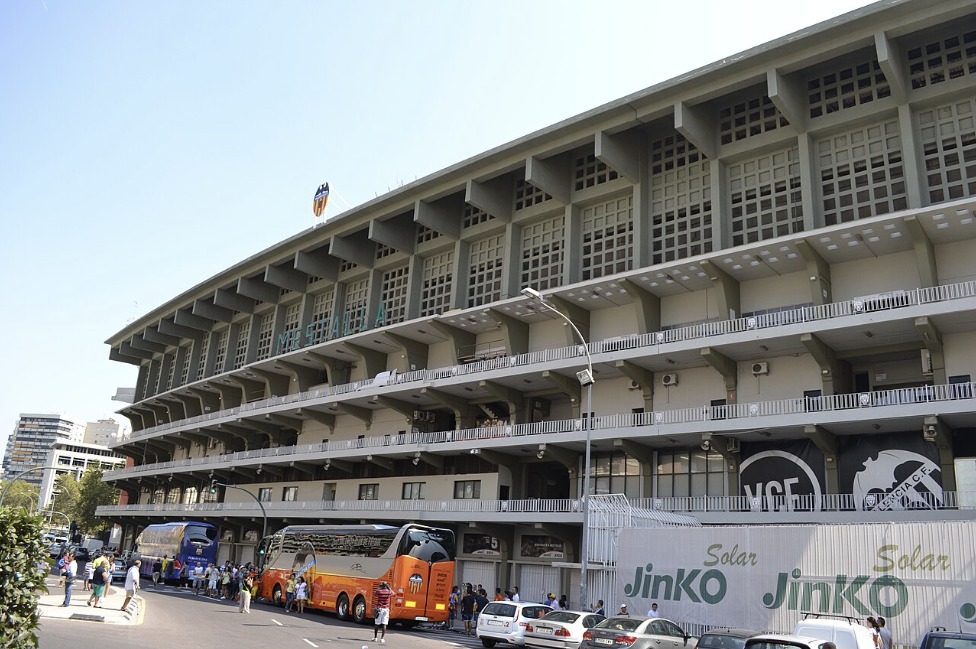
Photo: Dorieo (Jerónimo Roure Pérez) · Wikimedia Commons · CC BY-SA 4.0 · Mestalla’s exterior ahead of the Valencia-Barcelona match, September 2013
Attendance and tickets
A report in August put this season’s season-ticket renewal rate at 99.5%, with new sign-ups effectively closed off.
Building on the frozen season-ticket pricing covered in the earlier piece, what’s newly confirmed here is on the general-sale side. One report puts the general-sale price increase at around 15% — a textbook move of locking in loyal customers while adjusting revenue through the price of whatever seats are left over.
How much the stadium’s capacity itself capped revenue shows up in the 2024-25 season numbers. Matchday revenue (tickets plus season tickets) came to just €26.4 million, premium seating fell short of 1,000 seats total, and per-match sales ran around 500 seats (this is the “under 500 seats” figure referenced in the earlier piece).
Of the new stadium’s premium offerings covered in that earlier piece, the Mediterranean Suite, Suite, and Loge products have all sold out, with contract terms requiring a minimum of 4 seats for at least 6 seasons.
On September 16, a new Bronze Club tier launched, starting at €2,150 per season (plus VAT). It includes a private terrace of over 1,000 square meters with food and beverage service, with seats located on the east side.
It’s the standard sequence of selling the top-tier products first, then adding a lower-priced tier once those are gone.
Venue-planning consultancy Legends estimates the new stadium’s annual revenue at €81 million, split between €36.4 million from season tickets and general admission and €24.6 million from premium seating.
The club’s stated target is tripling direct stadium revenue, and a simple comparison of the two figures — from €26.4 million to €81 million — comes out to just over triple. A pre-sale structure where premium inventory sells a full year before the new stadium even opens also matters a great deal for financing the construction itself.
Naming rights and sponsors: the TM group, and a new stadium still without a name
The new stadium’s name is still undecided. As of September 30, when I checked, no deal has been announced out of the Elevate naming talks covered in the earlier piece.
What’s newly confirmed is the approach under consideration: reportedly, the club is looking at pairing a sponsor’s name alongside the Mestalla name rather than replacing it outright. It’s notable that other commercial products at the new stadium are selling out while the search for a naming partner drags past a year.
TM Grupo Inmobiliario, the shirt’s main sponsor covered in the earlier piece, has come up again this time in a different context: as one of the names floated as a potential bidder for the Mestalla site itself.
StadiumDB and El Desmarque both listed the company among the candidates, though it’s absent from another report naming the three finalists (Pryconsa-Atitlan, Neinor, and Argis-Bertolín).
Whether or not it remains in the running, having a main sponsor named at the same time as a potential buyer of the club’s own real estate is the kind of setup that makes you wonder what the conflict-of-interest clauses in the sponsorship contract actually say.
Selling off the old site, and the club’s finances
This is the third attempt to sell Mestalla. The first came around when construction started on the new stadium, the second was in 2019, when ADU Mediterráneo offered €140 million.
In October 2025, the club handed the third attempt to real estate consultancy CBRE. As of 2025, Mestalla is 102 years old, the second-oldest stadium in Spanish professional football after El Molinón.
Once sold, it will be demolished to make way for residential and commercial buildings.
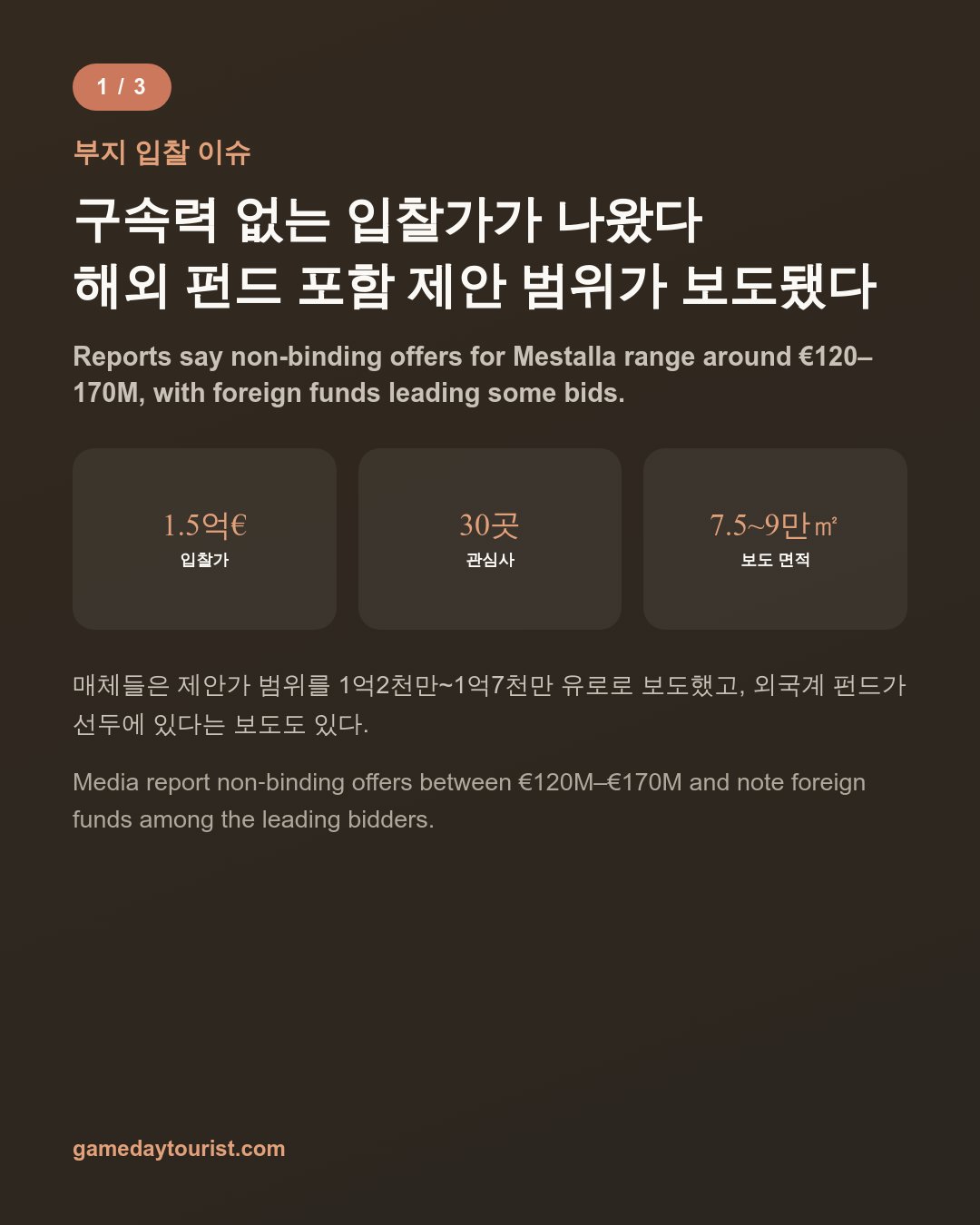
Bid news has kept coming through September. StadiumDB reports around 30 parties showed interest, with non-binding offers in the €120-150 million range, some slightly above €150 million, while El Español reports foreign funds are leading the pack with offers of €150-170 million.
Given how much the figures vary by outlet, it’s worth keeping in mind none of these are amounts the club has officially confirmed. The site’s area is also reported differently — 75,000 square meters according to ElDiario, versus 90,000 according to StadiumDB.
The buildable area allowed is 100,000-120,000 square meters, with plans for 400-500 housing units including a 29-story, 107.7-meter tower, and no social housing included. Projections differ on whether the sale closes in October or sometime later this year, while the club itself must submit its urban development plan by October 27.
The money is needed because of debt. Vozpópuli reports known debt at around €530 million as of the 2024-25 season, and lays out a scenario where Peter Lim converts a €35 million personal loan into equity, pushing his stake above 92%, while land-sale proceeds of €150-165 million come in — together cutting more than €200 million off the debt.
The same outlet also raised the possibility that Lim could sell his stake once the new stadium opens, in the 2027-28 season — though that’s a projection, not a confirmed plan.
As noted in the earlier piece, the sale proceeds go toward financing the new stadium, and this round of reporting also brings up Goldman Sachs debt repayment and the need to meet financial fair play (FFP) requirements. In the end, the money to build the new stadium is coming from selling the old one — which is exactly why this season, with both stadiums overlapping, is the most sensitive point in the whole process.
How Mestalla’s last season is being sold
Mestalla has hosted over 3,000 matches across 104 years, including 1,503 La Liga games alone. This season’s final regular-season home match is against Elche in round 37, on May 16, 2027, and local media report that both the club and fans are already calling this the farewell season.
The frozen season-ticket pricing and 99.5% renewal rate look like that sentiment translating into commercial results — rather than raising prices because it’s the last season, the club chose to hold onto its 40,000 season-ticket holders instead.
One more thing worth watching is the commute. The old stadium is a 20-25 minute walk from the city center, while the new one is being built in the Benicalap district, on a former factory site.
A comparison with the KBO
The earlier piece noted that most domestic stadiums in Korea are owned by local governments. This case shows how that ownership structure cuts off the “sell the asset” option entirely.
Valencia’s approach is only possible because the club itself owns the stadium. Jamsil Baseball Stadium, by contrast, is a Seoul city facility managed by the Seoul Facilities Corporation, with LG and Doosan running it under contract since January 1, 2000, and it logged 3.06 million visitors in 2025.
Under that structure, a club selling off its old stadium site to fund a new one was never an option to begin with. A club operating under contract can only generate revenue from admissions, advertising, and merchandise — purely operational income.
The trade-offs are clear. A club that owns its stadium, like Valencia, can sell the asset to raise funds, but it also carries the risk of being stuck, as Valencia was for 16 years of halted construction, entirely on its own.
A club operating under contract never has the authority to dispose of the asset in the first place.
It’s hard to say definitively which approach is better, but what Valencia is doing right now isn’t really building a stadium — it’s a financial maneuver of converting one asset into another, and that’s a case worth keeping in mind for clubs back home too.
Leave a Reply