Contents · About 8 min read
📱 View as card news

I recently noticed a familiar name sitting in third place on La Liga’s final standings.
Right behind Real Madrid and Barcelona, ahead of even Atletico Madrid, was Villarreal CF.
A club finishing that high usually has deep-pocketed ownership behind it, or so I assumed, but it turns out Villarreal is based in a town of barely 50,000 people.
As a working marketer, that’s not a club I could just scroll past, so I started digging.
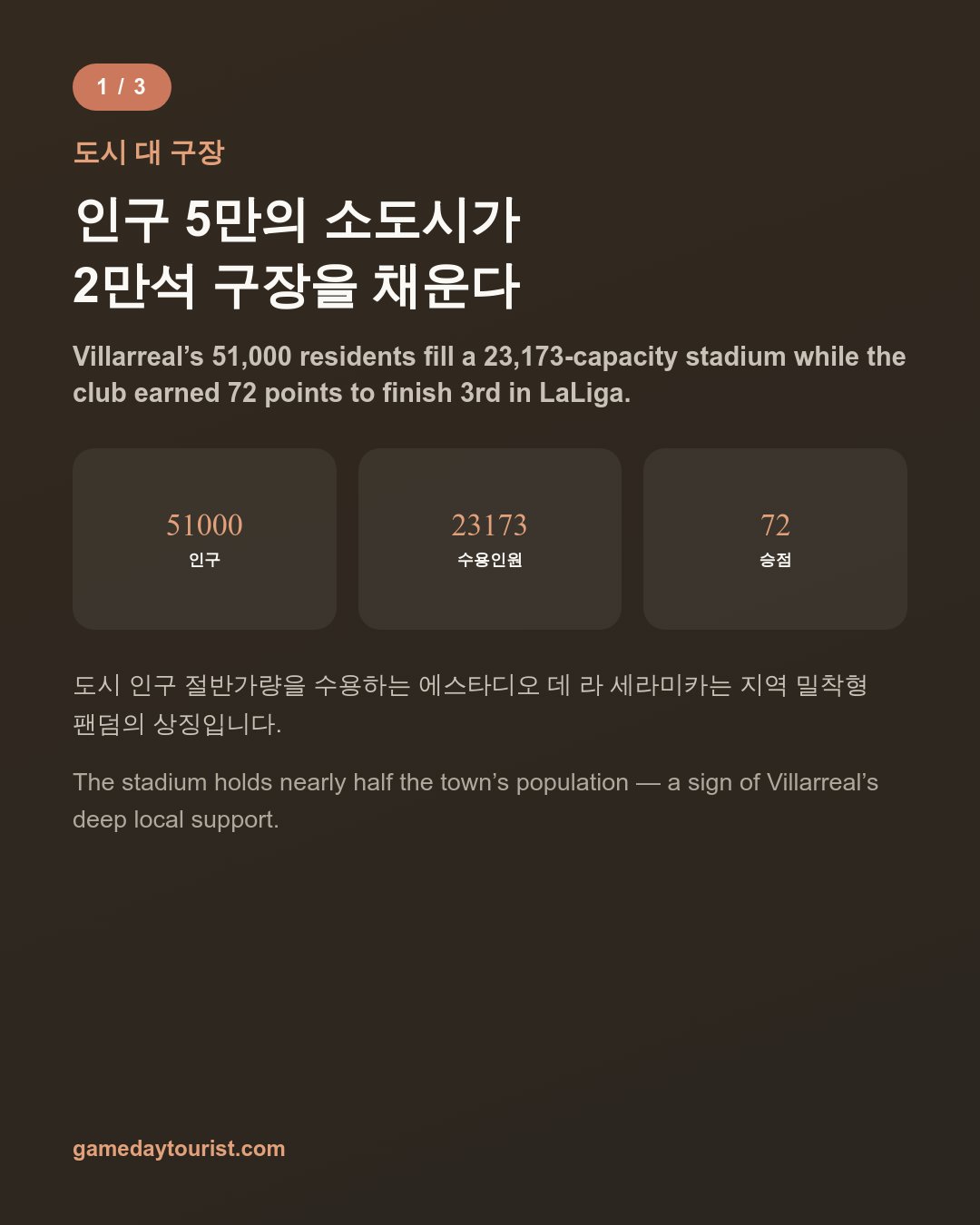
Villarreal CF went 22-6-10 in La Liga in 2025-26, finishing third with 72 points and booking a spot in the 2026-27 UEFA Champions League.
The club’s hometown, Villarreal in Castellón province, has a population of just over 51,000, and its home ground, Estadio de la Ceramica, holds roughly 23,000 — close to half the town’s entire population.
It’s rare in Spanish football history for a town this small to keep pace with the big clubs this consistently.
The stadium’s name alone sets it apart.
Estadio de la Ceramica (“Ceramic Stadium,” literally) replaced the old name “El Madrigal” in January 2017, timed for a trip to face Barcelona.
What’s interesting is how that name actually came about.
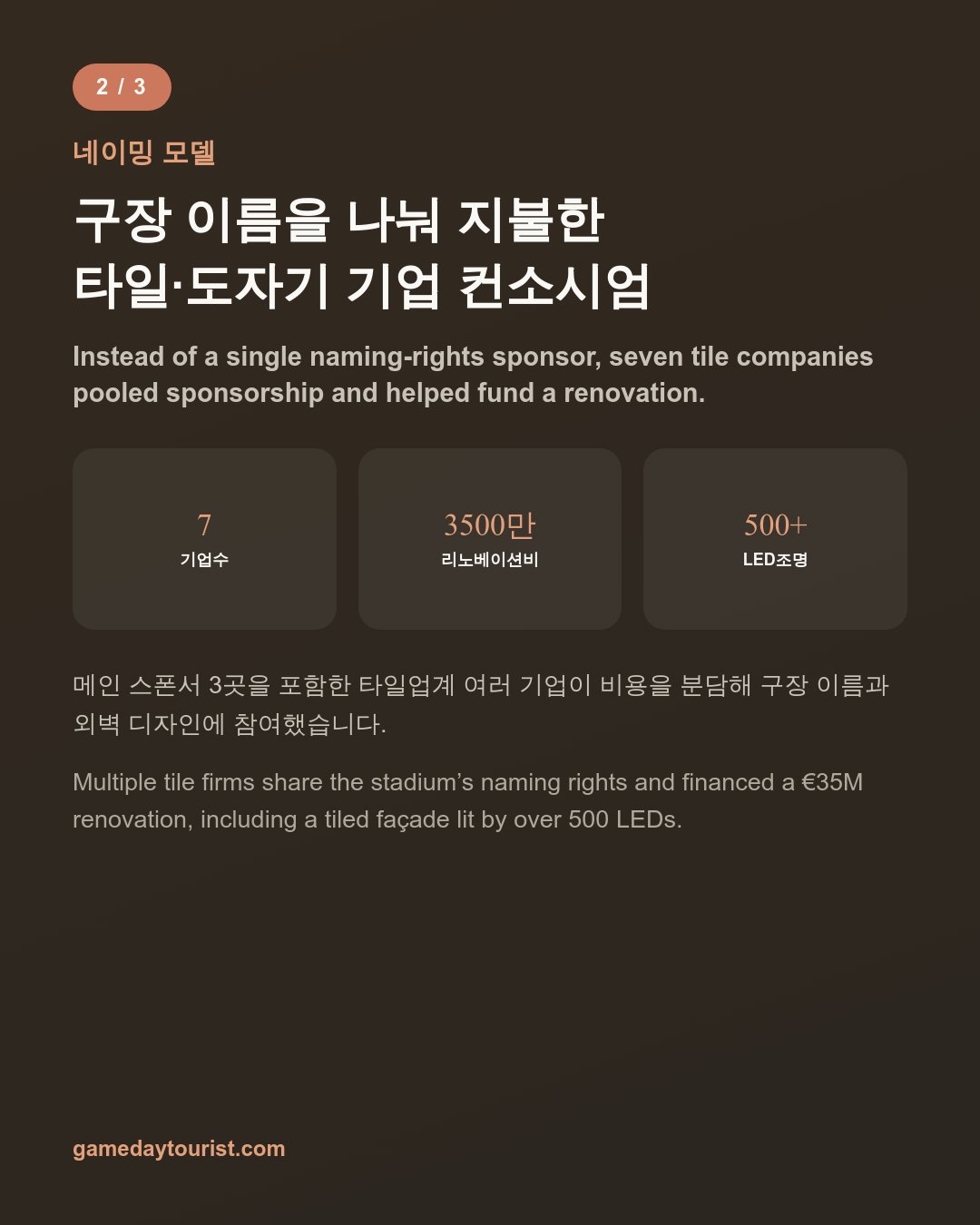
Stadium naming rights (the right to attach a corporate name to a venue) usually work by one company paying a large sum for the honor, but Villarreal instead brought in seven tile and ceramics companies from Castellón, the region’s core industry (Pamesa, Porcelanosa, and Argenta Ceramica as main sponsors, with Tau Ceramica, Bestile, Esmalglass-Itaca, and Colorobbia as official sponsors).
Since then, companies like Peronda and Torrecid have joined the main-sponsor tier, and once you count material suppliers and other official partners, the sponsor list runs to well over a dozen firms.
Castellón is the industrial cluster responsible for most of Spain’s tile production, so in effect, an entire regional industry is splitting the bill for the stadium’s name.
That naming deal turns out to be more than just a sign, too.
A €35 million renovation (designed by architecture firm IDOM) marking the club’s 2022 centenary clad the entire south stand exterior in glossy yellow ceramic tile.
More than 500 LED fixtures light up that tiled facade every night, and the club’s website shows footage of “ESTADIO DE LA CERAMICA” glowing in giant illuminated letters after dark.
The stadium itself was essentially designed to double as a billboard and a landmark for the local industry.
Attendance and Tickets
Estadio de la Ceramica’s official capacity is 23,173, per the club’s own site.
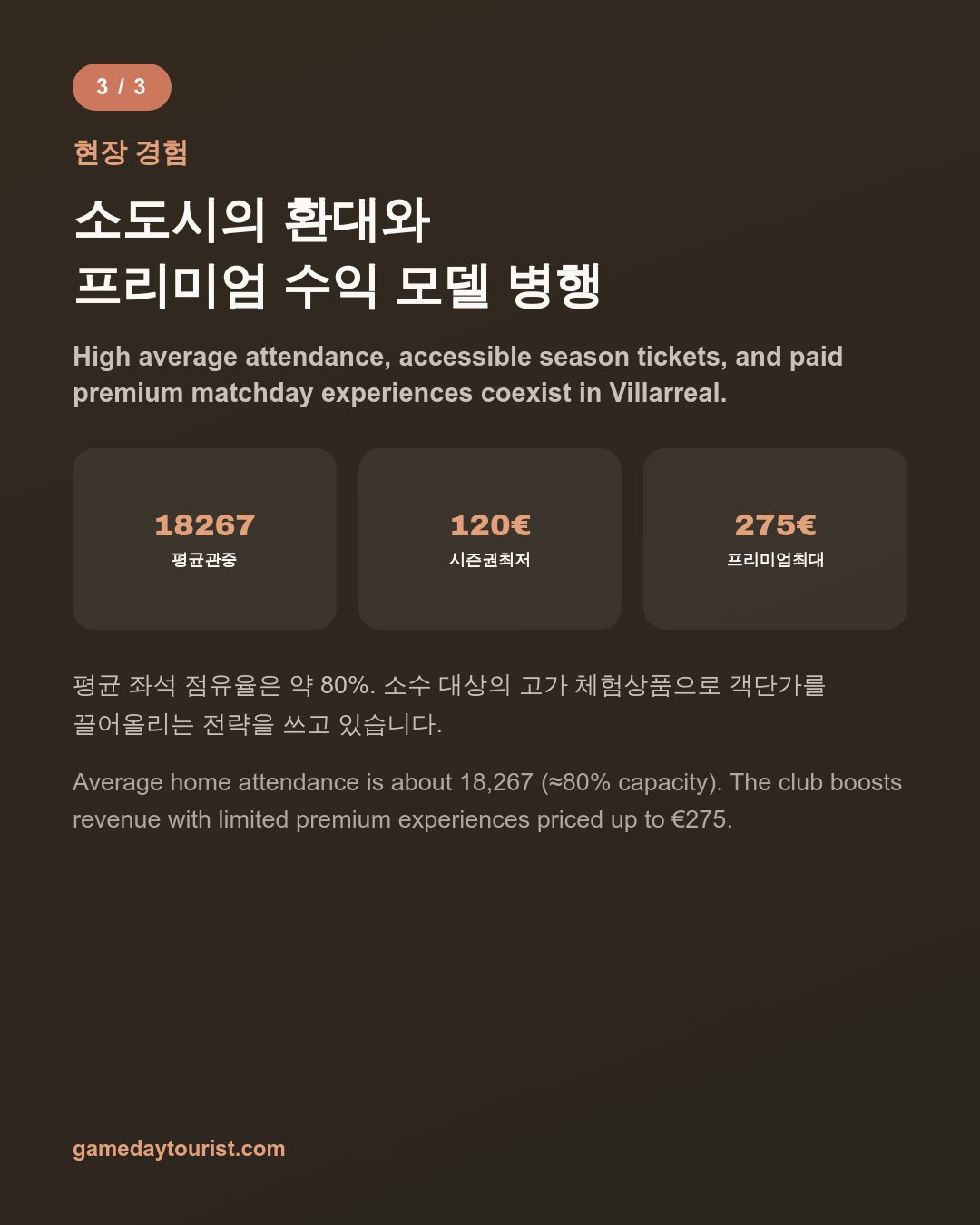
Average home attendance in La Liga for 2024-25 was 18,267, putting occupancy at roughly 80%.
That’s a small crowd next to the big clubs in absolute terms, but measured against a town of 51,000, it means roughly one in three residents fills the stadium every home game — by that measure, few clubs run deeper local penetration.
Season ticket prices range widely by age and seating tier, from €120 up to €630, while single-match tickets start as low as €25 and climb into the €40-70 range for the better seats.
Away fans sit at the top of the Fondo Norte (north stand), and one international football-travel site’s review of the away experience described the seats as steep and high up but fully covered, giving surprisingly decent sightlines, and noted that home fans would shake hands and wish visitors luck rather than give them a hard time.
That’s a different flavor of hospitality than a big-city away trip, and it reads as a genuine part of the matchday experience here.
The club has also rolled out new premium matchday experiences.
Branded “Match Grok Experience” and “Meet & Grok,” these cap groups at around 10 people in exchange for an up-close look at the squad leaving the pitch, complete with autographs and photos, priced between €75 and €275 per person.
Rather than chasing bigger crowds, it’s a strategy of raising per-fan spend through small, dense, premium groups — a realistic revenue model for a club that can’t easily grow its overall attendance ceiling.
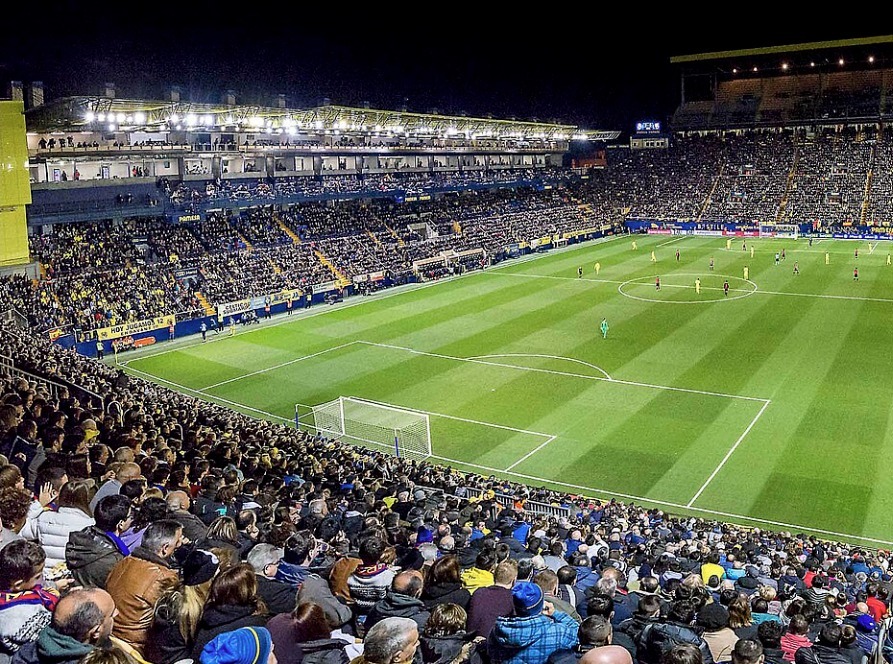
Photo: Villarreal vs FC Barcelona, December 2017, Wikimedia Commons (Frank94Rock, CC BY-SA 4.0)
How the Space Is Used, and F&B
The 2022 renovation gave the stadium a fully enclosed roof covering every stand, and seating was also spaced out further.
The club rebuilt its restaurants down to two, and one of them, “El Ceramista,” now operates as a full-time restaurant open to the public even on non-matchdays.
That points to a deliberate shift away from treating the stadium as a matchday-only facility, toward a space that earns revenue on weekdays too.
Solar panels have also gone up on the stadium roof.
The club has said the goal is energy self-sufficiency, and from a marketing standpoint, it’s also a case of baking a sustainability message directly into how the venue is run.
The VIP tier, branded “Casals Groc” boxes, comes to 30 boxes total, split into 20-, 16-, and 12-person configurations with air conditioning, private TVs, and catering, reached by a separate elevator through the south stand.
The same pattern — raising revenue per seat rather than growing total attendance — shows up consistently in both the F&B side and the VIP boxes.
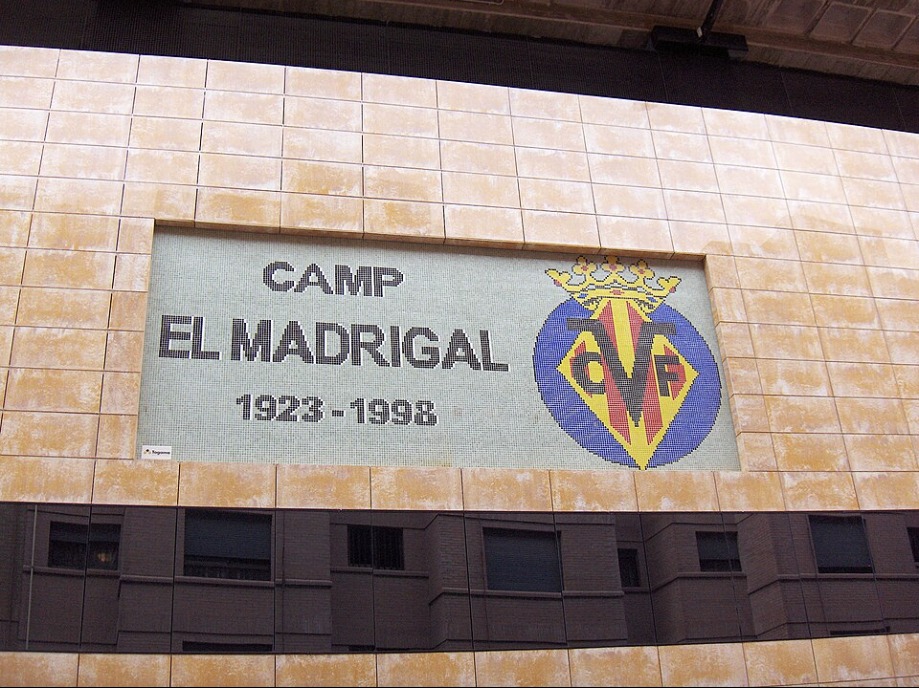
Photo: Ceramic tile facade and a plaque commemorating the stadium’s former name, Wikimedia Commons (Sking, CC BY-SA 3.0) · no watermark, license verified
Merchandise and Ad Inventory
Villarreal’s shirt sponsor is Pamesa Ceramica, the tile company where club owner Fernando Roig Alfonso holds a controlling stake.
With the owner’s own company as the main sponsor, this club’s commercial structure has never really been separable from Castellón’s tile industry.
Its kit supplier is the Spanish brand Joma, and sponsors also include Coca-Cola and CaixaBank, among others.
The club’s flagship store sits alongside its online store on the club’s website — a physical shop on Villarreal’s Plaza Mayor.
At around 150 square meters, it opens at least two hours before kickoff.
That’s modest next to the multi-thousand-square-meter megastores of Europe’s biggest clubs, but plenty visible within a small-town retail strip.
On the advertising side, the stadium itself is the biggest asset.
From the branded ceramic tile on the exterior to pitch-side boards, that same roster of over a dozen tile and ceramics firms splits up the exposure by sponsorship tier — main, official, or partner.
Instead of one company monopolizing the entire naming rights, several companies split the cost, which appears to lower the entry barrier for any single sponsor while spreading the club’s exposure if one of them ever walks away.

Photo: Villarreal’s 2025-26 Champions League squad, with the Pamesa Ceramica sponsor logo on the kit, Villarreal CF official store · official club promotional image
Broadcast Revenue and Local Economic Impact
Villarreal took home €57.8 million from La Liga’s 2024-25 broadcast revenue split.
That’s well short of the big three — Real Madrid (€157.92 million), FC Barcelona (€156.5 million), and Atletico Madrid (€108.2 million) — but it puts Villarreal near the top of the mid-tier when compared with similarly sized clubs like Girona (€55.6 million).
With Champions League qualification for 2025-26, next season’s payout should climb another notch.
Regularly hosting La Liga and European nights in a town of 50,000 carries real weight for the local economy.
Every home match brings in a crowd of over 20,000, a meaningful share of them away fans or tourists generating demand for hotel rooms and restaurants.
The town’s limited hotel options are almost proof of that pressure — international stadium-guide sites even advise picking lodging based on budget because the options are thin, suggesting the local tourism infrastructure hasn’t fully caught up with demand this size.
The club’s ongoing push into non-matchday content, like stadium tours and the “Immersion Villarreal” exhibition, looks like an attempt to stretch that local economic impact beyond matchdays alone.
What Makes This Stadium Unique
Villarreal’s nickname, “El Submarino Amarillo” (the Yellow Submarine), has nothing to do with the team colors in origin.
Back during the 1967-68 season, when the club was fighting for promotion out of the third division, a group of young fans at El Madrigal (as Estadio de la Ceramica was then known) brought a battery-powered record player into the stands, put on the Beatles’ “Yellow Submarine,” and started chanting “Amarillo es el Villarreal” — “yellow is Villarreal.”
The club actually won promotion that year, the whole town celebrated with the song blasting, and the nickname stuck from there.
A submarine nickname in a ceramics town looks odd on paper, but it was really just a coincidence — the team’s color happened to match a Beatles song title.
A Comparison With the KBO and K League
The most striking thing about Villarreal’s case is that it’s not one company but an entire regional industry carrying the naming weight for the club and its stadium.
The K League has a similar strand of thinking running through it.
Citizen-owned clubs without a large corporate parent — Incheon United, Gangwon FC, Gwangju FC, and others — run on local government, resident, and local-business backing, though that tends to take the form of equity stakes or public budget support rather than Villarreal’s model of multiple private companies splitting the naming fee by sponsorship tier.
Korea also has regional clubs tied to industrial clusters, like Ulsan HD (shipbuilding) and Pohang Steelers (steel), so a model where an entire regional industry group shares stadium naming rights as a kind of consortium seems worth a serious look here too.
Broadcast revenue distribution is another point worth comparing.
The K League has recently strengthened a model where the league office negotiates broadcast rights collectively and then distributes to clubs, and La Liga runs on a broadly similar structure — league-wide negotiation followed by differentiated payouts per club.
The difference is that La Liga’s formula weighs recent results and viewership heavily, stretching the gap between the big three and the lower-mid tier to nearly tenfold, while the K League’s gap is comparatively narrow.
Rather than one approach being better, it seems to reflect how a league’s maturity and market size shape its own distribution philosophy.
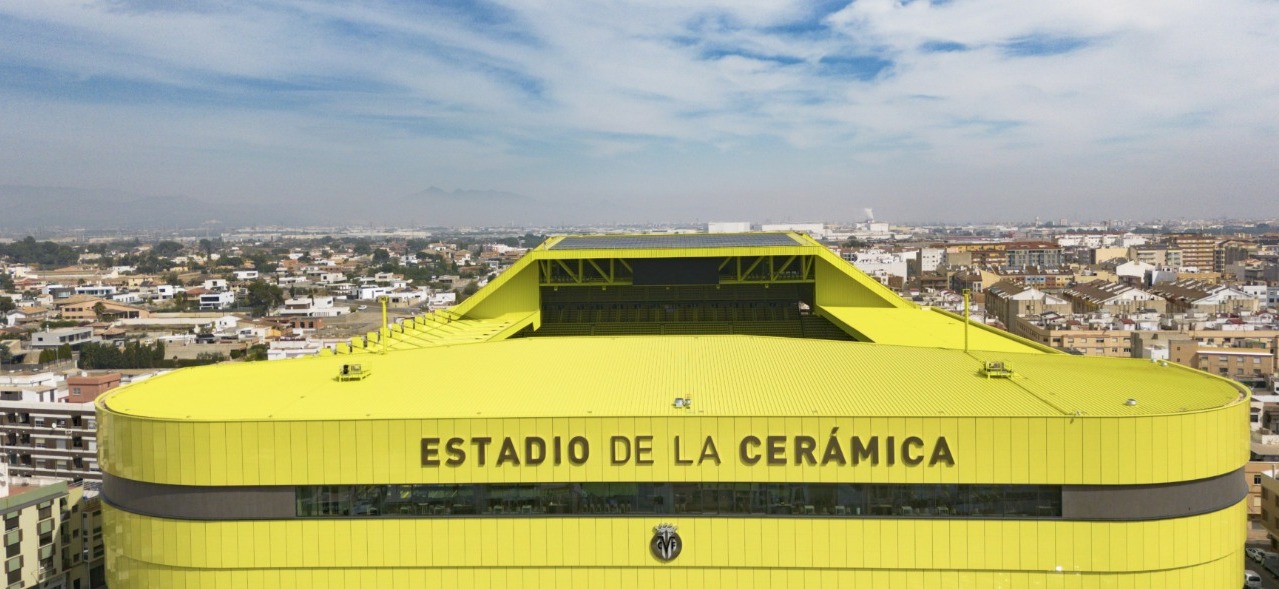
Photo: “ESTADIO DE LA CERAMICA” signage on the exterior with Villarreal’s skyline behind it, Villarreal CF official website · official club promotional image
Behind a town of 50,000 producing a third-place La Liga finish and a Champions League berth sits this intricate commercial structure.
Instead of splashy parent-company money, weaving together local industry and sponsorship this carefully looks like a genuine case study in running a club sustainably at a small scale.
Leave a Reply