Contents · About 15 min read
- The Wall Where Captain Tsubasa Declares Peace, and a Football Field on a 1950 Plan
- Meet Sanfrecce Hiroshima — A Name Built on Three Arrows and the 2025 League Cup
- How to Get to Edion Peace Wing and Buy Tickets — Based on the Club’s Official Guidance
- Attendance and Tickets — Harder to Get Because the Stadium Is Small
- Space Use and F&B — 550,000 Visitors Who Came for Something Other Than Football
- Merchandise and Advertising Inventory — Edion and ¥1 Billion Over 10 Years
- Club Finances and Local Economic Impact — A Club That “Runs” the Stadium
- Compared with the KBO and K League
📱 View as card news
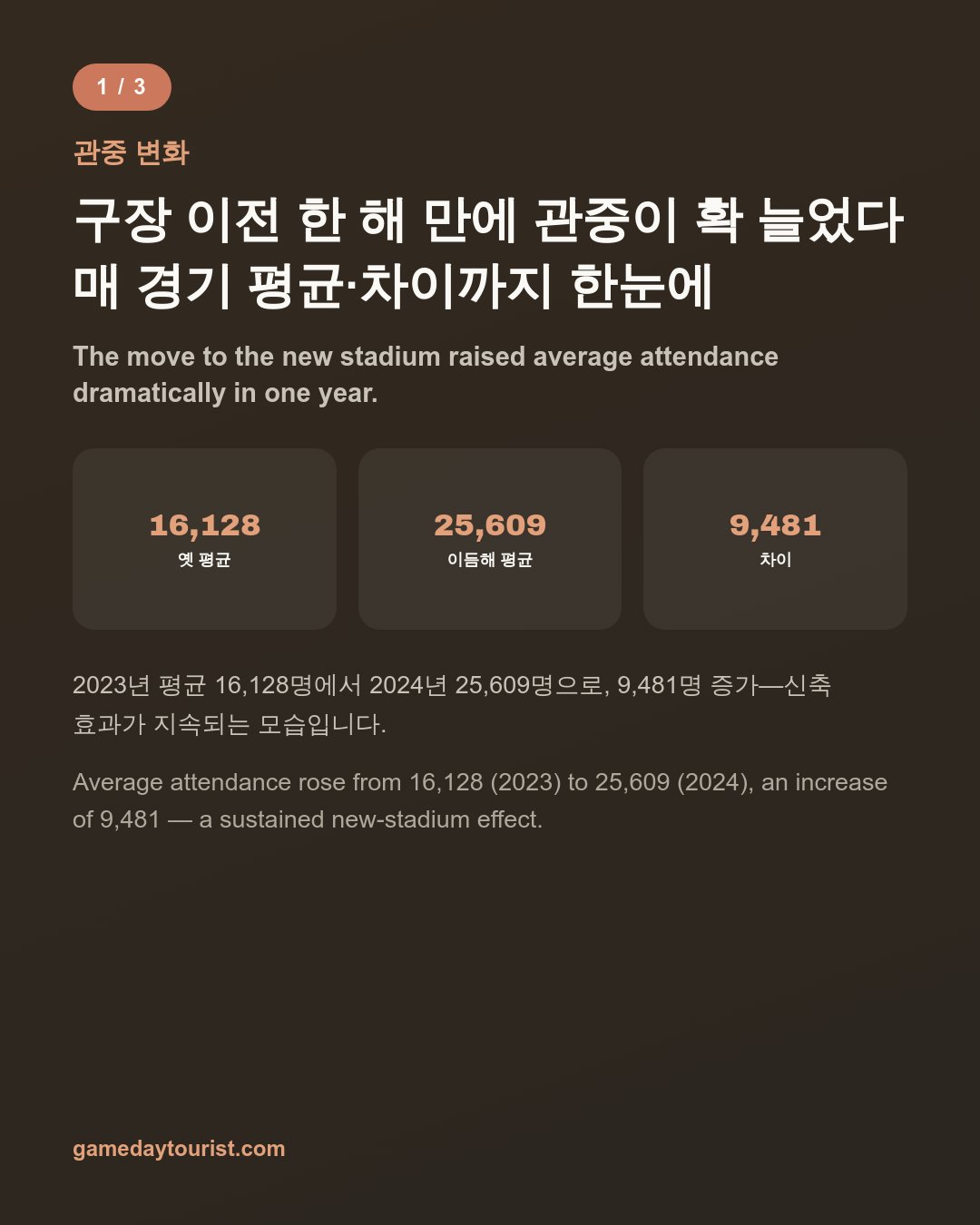
In 2023 the team averaged 16,128 fans a game. The year after it moved to a new stadium, the average was 25,609, a gap of 9,481.
The old-stadium figure comes from a Toyo Keizai report and the 2024 average from the J.League season review.
It is hard to call that a new-stadium bump when the numbers have held up this long. The 2025 league average was 25,585, and in the regional round of the 2026 Hyakunen Kosou League it was 26,390 with 92.9% occupancy (Football Channel).
My J.League turn in the rotation came up, so this time I picked the home of Sanfrecce Hiroshima, Edion Peace Wing Hiroshima.
The team is near the top right now, too. On the official J.League standings (updated October 11), Sanfrecce are second with 20 points after nine matches.
I have never been to this stadium, though. What follows is my reading of public material from the club, the city and the J.League, set against fan reviews from people who have been.
As a marketer, what interests me about this stadium is less the attendance itself than the way one stadium of a little over 28,000 seats has changed the club’s revenue structure and the flow of the city along with it.
This post covers how to get to Edion Peace Wing, how to buy tickets in what order and at what price, sights like the mural, and how the club makes money from the stadium. The access and ticket information was checked against the club’s official pages.
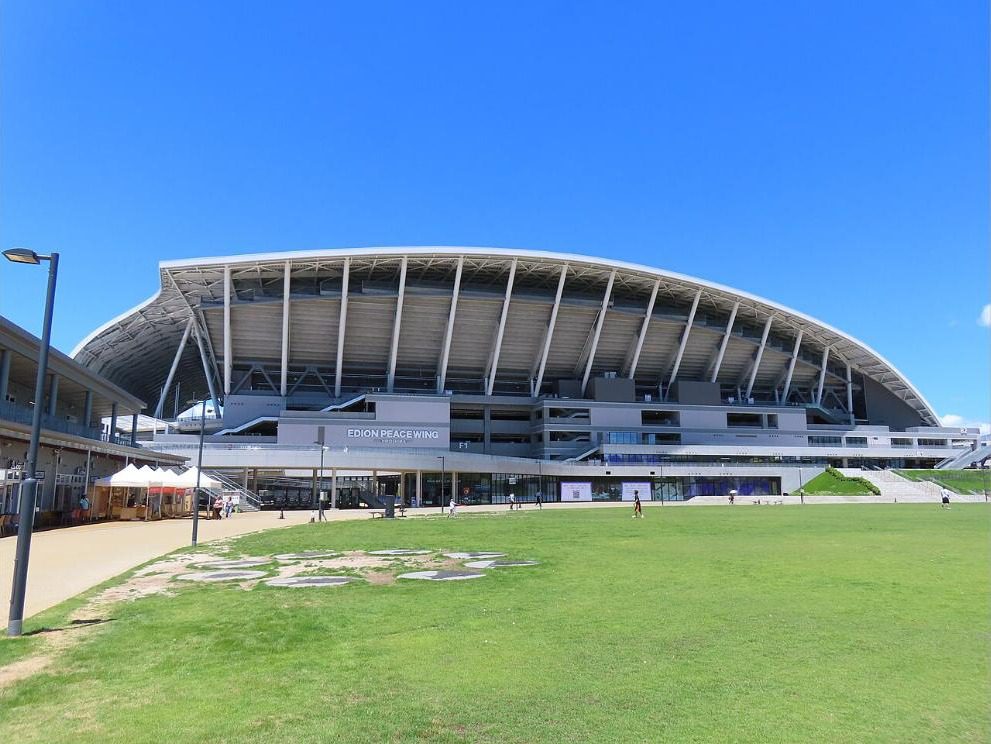
Photo: Bsx · Source: Wikimedia Commons · License: CC0 1.0 · Taken July 21, 2025. Edion Peace Wing Hiroshima seen from the lawn in Chuo Park
The Wall Where Captain Tsubasa Declares Peace, and a Football Field on a 1950 Plan
Even the name has a story. Peace Wing joins “peace” and “wing,” and the roof design takes its motif from the “wings of hope” that symbolize the peace city of Hiroshima (Japanese Wikipedia).
A Japanese media article also explains that seen from Aioi Bridge, the stadium looks like a bird with its wings spread, which reads as “wings of peace.”
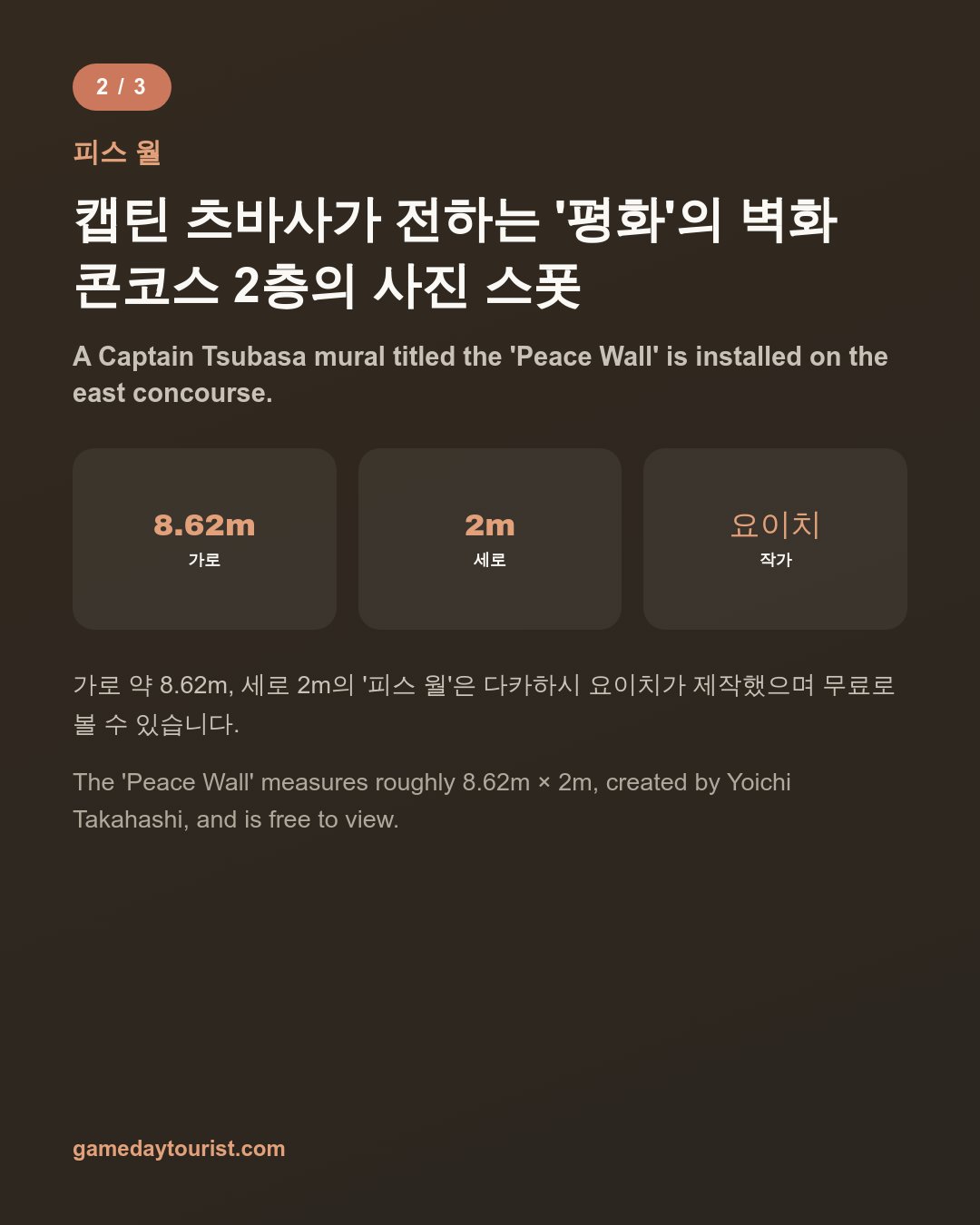
On the east side of the second-floor concourse hangs a mural called the Peace Wall, about 8.62 m wide and 2 m high. Yoichi Takahashi, the creator of Captain Tsubasa, produced it, and the subject is the “football world peace declaration” speech Tsubasa Ozora gives after winning a world youth tournament as captain of Japan’s U-20 team.
The plan was announced at a press conference on November 16, 2023, and the JAL travel magazine says that since the opening you can see it and take photos for free. Its size was given as about 10 m at the announcement and later as 8.62 m by 2 m in a review outlet.
At the time, Shingo Senda, the club’s president, said the club wanted to convey that the power of sport, football in particular, had been part of Hiroshima’s recovery.
I have not included a photo of the mural because of copyright, and point instead to the FUN! JAPAN article. The copyright notice there reads ⒸYoichi Takahashi/SHUEISHA.
The site has an older story too. According to material published by the City of Hiroshima, a drawing of the “Peace Park Project” by the Kenzo Tange group, estimated to date from May 25, 1950, places a “Football Field” south of Hiroshima Castle.
On that drawing, the stadium sits on the axis running north from the Atomic Bomb Cenotaph. It means that a football ground was already part of the postwar reconstruction thinking for this area.
More than 70 years later an actual stadium opened in the same Chuo Park area, and the Atomic Bomb Dome is a little over a 10-minute walk away (Number field report).
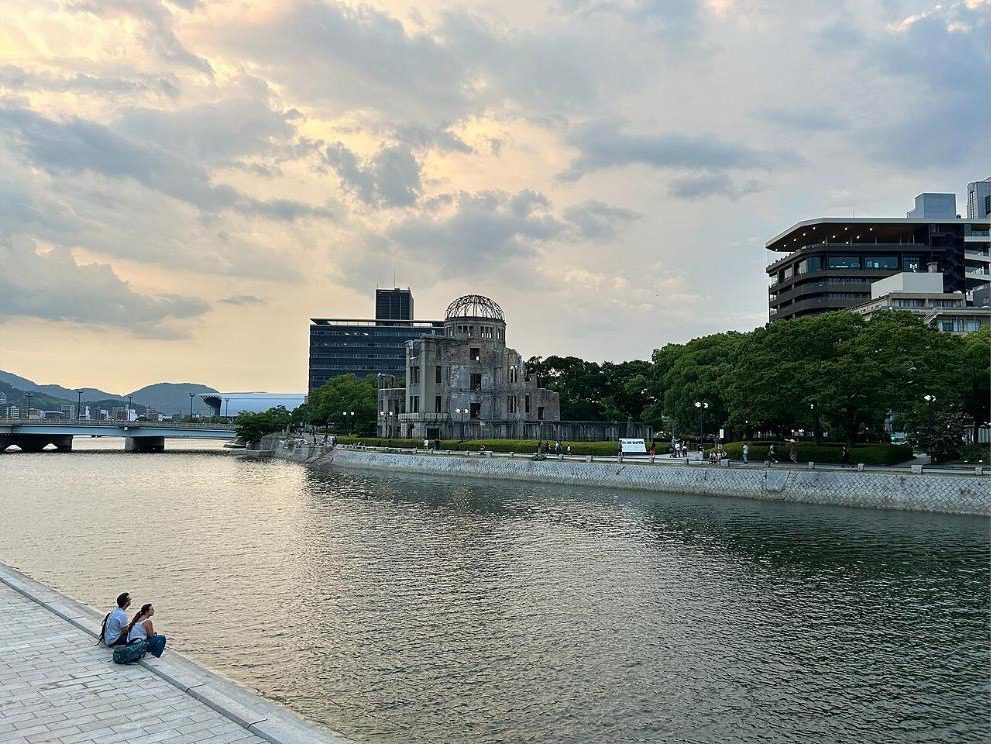
Photo: Kanesue · Source: Wikimedia Commons · License: CC BY 2.0 · Taken August 15, 2024. The Atomic Bomb Dome seen from across the Motoyasu River
Excavation during construction turned up stone paving and part of an asphalt surface from the former Army Chugoku Military District transport corps replenishment unit. It is said to have been the flooring where military horses drank water and were groomed.
The city says it has had an outdoor display near the horse monument in Chuo Park since November 21, 2024. To a marketer, a single sports facility layered with this much of the city’s modern history looked like content.
It gives people a reason to walk this area even on days without a match.
Meet Sanfrecce Hiroshima — A Name Built on Three Arrows and the 2025 League Cup
The club’s roots go back to the Toyo Kogyo (later Mazda) football club of 1938. It took its current name in 1992 as one of the ten original J.League clubs.
Sanfrecce combines the Japanese word for three (san) and the Italian word for arrows (frecce), from the story of the warlord Mori Motonari telling his three sons that three arrows bound together are hard to break (English Wikipedia).
The club won the J1 title in 2012, 2013 and 2015 and the League Cup in 2022 and 2025 (J.League club profile). In the 2025 final it beat Kashiwa Reysol 3-1 (TV Tokyo).
In 2025 the club finished fourth in the league with 68 points. It was level on points with third-placed Kyoto but behind on goal difference (Daily Sports standings).
The head coach is Bartosz Gaul, announced on December 15, 2025: aged 38, with German and Polish nationality, and previously an assistant coach at RB Leipzig (official J.League article).
Korean fans may also want to watch defender Kim Ju-sung. His permanent transfer from FC Seoul was announced on July 31, 2025, and the Korean edition of Soccerway lists him as a Hiroshima defender.
The walk from the tram stop in front of the Atomic Bomb Dome is described as about 10 minutes (official J.League guide). One thing to know in advance is tickets.
An overseas fan blogger wrote in a review that the club runs its own ticketing system, unlike other J1 clubs, that signing up was not easy, and that by the time general sale opened the tickets were already gone.
How to Get to Edion Peace Wing and Buy Tickets — Based on the Club’s Official Guidance
Everything below is based on the club’s official website and was checked on October 14, 2026. First, access.
The club’s official access page says it is about a 30-minute walk from JR Hiroshima Station, using the east pedestrian deck. That is a long way to walk from the station.
About 10 minutes on foot is given for the Hiroden (streetcar) Kamiyacho-nishi and Genbaku Dome-mae stops, Astram Line Kenchomae Station and the Hiroshima Bus Center. Shin-Hakushima Station is about 15 minutes on both JR and the Astram Line, and JR Yokogawa Station about 20.
From Hiroshima Airport, the limousine bus to the Hiroshima Bus Center takes about 55 minutes and costs ¥1,500 for adults.
Driving is hard to recommend. On match days the club does not provide customer parking and recommends nearby car parks or public transport.
The City of Hiroshima also asked people in a city PR article to use public transport because roads around large events such as J.League matches are congested. For bicycles, a free lot for about 1,100 bikes is listed south of Josei Street, on the municipal pool side.
Tickets are sold only on the club’s official ticket site, SANFRE TICKET. The club has a separate English guide page, and its FAQ says convenience stores, the official store and phone orders are not sales channels.
You do not need to be a club member or log in to buy, and paid members get early access during the advance sale. The limit is four tickets per payment.
QR e-tickets are credit card only, carry a ¥110 system fee per ticket, and arrive as a QR code at the email you register. If you choose a paper ticket, you reserve online and then pay and collect it at a Seven-Eleven in Japan.
Credit card payment requires 3D Secure authentication. I could not find on the official pages whether cards issued overseas work, so it is safer to ask first at the contact address (ticketquestion@sanfrecce.co.jp).
Prices vary by match under a flexible pricing system. Based on the lowest advance-sale prices in the price list on the club’s English page, adult tickets are ¥2,700 for Upper Back Stand Category 9 (¥3,200 on the day), ¥3,000 for the non-reserved standing Supporter Seat (¥3,500 on the day) and ¥12,000 for the Lower Main Stand Prime Seat (¥12,500 on the day).
A front-row seat adds ¥1,000 and an aisle seat ¥500, but the guidance does not say which seats those apply to. Prices and purchase limits are announced match by match.
There are rules a first-time foreign visitor should know. The visitor section (standing) is separate, at ¥3,300 in advance (¥3,800 on the day).
The club’s English guidance says everywhere outside the visitor section is for home fans only, and that anyone openly supporting the visitors or showing their colors or merchandise risks ejection. The Japanese FAQ words this differently, allowing visitor shirts and goods in most seats while banning cheering for them, so it is safest not to show opposing colors outside the visitor section.
Tickets bought outside the official channels are invalid, and after payment cancellations, refunds and changes are not possible. If a match sells out in advance there are no same-day tickets, and if any are left they are sold at the stadium window on match day with a ¥110 counter fee per ticket.
A preschooler can attend without a ticket by sitting on an adult’s lap.
Looking at this purchase flow as a marketer, the highest hurdle for foreigners reads as less the price than the Japanese-centered site, the card authentication and the speed of the sellouts. A separate English page looks like a sign that the club wants to widen its points of contact with visitors.
However, in what I checked the English page did not cover guidance for overseas cards. That connects with the blogger’s remark that signing up was not easy.
Attendance and Tickets — Harder to Get Because the Stadium Is Small
By the club’s records, total attendance for 19 J.League home matches in 2024 was 486,579, or 25,609 a match, the most in club history. The previous record was 378,195 in 1994, and 18 of the 19 matches sold out (Sanfrecce media forum).
In 2025 the league total was 486,116 and the average 25,585, almost the same level, and every seat type sold out (the club’s 2025 season review). Home attendance across all official competitions was 602,944, a new club record.
In the regional round of the 2026 Hyakunen Kosou League the lowest home crowd was 25,547 (about 90% occupancy), and Hiroshima was the only one among the top 10 clubs by attendance above 90% occupancy.
Sources put the stadium’s capacity at roughly 28,400 to 28,500 seats. A blogger wrote that the old home ground held nearly 37,000, and I could not confirm whether the club deliberately built this one smaller.
I read the result as a stadium where sellouts are routine. When tickets are always short, season-ticket sign-ups can keep coming, and club membership was about 94,000 at the end of November 2025, up about 22,000 in a year.
The barrier to entry rises with it, though. The blogger mentioned earlier wrote that the stadium could have been a little bigger to leave room for growth.
Whether selling out before general sale opens protects the fan base or raises the threshold for new spectators looks like a question the club still has to answer.
The atmosphere comes up often in reviews. The same blogger wrote that nearly 12,000 came to a women’s team match on a sunny Golden Week day, that a cheer leader with a megaphone led the crowd well and that big flags were waved.
In fact, the club’s women’s team, Sanfrecce Hiroshima Regina, drew 20,156 to an event at this stadium in March 2025, nearly double the 10,000 target. When men’s tickets run short, women’s matches and events act as a new way in.
Space Use and F&B — 550,000 Visitors Who Came for Something Other Than Football
On facilities, every seat is covered by the roof and the closest point from the stands to the pitch is about 8 m. The seat types are described as the most in the J.League, though the count differs by source: 42 (official J.League guide) or 43 (Stadium Park official site).
Kids’ rooms and play spaces and a hospitality lounge are also described.
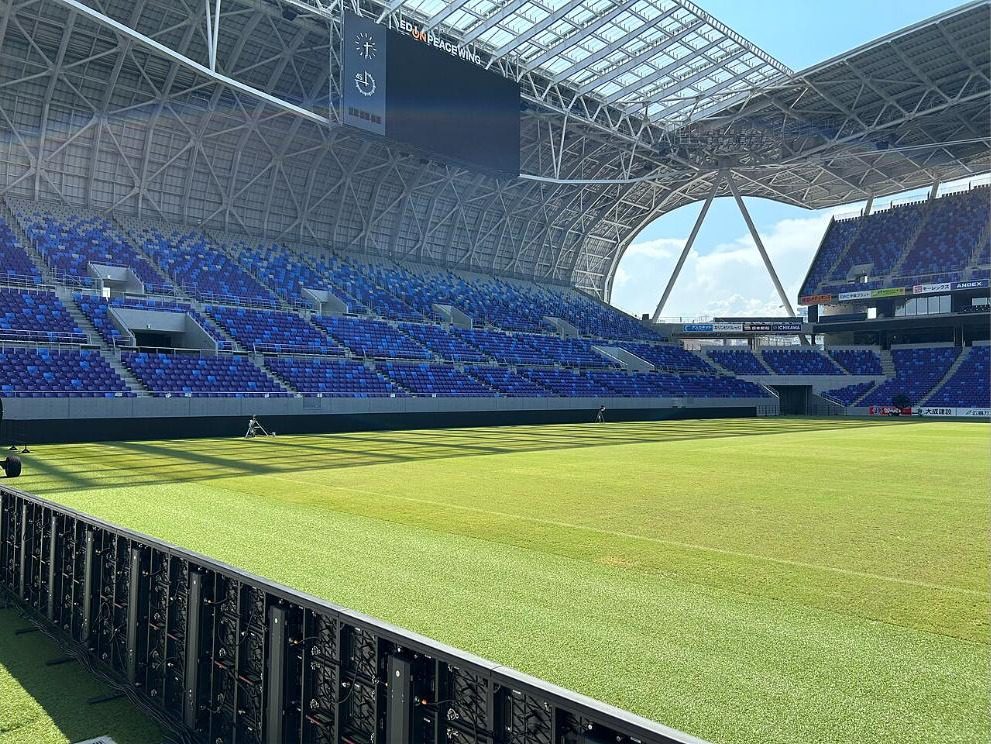
Photo: Kanesue · Source: Wikimedia Commons · License: CC BY 2.0 · Taken August 15, 2024. Inside the stadium seen from beside the pitch, with the stands close to the field
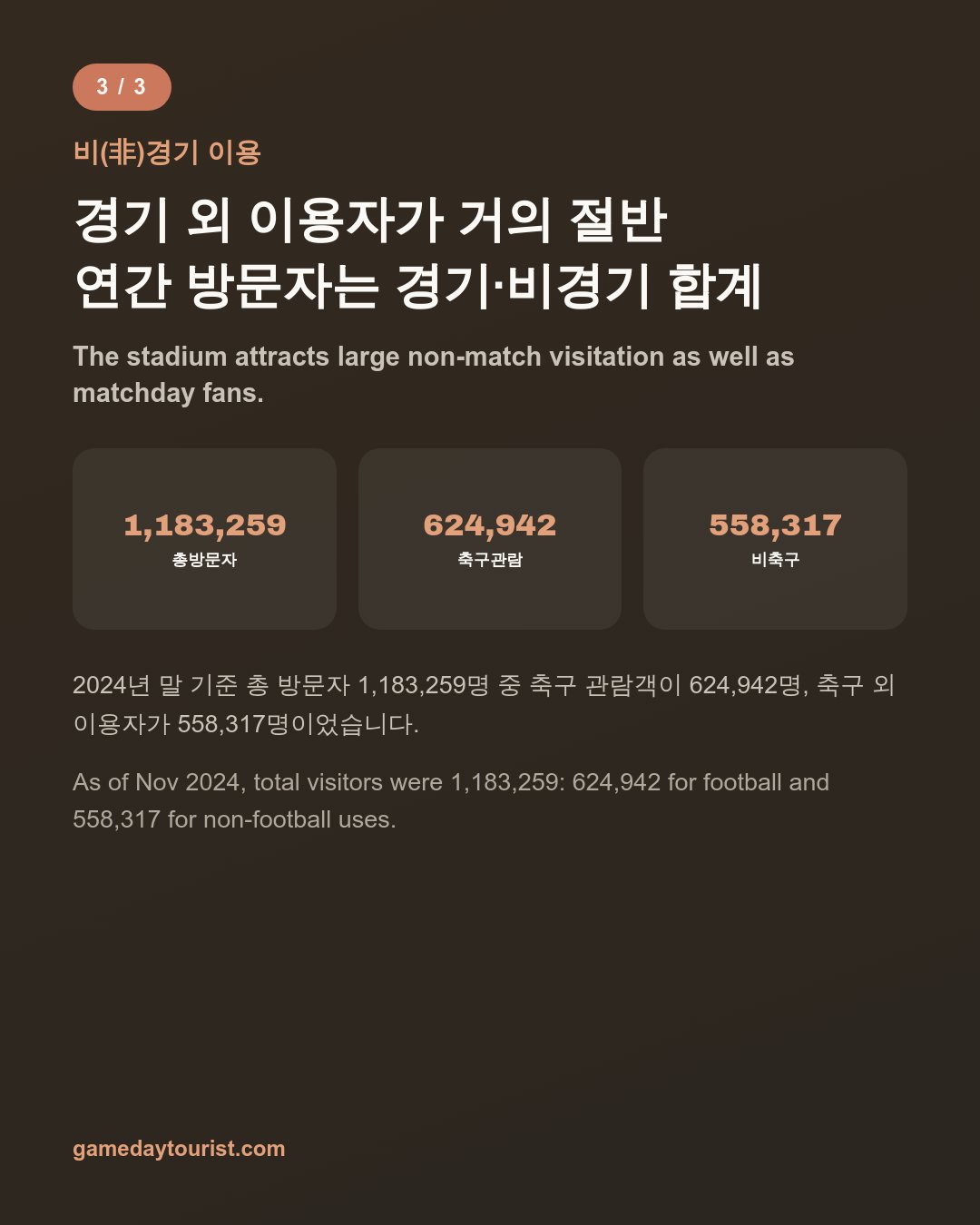
What deserves a closer look in the visitor numbers is use that is not about matches. By the club’s count, total visitors to the stadium through the end of November 2024 were 1,183,259, of which 624,942 were football spectators and 558,317 were there for something other than football (figures from the media forum material above).
The club says non-match use grew further in 2025 with corporate entrance and job-offer ceremonies, a relay marathon and a Christmas show on the concourse, and the community program STAHUG. The football museum inside had about 18,000 visitors as of November 10, 2024, according to the J.League season review.
On food, a JAL article says about 100 items from 8 countries and 1 region are on offer, including collaboration menus developed with players.
The numbers still show homework, though. According to the club’s 2025 season review, stadium food sales for 2025 are forecast at about ¥310 million, shown as about ¥70 million lower than the year before, and the club plans to rework the menu.
However, the club’s 2024 announcement put food sales at about ¥440 million, so I could not confirm whether the two figures use the same basis. It reads as a case showing that full houses do not automatically mean growth in F&B sales, but I will not state the size of the decline.
Merchandise and Advertising Inventory — Edion and ¥1 Billion Over 10 Years
By club figures, official merchandise sales were ¥940 million in 2024, and the 2025 forecast, excluding uniforms, is about ¥1.16 billion, up about ¥200 million on the previous period (two club sources above). I could not confirm whether the two figures cover the same range.
The stadium’s name carries the electronics retailer Edion. Edion signed a naming-rights deal with the city, and a report in August 2023 gave the term as 10 years through 2034 and the amount as ¥1 billion in total.
Japanese Wikipedia gives 10 years from February 1, 2024 at ¥100 million a year (consumption tax included). Naming rights are a contract that sells the right to attach a company’s name to a facility.
What is interesting is that the company has also been on the name of the old home ground since 2013. It is a structure where the club’s main sponsor carries on into the stadium name.
The official name under the city ordinance is Hiroshima Soccer Stadium.
Club Finances and Local Economic Impact — A Club That “Runs” the Stadium
Walkerplus reported that the club is the stadium’s designated manager and that designated management was due to start on December 28, 2023. That changed the revenue structure considerably.
Club revenue for 2024 was a record of about ¥7.8 billion (forecast), 1.86 times the previous year’s ¥4.2 billion. Results for fiscal 2025 were reported as a record ¥8.347 billion, and the report cited the second year of running Edion Peace Wing as the reason.
Net profit was ¥413 million, a second straight year in the black. The forecast the club gave in its December 2025 season review was about ¥8.15 billion.
The local impact has to be read starting from a figure the club itself estimated. With the cooperation of Hiroshima University of Economics, the club estimated the economic effect of a single match, the December 1, 2024 game against Sapporo, at about ¥1.1 billion.
It should be read keeping in mind that this number has not been independently verified. I could not confirm the breakdown between inside the stadium and the surrounding area.
Even so, the direction is clear. Because the stadium is downtown, the logic goes, spending before and after a match does not end inside the stadium but spreads into the surrounding shops.
The cost of building the stadium, including surrounding facilities, was about ¥28.5 billion, with over ¥7 billion in donations, about ¥8 billion from the national government and about ¥10 billion from the prefecture and city combined, according to a report (the source of the remaining ¥3.5 billion or so is not given).
The design-and-build contract between the city and a joint venture led by Taisei was ¥25.696 billion as of June 2021 (Japanese Wikipedia).
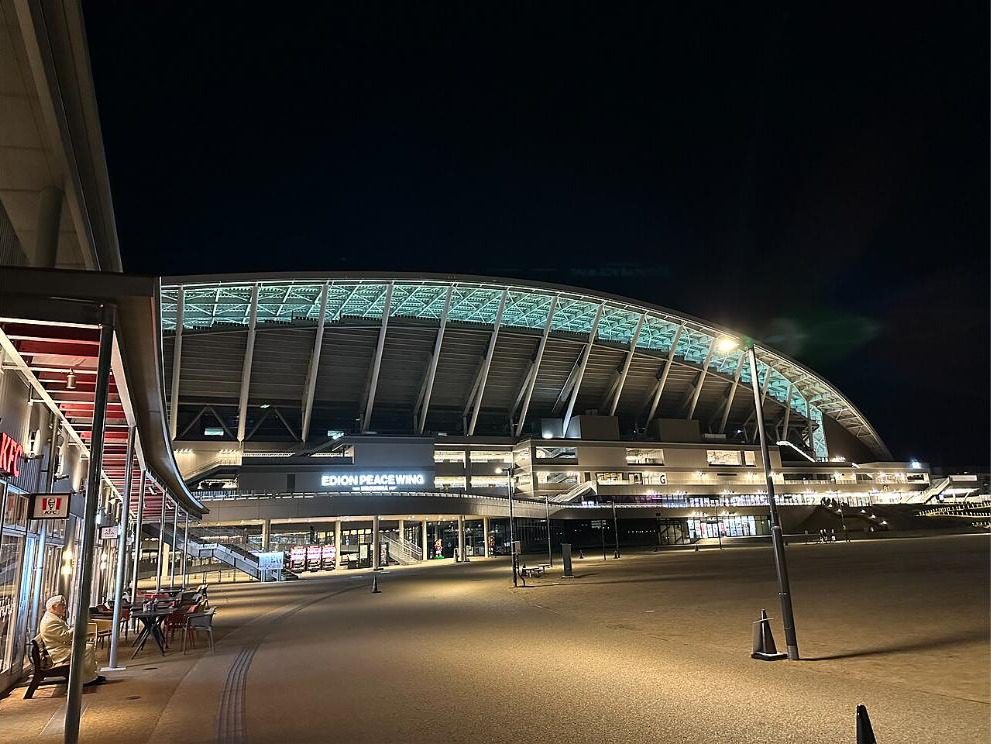
Photo: ノボホショコロトソ · Source: Wikimedia Commons · License: CC BY 4.0 · Taken March 14, 2026. The stadium exterior lit up at night
Compared with the KBO and K League
The first thing to weigh against Korea is the ownership and operating structure. Edion Peace Wing is a city-owned facility, and the club operates it as designated manager, so its operating results show up in the club’s own performance.
How much of the construction cost fell to the club does not appear in the reports I checked. What is clear is that the club, as operator, is responsible both for filling the house on match days and for filling the days without a match.
In Korea, at the committee settlement review of the Jeonnam-Gwangju Integrated Special City Council this September, it was pointed out that the Gwangju football-only stadium, which cost ₩16.4 billion, cannot host official matches after stadium regulations changed and is used only for training, reported on September 10.
Why the regulations changed and who is responsible is beyond what I checked, so I will not state it. But one is a stadium that tallies for itself more than 550,000 non-match users in its first year, and the other is a stadium that has to think about what it is even for.
It makes me think about how important the step is, before building, of calculating which matches and events will fill it, how many times, and who will fill them.
To sum up, the heart of this stadium was not the big roof but a structure that gives people reasons to come and go all year round. The person who came to photograph a mural, the office worker at an entrance ceremony, the runner in the relay marathon and the fan turned away without a ticket are all customers the club meets.
If domestic clubs have anything to learn from a single stadium, I think it is less the sellout figures than how the club linked those customers together.
Leave a Reply