Contents · About 16 min read
- 0-5, 0-4 — nine goals conceded in a week, Shimizu now
- Chibi Maruko-chan came in person to the 2026 home opener
- What kind of team are Shimizu S-Pulse
- How to get to IAI Stadium Nihondaira and how to get tickets — based on official club and stadium information
- Crowds and finances: an average of 15,392 over eight games, revenue in the 5 billion yen range
- Selling a day outside the stadium — S-Pulse Dream Plaza
- The new stadium: the city buys the land first and the club talks about 2033
- Compared with the K League
📱 View as card news
J.League’s Shimizu S-Pulse lost 5-0 to FC Machida Zelvia at home at IAI Stadium Nihondaira on October 21 and then 4-0 away at Sanfrecce Hiroshima three days later (per the official J.League records of the Machida game and the Hiroshima game). After 12 matches they have 14 points (4 wins, 2 draws, 6 losses) and sit 13th of 20 teams (per the official J.League table updated October 25).
This article covers two things. One is how you actually get to this stadium, which is nearly 20 minutes from JR Shimizu Station even by taxi, and where and for how much you buy tickets.
The other is why the club is preparing a new stadium for around 2033 and the issues in that, from a marketer’s point of view. I have not been to this stadium, so please note that this is a benchmarking analysis built on official club and city materials, press reports and local fan reviews.
The access and ticket information in this article is what I checked by opening the club’s official site myself on October 27, 2026.
0-5, 0-4 — nine goals conceded in a week, Shimizu now
The October 21 round-11 match was a Wednesday night kickoff at 7 p.m. with a crowd of 10,750. In the match between 10th-placed Shimizu and 2nd-placed Machida, Machida scored five, with Nishimura, who started at short notice after a teammate dropped out during the warm-up, scoring a hat-trick.
Shimizu were down to 10 men when Matsuzaki was sent off for a second yellow card in the 63rd minute, and the J.League’s official match report said it was the most goals conceded since Takayuki Yoshida became head coach. It was Machida’s first win in their fourth official match at this stadium.
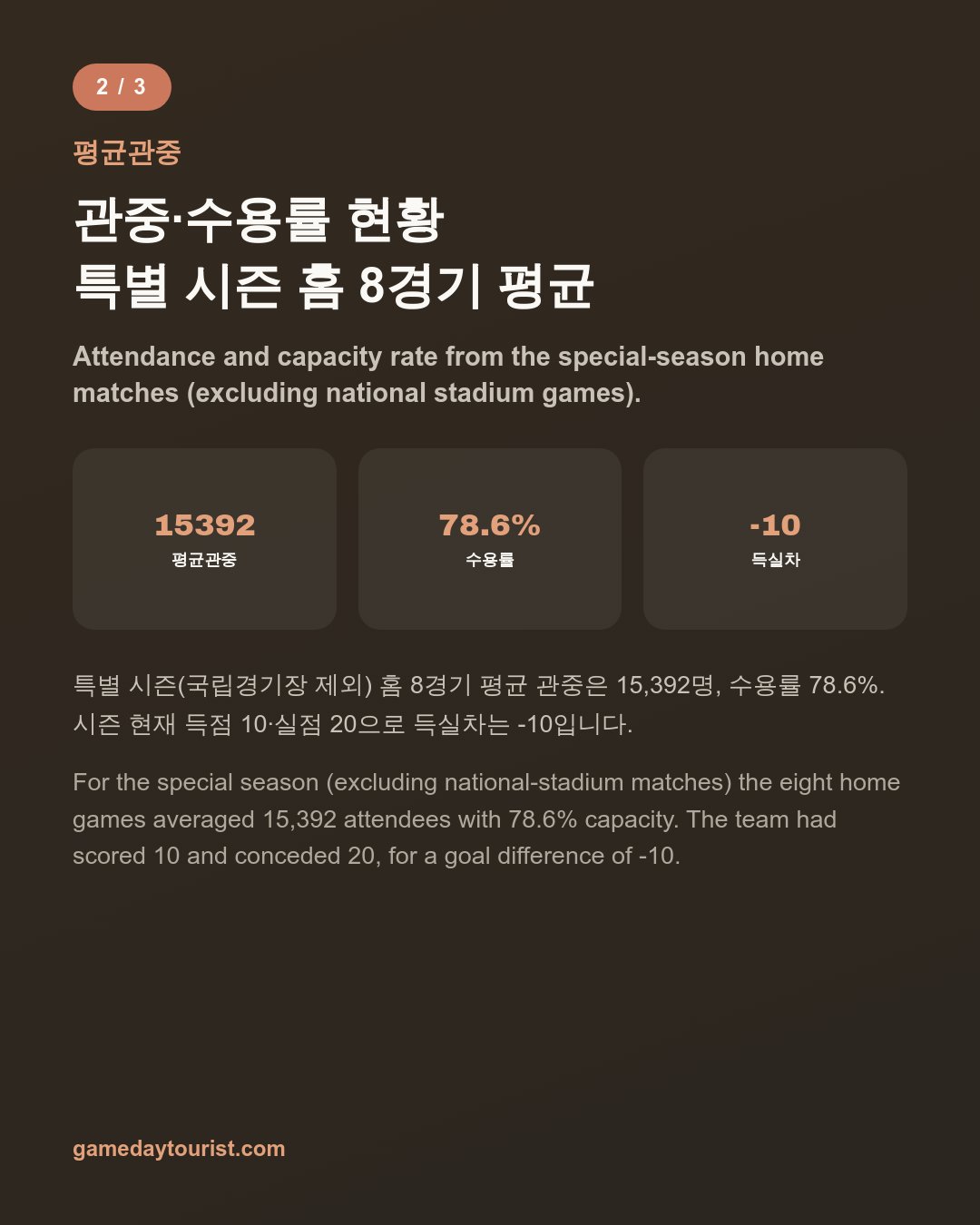
The October 24 round-12 away game at Edion Peace Wing Hiroshima ended 4-0 (attendance 26,014). That leaves Shimizu at 4 wins, 2 draws and 6 losses from 12 games, with 10 goals for, 20 against and a goal difference of -10.
At the top of the table now are Machida and FC Tokyo on 27 points, and just below Shimizu in 14th is Nagasaki on 12 points. The next game is away at Kyoto on Saturday, October 31, at 2 p.m.
The home tickets on sale on the club’s official site are for Tokyo Verdy on Saturday, November 7, with a 1 p.m. kickoff (round 14) and Urawa on Saturday, November 28, at 2 p.m. (round 17) (the club’s official site, the notice that sales for the November 28 Urawa match opened). Tokyo Verdy are 18th with 8 points.
For the November 25 away game at Okayama, a public viewing event for the club’s paying members has been announced (club notice).
Chibi Maruko-chan came in person to the 2026 home opener
At 2 p.m. on Saturday, February 14, 2026, Maruko, the heroine of the manga “Chibi Maruko-chan”, came to the stadium for the home opener against Kyoto Sanga. In a tie-up the club announced on February 4, Maruko was to greet fans up close and join the mascot Pal-chan’s family in a show performing “Odoru Ponpokorin” (Football Channel report).
It is a project that works because the setting of Chibi Maruko-chan is this club’s hometown, Shimizu. That match was the home opener of the special tournament, the “Hyakunen Koso League”, that came before the regular season (2026/27) that began in August.
The details of the collaboration stand out too. According to the club’s collaboration guide, panels of Maruko in kits from each era were displayed at every home game, and the collaboration illustration that copies Pal-chan’s pose was to be shown from mid-February to early August in the first-floor window of the “Romankan” building in front of the shuttle bus stop (a hobby outlet’s summary).
The collaboration goods cost 1,200 yen (tax included). As a working marketer, I read it as a design that borrowed one piece of IP and turned the entire “way into the stadium” into content, giving people more reason to stay than the price of a ticket.
What kind of team are Shimizu S-Pulse
Shimizu was founded in 1991 as “Shimizu FC” and is one of the original ten clubs that have been in the J.League since its start. They won the League Cup in 1996 and the Emperor’s Cup in 2001 (Wikipedia summary).
The same source says they were relegated to the second tier for the first time on October 17, 2015 after 23 seasons in the top flight, and confirmed promotion on the final matchweek of the 2016 J2 season. They dropped back to J2 in 2022 and returned to the top flight by winning J2 in 2024.
In this year’s special tournament, the “Hyakunen Koso League”, Shimizu under Takayuki Yoshida finished the regional league round 7th in the West group (out of 10 teams), then lost the 13th-14th place playoff to Yokohama F. Marinos 1-1 and 0-3 and ended 14th overall (Football Channel’s season preview).
Among Korean players there is the defender Park Seung-wook, who moved permanently from Pohang last December (Star News report). The club introduced Park as a multi-defender who can play both centrally and on the flank.
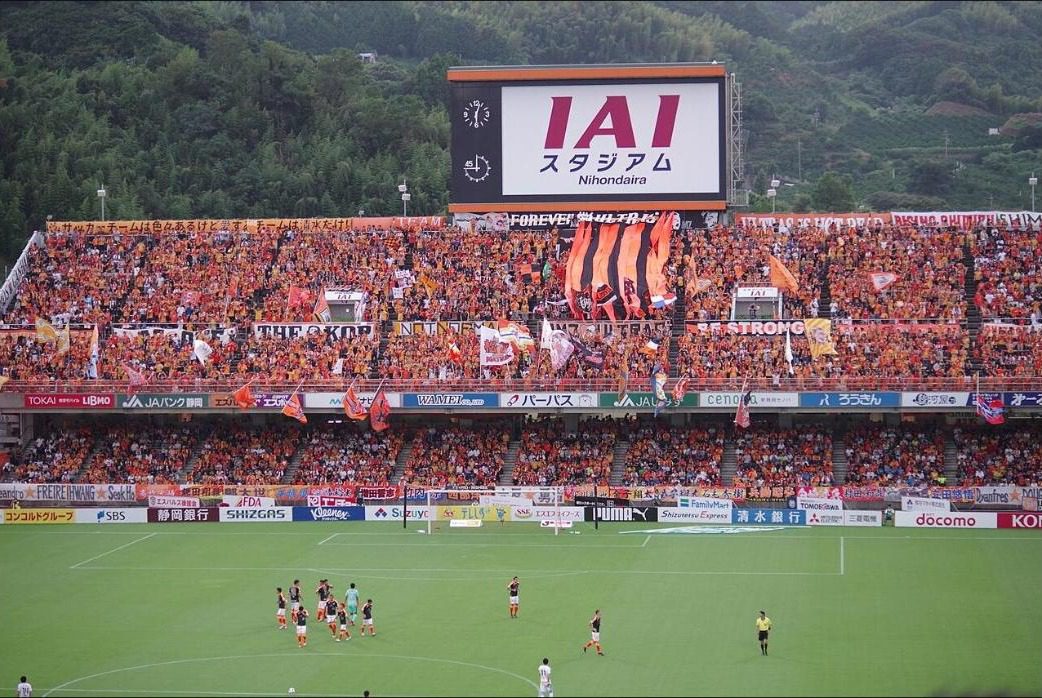
The Shimizu supporters’ stand at IAI Stadium Nihondaira, August 11, 2018 · Photo: Waka77 · Source: Wikimedia Commons · License: public domain · The photo is eight years old, so ad boards and so on may differ now
How to get to IAI Stadium Nihondaira and how to get tickets — based on official club and stadium information
The following is what I checked by opening, as of October 27, the club’s official site: the stadium access and viewing guide for the November 7 Tokyo Verdy game (posted October 16), the seat and price page and the FAQ. It can change from match to match, so please check again before you go.
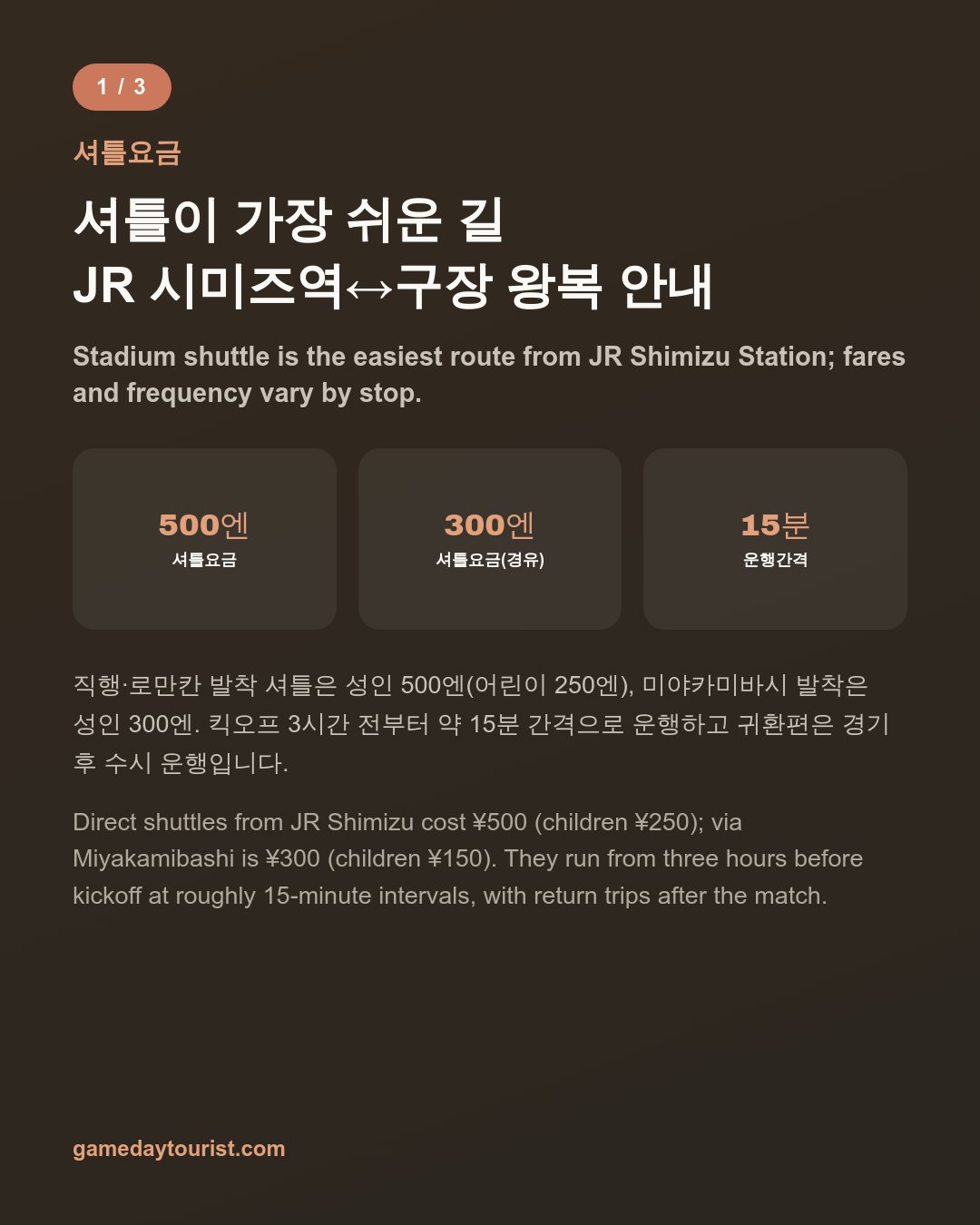
The easiest way is the shuttle bus. The club’s guide lists a direct shuttle from the east exit of JR Shimizu Station to the stadium, and a route via the harbor side in front of Romankan and Miyakamibashi.
Fares are 500 yen for adults and 250 yen for children on the direct route and from Romankan, and 300 yen for adults and 150 yen for children from Miyakamibashi. It says there is no shuttle from Shizuoka Railway’s Shin-Shimizu Station.
Buses run about every 15 minutes from three hours before kickoff to kickoff, and return buses run as needed after the match. For the November 7 match, gates open at 10:30 a.m. with a 1 p.m. kickoff.
The regular route bus runs from platform 2 at the west exit of JR Shimizu Station to “Nihondaira Undo Koen Iriguchi” for 410 yen for adults (210 yen for children), and from the south exit of JR Kusanagi Station for 400 yen for adults (200 yen for children).
Taxis can enter as far as the bus rotary inside the stadium, and for the return trip you are told to board in front of “JA Shimizu,” about an eight-minute walk from the stadium. The club’s reference fares for a compact taxi are about 2,040 yen for 5.9 km (about 20 minutes) from the west exit of JR Shimizu Station, 1,950 yen for 5.1 km (about 18 minutes) from Shin-Shimizu Station, 1,590 yen for 4.3 km (about 10 minutes) from Dream Plaza and 4,500 yen for 15 km (about 35 minutes) from JR Shizuoka Station.
By car, the stadium lot costs 2,500 yen and the nearby Sakura Park lot 2,000 yen, and both are bought in advance on the club’s ticket app, “Palchike.” Off-site lots listed are the Hitachi gymnasium, the Minami-Shinkai lumber yard and the Nitto Fuji Flour site at 1,000 yen each, and the Shimizu port area at 500 yen.
Use hours run from four hours before kickoff to two hours after the match. Dream Plaza’s P1 lot is listed as a park-and-ride base with a daily cap of 1,200 yen on home match days, and bicycles can be left free at JA Shimizu and Tennozan Park.
A foreign football blogger’s record from 2021 includes missing the shuttle and walking about 50 minutes from Shimizu Station to the stadium (the 2021 post), and in a 2023 post the same blogger named it a favorite stadium in Japan but also wrote of how much trouble it is to get there.
What catches my eye as a marketer is that this inconvenience has hardened into a line of club revenue. An adult round trip on the shuttle costs 1,000 yen extra.
Against the cheapest adult seat, the second-floor 3,300 yen, the cost of a match rises by nearly 30%. Accessibility becomes the price per head, and you can see in that why the new-stadium discussion keeps gathering around “in front of the station.”
Tickets are sold on the Shimizu-only corner of the J.League’s official ticket site, “Palchike.” The club FAQ says you need a smartphone or PC to buy, and that there is no sale at the store or convenience stores and no same-day sale at the stadium.
Same-day tickets are also sold on Palchike until one hour after kickoff. There are QR tickets and paper tickets (paper tickets must be issued before you arrive, and for QR the guide advises taking a screenshot in advance), and tickets cannot be cancelled or changed after purchase.
The price is dynamic, so the same match can cost different amounts depending on when you buy, and if the price changes later the difference is neither charged nor refunded.
I could not find on the official pages whether cards issued abroad work or whether there is an English purchase screen. Please ask the club directly about this.
The 2026/27 J1 base price list is all reserved seating. The SSS seats, new this season, are 11,000 yen, SS seats 8,000 yen (9,000 yen in the front row) and S seats 6,500 yen (7,500 yen in the front row).
A seats are 5,000 yen for adults and 2,500 yen for elementary to high school students (6,000 and 3,500 yen in the front row), and B seats are 4,000 yen for adults and 2,000 yen for students (5,000 and 3,000 yen in the front row). First-floor reserved seats are 3,500 yen (1,200 yen for elementary to high school) and second-floor reserved seats 3,300 yen (1,000 yen), and the away second-floor reserved seats are also 3,300 yen (1,000 yen).
These figures are base prices to which the dynamic pricing applies, and when you buy single tickets an aisle seat adds 500 yen (not for SSS seats). You can queue from 15 minutes before gates open, and one preschool child per adult can come in free if seated on the lap.
Here are some rules first-time visitors from abroad often miss. Fans in the away team’s kit or goods must enter through the east side, main or back gates and watch from the east side, main or back stands, and the west side gate and stand are off limits.
Re-entry is allowed, but you must show the re-entry permit you received on the way out together with your ticket.
The whole park is smoke-free, and swapping or moving seats is banned. Waving big flags and towel scarves is allowed.
The FAQ says only part of the back stand (SS, S and A seats) and part of the first floor of both side stands have a roof, so seat choice matters on rainy days. Coin lockers are in two places, the back stand and the east stand, and a power plug for charging a smartphone can be borrowed at the general information desk (bring your own charger).
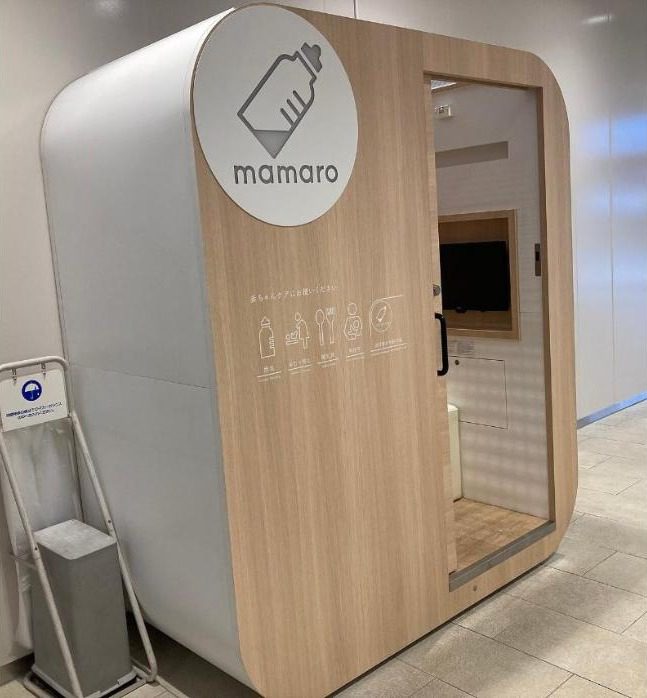
A note for those going with children: the club FAQ says there is a simple nursing room, “mamaro,” in front of the main gate. The photo is a booth of the same name set up at Dream Plaza (July 24, 2024) · Photo: なまけもの人間 · Source: Wikimedia Commons · License: CC BY 4.0 · Cropped at the bottom
Looking at the price list, the first thing I thought as a marketer was that the barrier in the purchase flow is low. Every sale gathers in one app, a single QR code gets you in, and same-day tickets are sold until one hour after kickoff.
For people from abroad, on the other hand, payment methods and language guidance cannot be confirmed on the official pages, so they may get stuck at the final step. If a J.League club is aiming at demand from overseas fans, I think this one page of guidance is the cheapest investment.
Crowds and finances: an average of 15,392 over eight games, revenue in the 5 billion yen range
In this year’s special season, Shimizu drew an average of 15,392 over eight home games, excluding the match at the National Stadium. The occupancy rate was 78.6%, ninth in the league.
That is about 9% down from last year’s average of 16,912 (excluding National Stadium games), and Football Channel put the cause of the drop in the format of this special tournament. In the regular season, the Wednesday-night match on October 21 drew 10,750.
On the financial side, in a May 18 interview with the outlet Half Time Magazine, president Shinya Yamamuro said that revenue had passed 5.3 billion yen. The article does not state the fiscal year.
The same interview says the club’s own “self-earned contribution revenue” is at a record level, but I could not confirm a figure. It is also interesting that Yamamuro is a former president of the pro baseball team Chiba Lotte Marines.
It is worth watching how the “sell through space and events” approach used at the baseball club carries over to a football club. The club’s official site also carries news of two new club partners signed on October 20 (Chusun Jidosha Unso and Kandenko’s Shizuoka branch), so partner sales that gather small and mid-sized local companies one by one seem to continue.
Here is the money attached to the stadium name.
According to materials the city of Shizuoka published, IAI signed a naming rights contract at 31.46 million yen a year (consumption tax included) for five years from March 1, 2023 to February 28, 2028, and this is the third term. It is a three-party contract with both the city and the club as parties.
In the same J.League, Nissan Stadium in Yokohama has a five-year total of 650 million yen (a package including facilities around the stadium, per a Gekisaka report), which averages about 130 million yen a year. The two stadiums differ in scale and package makeup, so a simple comparison is hard.
Still, on the annual figure alone, Shimizu’s is about a quarter of that, which gives a sense of the size of a regional club’s naming market.
Selling a day outside the stadium — S-Pulse Dream Plaza
A place where visitors from abroad could spend time before or after a match is “S-Pulse Dream Plaza” on the harbor side. It is a commercial complex that opened on October 8, 1999 and is run by Suzuyo (Wikimedia Commons entry).
The travel outlet Rurubu‘s guide (updated October 2025) introduces the third-floor “Chibi Maruko-chan Land” (admission 1,200 yen, 700 yen for ages 3 to elementary school, 10 a.m.-8 p.m.), the second-floor Shimizu Sushi Museum (500 yen, 200 yen for ages 4 to elementary school, 11 a.m.-6 p.m.) and the first-floor Shimizu Ramune Museum, among others.
It says a free shuttle takes about eight minutes from JR Shimizu Station and about three minutes from Shin-Shimizu Station, with about two an hour on weekdays and about four an hour on weekends and holidays.
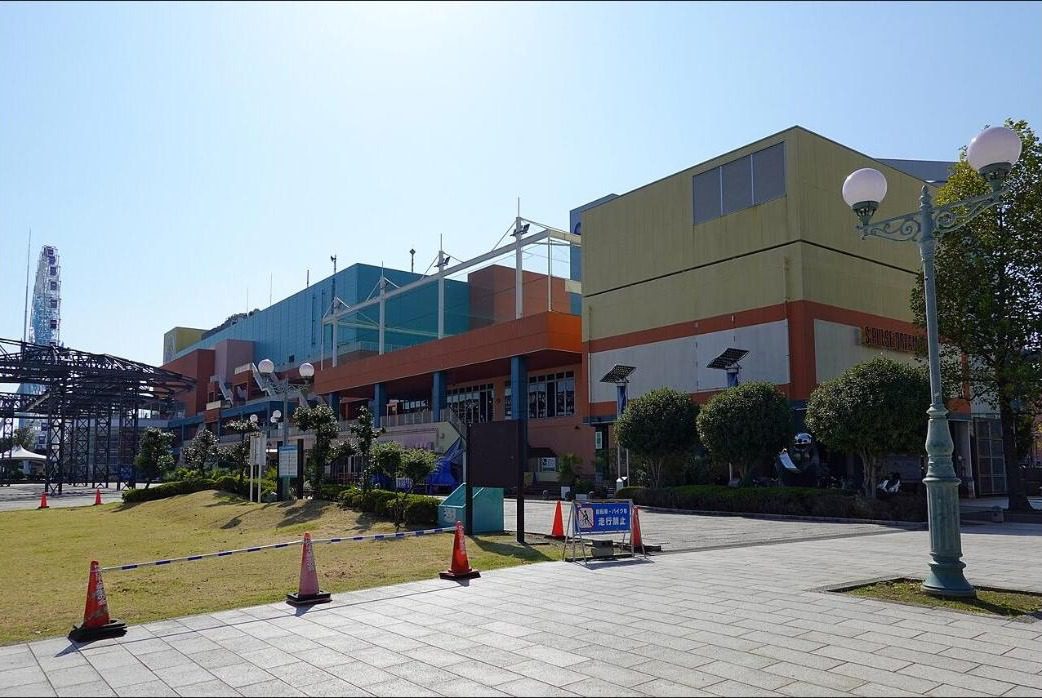
The exterior of S-Pulse Dream Plaza (October 27, 2023) · Photo: 663highland · Source: Wikimedia Commons · License: CC BY-SA 4.0
Local fan reviews also describe the facility as part of the matchday route. A foreign blogger said in a 2021 post that there is a Pal-chan statue and a red telephone booth in the complex, and in a 2023 visit account said it took about 25 minutes by bus from Dream Plaza to the stadium after taking the free shuttle from JR Shimizu Station.
So Suzuyo runs a “stopover” where people can rest before heading to the stadium.
The 1,200 yen park-and-ride cap also reads as a device to gather people into this commercial area. However, I could not confirm the scale of food and merchandise sales inside the stadium from official materials, so this article does not cover them.
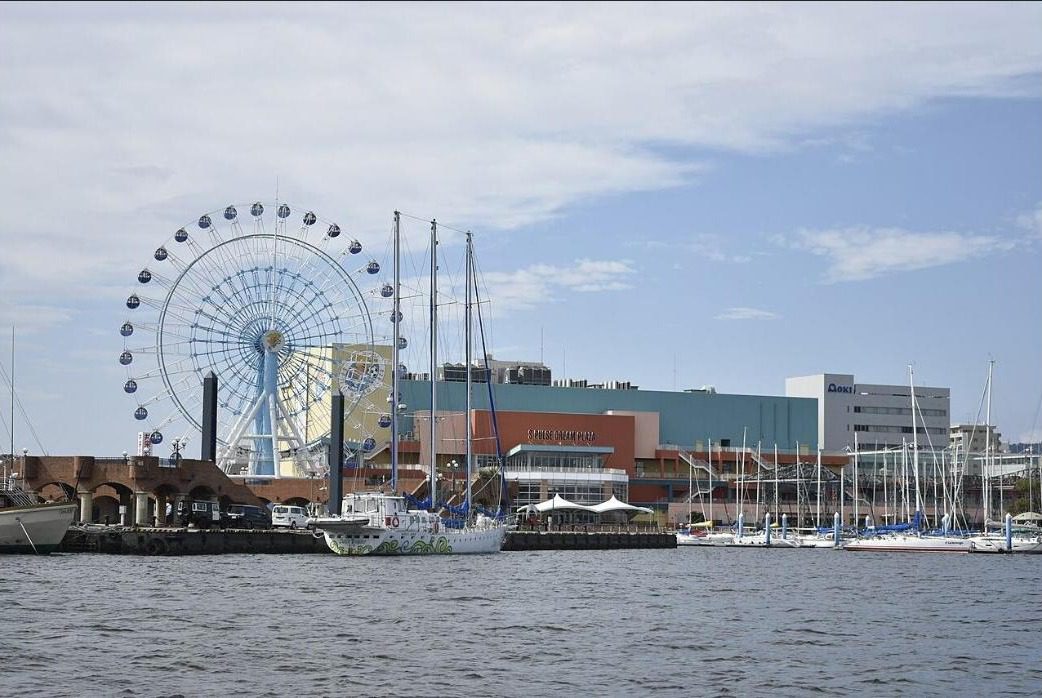
S-Pulse Dream Plaza seen from Shimizu harbor (October 16, 2020) · Photo: 江戸村のとくぞう · Source: Wikimedia Commons · License: CC BY-SA 4.0
The new stadium: the city buys the land first and the club talks about 2033
This stadium opened in 1991, and it is owned by the city of Shizuoka and run by the city’s public facility corporation (Wikipedia). The card the city has played is “securing the site.”
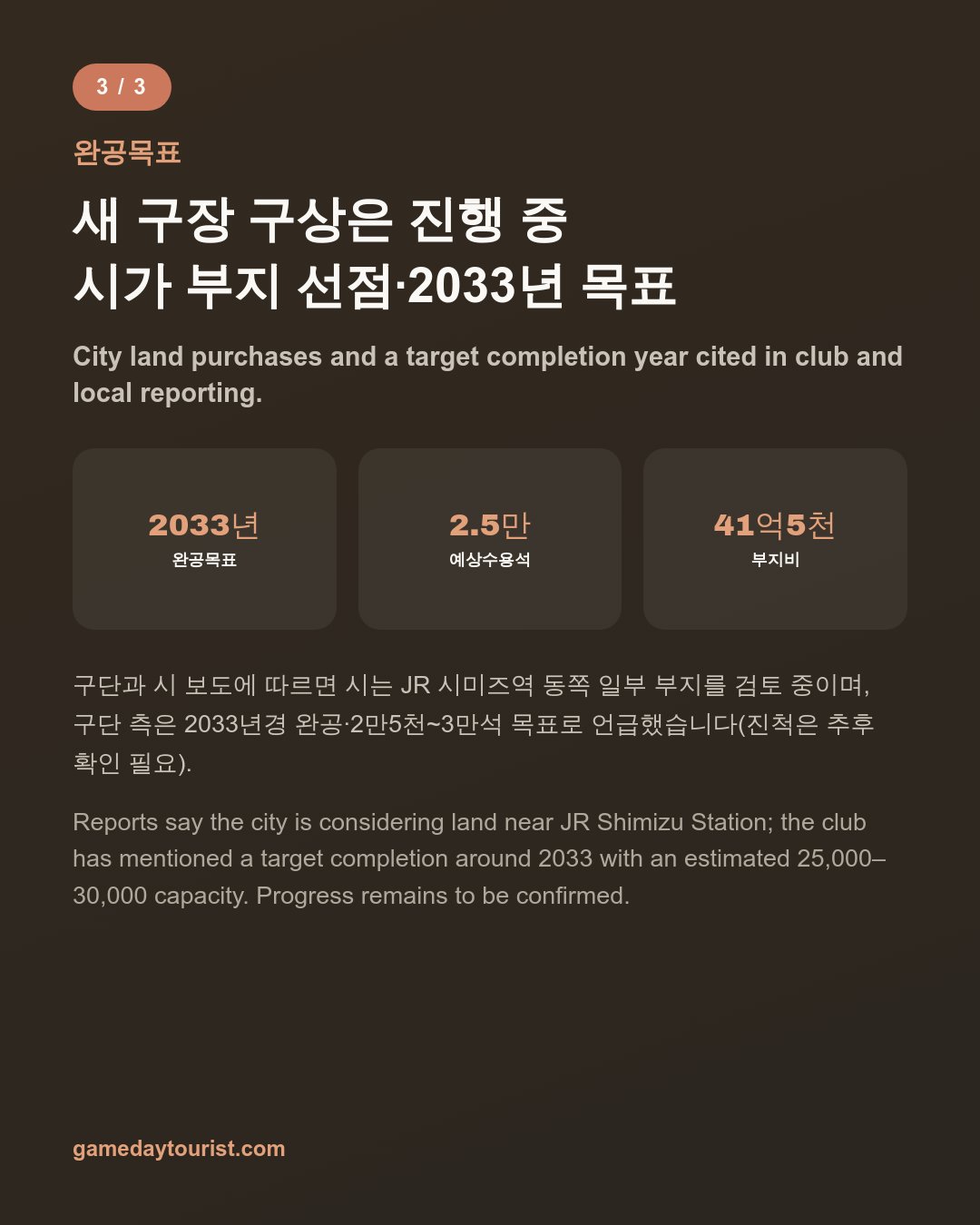
One analysis post (note) sets out a plan for the city to buy about 7.86 hectares of the ENEOS site at the east exit of JR Shimizu Station for 4.15 billion yen, and quotes an estimate that against the city’s cost of 8.05 billion yen the asset value after completion would be 11.3 billion yen.
The same post introduces reports that the Suzuyo Group is willing to respond to a private-sector offering of more than 30 billion yen in development costs, but says this is not confirmed. A fan blog (blog summary) summarizes that in May president Yamamuro talked of completion around 2033, a capacity of 25,000 to 30,000 and an attendance of at least 1.5 times the present.
Because part of the original interview is paywalled, I note that I rely on the blog summary for this. The city has named Boston Consulting Group as the contract candidate for the “feasibility study for a new stadium in the area east of Shimizu Station,” and the contract period runs until March 19, 2027 (feasibility study).
Construction has not been decided, and as of October I could find no new progress. The latest situation has to be checked through the city’s announcements and the local press.
There are two issues from a marketer’s view.
The first is the timetable. IAI’s naming-rights contract ends in February 2028, while the new stadium target is around 2033, so how to carry the stadium’s name value through those five years becomes the homework.
The second is that one should be wary of the optimism that “a new stadium is revenue.”
Even if a new stadium solves access, I think attendance can grow only if the club’s operating ability follows. “In front of the station” is only a candidate site that meets one necessary condition, in my judgment.
Compared with the K League
A scene in Korea that shows a similar worry is Busan’s Gudeok Stadium. Before the July 25 game between Busan I’Park and Suwon Samsung (K League 2, round 19), Money Today reported that the 8,876 seats on general sale had sold out, and the club opened 1,293 more and reduced banner space (Money Today, a pre-match report).
If everything sold, it would be 10,169 seats and the first sellout in 24 years. In the match itself Suwon won 4-1, and SpoTV News reported that Busan achieved a full house at Gudeok for the first time in 23 years that day (SpoTV News).
Busan, which cannot sell more because the ground is small, and Shimizu, which fills only 78.6% because the ground is old and far, sit side by side on one page. Putting the two cases next to each other shows that what splits attendance is not “capacity” but the “friction of the way in.”
Shimizu fills an average of 15,000 with fans willing to take a 500 yen shuttle and a transfer, and Busan clears the banners to make room for one more seat. Either way, I hope the new-stadium discussion does not lose sight of the fact that what a club sells is not a seat but the route before and after the match.
Not having been there myself, I cannot tell you how long the lines are on site. Still, I think it is a reassuring starting point for first-time fans that the club publishes shuttle, parking and taxi fares for every match to this extent.
What I could not confirm: whether cards issued abroad work for ticket payment and whether there is an English purchase screen, seat availability for matches after November 7, the scale of food and merchandise sales inside the stadium, progress on the new-stadium plan since October, and the fiscal year of the revenue figure given in the Half Time interview.
This information is as of October 27, 2026, so please check the club’s official site again before you visit.
Leave a Reply