Contents · About 8 min read
📱 View as card news
It’s not often that a marketer sits down and pores over a team’s shareholding disclosure.
But a short statement Yokohama F. Marinos put out on June 25 kept nagging at me.
Manchester City’s parent company, City Football Group (CFG, a multi-club group that holds stakes in football clubs across several countries), was handing its entire Marinos stake over to Nissan Motor.
A 12-year run of foreign sports-group ownership — one of the more notable ones in Asian football since 2014 — was closing a chapter, and that sent me back to look at the stadium and the business structure behind it.
I haven’t been to this stadium in person.
Instead, this ownership story gave me a reason to dig through official materials, local reporting, and firsthand fan accounts, and put together a marketer’s read on the place.
Attendance and Tickets
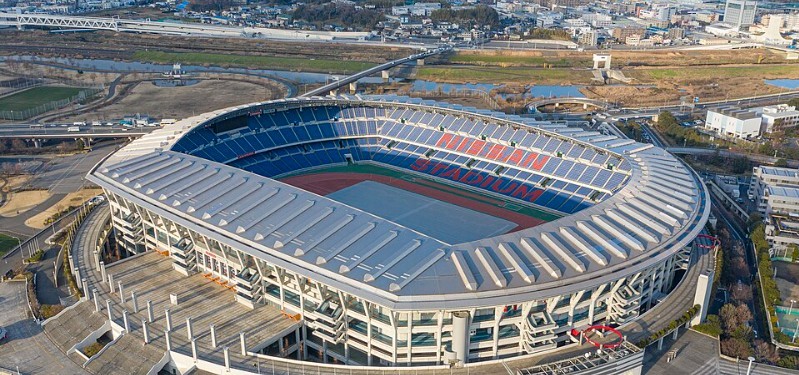
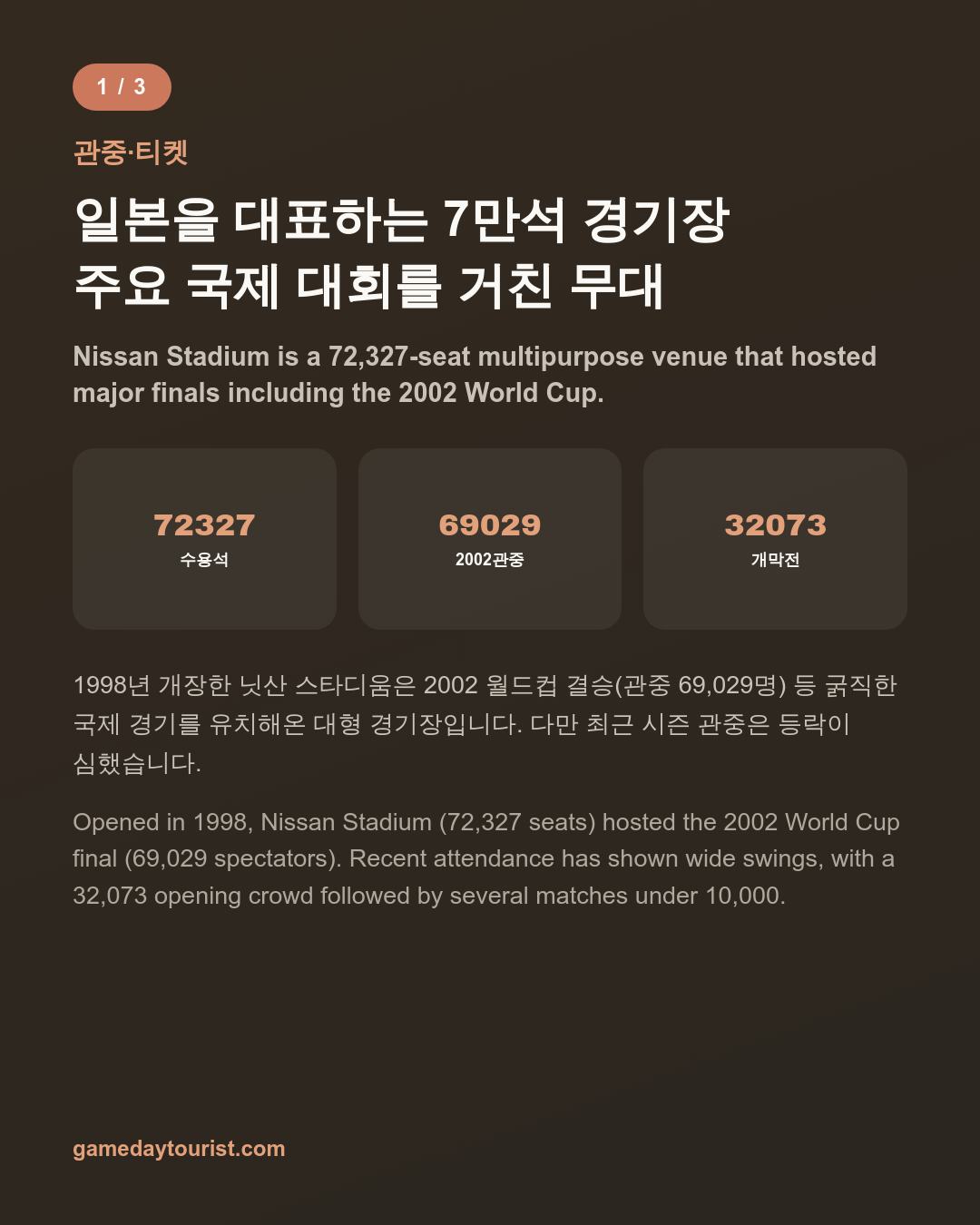
Marinos’ home, Nissan Stadium (officially Yokohama International Stadium), holds up to 72,327 fans — one of Japan’s largest multi-purpose venues.
Since opening in 1998 it has hosted the 2002 FIFA World Cup Final (Brazil’s 2-0 win over Germany, with two goals from Ronaldo in front of 69,029 fans), the 2011 and 2012 FIFA Club World Cup finals, and the 2019 Rugby World Cup final.
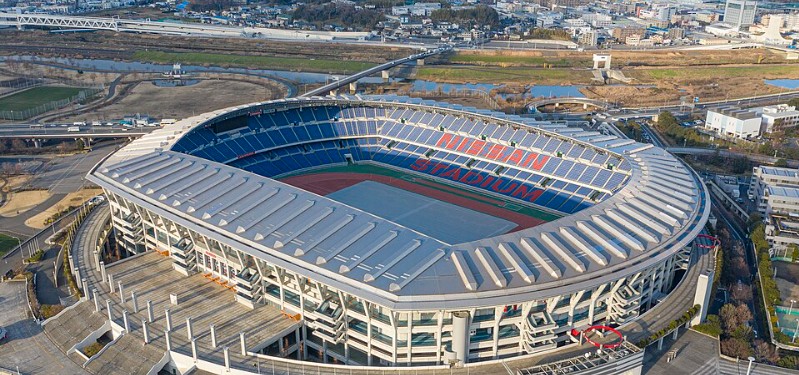
Aerial view of Nissan Stadium · Source: Arne Müseler (arne-mueseler.com), CC BY-SA 3.0
Recent form hasn’t lived up to that pedigree, though.
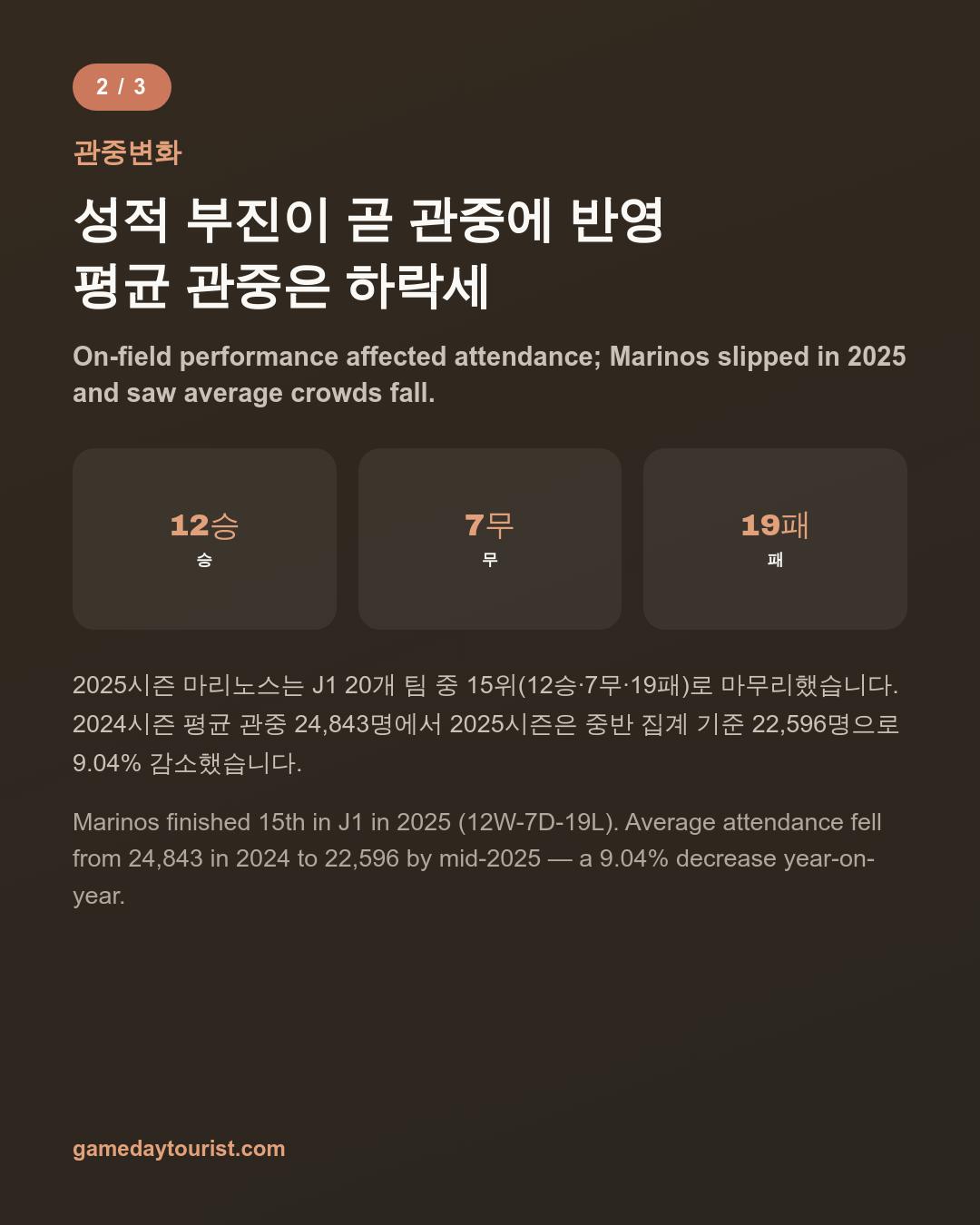
Marinos finished the 2025 season 15th out of 20 J1 clubs (12 wins, 7 draws, 19 losses), and that slump showed up directly in the attendance numbers.
The season opener against Albirex Niigata drew 32,713, but reporting also noted five separate matches afterward where attendance dipped into the 10,000s — a wide swing from game to game.
But whenever seating comes up, sightlines are never far behind.
One local matchday-guide blogger pointed out that because Nissan Stadium is a multi-purpose venue ringed by a running track, there’s real distance between the stands and the pitch, and the view varies a lot depending on where you sit.
Coming from a marketer used to football-specific stadiums, I found it striking that a whole fan community has formed just to offset that structural drawback — photographing the view from over 100 different seats and publishing seat-by-seat guides.
Concourse and F&B
The concourse layout is fairly well put together, too.
TRICOLORE ONE (the Marinos team-goods shop), Bathday (a convenience-store-style outlet), and Sunday Monday Kitchen (a restaurant with a menu built by a sports-focused chef) are all permanent fixtures, and near the East Gate the official site describes a separate food zone called Tricolore Land.
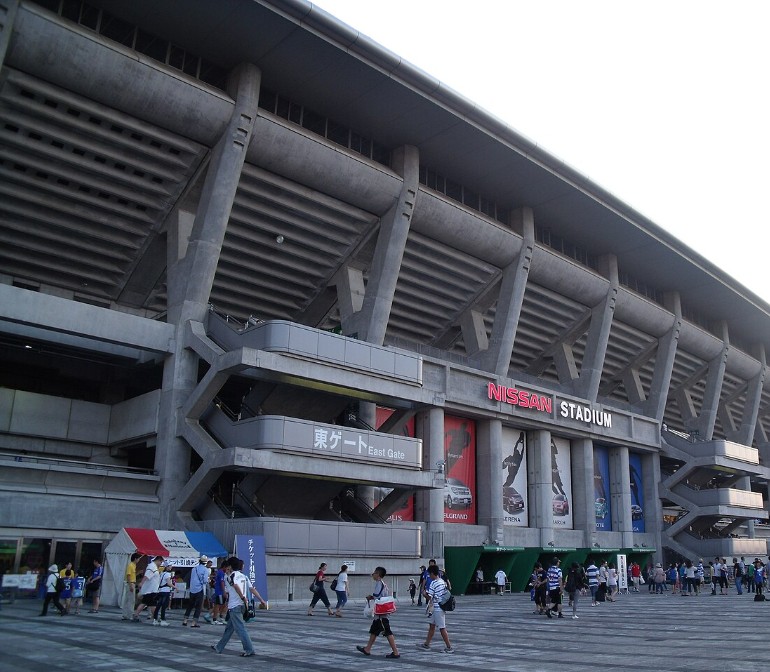
Matchday scene outside the East Gate · Source: TAKA@P.P.R.S (Flickr), CC BY-SA 2.0
Visitor reviews are mixed on this front.
Bento boxes, karaage, yakisoba — the variety is there, but multiple matchday review sites repeat the same tip: get to the popular stands early, because the lines get long.
There were also complaints that water stations aren’t easy to reach on hot days.
From a marketer’s chair, F&B flow and wait-time management are make-or-break variables at a venue this size (over 70,000 seats) — and it seems like this is still an unsolved piece of the puzzle here.
My guess is that’s just a byproduct of the building’s age, not unlike Jamsil or Sajik ballparks back home in Korea.
The stadium does have its own trademarks, though.
The chants led by the South Stand supporters group Tricolore Pride, the fireworks that go off after goals, and the club anthem “Yokohama ni Ikou” (“Let’s go to Yokohama”), which a matchday-guide blog says plays before every kickoff.
There were also comments about how beautiful the area around the stadium looks during cherry blossom season — a reminder that local color and fan culture can fill in for what a general-purpose stadium structurally lacks.
Merchandise and Ad Inventory
The sponsorship structure runs three tiers deep.
The official partner list puts four Top Partners — Nissan Motor, Draft, Nisshin OilliO Group, and Adidas Japan — at the top, and below them sit over 70 more company logos across Official Partner and Official Sponsor tiers.
The mix is broad — national names like Asahi Beer, 7-Eleven Japan, Mizuho Bank, and Coca-Cola Bottlers Japan sit alongside local credit unions, real estate firms, and food companies.
On broadcast rights, Marinos doesn’t have its own separate deal — it’s covered under DAZN’s league-wide distribution of every J.League match.
Instead, during its years working with CFG, a football trade outlet reported that the club pursued new ventures in content and brand business — esports, close-access team documentary content, and global sponsor acquisition through the CFG network.
The Ownership Shift — CFG and Nissan Part Ways After 12 Years
Now to the ownership story that got me writing this post in the first place.
In May 2014, Nissan Motor handed part of its Marinos stake to CFG, sealing a partnership.
Marinos went on to win the J1 title in 2019, its first in 15 years, and again in 2022 — so purely on results, the partnership clearly delivered.
Recently, though, the relationship has been unwinding a little at a time.
First, in late June 2025, the sponsorship (partnership) agreement between Nissan and CFG expired — and after that, local football media reported Marinos kept paying separately for consulting to continue using CFG’s football know-how.
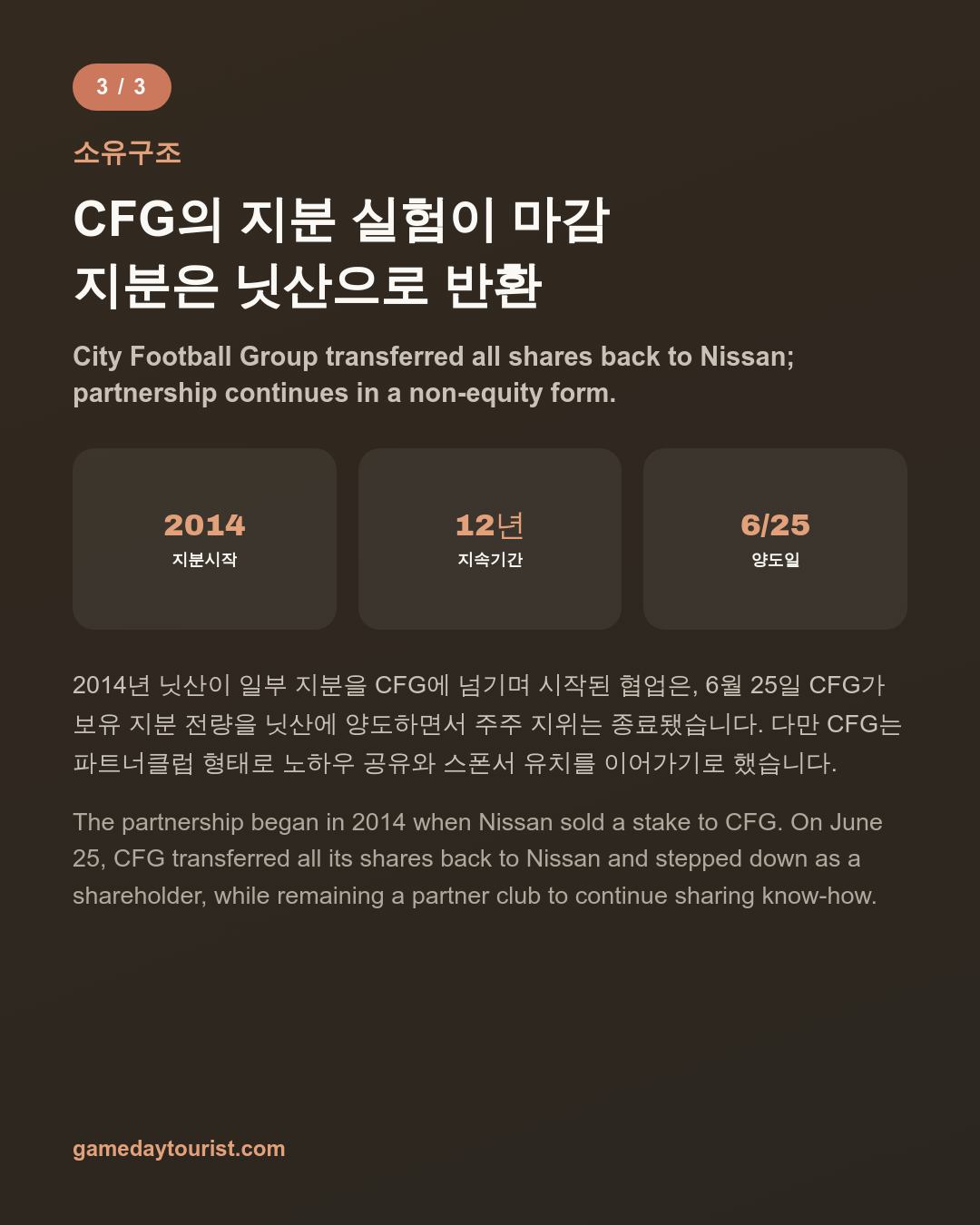
Then on June 25, Yokohama Marinos Co., Ltd., the company that runs the club, officially announced it was transferring all of CFG’s shares to Nissan Motor.
With that, CFG steps down as a shareholder, but the club explained the relationship is shifting into a “partner club” arrangement — no equity, but continued collaboration on team-strengthening know-how and new sponsor and partner acquisition.
Marinos also stated that this decision is part of a mid-to-long-term growth strategy aimed at stabilizing its management foundation and improving financial sustainability.
Watching a 12-year equity experiment wrap up this way, it struck me that this might read less as a straightforward exit and more as a signal that the transplanted know-how can now run on its own.
The evidence for that is right there: even after CFG let go of its stake, Marinos is still paying to keep buying CFG’s football know-how.
A relationship that started as an equity stake, stepped down to a consulting contract, and is now stepping down again into an unpaid partnership — that gradual de-escalation itself feels like a useful reference case for how foreign capital and a domestic club can build a relationship and later wind it down.
A Look at KBO and K League
This naturally raises the question of whether anything similar has happened back home.
As it turns out, CFG held high-level meetings with multiple K League clubs during a visit to Korea in July 2023, and one exclusive report named Jeonbuk Hyundai — the country’s largest club — as one of them.
The meetings reportedly aimed at a small equity stake, similar to the Marinos case, but a Jeonbuk club official acknowledged the contact while drawing a firm line: “no equity acquisition talks took place”.
The following year, in 2024, Red Bull acquired Japan’s J3 club Omiya Ardija, becoming the first case in Asia of full ownership of a J.League club — and speculative Japanese media reports afterward suggested Red Bull had its eye on a K League club in the greater Seoul area, though nothing ever became a real deal.
So far, then, neither K League nor KBO has a single case of a foreign multi-club ownership (MCO) group actually holding equity in a club.
Domestic pro club governance in Korea splits into two broad models — full ownership by a large conglomerate (Hyundai, Samsung, Hanwha and similar corporate groups) or operation by a local government — and the Marinos-style model, where a foreign sports group comes in with a minority stake and transplants know-how, has never really taken root here.
That CFG has now unwound its Marinos stake doesn’t necessarily mean the model itself is fading, either.
CFG is still adding clubs around the world.
If anything, this feels like one more reference case for domestic clubs to keep in their back pocket — for weighing how small an equity stake to accept, how far to let the know-how transfer go, and how to design the exit when it’s time to wind the relationship down.
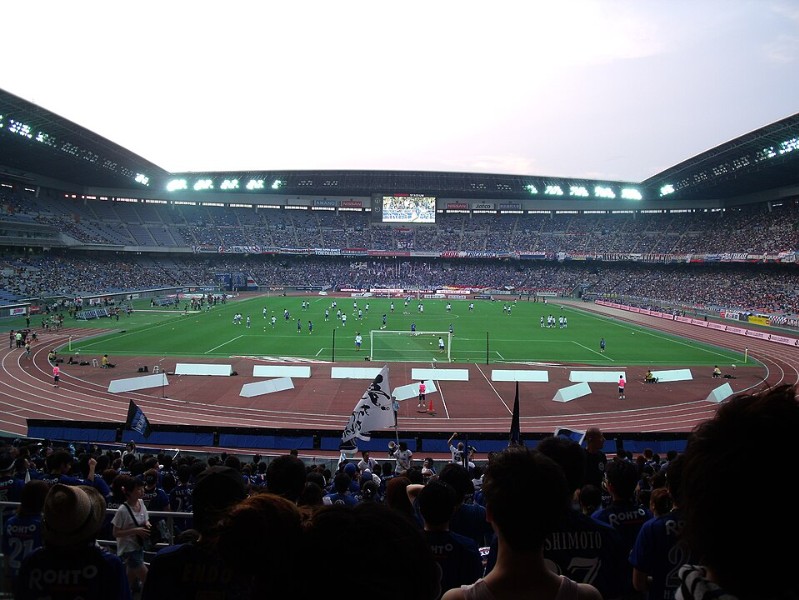
The pitch and running track, as seen from the stands · Source: TAKA@P.P.R.S (Flickr), CC BY-SA 2.0
Watching a club with a 70,000-plus-seat stadium and two J1 titles delivered partly through a foreign-capital experiment still see its crowds shaken by a single poor season is a good reminder that, in the end, on-field performance matters more than facilities or ownership structure ever will.
Still, the way this ownership relationship was wound down — gradually, and without much noise — is a piece worth paying attention to.
Leave a Reply