Contents · About 7 min read
📱 View as card news
Something stuck with me while I was researching the Rakuten Eagles a while back: chairman Hiroshi Mikitani was never going to be satisfied with owning just one pro baseball team. Rakuten Group owns not only that baseball club in Sendai but also Vissel Kobe, a J1 League club in Kobe — and since it’s rare back home to see one company running both a baseball team and a football club, I got curious.
Digging through the club’s official site and recent coverage, I found Rakuten’s cross-sport marketing playbook tangled up with something unexpected: the group never put its own name on the stadium.
Crowds and Tickets
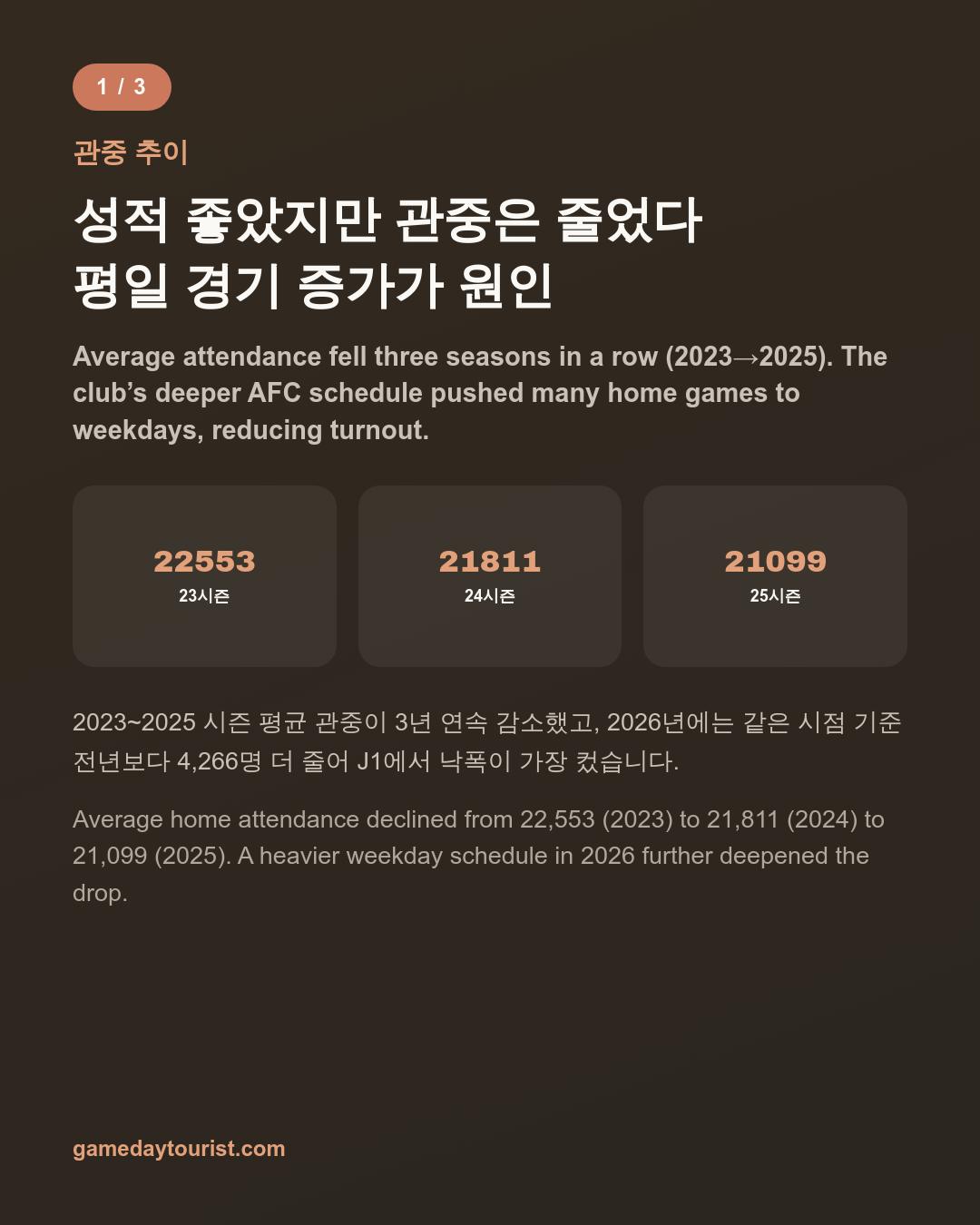
Since winning the J1 League title in 2023, Vissel Kobe has actually seen attendance decline. Average home crowds dropped for three straight years — 22,553 in 2023, 21,811 in 2024, and 21,099 in 2025.
Through round 10 of the new “Hyakunen Koso League” format in 2026, average attendance was down 4,266 from the same point the year before, the steepest drop of any of the 20 J1 clubs. The cause wasn’t poor results — if anything, it was the opposite.
Advancing to the AFC Champions League Elite packed the domestic calendar, pushing 6 of 9 home matches onto weeknights, and the club got none of the boost other teams sometimes see from renting out the national stadium.
In my experience with domestic leagues here, once the annual schedule comes out, you can roughly forecast attendance just by looking at the mix of weekend versus weekday matches and which opponents are drawing crowds. What caught my attention in an analysis from a local football outlet was that Vissel Kobe fans aren’t actually staying away from weeknight games specifically.
Their 2025 weekday attendance rate — tickets used divided by tickets sold — was 71.0%, higher than Urawa Reds (61.0%) or Yokohama F. Marinos (55.1%). So the real issue wasn’t fan loyalty at all; it was simply that Vissel Kobe had far more weeknight matches than anyone else.
It struck me that this paradox — better results leading to fewer fans in the stands — is one that domestic clubs chasing more Asian competition spots may eventually run into as well.
Ticket sales run through Rakuten Ticket using dynamic pricing, where prices shift with demand and timing, and pre-sale windows are staggered by membership tier — Royal, Elite, Regular — to reward season-ticket holder loyalty.
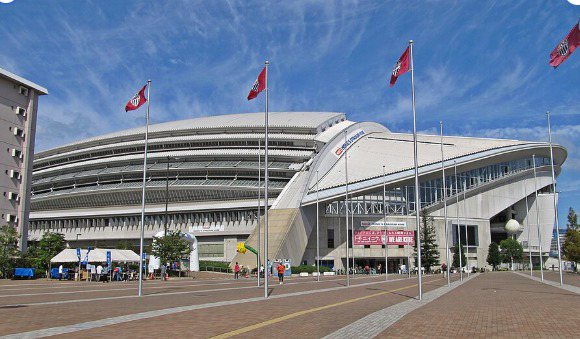
Exterior of Kobe Wing Stadium, now Noevir Stadium Kobe · Source: Pastern, CC BY-SA 3.0
Space Usage and Merchandise
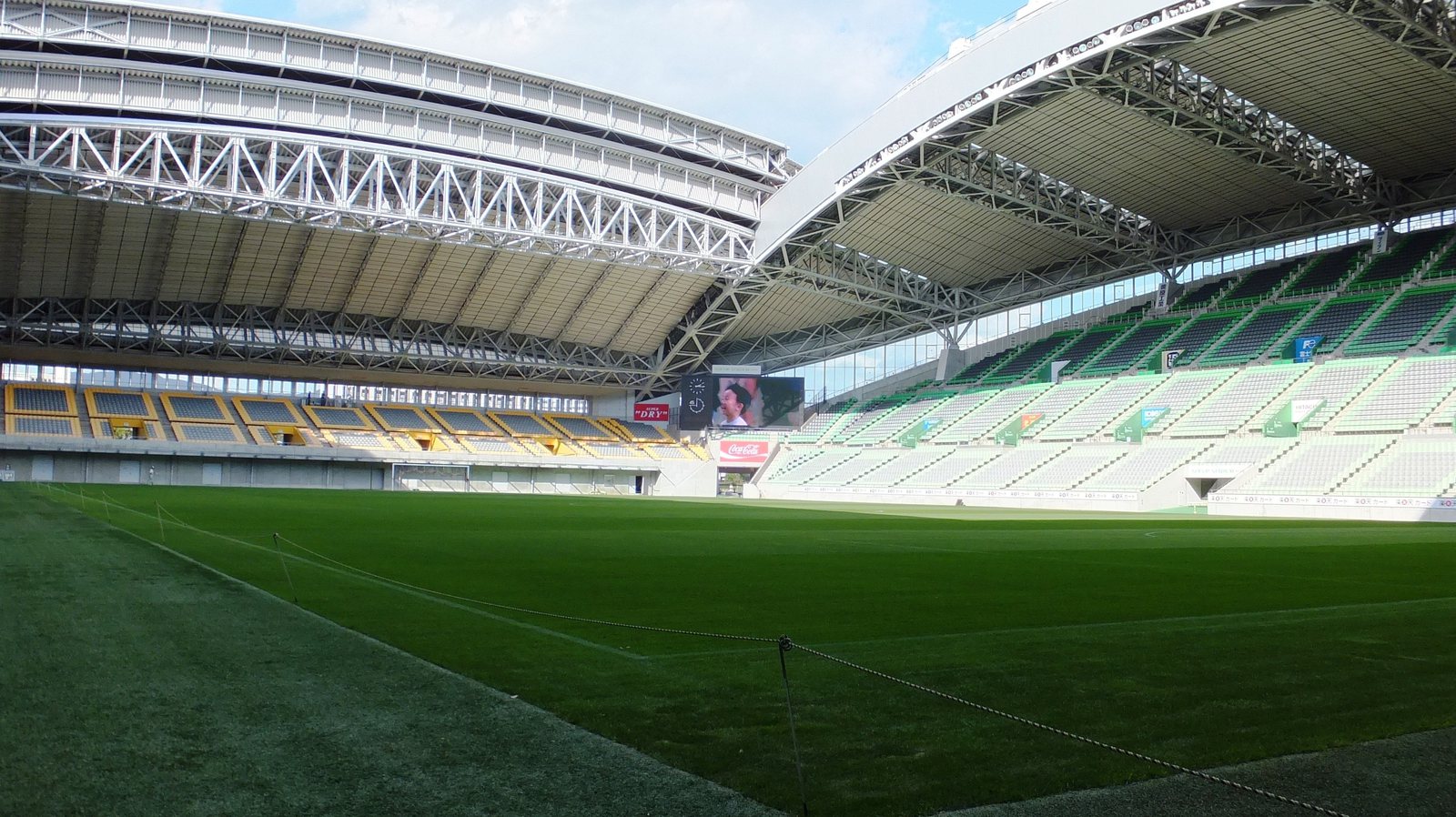
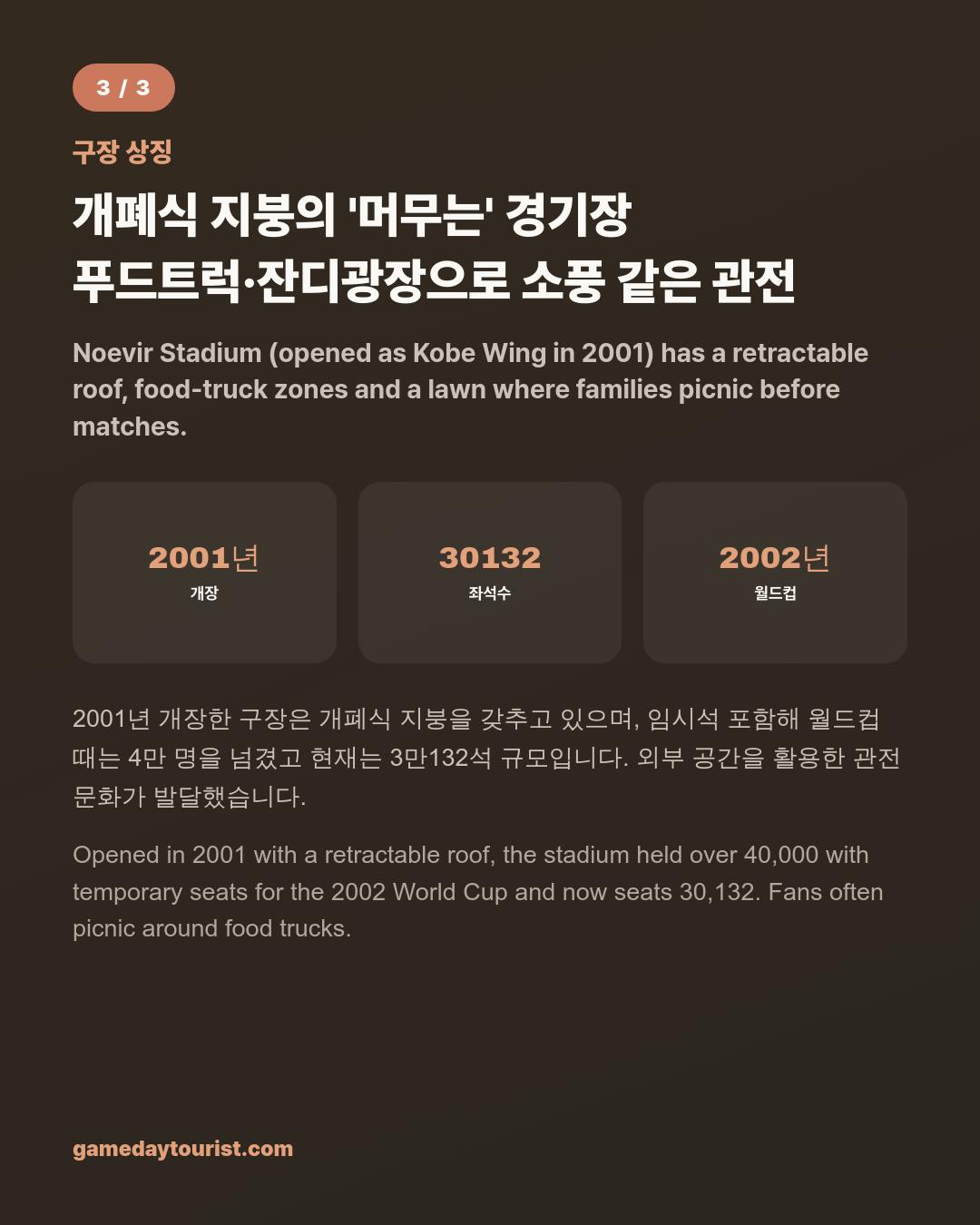
The home ground, Noevir Stadium Kobe, opened in November 2001 as Kobe Wing Stadium ahead of the 2002 FIFA World Cup, and it’s a venue with a retractable roof. At the time of the World Cup it held over 40,000 with temporary seating; once that seating came out afterward, capacity settled at today’s 30,132.
Outside the stadium, food trucks line up selling everything from Sanuki udon to Kobe beef steak, and a local football outlet’s write-up of a 2025 summer event described families spreading picnic mats on the artificial turf around a U-shaped row of roughly a dozen trucks, sharing bento lunches together.
It’s a stadium designed to be lingered in like a picnic spot, not just watched from — a detail that’s hard to catch from the numbers alone and only really landed for me through someone else’s firsthand account.
Merchandise runs through two flagship shops: THE VISSEL in Sannomiya and VISSEL PORT in Harborland.
At the club’s 30th anniversary charity match in August 2025, around 300 fans reportedly lined up in the blazing sun to buy a limited-edition jersey priced at ¥27,000 (roughly $180) — a good sign of just how much fans are willing to pay for a special-edition item.
Panorama of Misaki Park Stadium, Vissel Kobe’s training facility · Source: Kanko3131, CC BY-SA 3.0
Ad Inventory and Naming Rights
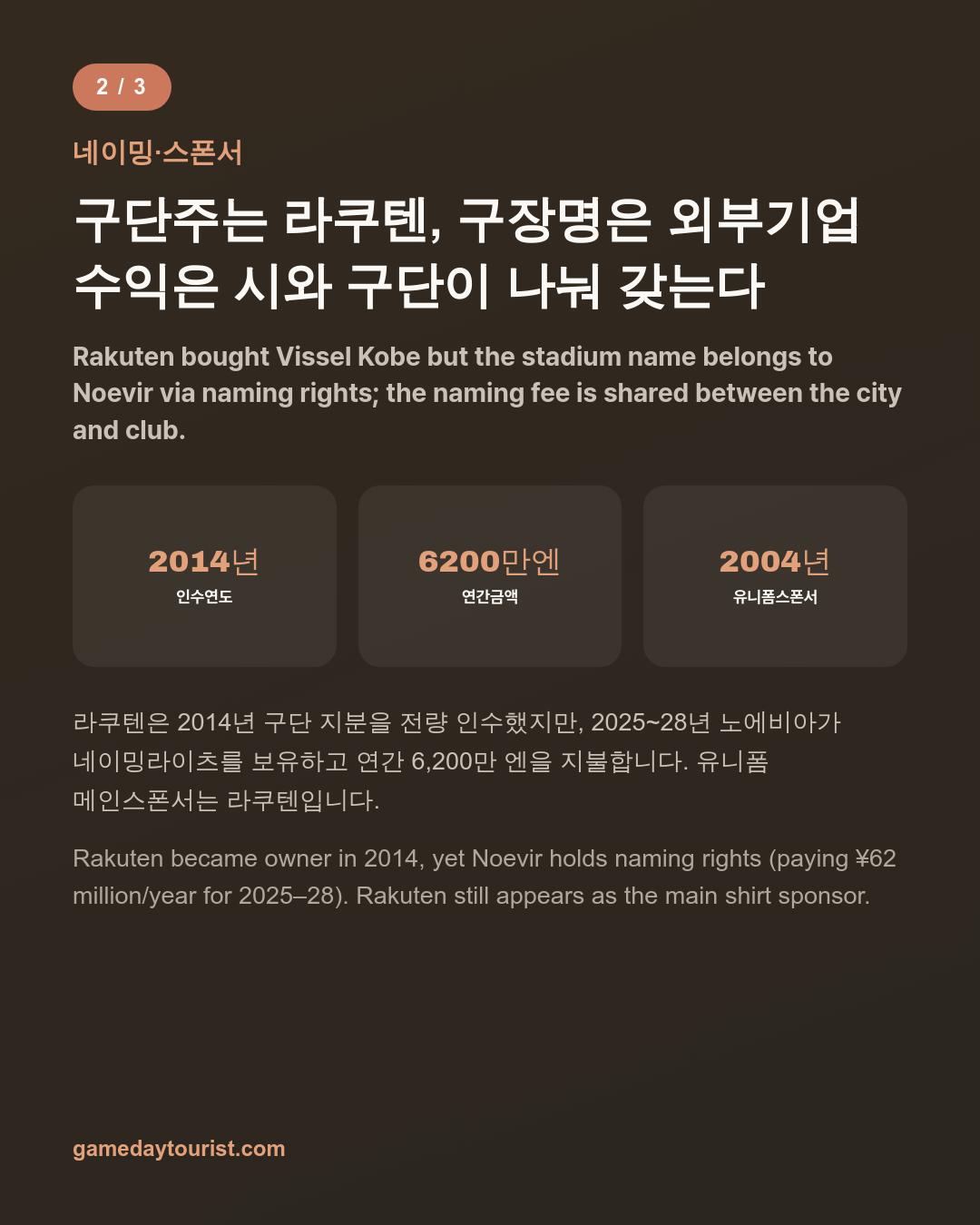
This is where Rakuten’s approach gets genuinely interesting. Rakuten Group acquired full ownership of Vissel Kobe in 2014, becoming the club owner — yet it never put its own brand on the stadium name.
The name Noevir Stadium Kobe comes from cosmetics company Noevir, which bought the naming rights — the right to put a company’s name on a facility — for three years, March 2025 through February 2028, paying roughly ¥62 million a year pre-tax (around $410,000).
This is their fourth consecutive renewal, and the fee is reportedly split evenly between the city of Kobe and the club’s operating company.
Rakuten’s own branding instead lives on the jersey front, where it’s been the main sponsor since 2004, joined more recently by the Rakuten Mobile brand — turning the shirt into ad inventory that spans the group’s businesses from e-commerce to telecom. Asics supplies the kit.
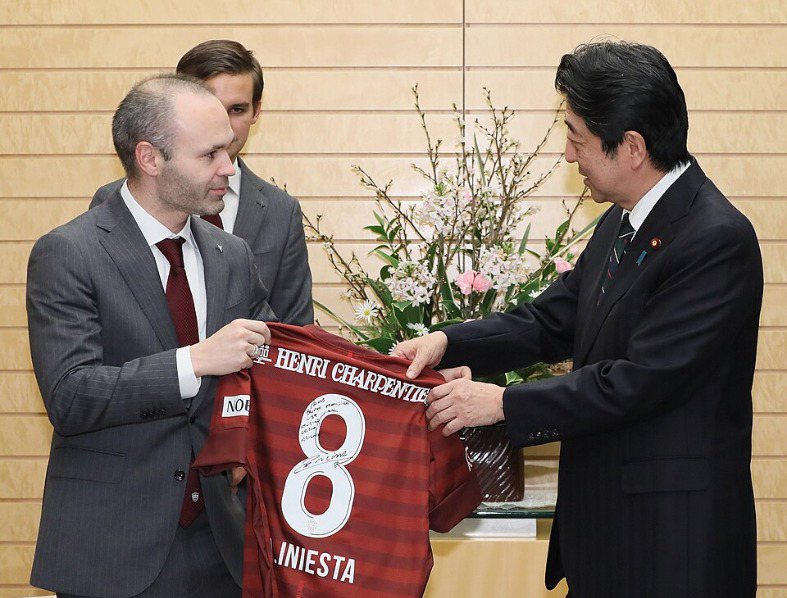
Prime Minister Shinzo Abe receiving a courtesy call from Andres Iniesta (photographed January 2019) · Source: Prime Minister’s Office of Japan, Wikimedia Commons, CC BY 4.0
Broadcast Rights and Regional Economic Impact
DAZN holds the entire J League broadcast rights through an 11-year deal running from the 2023 through 2033 seasons, with a maximum contract value — including revenue-linked payouts — of ¥239.5 billion.
That’s up from the previous 10-year deal (2017-2026, worth around ¥210 billion), and it now covers J1, J2, and the promotion playoffs.
On the regional economic impact side, Vissel Kobe was credited with a nationwide economic effect of ¥41.398 billion in the 2023 season, ¥19.6 billion of that within Hyogo Prefecture alone.
As the only J League club in Hyogo, all 41 municipalities in the prefecture joined a formal declaration of support for the club back in 2013, and that regional tie-in continues today under a “partner town” program.
The Stadium’s Signature Feature — A Retractable Roof and the 2025 30th Anniversary Charity Match
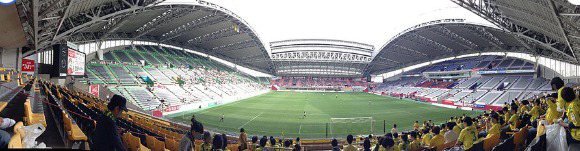
Noevir Stadium is one of the few J League venues with a retractable roof, valued for keeping rain out and often mentioned for the curved lines the roof structure traces under the floodlights at night.
In August 2025, the stadium hosted a charity match marking both the club’s 30th anniversary and the 30th anniversary of the 1995 Great Hanshin-Awaji Earthquake, bringing out former stars including Masayuki Okano — who scored the golden goal against Iran that sent Japan to its first World Cup in 1998 — and Kazuyoshi Miura, still playing professionally at age 58.
Iniesta couldn’t attend due to a family matter but sent a video message expressing his affection for Kobe.
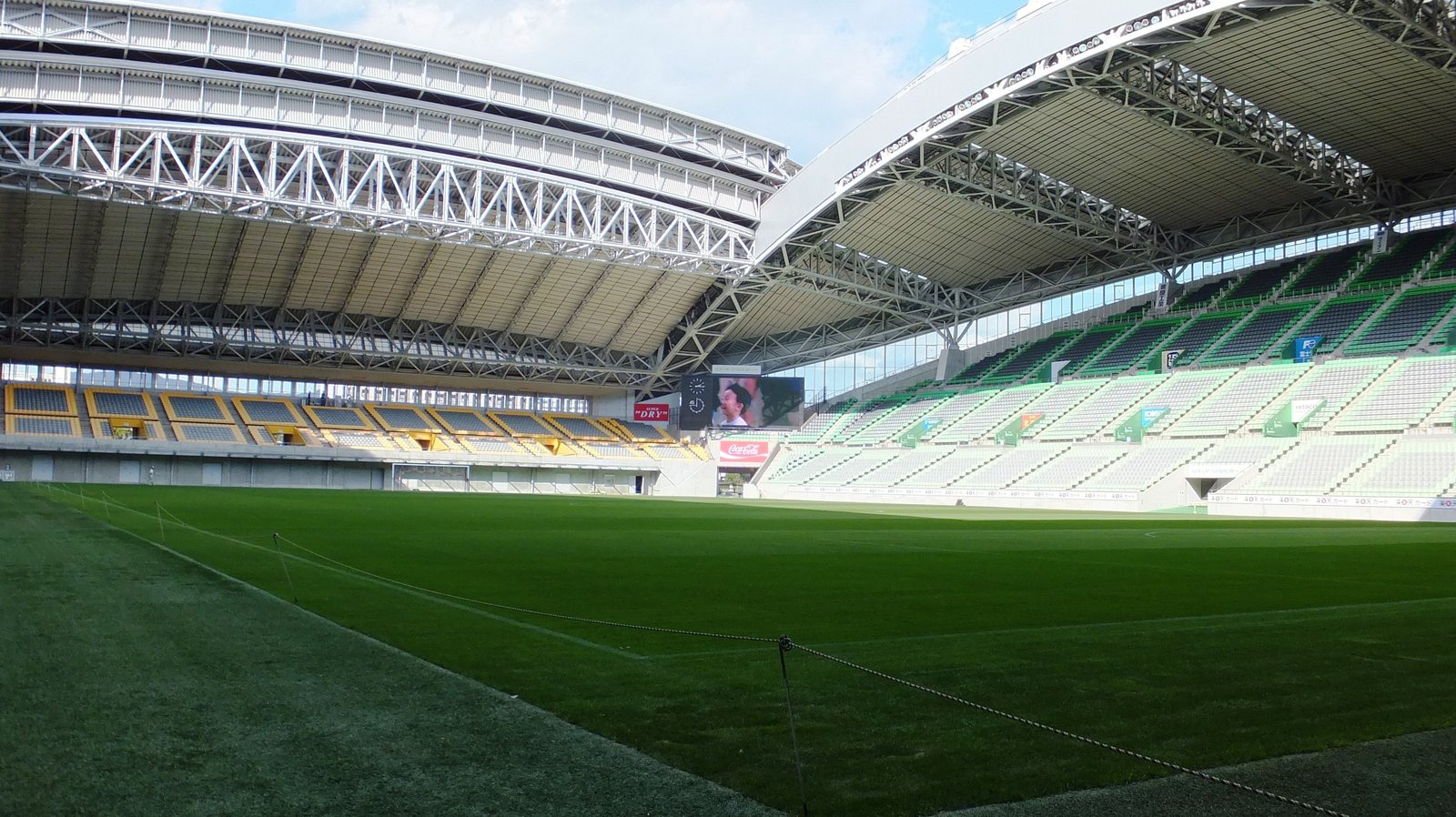
The retractable roof structure of Noevir Stadium Kobe · Source: 0-0t, CC BY-SA 3.0
A football outlet that covered the match in person described it as “not just a football match, but a night that mixed remembrance, gratitude, and joy.”
From a marketer’s perspective, events like this operate on a different plane than sponsor visibility or ticket revenue — they’re really about reaffirming the trust a club has built with its city over time.
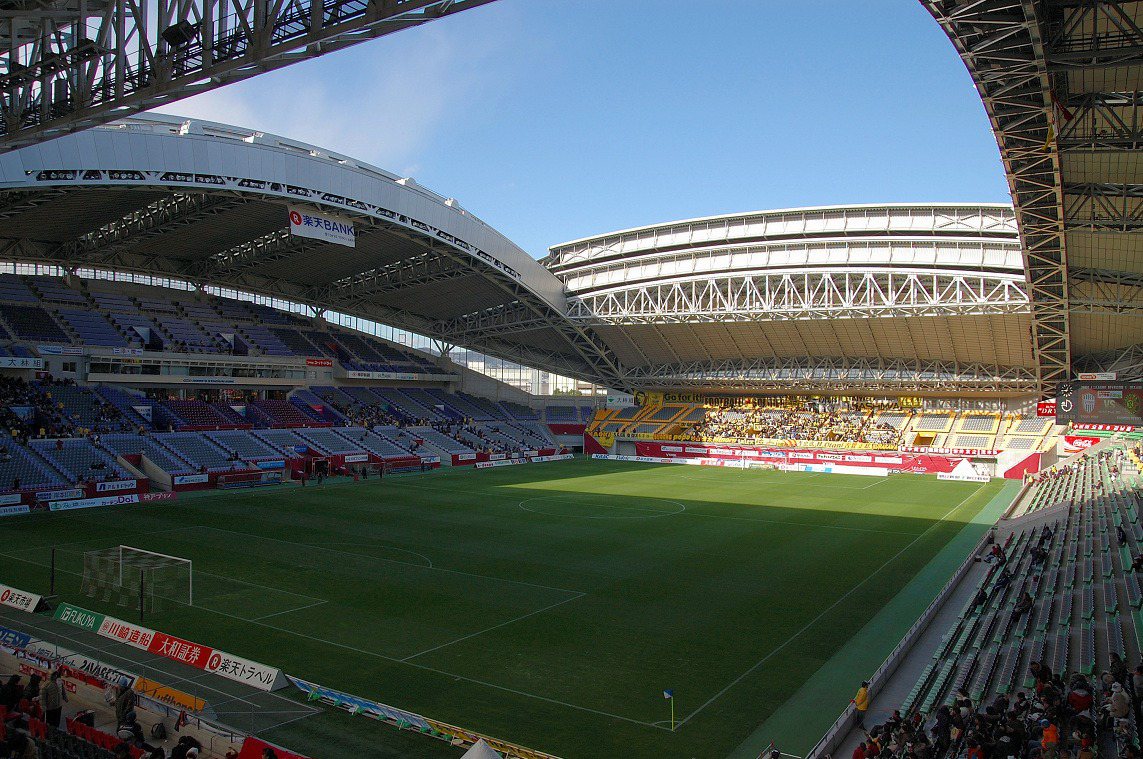
Interior view of Kobe Wing Stadium · Source: yuk, CC BY-SA 3.0
Ties to Korean Players
There’s no Korean national on the current first-team roster, but Vissel Kobe has had plenty of Korean players pass through over the years, including Kim Nam-il, Jung Woo-young, Choi Sung-yong, Kim Do-hoon, and Kim Seung-gyu.
Kim Do-hoon in particular has stayed active as a coach since retiring, most recently managing Singapore’s Lion City Sailors, and he was invited back onto the pitch for the 2025 30th anniversary charity match.
How This Compares to the KBO and K League
A few things stand out when I compare this to clubs back home. First, splitting naming-rights revenue evenly between a municipality and a club is a structure that’s basically nonexistent domestically.
Korean ballparks — Daegu Samsung Lions Park, Incheon SSG Landers Field — are almost always cases of a parent company putting its own name on its own stadium; it’s rare to see a genuinely third-party company pay market rate purely for naming rights with no ownership stake involved.
A model like Noevir’s, where an outside company pays and the proceeds are split between the public sector (the city) and the private sector (the club), strikes me as worth studying if a municipally-owned Korean stadium ever considers selling naming rights.
Second, the paradox of better results leading to more weeknight games and fewer fans in the seats is something K League clubs chasing more continental competition spots may well run into before long.
Third, Rakuten’s approach of owning a baseball club and a football club under one roof and cross-promoting the brand across both is a marketing model that simply doesn’t exist here yet — and it’s one worth keeping an eye on.
Leave a Reply