Contents · About 6 min read
📱 View as card news
A few days ago, while skimming European transfer market articles, a familiar name caught my eye.
It was about Serbian powerhouse Crvena Zvezda (the club better known in Korea as “Red Star Belgrade”) looking for a left-footed center back, and the name of South Korean player Kim Tae-hyun was being mentioned as a candidate. It wasn’t at the stage of confirmed negotiations or a formal offer yet, but once I realized Kim Tae-hyun currently plays for the Japanese J1 League’s Kashima Antlers, I naturally became curious about the club’s recent moves.
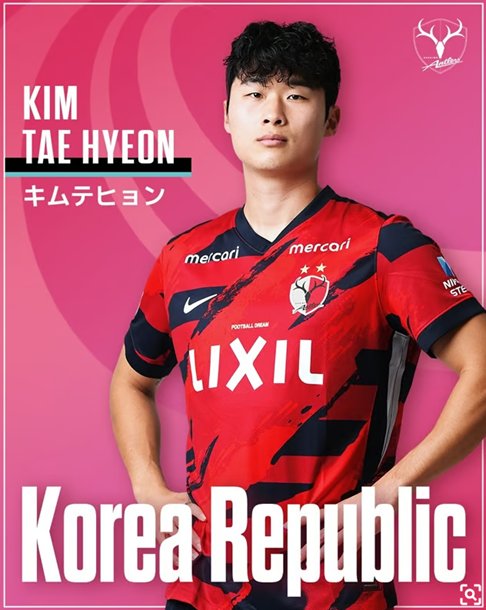
Source: Kashima’s post announcing Kim Tae-hyun’s national team call-up. /Photo = Kashima Antlers official SNS
Why It Became Mercari Stadium
When I opened the official website, an unexpected name jumped out at me right on the front page.
The stadium name was “Mercari Stadium.”
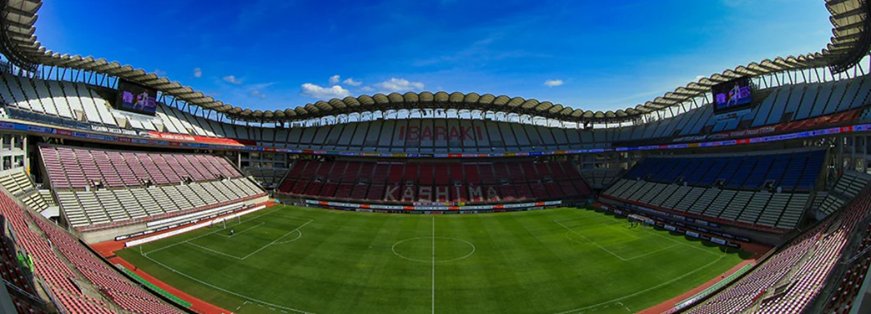
Source: Kashima Antlers official website (antlers.co.jp)
Mercari is Japan’s largest secondhand marketplace platform.
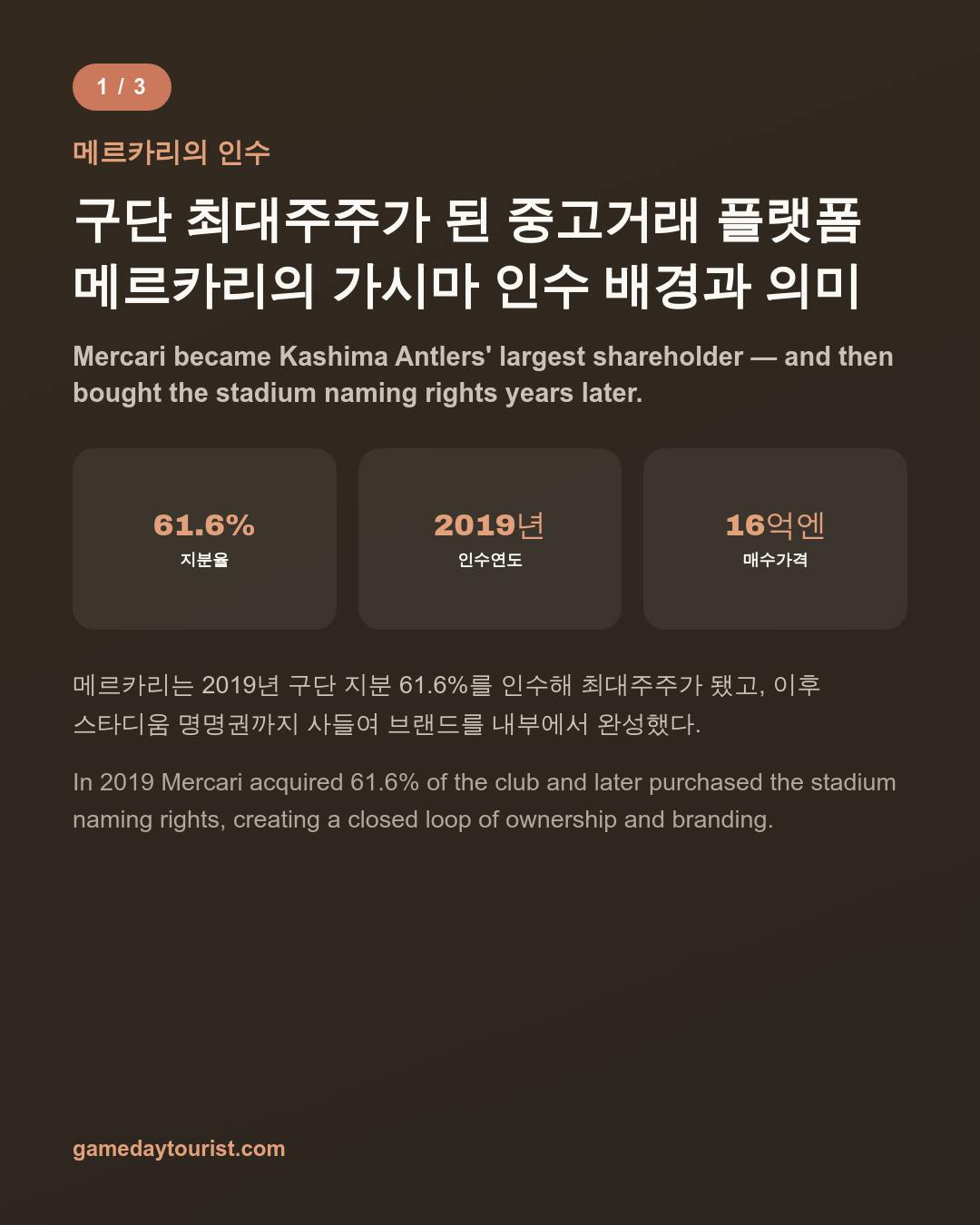
If you compare it to Korea, it’s similar to services like Danggeun Market or Bunjang. But this company didn’t just buy an advertising board — in July 2019 it acquired 61.6% of Kashima Antlers’ shares from the former parent company Nihon Seitetsu (formerly Sumitomo Metal Industries) for about 1.6 billion yen (exactly 1,597,000,000 yen), becoming the largest shareholder.
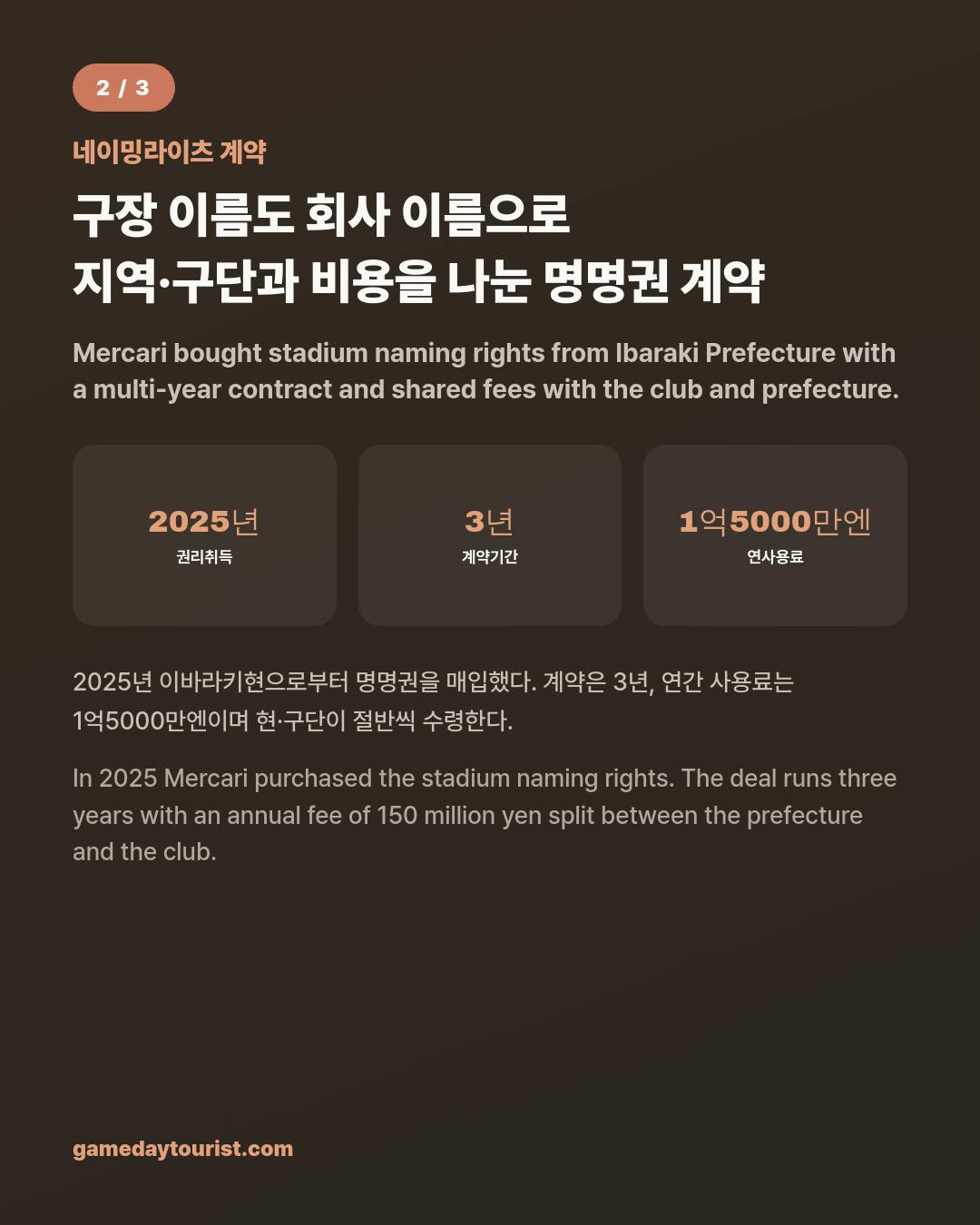
Nihon Seitetsu remained involved as a sponsor with an 11% stake, and the remainder is held by Kashima City, other local municipalities, and regional companies. Then, six years later in June 2025, Mercari purchased the naming rights to the stadium itself (the right to attach a company name to the stadium, commonly called naming rights) from Ibaraki Prefecture. The contract runs for three years, with an annual fee of 150 million yen, which Ibaraki Prefecture and the club split equally.
As a result, the company that is the club’s major shareholder ended up putting its own name on the club’s home stadium. From a marketer’s perspective, it’s not simply landing a sponsor — it’s a setup where the brand loops back on itself — I don’t often see ownership, naming, and marketing all circulating within a single company to this extent, so it caught my attention.
Fans and Attendance
Under this structure, Kashima Antlers won their 9th J1 League title in the 2025 season — their 9th overall and the most in J1 history (their previous title was in 2016).
They beat Yokohama F. Marinos 2-1 in the title-deciding match on December 6, and Leo Ceara, who scored both goals in that match, finished the season as top scorer with 21 goals.
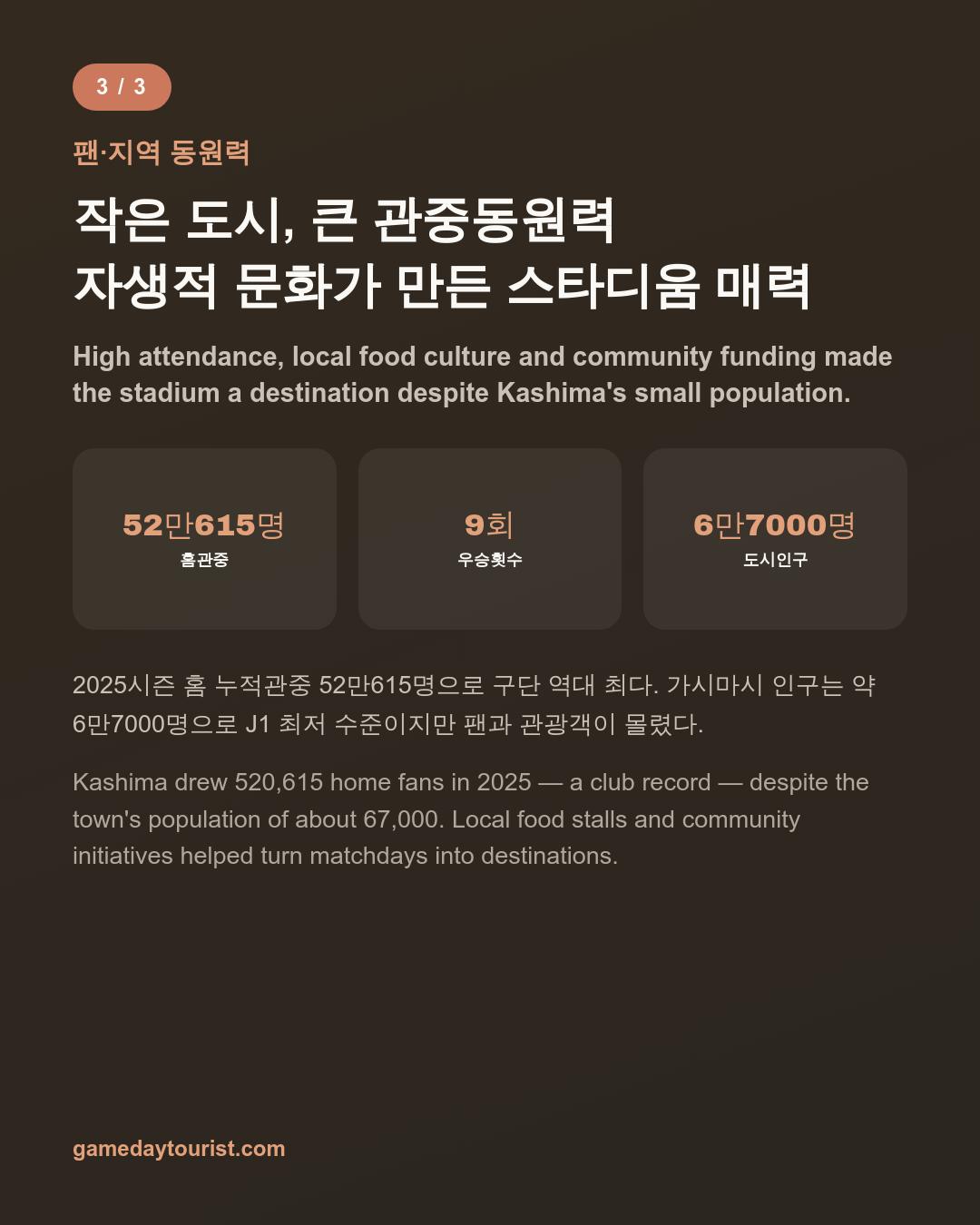
The total home league attendance that year reached 520,615, a new club record. However, in 2026 the league format was temporarily changed (a special tournament format called the “Centennial Vision League,” with East/West group stages followed by playoffs to decide the champion): they dominated the group stage with 18 matches, 29 goals scored and 9 conceded, but lost to Vissel Kobe in the final on aggregate 2-5 over two legs and finished as runners-up.
What makes this attendance figure more interesting is that Kashima City, the hometown, has a population of about 67,000 — the smallest among J1 club home bases.
Moreover, it requires at least a two-hour express bus ride from Tokyo Station without using the Shinkansen (one way about 2,100 yen). One local feature outlet ran a piece titled “Why tens of thousands flock to a landlocked, remote island,” describing the phenomenon.
Concession Culture and F&B — The Grassroots “Motsuni” Brand
One football media reporter who watched a match from the home supporters’ side for the first time wrote that, having only sat in away sections before, they were surprised to find more than twenty food stalls lined up on the second-floor concourse on the home side and a school-festival-like atmosphere that felt delightful.
Many of these stalls commonly sell a famous dish called motsuni (tripe stewed for a long time in a miso-based broth). About twenty years ago, one stall’s accidental hit menu was imitated by neighboring stalls and naturally became the stadium’s signature food. I haven’t tried it personally, but if I get the chance I’ll definitely try it.
It wasn’t planned by anyone; the stalls competed and the brand emerged organically. As a marketer, this reconfirmed that bottom-up spread like this often endures longer and becomes true fan culture more than forced campaigns pushed from above.
The price range is also affordable at about 500–700 yen, and bloggers writing online viewing guides provide detailed advice on how different stands and times feel — for example, the main stand has a lot of shade and can be chilly during day matches, while the back stand gets good sun but can be harshly west-facing in the evening.
Merchandise, Sponsorship, and Broadcasting Rights
Looking at merchandise and sponsorship indicators, operating revenue for fiscal 2024 was 7.2 billion yen, the second-highest in club history, and the club returned to profit for the first time in three years. Notably, transfer income amounted to 964 million yen (499 million yen from overseas transfers and 465 million yen from domestic transfers).
The uniform is filled with sponsors: main sponsor JAL (Japan Airlines) on the front, Casio on the chest area, Otsuka Pharmaceutical on the back, Nidec on the sleeves, and partners such as Ajinomoto AGF, Kirin Beverage, ASICS, Sagawa Express, and JT also listed. On broadcasting rights, the entire J.League signed a 10-year, 210 billion yen contract with DAZN starting in 2017, and in 2023 it was extended again for up to 239.5 billion yen over 11 years, so Kashima also receives a portion of that pie.
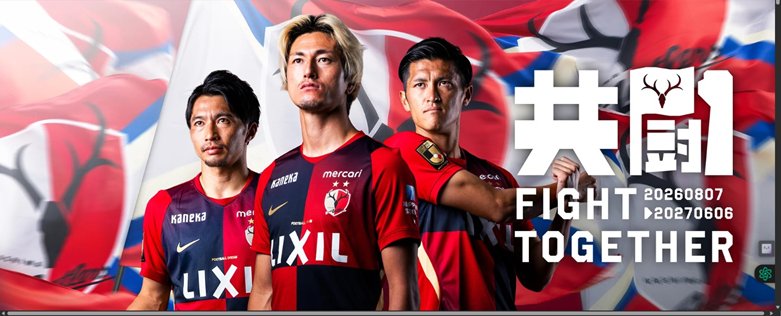
Community Integration — Hometown Tax Crowdfunding
While researching, what impressed me most on the community side was the “hometown tax-style crowdfunding.” It’s similar to Korea’s “hometown love donation system.” I recall players and fans actively promoting this system, but it hasn’t been that widely activated in the Korean sports industry yet.
Using Japan’s hometown tax system (where donating to a municipality other than where you live entitles you to tax deductions), fans can donate with an effective personal cost of around 2,000 yen, the money counts as municipal revenue, and it’s then funneled back into things like the club’s youth facility improvements — a structure they created during the COVID-19 crisis in 2020.
Using this method, they collected about 610 million yen cumulatively over five years up to 2024 and gathered roughly 10,000 supporters in total. Additionally, the “Antlers Hometown Tourism Area Development Corporation,” established in 2018 (a Japanese-style tourism promotion organization that plans and manages integrated regional tourism content, commonly called a DMO), runs corporate collaboration projects not only with Kashima City but with four neighboring cities — an approach that seems to go beyond simple promotion.
Comparing with the K League
Compared to the K League, the implications are clear.
For the 2025 season, K League 1’s paid attendance exceeded 2 million, and the league’s total gate revenue reached 46.1 billion won, reportedly a record high. Yet the combined home attendance for all 12 K League 1 clubs is still less than four times Kashima’s single-club 2025 home attendance (520,615).
Of course, it’s risky to make a direct comparison given differences in league scale and history, but while there are virtually no examples of stadium naming rights being sold domestically in Korea, in the J.League the parent company even buys naming rights directly and experiments with brand integration — a point K League clubs should take note of.
In particular, the fact that the “motsuni culture,” grown voluntarily by food stall vendors rather than planned by the club, became a symbolic element of the stadium shows that creating room for organic growth can be an excellent marketing strategy, rather than forcing fan experiences from above.
Leave a Reply