Contents · About 6 min read
- Intuit Dome — An Arena Built Around AI From Day One
- The Halo Board — A 360-Degree Screen With No Blind Spots
- The Wall and Seat Design Built for Participation
- No-Paper Entry — Facial Recognition and Biometrics
- A Sustainability Detail — The Vertical Farm
- Comparing with kt wiz — Different Starting Points, Same Direction
- How AI Is Reshaping the Sports Industry
- Closing Thoughts
📱 View as card news
I toured the Intuit Dome, the LA Clippers’ home arena.
This post takes a different angle from other stadium reviews: I want to focus solely on this venue through the lens of AI technology and digital innovation. Having worked in marketing for over 15 years, I’ve heard the term “AI stadium” many times, but Intuit Dome is the first — and the best — I’ve seen that realizes that concept so completely.
Intuit Dome — An Arena Built Around AI From Day One
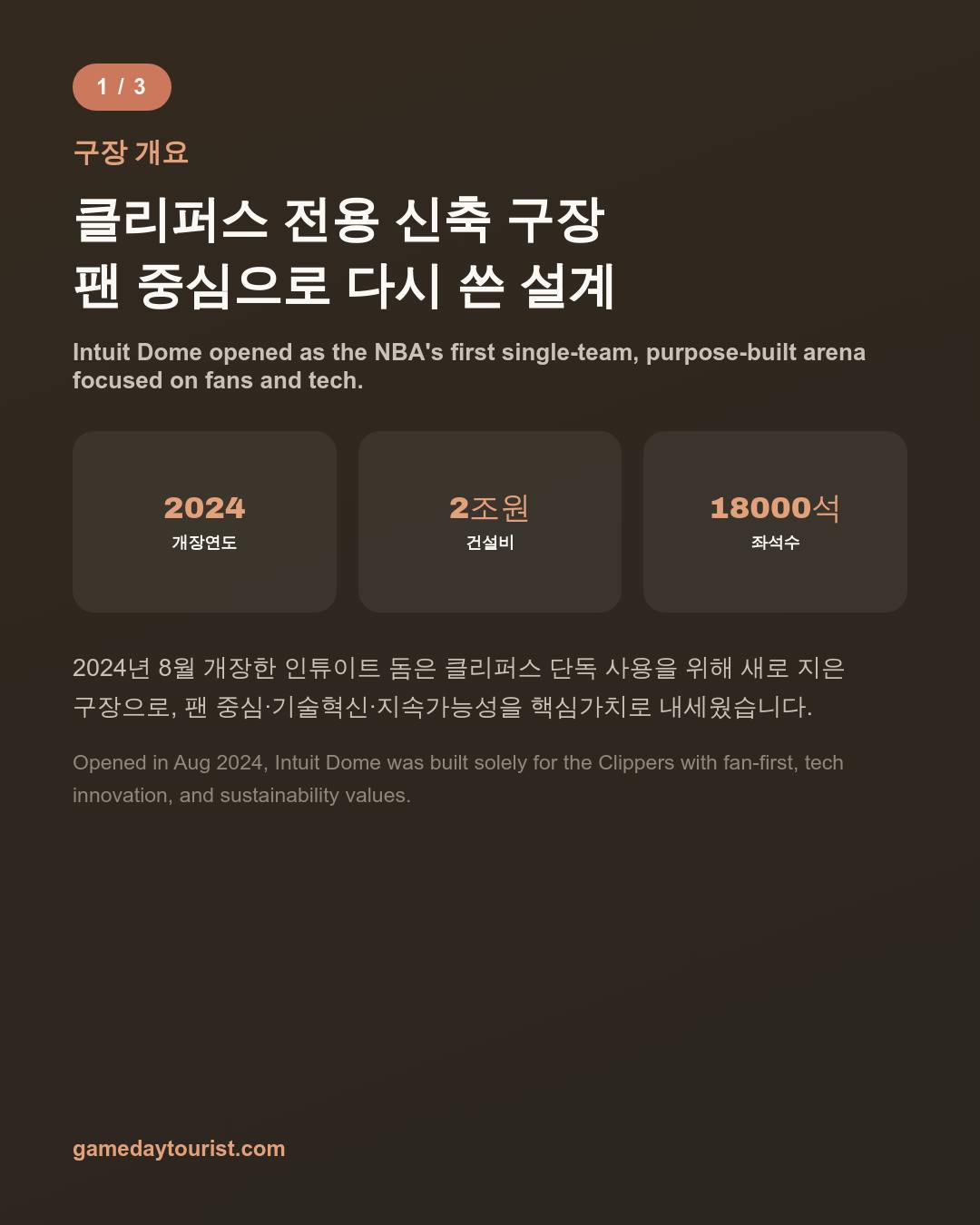
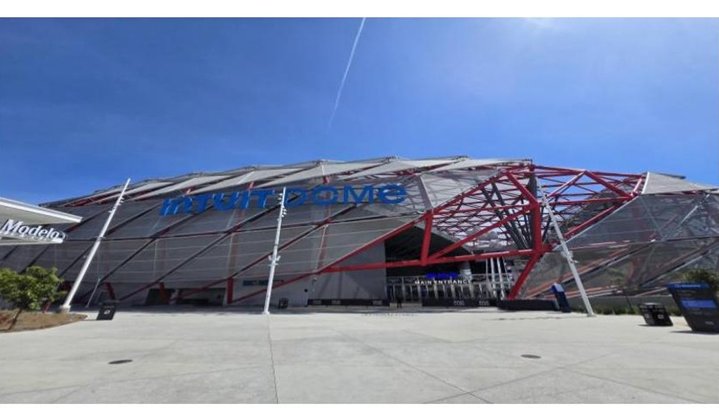
The Intuit Dome is a newly opened arena that debuted in August 2024, located in Inglewood, California.
What’s notable is that this arena was built from the ground up for the Clippers alone — the first time in NBA history a venue was constructed without sharing with another team. The owner reportedly funded it entirely out of pocket, and construction costs alone exceeded 2 trillion Korean won.
The seating capacity is about 18,000, which is actually smaller than many other NBA arenas, but it felt like they invested more in the density and quality of each seat. The club’s core values from the start were “fan-centric,” “technological innovation,” and “sustainability.”
The Intuit Dome is a newly opened arena that debuted in August 2024, located in Inglewood, California. What’s notable is that this arena was built from the ground up for the Clippers alone — the first time in NBA history a venue was constructed without sharing with another team. The owner, Steve Ballmer, reportedly funded it entirely out of pocket, and construction costs alone exceeded 2 trillion Korean won. The seating capacity is about 18,000, which is actually smaller than many other NBA arenas, but it felt like they invested more in the density and quality of each seat. The club’s core values from the start were “fan-centric,” “technological innovation,” and “sustainability.”
The Halo Board — A 360-Degree Screen With No Blind Spots
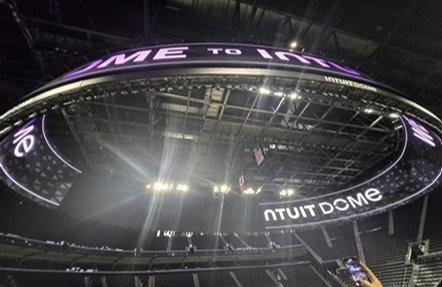
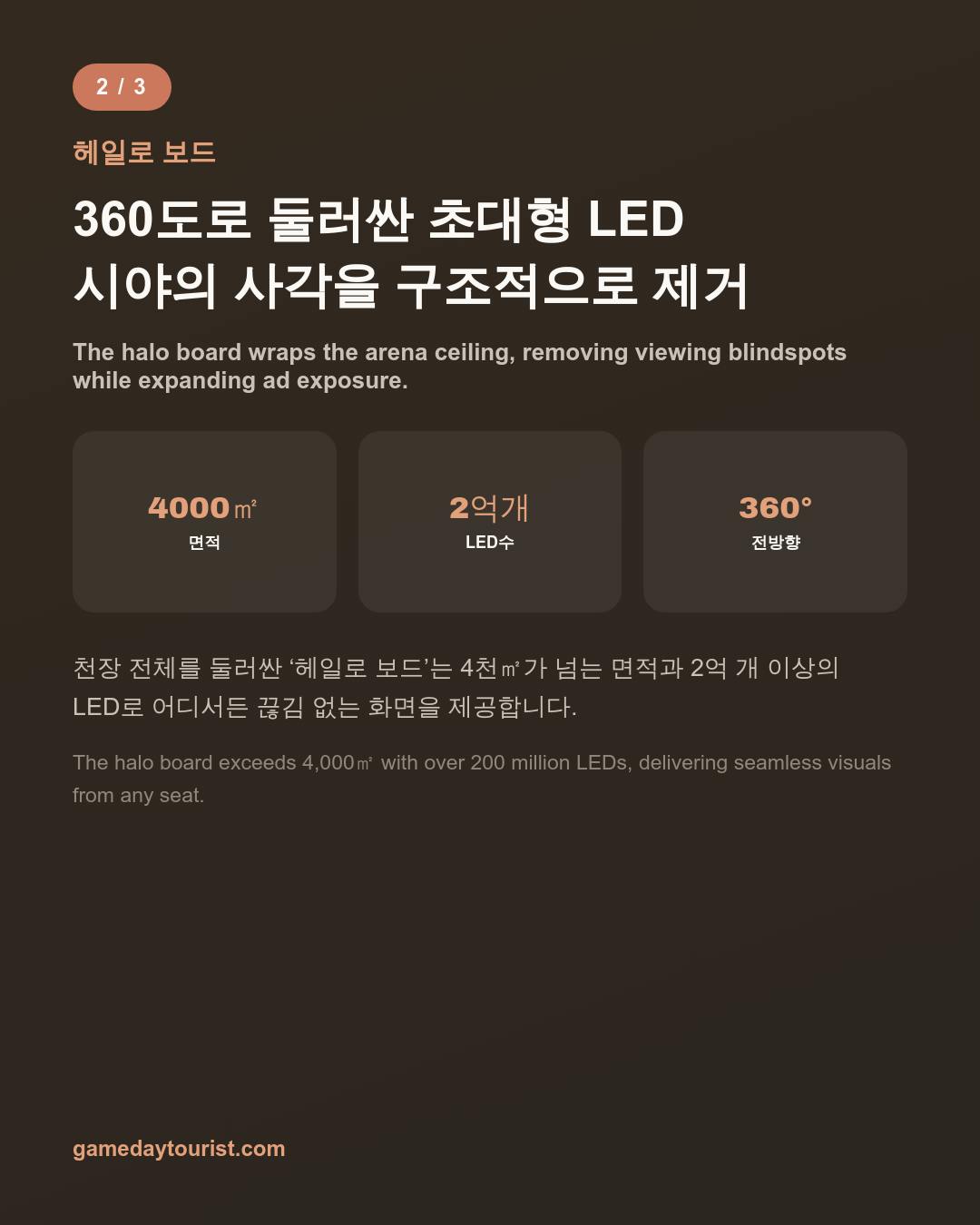
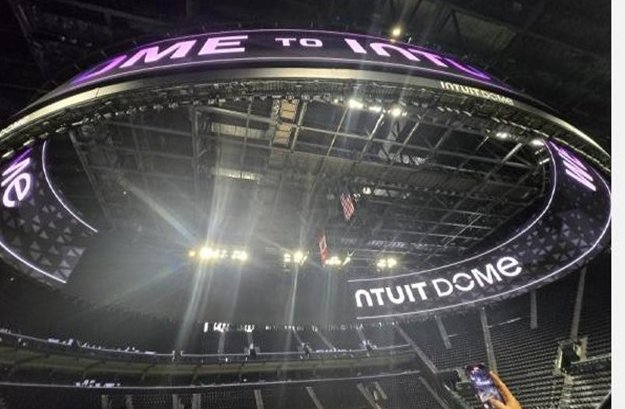
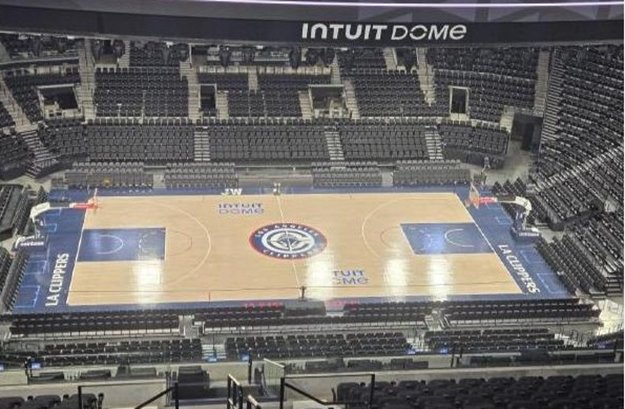
The most iconic feature was the scoreboard called the “Halo Board.”
It’s a double-sided LED screen encircling the entire ceiling 360 degrees, covering more than 4,000 square meters and containing over 200 million LED elements.
I deliberately moved around to different seats to see how the screen looked, and even from the far end opposite the court the display appeared seamlessly without interruption or awkward neck angles.
Traditional arenas typically hang scoreboards only at the ends of the court, which naturally creates blind spots depending on seat location. This arena’s ring-shaped scoreboard is visible from anywhere above the seating bowl, solving that problem structurally.
From a marketer’s perspective, this isn’t just a scoreboard upgrade — it rethinks the age-old trade-off between ad impressions and sightlines.
The Wall and Seat Design Built for Participation
The seating design was also thoroughly built around fan participation. A section called “The Wall” is a continuous 51-row block of seats right next to the visiting team’s bench for diehard Clippers fans, inspired by Dortmund’s “Yellow Wall,” familiar to soccer fans.
I sat in a regular seat and plugged my phone into the USB-C port and tried the lighting buttons at the side — small devices but strangely addictive to use. Some seats even have built-in game controllers so fans can enjoy short interactive events between plays. These details turned watching from passive observation into a continuous participatory experience.
No-Paper Entry — Facial Recognition and Biometrics
What really made the term “AI stadium” feel tangible was the entry process.
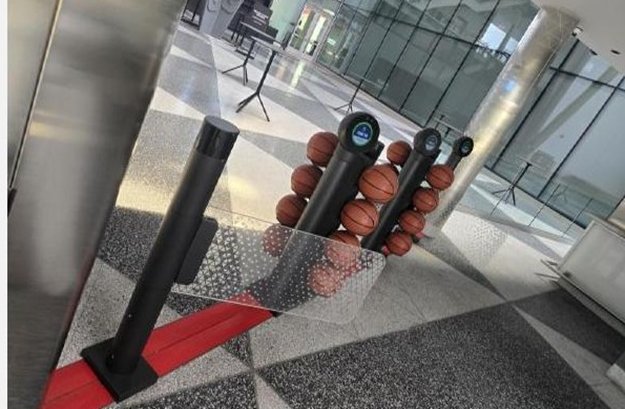
They use facial recognition and biometric technology to enable a “no-paper” flow where tickets and payments are all handled without physical media. Standing at the gate, it felt like 2–3 seconds from face scan to passing through. At first it felt slightly strange not to pull out a wallet or phone, but after two or three times, the old way of digging for a ticket felt cumbersome.
They said AI underpins the CCTV and multimedia systems, and the collected personalized data feeds back into marketing, linking seat controllers and the app to drive real-time fan engagement. I also bought a drink via self-checkout at a restaurant called “310 Provision,” and the contactless process completed immediately with no lines or staff wait time — the wait time was nearly unnoticeable.
A Sustainability Detail — The Vertical Farm
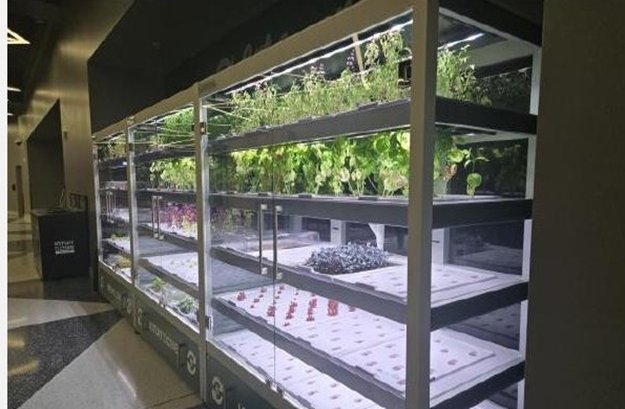
Along one circulation path, a small vertical farm was exhibited in a glass display case — a visible implementation of the arena’s sustainability value of carbon neutrality. After hearing all the flashy tech stories, seeing this detail gave the impression that while the venue pushes AI and technology, it also carefully manages the overall tone of the fan experience.
Comparing with kt wiz — Different Starting Points, Same Direction
In Korea, the team that first and most actively promoted the concept of an “AI stadium” is kt wiz of the KBO.
Starting in the 2025 season, kt wiz promoted itself as the country’s first AI stadium under the theme “AI meets baseball,” introducing systems that analyze crowd density and safety in real time and display guidance on the scoreboard, plus an English app for foreign spectators.
At the 2025 season opener against the Hanwha Eagles, they also drew attention with events like a drone show. They have a tradition of using IT for unmanned ceremonial first pitches. These efforts were recognized in the industry: kt Sports received the Prime Minister’s Commendation at the 21st Korea Sports Industry Awards in December 2025. It was their second national-level award following a Presidential Commendation in 2019, showing these results didn’t appear overnight.
Comparing the two stadiums, the approaches are quite different. The Intuit Dome was designed from site selection through construction on a blank slate with AI and technology as prerequisites, while kt wiz renovated a stadium built in 1989 and has been layering AI on top step by step. Though they started from different places, their direction is the same.
I’ll cover kt wiz’s AI stadium development process and technical details much more thoroughly in a separate post, since there’s a lot to discuss.
How AI Is Reshaping the Sports Industry
What this visit reaffirmed is that AI is rapidly reshaping the sports industry.
The generative AI analytics platform from FIFA and Lenovo can recreate a team’s tactical patterns with 3D avatars to provide coaching staff with pre-game tactical simulations. The German Bundesliga, collaborating with AWS, overlays real-time data like shot-to-goal probability and players’ average speeds on the broadcast. Services that automatically generate personalized highlight clips from game footage for each fan are already on the market, and AI-driven unmanned broadcasting systems are enabling thousands of live-streamed amateur matches annually that would previously have been impossible due to budget constraints.
Closing Thoughts
In summary, AI is no longer a supplementary feature on a broadcast screen; it has become the infrastructure that runs through venue operations — from entry, payment, seating, and marketing to content production.
Whether built new like the Intuit Dome or layered onto an existing venue like kt wiz, the direction is already set. How early and how deeply teams ride this wave will likely determine the gap between domestic clubs within a few years — a conviction that became clearer after passing through the gate and sitting in the seats myself.
Leave a Reply