Contents · About 8 min read
📱 View as card news
While summarizing recent international sports business news, one number caught my eye.
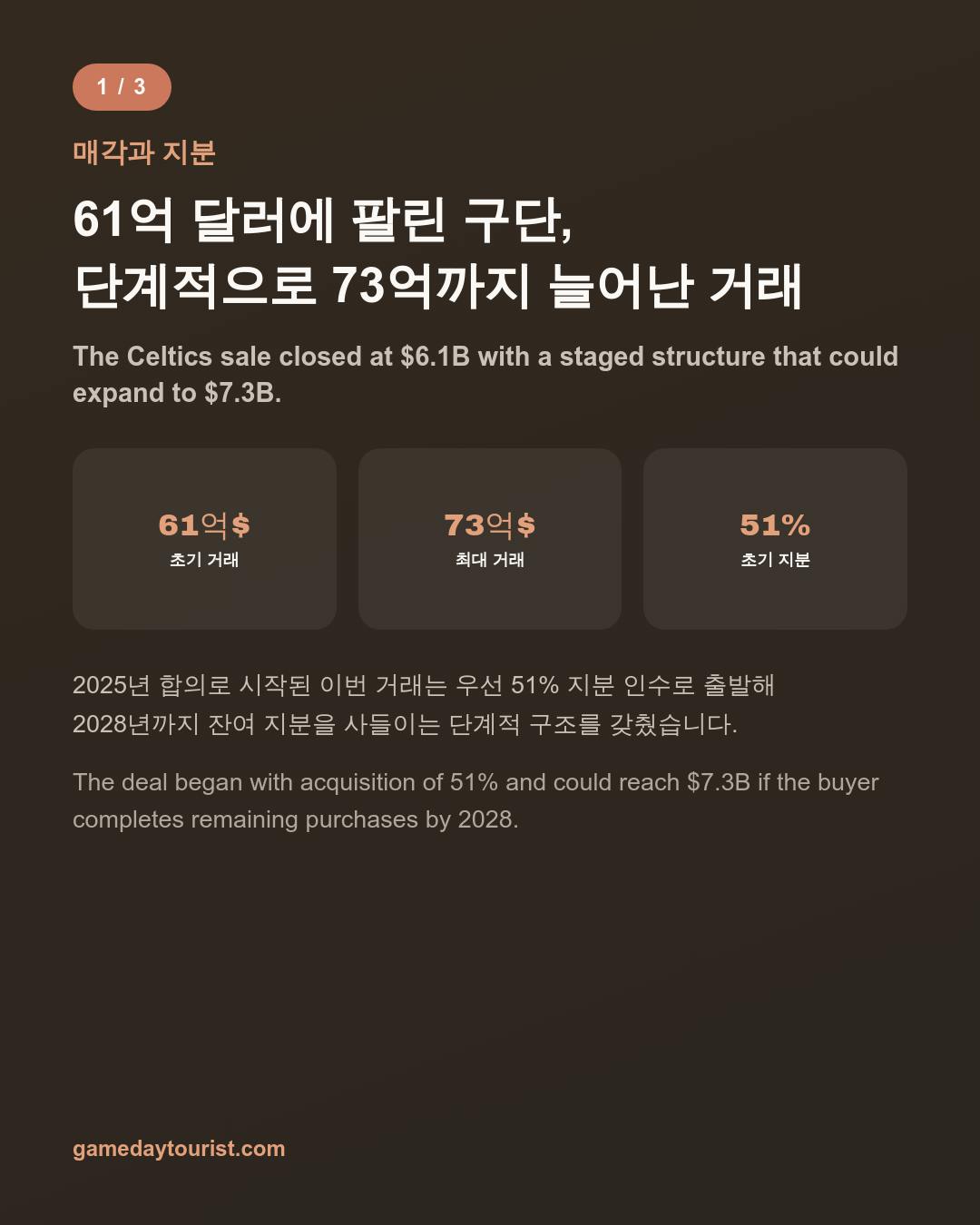
The agreed-upon and finalized sale price of the Boston Celtics last March/August was $6.1 billion. Converted to Korean won (at an exchange rate of ₩1,580), that’s about ₩9,638 billion, marking the most expensive sale of a professional sports franchise in U.S. history.
Bill Chizolm, who heads private equity firm Symphony Technology Group, is the lead buyer. His consortium initially acquired a 51% stake, with a staged structure in which buying the remaining shares by 2028 would raise the total deal value to $7.3 billion.
As a marketer who has followed many team sales and investment news, I couldn’t stop thinking that a team anchored to an arena of only about 19,000 seats—much smaller than a Major League Baseball park or a soccer stadium—could command such a price. That made me look at TD Garden again from a marketer’s perspective.
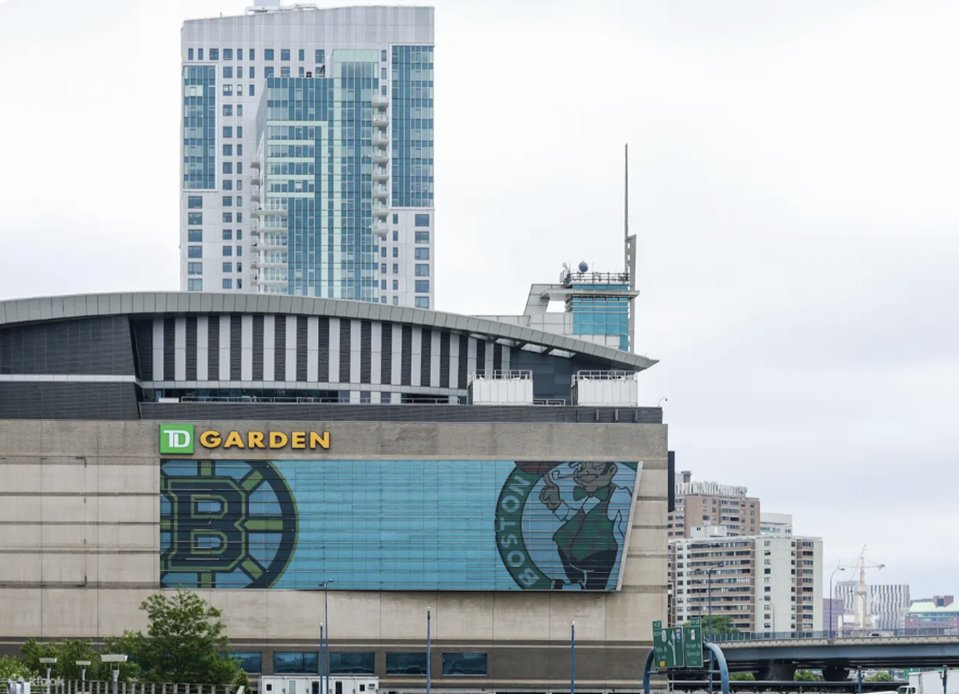
Source: en.wikipedia.org (capture from the ‘TD Garden’ Wikipedia page)
Fans and Attendance
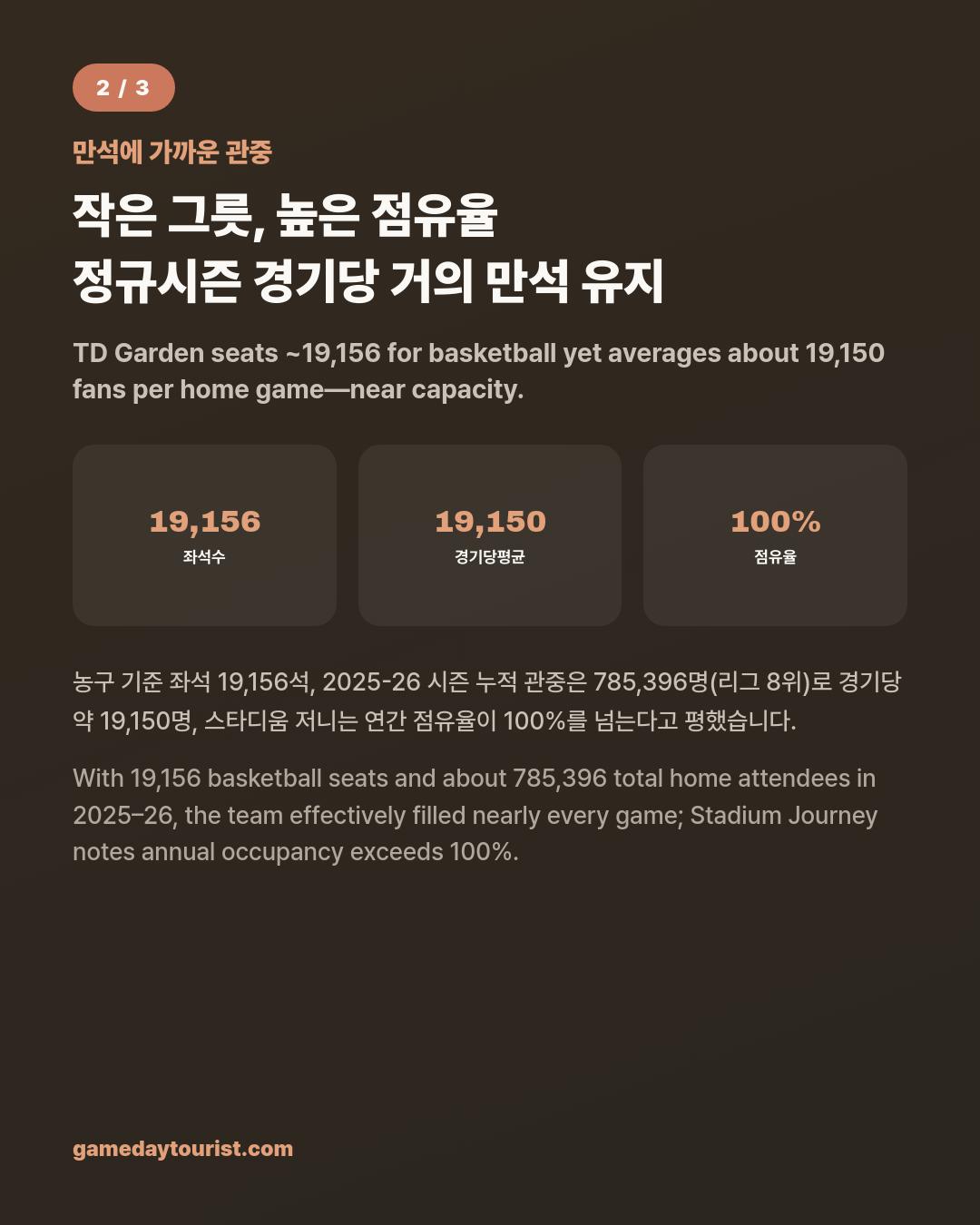
TD Garden opened in 1995; its basketball seating capacity is 19,156 and its maximum capacity is 19,580.
Among the NBA’s 30 teams it ranks in the lower-middle range by facility size, but the fill rate of this relatively small bowl is worth noting.
Stadium Journey, a review outlet specializing in North American sports venues, assessed the Celtics’ annual average occupancy as exceeding full capacity year after year.
In fact, the cumulative attendance for the 41 regular-season home games in 2025–26 was 785,396, ranking 8th in the league. That works out to roughly 19,150 per game—essentially a sellout every night.
From a marketer’s point of view, seats being nearly always filled means the value of advertising inventory (the exposure space/time available to sell to advertisers) is stably guaranteed.
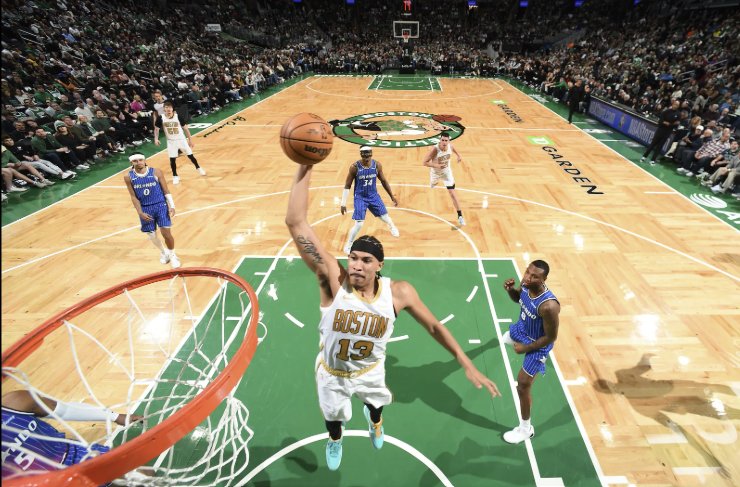
TD Garden’s Signature Asset — The Parquet Floor
One asset of TD Garden that I, as a marketer, envy is the Celtics’ distinctive parquet floor.
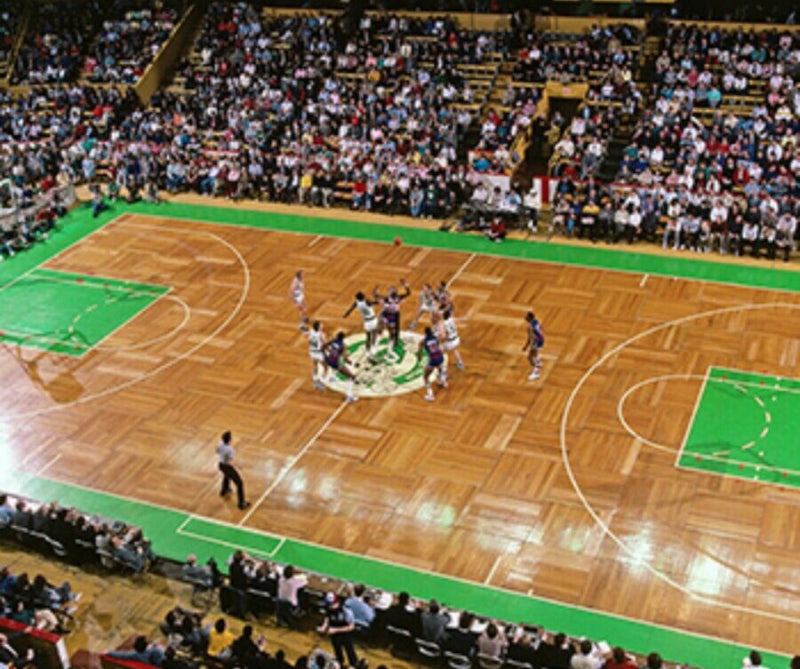
Source: Screenshot from NBA.com, the Boston Celtics’ parquet floor
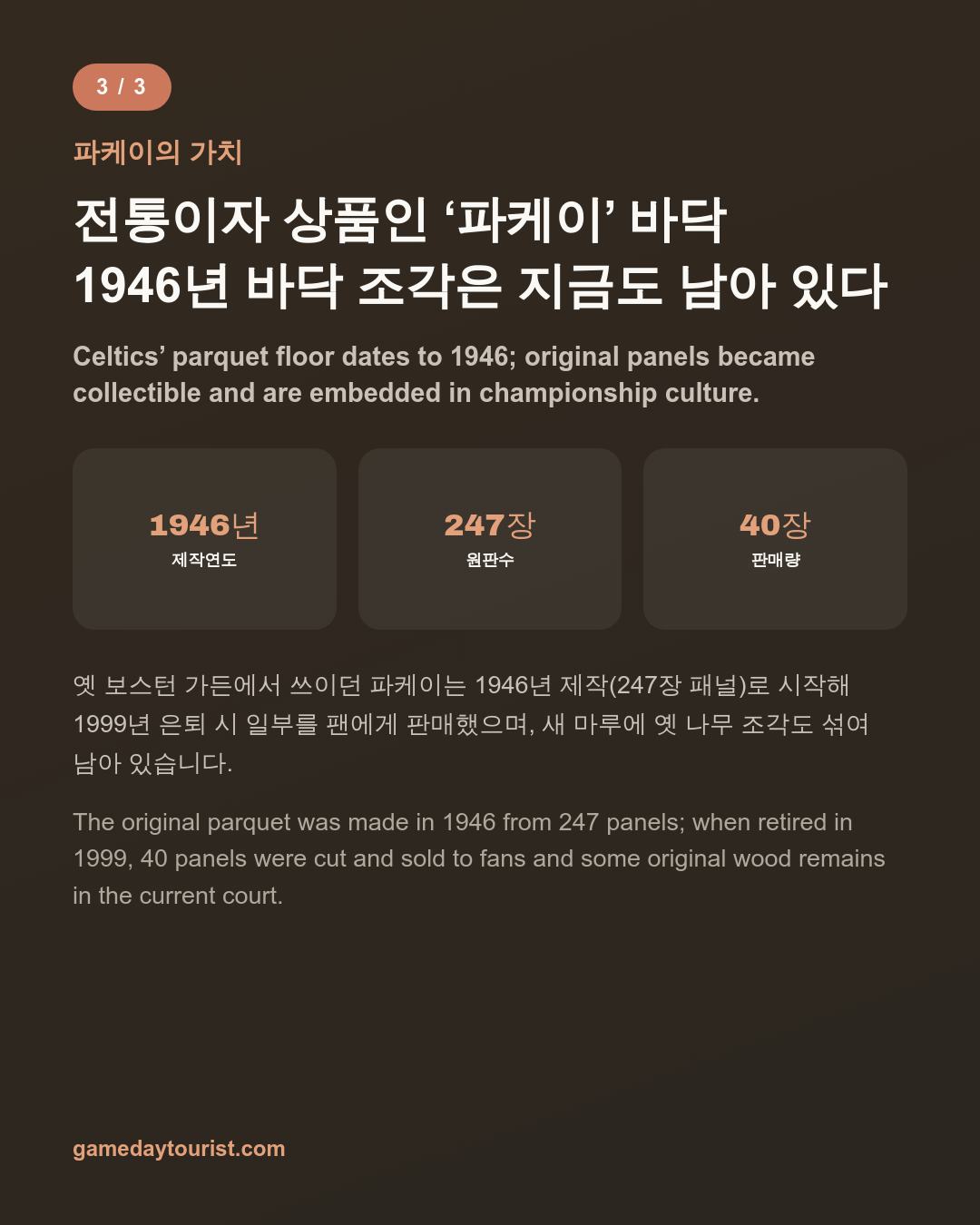
The original parquet was created just after World War II in 1946 during a lumber shortage. To conserve Tennessee oak, 247 square panels of 5 feet (about 1.5 meters) were staggered and joined to form the floor.
It is said that then-owner Walter Brown installed the floor because he believed that to attract top players the home court needed to be the best in the league.
The parquet used in the old Boston Garden was transplanted to the current arena in 1995 and remained in use until its retirement in December 1999. Some pieces of the original wood were mixed into the new floor at retirement, so somewhere on the TD Garden court there is still wood dating back to 1946.
As a result, the Celtics are the only NBA team to use oak rather than maple for their court. Longstanding talk of dead spots—areas where the ball bounces unpredictably—has followed the floor for years; the rumor goes that home players memorize those spots and gain a subtle advantage over visitors, making the floor itself a narrative asset.
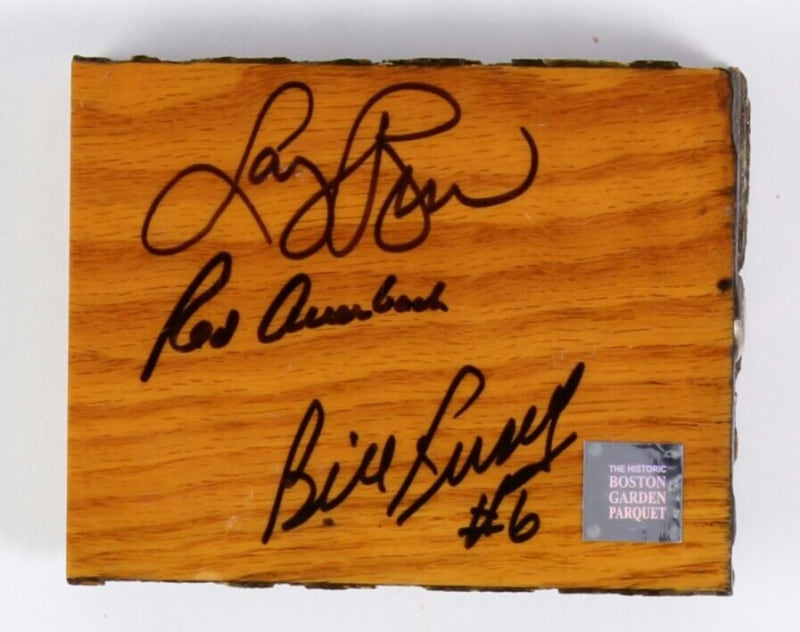
Source: Auction — Celtics parquet floor with signatures of Bill Russell and coach Red Auerbach
Fans’ attachment to this floor has translated into tangible products and events.
When the old floor was retired in 1999, the team cut 40 panels into pieces and sold them to fans; to this day, pieces of the old parquet with player signatures regularly appear on the auction market.
The club has a long-standing tradition of gifting a piece of floor to retiring players as a memento.
The championship ring made for the 2024 title even embeds a piece of the parquet inside the ring, with the date and score of the clinching game engraved. The ring is designed so that turning the top reveals the wood piece, and an NFC chip next to the segment plays a video of the ring’s creation when a smartphone is tapped.
Inside the arena there is a corridor recreating the old floor between suites 504 and 505, and the team regularly invites local children to run on the actual court. One child who participated told local media, “I couldn’t believe I actually ran on the same court where Celtics players run.”
From a marketer’s perspective, the floor differs from visual brand assets like logos or team colors. Because physical pieces are sold to fans, embedded in championship rings, and given to retiring players, it’s not just a visual asset but a tangible brand heritage.
Space Utilization and F&B
On the space-utilization side, a 2014 renovation by Delaware North (owner/operator of TD Garden) that cost $70 million was a turning point.
By widening the concourses, they secured about 1,394 m² (approximately 422 pyeong, 15,000 sq ft) of new concession space on the 4th and 7th floors, and per-capita concession revenue reportedly rose 50% as a result.
There are 47 permanent concession stands offering vegetarian, vegan, kosher, and gluten-free options. However, local reviews frequently point out that concession prices are among the highest in the league; Stadium Journey even gave a 2 out of 5 for value-for-investment, which is worth noting.
And in April this year, Delaware North announced an additional $100 million renovation plan to refurbish all 83 suites in the arena over three years.
When that investment is completed, Delaware North’s cumulative spending on TD Garden will exceed $500 million.
Merchandise (MD)
Nike runs the team’s official merchandise store, with jerseys, hats, and hoodies sold through the arena pro shop, online store, NBA Store, Fanatics, and other channels.
The team does not disclose exact merchandise sales figures, but the fact that Jason Tatum jerseys remain among the best-sellers suggests a star player’s narrative influences product sales. Tatum suffered a ruptured right Achilles during the Eastern Conference semifinals last May but returned to the court this season after an unusually quick recovery.
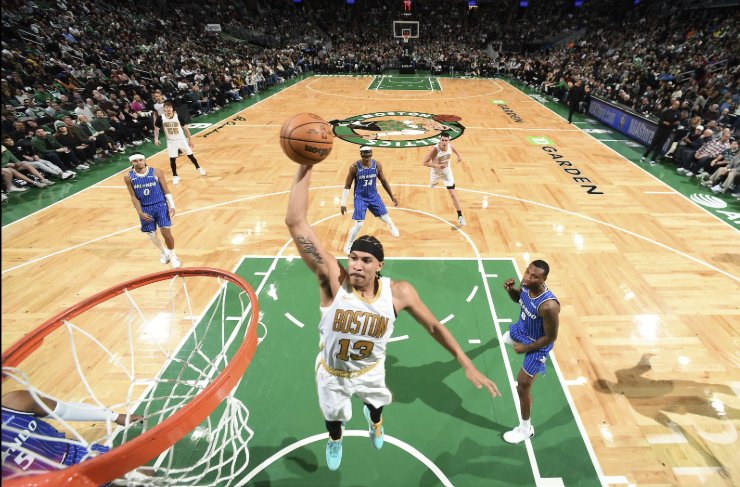
Source: Boston Celtics official website PHOTO section
Advertising Inventory and Naming Rights
The most prominent advertising asset is the naming rights. It’s also impressive to see the team’s history hung from the arena ceiling.
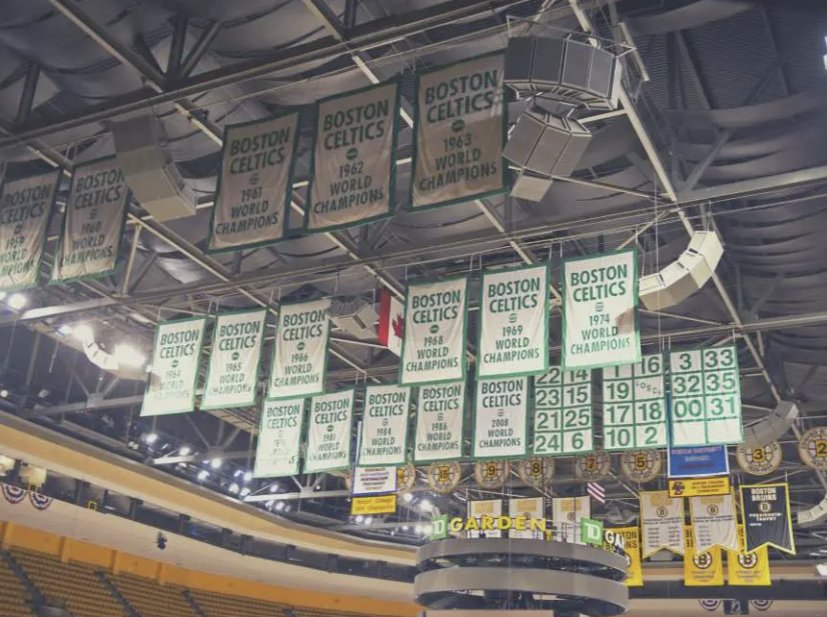
Source: Boston Celtics official website PHOTO section
Toronto-based TD Bank first put its name on the venue in 2005 with a 20-year deal (about $6 million per season plus community and facility investments totaling roughly $138 million). In January 2023, TD extended the agreement for another 20 years through 2045.
The extension’s exact terms were not disclosed, but TD Bank’s pledge of $15 million for community programs suggests the renewal was also substantial.
The uniform jersey patch spot has been occupied by Amica Mutual Insurance since the 2024–25 season; the multi-year deal is notable because it covers the full range of automobile, home, and life insurance as an official partner.
Tickets
Ticket prices averaged $114 in the 2025–26 season, ranking 4th in the league.
That’s just the face value, though — on the secondary market, prices vary widely by game and seat.
Parking is also steep: the arena’s underground garage is $65, and nearby private lots run $30–$52. Local reviews consistently recommend using North Station subway directly above the arena and taking the $2.40 fare, so that tip may be helpful.
Broadcasting Rights
Regarding broadcast rights, the NBA’s landscape changed completely this season. Beginning with the 2025–26 season, a new 11-year, $76 billion league-wide media rights deal reorganized coverage: Turner Sports (TNT), which had broadcast the NBA for 36 years, is out, and ESPN/ABC ($2.6 billion per year), NBC ($2.5 billion per year), and Amazon Prime Video ($1.8 billion per year) now form the three-broadcaster structure.
Regional Celtics broadcasts remain on NBC Sports Boston, which airs 67 games and streams some via Amazon Prime. When league-wide rights expand this much, the distributions to individual teams become a major revenue source comparable to ticket income.
Community Integration and Economic Impact
On the community-integration front, the Hub on Causeway development next to TD Garden is symbolic. Spanning nearly the area of twenty soccer fields, it includes a citizenM hotel (272 rooms), a 440-unit residential tower with one of Boston’s highest rooftop pools, the city’s largest supermarket, an 18-store food hall, a movie theater, and offices.
Even on non-game days, the area draws people—this is less about building a stadium and more about a city-development model anchored by a sports facility.
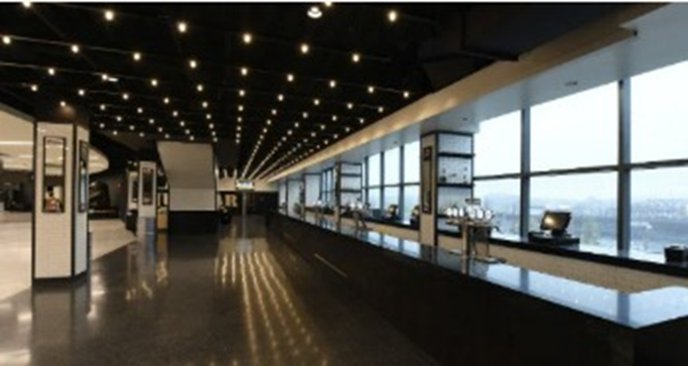
Source: tdgarden.com (capture from TD Garden official website Food & Drink page)
Looking at these numbers together, Forbes’ recent valuation of the Celtics at $6.7 billion (5th in the league, behind the Golden State Warriors, LA Lakers, New York Knicks, and LA Clippers) is not so surprising.
Comparing with the KBO and K League
Compared with the KBO and K League, the absolute scale is of course very different, but there are clear takeaways.
Domestic teams have also been actively pursuing stadium sponsorship deals and F&B renewals in recent years, and the TD Garden example shows these investments shouldn’t be one-off but renewed on decade-long cycles.
From the $70 million renovation in 2014 to the naming-rights renewal in 2023 and the $100 million suite refurbishment in 2026, TD Garden has continuously reinvested in its facilities to raise per-customer spending and advertising rates.
For downtown venues where increasing seat count is difficult, TD Garden demonstrates there is no magic solution other than repeated renovations to grow per-capita spending and brand assets.
And like the parquet floor, reanimating an old asset through storytelling rather than building something new is a marketing asset domestic clubs should seriously consider.
Leave a Reply