Contents · About 14 min read
- The Name That Got “Daejeon” Back — 25 Years Bought for ₩48.6 Billion
- What Kind of Team Are the Hanwha Eagles? — One Title, Six Runner-Up Finishes
- How to Get to Daejeon Hanwha Life Ballpark and Buy Tickets — Based on the Club’s and Stadium’s Official Guidance
- Attendance and Tickets — A Ballpark That Hit the 17,000-Seat Ceiling
- Space Use and F&B — The Food Design of a Ballpark That Allows Outside Food
- Advertising Inventory and Naming Rights — Even the Gates Carry a Name
- Compared with the KBO — Samsung Lions Park Has 24,000 Seats, Hanwha Will Have 20,000
📱 View as card news
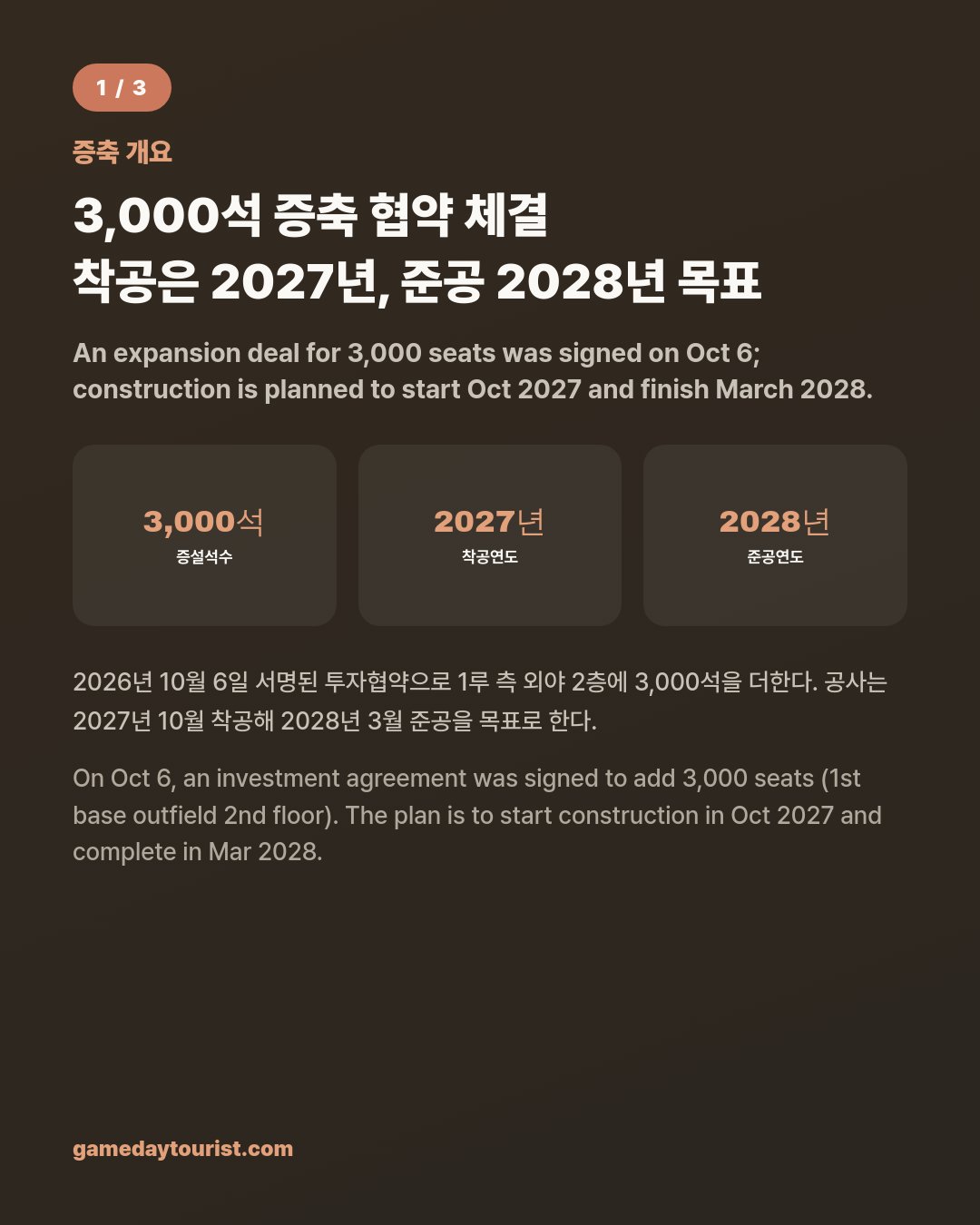
On October 6, a signing ceremony was held in the underground second-floor press room at Hanwha Life Ballpark. Hanwha Eagles CEO Park Jong-tae and Daejeon Mayor Heo Tae-jung signed an investment agreement to add 3,000 seats, with construction targeted to start in October 2027 and finish in March 2028.
Not a spade has gone into the ground yet, so until the 2027 season the current roughly 17,000 seats are all this ballpark has.
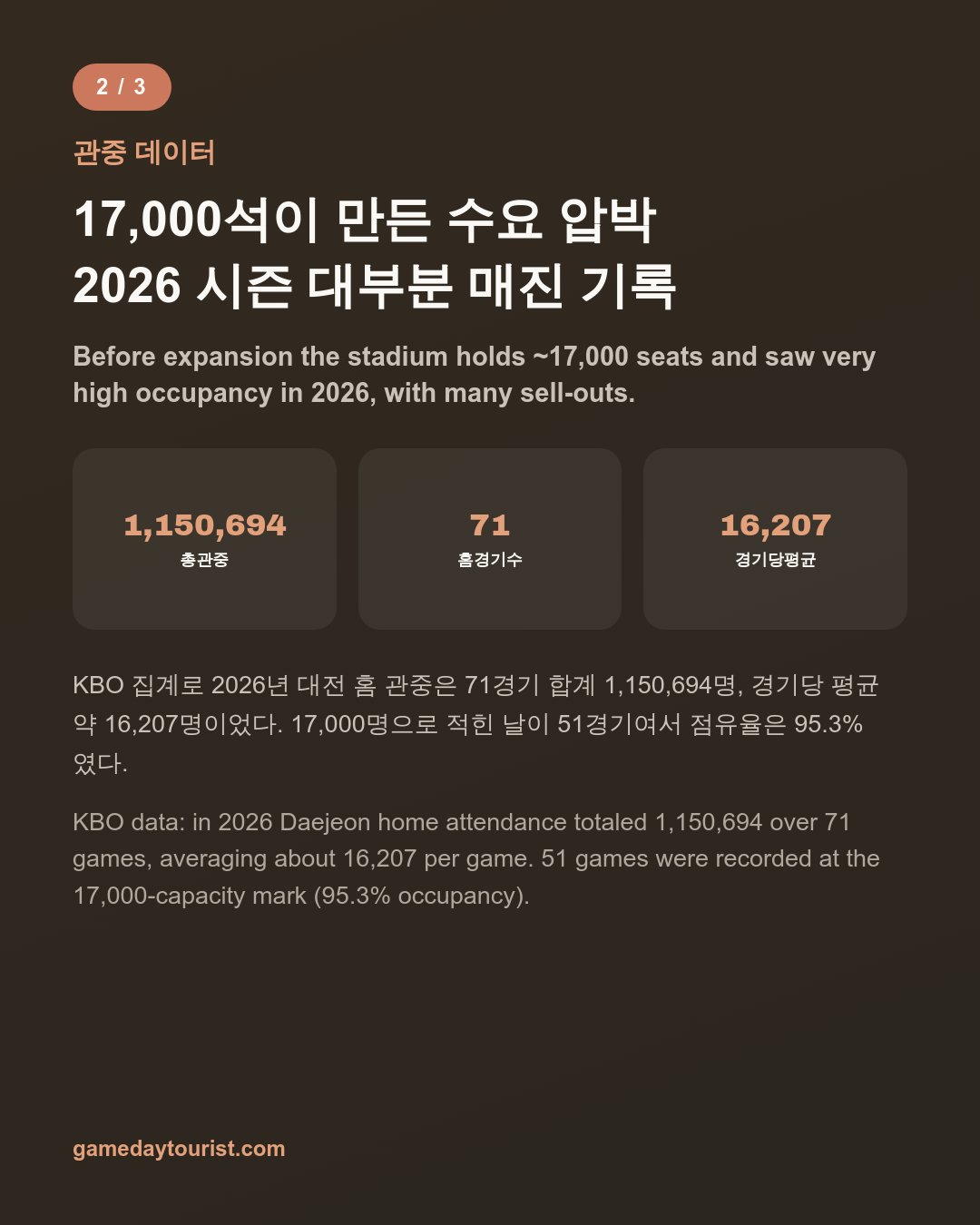
The ballpark opened in March 2025 and was hard to get into from the first year, and in 2026 as well, the KBO’s official figures list the attendance at 51 of Daejeon’s 71 home games as the 17,000 capacity.
To a marketer, this agreement reads both as an answer to fans’ complaints that “there aren’t enough tickets” and as an investment that lifts the club’s revenue ceiling by 3,000 seats.
So for those who want to visit before construction starts, I begin with how to get there and the booking rules, then go through the ₩48.6 billion, 25-year usage deal and the structure of attendance, food and advertising in numbers.
This post covers two things. One is how to get there, how to book tickets and the entry rules, as confirmed from the club’s official guidance, and the other is data on how a 17,000-seat ballpark runs and why it has reached an expansion agreement.
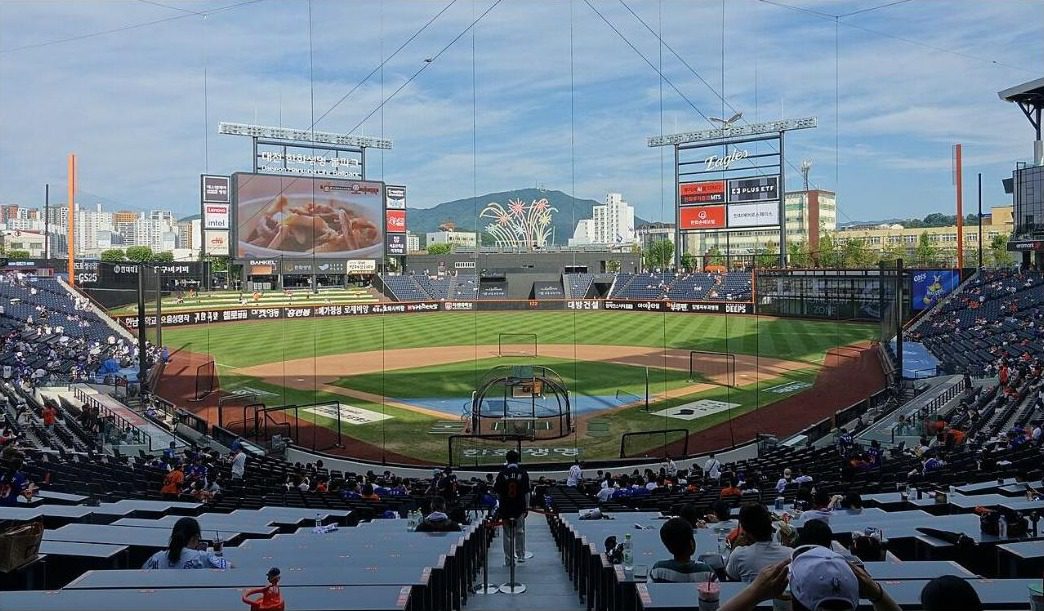
Photo: Seohae1999 · Source: Wikimedia Commons · License: CC BY-SA 4.0 · Uploaded to Wikimedia on July 31, 2025. A view of Daejeon Hanwha Life Ballpark from the infield stands (with fans)
The Name That Got “Daejeon” Back — 25 Years Bought for ₩48.6 Billion
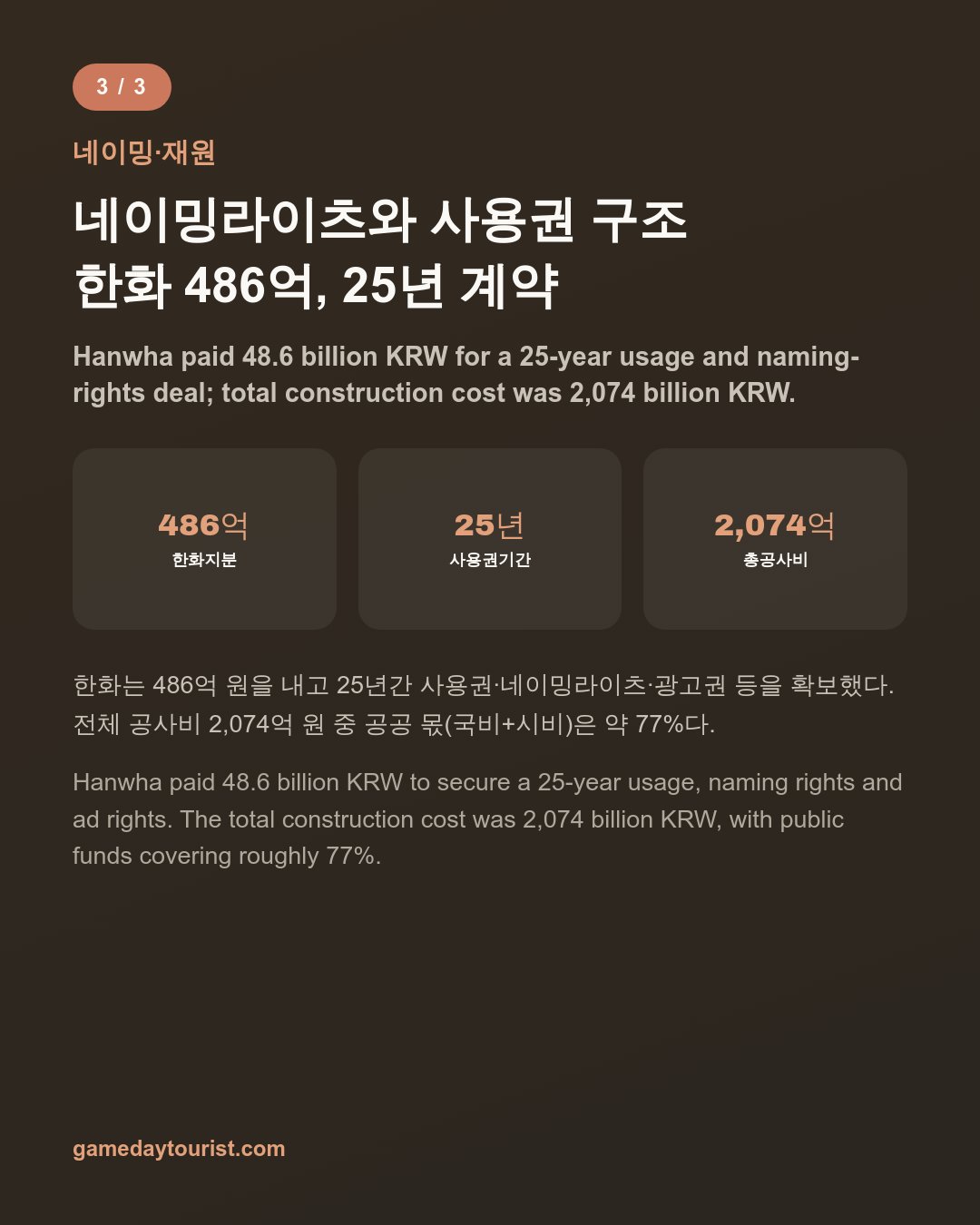
There was a tug of war over the ballpark’s name. In November 2023 Hanwha signed a usage and revenue contract for the new ballpark with the city of Daejeon, paying ₩48.6 billion, and in return secured revenue rights such as 25 years of use of the ballpark, naming rights (the right to attach a company brand to a stadium’s name) and advertising rights.
The total construction cost of ₩207.4 billion was split into ₩15 billion from the national government, ₩143.8 billion from the city and ₩48.6 billion from Hanwha (per OSEN). The public share, national and city combined, comes to about 77% (my own calculation).
The name Hanwha first chose was “Hanwha Life Ballpark,” but as Daejeon wanted the city name in it, public opinion grew that the place name had been left out. In the end, on January 20, 2025, the name was fixed as “Daejeon Hanwha Life Ballpark.”
The club explained that it put in “Daejeon” as a way of repaying the fans who came to its Daejeon home ballpark, and said “ball” stands for the identity of a baseball park and “park” for a complex cultural space. There was also a report that the city’s position was that “₩48.6 billion is only the price for the right of use, not the right to decide the name.”
As a marketer, it seems like common sense that whoever pays chooses the name, but in a ballpark where the public paid most of the construction cost, local identity effectively ends up at the negotiating table.
It is a case worth remembering: look first at who built the ballpark, not only at the size of the naming-rights fee.
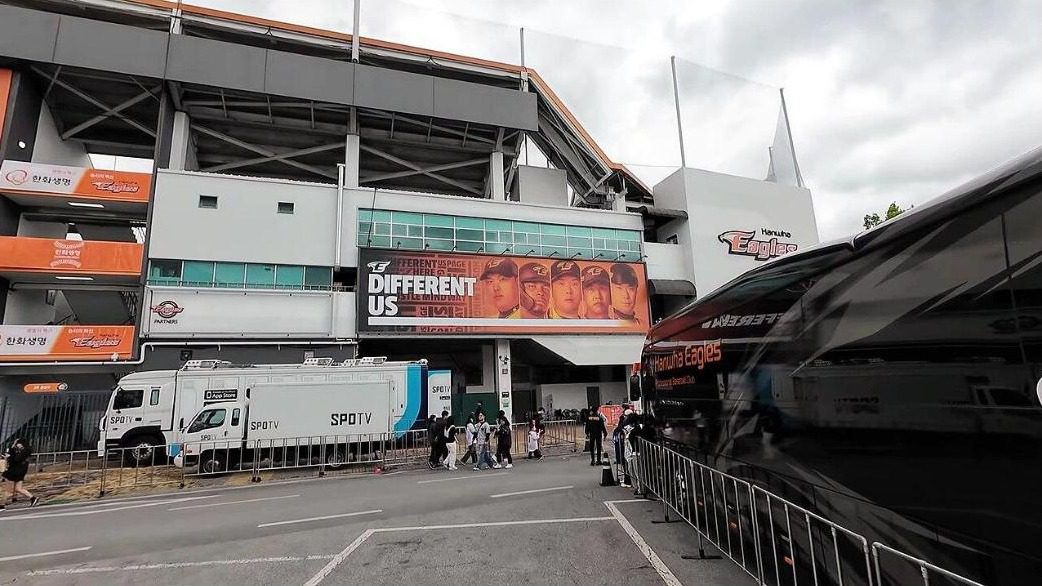
Photo: Fomos Esports · Source: Wikimedia Commons · License: CC BY 3.0 · Taken April 21, 2024. A screenshot from video of the “Hanwha Life Esports Day” event, showing the Hanwha Life and Eagles signs on the outer wall of the old ballpark (Hanwha Life Eagles Park)
The opening had its own stories. The club said in its official news item that it would have the four retired-number players (Song Jin-woo, Jung Min-chul, Jang Jong-hoon and Kim Tae-kyun) throw the first ceremonial pitch, and, out of consideration for the wildfire damage described as the worst on record, cancelled the fireworks planned for the home opener and replaced them with souvenirs and a post-game drone show.
The first game was against KIA on March 28, and some fans reportedly waited in front of the ticket window from 7:30 a.m. to buy returned tickets or seats with blocked views (Nocut News report).
What Kind of Team Are the Hanwha Eagles? — One Title, Six Runner-Up Finishes
The Hanwha Eagles were founded in 1985 and debuted in the league in 1986. They have won the Korean Series only once, in 1999, and finished runner-up in 1988, 1989, 1991 and 1992, and in 2006 and 2025 (Wikipedia).
In 2025 they lost the Korean Series to LG 1-4. The retired numbers belong to four players: Song Jin-woo (No. 21), Jung Min-chul (No. 23), Jang Jong-hoon (No. 35) and Kim Tae-kyun (No. 52).
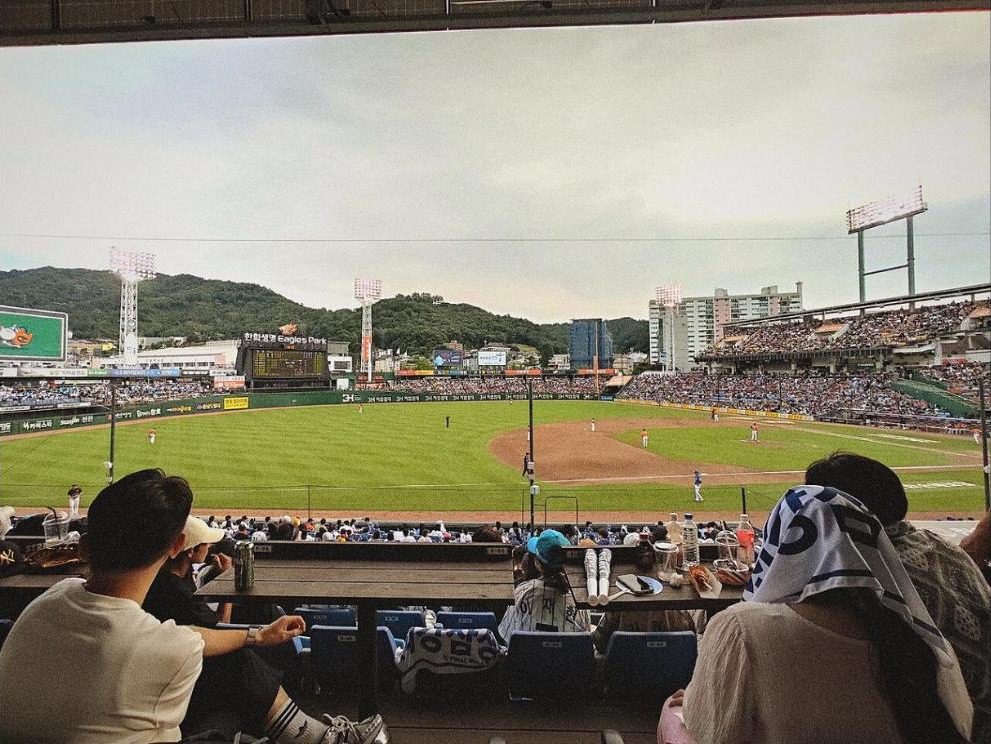
Photo: Pmlydon · Source: Wikimedia Commons · License: CC BY-SA 4.0 · Taken June 4, 2023. The old Daejeon Hanbat Baseball Stadium, where the Eagles played before moving to the new ballpark in 2025 (with fans)
The Eagles used the old Daejeon Hanbat Baseball Stadium as their home from 1986 to 2024. In 2025, their first season after moving to the current ballpark, the team reached the Korean Series, so they enjoyed a new-stadium effect.
The 2026 season, by contrast, ended in ninth place (57 wins, 4 ties, 83 losses), and after Kim Kyung-moon stepped down, the club named Ryu Ji-hyun, the former national team manager, as its 15th manager on October 13.
The contract is for three years and ₩2 billion in total, and the press reported that Ryu comes with credit for the national team’s 2026 WBC quarterfinal run and an Asian Games gold medal.
The Top Star News season roundup also carried news that the club’s ace Ryu Hyun-jin reached 1,500 career KBO strikeouts this year.
If you are new to the cheering culture, the advice in the Korean Cultural Center webzine (May 2026 issue) is quite useful: local fans sing the cheer songs together and match the motions, so listen to the songs on video once before the game.
How to Get to Daejeon Hanwha Life Ballpark and Buy Tickets — Based on the Club’s and Stadium’s Official Guidance
This section is based on the Hanwha Eagles website’s entry and stadium FAQ and ticket FAQ, which I opened directly on October 17, 2026. The ballpark’s address is 373 Daejong-ro, Jung-gu, Daejeon.
Hanwha finished the 2026 season in ninth place and missed the postseason, and I have not yet confirmed the 2027 schedule, so check the schedule and prices again before you go.
By public transit, the bus looks simplest. By the official guidance, buses 513, 604, 52 and Express 4 get off at “Hanbat Sports Complex” for a 5-minute walk, buses 108, 618, 619 and 620 at “Busa Five-Way Intersection” for 10 minutes, and bus 802 at the “Hanwha Life Eagles Park” stop for 10 minutes.
For the subway, you get off at Jung-gu Office Station on Daejeon Line 1 and take a taxi of about 10 minutes (1.6 km), or take bus 513 from the “St. Mary’s Hospital” stop, and walking takes 30 minutes. If you arrive by KTX, it is about 15 minutes (3.9 km) by taxi from Daejeon Station, and you can take Express 4 or bus 802 from the Daejeon Station stop.
If you plan to bring a car, you can use the ballpark’s first-basement and surface lots. The first basement level is first come, first served, and is said to open to cars one hour before the entry time (3 hours before the game on weekdays, 3 hours 30 minutes before on weekends).
When it is full, you have to use the surface lot or outside lots. I could not confirm the parking fee in the official FAQ, so I suggest asking the club first.
Tickets are booked on the Hanwha Eagles website or the Ticketlink website by PC, the Hanwha Eagles app or the Ticketlink app on mobile, or by phone on Ticketlink 1588-7890. Booking opens at 11 a.m. seven days before the game you want to see and can be done online until the game starts.
You can book up to 4 tickets per person, up to 2 times. Seats cannot be changed after booking, and you can send a smart ticket to your companions through the gift function of the place where you booked (the Ticketlink app or the Hanwha Eagles app).
The mobile smart ticket is issued where you booked. Seat types and prices vary by game date and category (weekday or weekend, opposing team and so on), so you have to check them on the booking page.
Children are defined as 13 and under and students as 14 to 19, and children from 36 months old need a ticket to get in. On-site purchase is available from 2 hours before first pitch for weekday (Tuesday-Friday) games and 2 hours 30 minutes before for weekend games, but only same-day tickets for returned tickets and some obstructed-view seats are sold.
I could not confirm in the official FAQ whether cards issued overseas work or whether the booking screen has an English version. If you are coming from abroad, check first with the Ticketlink customer center (1588-7890) or the inquiry channel on the Hanwha Eagles website.
Entry is from 2 hours before the game on weekdays and 2 hours 30 minutes before on weekends and holidays, and FULL membership holders get in 30 minutes earlier on weekend games. There are five entry gates in total: the main gate (Hanwha Life Gate), 1-2 (GS Gate), 1-1 (members only), 3-1 (Sposix Gate) and outfield gate 4-2.
You may bring one bag of 45 x 45 x 20 cm or smaller and one shopping bag of 30 x 50 x 12 cm or smaller, and drinks must be unopened, up to one PET bottle or two cans per person (1 L or less in total). Glass bottles and frozen bottled water are not allowed, but carton milk and juice, baby bottles and medicine can go in.
Outside food can be brought in within the size of your belongings, but hot soups or strong-smelling food may be stopped, and fruit has to be cut up beforehand. The ballpark elevators are only for socially vulnerable visitors and staff, so ordinary visitors have to use the stairs or escalators (official FAQ).
Looking at all these rules together as a marketer, you can see how a ballpark that splits demand among 17,000 seats operates. The limits of 4 tickets per person and 2 bookings read as a device to stop one person sweeping up seats, and narrowing on-site sales to returned tickets and obstructed-view seats favors fans who booked early.
Allowing outside food and drink reads as a choice not to pull all of the “spending after the ticket price” into in-stadium food revenue, so it gives a fan-friendly impression while securing the food-and-drink share another way (premium seats, specialty stands).
Attendance and Tickets — A Ballpark That Hit the 17,000-Seat Ceiling
I opened the KBO’s official figures and did the arithmetic myself. Hanwha’s Daejeon home attendance in 2026 was 1,150,694 over 71 games, an average of about 16,207, seventh among the 10 clubs.
There were 51 days listed at 17,000, which is 95.3% of the total (1,207,000) if the 17,000 capacity were filled in all 71 games (my own calculation).
The whole league drew 12,770,551, an all-time high, with an average of 17,737 and 345 of 720 games sold out (Top Star News season roundup).
In 2025, in its 60th home game on August 23, the club passed 1 million home fans (1,011,110) for the first time in its history, with an average of 16,851, 99.1% seat occupancy and 50 sellouts up to that point (MK Sports). The two sets of numbers cover different periods, so be careful about comparing them directly.
What is interesting is the variation within the season. Of 37 home games from March to June, 34 had 17,000, but in 8 home games in September only 1 did, and the average fell to about 12,800, with the season low of 10,194 on September 16 (my own calculation based on the KBO daily figures).
By day of week, 22 of 35 games from Tuesday to Thursday and 29 of 35 from Friday to Sunday were at 17,000. These numbers overlap with the late part of the season when the team slumped and finished ninth.
So how was the expansion put together? The total project cost is expected to be up to around ₩13 billion, with Hanwha covering 25% (up to ₩3.25 billion) and the city of Daejeon the rest (about ₩9.75 billion) (reported by Green Economy News and others).
The location is the first-base-side outfield, at ground level 2. An August report said ₩500 million in design costs was included in the supplementary budget bill and that the infinity pool and lawn seating would be left as they are, according to Korea JoongAng Daily.
It is also worth noting that the original design had 20,007 seats, but the club cut it to around 17,000 for viewing density and comfort. Even at 20,000 seats after the expansion, it would fall short of the 24,000-seat Samsung Lions Park in Daegu.
Simple multiplication says that filling 3,000 seats in all 71 games would add 213,000 fans a year in theory (my own calculation). But this year’s September numbers show that more seats are not automatically filled, and in the end results and weekday demand are the variables.
As a marketer, I think which zones are sold at what prices after the expansion, and how the current “scarcity” image is kept, will decide the return on the investment.
Space Use and F&B — The Food Design of a Ballpark That Allows Outside Food
Before the 2025 opening, the club announced in its official news item that 21 food and drink brands and 31 stalls, including Daebon Korea stalls, would be set up in the 1st- to 3rd-floor stands.
“Daebon Tasty” on the third-base side gathers eight Daebon Korea brands in one space, and Gotuwok’s “lemon cream shrimp” was introduced as a menu you can taste only at this ballpark. Before the May 21 game against Lotte, the ballpark was crowded from 5:30 p.m., and Digital Daily showed people lining up in front of Daebon Tasty in a photo.
The Korean Cultural Center webzine said the ballpark has more than 30 food and drink brands and that you can order food from your seat by QR code.
The ballpark’s signature infinity pool, as reported in 2025, measures 15 m by 5 m and 1.2 m deep, holds up to 40 people at once, and ran in one-hour sessions (50 minutes of use, 10 minutes of cleanup) from 2 hours before the game to the 7th inning, at ₩44,000 to ₩51,500 per person depending on seat location.
You have to bring your own swimwear (Daum News). The same report also lists the “Innings VIP Terrace” on the second floor on the first-base side at ₩80,500 to ₩94,000 per person.
I could not confirm 2026 prices and operations, so check the booking page again. In its pre-opening news the club also said it had finished the interiors of specialty seats such as the skyboxes and outfield lawn seating.
I read the food design of this ballpark as “release outside food, and create stands people want to queue for.” As reports of long lines in front of the Daebon stands suggest, a menu you can eat only inside the ballpark is a reason to visit in itself.
However, a waiting line is also an inconvenience, so the marketing effect cuts both ways.
Advertising Inventory and Naming Rights — Even the Gates Carry a Name
The club is splitting up the rights it secured for ₩48.6 billion quite finely. Reading the official guidance, the entry gates carry names such as Hanwha Life Gate, GS Gate and Sposix Gate.
It means that the club has created advertising touchpoints along every route spectators walk, not just a corporate name on the ballpark’s name.
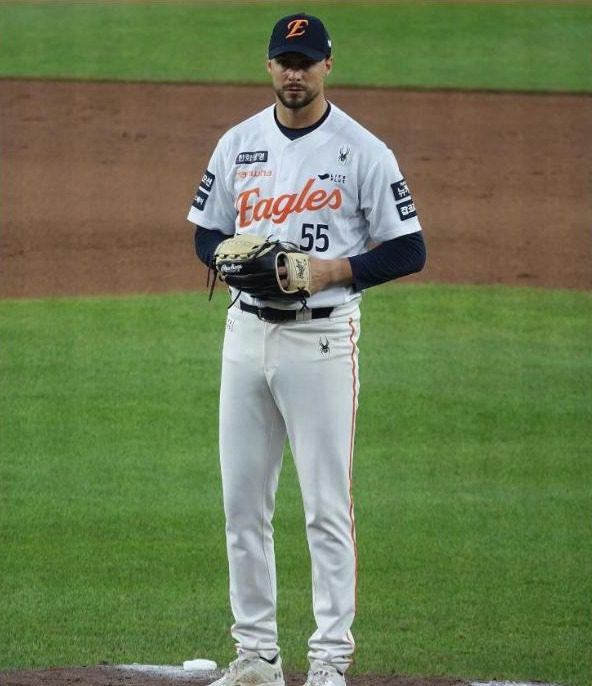
Photo: Seohae1999 · Source: Wikimedia Commons · License: CC BY-SA 4.0 · Taken July 31, 2025 at Daejeon Hanwha Life Ballpark. The Eagles home uniform, with sponsor patches on the chest and sleeves
In a ballpark where attendance is fixed at 17,000, one way to raise advertising value other than increasing attendance is to increase the number of touchpoints. If Hanwha holds the rights of use and revenue for 25 years, a strength is that it can split the units that carry a name into small pieces and sell them.
However, I could not confirm the amounts or terms of the individual contracts in the published material.
Compared with the KBO — Samsung Lions Park Has 24,000 Seats, Hanwha Will Have 20,000
As the comparison I will use Samsung, number one in league attendance in the same season. Samsung drew 1,717,050 at home, the first KBO club to pass 1.7 million, with 99.4% seat occupancy and 59 sellouts (73 home games including two in Pohang) (Sports Kyunghyang).
The Daegu ballpark has 24,000 seats and Hanwha’s has 17,000. The occupancy rates of 99.4% and 95.3% are only 4.1 percentage points apart, but the total attendance differs by about 566,000 (my own calculation).
It says that the number of seats sets the ceiling on a club’s income.
So Hanwha’s 3,000-seat expansion is a bet on “raising the ceiling while keeping the occupancy rate.” To make sellouts routine as Samsung has, it has to create more reasons to hold weekday and late-season demand, not just seats.
Few clubs reach an expansion agreement one season after a new ballpark, but if the results and weekday content to back it up do not follow, 3,000 seats could become empty seats.
Leave a Reply