Contents · About 8 min read
📱 View as card news

It always surprises people to hear that a single basketball arena also hosts an ice hockey team, a college basketball program, and even a women’s pro basketball team’s home games.
But looking through the new renovation renderings released this week (August 11) alongside Capital One Arena’s announcement of a 20-year naming-rights renewal with Capital One, I realized the business math behind that “one roof, multiple teams” structure is far more sophisticated than it first appears.
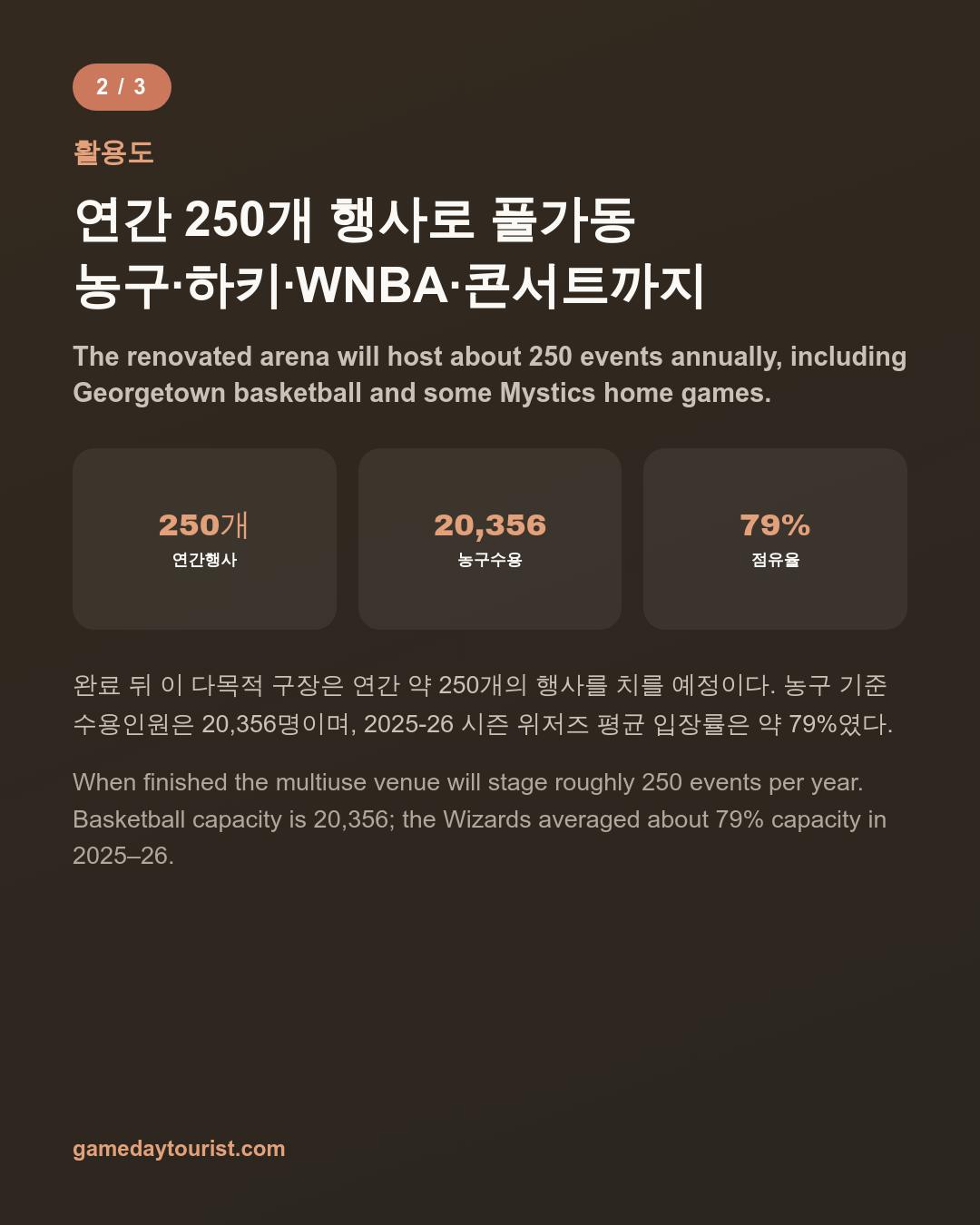
The arena is best known as the shared home of the NBA’s Washington Wizards and the NHL’s Washington Capitals, but this review confirmed it’s really a multi-purpose venue hosting roughly 250 events a year — everything from Georgetown men’s basketball to select WNBA Washington Mystics home games to concerts.
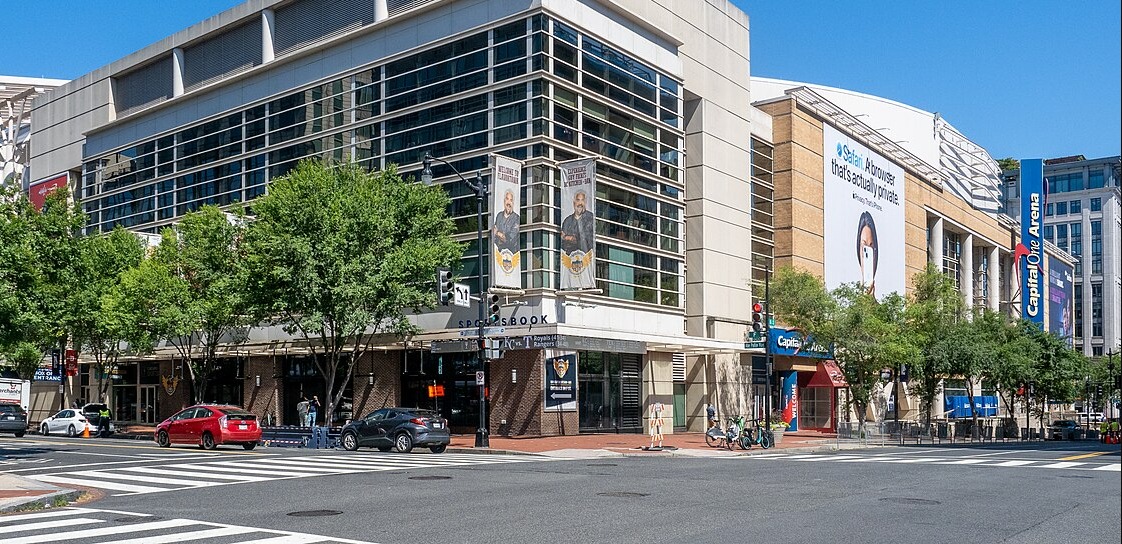
Source: Wikimedia Commons (photo by ajay_suresh, CC BY 2.0 license) — Capital One Arena’s exterior, photographed in June 2024
Naming Rights and Partnerships
The arena’s name has changed three times so far.
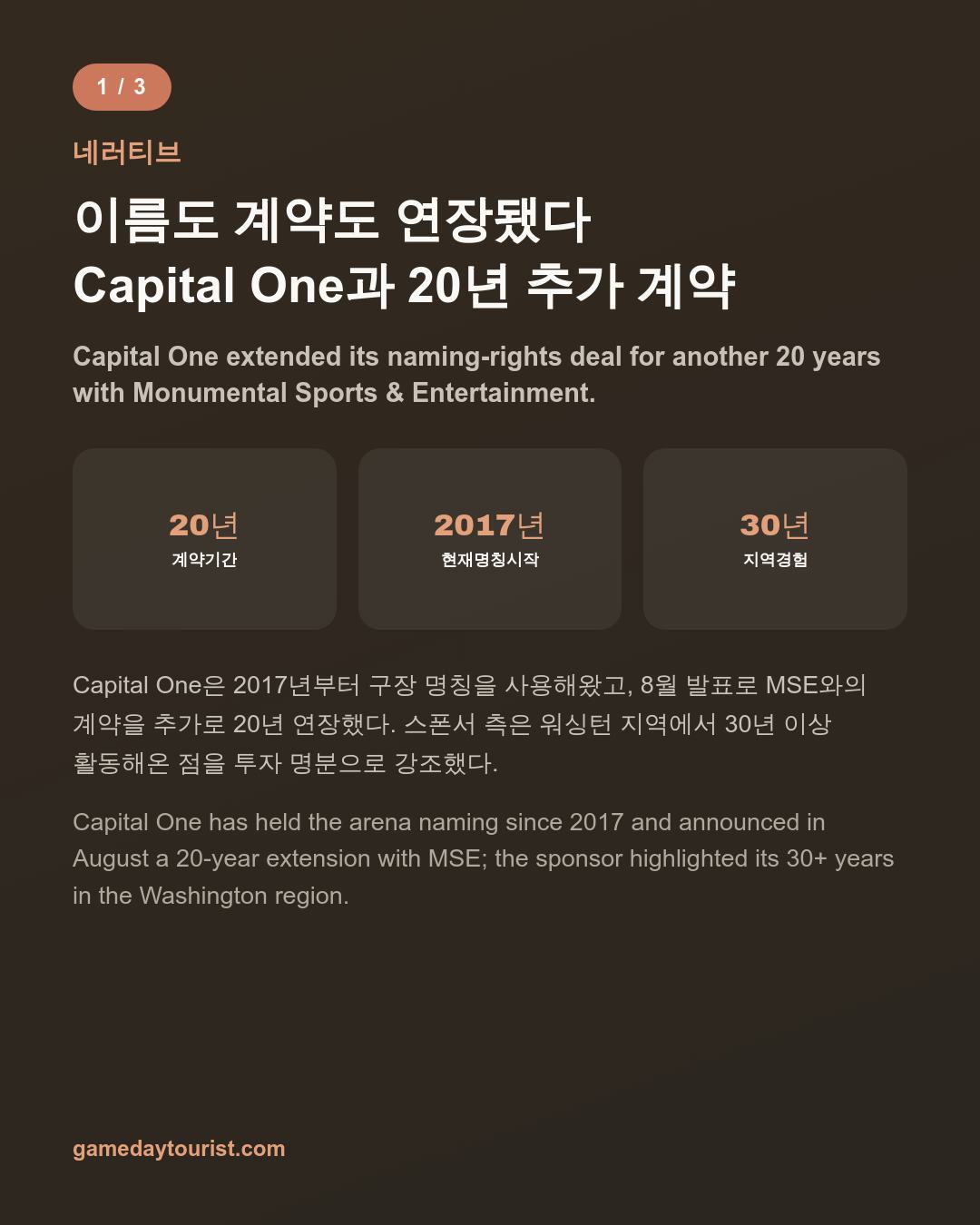
It opened in December 1997 as the MCI Center, named after telecom carrier MCI; became the Verizon Center in 2006 after Verizon acquired MCI; and has carried its current name since August 2017, when financial company Capital One purchased the naming rights — the right to attach a corporate name to a facility.
Then on August 11, Monumental Sports & Entertainment (MSE), which owns and operates the arena, and Capital One officially announced they were extending the deal for another 20 years.
Neither side disclosed the deal’s value, but MSE’s Chief Business & Commercial Officer Jim Van Stone described it in an official press release as “an incredibly broad agreement spanning Monumental’s facilities, teams, and media assets.”
Capital One’s VP of Sponsorships and Experiential Marketing, Byron Dove, likewise said, “Having called the Washington region home for more than 30 years, Capital One is proud to keep investing in this region’s future.”
What stands out in this deal is that the naming rights go well beyond just putting a name on the building.
A dedicated entrance for Capital One cardholders is being relocated and expanded to the F Street side; previously available only for Wizards and Capitals games, that perk will extend to every event, including concerts, starting fall 2027.
This is a card issuer buying naming rights and layering on payment-data-driven member perks — not an unfamiliar concept, since Korean baseball and football clubs commonly partner with specific card companies for seat discounts or priority booking, but the scale is different here because it’s bundled into a 20-year naming-rights deal.
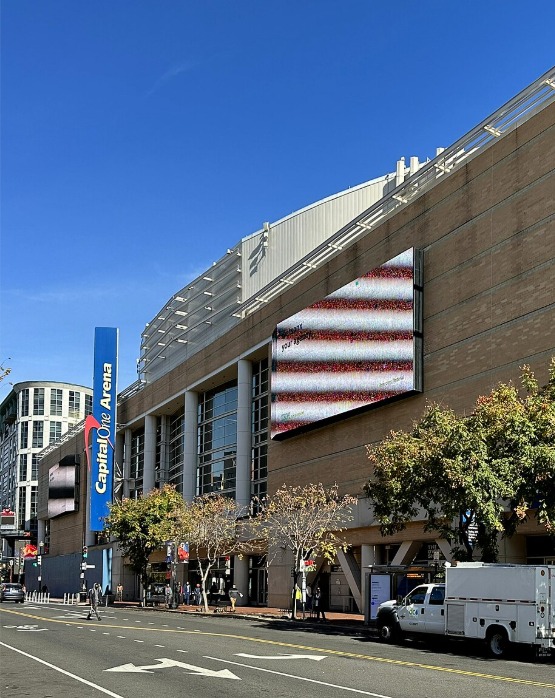
Source: Wikimedia Commons (photo by APK, CC BY 4.0 license) — the F Street-side exterior, photographed in November 2023
Attendance and Tickets
Capital One Arena seats 20,356 for basketball.
In the 2025-26 season, the Wizards drew 660,376 fans total across 41 regular-season home games, averaging 16,107 per game — putting attendance at only around 79% of capacity.
The Wizards also finished that same season near the bottom of the league at 17-65, so both results and attendance struggled together.
Even so, the team raised season-ticket prices by an average of 6.31% for the 2026-27 season, with some sections up by nearly 15%.
That effectively passes the renovation investment on to ticket prices — raising prices after a losing season is a decision that could easily backfire, but pairing it with the story of a “completely reimagined facility” appears to be how they built the justification for the increase.
Space and F&B
Reviews from stadium-visit bloggers who’ve toured the venue in person frequently point out that, before this renovation, Capital One Arena’s concourses — the corridor-style common areas circling the seating bowl — weren’t especially wide.
One local stadium-review blogger rated the venue 2.5 out of 5, writing that “every entrance funnels into the same narrow, circular 100-level corridor,” and also noted the upper-level (400-level) seats felt cramped due to narrow seat widths.
What’s interesting is that this renovation targets exactly that pain point.
Along with the new renderings, MSE announced it will increase restroom count by 30%, expand from 3 kitchens to 14-15, and build a large new food hall spanning one end of the F Street-side terrace level to the other.
The renderings also show a market with self-checkout kiosks and a communal-table beer hall (a “pour station”); watching complaints from actual visitors turn into design fixes years later made me think this kind of visitor-review data is genuinely being factored into renovation priorities.
There’s also a new large immersive screen called the “Visibowl,” which lets fans standing in the middle of the concourse see straight into the bowl, fed by more than 50 cameras streaming live footage from the court and ice.
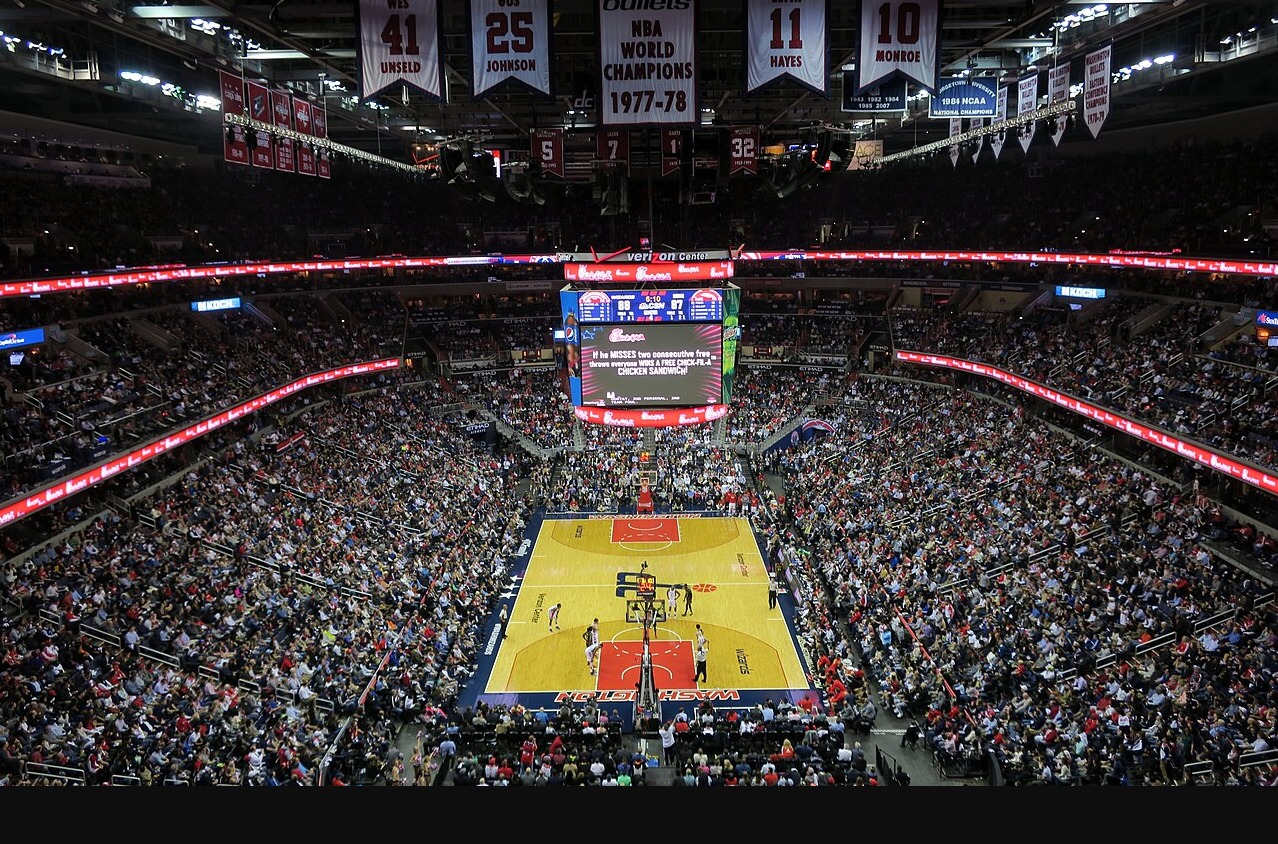
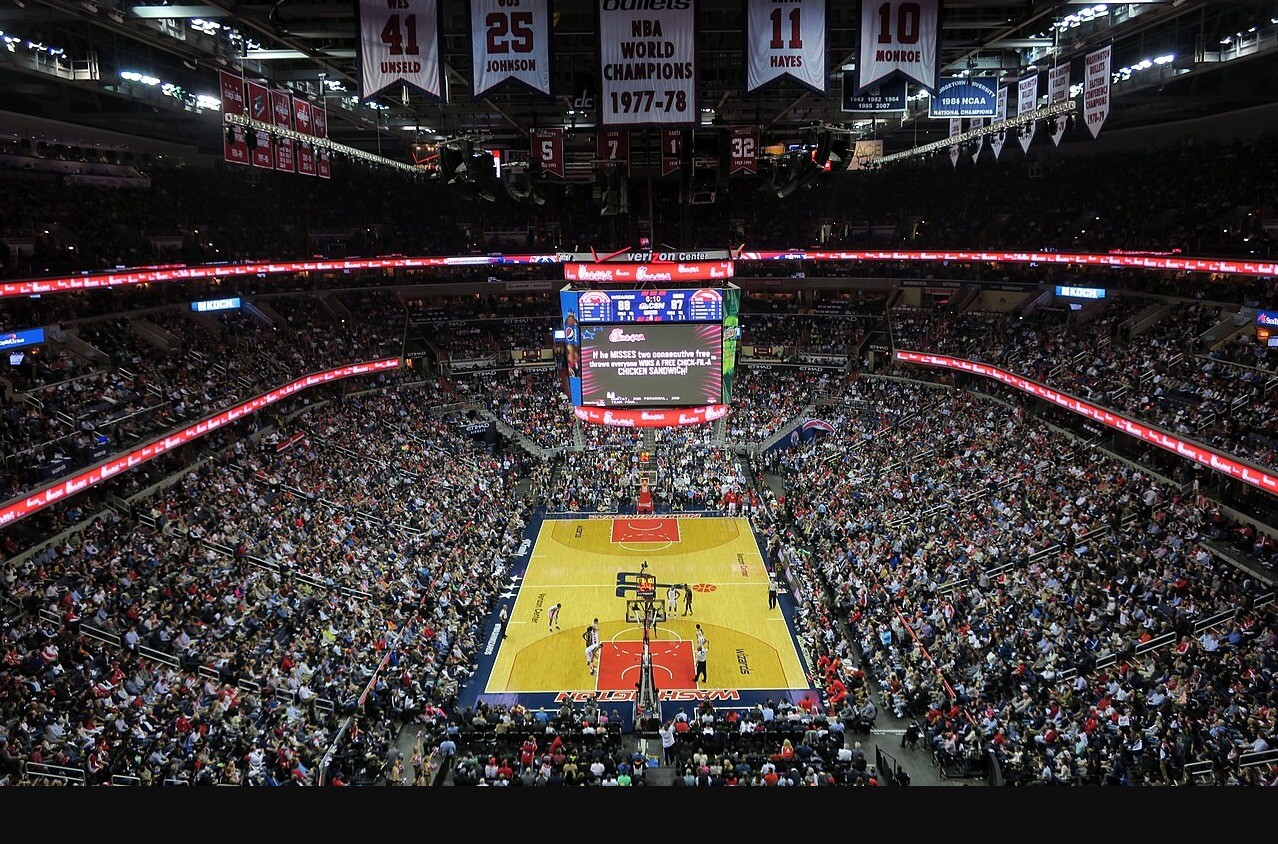
Source: Wikimedia Commons (photo by Daniel Lobo, CC0 public domain) — interior view during the April 2017 NBA playoffs (then known as the Verizon Center)
Merchandise and Ad Inventory
At the 2026 NBA Draft last June, the Wizards selected BYU’s AJ Dybantsa with the No. 1 overall pick.
He averaged 25.5 points per game in college and was ranked the top scorer in Division I, so his jersey is now front and center in the team’s online store.
Seeing it sold side by side with the jersey of French big man Alex Sarr, who joined via the 2024 draft, it’s clear the strategy of driving merchandise sales through rookie stars keeps running steadily even in a losing season.
On the ad inventory side — the total volume of advertising space and exposure a team can sell — Monumental Sports Network (MNMT) is worth watching.
This channel holds exclusive regional broadcast rights for the Wizards, Capitals, and Mystics, and has offered a direct-to-consumer streaming subscription without cable since October 2023, priced at $19.99 a month or $199.99 a year.
By selling broadcast rights directly through its own channel instead of to an outside network, the team keeps both the ad inventory and the subscription revenue for itself.
Broadcasting Rights and Regional Economic Impact
The renovation’s funding structure is also worth a closer look.
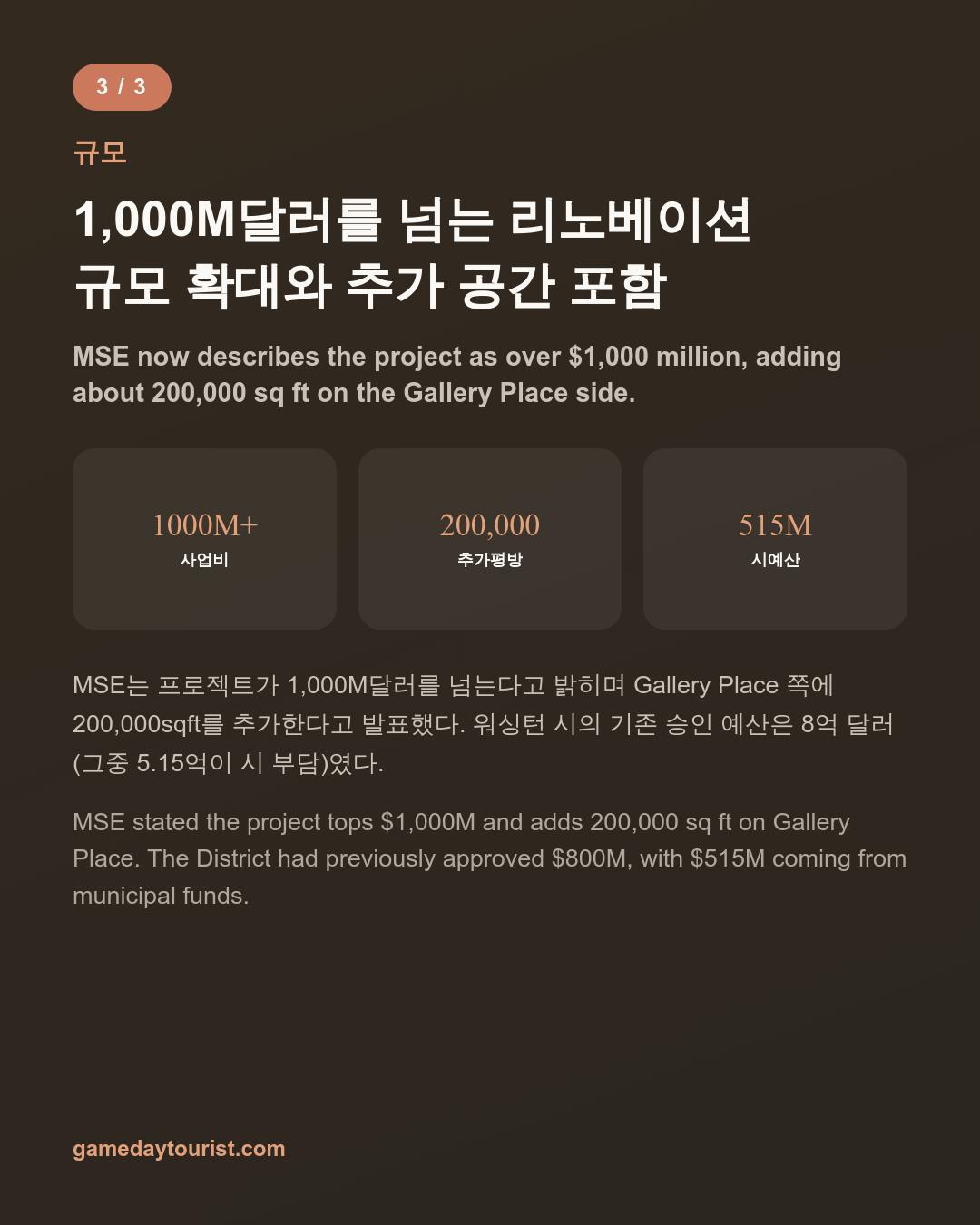
In April 2024, the Washington D.C. Council approved an $800 million project budget, structured as a public-private partnership in which $515 million came from city funds and the remaining $372.5 million-plus was covered by an MSE-affiliated special-purpose entity.
The city’s projected economic impact at the time totaled roughly $1 billion — including 4,900 construction-period jobs and $21 million in tax revenue — but it’s important to note that figure was a separate economic-impact estimate, not the project budget itself.
In this August’s announcement, MSE described the project itself as being “over $1 billion” — a figure that reflects an expansion absorbing 200,000 additional square feet (about 5,600 pyeong) on the Gallery Place side, including the former Bed Bath & Beyond site.
In other words, the project cost has grown beyond what was originally approved.
Capital One likewise emphasizes its own regional investment.
According to figures the company disclosed, it provided $7.2 billion in community development financing across the greater Washington region in 2025 alone, with a substantial share going toward creating or preserving more than 31,000 affordable housing units.
Direct charitable giving reached $17.2 million as well.
Considering the arena was already credited with reviving a then-blighted downtown Chinatown area into a commercial district when it first opened as the MCI Center in 1997, this pattern of a single stadium serving as an anchor for regional development has now repeated for nearly 30 years.
The Arena’s Own Symbol
One of the signature sights at Capital One Arena is the row of championship banners hanging from the rafters.
Alongside the banner left by the Washington Bullets — the Wizards’ predecessor franchise — for winning the 1977-78 NBA championship, retired-number banners for legendary players like Wes Unseld and Elvin Hayes hang side by side, a reminder that this isn’t just a new facility but one carrying nearly half a century of franchise history.
Add in the banner marking the Capitals’ 2018 Stanley Cup win, and you get a venue where championship narratives from two entirely different leagues coexist under one roof — a feature unique to this arena.
This multi-purpose, multi-team structure has also helped the arena land the 2027 NCAA Division I men’s ice hockey championship (the Frozen Four) and a 2028 NCAA women’s basketball regional — and ultimately, it’s this shared-use model that lets a single sports facility stay booked virtually year-round.
Compared With the KBO and K League
Korea has cases of a single corporate group owning pro clubs across multiple sports, but an integrated model like Capital One Arena — one company owning a single venue that houses pro basketball, ice hockey, women’s pro basketball, and a college basketball program all under one roof, and then selling the broadcast rights directly through its own streaming channel — is hard to find domestically.
KBO and K League clubs typically each use a single dedicated venue, so this approach — multiple pro leagues sharing facilities and media assets to maximize utilization — is a point Korean clubs could genuinely learn from.
The naming-rights structure is also worth noting.
Most corporate names attached to KBO stadiums in Korea belong to the parent company that owns the club, putting its own name on its own ballpark.
Capital One, by contrast, is a purely third-party financial company with no ownership stake in the Wizards or Capitals, yet it has kept its name on this arena for nearly nine years since 2017 and just committed to another 20.
Since it involves an outside company unrelated to club ownership paying for the long haul, this is genuine naming rights in the truest sense — a structure that actually resembles Kiwoom Heroes’ club-name sponsorship arrangement more closely than any Korean stadium-naming case.
Watching a team raise season-ticket prices during a bottom-of-the-league season while still locking in a sponsor for a 20-year mega-deal reconfirms that what pro sports marketing ultimately sells isn’t this season’s record — it’s an asset called “experience” that will keep paying off for decades to come.
Whether pouring $1 billion into the live in-person experience — in the streaming era, of all times — pays off will show up in attendance and revenue after the 2027 reopening. I’ll be sure to revisit this arena then.
Leave a Reply