Contents · About 13 min read
- Rocky’s Lightning Tail and the Debut of December 15, 1990
- What Kind of Team Are the Denver Nuggets?
- Getting to Ball Arena and Buying Tickets — Light Rail, Parking and Entry Rules
- Attendance and Tickets
- Space Use and F&B
- Renovation and Premium Spaces
- Merchandise and Advertising Inventory
- Broadcast Rights and Local Roots
- Compared with the KBO: Rebuilding Sajik Baseball Stadium
📱 View as card news
The Denver Nuggets open their 2026-27 season on October 22 at Oklahoma City, and the home opener follows two days later, on Saturday, October 24, against the New Orleans Pelicans (per the schedule). That puts the first regular-season game of the year at Ball Arena right around the corner.
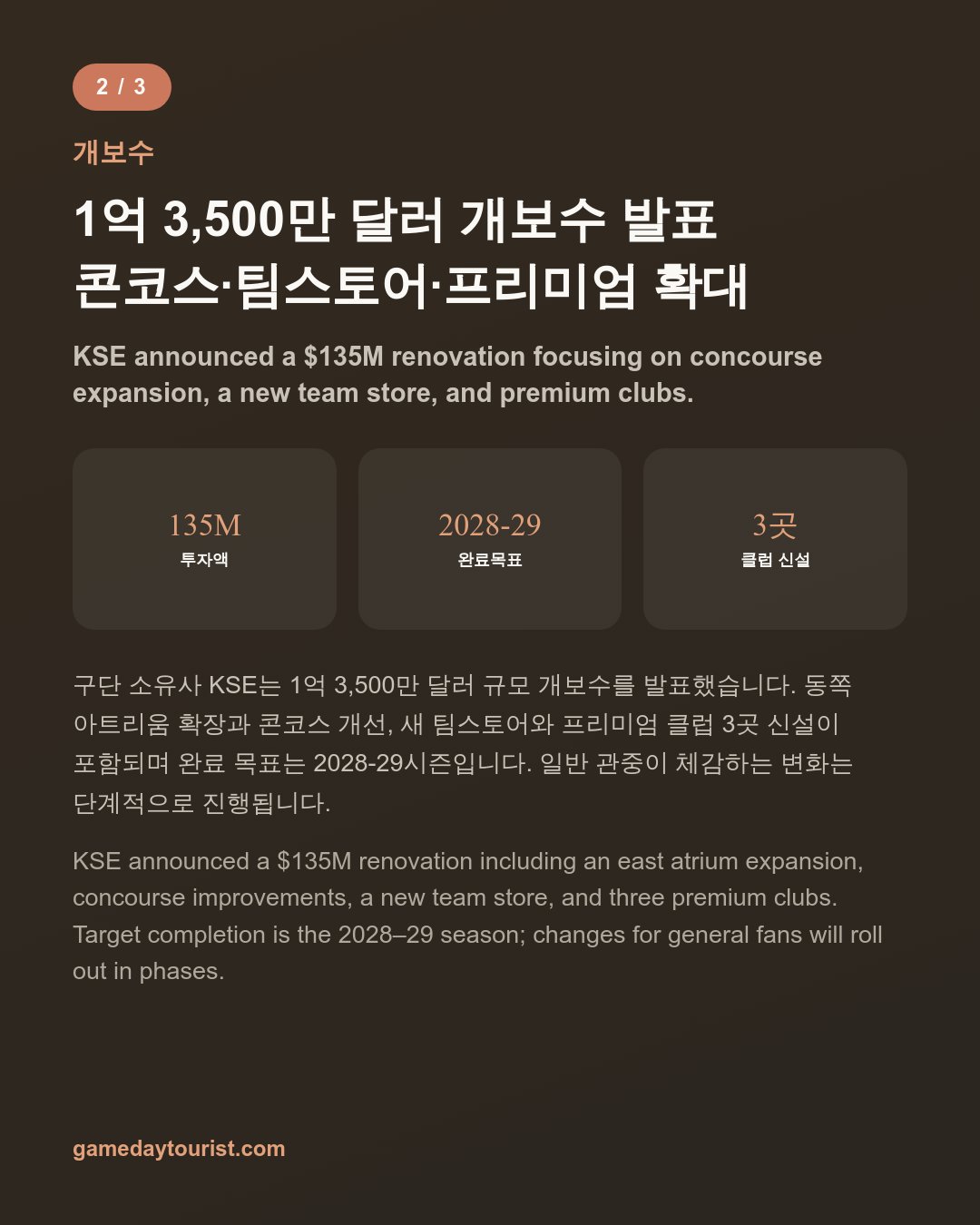
The arena made some big news on September 18. Kroenke Sports & Entertainment (KSE), which owns both the team and the building, announced a $135 million renovation plan.
Rather than tearing down the 27-year-old building that opened in 1999, the plan expands the east entrance atrium, adds a new team store, widens the concourses and builds three new premium clubs, with completion targeted for the 2028-29 season. The NBA’s turn in my rotation had come up, and with a team about to start its season and a major announcement just made, this was the arena to pick.
This is not a firsthand visit report but a benchmarking analysis built by cross-checking club announcements, local news coverage and fan reviews. Where sources give different figures, I say so rather than pick one.
After a look at the mascot Rocky and the team, the post covers how to get to Ball Arena along with tickets, parking and entry rules, then attendance and F&B, the renovation and the club’s revenue structure. The access and ticket details were checked against the arena’s and the club’s official pages.
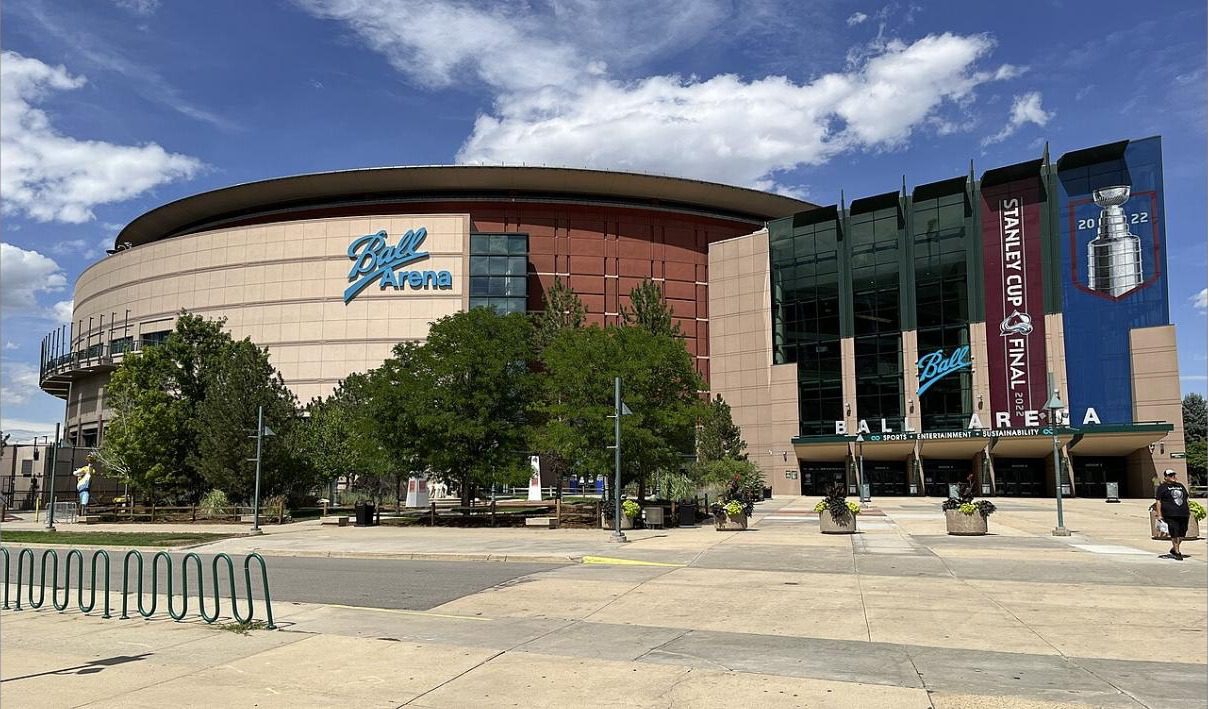
Photo: Troutfarm27 · Source: Wikimedia Commons · License: CC BY-SA 4.0 · Taken August 2, 2022. Exterior of Ball Arena (the entrance banner is from the 2022 Stanley Cup Final, a title season for the NHL’s Colorado Avalanche, who also call the building home)
Rocky’s Lightning Tail and the Debut of December 15, 1990
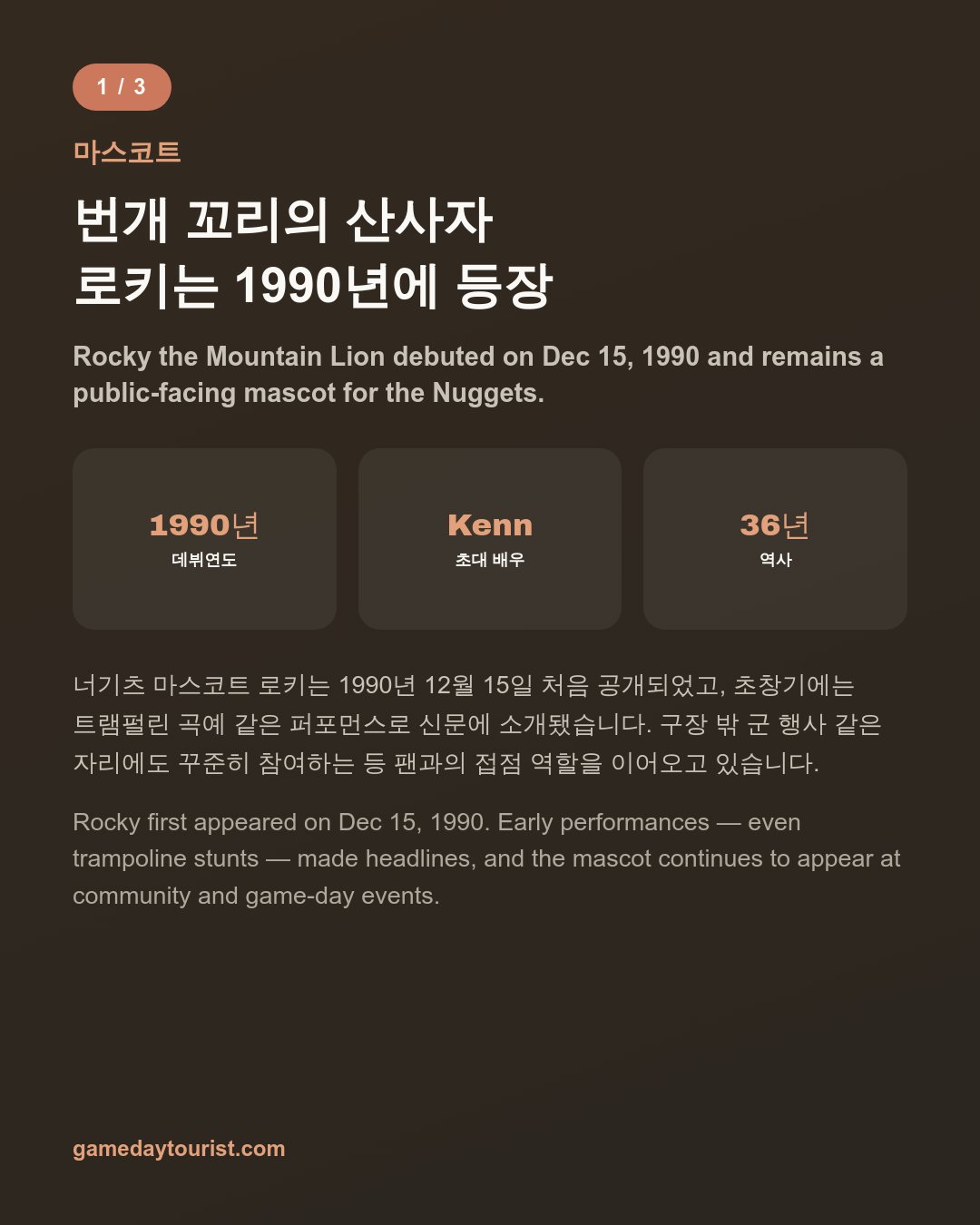
Rocky the Mountain Lion, the Nuggets’ mascot, made its debut on December 15, 1990. According to the history compiled by the Denver outlet Westword, the character was created by Real Characters, a mascot maker based in Atlanta, who paired the mountain lion with a lightning story.
Even the lightning-bolt tail has a backstory: a fragment of lightning separated from its family in a storm and became the lion’s tail.
The early performances made it into the newspapers too. The Denver Post coverage quoted by the same outlet describes Rocky leaping over ball boys on a trampoline and landing flat on the tail.
The first person to wear the suit was Kenn Solomon.
As a marketer, I have long thought of a mascot less as an advertising surface than as a device that gives people a reason to gather. A character who made the papers 36 years ago for a trampoline stunt and now turns up at events beyond the arena, like the military-family event in the photo below, seems to support that idea.
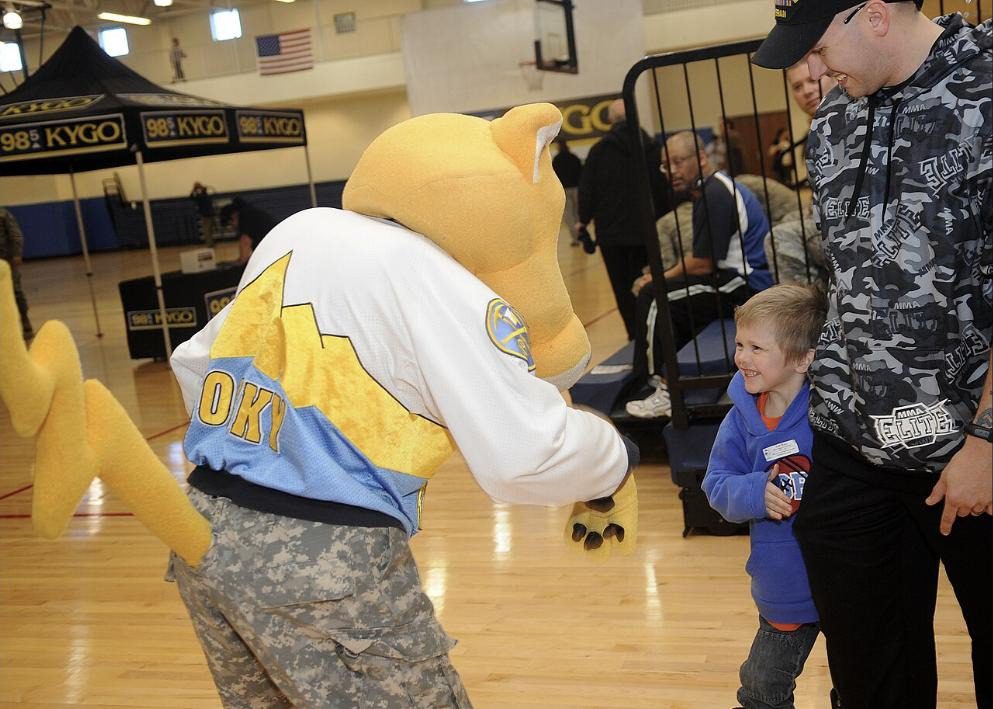
Photo: U.S. Air Force Airman 1st Class Marcy Glass · Source: Wikimedia Commons · License: Public domain (work of the U.S. federal government) · Taken February 17, 2011. Rocky at a military family event at Buckley Air Force Base
What Kind of Team Are the Denver Nuggets?
The Nuggets began in 1967 as the Denver Larks in the ABA, were renamed the Rockets before the first season, became the Nuggets in 1974, and joined the NBA through the 1976 ABA-NBA merger (Wikipedia).
On June 12, 2023, they beat the Miami Heat 94-89 in Game 5 at Ball Arena to win the series 4-1 and take the first championship in franchise history, with Nikola Jokić as Finals MVP.
The 2025-26 season ended at 54-28, third in the West (Basketball-Reference). They lost the first round to the Minnesota Timberwolves 2-4, with Game 6 on April 30 a 98-110 defeat.
The Denver Gazette described it as the first first-round exit since 2022 and the first playoff elimination with both Jokić and Jamal Murray healthy. The head coach is David Adelman, formally named on May 22, 2025.
Getting to Ball Arena and Buying Tickets — Light Rail, Parking and Entry Rules
The information below is based on the arena’s official guides and the club’s ticket pages, and was checked on October 13, 2026. For public transit, the closest RTD light rail stop is Ball Arena/Elitch Gardens, served by the D, E, H and W lines (see the arena’s public transportation page).
Some other travel sites list the lines as C, E and W, so this post follows the official guide. Buses use the stops at 9th Street and Auraria Parkway.
Downtown, the free MallRide shuttle on the 16th Street Mall connects Union Station with the light rail, but the official page says it is currently running along 15th and 17th Streets because of construction, so check the route when you board.
If you drive, you will be using the official lots. According to the parking page, the lots open three hours before game time, and for Nuggets and Avalanche games the drive-up price is $35–45 for 4Runner, $40–50 for Tundra and $35–45 for Elitch’s, while the closest lot, RAV4, runs $70–80.
Prices change in real time with demand. Cards are accepted at every lot, while cash is accepted only at the Tundra lot, and paying by card takes $5 off.
You can also buy parking in advance, at checkout after buying a ticket on Ticketmaster or on the parking add-on page. For rideshare, the arena directs drivers to the dedicated drop-off and pick-up zone at the 5th Avenue and Walnut Street entrance.
The club directs fans to Ticketmaster as its official sales channel. When season ticket holders resell single-game tickets, the club also recommends Ticketmaster’s verified marketplace, and it warns buyers to be careful with third-party sellers such as online brokers, Facebook Marketplace and Craigslist.
Tickets bought through counterfeit or unofficial transactions cannot be exchanged or refunded. Entry tickets and parking passes are all digital and scanned from a phone, and the club advises managing them in the official Nuggets app.
A replacement for a lost ticket costs $25 per ticket.
Entry rules are worth knowing in advance too. According to the official FAQ, doors normally open one hour before the game, and there is a no re-entry policy once you leave.
Concession stands are cashless by default, with only some accepting cash, and ATMs are located at section 144 on the lower level and section 366 on the upper level. Children 3 and older need a ticket, and children under 3 can sit on a guardian’s lap.
The official bag policy lists no size limit for regular bags and only gives guidance for diaper and medical bags (up to 14 x 14 x 6 inches), so for a large bag it is safer to ask Guest Relations (303-405-8548) first. Bag storage starts at $15, is non-refundable and does not accept cash.
The point I would pick out of this list as a marketer is that almost every touchpoint in the building runs on digital and card payments. Tickets, parking passes, concessions and bag storage are all built around cards and mobile, so all you need is a payment method and you can get around without cash.
On the other hand, parking prices that change in real time with demand also mean the venue adjusts the price down to the moment you arrive.
Attendance and Tickets
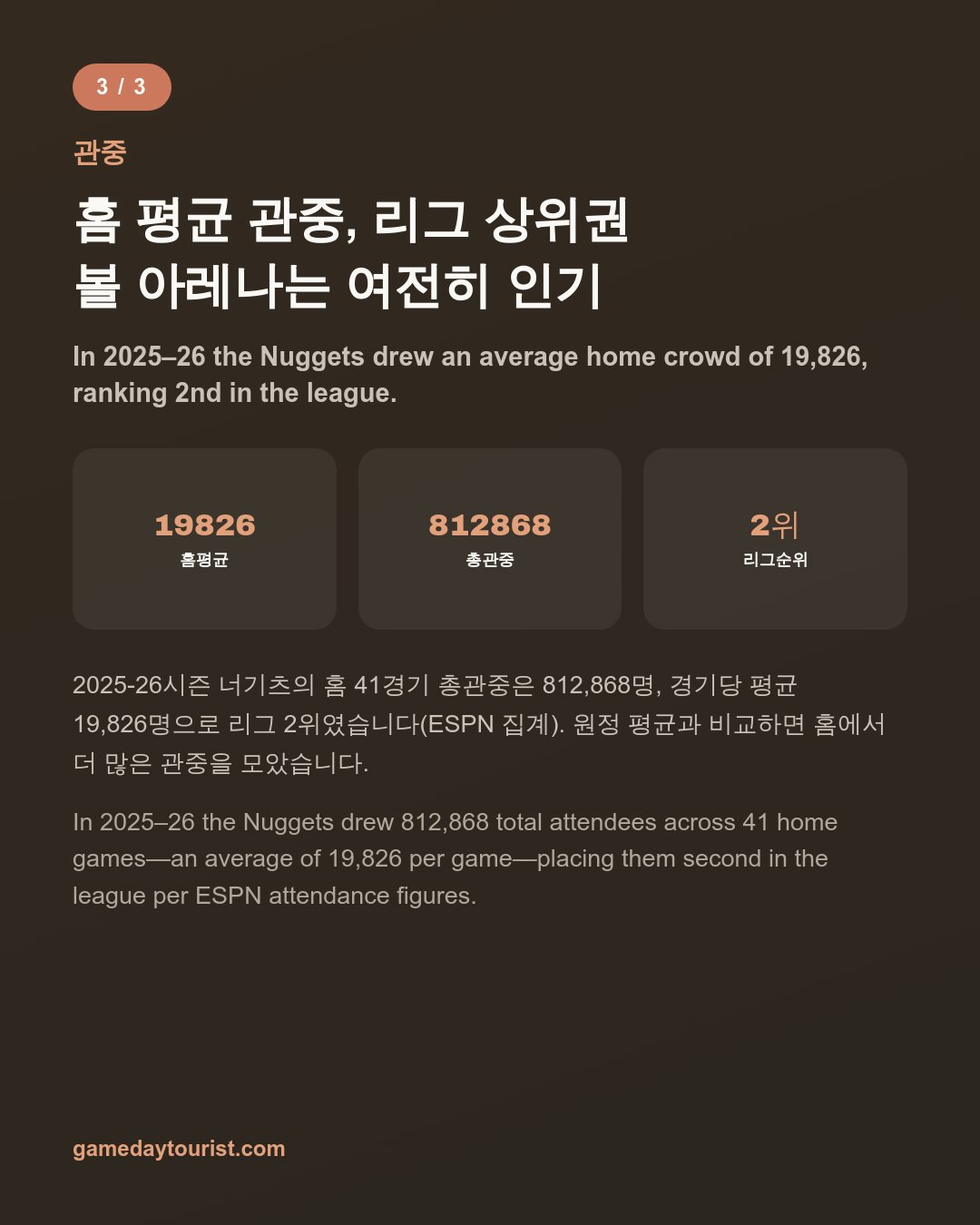
In 2025-26 the Nuggets drew 812,868 fans over 41 home games, an average of 19,826, second in the league by average. First was the Chicago Bulls at an average of 20,243 (ESPN attendance figures).
The road average that season was 17,869, which works out to 1,957 more fans per game at home than on the road (my own calculation). In the earlier 2023-24 season, every regular-season home game was a sellout by the NBA’s count.
Capacity is another matter: Wikipedia lists 19,520 seats for basketball but gives no source, and since the average attendance is higher than that number, this post does not state a capacity. Ticket prices are not included because I could not cross-check them against official or press figures.
This spring’s playoffs also brought an attempt to reach fans beyond the sellout crowd. Base Camp 5280, a fan zone that opened in the parking lot outside the arena for the April 18 first-round game, was the first to stay open during the game itself, according to KSE’s marketing director (Denver Gazette).
For rounds one and two, entry was with a free digital pass from the club’s website, and after the conference finals the plan was to charge admission and put the proceeds toward KSE’s charitable work. Personally, I read it as a front door that lets people without tickets meet the brand outside the building.
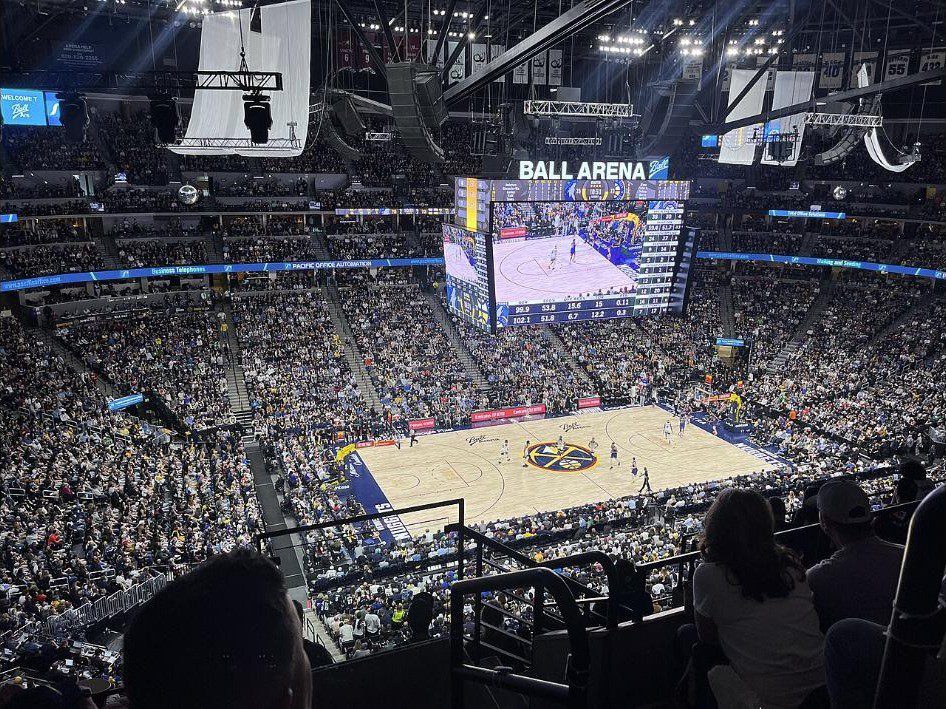
Photo: Grunn050 · Source: Wikimedia Commons · License: CC0 1.0 · Taken May 4, 2024. The upper-level view at Ball Arena during a Nuggets-Timberwolves playoff game
Space Use and F&B
The most noticeable change came last fall. In October 2025, KSE cut food and drink prices at the arena.
Hot dogs went from $7.50 to $5, jumbo pretzels from $8 to $5, and a 20-ounce domestic draft beer from $14 to $10, while popcorn, candy, nachos, fries and soda were bundled into a $5 menu (Denver Sports, CBS Colorado).
Fan complaints were the backdrop. KSE’s marketing director said fan surveys showed people were not satisfied with the quality of the food and drink, and that prices had reached a tipping point for the average family (CBS Colorado), and the Denver Gazette reported that the beer, at 50 cents an ounce, is the cheapest domestic draft among Denver’s major venues.
It was not only about prices. Six local restaurants (Redeemer Pizza, Nola Jane, Big Belly Brothers, Mexico City, Illegal Burger and Jake’s Baby Dishes) opened new locations in the arena.
Marketing director Jim Mulvihill explained, in essence, that when prices come down, people buy more (KOAA report).
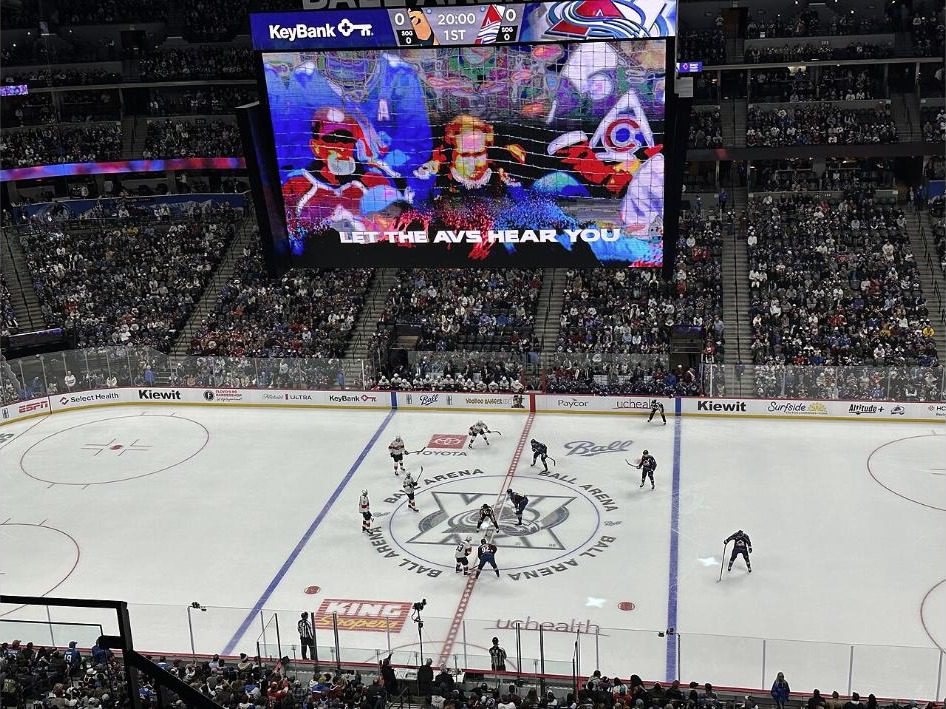
Photo: Gatorfan252525 · Source: Wikimedia Commons · License: CC BY-SA 4.0 · Taken December 11, 2025. Inside Ball Arena in hockey configuration during an Avalanche-Florida Panthers game, with sponsor boards running along the boards
Putting this price cut next to the renovation list, the direction felt fairly consistent to me. Instead of a flashy new build, the money goes to waiting time (better checkout technology), walking routes (wider concourses), and the price and quality that fans were complaining about.
An email KSE’s Kevin Demoff, president of team and media operations, sent to season ticket holders in February 2025 fits the same picture. The next priority was the fan experience at the arena, with retail, food and drink, and parking to be improved (Denver Sports report).
Renovation and Premium Spaces
The renovation announced on September 18 will be carried out in phases to limit the disruption to fans and nearby residents (NHL.com). It includes expanding the glass-walled east atrium entrance, new escalators, a new team store, wider entrances and concourses in the most crowded areas, better checkout technology and three new premium clubs.
One of the clubs is said to connect directly to 100-level seating. Completion is targeted for the 2028-29 season.
Separately, the first 24 suites (Legacy suites on the 100 level and Signature suites on the 200 level) are due to open in the 2026-27 season (Pollstar). So the change fans will feel at this season’s home opener is limited to some suites, while the concourses and atrium that regular fans use will have to wait until 2028-29.
The funding has not been disclosed yet. Axios reported that KSE did not say how it will finance the renovation or whether public money is involved.
Under a 2024 agreement, the Nuggets and Avalanche committed to stay at Ball Arena through June 30, 2050, in exchange for a height-limit exception and rezoning around the site, according to 9News.
It means one company holds the team, the building and the land around it. The Denver City Council approved a roughly 20-year plan to develop the 55 acres (about 220,000 m²) around the arena (9News), and its first-phase plan includes a hotel, an entertainment venue and apartments, according to Bisnow.
Merchandise and Advertising Inventory
The arena’s naming rights, meaning the right to put a company’s name on a facility, belonged to PepsiCo as Pepsi Center from the 1999 opening through 2020, and on October 22, 2020 they passed to Ball Corporation, the maker of aluminum cans, bottles and cups (Wikipedia).
According to ESG Today, the deal was part of a sustainability partnership that ran from Denver to Los Angeles and London. Ball became the official aluminum packaging partner of Arsenal’s Emirates Stadium and the LA Rams’ SoFi Stadium, and the goal in Denver was to switch the arena’s beverage packaging to aluminum.
The report gives neither the amount nor the length of the deal. In effect, the venue’s name was designed to double as a sustainability message.
The jersey patch belongs to Ibotta, a digital marketing platform headquartered in Denver. The first deal was signed in October 2023 (a three-year contract), and a multi-year extension was announced in mid-April this year, just before the first round of the playoffs (SportCal).
The length and value of the extension are not given in the reports. On the merchandise side, a local travel guide says there is a fairly large team store in the entrance atrium, and the renovation plan includes a new team store.
However, there are no published figures for store size or sales targets, so this post does not cover them.
Broadcast Rights and Local Roots
The key to Nuggets broadcasts is Altitude, a regional sports channel owned by the team’s owner. In a carriage dispute with Comcast (Xfinity), the channel was off Comcast’s lineup for about five years and five months, from August 31, 2019 to February 4, 2025, before a deal brought it back.
There is also a report that Altitude stated in court that about 92% of cable subscribers in the region at the time were on Comcast (CBS Colorado). It is a case that shows both the upside and the risk of one company holding the team, the arena and the broadcast channel.
On local roots, the arena has hosted more than 6,000 events since opening and about 200 live events a year on average, according to a club statement quoted by Pollstar. However, I could not find any material in this research that puts the arena’s local economic impact into dollars.
Compared with the KBO: Rebuilding Sajik Baseball Stadium
If Ball Arena is being fixed by the sole decision of the owner’s company, Busan’s Sajik Baseball Stadium is the opposite case. The rebuilding plan the city of Busan announced on October 31, 2025 splits a total project cost of ₩292.4 billion into ₩29.9 billion from the national government, ₩180.8 billion from the city and ₩81.7 billion from the Lotte Giants, with the new ballpark targeted to open in March 2031 (Twig24 report).
Lotte’s share is about 28% of the total (my own calculation). The problem is that politics got in the way in the meantime.
After the June local elections changed the mayor, OSEN reported on June 9 that the Sajik rebuild was effectively being reconsidered from scratch (the reporter’s interpretation).
In a Newsis report on October 7, Mayor Jeon Jae-soo was said to have stated that the Sajik rebuild will go ahead on the existing schedule, that additional support measures for nearby small businesses will be prepared, and that a 50,000-seat dome arena, not a baseball-only venue, will be pursued at the North Port.
Of course, a $135 million renovation and a rebuild approaching ₩300 billion differ in scale and nature, so a direct comparison is hard. And Ball Arena also has to go through the city’s development review process.
Still, as a marketer, one thing stands out: on one side the owner holds the land, the building and the team, so the decision-maker is in one place, while on the other the city, the national government and the parent company split the cost, so the cost of reaching agreement is high. How much this difference affects the way Korean clubs, many playing in publicly owned ballparks, design commercial revenue inside the stadium is a topic worth keeping an eye on.
Ball Arena’s choice is a simple one. Instead of tearing down a 27-year-old building, it will work on three things: flow, food and drink, and premium space.
With only some suites and cheaper concessions as the changes this season, the home opener may not feel very different, and the first report card will probably be whether the lines and concourses are actually better when the work is finished in 2028-29.
Leave a Reply