Contents · About 7 min read
📱 View as card news
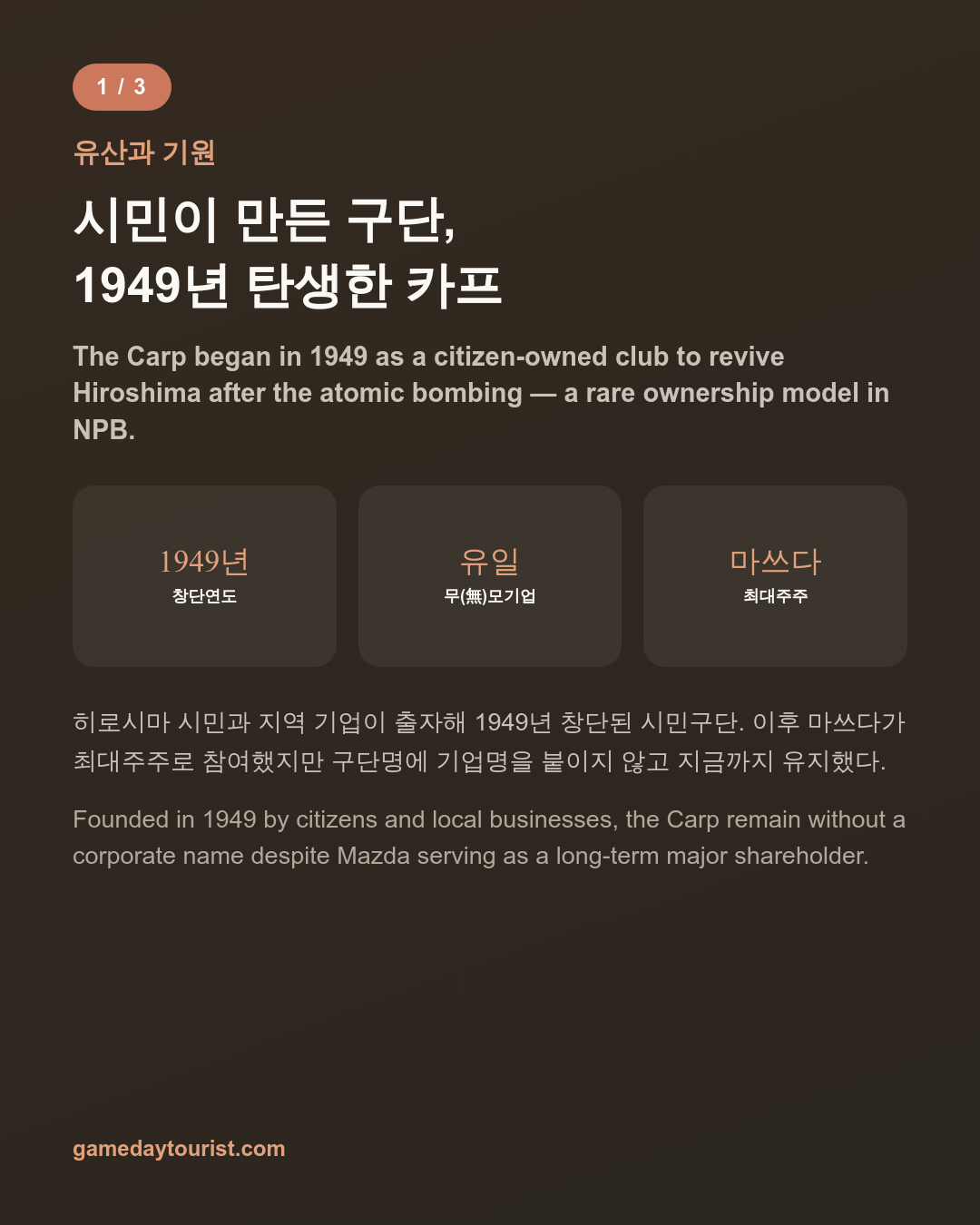
Of Japan’s 12 pro baseball clubs, exactly one has never had a corporate parent since its founding.
In a country where the Yomiuri Giants belong to a newspaper, the Hanshin Tigers to a railway, and the SoftBank Hawks to a telecom giant, the Hiroshima Toyo Carp are the only club that has held on from day one without putting a big company’s name on the team.
I was going through the sponsorship structure of each NPB club one by one and kept getting stuck on this team, which led me to look at its history and recent attendance trends together.
The Carp’s story starts in 1949.
It began as a citizens’ club, funded in small amounts by local government and local businesses in the hope of bringing some life back to a city left in ruins by the atomic bomb.
The name “Carp” is said to have come from “Rijo” (鯉城), an old nickname for Hiroshima Castle, and the image of a carp swimming upstream.
When the club hit serious financial trouble in its early days, local residents famously took to the streets carrying sake barrels to collect donations, a scene that still comes up in nearly every telling of the club’s history.
Automaker Mazda later became the largest shareholder, but that didn’t turn the club into something Mazda carries on its own — the club has kept a structure of citizen shareholders and local companies spreading the ownership around, which is why it’s considered practically the only case among the 12 teams.
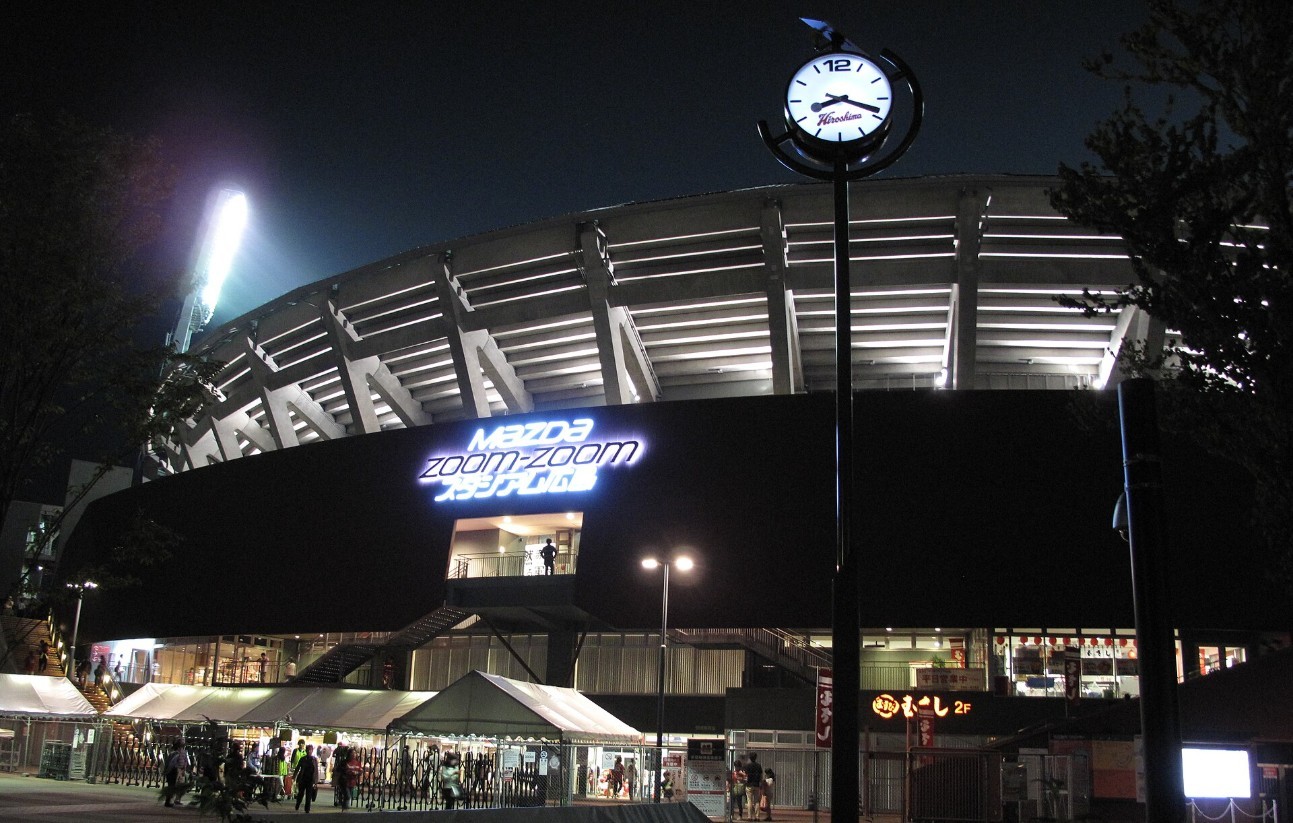
Source: Wikimedia Commons (photo by HKT3012, CC BY-SA 4.0) · night view in the stadium’s early days after its 2009 opening
Crowds and Tickets
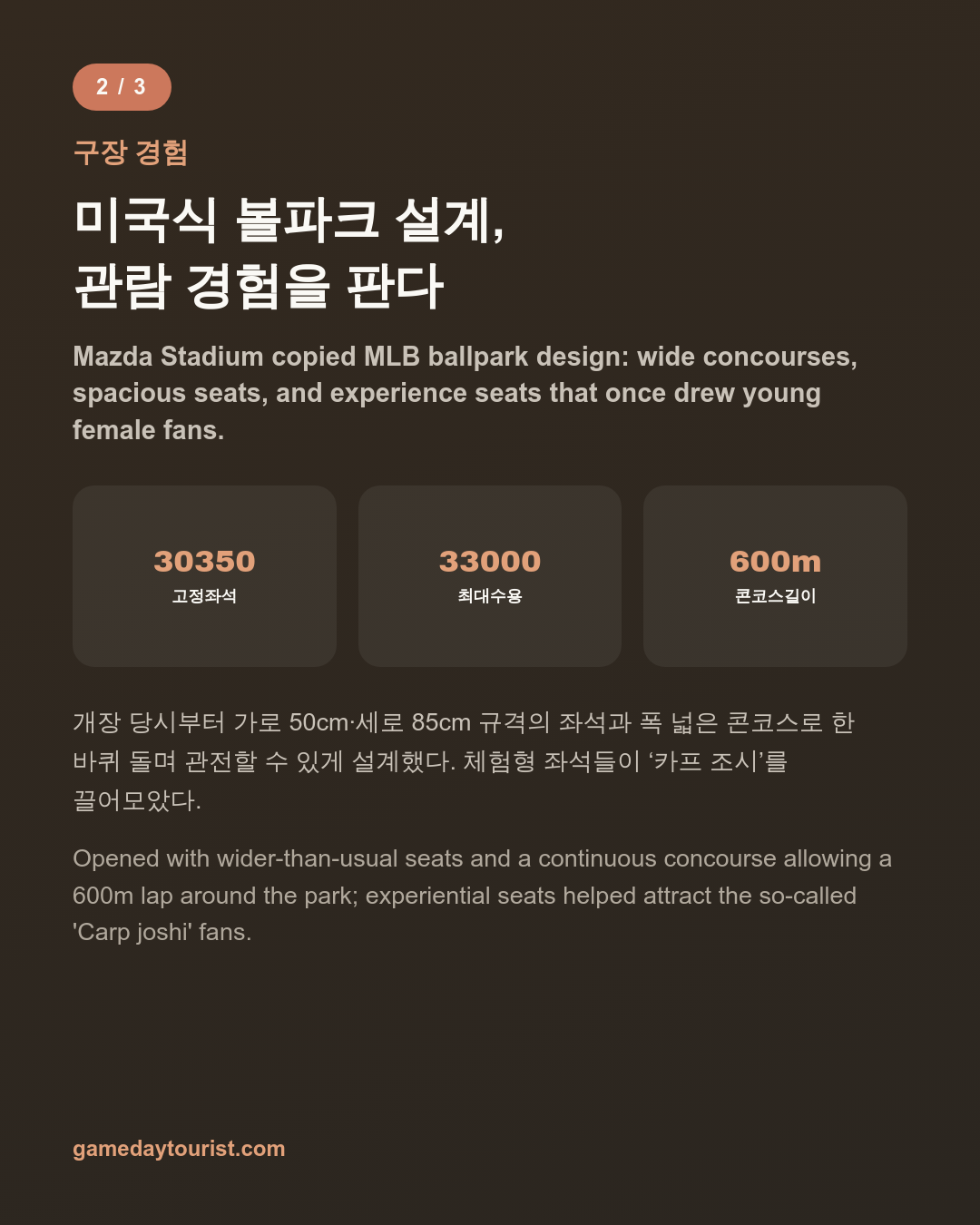
Mazda Stadium opened in 2009 with 30,350 fixed seats, and it can hold up to 33,000 once standing-room spots are included.
Even the main gate carries Mazda’s car-brand slogan, “Zoom-Zoom,” which shows how this club’s sponsorship works: the region’s flagship company put its name on the stadium, not on the team.
But the stands have looked worrying since the 2026 season began.
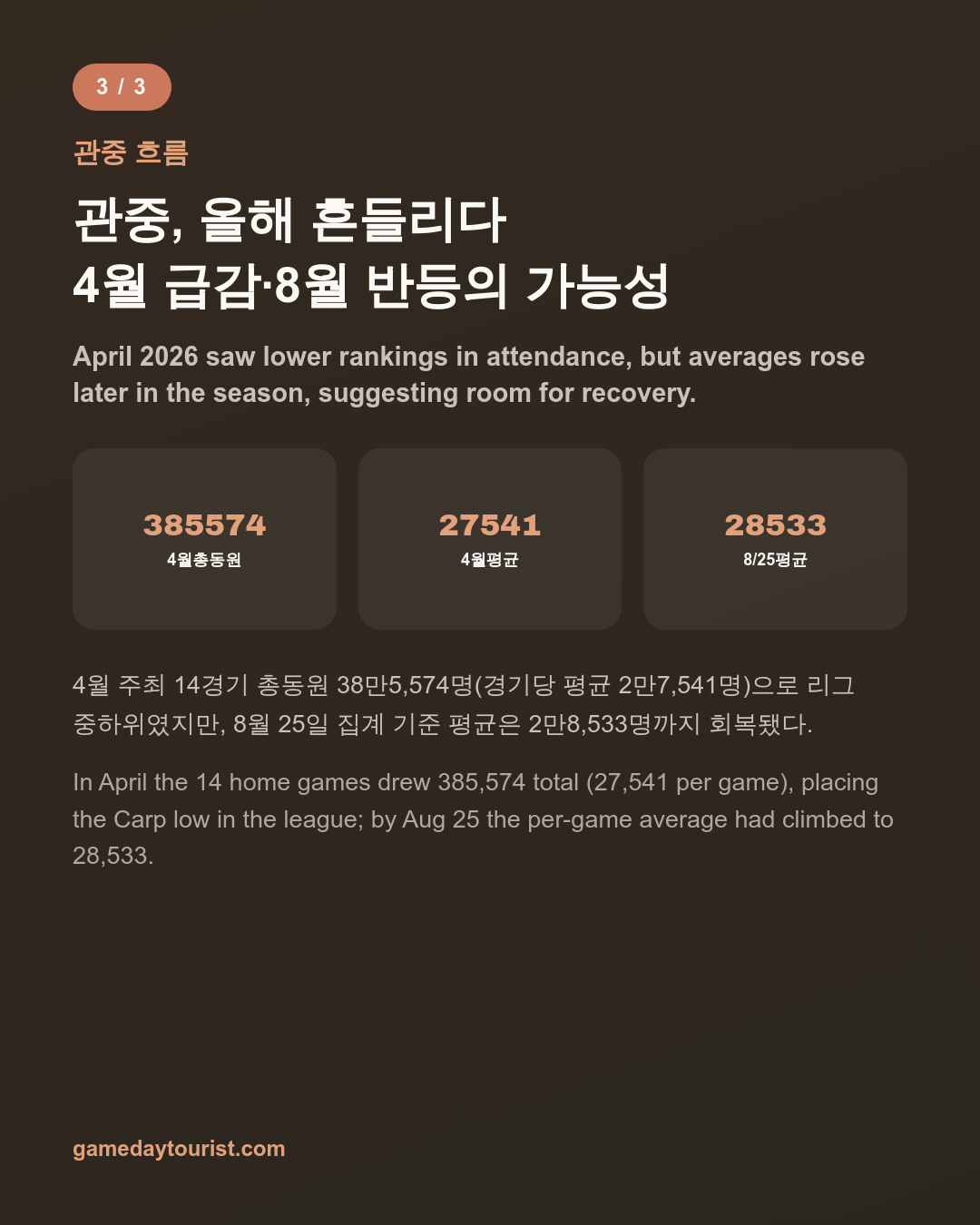
According to a local report, the 14 home games in April drew 385,574 fans in total, eighth among the 12 clubs, and the average of 27,541 per game was the lowest in the Central League.
In mid-July, at least one game dropped into the 19,000s.
As the season has gone on, though, the mood has picked up a bit: figures as of August 25 put the per-game average at 28,533, so there’s still room for a rebound.
On the ticketing side, prices stay at a flat 4,200 yen for infield reserved seats (Section A) rather than moving with the day of the week or the opponent, so fans don’t have to agonize over when to buy.
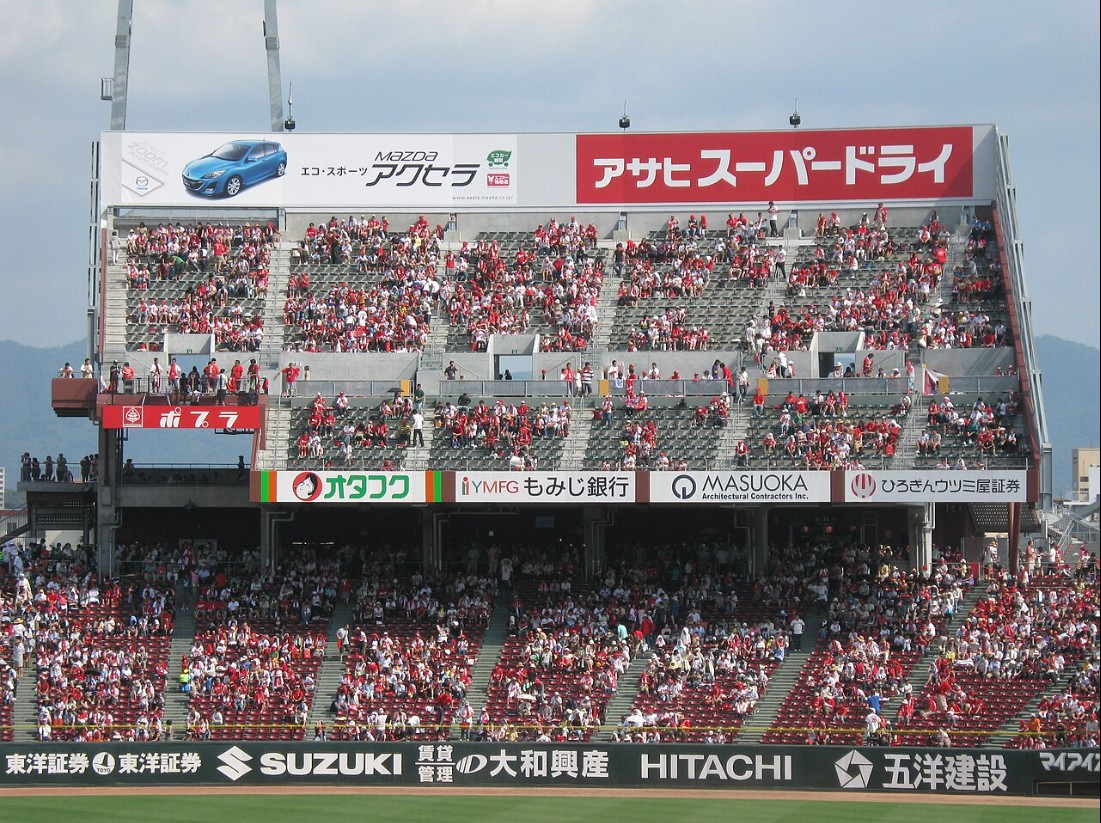
Source: Wikimedia Commons (photo by ElCapitanBSC, CC BY-SA 2.0) · the cheering section in the stadium’s early days after its 2009 opening
Space and F&B
From the day it opened, Mazda Stadium’s design philosophy was to bring the grammar of American Major League ballparks to Japan.
A wide concourse (12 m behind the infield, 8 m behind the outfield) runs unbroken behind the lower-level seats, so you can walk a full lap of about 600 m while still watching the field, and the seats themselves are American-sized, at 50 cm wide and 85 cm deep.
There are also playfully named experience seats, like a lie-down seating area and barbecue terraces where you eat while you watch, and several marketing analyses agree that this kind of spatial design played a decisive role in drawing in the young female fans once known as “Carp Girls” (Carp Joshi).
What’s interesting is that outside the stadium there was once an officially run free viewing area where you could watch the game without a ticket.
It was a way to build the club’s popularity in the early days, and according to a Carp fan blog’s write-up, the area was scrapped once the club’s popularity genuinely recovered and demand for seats grew.
It’s gone now, but I like the flexibility: when popularity is low, they create a free zone to draw people in, and when it picks up, they turn that spot back into paid seating.
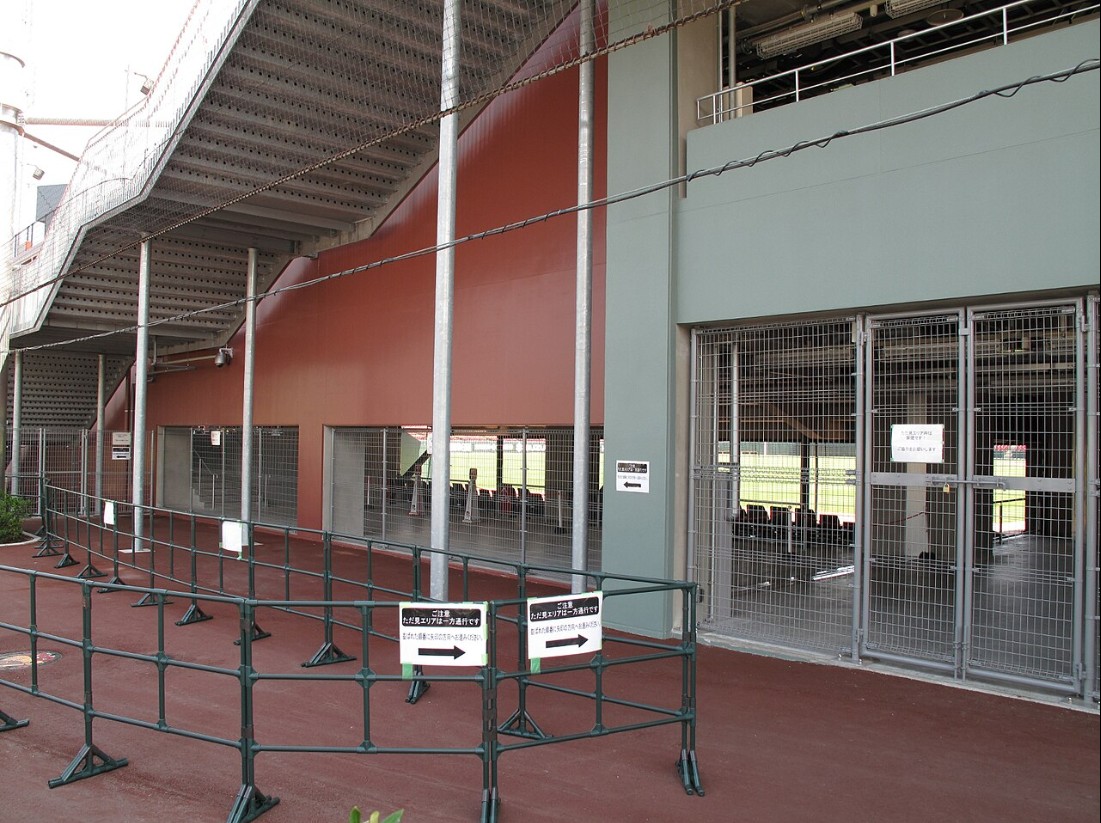
Source: Wikimedia Commons (photo by HKT3012, CC BY 3.0) · photographed in 2009, an area that has since been discontinued
One visitor review on an international travel site called the moment in the bottom of the seventh, when the whole crowd breaks the silence and sends red balloons into the sky together, the most memorable part of the stadium.
Vendors carrying beer through the rows also meant you could enjoy the game without ever leaving your seat, the reviewer noted.
As a working marketer, I think small rituals like this do a lot of the work of positioning a club’s brand as an experience you have to try at least once.
Merchandise and Advertising Inventory
The official Carp goods shop on the first and second floors of the main gate was extensively renovated in January 2023, with more floor space and lower shelves so products are visible at a glance.
The official sponsor lineup on the club’s website has Mazda at the center, alongside representative companies from nine industries, including Ryobi, Asahi Breweries, Coca-Cola Bottlers Japan, Izumi, Edion, Seven-Eleven Japan, Daiso Sangyo, and the Tsuneishi Group.
Front-of-jersey advertising, common in European and American pro sports, doesn’t exist in NPB, so the advertising inventory is built mostly around outfield fence boards and games sponsored by specific companies.
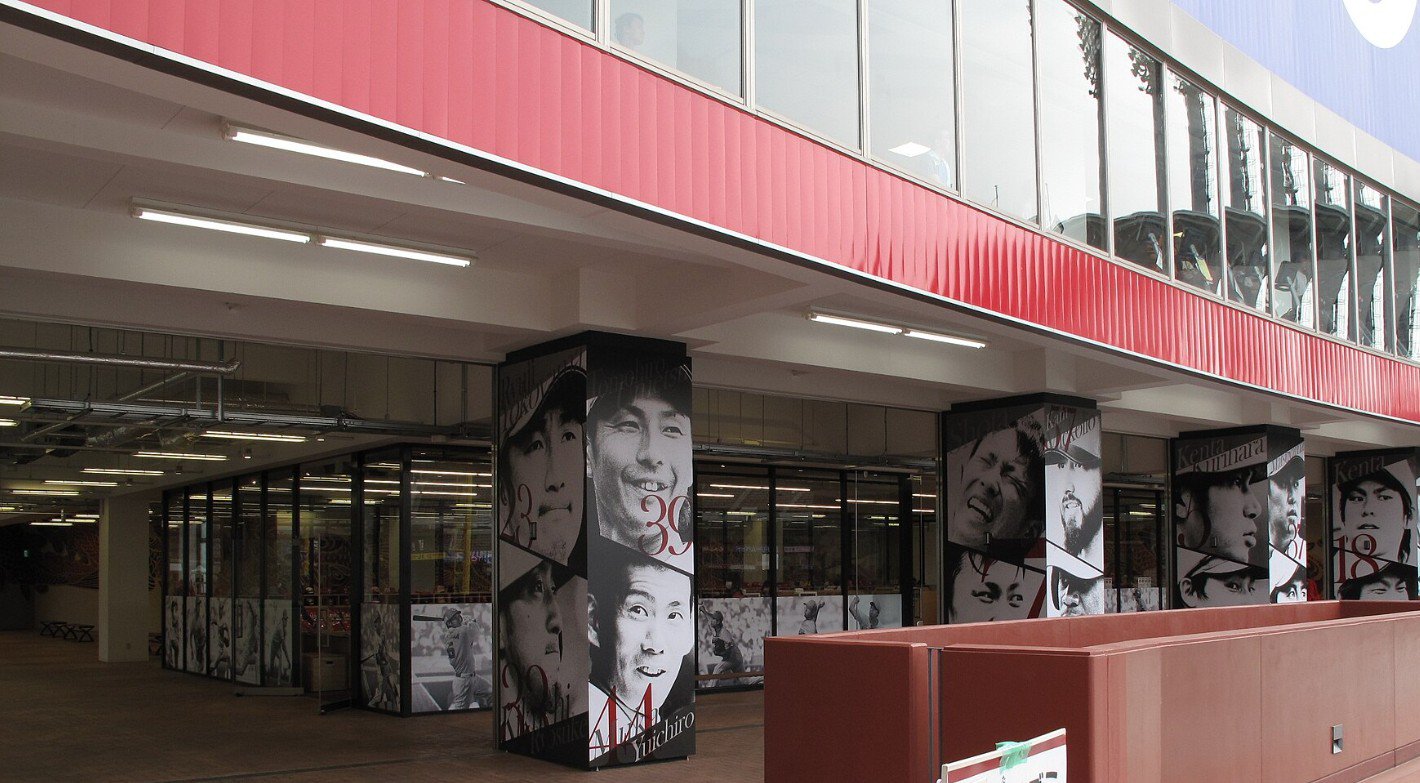
Source: Wikimedia Commons (photo by HKT3012, CC BY-SA 3.0) · the goods shop when it was renovated in 2013
Broadcast Rights and Local Economic Impact
On the broadcast side, local station RCC (Chugoku Broadcasting) handles radio for every Carp home game, TV is split between RCC and Hiroshima TV (HTV), and J SPORTS streams the whole home schedule live with replays.
A local broadcaster holding effectively exclusive rights to every radio broadcast also says something about how closely the club is tied to its region, more so than the big clubs in the capital area.
The stadium’s operating structure is interesting too: the city of Hiroshima designated the Carp as the stadium’s manager, handing over the food and beverage and advertising board operations in exchange for the club covering the stadium’s loan repayments through usage fees, within a total project cost of about 14.475 billion yen.
Once that arrangement settled in, the stadium reportedly posted net profits of about 760 million yen in 2015 and about 1.446 billion yen in 2016, making it a case where the facility itself became part of the club’s revenue model.
A Look at the KBO and K League
All 10 KBO clubs are corporate-owned, and there are no citizen-owned clubs in the KBO where ordinary fans hold shares.
Look at the K League, on the other hand, and citizen clubs led by local governments and citizen shareholders make up a sizable share, including Daegu FC, Incheon United, Seongnam FC, Gangwon FC, and Bucheon FC 1995.
The Carp sit somewhere between the two: no single company owns the club, but Mazda, a flagship company of the region, has long served as the largest shareholder and a stable source of funding.
Having often heard that K League citizen clubs struggle to secure their budgets every season, I think the Carp’s compromise — one local company holding a major stake without putting its name on the team — is worth chewing on from a marketing angle.
What I find most interesting about the Carp’s shaky attendance right now is that even a team once cited endlessly as a sports-marketing success story sees empty seats pile up quickly once a new competing venue opens nearby and results stall.
Given analysis suggesting that local interest has shifted to Sanfrecce Hiroshima’s new home, Edion Peace Wing Hiroshima, which opened in 2024, it’s a fresh reminder that no brand can rest on the “Carp Girls” legend forever.
How a club that has survived for more than 70 years without a parent company handles its next chapter is a case I’ll keep watching as a marketer.
Leave a Reply