Contents · About 9 min read
📱 View as card news
A couple of days ago, I opened my laptop after seeing news about what was happening at Wrigley Field on August 29.
This year marks exactly 150 years since the Chicago Cubs joined as a founding member of the National League in 1876, and the club spent this past weekend (August 29-30) hosting a major two-day celebration.
At the corner of Clark and Addison, a permanent clock tower called the “Founders Clock,” engraved with four eras of club history, was unveiled for the first time, alongside the announcement of a fan-voted “150th Anniversary Team” of roughly 40 all-time greats spanning players and managers from 1876 to today.
As a marketer, there was another announcement that mattered even more to me.
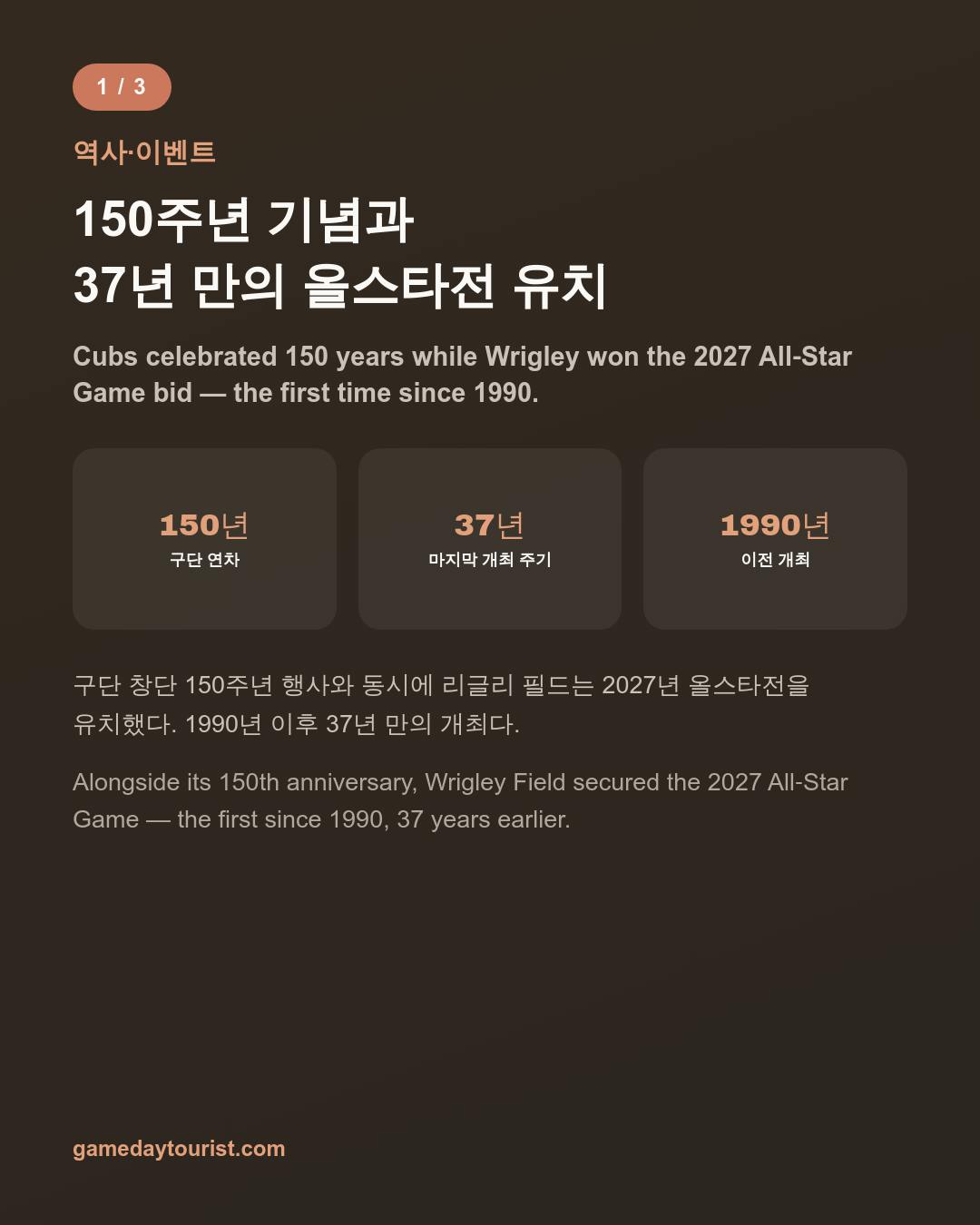
Right around this 150th anniversary came the news that Wrigley Field had landed the All-Star Game on July 13, 2027.
It’ll be the ballpark’s fourth All-Star Game and first in 37 years, since 1990 (after 1947 and 1962), and what struck me was that a club over 150 years old is still racking up new “firsts” and “mosts.”
So I decided to take a closer look at Wrigley Field from a marketing angle.
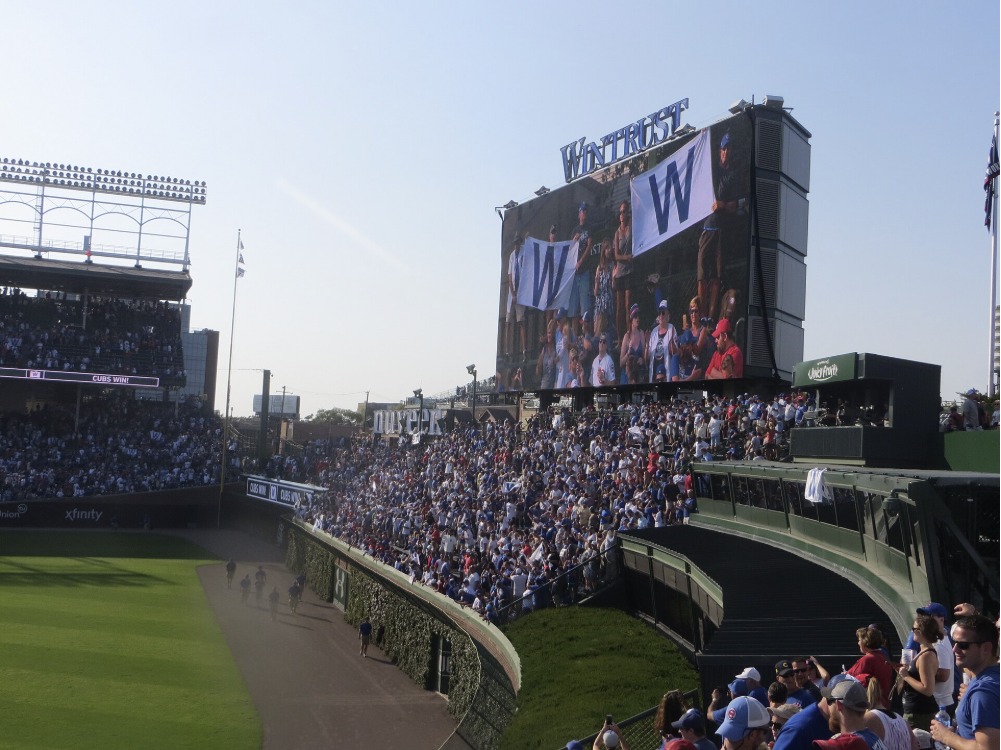
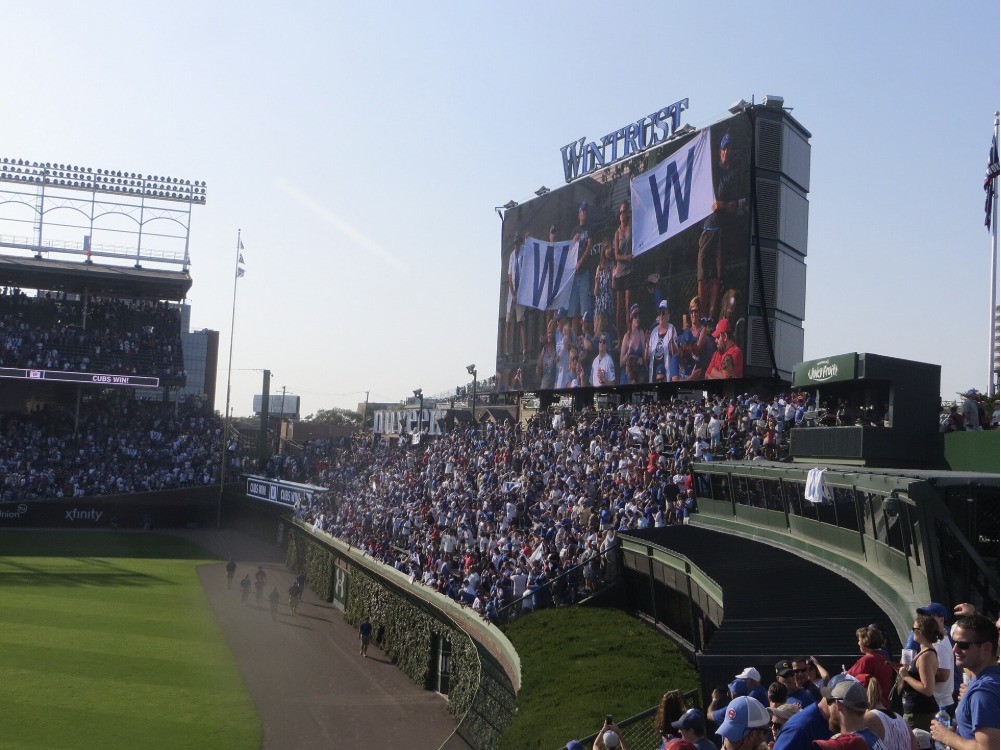
Source: Wikimedia Commons (David Wilson, 2017) · CC BY 2.0
That white flag flying at upper right is the Cubs’ W flag.
Since the scoreboard went up in 1937, the club has flown a blue W on white after a win and a white L on blue after a loss — a practical custom from an era with no TV or internet, so fans riding the L train home could just glance up and know the score.
It’s also a fun detail that the colors used to be reversed — a white W on blue — until they were flipped to today’s scheme in 1982, around Ernie Banks’ number retirement ceremony.
Source: Screenshot of the Cubs’ official 150th anniversary page · Official club image
Attendance and Tickets
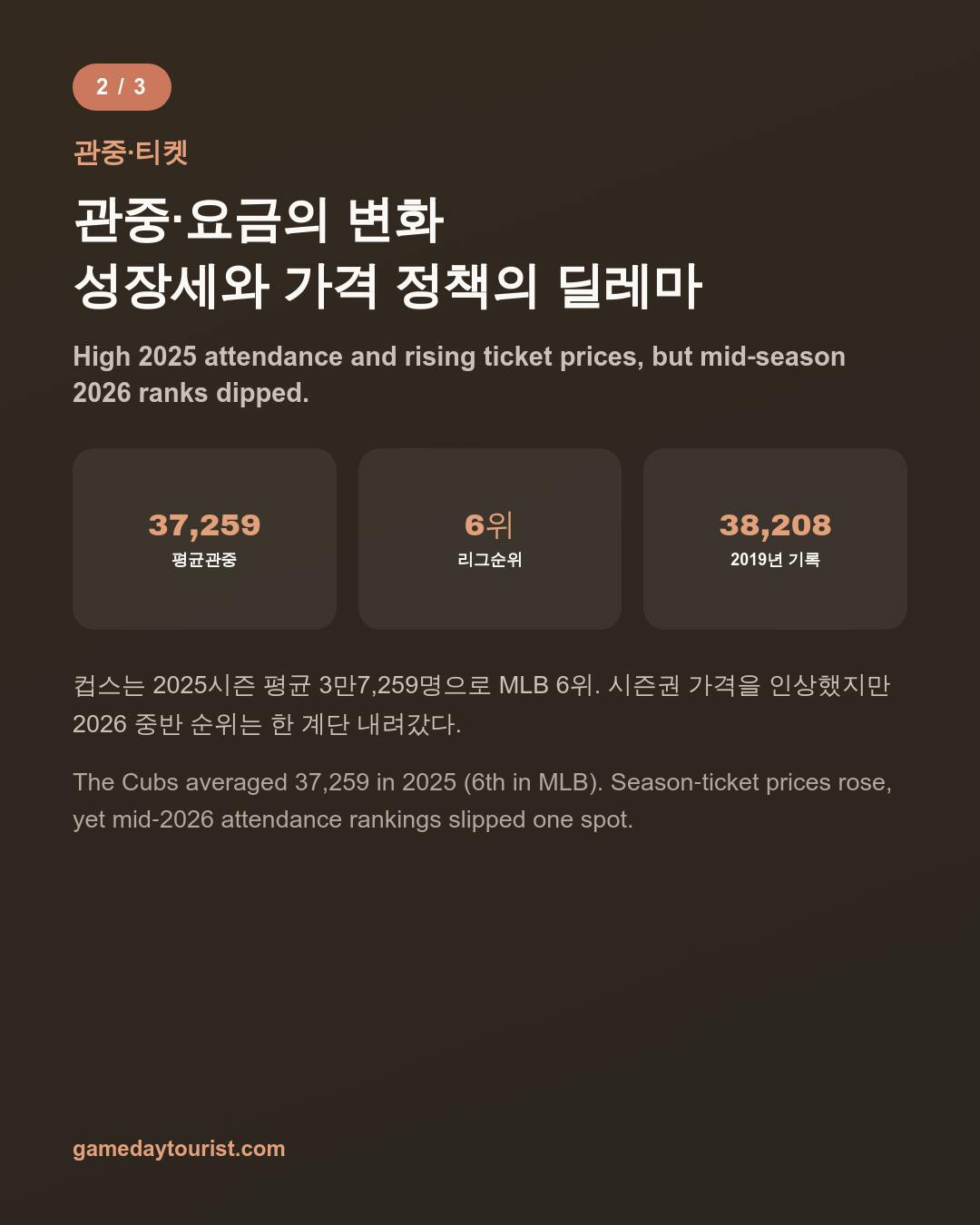
The Chicago Cubs drew an average of 37,259 fans across 79 home games in 2025, sixth-best in all of MLB.
That’s reportedly the club’s best mark since 2019 (38,208), and riding that momentum, the club raised 2026 season ticket prices by an average of 5-8% (6% overall).
That said, midway through 2026 (1,397,964 fans over 40 home games, an average of 34,949 per game), the Cubs have slipped a spot to ninth.
A study analyzing resale prices on the ticket marketplace SeatGeek found that the Cubs’ average cheapest home-game listing for 2026 was around $43, ranking seventh in the league — and that the Cubs’ road games gave the third-biggest boost to opposing teams’ ticket prices, behind only the New York Yankees and LA Dodgers.
The most striking change, though, is what happened to the season ticket waitlist.
The Cubs had run a season ticket waitlist since 2003, which at one point topped 100,000 names — but in November 2023, the club scrapped it entirely, switching to instant-purchase packages of 20, 41, or 81 games.
They walked away from over two decades of demand management by “getting in line,” and instead flipped the policy toward broader access through more granular product packages.
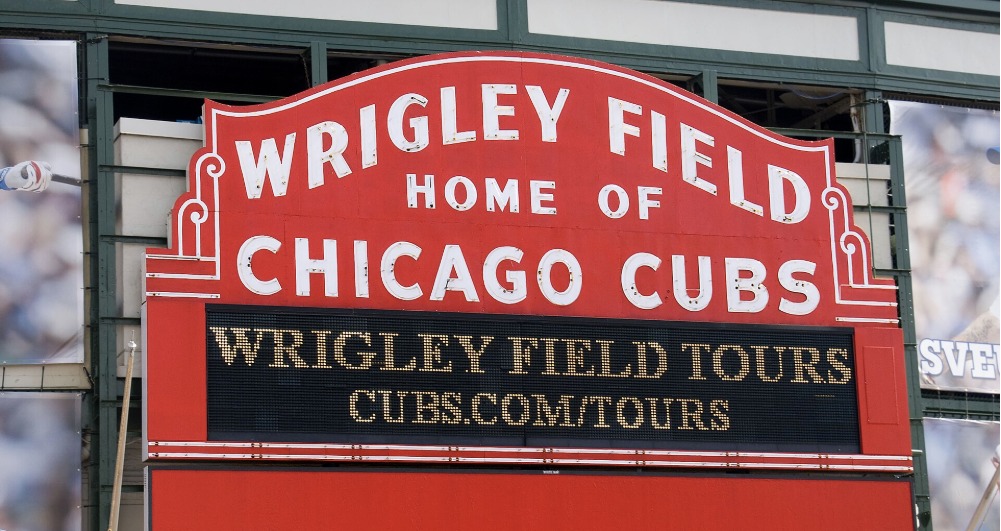
Source: Wikimedia Commons (Ron Cogswell, 2012) · CC BY 2.0
What Makes the Ballpark: Ivy Walls and Rooftops
The first image most people associate with Wrigley Field is probably the ivy covering the outfield wall.
In 1937, then-owner Philip K. Wrigley wanted a park-like atmosphere he’d seen in California, so he commissioned the landscaping Klaeber family, who started by planting a mix of Boston ivy and bittersweet vine.
A rule still on the books today automatically awards a ground-rule double if a batted ball disappears into the ivy, meaning this single wall has functioned as both the club’s identity and a marketing asset for nearly a century.
Just as distinctive as the ivy are the rooftop seats outside the park, known as the “Wrigley Rooftops.”
Starting in the 1980s, nearby building owners began putting seats on their roofs and charging admission, and at one point that rooftop-seating business grew into a roughly $7 million-a-year industry.
In the early 2000s, the club and the rooftop owners struck a deal splitting 17% of rooftop-seat revenue and 11% of outdoor signage revenue with the club, and after the Ricketts family bought the team in 2009, they went on to purchase 11 of the 16 rooftop buildings outright.
With the one remaining rooftop whose agreement has expired, litigation has been ongoing since 2024, with the club going so far as to call the operator “parasitic” in court filings — a sign of just how heated things have gotten.
It struck me that leaving something as hard to define as “viewing rights outside the ballpark” unaddressed for nearly a century, then trying to sort it out after the fact, was almost bound to blow up into a conflict this big.

Source: Wikimedia Commons (Cole Camplese, 2016) · CC BY 2.0
Making the Most of Space, and F&B
Built in 1914, Wrigley Field has a longstanding reputation for cramped concourses.
One local ballpark-review site noted that the ground-floor concourse is narrow and crowd flow is complicated — if your seat is more than 15 rows from the field, you’ll likely need to navigate stairs and ramps — and gave the food category just 2 out of 5.
That same review suggested fans are better off eating in the Wrigleyville neighborhood outside the park, though signature ballpark items like the Chicago-style hot dog and the 2-pound North Side Twist pretzel are apparently still popular.
The club’s answer to those tight concourses is Gallagher Way, right outside the ballpark’s west entrance.
On a 2-acre site, the development includes a 173-room boutique hotel called the Zachary (named after Wrigley Field architect Zachary Taylor Davis), along with offices, retail, and an outdoor event plaza that draws crowds with concerts, outdoor movie screenings, and markets even on non-game days.
The development was built directly by Hickory Street Capital, the Ricketts family’s real estate arm — essentially generating the dwell time and spending the concourse itself couldn’t accommodate, just outside the ballpark’s walls instead.
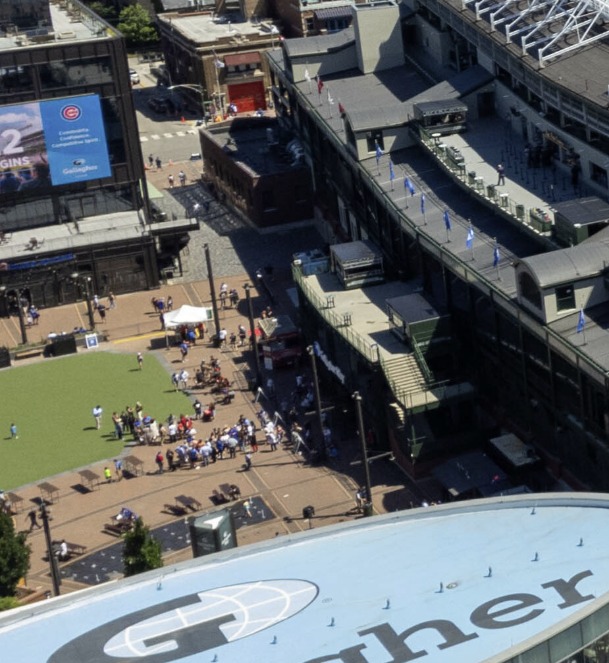
Source: Wikimedia Commons (Sea Cow, 2022) · CC BY-SA 4.0
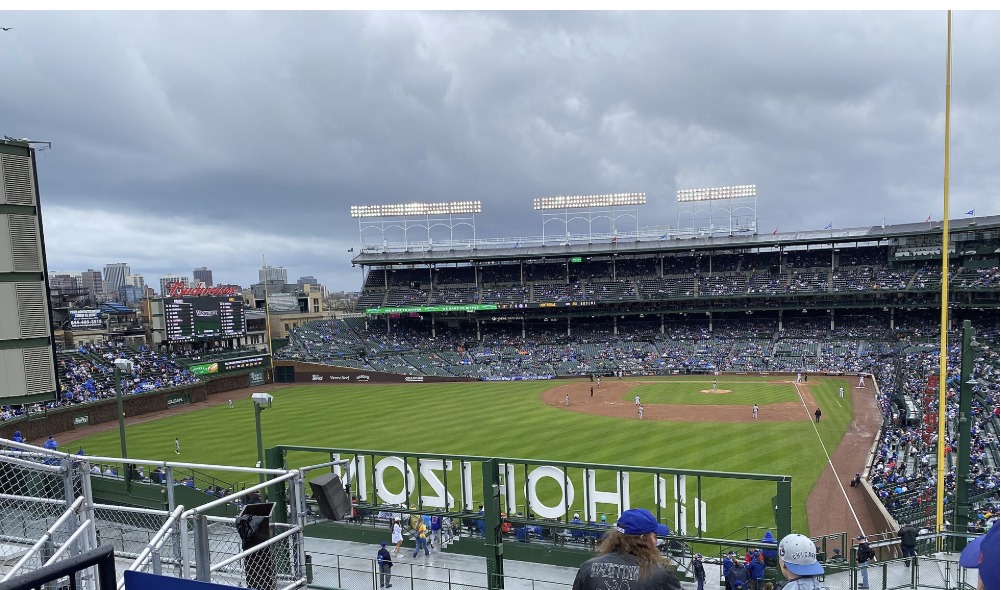
Source: Wikimedia Commons (Adc95, 2022) · CC BY-SA 4.0
Merchandise and Ad Inventory
The exact figure hasn’t been disclosed, but a club business executive told the press it ranks “among the top” in the league — putting it well above the league average of roughly $7-8 million a year, and likely closer to top-tier deals like the Yankees’ and Blue Jays’ (around $20 million a year).
What’s more interesting is the club’s approach to naming rights.
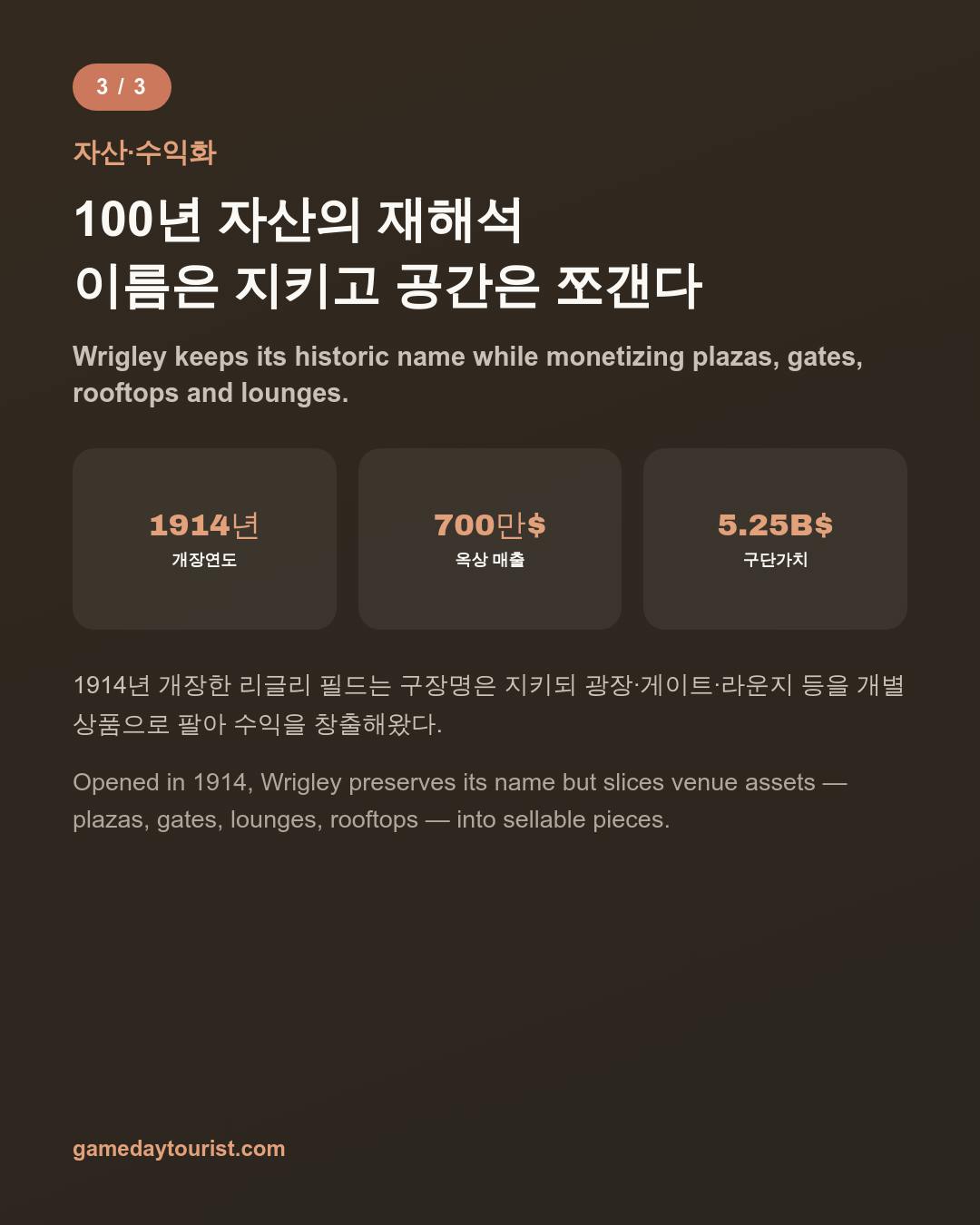
The Cubs will never sell the name “Wrigley Field” itself, but they’ve carved up nearly everything inside it into individual pieces for sale.
The west plaza and gate belong to insurance broker Gallagher (“Gallagher Way”); the left-field wall signage and the future Addison-Sheffield entrance belong to insurer Wintrust (“Wintrust Gate”); the panel beneath the front marquee sign belongs to Toyota; and the mid-level premium lounge belongs to insurance agency Assurance (“The Assurance Club”) — while Budweiser has its name on the outfield bleachers and Audi brands the interior VIP lounge.
It’s a strategy of never selling the ballpark’s name while slicing up everything inside it into individually sellable products.
At the permanent team store and gameday pop-up shops at 3637 Clark Street, Wrigley Field-shaped snow globes remain steady sellers, and this year brought a separate limited-edition line stamped with the 150th anniversary logo.
Broadcast Rights and Local Economic Impact
Cubs broadcasts are handled by Marquee Sports Network, a regional sports network (a cable channel that broadcasts only in a specific market) jointly founded by the Sinclair Broadcast Group and the club in 2020.
In 2025, a breakdown in retransmission talks with Comcast pushed the channel onto a pricier tier, but as of March 2026 it’s also available on Hulu + Live TV and Prime Video, widening distribution again.
Forbes valued the club at $5 billion in 2026, good for fourth in MLB, with revenue of $599 million, gate receipts of $195 million, and operating income of $58 million.
The club and ballpark’s impact on the local economy is substantial too.
One study found roughly 80 bars, restaurants, and shops in Wrigleyville sit directly within the ballpark’s economic footprint, supporting about 7,000 jobs, with visiting fans spending an average of $104 per game locally.
Add the July 13, 2027 All-Star Game on top of that, and the roughly three days of festivities should give the local economy another boost from visitor spending.
A Comparison With the KBO and K League
The Cubs are marking 150 years since joining the National League in 1876, and Wrigley Field is 112 years old this year, having opened in 1914 (the second-oldest active ballpark in MLB, after Fenway Park).
By comparison, the longest-running Korean club under an unchanged parent company is the Doosan Bears (formerly the OB Bears), founded in January 1982 — turning 44 this year, which is less than a third of the Cubs’ club history.
What caught my attention even more than that history gap, though, was the difference in how naming rights are handled.
In Korea, it’s common for the parent company that owns and operates a ballpark to slap its own brand on the entire venue, as with Hanwha Eagles Park or Samsung Lions Park.
Wrigley Field takes the opposite approach — the ballpark’s name has gone untouched for over a century, while the plazas, gates, lounges, and bullpens inside it are each sold off individually to different third-party companies.
It’s a difference between bundling brand equity into one big sale versus slicing it up and selling it in many small pieces — but both are, in the end, different answers to the same question: whose name gets left on the ballpark.
Putting the 150th anniversary celebration and the 37-years-in-the-making All-Star Game side by side, two seemingly unrelated pieces of news, I realized they were really telling one story.
The older an asset gets, the more it needs fresh events layered on top to keep the brand feeling current — and Wrigley Field has funded that renewal not through the ballpark’s name, but through all the small spaces inside it.
Korean clubs will eventually face the same question of how to keep selling an aging ballpark as something new, and I found myself thinking that the way Wrigley Field has answered that for over a hundred years could be a useful reference point.
Leave a Reply