Contents · About 9 min read
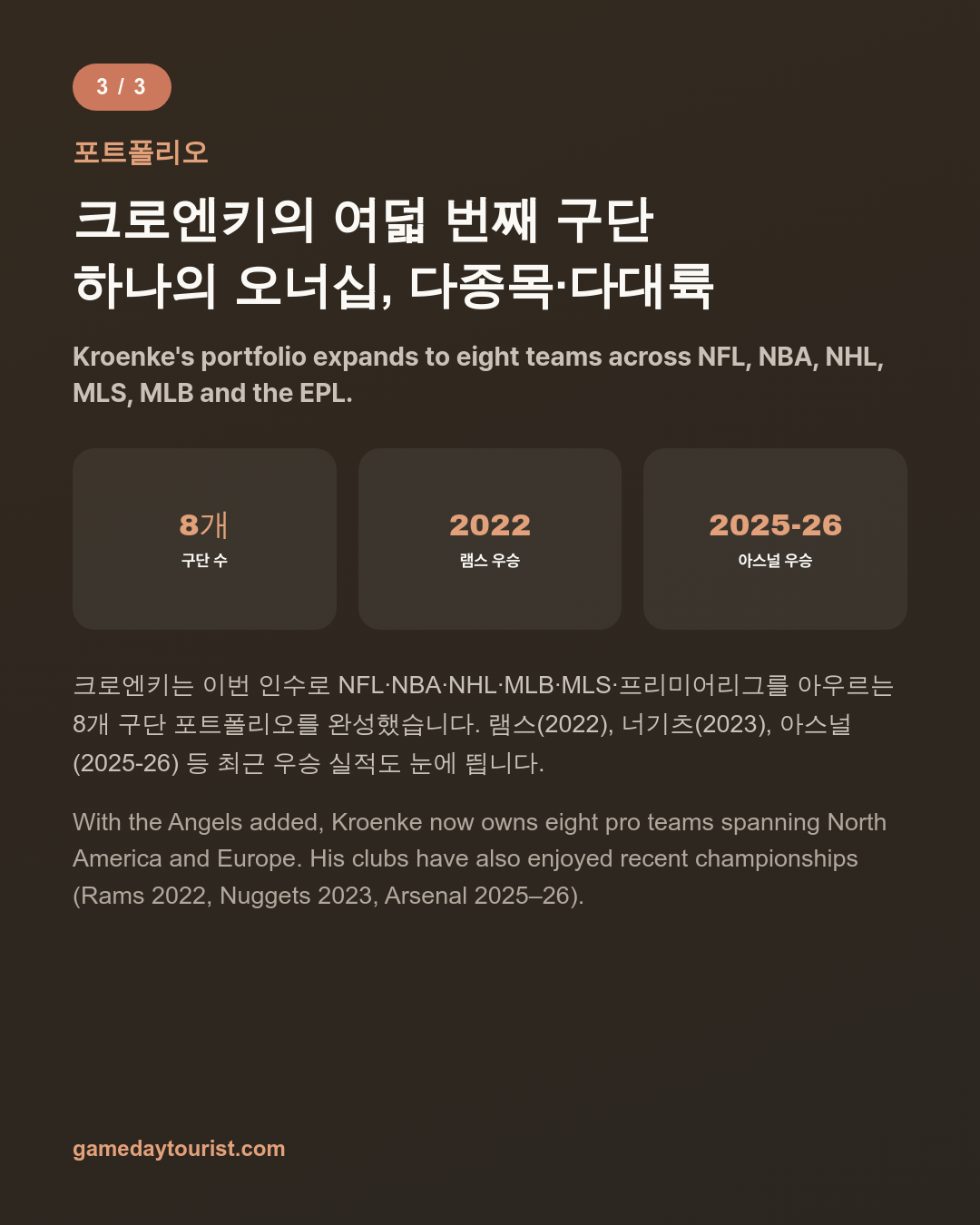
📱 View as card news
Last month, I featured Angel Stadium in Anaheim as a benchmarking case.
My strongest impression was of an old ballpark that still had its own charm, with traces of its Disney-ownership era still visible here and there.
Then news broke that the ballpark’s owner was about to change completely, so I found myself looking at it again.
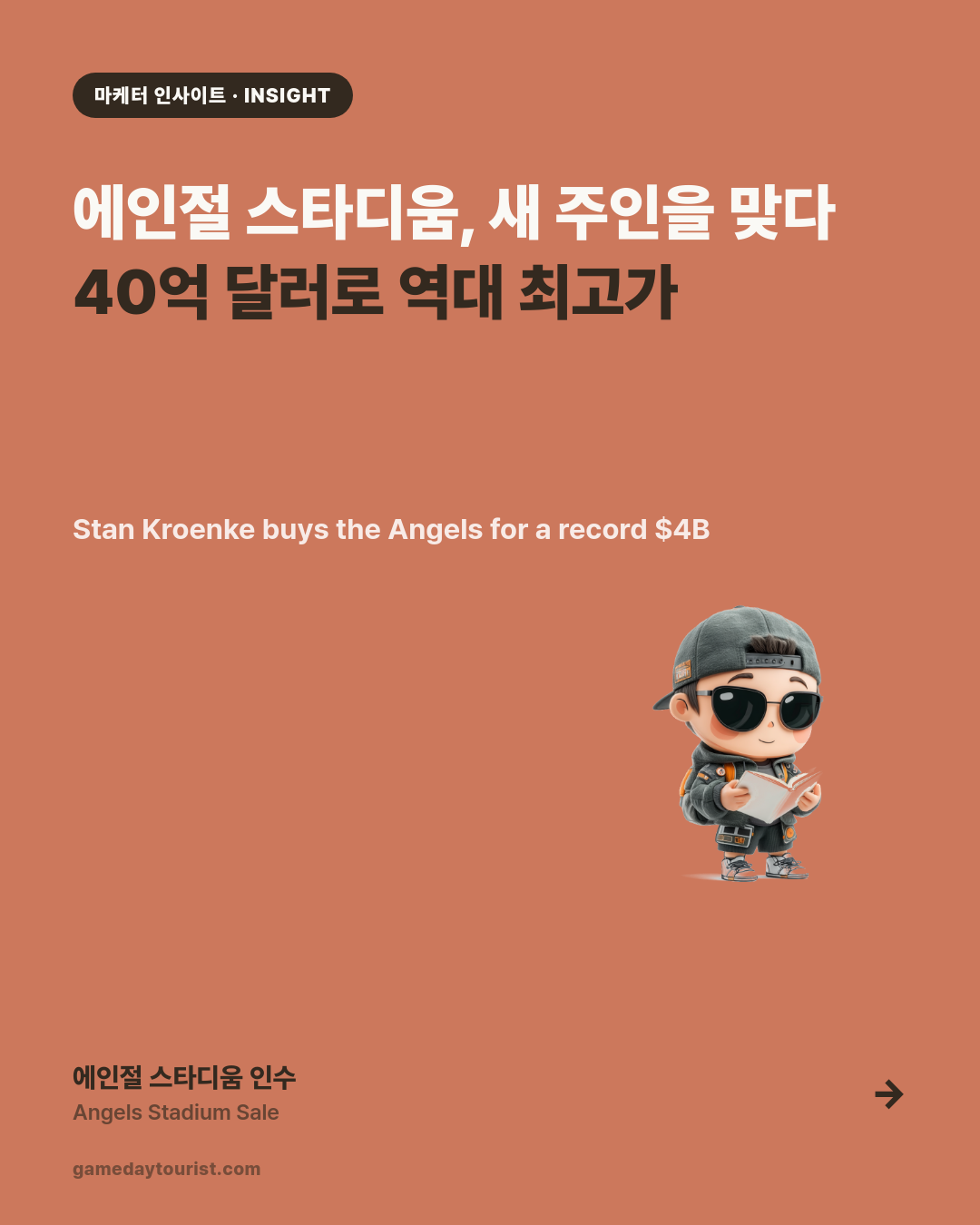
Angels owner Arte Moreno agreed to sell the club after 23 years, in a deal that ranks among the largest in American pro sports history.
The new owner wasn’t an unfamiliar name.
It’s Stan Kroenke — owner of the NFL’s Los Angeles Rams and majority owner of England’s Arsenal.
Arsenal is a club I’ve already covered twice on this blog over the past two months, in pieces about the Emirates Stadium and its naming rights, so this one naturally caught my eye.
Now a baseball club is joining that same ownership umbrella, and as a marketer, it struck me as more than just another ownership-change headline.
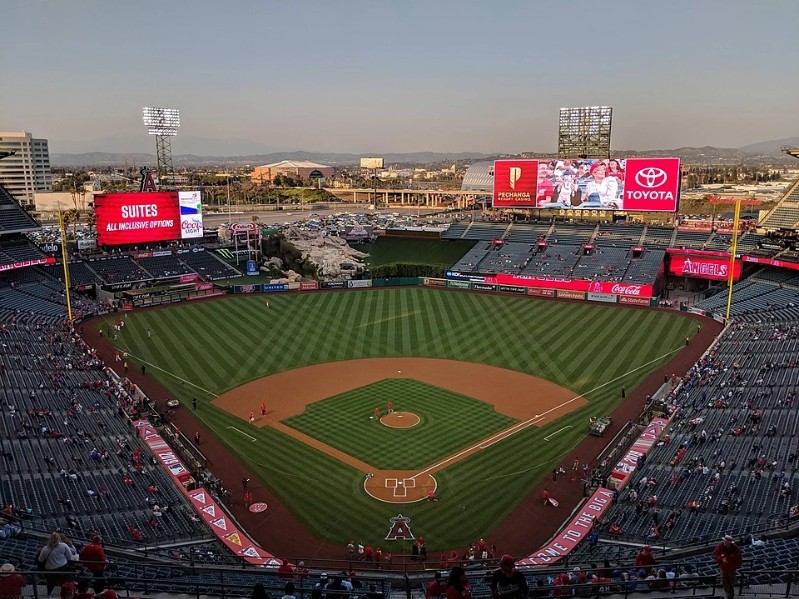
Source: Wikimedia Commons (CrispyCream27, March 25, 2019, before a spring training opener) · CC BY-SA 4.0
$4 Billion — an MLB Record Sale
In late August 2026, an official MLB announcement confirmed that Kroenke Sports & Entertainment (KSE) had agreed to acquire a controlling stake in the Angels from Arte Moreno.
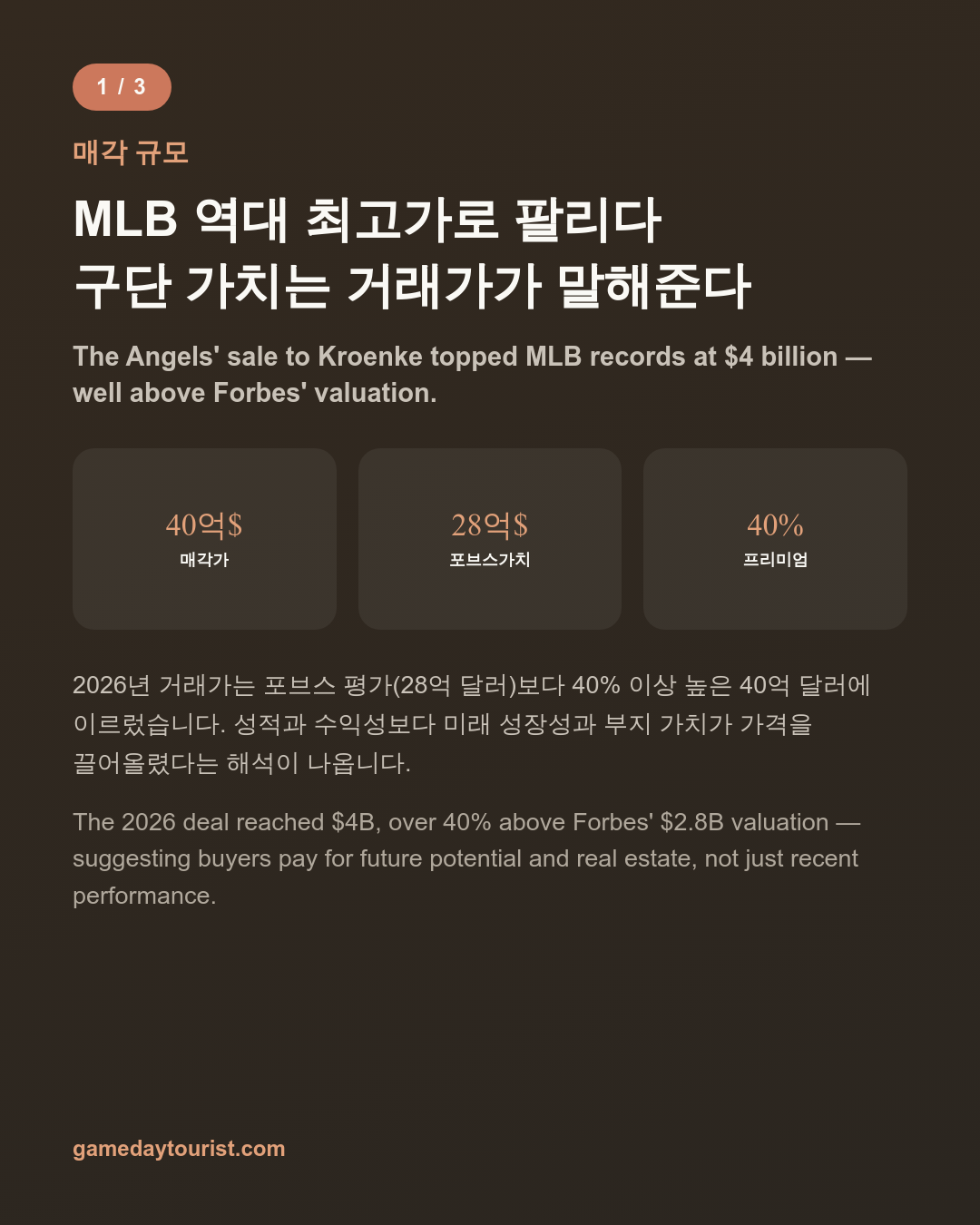
The deal is valued at $4 billion or more — again breaking the MLB record set just months earlier, in early 2026, when the San Diego Padres sold for $3.9 billion.
Pending MLB approval, the deal is expected to officially close in the first quarter of 2027.
Moreno bought the Angels from Walt Disney in 2003 for $180 million.
Early on, the club found success, winning division titles in 2004-05, 2007-09, and 2014, but the last decade told a different story.
The Angels haven’t posted a winning record since 2015, and this season they’re stuck near the bottom of the American League at 53-85.
Moreno said as recently as this spring’s training camp that he had no plans to sell, so the announcement caught much of the industry off guard.
What’s interesting is the sale price itself.
Forbes valued the Angels at $2.8 billion in 2026, meaning the actual sale price came in more than 40% above that.
That kind of premium isn’t unique to the Angels, either.
Add in the Seattle Seahawks ($9.6B), LA Lakers ($12.5B), and Minnesota Timberwolves ($4.5B), and roughly $30 billion in US pro sports team equity has changed hands in just the past three months.
As a marketer, I read this as a sign that investment demand for pro sports teams as an asset class is surging, largely independent of any single team’s recent results or profitability.
Eighth Team, One Ownership
Kroenke’s name wasn’t unfamiliar to me for the Arsenal reason mentioned above.
Kroenke Sports & Entertainment is a holding company that already owns the NFL’s Los Angeles Rams, the NBA’s Denver Nuggets, the NHL’s Colorado Avalanche, MLS’s Colorado Rapids, indoor lacrosse’s Colorado Mammoth, and the Premier League’s Arsenal.
Add the Angels, and foreign outlets are reporting that Kroenke’s pro-sports portfolio has now grown to eight teams.
That’s one owner spanning football, basketball, hockey, baseball, and soccer (on both sides of the Atlantic) — a sport-and-continent-spanning ownership structure that’s rare even among America’s biggest sports owners.
Kroenke’s track record is also worth a look.
The Rams won the Super Bowl in 2022, the Nuggets took the 2023 NBA Finals, and the Avalanche have won the Stanley Cup twice, in 2001 and 2022.
Arsenal also won the Premier League last season (2025-26) for the first time in 22 years, so Kroenke-owned clubs have had an unusually close relationship with championships in recent years.
There’s real excitement among Angels fans about the new owner — local outlet KTLA even captured one half-joking reaction wondering whether Shohei Ohtani might regret leaving the Angels if he heard this news now.
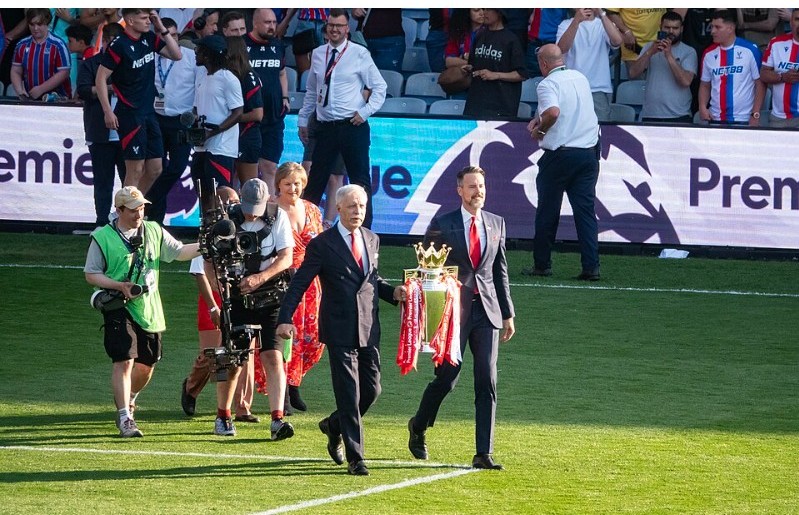
Source: Wikimedia Commons (Chensiyuan, May 24, 2026, just after a Crystal Palace vs Arsenal match) · CC BY-SA 4.0
Kroenke’s interest doesn’t seem limited to trophies, though.
He personally developed SoFi Stadium, the Rams’ home ground, transforming roughly 300 acres in Inglewood into “Hollywood Park,” a mixed-use district combining retail, housing, and entertainment.
That district has since become such a regional sports-and-entertainment hub that part of the 2028 LA Olympics opening ceremony is slated to be held there.
Anaheim’s “Platinum Triangle,” where Angel Stadium sits, is a similarly large plot — roughly 150 acres, about 85 soccer fields’ worth, with a single ballpark surrounded mostly by surface parking — leading some in the industry to speculate that Kroenke could bring the same SoFi/Hollywood Park playbook to Anaheim.
If that happens, a site that’s been just a ballpark could turn into a year-round commercial district mixing retail, housing, and hotels.
Attendance and Tickets
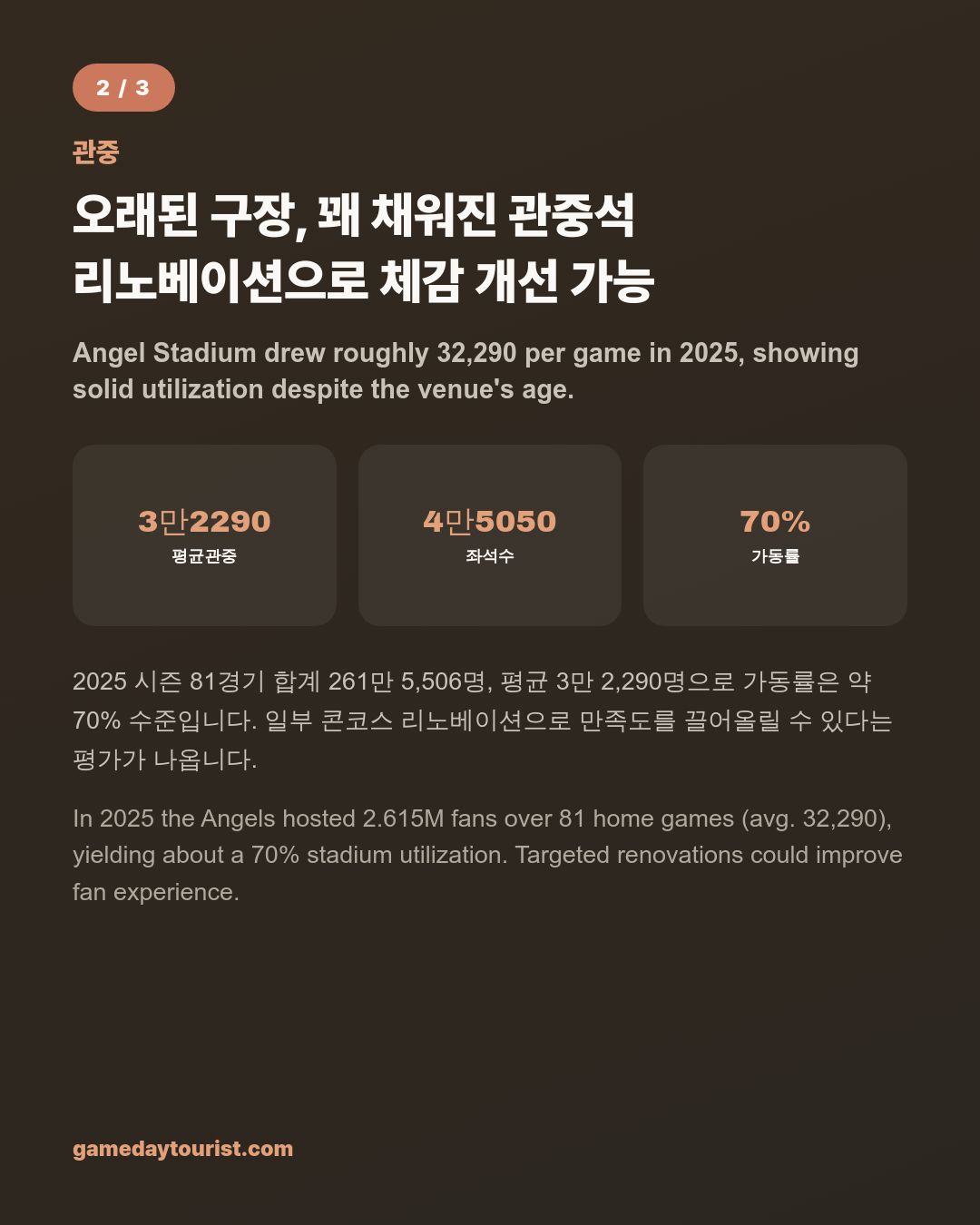
The Angels drew 2,615,506 fans across their 2025 home schedule, averaging roughly 32,290 per game over 81 games.
Against a capacity of 45,050 (per the latest 2026 figures from stadium guide site Itinerant Fan — Wikidata’s infobox lists a different figure, 43,250, likely reflecting seat-count adjustments from past renovations), that puts occupancy just over 70%.
Some surveys put the Angels’ face-value ticket prices among the cheapest in the league, suggesting the club is deliberately keeping the price bar low to fill seats even through a stretch of poor results.
Going by reviews from local fans who’ve attended, Angel Stadium — now more than 60 years old — has its worn spots, but also plenty that people genuinely like.
Because it was built as a baseball-only ballpark, sightlines are unobstructed from foul pole to foul pole from any seat, and part of the field-level concourse has been converted into an open-air food court with picnic tables under palm-tree shade — both frequently praised.
On the flip side, the upper (view-level) concourse is narrow enough that it gets uncomfortably crowded, a complaint that comes up repeatedly.
From a marketer’s perspective, it’s a good reminder that even an aging ballpark can see a real bump in perceived satisfaction just from renovating its busiest pinch points.
Broadcast Rights and Sponsorship
The Angels have taken a direct hit from turmoil in the regional broadcast market in recent years.
The club ended up buying out Main Street’s stake and converting the channel into its own regional network — and in the fallout, total 2026-season player payroll fell sharply to $180.5 million, down from the prior year’s $206 million.
In press interviews, Moreno pointed directly to shrinking broadcast revenue as the reason for the payroll cuts, noting it had already taken a hit moving from Fox to Main Street/FanDuel, and was taking another hit now.
It’s a clear example of how broadcast rights — a revenue stream fans rarely think about — end up shaping roster construction and results.
The jersey sleeve patch has belonged to building-materials distributor Foundation Building Materials (FBM) since 2023.
Its cedar-tree logo is rendered in the Angels’ red and blue team colors; the deal’s financial terms weren’t disclosed.
For context, Angel Stadium signed a 20-year naming-rights deal with Edison International in 1998, only for Edison to exercise an early-exit option after the 2003 season, handing the name back.
One of the first things Moreno reportedly did after buying the club was commit to not re-selling the naming rights and keeping the original “Angel Stadium” name — it’ll be worth watching whether that two-decade-plus principle survives under the new ownership.
What Makes the Ballpark: The Rally Monkey
All these numbers can get dry fast, so I want to share one fun tradition unique to this ballpark.
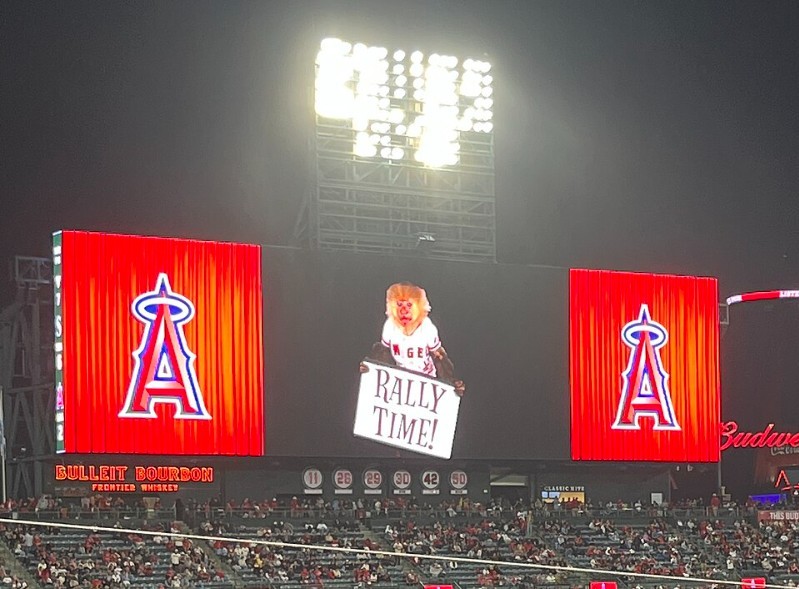
It’s the “Rally Monkey.”
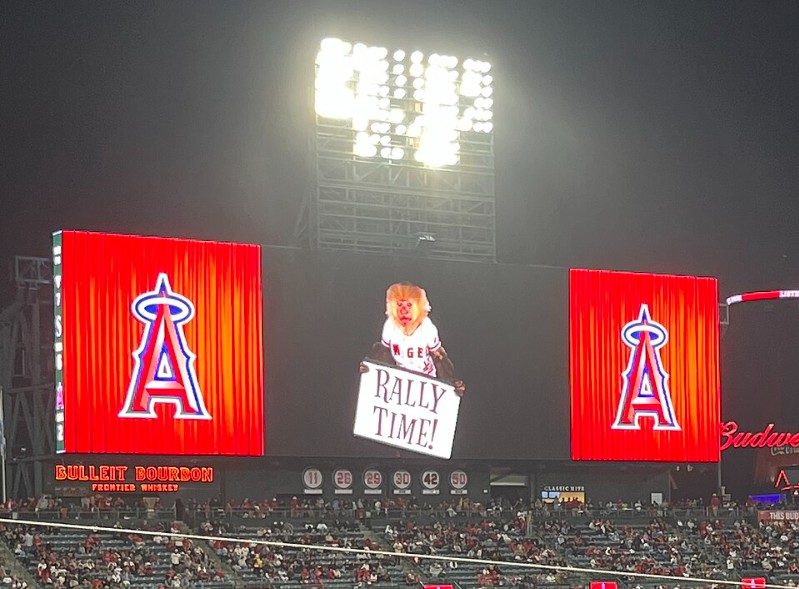
On June 6, 2000, with the Angels trailing the San Francisco Giants 5-4 in the bottom of the ninth, two video-board operators spontaneously cut a clip of a monkey bouncing around from the movie “Ace Ventura” and overlaid it with the caption “RALLY MONKEY!”
The Angels actually rallied to win that game, and from then on the clip became a fixture on the video board at every key moment.
The team later hired a white-headed capuchin monkey named Katie for a new clip set to the hip-hop track “Jump Around,” and the tradition went nationally famous during the 2002 World Series championship run.
What I find genuinely striking as a marketer is that a spontaneous bit of fun from two video-board operators has held up as a genuine club asset for more than two decades now.
Source: Wikimedia Commons (Troutfarm27, June 10, 2023) · CC BY-SA 4.0
Source: Wikimedia Commons (Sony 19th, June 19, 2019) · CC0 Public Domain
A Comparison With the KBO and K League
There are cases in Korea of a single group owning pro clubs across multiple sports too.
Samsung Group is the classic example, having run baseball (Samsung Lions), soccer (Suwon Samsung Bluewings), and volleyball (Daejeon Samsung Fire Bluefangs) clubs as group affiliates for years, and at one point even ran both a men’s and women’s basketball team.
But there’s a key difference from the Kroenke model.
All of Samsung’s clubs stay within Korean domestic leagues, while Kroenke has built a portfolio that spans America’s four major leagues plus England’s Premier League, crossing both borders and continents.
No Korean company has yet owned a club in an overseas league at the same time as a domestic one, which is exactly why I think the Kroenke model offers something for Korea’s sports-marketing industry to study.
Being able to expose a single sponsorship partner or a single piece of content IP across clubs in multiple leagues and multiple countries at once is a picture that’s hard to even sketch for Korean clubs, which have designed their marketing within one league at a time.
The $4 billion figure itself is striking, but what I found more interesting, personally, is what this deal says about how a struggling team can still fetch that kind of price.
The Angels haven’t sniffed the postseason in over a decade, yet they still sold for a premium of more than 40% above Forbes’ valuation.
In the end, it seems a club’s value as an asset is now being priced less on how well it’s playing right now, and more on how much bigger this market, this brand, and this land can still become.
Whether Kroenke actually pushes a Hollywood Park-style development in Anaheim, or keeps Angel Stadium exactly as it is, remains to be seen — but the next time I look at this ballpark, it might well look completely different.
Leave a Reply