Contents · About 8 min read
📱 View as card news
In a previous post I briefly mentioned the Yankees when discussing “New York’s two clubs, the Yankees and the Mets (Marketer Insight Post, July 9),” but I can’t pass up the chance to look closely at the New York Yankees — a brand boasting the world’s highest value.
I’ve visited the Yankees’ home field about five times on business trips, and this time I want to take another detailed, data-driven look at the New York Yankees from a marketer’s perspective.
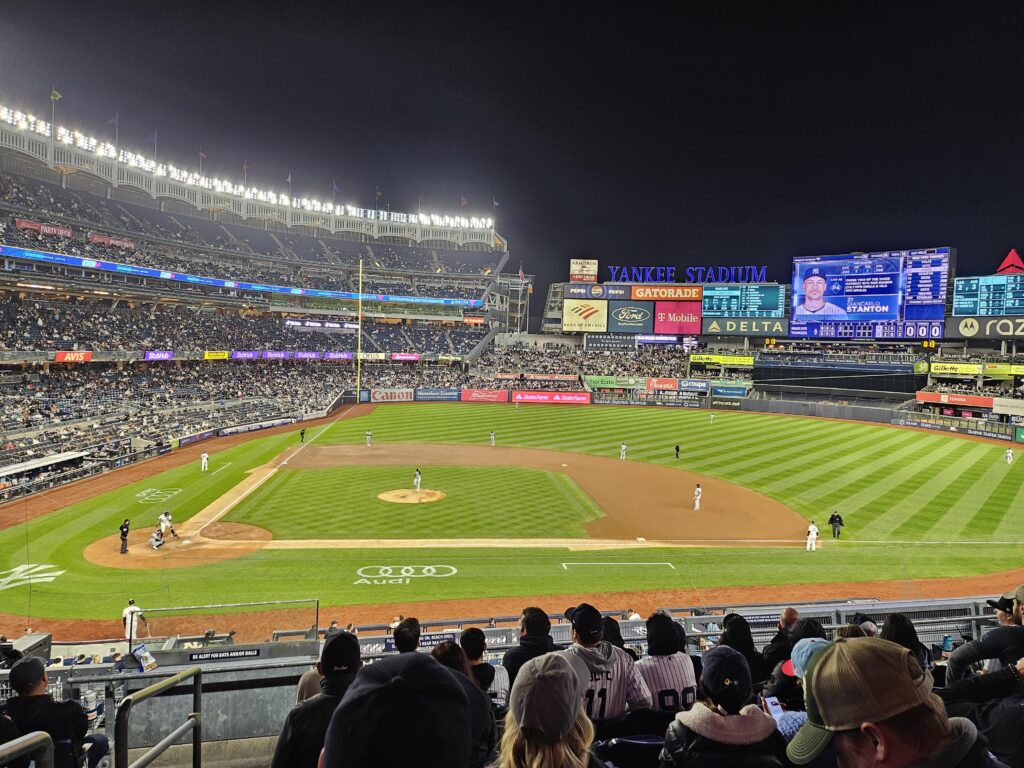
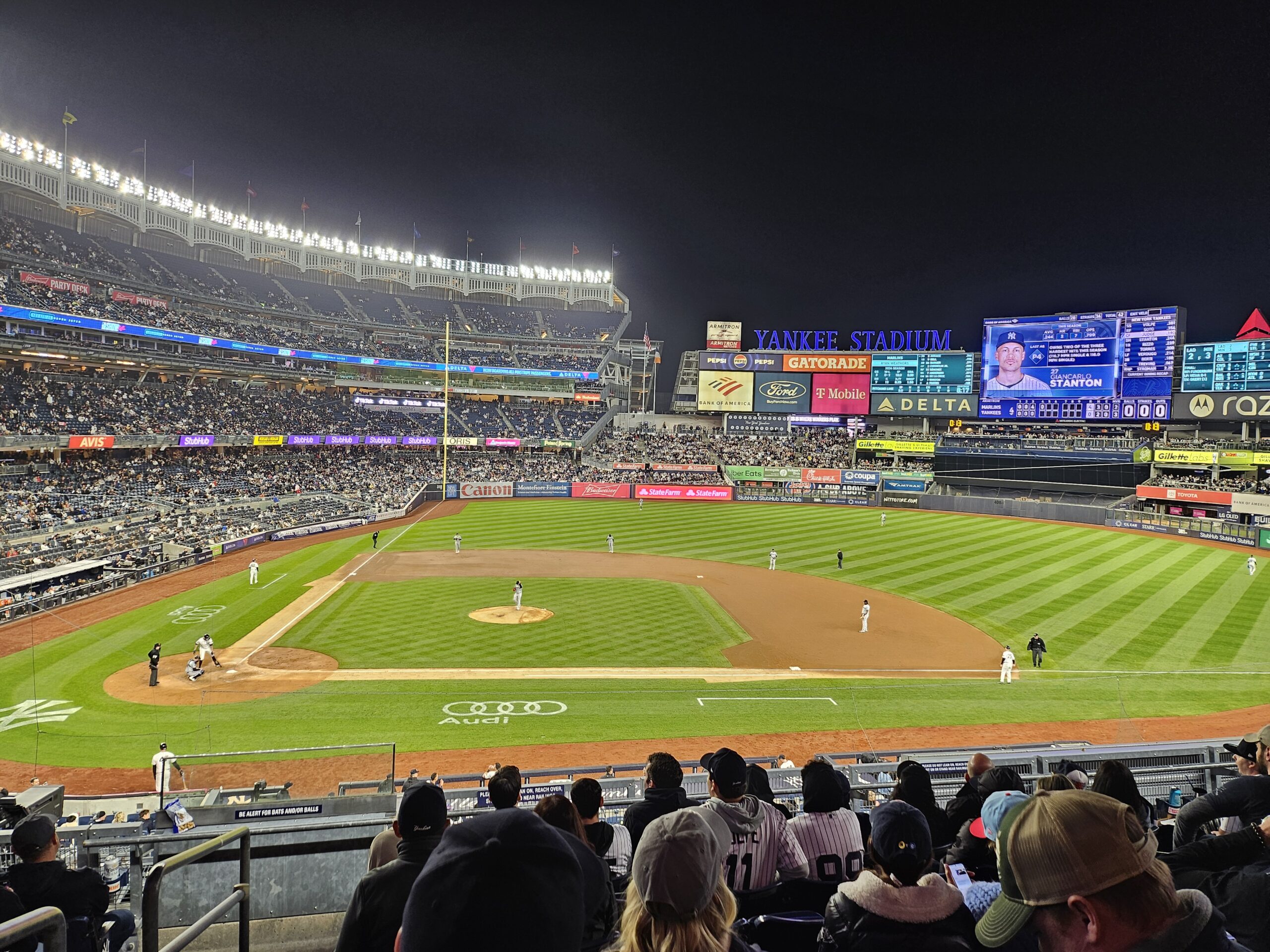
Photo taken while attending a Yankees game in 2024
While reviewing Forbes’ March list of MLB team values for 2026, I noticed one striking figure.
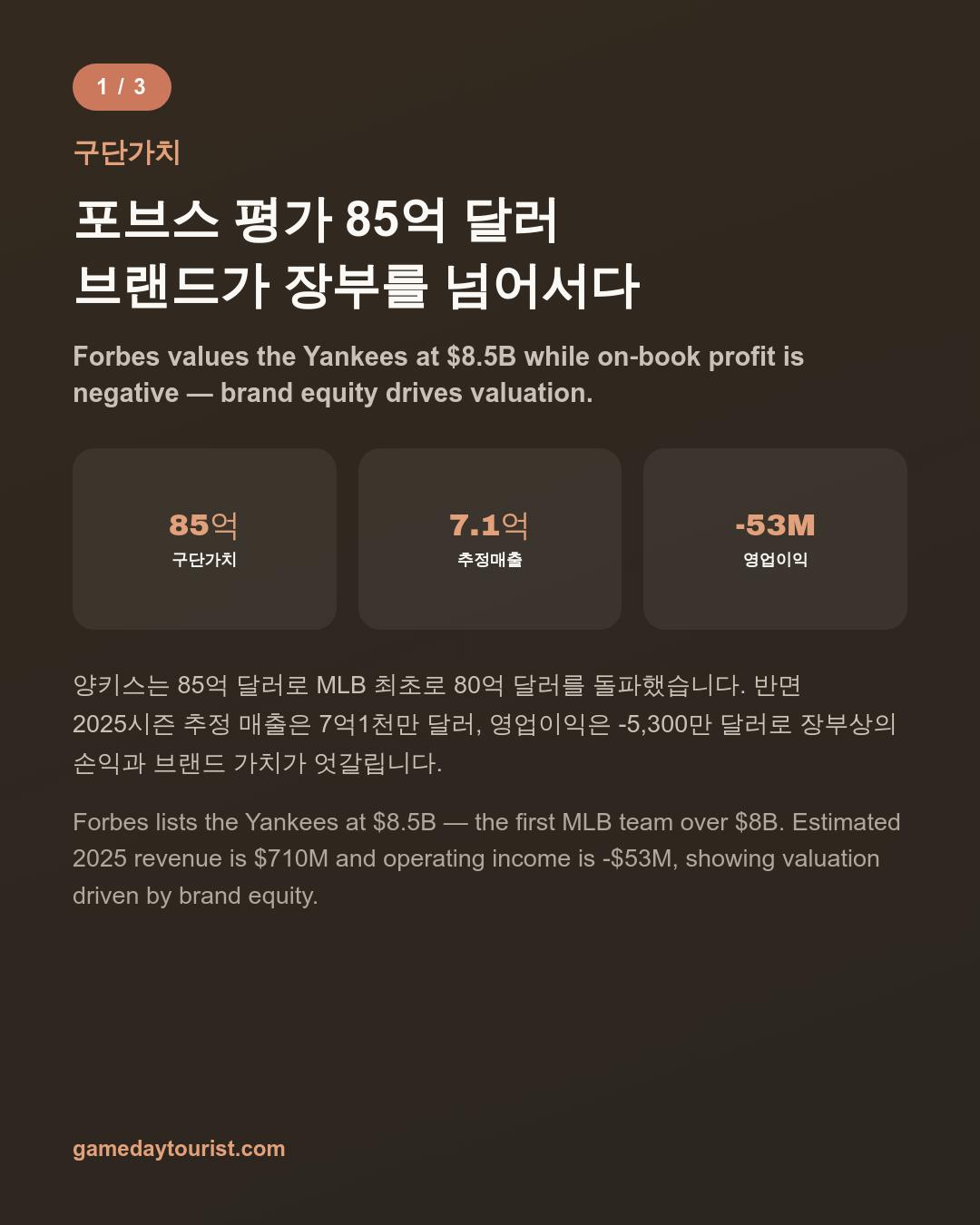
The New York Yankees were valued at $8.5 billion (about KRW 11.9 trillion), making them, in CBS Sports’ words, “the first MLB franchise ever to exceed $8 billion.”
Since Forbes began publishing this ranking in 1998, the Yankees have never relinquished first place. Still, the story became notable as the second-place Los Angeles Dodgers narrowed the gap from $1.4 billion to $700 million in just one year (two years ago the gap was $2.1 billion).
As a practicing marketer, one detail caught my interest in particular.
The Yankees’ estimated revenue for the 2025 season is $710 million, which is less than the Dodgers ($850 million), and their operating income is actually a negative $53 million.
This imbalance — top revenue and team value but a loss on the books — suggests that the Yankees brand is being evaluated more as a long-built brand asset than on short-term accounting profitability.
Source: mlb.com/yankees (Yankees official website) — screenshot of Yankee Stadium introduction page
Fans and Attendance
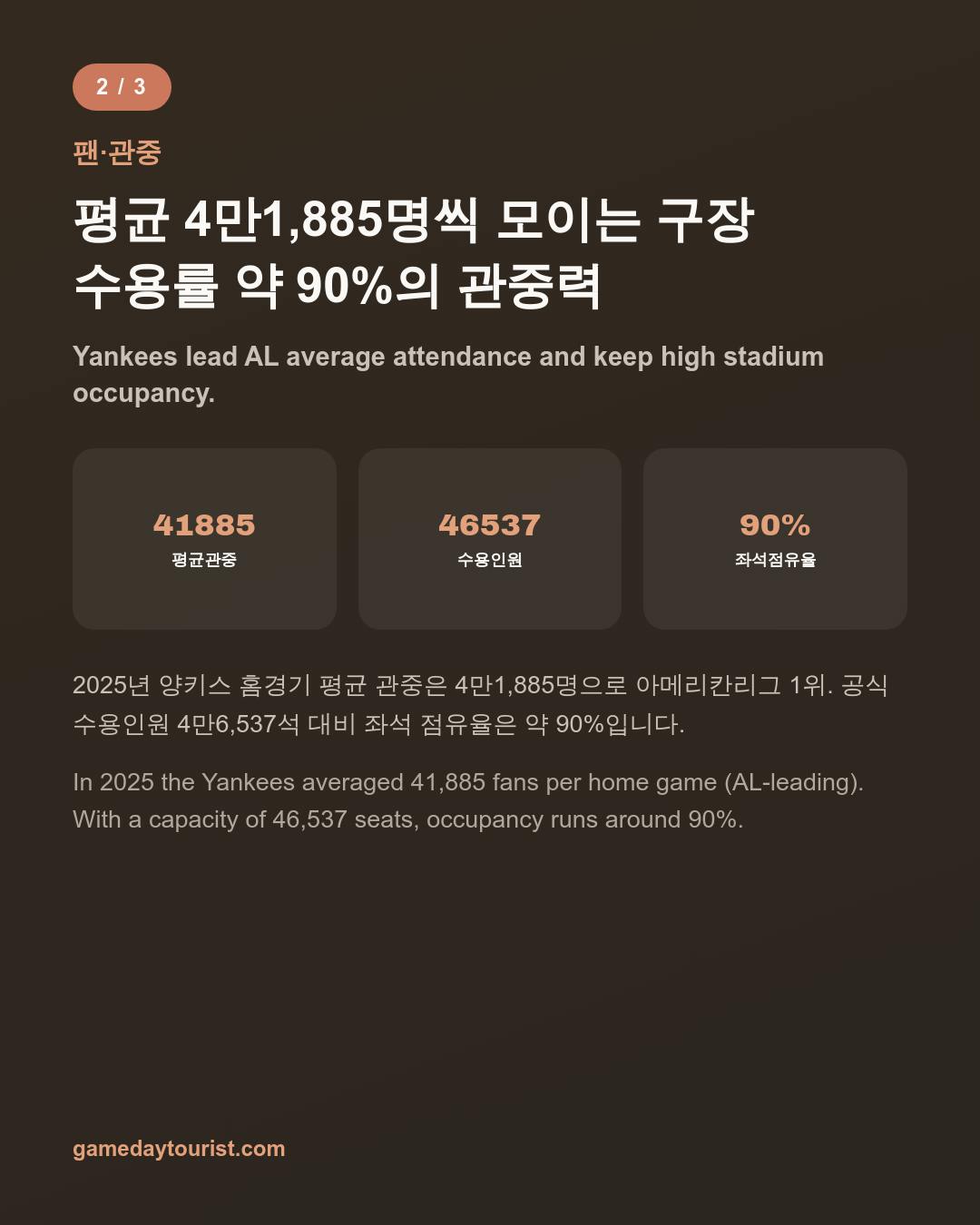
According to Baseball-Reference official records, the Yankees drew a total of 3,392,659 fans for home games in the 2025 regular season, averaging 41,885 per game, ranking first among the American League’s 15 teams.
With an official seating capacity of 46,537 at Yankee Stadium, that equates to roughly a 90% average seat occupancy rate.
Professional review site Stadium Journey noted that between 2013 and 2023 there were three seasons when the Yankees missed the playoffs and three seasons when the average attendance fell below 40,000, but they said the run to the 2024 World Series revived fan enthusiasm.
The site applies its own 5-point FANFARE rating system to Yankee Stadium (a composite score covering food, atmosphere, surrounding businesses, fans, accessibility, value for investment, and extras) and gave an overall 4.14, awarding a perfect 5 in the Extras category (amenities).
Space Utilization and F&B
Yankee Stadium’s food and beverage operations are run by a specialist operator, Legends Global. One notable tactic is branding concessions outright with the names of celebrity chefs.
From Bobby Flay’s “Bobby’s Burgers,” Marcus Samuelsson’s “Streetbird,” David Chang’s “Fuku,” to Christian Petroni’s garlic bread and meatball stands, licensed partnerships with celebrity chefs are placed throughout the concourses, turning F&B revenue into a branded customer experience.
In the 2025 season they opened a new dining area called “Changeup Kitchen” in section 105, rotating upscale items like porchetta sandwiches and lobster rolls with guest chefs. In 2026 they introduced many new items — apple pie nachos, the 99 Burger and MVP Burger with double wagyu patties, and the Diamond Deal bucket which bundles 12 chicken tenders with four drinks.
However, repeated criticism says that once the game starts the concourses become extremely crowded and concession lines grow long. Stadium Journey likewise advised that “the best strategy is to move early if you want to buy food or drinks.” This underscores that while celebrity chef outlets are great content, if the physical circulation and service layout don’t support consumption, the customer experience metrics will suffer.
This illustrates that assembling a flashy F&B lineup and designing concourse widths and stall arrangements to serve them smoothly are separate issues.
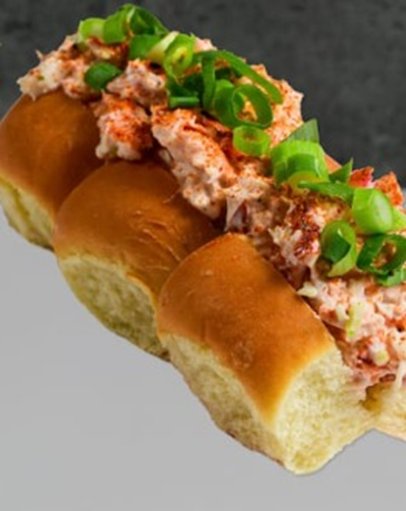
Source: mlb.com/yankees (Yankees official website) — screenshot of the 2026 dining guide page
Merchandise (MD)
CBS Sports’ 2025 MLB jersey sales ranking placed Aaron Judge’s jersey second, behind Shohei Ohtani.
Looking at historical records is even more interesting: representatives from Majestic Athletic, the official maker of Judge’s jerseys, cite Derek Jeter’s No. 2 as “the best-selling baseball jersey of all time.”
Beyond individual star player jerseys, the interlocking NY logo itself has consistently ranked at the top across licensed goods. This shows the Yankees are one of the few sports brands able to defend merchandise revenue regardless of on-field performance.
Advertising Inventory and Naming Rights
Delta Air Lines is the Yankees’ official airline partner and has its name on the “Delta Sky360 Suite,” which occupies the upper areas of sections 218–222 directly behind home plate.
In addition to this premium seating with indoor lounges and outdoor terraces, Delta’s exposure points are scattered throughout the ballpark — left-field scoreboard ads, home plate and baseline rotational signage, center-field HD scoreboard and terrace-level LED branding.
What struck me was that Yankee Stadium itself does not have naming rights. Unlike many newly opened stadiums that attach a corporate name from day one, the Yankees have chosen to keep the ballpark’s name as-is, foregoing that revenue stream.
Likely this is because the name “Yankee Stadium” is already a globally recognized brand, and not selling that name may yield greater long-term brand value.
Tickets
Stadium Journey’s price breakdown shows upper outfield seats can be found for under $15, and the standing-room “Pinstripe Pass,” which includes a roughly $12 drink, starts at $24.
But the moment you move into infield or lower-level seats, prices jump into the triple digits, and the Delta Sky360 Suite starts at around $325 per seat.
Multiple ticket platforms commonly note that the Yankees are one of the teams with the highest average ticket price in MLB, which, combined with the roughly 90% average attendance seen earlier, supports the stability of ticket revenue itself.
Broadcast Rights
The Yankees’ regional sports channel, the YES Network, made headlines when a consortium of the Yankees, Amazon, and Sinclair Broadcast Group bought back an 80% stake from Disney in 2019 for $3.47 billion.
Since then they’ve continued a deal to stream 21 games exclusively on Amazon Prime Video each year; Prime members within the Yankees’ regional broadcast territory — New York state, Connecticut, northern and central New Jersey, and northeastern Pennsylvania — can watch at no additional cost.
As of 2022, broadcast-related revenue alone was reported at $143 million. This dual approach of combining traditional cable broadcasts with a streaming partnership broadens viewing touchpoints while preserving broadcasting rights as a core revenue source.
Local Engagement and Economic Impact
The New York City Economic Development Corporation (NYCEDC) projected that Yankees home games in the 2026 season would generate about $500 million in economic impact for New York City (the Mets’ home games were projected to add $300 million, for a combined $800 million for both clubs).
In that announcement the Bronx borough president specifically mentioned “longstanding local shops lining 161st Street that have been there for generations,” emphasizing that the baseball season provides tangible vitality to small neighborhood businesses.
However, Stadium Journey also pointed out that streets near the stadium are less tidy and have more litter than the Bronx’s local pride would suggest — a critique that highlights the gap between economic impact figures and the neighborhood’s lived experience.
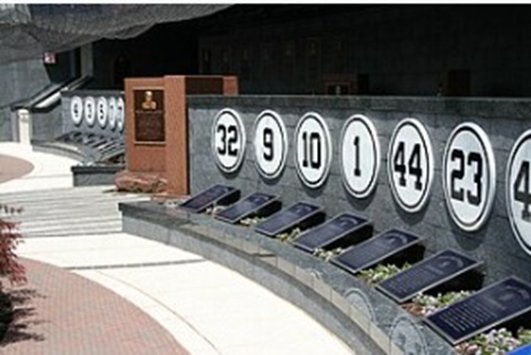
Source: en.wikipedia.org — screenshot of the ‘Monument Park (Yankee Stadium)’ article
Yankee Stadium Symbols — Monument Park and the Bleacher Creatures
Behind the center-field outfield at Yankee Stadium is an outdoor hall of fame called “Monument Park.” Even though I’ve seen it five times, it’s truly an enviable symbol.
Its origins trace back to a granite monument honoring manager Miller Huggins from the old ballpark in 1932, and it opened to the public in 1985.
When the new stadium opened in 2009, the old park’s monuments were carried over. Today there are 37 plaques and 22 retired numbers on display.
The highest honor — engraved on a block of red granite — has been bestowed on only six people so far: manager Miller Huggins, Lou Gehrig, Babe Ruth, Mickey Mantle, Joe DiMaggio, and owner George Steinbrenner.
Monument Park is free to view with a game ticket, but it closes 45 minutes before the start of the game, so it’s worth arriving early. In right-field bleacher section 203 sits a passionate fan group called the “Bleacher Creatures,” which has been there since the mid-1990s; their pregame “roll call,” where they shout out the first names of the nine starters one letter at a time, is a fan ritual symbolic of Yankee Stadium.
I thought it was revealing that Monument Park, which preserves historical artifacts, coexists in the same stadium with the impromptu fan ritual of the roll call. That coexistence offers a clue as to why the Yankees brand has maintained its strength for so long.
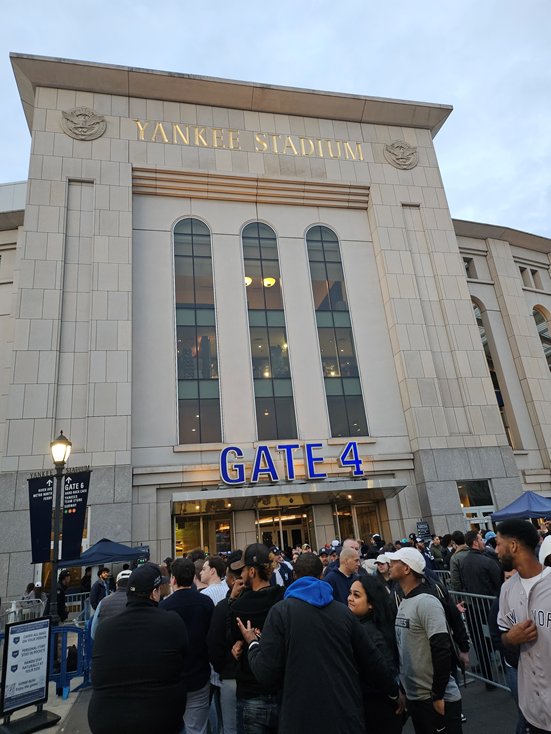
Comparison with the KBO and K League
In the 2025 season the KBO recorded a total attendance of 12,312,519 across 720 games (144 games per club), averaging 17,100 per game and a record-high seat occupancy of 82.9%.
Compared to the league average, a single Yankees team’s per-game average attendance (41,885) is more than 2.4 times the KBO league average.
Of course, simple comparisons are risky given different stadium sizes and markets, but it’s noteworthy that the gap between the Yankees’ 90% seat occupancy and the KBO’s 82.9% isn’t as large as one might expect.
What domestic clubs might learn from the Yankees is their approach to naming rights. In cases like the Yankees, where the team name itself is a fully realized brand, foregoing naming rights can be a strategic choice — an example domestic clubs could consider when deciding when and how to strengthen and transfer brand ownership internally over the long term.
Collaborations with celebrity chefs on F&B and a dual broadcast strategy combining streaming and cable also appear feasible for domestic clubs to benchmark, despite differences in scale.
Leave a Reply