Contents · About 11 min read
- What Changes, and What Stays the Same
- Attendance and Tickets: A Name Changing at Its Most Valuable Moment
- Space, F&B, and Broadcast Rights: What Changed Before the Name
- Ad Inventory: The Scoreboard Sign Changes Again After Two Years
- Fan Reaction: “I’ll Still Call It Tiger Stadium”
- A Comparison With the KBO and K League
📱 View as card news
On my phone I still have a photo of the entrance sign at the ballpark, white letters spelling “Comerica PARK.”
I took it on a day when heavy rain kept the game from starting, walking around every corner of the park, and I used the same photo in my Comerica Park review on this blog back in July.
That sign is coming down this winter.
On September 21, local time, the Detroit Tigers and Fifth Third Bank held a press conference on the field and announced that starting with the 2027 season the ballpark will be renamed “Fifth Third Park.”
I’ve covered this ballpark once before.
I decided to write a follow-up anyway, for three reasons.
First, when a park you’ve visited and reviewed changes its name, your earlier post turns into out-of-date information overnight.
I felt a responsibility to lay out what’s changed, so that a reader visiting Detroit next year who searches “Comerica Park” doesn’t end up confused.
Second, this isn’t the usual case of a sponsor ending its deal and another company buying the name.
The bank that bought the name was itself merged into another bank, so the naming rights (the right to put a company’s name on a facility) changed hands wholesale, which makes it a rare case I, as a working marketer, want on record.
Third, when I searched right after the announcement, I couldn’t find a Korean-language piece pulling this news together yet.
If the first post was about a rainy-day experience on the ground, this one is about how that name was created and how it’s being handed over.
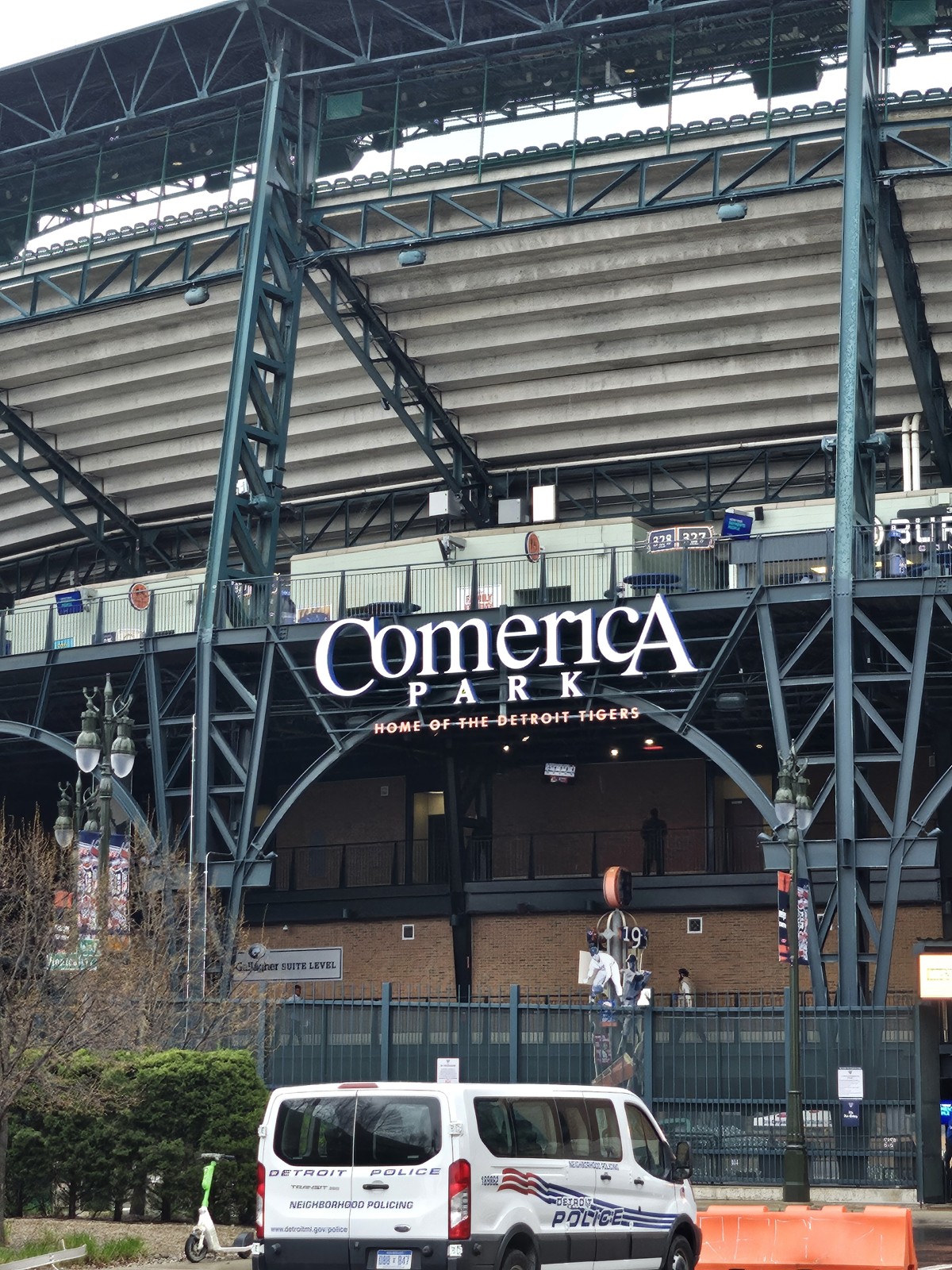
The Comerica Park entrance sign (photographed by the author, April 2024) · my own photo, the same file used in the July review, with people removed by AI for privacy
What Changes, and What Stays the Same
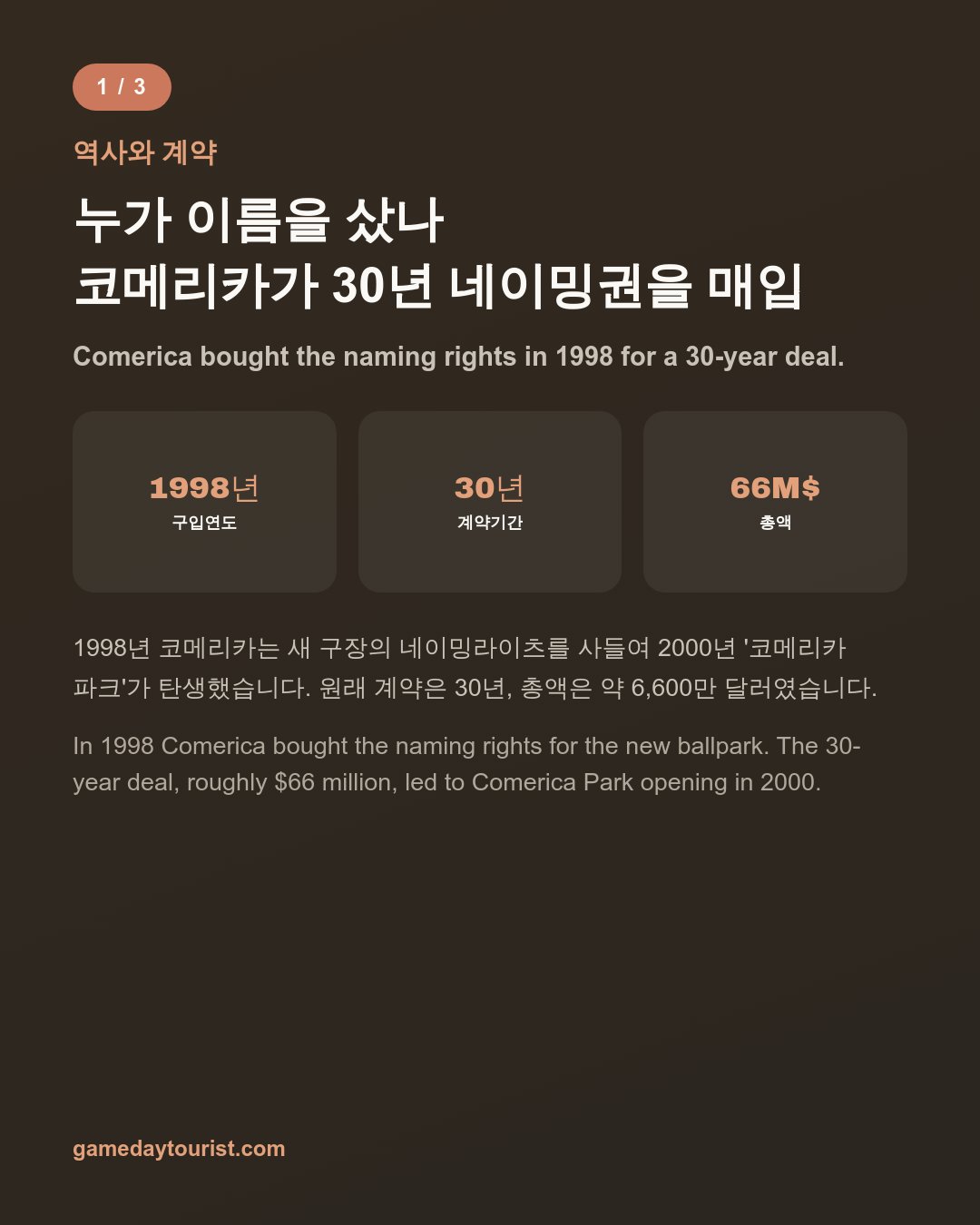
It starts in December 1998.
Comerica, a regional bank that began in Detroit, bought the naming rights to the new ballpark for 30 years at $66 million, and the park opened in April 2000 as “Comerica Park.”
That works out to $2.2 million a year.
The deal was originally set to run through the end of 2029, but Comerica exercised an extension option in 2018 and it was pushed out to 2034.
The bank said at the time that the sponsorship had gotten its name known not just in its main markets but across the country.
The wild card came from the banking side.
Fifth Third Bank, headquartered in Cincinnati, Ohio, announced its acquisition of Comerica in October 2025, and the roughly $10.9 billion all-stock merger was completed on February 2, 2026.
The merger made Fifth Third a bank with about $294 billion in assets, the ninth largest in the U.S.
The park’s name naturally became the new owner’s to carry, and Fifth Third said it would take over the existing contract term as is.
In other words, it’s closer to a “succession” where only the nameplate changes than a newly negotiated deal on price and length.
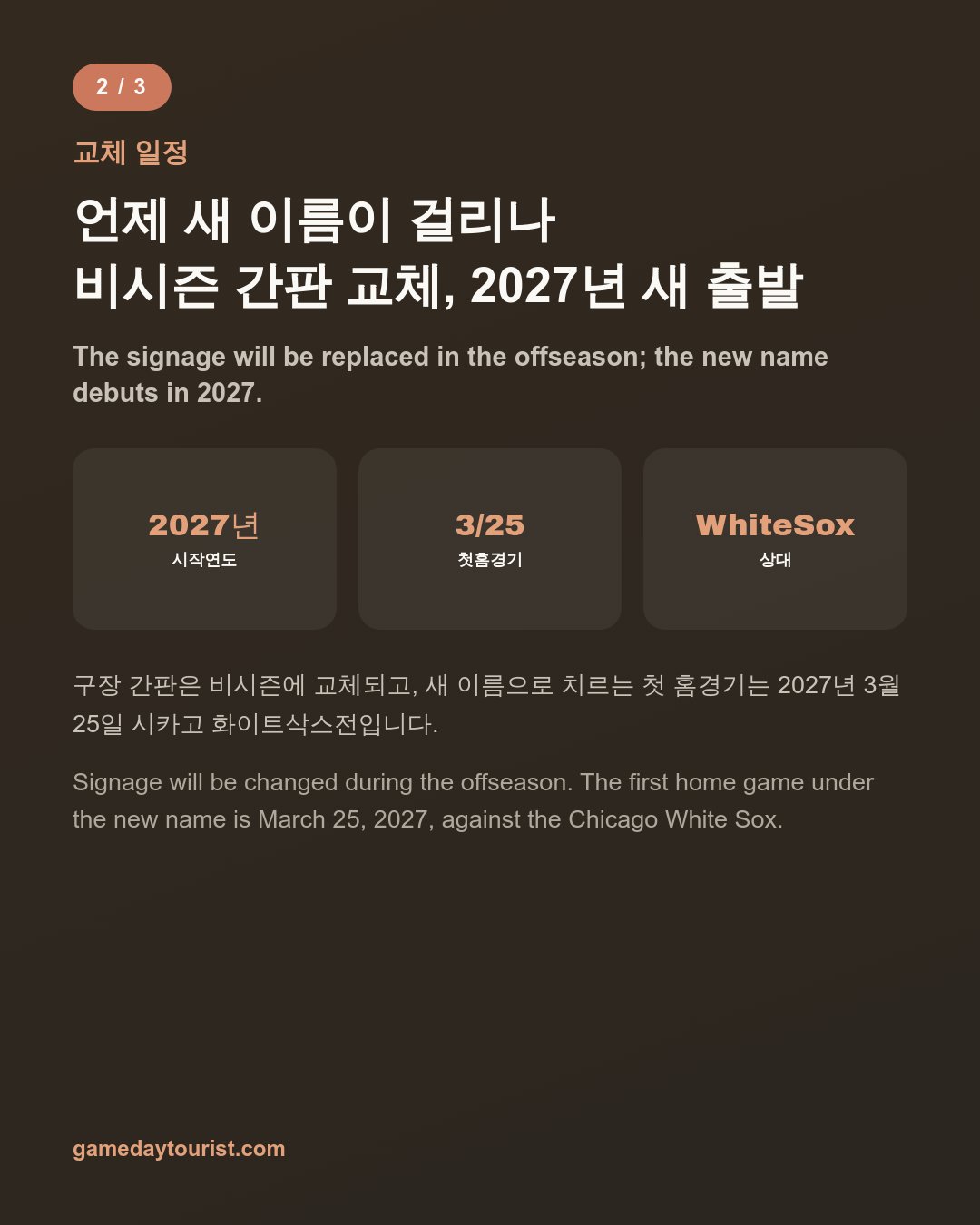
The signage will be swapped out this offseason, and the first home game under the new name is on March 25, 2027, against the Chicago White Sox.
MLB.com pointed out that only nine major league clubs have played longer than Comerica Park has without ever changing the name of their current home.
Having kept one name for more than 26 years puts it in the company of names like Fenway Park, Wrigley Field, and Dodger Stadium.
There is precedent for a bank merger changing a stadium name.
The Arizona Diamondbacks’ home, Bank One Ballpark, became Chase Field in 2005 when Bank One merged with JPMorgan Chase, and the fans’ nickname for it, “BOB,” went away with it.
Attendance and Tickets: A Name Changing at Its Most Valuable Moment
On timing alone, the new sponsor is lucky.
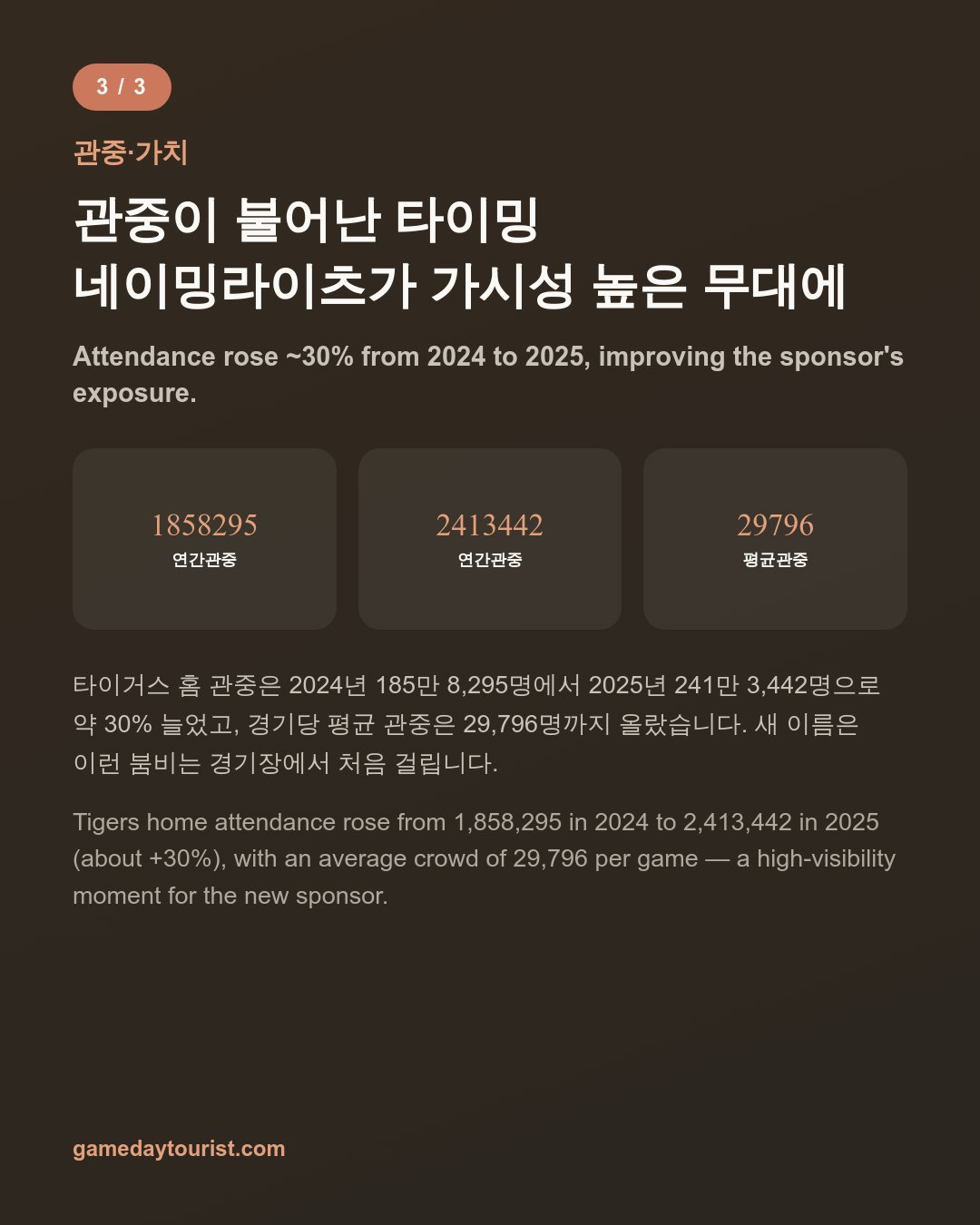
According to Baseball Almanac’s figures, Tigers home attendance rose about 30%, from 1,858,295 in 2024 to 2,413,442 in 2025, with the per-game average climbing to 29,796.
That’s the effect of back-to-back postseason trips, and in 2025 the team beat Cleveland in the Wild Card Series and went to a 15-inning Game 5 against Seattle in the Division Series.
CNBC estimated the Tigers’ 2026 franchise value at $1.93 billion, up 21% from a year earlier, with revenue up 9% to $356 million, and pointed to the attendance gains as the backdrop.
Still, compared with the all-time high of 3,202,654 in 2008, there’s room to go.
This year the team missed the postseason, so the September 27 game against the Pittsburgh Pirates is expected to be the last one played under the name “Comerica Park.”
A name changing just as crowds are swelling again means the new name goes up over a full house from the start.
For a company buying naming rights, there are few better opening acts.
Space, F&B, and Broadcast Rights: What Changed Before the Name
Ilitch Sports + Entertainment, which runs the park, said ahead of the 2026 season that it is in the middle of a multi-year, $200 million facility investment.
It built a new premium space, the “Press Club,” that takes just 24 guests per game, and turned the “Tiger Club,” which used to be booked game by game, into a season membership starting at $99 per person per game.
At the other end is the value menu.
A hot dog, chips, and drink combo is $9.42, a 12-ounce canned beer is $5, and on Tuesdays hot dogs are $3.
Widening both premium seating and cheap menu options at once reads as a strategy of holding on to the crowd at the top and bottom together.
The change on the broadcast side was bigger.
The regional sports channel that carried Tigers games, FanDuel Sports Network Detroit, shut down amid its parent company’s financial troubles, and starting this season the Tigers moved to Detroit Sportsnet, produced by MLB’s media arm.
For $19.99 a month ($189 a year), you get Tigers and Red Wings games in one package.
The name of the park, the broadcast channel, and the scoreboard sign — the touchpoints fans see every day have been changing one after another in just two years.
Ad Inventory: The Scoreboard Sign Changes Again After Two Years
The most interesting part for me personally is the top of the left-field scoreboard.
In the photo I took in April 2024, an orange script “Tigers” sign sits in that spot.
Installed in 2012, it was a sign whose colors changed and where tiger stripes flowed, but in March 2025 the club said it had mechanically reached the end of its life and replaced it with a white-lettered “Comerica Park” sign.
When a bank’s name went up in the spot that had symbolized the team, quite a few local fans grumbled that the Tigers aren’t Comerica.
Now that sign is coming down again after just two seasons.
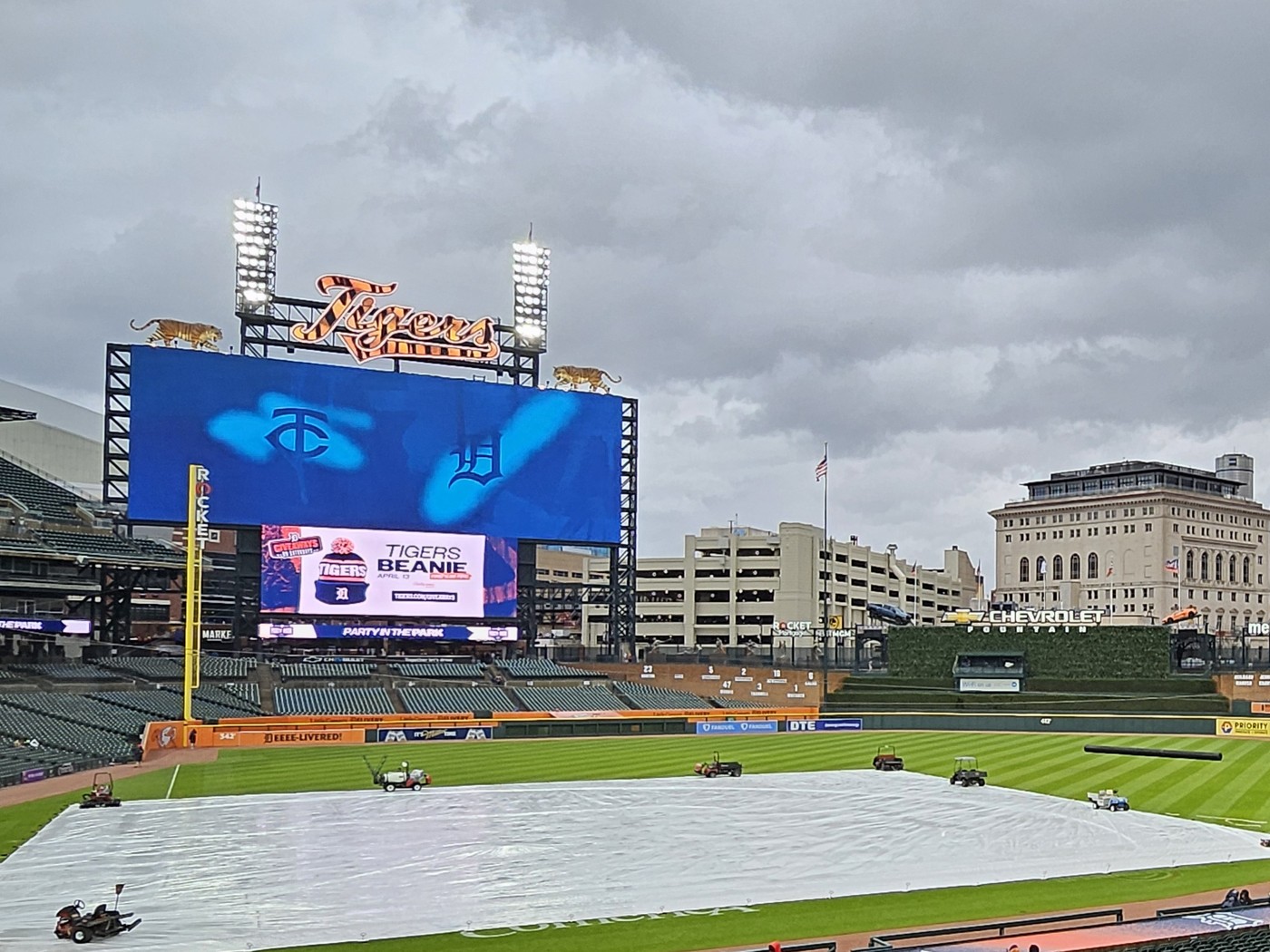
April 2024, when the script “Tigers” sign sat above the scoreboard (photographed by the author) · my own photo, with a small figure of a groundskeeper visible
One local game-day reviewer blogged that, of the script sign’s color and pattern changes through a game, the tiger-stripe version was the most memorable.
Reading that review and pulling my photo back out, I thought that giving up the most visible spot in the ballpark to a sponsor’s name must have landed on fans harder than you’d expect.
For Comerica, too, the merger got going right after its name went up in the best spot, which is unlucky timing.
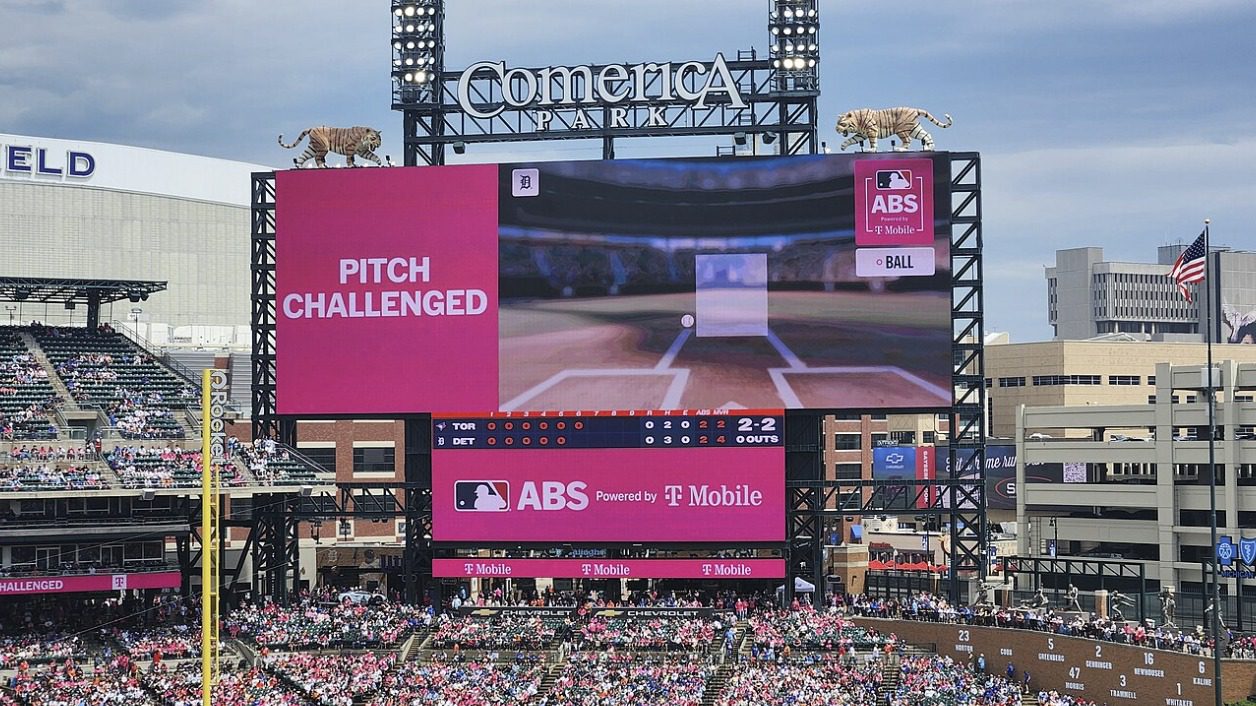
The “Comerica Park” sign atop the scoreboard during the May 16, 2026 game against Toronto · photo by 42-BRT, Wikimedia Commons, CC BY-SA 4.0
Fifth Third isn’t a brand new name at the park.
One entrance was already run as a VIP gate called the “Fifth Third Entry,” and there was a “Park Perks” program giving Fifth Third customers benefits, as well.
In terms of ad inventory (the exposure spots and rights inside the park that can be sold to advertisers), it’s a sponsor that used one gate moving up to the name of the whole park.
On the flip side, this season’s schedule still had the “Black in Baseball” weekend and a May crewneck giveaway listed under Comerica’s name, and figuring out how to handle those small Comerica-branded sponsor assets looks like an offseason task.
It’s also a familiar name inside the Tigers organization.
The Triple-A affiliate Toledo Mud Hens have played at “Fifth Third Field” since it opened in 2002, and the High-A West Michigan Whitecaps played at “Fifth Third Ballpark” for about 20 years until the name changed in 2021.
A player who came up through the minors would spend his whole career under the same bank’s name.
Choosing “Park” rather than “Field” for the new name also looks like a way to avoid overlapping with the Toledo ballpark, as MLB.com explained.
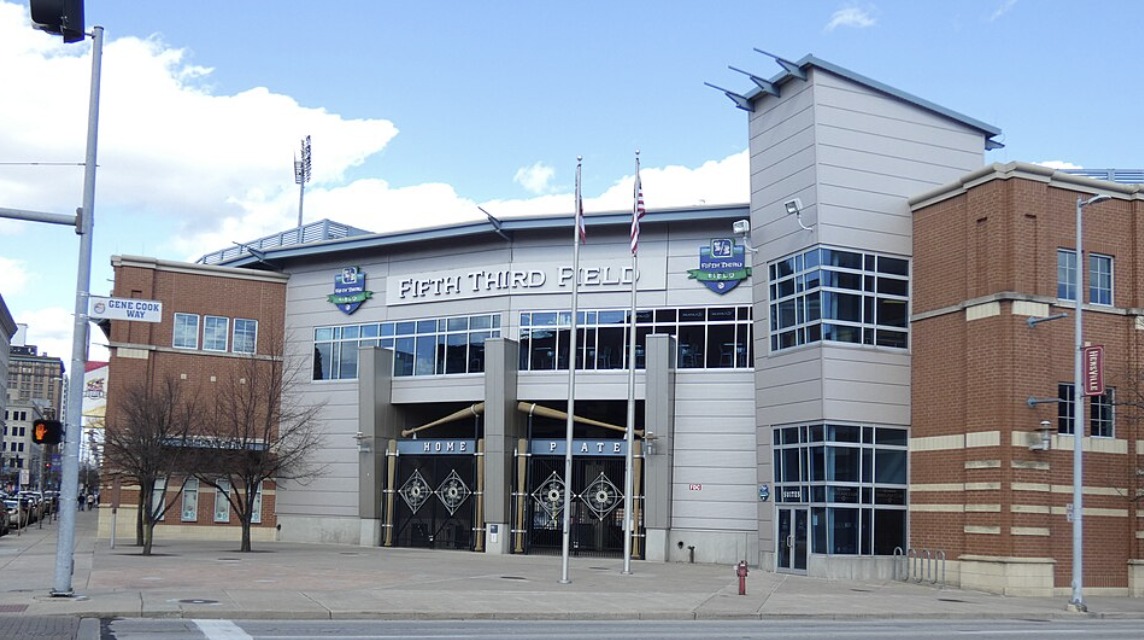
Main entrance of Fifth Third Field, home of the Tigers’ Triple-A affiliate Toledo Mud Hens (April 2022) · photo by MrJacon000, Wikimedia Commons, CC BY-SA 4.0
During the final homestand of the season, Fifth Third and the club will hold a photo event and a fan vote to pick the design of an upcoming Tigers debit card.
It’s a fairly candid activation (turning the rights a sponsor has bought into an event that reaches fans directly), not hiding that a bank’s naming rights only pay off if they lead to accounts and cards.
Fifth Third said it became the No. 1 retail deposit bank in both Michigan and Detroit after the merger, and the same announcement included a $20 million local investment plan for two Detroit neighborhoods, which looks like part of the same picture.
Fan Reaction: “I’ll Still Call It Tiger Stadium”
The local reaction isn’t warm.
Detroit-born rock musician Jack White wrote on Instagram on the day of the announcement that he hates even saying the new name and that no matter where the Tigers play, he’ll call it “Tiger Stadium.”
Tiger Stadium is the old ballpark the Tigers called home from 1912 to 1999.
Fans interviewed on local TV were split between those who said the name doesn’t roll off the tongue and those who said they’re curious what the new partner will do, and there was even a family that came in from St. Louis specifically to see Comerica Park’s final season.
In truth, Comerica Park has also lived in the shadow of Tiger Stadium for a long time.
A U.S. ballpark-review blogger wrote that Comerica Park does almost everything well except “not being Tiger Stadium,” adding that many Tigers fans still look down on the new park by comparing it with the old one.
In the 26 years since, it even picked up the abbreviation “CoPa” and a nickname, “Comerica National Park,” for its spacious outfield, so now it’s setting down a name that has only just grown on people.
Reading these reviews, I was reminded that even a sponsor’s name becomes the neighborhood’s memory after a generation.
A professor at the University of Michigan’s sports marketing research center saying in a local TV interview that fans will definitely need time to get used to the new name is the same story.
What’s funny is that the distinctive bank name “Fifth Third” was itself born of a merger.
In 1908 Cincinnati’s Third National Bank and Fifth National Bank combined and simply joined their two names, and there’s a story that goes around that, with Prohibition sentiment running high, they avoided the reversed order “Third Fifth” because it sounded like a reference to three bottles of liquor.
That’s the name Jack White was needling when he asked who on earth came up with a bank name like that, and a name born from one merger now goes up over a Detroit ballpark 118 years later on the back of another.
A Comparison With the KBO and K League
Korean pro baseball has cases of names changing because of corporate circumstances too.
Still, in Korea it’s more familiar for a club’s name to change than a stadium’s.
In 2019, when the Heroes’ main sponsor switched from Nexen Tire to Kiwoom Securities, the “Nexen Heroes” became the “Kiwoom Heroes.”
That contract was about ₩50 billion over five years (roughly ₩10 billion a year), and in 2023 it was extended for another five years through 2028, at a minimum of ₩55 billion and up to ₩69.5 billion with incentives.
In that a financial firm buys the name to widen its customer touchpoints, the idea resembles Fifth Third’s plan to connect the park’s name to deposit and card customers.
When the Shinsegae Group bought the SK Wyverns for ₩135.3 billion in 2021, the team became the “SSG Landers” and Incheon’s Munhak ballpark became “SSG Landers Field,” a case of the whole name changing with a change of owner.
The difference is in how the transition is handled.
In both Korean cases, the announcement and the changeover happened within the offseason.
The Tigers and Fifth Third, by contrast, announce during the season’s final homestand, play out the remaining games under the old name to give fans time to say goodbye, and then swap the sign in the offseason.
On paper a name is a right, but to fans it’s the name of a place where memories piled up.
The moment a sponsor changes is a chance to introduce the new name, but also a time that needs a ritual for sending the old one off.
If a stadium or club name ever changes in Korea from here, my view as a working marketer is that it would help to plan how to mark the final season as early as the unveiling of the new logo.
That entrance photo taken on a rainy day is now a record of the Comerica Park era.
When a “Fifth Third Park” sign hangs in the same spot around this time next year, I plan to check in again on how quickly Detroit fans take to that name.
Leave a Reply