Contents · About 14 min read
- 28,000 Candles on December 23 — The Weihnachtssingen Began with One Post on a Fan Forum
- What Kind of Club Is Union Berlin? — 2004 Saved by Blood Donations, and a Ground Built by 2,300 Fans
- How to Get to the Alte Försterei and How to Get Tickets — Based on Official Club and Stadium Information
- A Stadium in Which Members Hold a Share — 22,012 Spaces, 84% Standing, and a Fan-Owned Company
- After the End of 2027 — A New Stadium of 40,500 and the Temporary Move to the Olympiastadion
- Compared with KBO and the K League — Members Who Own the Ground
📱 View as card news
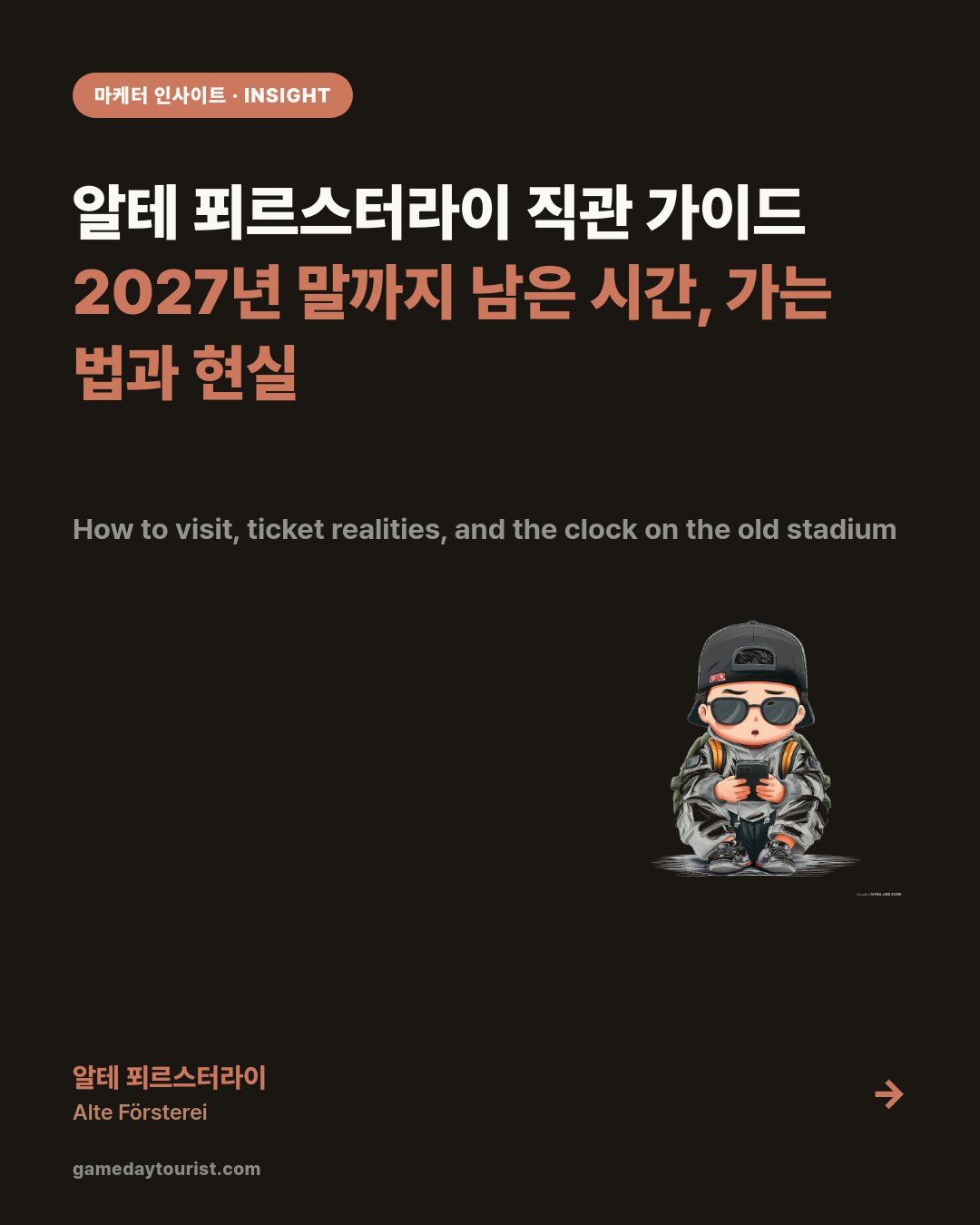
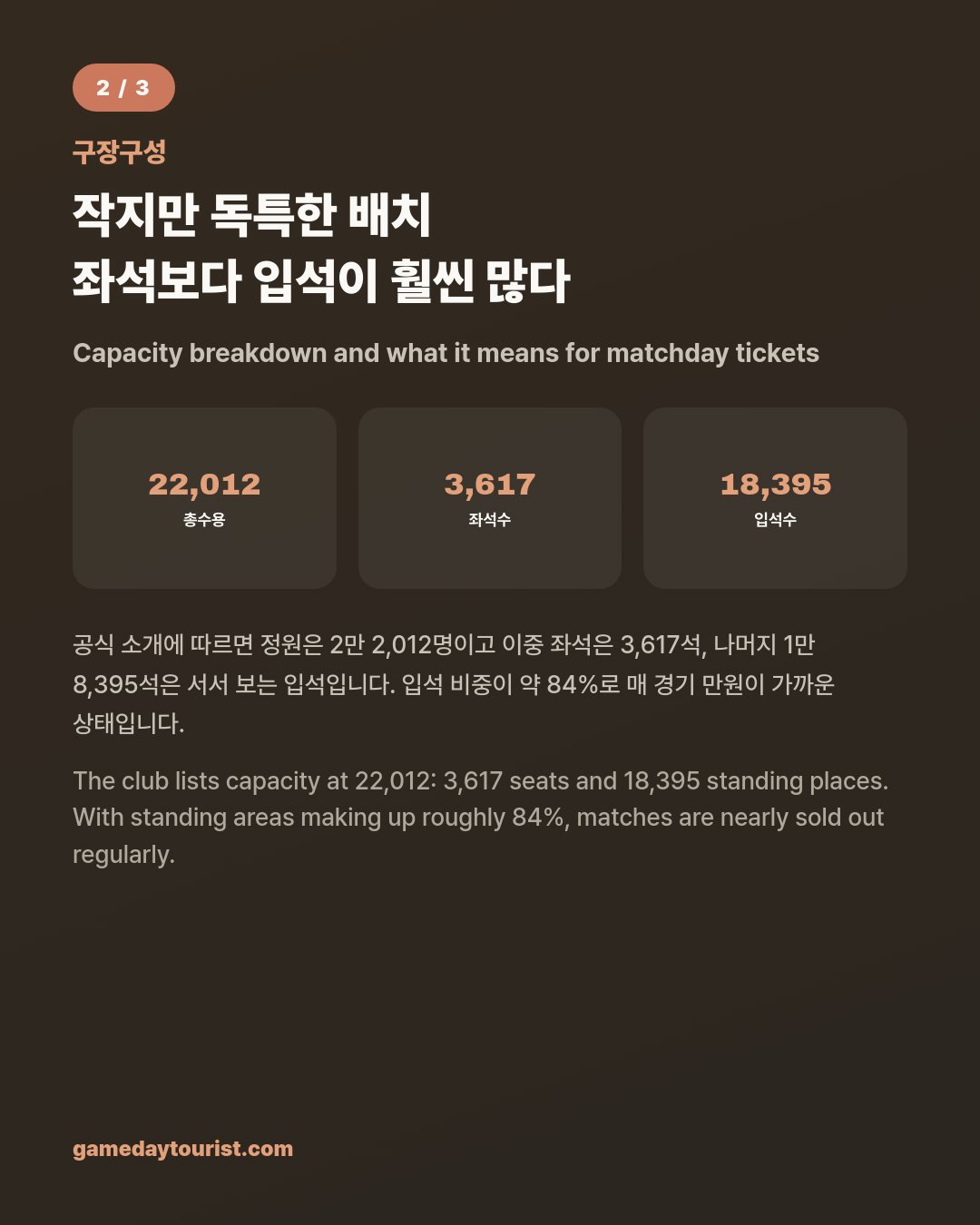
Of the 22,012 spaces in the stands, only 3,617 are seats, and the other 18,395 are standing places. The Stadion An der Alten Försterei (Alte Försterei for short), home of 1. FC Union Berlin, sits next to the woods in Köpenick in southeast Berlin, and the club’s official stadium page still describes it as an almost purely standing-room stadium.
The reason I am raising this stadium now is the timetable.
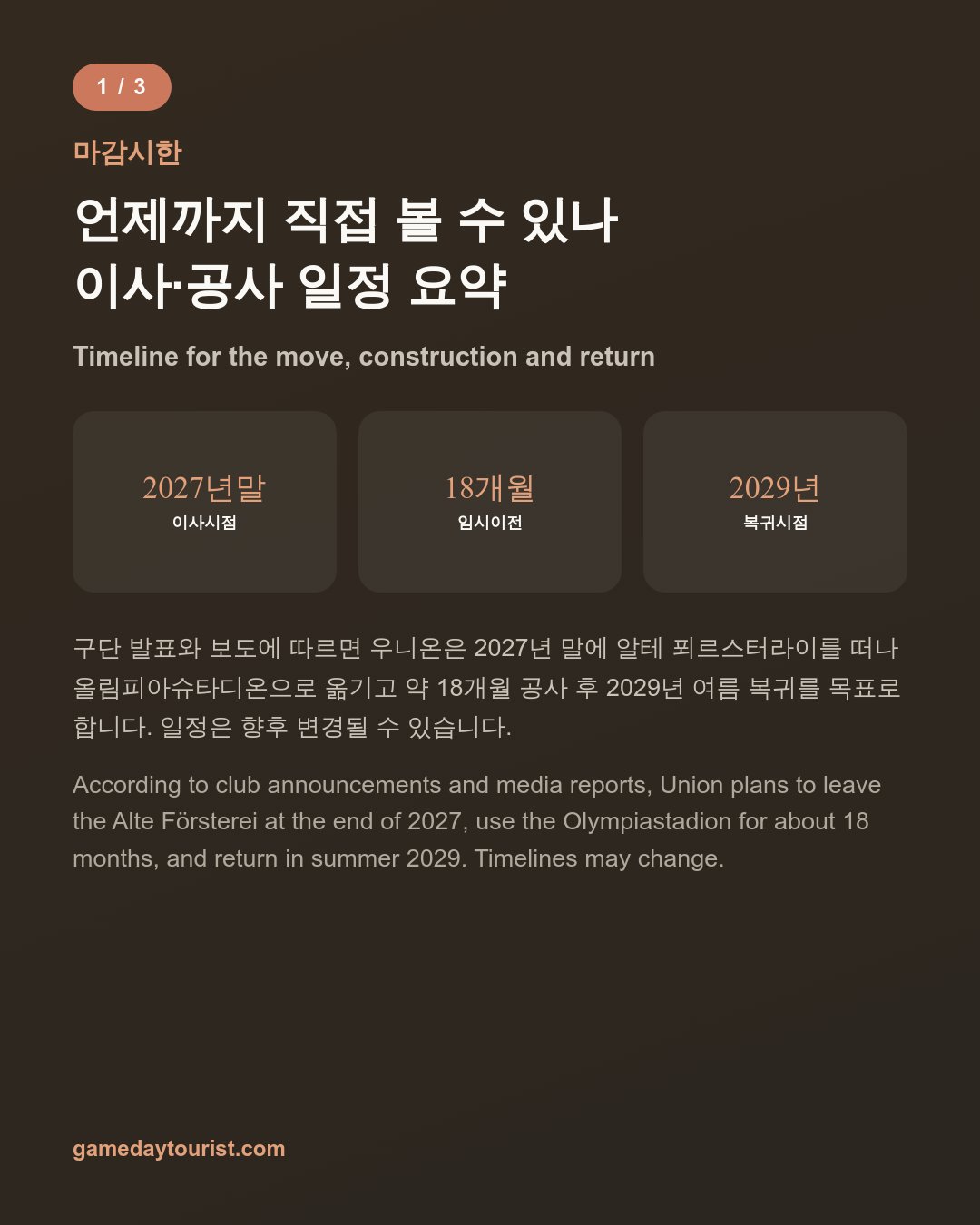
At the club’s members’ meeting on September 3, president Dirk Zingler laid out the expansion schedule, and Sport1, relaying SID, reported that Union will leave the Alte Försterei at the end of December 2027 for the Olympiastadion.
A dpa report on October 14 said the club will use the Olympiastadion for 18 months from the second half of the 2027/28 season, and the official Bundesliga website describes a roadmap of demolition between late 2027 and early 2028, about 18 months of construction and a return in summer 2029.
The wording differs a little by outlet and the construction schedule may still change, so please read this as the club’s plan as of September–October 2026, not as a certainty.
If the plan holds, what you can still see at the Alte Försterei is the 2026/27 season and the first half of 2027/28, so anyone who wants to catch the last season of an old ground has a reason to hurry.
This guide covers two things.
First, how to get to the Alte Försterei and how to get tickets, based on the club’s official information (checked on October 20, 2026).
Second, from a marketer’s point of view, how standing terraces, membership and a share in the stadium itself underpin this club’s fan loyalty and revenue.
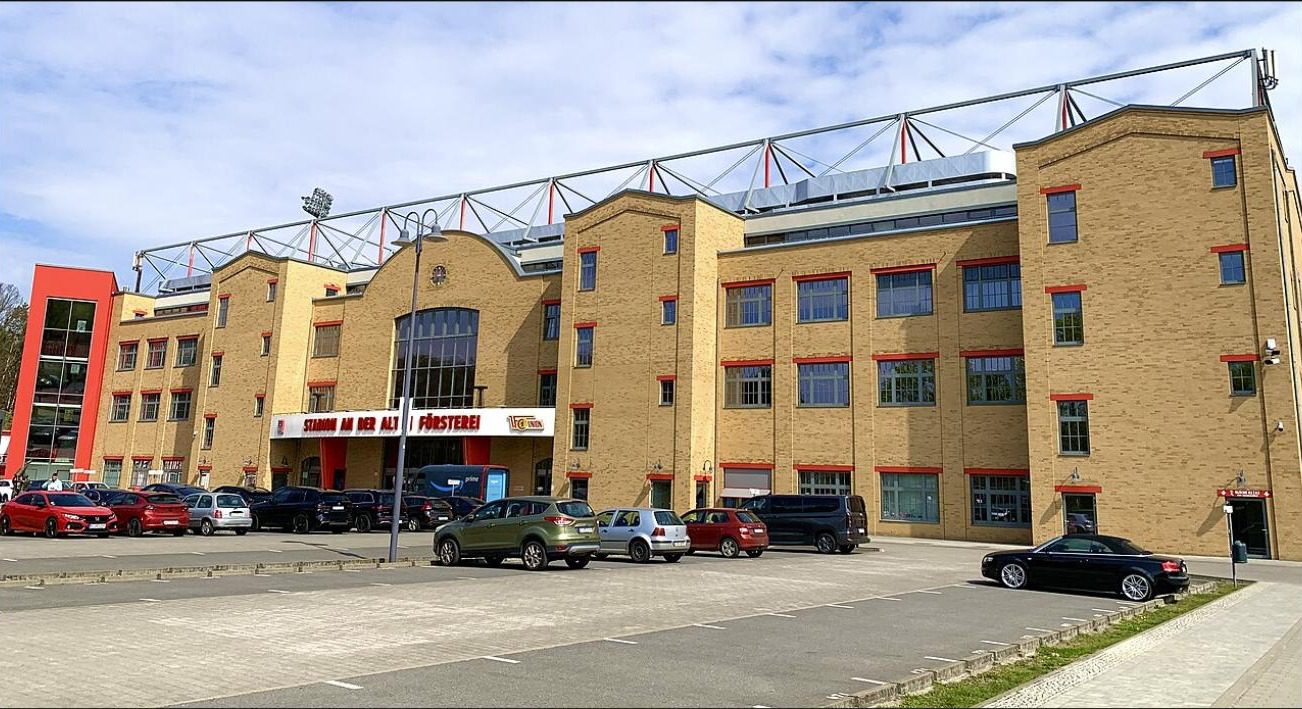
Photo: Lear 21 · Source: Wikimedia Commons · License: CC BY 4.0 · Taken on April 16, 2026, exterior of the main stand at the Alte Försterei
28,000 Candles on December 23 — The Weihnachtssingen Began with One Post on a Fan Forum
One event always comes up when people talk about the Alte Försterei: the Weihnachtssingen, a Christmas carol gathering.
According to a 2019 article on the official Bundesliga site, it began with a post on the club’s old internet forum in December 2003 by one fan.
That fan recalls thinking that, since fans had long sung old Union songs half an hour before kickoff, they could hold the same kind of singing session at the end of the year.
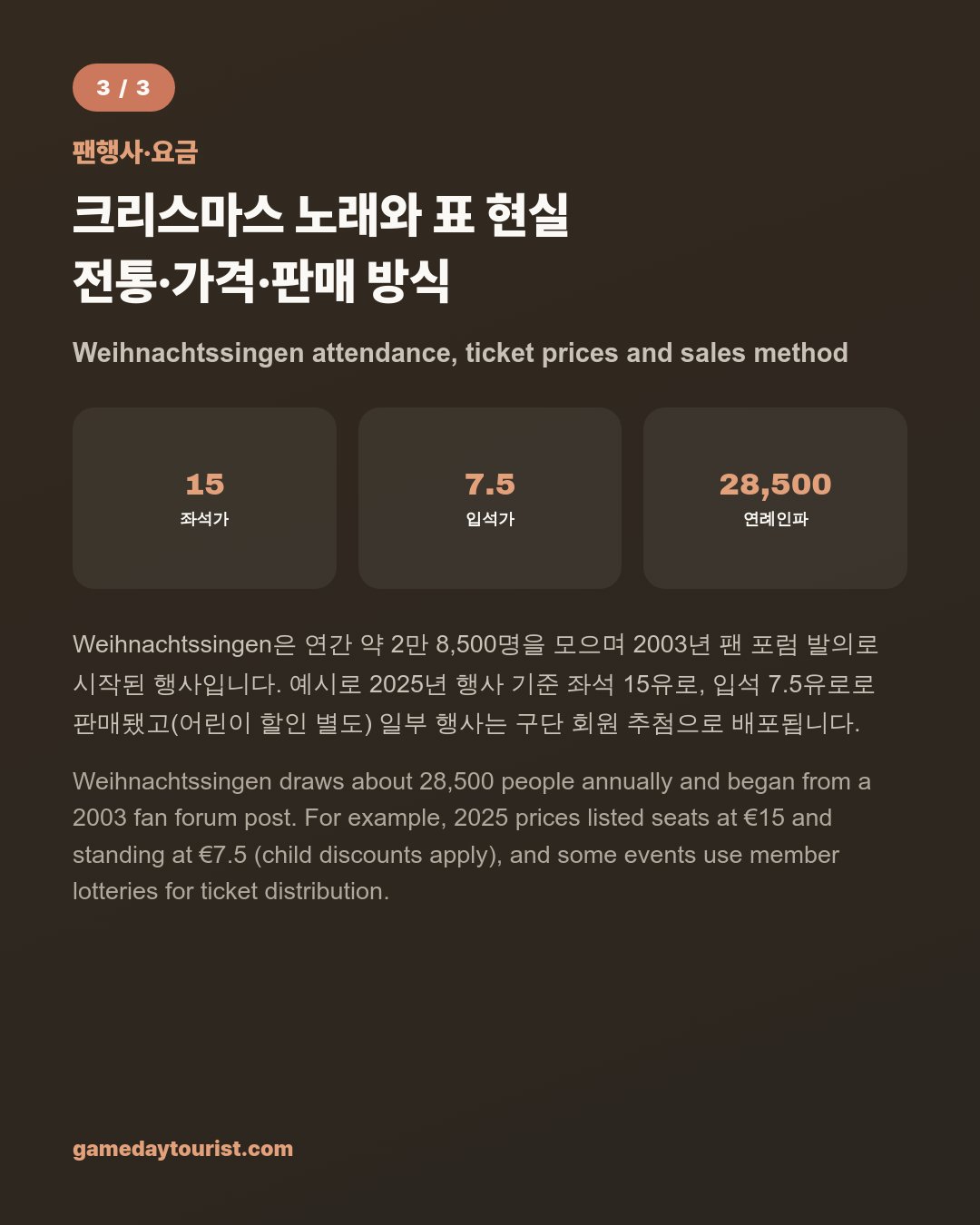
The same article says about 28,500 fans fill the stadium every year, a school choir provides the music, and there are bratwurst, mulled wine (Glühwein) and club souvenirs on sale.
The schedule of the 22nd edition in 2024, described by the Berliner Zeitung, had gates opening at 5 p.m., the main program at 7 p.m. and the end around 9 p.m.
Candles and songbooks were handed out free at the entrances, but strollers, folding stools, glass bottles and thermoses were not allowed, and visitors were asked not to bring large bags. That year too, it had been sold out for weeks.
How tickets are obtained is the hardest part for visitors from abroad.
In the 2025 sales notice, tickets were allocated by a lottery open only to club members. Entries were taken from November 13 to 17, winners bought from November 20 to 24, and the remaining tickets were released again from November 25 to members who had not yet bought, in three stages.
Prices were €15 for seats and €7.50 for standing (€7.50 and €4 for children aged 6 to 12), and the club said it was adjusting prices for the first time since ticket sales began in 2014.
I could not yet confirm the sales schedule or method for the 2026 event in this research, so please check the club’s news page.
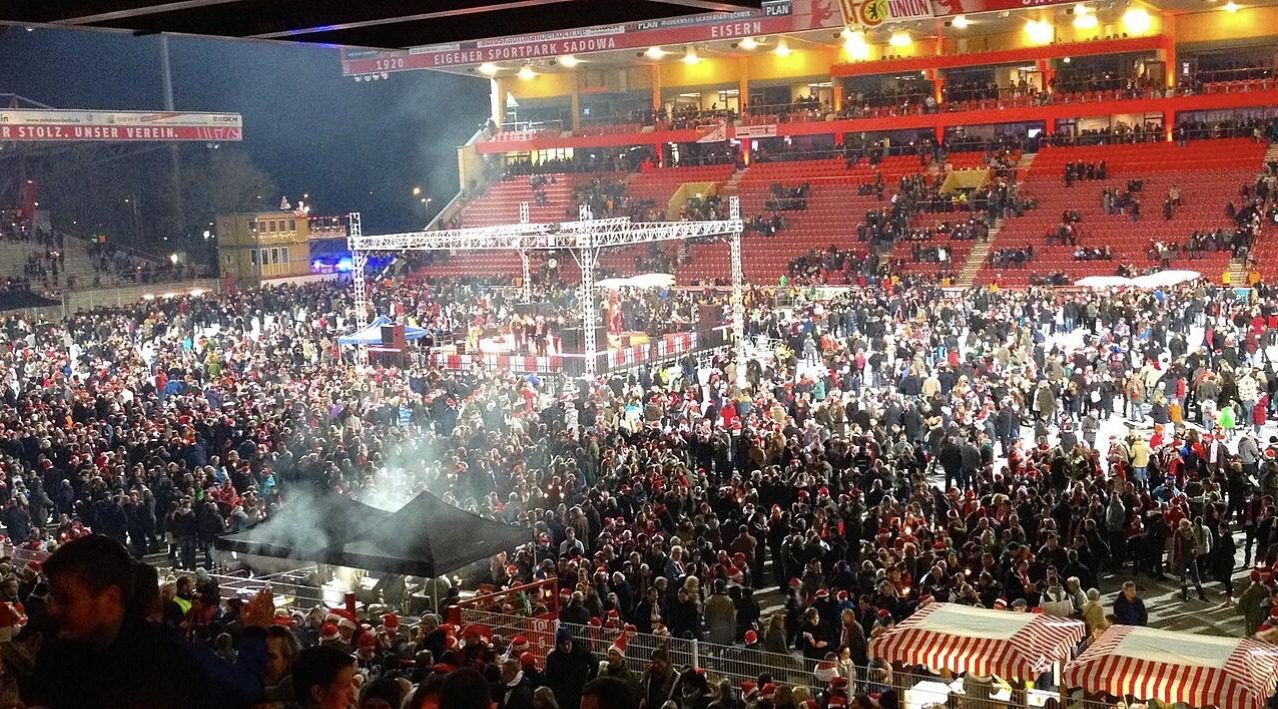
Photo: Lear 21 · Source: Wikimedia Commons · License: CC BY 4.0 · Taken on December 23, 2015, the Christmas carol gathering
As a marketer, what I envy most about this story is not the €7.50 admission but the order of events.
It was not a product the club planned and sold to fans; I read it as something the fans started first and the club then grew.
Our sports marketing mostly runs the other way, with clubs planning and fans consuming, so an event with this order is an asset you cannot build even if you try.
What Kind of Club Is Union Berlin? — 2004 Saved by Blood Donations, and a Ground Built by 2,300 Fans
The roots go back to 1906.
The club’s official history page says the club was founded on June 17 of that year at an inn in Oberschöneweide under the name Olympia Oberschöneweide.
On January 20, 1966, in East German times, 1. FC Union Berlin was newly founded, and according to the same page the 1967/68 FDGB Cup final win over FC Carl Zeiss Jena, 2–1, is the greatest success in club history. The British outlet Planet Football says the club was reborn in red and white kit.
In 2004 a financial crisis hit.
According to Planet Football, the German FA demanded a €1.5 million guarantee, and Dirk Zingler, then a fan and businessman, covered most of it (he is the club president today), while fans made up the rest with a campaign called “Bluten für Union” (“Bleed for Union”), donating blood and passing the money to the club.
The article does not say how many people gave blood or how much was raised, so I could not confirm that.
Fans also rebuilt the ground.
The club says on its official stadium page that more than 2,300 volunteers contributed 140,000 working hours to the 2008/09 rebuild. The work of roofing the standing terraces ran from June 2008 to July 2009.
Current form is as of October 20, 2026.
According to the club’s official match preview, Union under head coach Mauro Lustrinelli went into matchday 5 having drawn with Frankfurt in its first four league matches and taken no points against Schalke, Bayern or Leverkusen.
At home on October 10 against newcomers SV 07 Elversberg, Union earned a 1–0 first win thanks to Livan Burcu’s goal in the 81st minute, in front of 22,012 spectators.
In the official Bundesliga table, Union sit 17th of 18 after six matchdays with one win, two draws and three losses, five points.
As for the fan base, the club’s official stadium page says it has nearly 70,000 members.
How to Get to the Alte Försterei and How to Get Tickets — Based on Official Club and Stadium Information
This section reflects what I confirmed by opening the club’s official pages directly as of October 20, 2026.
I did not use blog reviews, and where I could not find something on an official page, I say so.
The official information states flatly that traffic around the ground is very heavy on match days, that there is hardly any parking nearby, and that public transport is recommended.
The most basic route, as described on the club’s official directions page, is to take the S3 from Berlin Hauptbahnhof toward Erkner to S-Bahnhof Köpenick, then walk about 15 minutes along the railway embankment over Hämmerlingstraße.
From Lichtenberg, take the S5, S7 or S75 to Ostkreuz and change to the S3.
However, the club’s notice before the October 10 match said the Hämmerlingstraße underpass and the Waldweg forest path were closed and that the footpath to the stadium ran alongside the Ballsporthalle.
The same notice also said significant disruption to public transport and around the stadium was continuing, so it is safest to check the club’s latest announcement on the day.
The same page also covers getting there from the airport. The official information says to take the S45 or S9 from BER to Schöneweide station and change to tram 60 or 67, which stops at Alte Försterei right next to the stadium.
The air-travel entry on the same page says a taxi from Schönefeld Airport costs about €30.
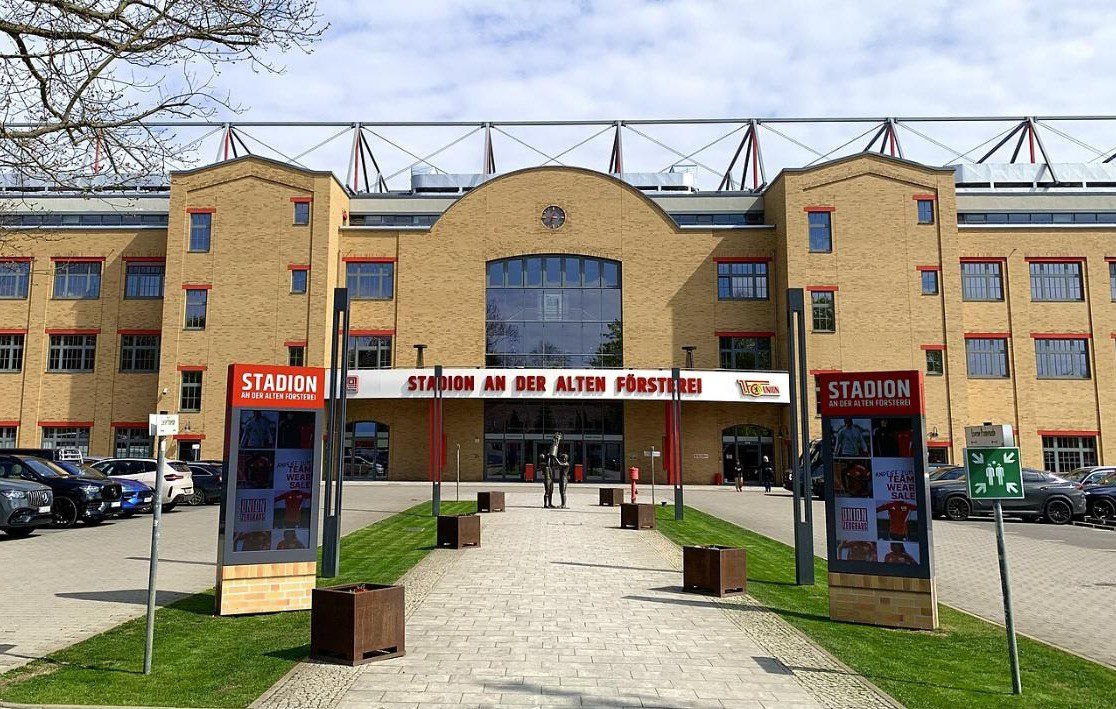
Photo: Lear 21 · Source: Wikimedia Commons · License: CC BY 4.0 · Taken on April 16, 2026, the walkway in front of the main entrance
For drivers, the official information warns that parking nearby is extremely limited.
As alternatives, the Forum Köpenick car park can be used outside its regular opening hours on match days and a space can be reserved online in advance, and the page also describes parking at the free P+R lot at Altglienicke S-Bahn station and continuing from there.
Gates open 120 minutes before kickoff for the men’s team and 90 minutes before for the women’s team. Sectors 1 to 4 are the home sections and Sector 5 is the away section.
Now the tickets. There is good news and bad news.
First, on the club’s official price list, 2026/27 Bundesliga day tickets for the men’s team cost €33 to €48 for seats in four categories (main stand, Sector 1) and €14 to €16 for standing depending on the sector.
With proof, club members, students, trainees, job seekers, retirees and people with disabilities get a discount of roughly €1.50 to €2, children aged 6 to 12 generally pay about half, and children up to age 5 do not need a ticket.
A €1 advance sales fee and a €2 system fee are added to the price, and tickets bought at the box office carry a €2 processing fee per ticket.
The bad news is how tickets are sold. The same price page says day tickets for the men’s home matches are raffled among club members.
I could not confirm in this research any statement that non-members can buy men’s match tickets through general sale.
The same page says tickets for home matches of the women’s team, which was promoted to the Bundesliga in 2025, are usually available for general sale, and 2026/27 women’s day tickets are listed at €12 for standing and €20–30 for Sector 1 seats.
The club’s official information says both professional teams play at this ground, but you should check venue and sales dates match by match with the club, and there is a report that the women’s team’s home ground during the expansion is still undecided (Sport1).
If you really want to see the men’s team, membership may be the practical route.
The official membership page lists €120 a year (€10 a month) from age 18 and €60 a year (€5 a month) for holders of student, pensioner or disability proof, and says a one-time admission fee equal to one month’s contribution is added when you join.
Member benefits include pre-sale rights for home, away and DFB-Pokal tickets, but the same page states that demand is far greater than the stadium’s capacity, so the pre-sale right is also allocated by lottery and is not guaranteed.
It also says the season ticket quota is smaller than the number of members and that no companion tickets are provided.
The same page mentions members living abroad (the farthest lives about 13,550 km away as the crow flies) and says that if you give a non-German bank account, payment is switched to bank transfer automatically.
You join through the club’s online application, and questions go to mitglieder@fc-union-berlin.de. I could not confirm whether someone living abroad can complete the online application without a hitch, so please ask the club directly before joining.
I checked the entry rules in the club’s official stadium regulations and the visitor information.
You may carry only waist bags and handbags up to A4 (21 × 29.7 cm), and larger bags and backpacks can be left at a special desk for €4 per item.
Bottles (even PET bottles), cups and cans made of breakable or hard material may not be brought in, and only non-alcoholic drinks in Tetra Pak or in children’s containers of up to 1 liter are allowed.
Umbrellas are listed as an example of items that could be used as weapons and are banned, so on a rainy day it is better to bring a rain jacket than an umbrella. Bulky items such as strollers, folding stools, ladders, suitcases and tripods are not allowed either.
During play, standing in the seated areas is prohibited, wearing the colors or symbols of an away team is not allowed in Sectors 2 to 4, the home areas, and Sector 5 is for away fans only.
Children up to age 14 must enter with an adult, and for children up to age 7 the standing areas are unsuitable and their use is not recommended.
I could not confirm the re-entry rules on an official page in this research.
According to the club’s official food and drink information, a charcoal-grilled bratwurst (pork or chicken) is €4 each, a steak roll €4.50, pea soup €3 and a half liter of Berliner Pilsner €6, with a €2 cup deposit added.
From a marketer’s view, what makes this structure interesting is that the barrier to buying is high on purpose.
My interpretation is that the member lottery and the season-ticket-first structure are bad for maximizing short-term revenue but build member loyalty and a sense of belonging to the club.
A Stadium in Which Members Hold a Share — 22,012 Spaces, 84% Standing, and a Fan-Owned Company
According to the official stadium page, capacity is now 22,012 (18,395 standing, 3,617 seated), and the attendance ranking by Die Falsche 9 lists Union’s 2025/26 average attendance as 21,996.
Measured against capacity, that means almost every match is practically a sellout, and that ratio and the standing share of about 84% are values I checked by dividing the figures above.
In a structure with such a high standing share, I see it this way: standing places sell at a lower price than seats, which makes it hard to raise revenue per head, but you can fit more people into the same area.
What is more unusual is the ownership structure.
The club says on its official stadium page that it founded a stadium operating company in July 2011 and first offered members and sponsors “Alte-Försterei-Shares,” then in December 2024 made a second share release for the now nearly 70,000 members.
It also explains that the club exercised the right of first refusal in its leasehold contract with the State of Berlin and bought the stadium grounds, so that for the first time since the ground opened in 1920 the site belongs to the Unioner.
On top of the 2008/09 memory of fans contributing labor to build the ground, the club has now had them contribute capital as well. The official information also describes renting out the main stand on non-match days for conferences, workshops, concerts and corporate events.
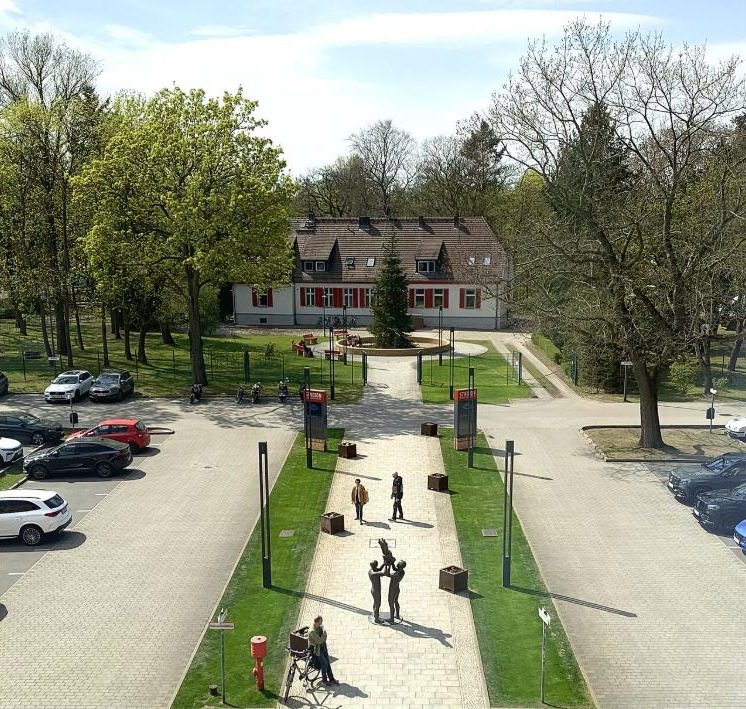
Photo: Lear 21 · Source: Wikimedia Commons · License: CC BY 4.0 · Taken on April 16, 2026, the plaza in front of the stadium entrance seen from above
The club’s financial scale is also worth a look.
According to the SID report, chief financial officer Oskar Kosche told the meeting that revenue for 2025/26 was €197.62 million with a profit of €410,000, and that revenue is planned at €174.04 million for 2026/27.
I could not confirm from that article why planned revenue falls.
After the End of 2027 — A New Stadium of 40,500 and the Temporary Move to the Olympiastadion
The size of the new stadium differs from source to source.
The official Bundesliga site says capacity will rise from 22,000 to 40,500 (including 32,500 standing places), while the Berlin Senate press release of October 2025 says Union proposed opening at 34,500 instead of the originally planned 40,500, the city welcomed it, and 40,500 remains a joint goal for a later stage.
The club’s official stadium page gives the first construction phase as 37,500, and the October 14 dpa report says the stadium will first be expanded to 34,500, so the figures differ by source.
What is certain is that capacity will grow well beyond today’s 22,000-plus, and the final number may still change.
According to the official Bundesliga site, the schedule is: expert surveys finished in autumn 2026, planning approval expected in autumn 2027, building permit in winter 2027, demolition between late 2027 and early 2028, about 18 months of construction and a return in summer 2029.
As the reason for the delay, president Zingler cited species protection as the reason demolition was pushed to winter, and said an underground tunnel system linking the buildings added half a year to construction (Sport1).
According to the dpa report, the modernization costs about €190 million, and Kosche, speaking as a board member of the stadium operating company, said the expansion will not fail for lack of financing.
Zingler said that signing the agreement with the Olympiastadion is imminent and that rent will be due from January 1, 2028.
The temporary home, the Olympiastadion, is used by Berlin neighbors Hertha, and Zingler said he sees the temporary move as a chance for supporters to bring family and friends again and to win over new people (official Bundesliga site).
How to carry the Alte Försterei’s special atmosphere over for about a year and a half will be the key marketing challenge.
Compared with KBO and the K League — Members Who Own the Ground
Korean baseball and K League clubs generally have a parent company or local government running the stadium, and I found no case in this research where members hold shares in the stadium operating company the way Union’s do.
My sense is that our clubs’ membership programs often stop at discount and pre-sale benefits. Union does the opposite: it ties fans to the club by sharing responsibility, not benefits.
A counterview is needed too.
A structure in which non-members can hardly get men’s match tickets through general sale is a clear barrier for tourists and new fans.
A club trying to grow its overseas fanbase cannot simply copy the Union model, and I think the most our clubs can take from it is giving members priority on a portion of a limited allotment.
If you really plan to go, I suggest asking the club first about realistic routes such as membership or women’s team matches.
Leave a Reply