Contents · About 14 min read
- The Floodlights Went Out Even in the First Game, in 1974 — the Westfalenstadion’s Dark First Month
- What Kind of Club Is Borussia Dortmund? — Unbeaten in the League, Level With Bayern on 17 Points
- Getting to Signal Iduna Park and Buying Tickets — Based on Official Club and Stadium Guidance
- A Stadium for 81,365, With a Standing South Stand
- Making Money Outside Matchdays — Fan Welt, Borusseum and Conferences
- The 2025-26 Results: Matchday Income Was Only 10.9% of Revenue
- Compared With the KBO — Between Gate Revenue and the Parent Company
📱 View as card news
If you are planning a Borussia Dortmund matchday trip, the nearest home games are the Champions League tie against Real Betis on Wednesday, Nov. 4 at 9 p.m. local time and the Bundesliga match against Elversberg on Saturday, Nov. 7 at 3:30 p.m. (per the club’s ticket sales schedule, subject to change). I could not find a Korean-language guide to getting to Signal Iduna Park and buying tickets; the closest results were travel-agency package pages.
Dortmund travel to Bayern Munich on Oct. 31 at 6:30 p.m. after five wins and two draws from seven Bundesliga games, 17 points. Bayern also have 17 points but lead on goal difference, +19 to Dortmund’s +8, so Dortmund are second (ESPN table, checked Oct. 29).
I opened the club’s official pages on access, tickets, entry rules, sales dates and prices one by one (checked Oct. 29, 2026) and added local reviews and news reports. This guide covers two things.
The first is how to get from the city center to the stadium, the realistic order for a foreign visitor to get a ticket, and the rules you meet at the gate. The second is how a working marketer reads the revenue structure of an 80,000-seat stadium.
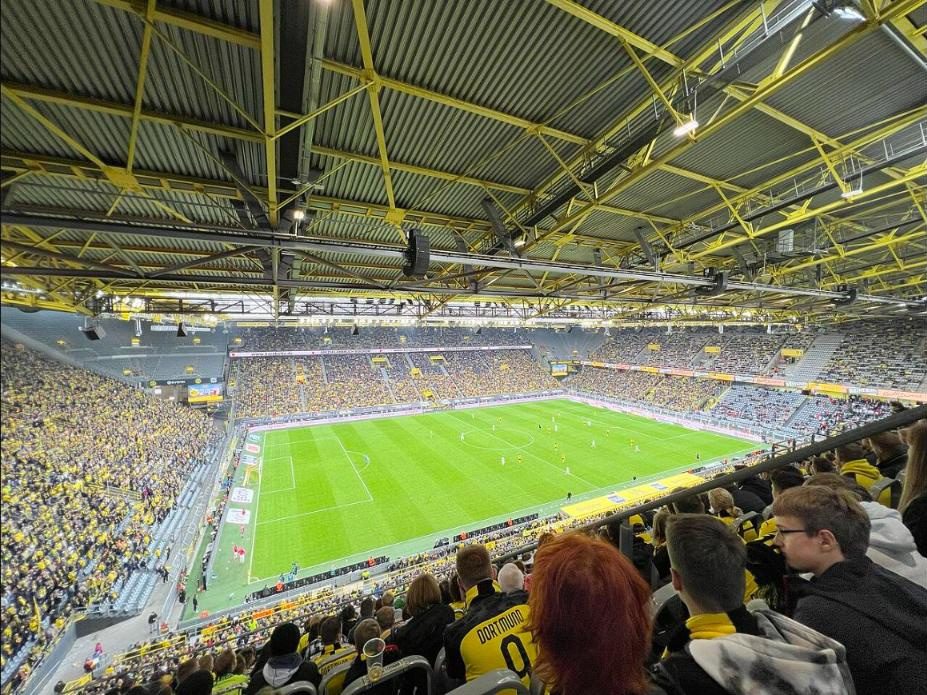
Photo: UNTERMVIERENBERGE-2 · Oct. 2, 2021 · CC BY-SA 4.0 · Source: Wikimedia Commons original
The Floodlights Went Out Even in the First Game, in 1974 — the Westfalenstadion’s Dark First Month
Today it is called Signal Iduna Park, but at its opening it was the Westfalenstadion. It was built for the 1974 World Cup in West Germany, and the club’s official history says that Cologne dropping plans for its own stadium in the early 1970s opened the way for Dortmund’s bid.
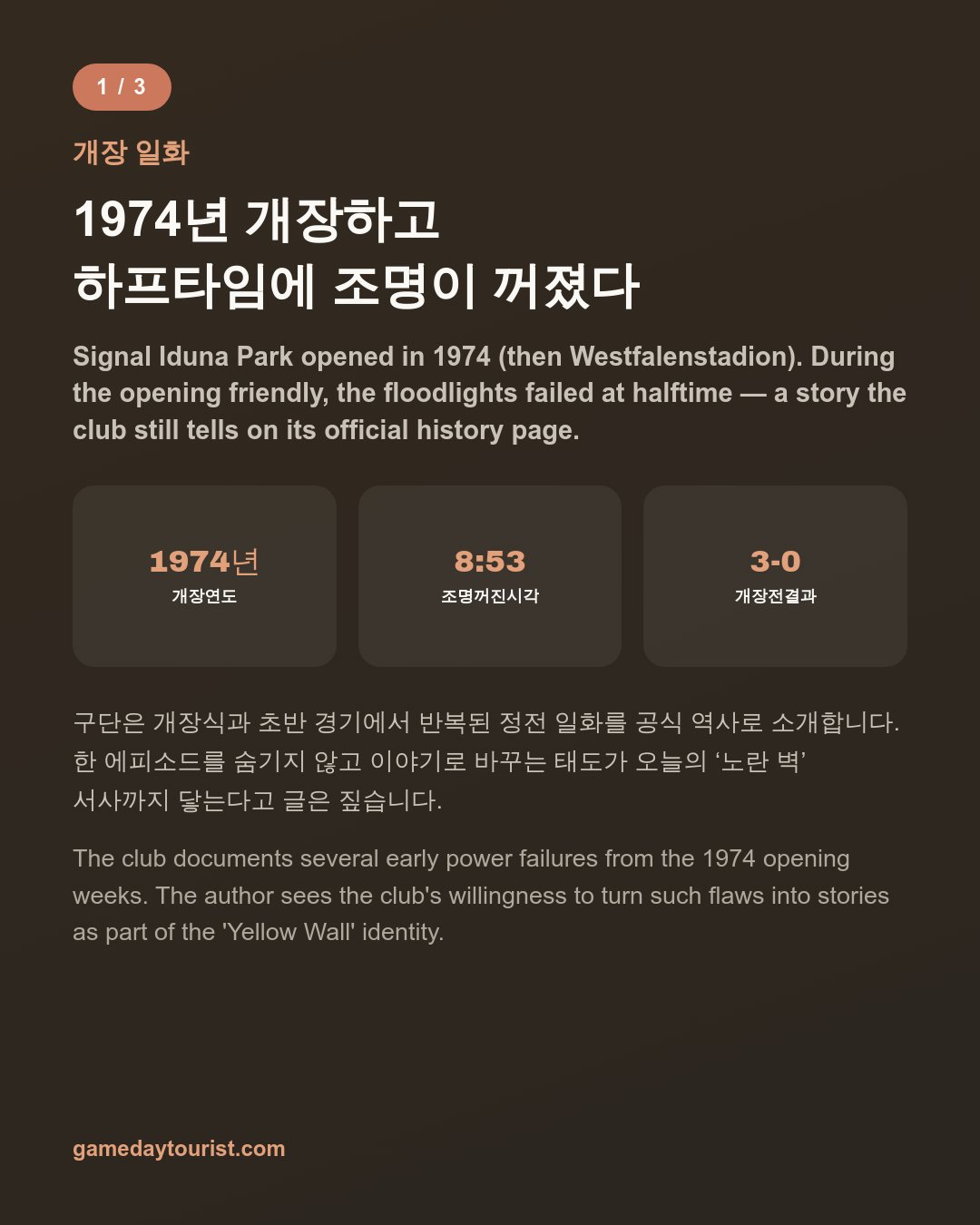
It opened on April 2, 1974 with a friendly between Dortmund and Schalke (Schalke won 3-0), and the club gave its own report on the opening the headline “And Then the Lights Went Out.” According to that report, the floodlights failed at 8:53 p.m. at half-time.
They failed again at the same time during West Germany’s friendly with Hungary on April 17, and similar trouble followed in the test matches and the World Cup opener between Scotland and Zaire. At first it hurt the stadium’s image.
Before the second World Cup match, a Dutch TV reporter predicted the lights would go out soon. The cause was that around 8:50 p.m. street lamps came on across Dortmund, overloading the stadium’s fuses, but the club’s report says the problem had already been found and fixed, so the prediction missed.
I should say that I confirmed this anecdote in only one place, the history report on the club’s own site.
The stadium’s first goal came earlier that day, in a women’s match before the main game (TBV Mengede against VfB Waltrop, which Waltrop won 2-1). Sources disagree on who scored: the club’s site gives Elisabeth Podschwadtke, the Bundesliga’s 50th-anniversary piece gives Margarethe Schäferhoff, and Sport1’s 50th-anniversary article could not settle on either.
It struck me that the club now puts on its official site, 50 years later, a story about the first weeks of a stadium rushed up for the World Cup being spoiled by blackouts. I suspect that habit of turning a flaw into a story also runs through today’s “Yellow Wall” narrative.
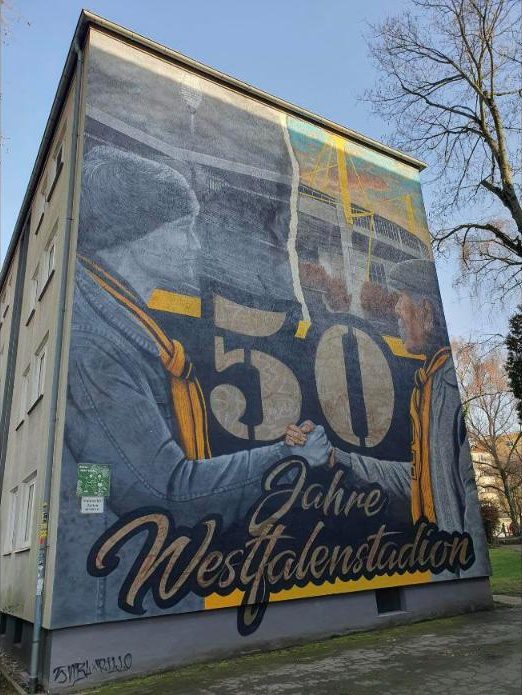
Photo: Joehawkins · Feb. 26, 2026 · CC0 · Source: Wikimedia Commons original · The “50 Jahre Westfalenstadion” mural on Sonnenstrasse in central Dortmund
What Kind of Club Is Borussia Dortmund? — Unbeaten in the League, Level With Bayern on 17 Points
Dortmund were founded on Dec. 19, 1909 (per English Wikipedia). They have won the league title eight times: 1956, 1957 and 1963 were German championships before the Bundesliga began, followed by 1995, 1996, 2002, 2011 and 2012.
In 1965-66 they beat Liverpool 2-1 after extra time in the Cup Winners’ Cup final, the first European trophy for a German club, and in 1996-97 they beat Juventus 3-1 to win the Champions League. Membership is about 218,000, the second largest of any sports club in Germany after Bayern Munich.
The current side is Niko Kovač’s. The club announced on Oct. 13 that his contract was extended to June 30, 2029 (report), and last season they finished second in the Bundesliga.
This season’s league campaign opened with four straight wins and, after a 1-0 win over Frankfurt on Oct. 24, stands at five wins and two draws from seven games (ESPN match record). They drew 2-2 with Bremen on Oct. 9 and 0-0 at Union Berlin on Oct. 17.
Outside the league, they won 2-1 at Sabah in Azerbaijan in the Champions League on Oct. 20 and beat Bremen 3-2 at home in the DFB-Pokal on Oct. 27. Next come Bayern away on Oct. 31 (“Der Klassiker”), Real Betis at home in the Champions League on Nov. 4 and Elversberg at home on Nov. 7.
There is a name familiar to Korean fans. Park Joo-ho joined in 2015, scored and set up a goal against Krasnodar in the Europa League on Sept. 17 that year, and played 11 official matches until he left in December 2017 (per English Wikipedia).
There is no South Korean player on Dortmund’s current squad list (32 players on ESPN) (ESPN squad). Matchday tips are collected in the getting-there section below.
Getting to Signal Iduna Park and Buying Tickets — Based on Official Club and Stadium Guidance
This section is based on the club’s official pages I opened on Oct. 29, 2026 (access guide, ticket FAQ, home match FAQ in English, price list). Where I could not confirm something I say so, so please recheck the official pages before booking.
The stadium is about 3 km southwest of Dortmund Hauptbahnhof, and the rail and bus guide says it takes 30 to 40 minutes on foot. The club recommends public transport, walking or cycling.
The main line is the U45 through the central station, which runs at least every five minutes between the station and the stadium from about three hours before kick-off to 90 minutes after the final whistle, and every 15 minutes in the evening until about 12:30 a.m. The U42 stop “Theodor-Fliedner-Heim” and the U46 stop “Westfalenhallen” are also close.
From the central station you can also take a regional train to the “Signal Iduna Park” station right beside the stadium, and the club points to eurobahn’s site for special RB 59 services. It also warns that service can change because of construction and that platforms get crowded, so check the DB Navigator app in advance.
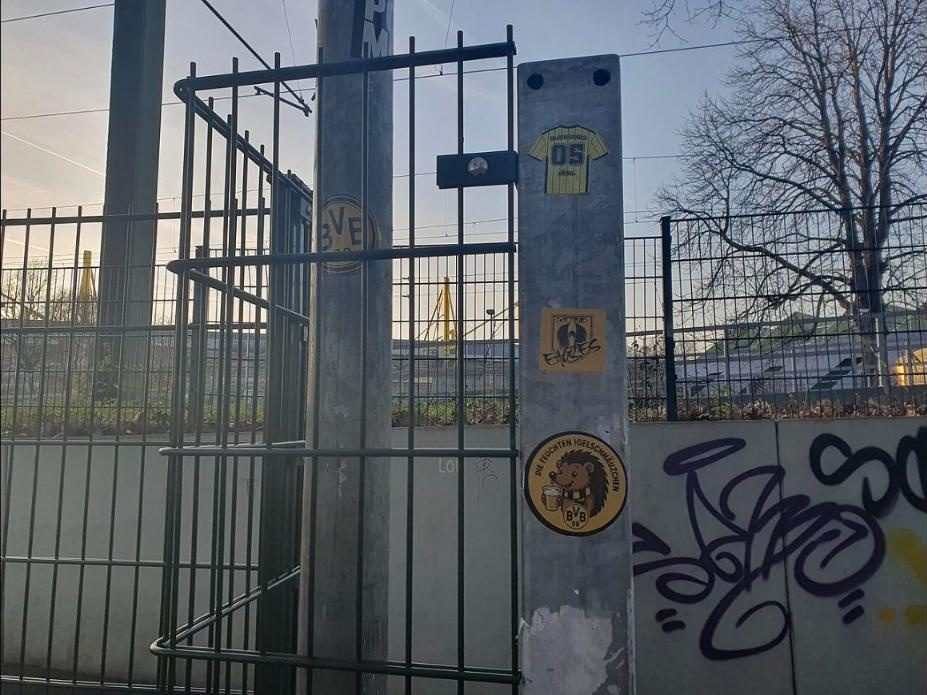
Photo: Joehawkins · Jan. 20, 2026 · CC0 · Source: Wikimedia Commons original · BVB stickers at the entrance to the Westfalenstadion light-rail stop
I lean toward advising against driving. There are more than 10,000 paid parking spaces around the stadium, but they must be bought online in advance (zone A through Messe Dortmund, zones C to F through DOPARK 21), and the club tells you not to enter the stadium address in your navigation but to follow the parking guidance system from the city.
After the match the roads in front of the stadium stay blocked for about two hours, and the whole area is a low-emission zone. Parking on Otto-Hahn-Straße and taking the Uni-Shuttle costs 2 euros, and the shuttle runs from three hours before kick-off to two hours after the final whistle.
Dortmund Airport is 12 km from the stadium.
A season ticket is valid on second-class transport across North Rhine-Westphalia from the matchday until 3 a.m. the next day, and for digital and print-at-home tickets the club says you must separately order DSW21’s free “KombiTicket” by choosing “BVB-Spiel” on the site and entering the ticket’s barcode number, after which it comes by email.
The bus and rail guide, on the other hand, says a BVB ticket is valid as a combined ticket for one return journey on the matchday, so check the notice on the purchase screen for the type of ticket you bought.
Single-match tickets are sold only through the club’s official online ticket shop, and the club says it does not hand tickets to third parties. The season-ticket waiting list was closed some years ago and cannot be joined now.
The club’s ticket sales schedule shows that members get a presale for each match first. For the Nov. 7 Elversberg game the member presale was on Oct. 8 at noon (six tickets each) and the general sale entry is empty, while for the Nov. 4 Betis tie the member presale was on Sept. 18 and the general sale (non-member BVB fans) on Sept. 21 (ten tickets each, subject to availability).
For the Nov. 29 Leverkusen game the member presale was on Oct. 12 (six tickets each), and for the Dec. 9 Inter game it is on Oct. 30 (four tickets each). Whether a non-member can get tickets for these games cannot be known without checking the live stock in the club’s ticket shop.
When a game sells out in the regular sale, the official secondary market in the ticket shop opens and runs until 2 hours 30 minutes before kick-off. The club bans commercial resale in its rules (stadium regulations) and warns strongly that fans receive counterfeit tickets from other sellers on every matchday.
There are also official packages that bundle a hotel (the “Adrenalin Trips”). I could not confirm on the official pages whether foreign-issued cards are accepted.
The club’s customer service is on +49 231 90200, Monday to Friday 8 a.m. to 6 p.m. and on home matchdays from 9 a.m. until kick-off.
Prices come from the club’s official price list, for a single-day ticket. Seats are 85 euros in category 1, 70 in category 2, 65 in category 3, 57 in category 4, 50 in category 5 and 35 in category 6, and standing is 18.50 euros.
Standing for under-18s is 12 euros, reduced standing is 11, category 4 for under-14s is 10, and category 6 for under-18s is 20. A surcharge can apply depending on the opponent, so check the actual price in the ticket shop.
The changes the club announced in its 2026-27 ticket notice are a freeze on reduced categories, standing, category 4 and category 6, a 3-euro rise for the remaining seats and an 8-euro rise for category 1. Matches against Bayern Munich and Schalke carry a 20% surcharge (except standing and category 6).
A south-stand season ticket costs 311.10 euros a year including the Champions League, according to 90min (May 27, 2026), and the most expensive seat season ticket is 1,164.80 euros.
The family area (REWE family block, blocks 64 and 65) has more than 1,500 seats in the north-west corner, at 10 euros for children and 57 euros for the accompanying adult. Children aged six and under can come in with an adult but have no right to a seat, and pay 1 euro on site for a children’s card.
I could not confirm whether standing places in the south stand can be bought in the general sale. Fans cannot wear the opposing team’s colors in that area, up to the corner.
The entry rules are as follows. The stadium opens two and a half hours before kick-off, and the club advises arriving early because queues can form at the entrances (home match FAQ in English).
Bags and backpacks up to A4 size, small umbrellas, power banks up to the size of a phone and cosmetics up to 50 ml are allowed. No food or drink of any kind can be brought in, and glass containers, cosmetics over 50 ml, aerosol cans, pushchairs, walking frames and baby car seats are also not allowed.
The stadium regulations also ban professional recording equipment, noisemakers, flagpoles over 1.5 m and laser pointers (stadium regulations). Children up to 14 must be accompanied by an adult, and children aged 7 and under cannot enter the standing areas.
All payment is cashless. Credit and debit cards, Apple Pay and Google Pay work, and the club’s “Stadiondeckel” card is accepted only at kiosks.
I could not confirm the re-entry rule.
On days without a match there is the Stadium Walk. It is a self-guided walk along a set route, 12 euros for adults and 8 reduced, with a combination ticket including the Borusseum (the club museum) at 18 euros for adults and 12 reduced.
You can start between 10 a.m. and 5:30 p.m., and it is closed on home matchdays and the day before. The meeting point is the Fan Welt north of the stadium (Strobelallee 54).
What stands out to me as a marketer in this purchase flow is where the hurdle sits. The problem is not a shortage of tickets but the eligibility and timing to buy one.
Member presale, general sale and then the official secondary market after a sell-out follow in order, and the club shuts out other markets as a counterfeit risk. For visitors from abroad, creating an account in advance and being ready when a sales window opens is practically a packing item.
This structure is solid for fan management, but it is also a barrier for foreign visitors coming for the first time.
A Stadium for 81,365, With a Standing South Stand
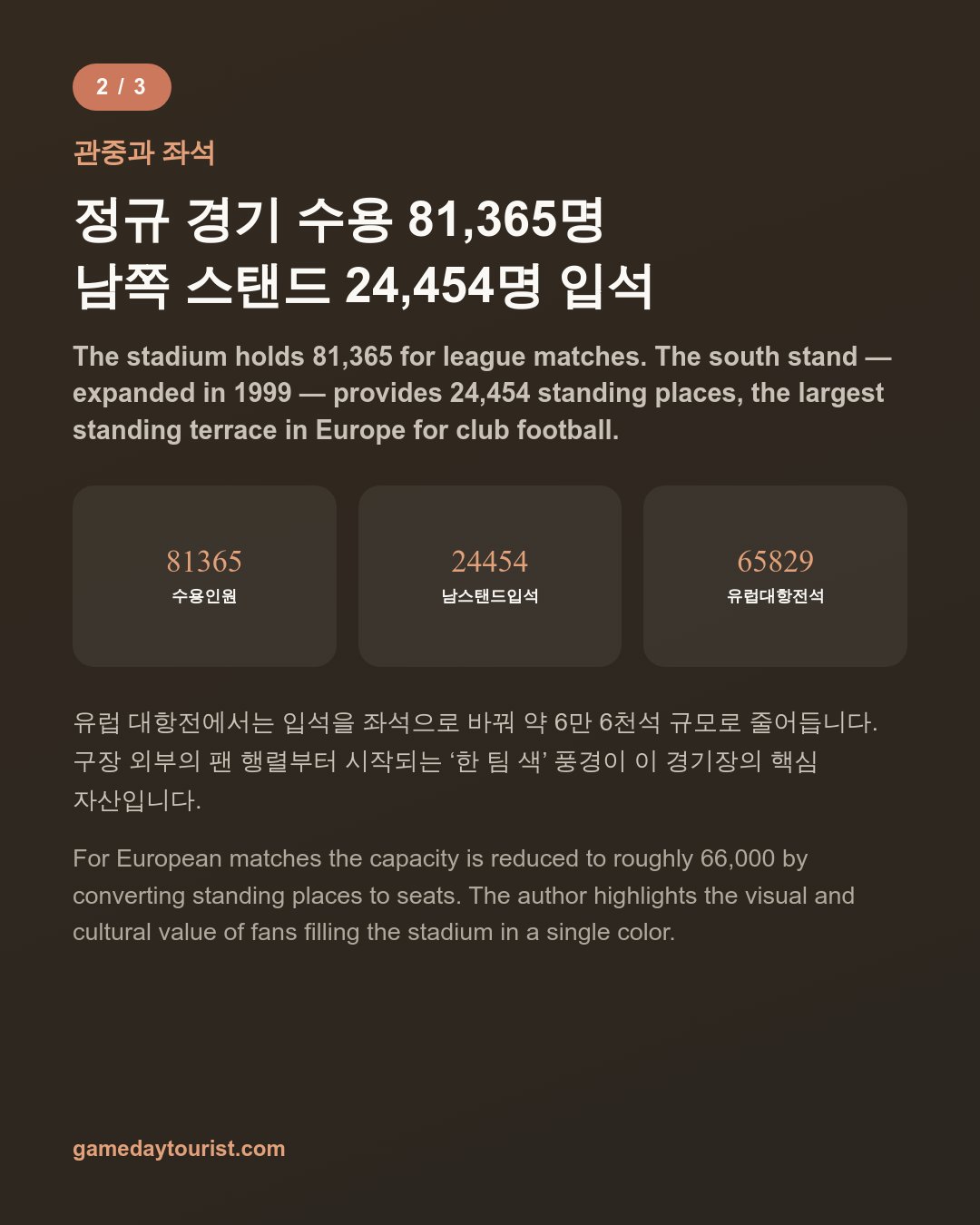
The league capacity is 81,365 (per English Wikipedia). For European competitions, standing places are converted to seats and the capacity drops to about 66,000 (sources differ: 65,829 and 66,099).
The club’s history page says the 1999 expansion made the south stand Europe’s largest standing terrace, for 24,454 people. A German attendance statistics site ranks Dortmund first in the country for 2025-26 with an average of 81,365 (table, updated April 27, 2026).
An English-language football columnist, writing about the last day of a season, described how the trains from the central station to the stadium filled with fans after the club asked everyone to wear yellow, and how after a defeat, when silence fell over the stadium, the south stand started singing first to console the players.
What came to mind first on reading it was that the sight of 80,000 people filling a stadium in one team’s colors begins on the trains outside. As a marketer I think this scene is the club’s most valuable asset.
But as we will see below, the place that asset takes in the books is narrower than you would expect.
Making Money Outside Matchdays — Fan Welt, Borusseum and Conferences
The BVB Fan Welt north of the stadium is a service center of about 2,000 square meters that opened in 2014, and according to the Commons description (BVB Fan Welt category) it brings merchandise, a ticket office, a travel agency, stadium tours, a football school and member services under one roof. The club museum, the Borusseum, is inside the stadium, and the stadium is also used as an event venue on days without football.
In September 2025 a banner for the conference event “CONF3RENCE” hung at the north entrance.
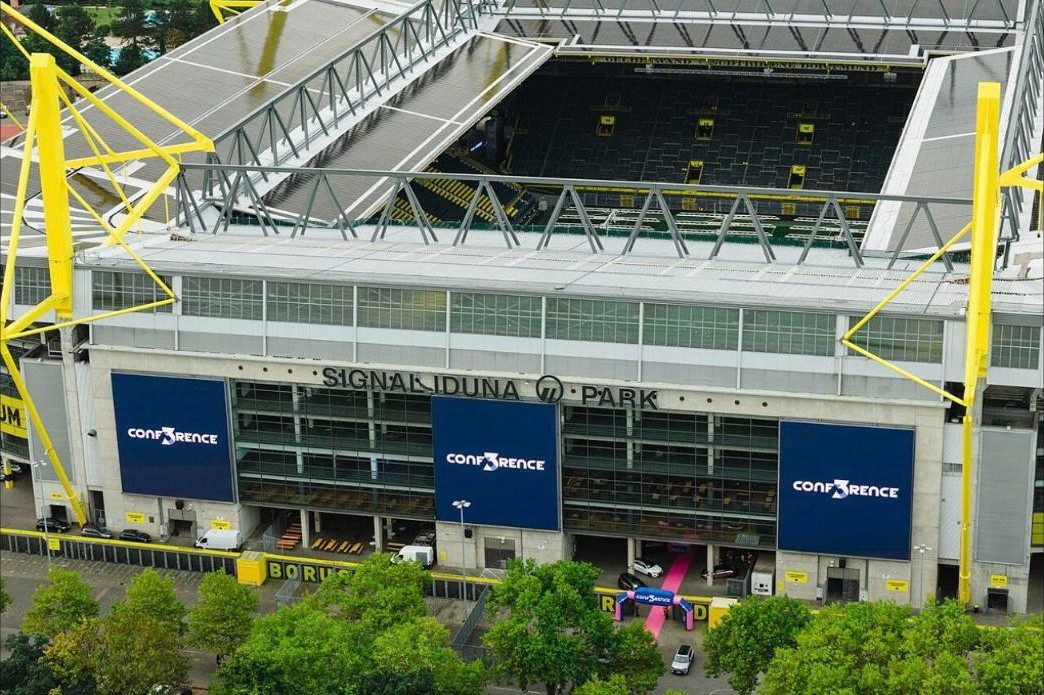
Photo: Ludger Staudinger · Sept. 4, 2025 · CC0 · Source: Wikimedia Commons original · The north entrance during a conference event
The 2025-26 Results: Matchday Income Was Only 10.9% of Revenue
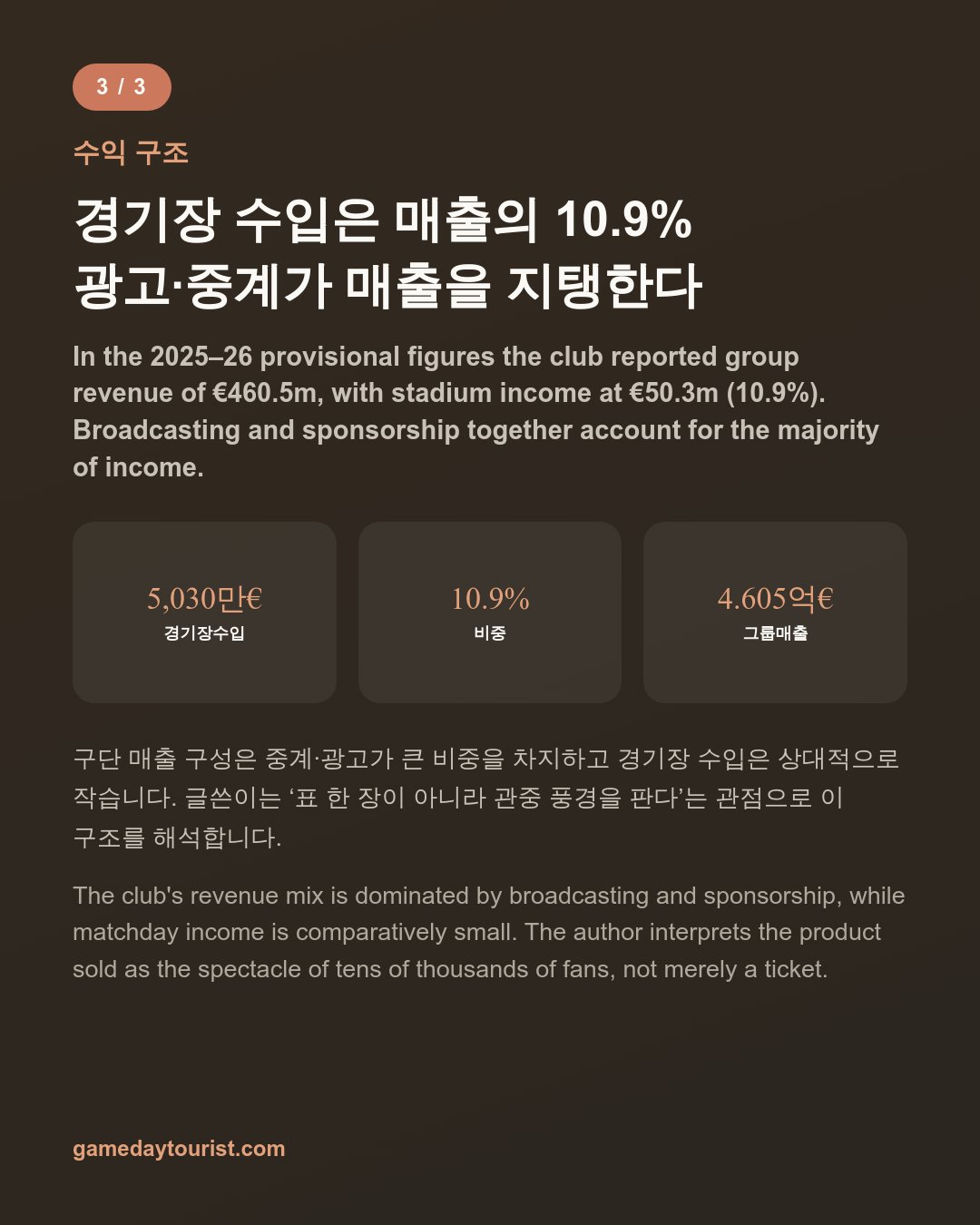
In the provisional 2025-26 figures (IFRS) that the club published on Aug. 21, group revenue was 460.5 million euros, down from 526.0 million, and the group swung from a 6.5 million euro profit to a 21.7 million euro loss. The breakdown is media 168.5 million euros (36.6%), advertising 157.9 million (34.3%), matchday income 50.3 million (10.9%), conferences, catering and other 45.1 million (9.8%) and merchandising 38.7 million (8.4%).
I calculated the percentages myself from those figures. Media revenue fell by about 58.7 million euros from 227.2 million, which a report attributes largely to the Champions League run ending in the round-of-16 play-offs, and the same report also names lower income from the Club World Cup (a Reuters-based report likewise gives lower TV income as the main cause).
Advertising, on the other hand, rose from 153.6 million euros, while matchday income fell by about 4.9 million euros from 55.2 million.
The club’s finance chief said the result “shows that we depend on sporting success, but we are healthy at the core,” and the club forecast a 2026-27 net result of 0 to 10 million euros. What stayed with me most while writing this is that, for a stadium filled to 80,000 on average, matchday income is barely a tenth of the total.
My reading is that the stadium is less a place that sells admission than a stage that advertisers and broadcasters buy, so the atmosphere the south stand creates underpins the value of roughly 150 million euros of advertising and 160 million of media rights. Knowing that, the club seems careful about raising ticket prices, and this year’s freeze on standing and some categories reads as a clue.
Compared With the KBO — Between Gate Revenue and the Parent Company
Korea’s pro baseball league passed 10 million in attendance for the first time in 2024, and a Yonhap-affiliated column put the league-wide gate revenue at over 150 billion won. The same piece estimates each club’s gate revenue at 10 to 20 billion won and operating costs at 45 to 70 billion won, and says that nine clubs other than Kiwoom receive 15 to 30 billion won a year in support from their parent companies.
The clubs do not disclose their finances, so these are only estimates from a news report, but a simple division puts gate revenue at between a seventh and just under half of operating costs. The years, currencies and accounting standards differ, so it cannot be compared directly with Dortmund’s 10.9%.
Still, the difference in direction is clear. Dortmund earn more than 70% of revenue from advertising and media combined, in exchange for a low share from tickets, and cover their costs without a parent company, while KBO clubs still keep parent-company support as one pillar of the structure even as gate revenue grows.
A Korean club cannot simply copy Dortmund’s 80,000 seats. But turning a full stand and a supporter culture into advertising and media value rather than ticket revenue is something a club can design for itself, which makes it worth watching.
In the end, what you buy at this stadium is not one ticket but the sight of 70,000 people standing in one team’s colors, I think.
See this club’s food guide and team page too.
Leave a Reply