📱 View as card news
A 22-year-old midfielder born in Düsseldorf, holding dual German-Korean citizenship, stepped onto a World Cup pitch for the first time last June wearing the Korean crest.
That’s Jens Castrop. Once I learned that this player, who came on as a second-half substitute against South Africa, plays his club football for Borussia Mönchengladbach in the Bundesliga, I wanted to take a proper look at the club as a working marketer myself.
As it happens, this is also the club’s first season attaching a company name to its home stadium in 22 years, so there was plenty to dig into from a marketing angle too.
Castrop came through the youth ranks at Düsseldorf and Köln, made his professional debut at Nürnberg in 2022, and joined Mönchengladbach in the summer of 2025 on a four-year deal for a transfer fee of €4.5 million.
Though he came up through Germany’s youth national teams, he switched his football nationality to South Korea in 2025 and was named to Hong Myung-bo’s final 26-man squad last May, becoming the first foreign-born, dual-national player picked for South Korea’s World Cup roster.
He came on as a substitute in the group-stage finale against South Africa in Monterrey on June 25 (Korea time) and was involved in the play that led to a goal against, which he admitted left him disappointed. Watching that moment, I found myself curious first about what kind of club he plays for — occupational habit, I suppose.
Crowds and Tickets
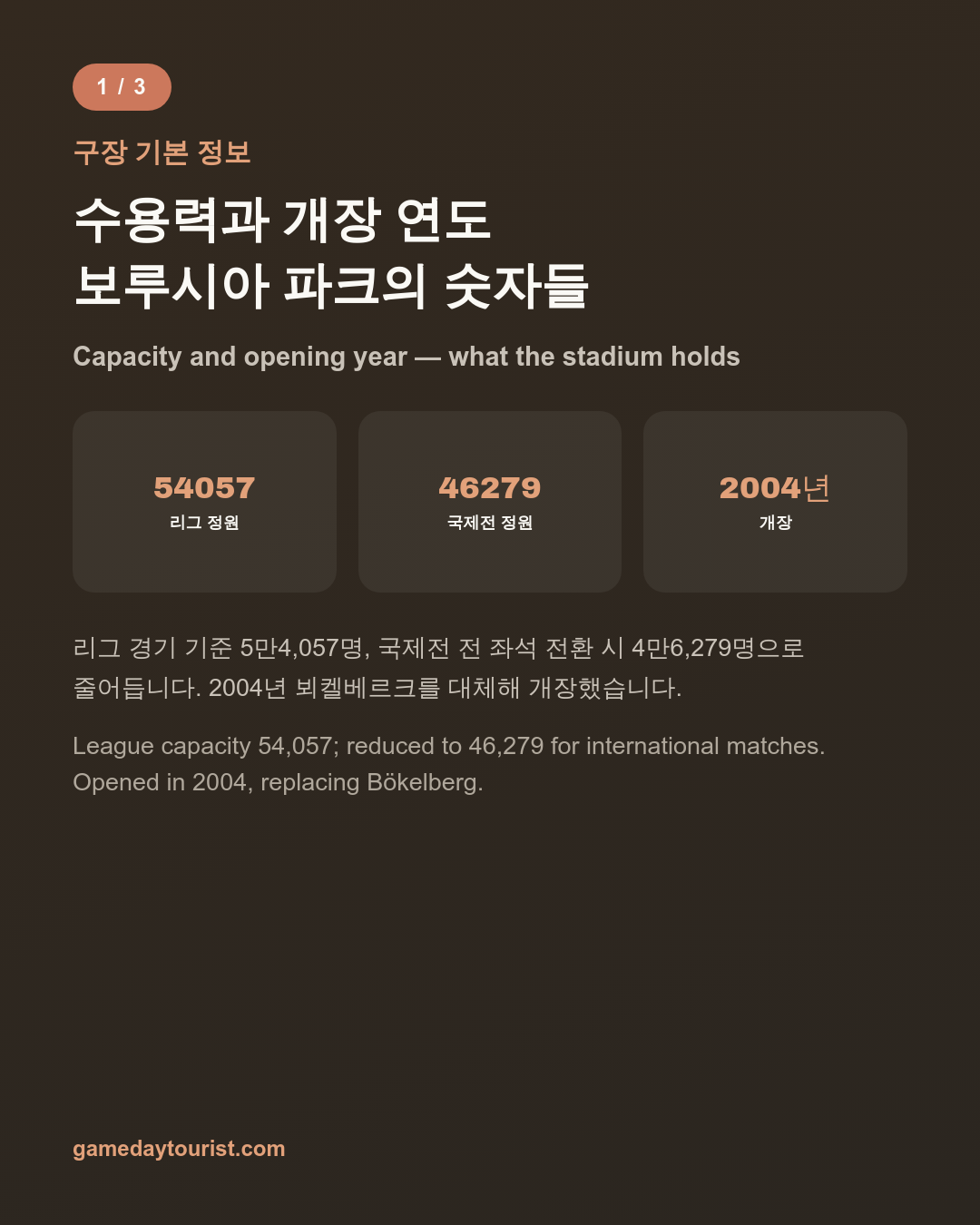
Borussia-Park opened on July 30, 2004. Built to replace the aging Bökelbergstadion, its capacity for league matches is 54,057 (including standing room), which drops to 46,279 when converted to all-seater for UEFA and FIFA internationals.
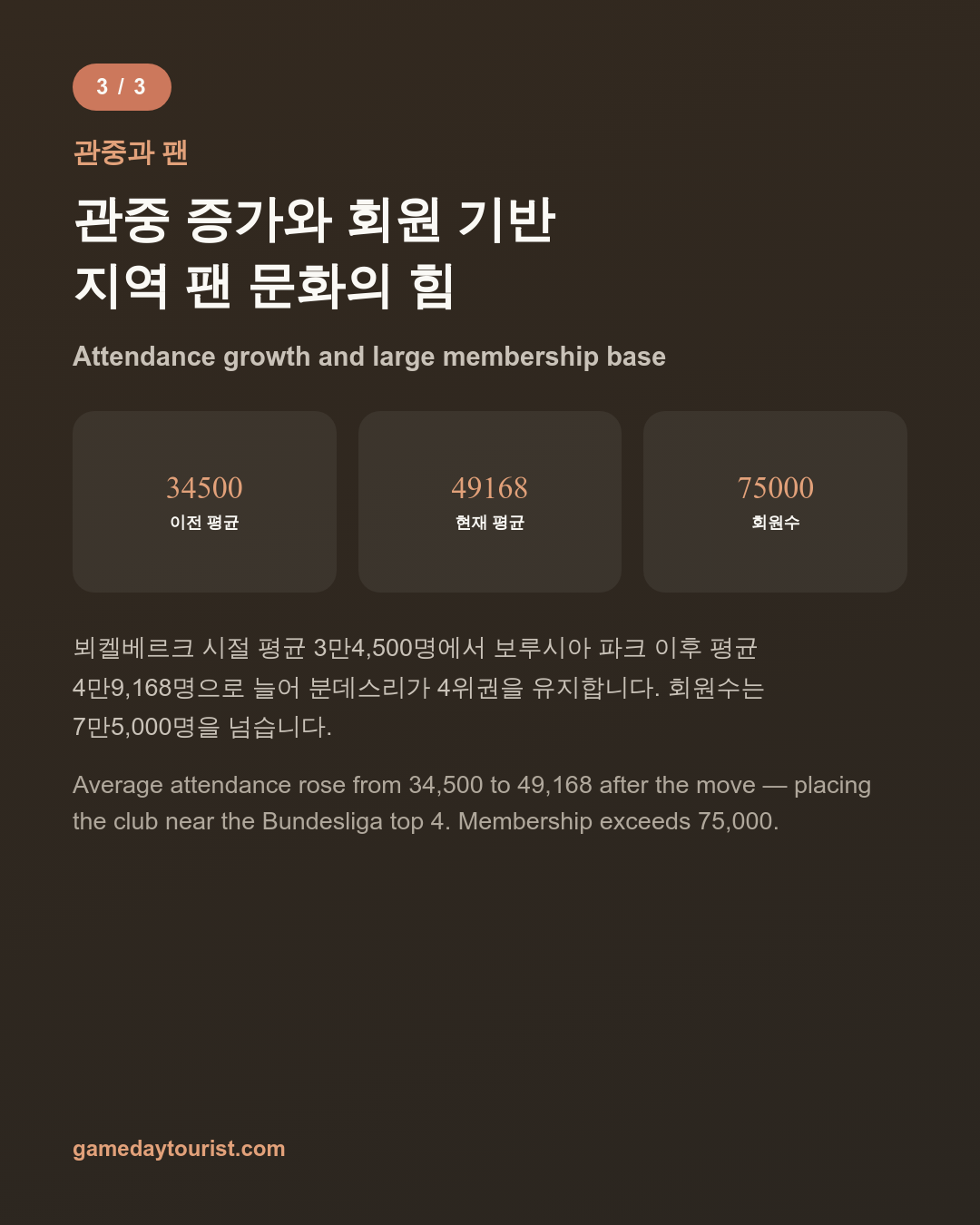
According to stadium specialist outlet Football Tripper, average attendance has climbed to 49,168 since the move from the 34,500-capacity Bökelbergstadion, keeping the club around 4th in the Bundesliga for average crowds.
Ticket prices span a wide range: standing terraces start at €14.50, seats behind the goal at €27.50, and central seats from €44.50, with a premium of up to €20 added for high-demand fixtures like the visit of Bayern Munich.
By membership numbers, Football History reports the club has passed 75,000 members, placing it among Germany’s larger clubs.
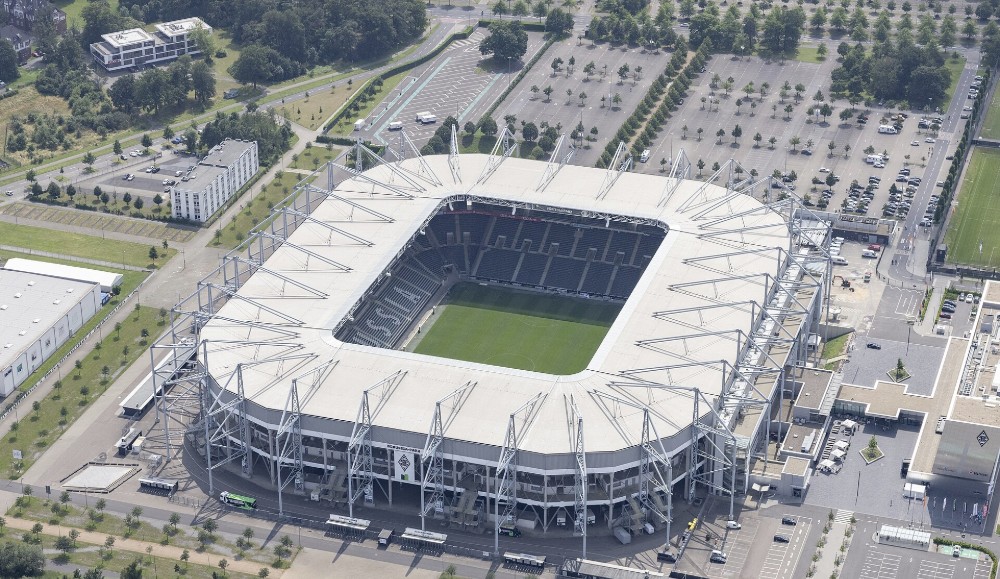
Source: Arne Müseler / arne-mueseler.com, CC BY-SA 3.0 DE · Aerial view, shot in 2021
A Mascot Named After a Legend
Mönchengladbach’s nickname, “Die Fohlen” (the Foals), dates back to the club’s 1965 promotion to the Bundesliga.
Under coach Hennes Weisweiler, a squad with an average age of just 21.5 played a fast, physical style of football, and the local press likened it to young foals romping around a field — hence the name.
That nickname carried over into the club mascot in 1998: Jünter is a slight local-dialect twist on the name of club legend Günter Netzer.
Naming a mascot directly after a real person feels like a quiet way of stamping the club’s history onto the next generation of fans.
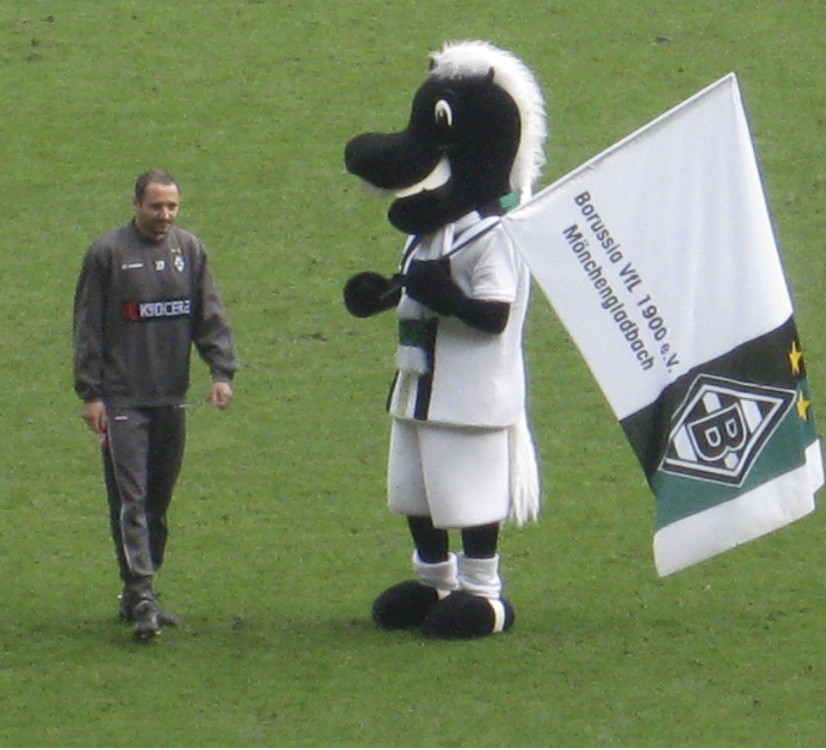
Source: Linksfuss, public domain · Wikimedia Commons
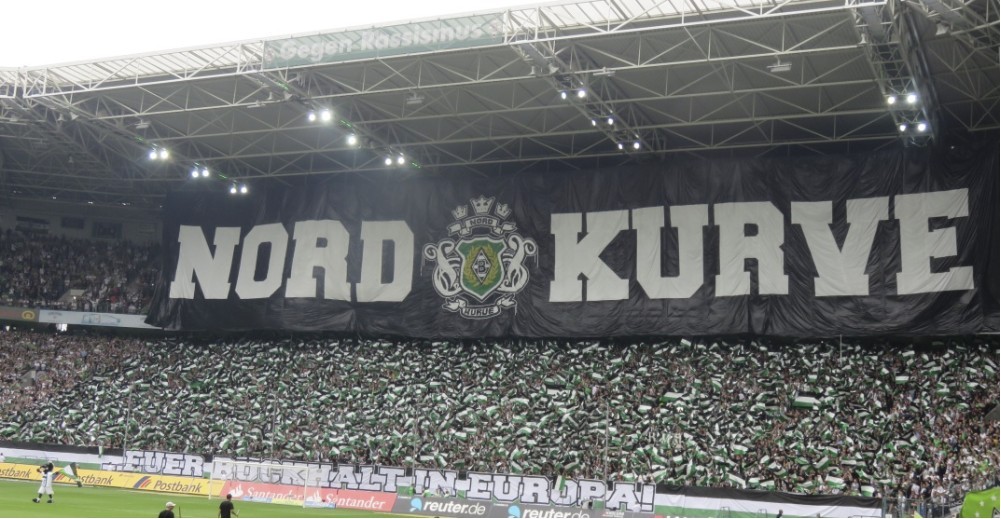
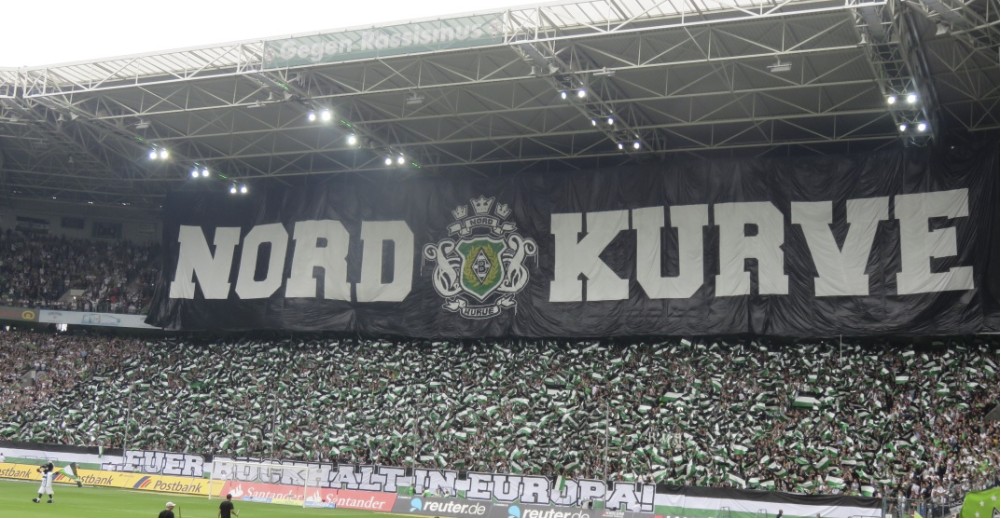
Among the home stands, the standing terrace known as the Nordkurve is by far the most famous. Football Tripper puts the stadium’s total standing capacity at 18,883, and the Nordkurve draws the largest crowd of any of them, regularly decked out in giant banners and card-stunt displays.
In one photo I came across while researching this piece, a “Gegen Rassismus” (anti-racism) banner hung casually above the main display — what struck me was that this wasn’t some one-off event message, but simply part of the everyday fan culture there.
Source: Heynckesjupp, CC BY-SA 4.0 · Wikimedia Commons
Naming Rights and Sponsorship
For 22 years after its 2004 opening, this stadium carried no sponsor name at all, simply going by “Borussia-Park.” With 14 of the Bundesliga’s 18 stadiums already carrying a corporate name, Mönchengladbach had long been an unusual holdout.
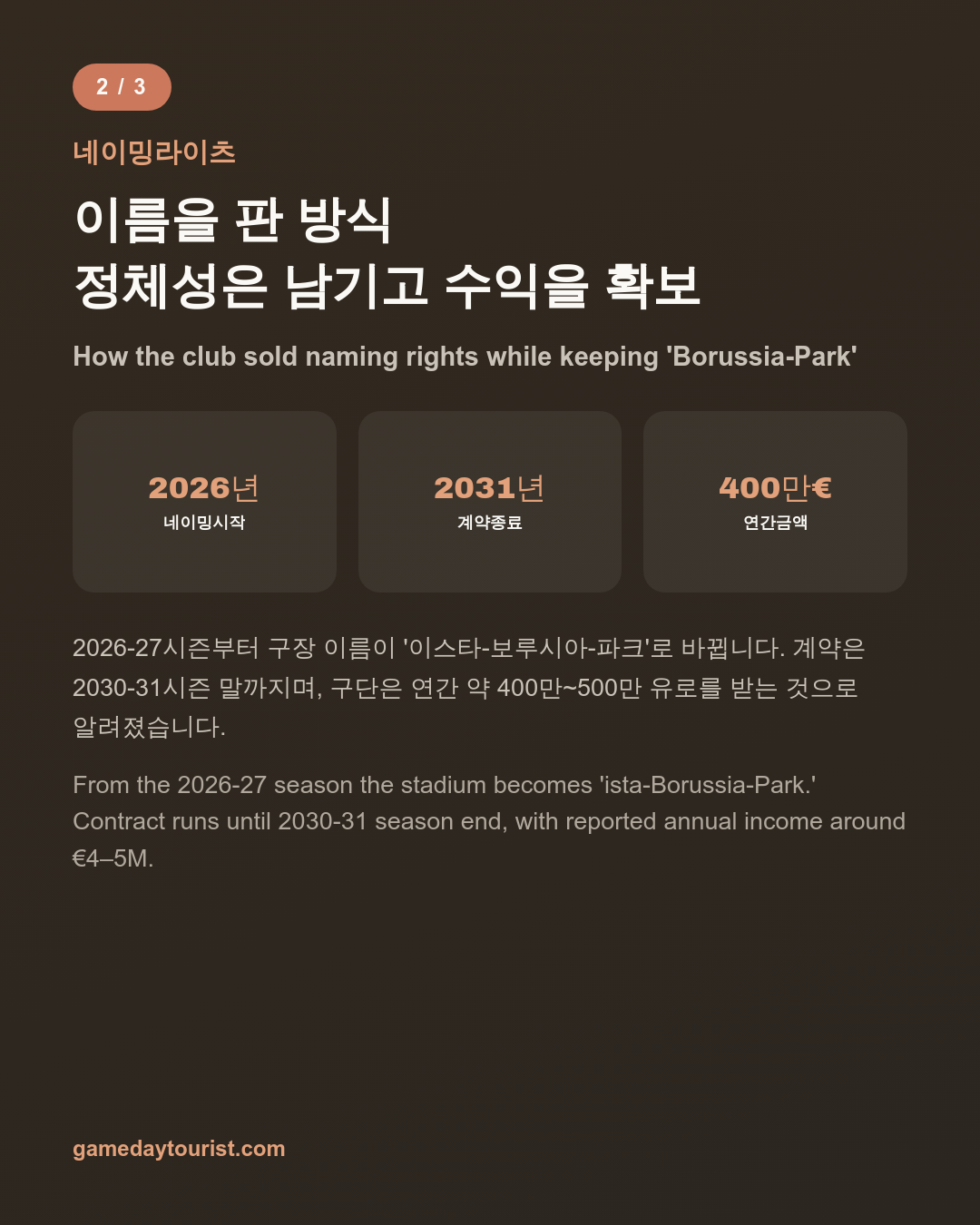
That changed starting with the 2026-27 season, when the name became “Ista-Borussia-Park.”
The club had been running a sustainability partnership around energy efficiency with energy services firm ista since summer 2025, and this deal extended that relationship into stadium naming rights.
According to a SportBusiness report, the deal runs through the end of the 2030-31 season, with the club reportedly receiving €4-5 million annually (about ₩6-7.5 billion).
That’s modest next to the roughly €8.5 million average fair value The Sponsor calculates for Bundesliga stadiums, but it makes sense given the club’s condition that whatever deal it signed had to keep the name “Borussia-Park” intact.
Selling the naming rights while still preserving the name tied to the club’s identity looks, from a marketer’s perspective, like a negotiation that found its own balance between visibility and revenue.
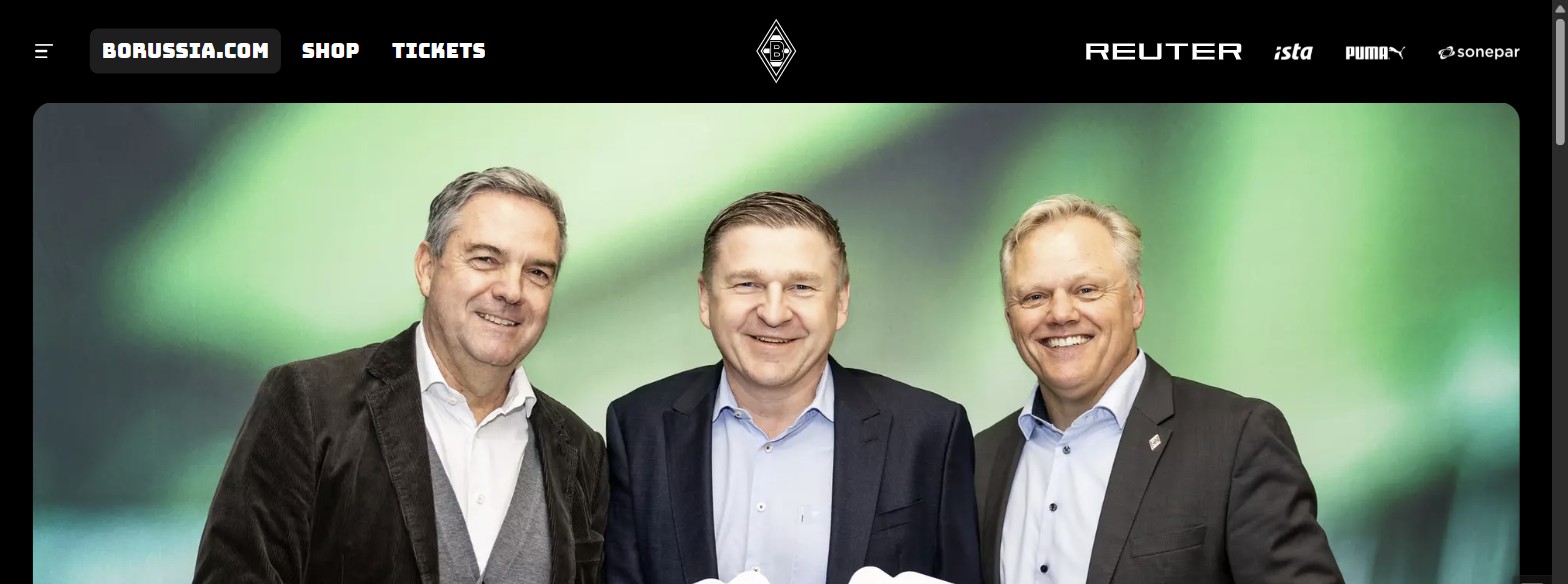
The shirt’s main sponsor since the 2024-25 season is REUTER, an online bathroom and interior retailer. It had been a secondary sponsor since 2011 before stepping up to the main spot; before that, Postbank (2009-2020) and Flatex (2020-2024) held the front-of-shirt position in turn.
Puma supplies kit, and Sonepar, an electrical and lighting distributor, is also a listed partner — the official website’s top menu alone shows the REUTER, ista, Puma, and Sonepar logos lined up side by side.
Source: Borussia Mönchengladbach’s official announcement page · Official club promotional image
On the broadcasting side, the Bundesliga as a whole has signed a deal with Sky Deutschland and DAZN for €1.121 billion per season in domestic rights alone (combined across all 36 clubs in the top two divisions) from 2025-26 through 2028-29.
That’s roughly 2% more than the previous deal, and reportedly makes it the second-largest domestic broadcast market in world football after the English Premier League. Individual club shares aren’t disclosed, but a steadily growing league-wide pie directly affects the finances of a mid-table club like Mönchengladbach.
Making the Most of the Space, and F&B
Borussia-Park looks like a football-only ground, but it’s really more of a multi-purpose events venue. It hosted group-stage and semifinal matches at the 2011 Women’s World Cup, has held five German national team matches, and has served as a stage for Bruce Springsteen and Elton John concerts.
Even on days without football, the venue keeps generating revenue rather than sitting idle.
The concourse houses a Sportsbar Gladbach along with stands selling pretzels, pies, pizza, and pilsner, and one football-travel blogger who visited praised the wide concourses, variety of stalls, and reasonable prices, noting how easy it was to enjoy food and beer even from your seat.
Reading a review like that as a working marketer, it drives home how F&B satisfaction really comes down to basics like flow and wait times rather than flashy facilities.
Compared with the KBO and K League
Comparing this with domestic Korean clubs, what’s actually more interesting than the sponsorship figure is the question of who owns and operates the stadium.
Borussia-Park is owned and operated directly by “Borussia VfL 1900 Mönchengladbach GmbH,” a subsidiary the club itself set up — meaning the club had full authority over whether to sell naming rights at all, and what name to preserve.
Most K League clubs, by contrast, lease publicly owned sports facilities from local governments, so even if a club wanted to sell naming rights, it couldn’t simply rename its stadium without the local government’s agreement.
FC Seoul’s Seoul World Cup Stadium and Suwon FC’s Suwon World Cup Stadium, for instance, are both public facilities owned by the Seoul and Suwon city governments respectively, and it’s the city — not the club — that ultimately decides whether naming rights get sold at all.
Mönchengladbach could hold out for 22 years without a sponsor, and sell the name only now, precisely because it was an asset the club owned outright and could sell whenever it chose. That makes me think naming-rights discussions at Korean clubs need to start with ownership structure, well before the question of attracting a sponsor.
It’s still unclear how many more caps Castrop will earn for South Korea, or whether Mönchengladbach can turn results around under its new “ista” name.
Still, the way the club sold a 22-year-old name while insisting on keeping its identity intact strikes me as a useful reference point for Korean clubs thinking about sponsorship as long-term stadium asset management.
Leave a Reply