Contents · About 7 min read
📱 View as card news
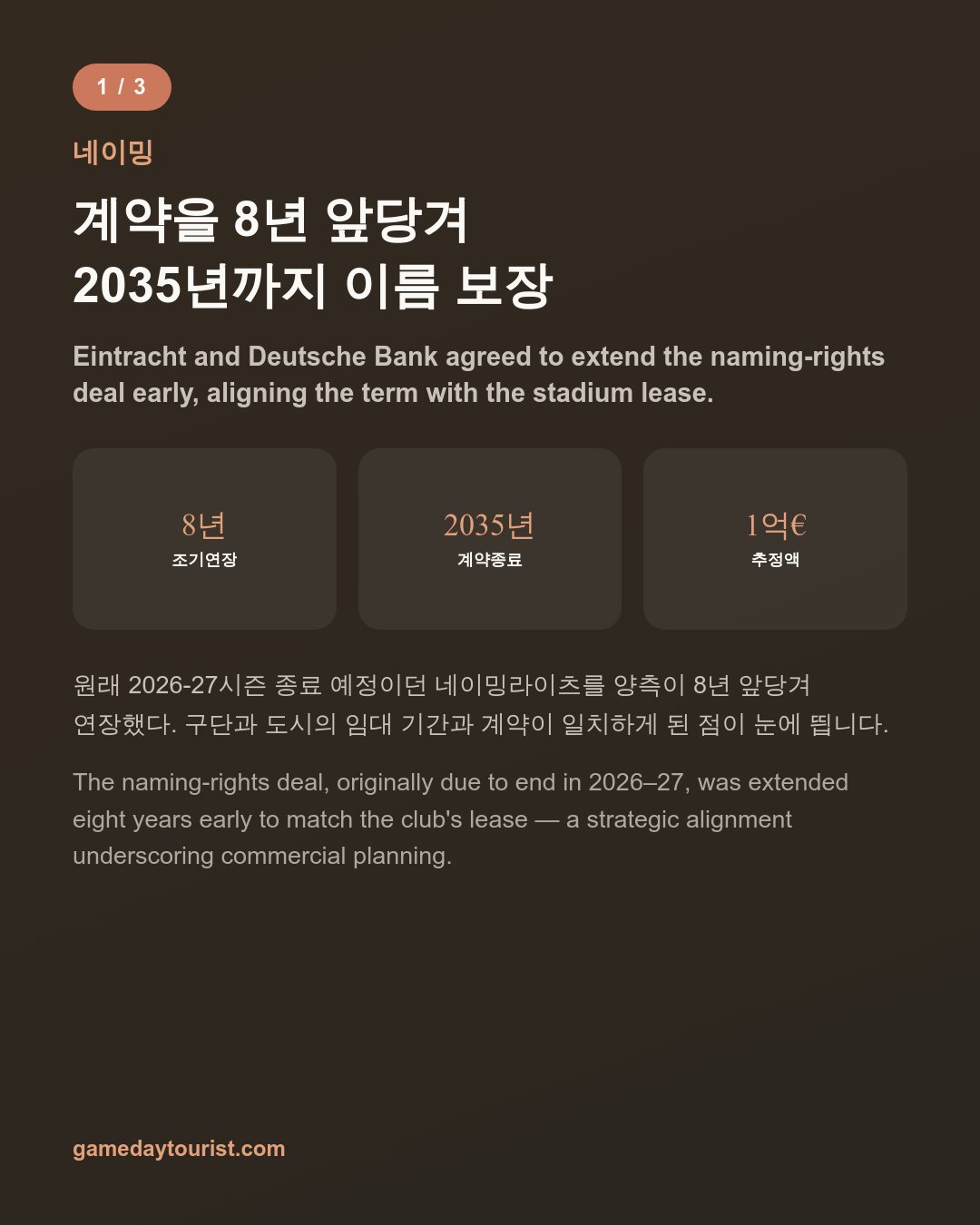
While belatedly catching up on this year’s Bundesliga sponsorship news, I came across the report that Eintracht Frankfurt and Deutsche Bank had extended their stadium naming-rights deal eight years early, through 2035.
The amount hasn’t been made public, but the German sports magazine Kicker reported it at an estimated €100 million or more, and the club described the deal as the most comprehensive partnership in its history.
The club’s name sounded familiar to me for a different reason, though.
Eintracht Frankfurt is the team where Cha Bum-kun, the former South Korea national team manager, played.
Cha joined in the summer of 1979 and led the club to the UEFA Cup the following year, and that title stood as the club’s last European trophy for 42 years, until Frankfurt won the Europa League (the UEFA Cup’s successor) in 2022.
As a working marketer, I got curious about what a club with such a familiar name has been doing commercially lately, so I dug in further.
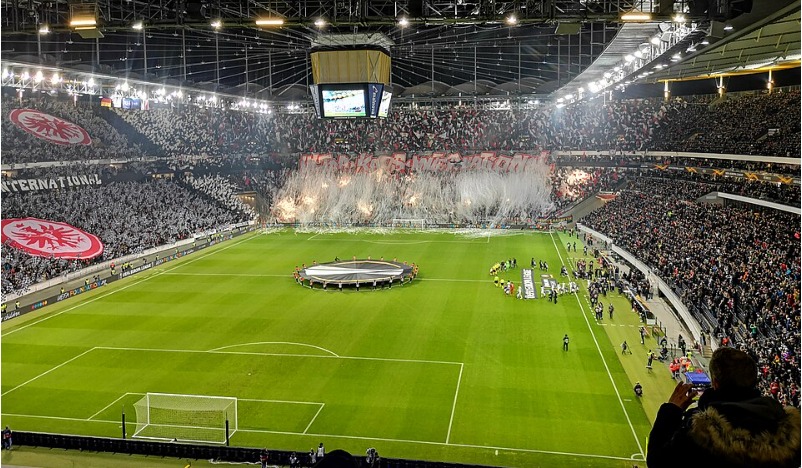
Source: Wikimedia Commons (Msgarak, CC BY-SA 4.0) · inside Deutsche Bank Park during the match against Marseille in November 2018
Crowds and Tickets
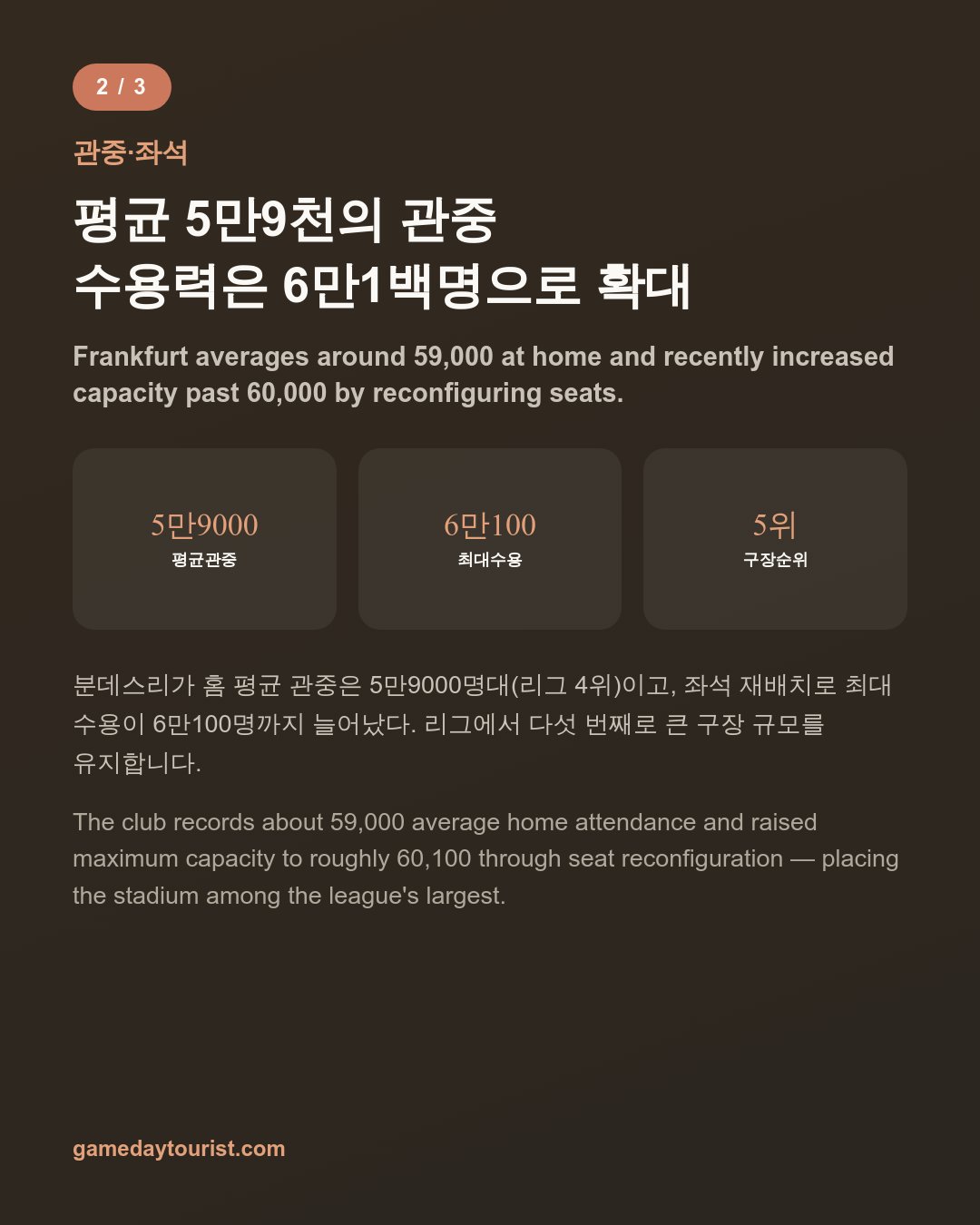
Frankfurt’s home ground, Deutsche Bank Park (formerly the Waldstadion), averaged just under 60,000 fans per home game in the 2025-26 Bundesliga season, fourth in the league.
A recent seating rearrangement also raised the maximum capacity to 60,100, reportedly by shrinking the press area and packing the business seats more tightly to get past the 60,000 mark.
That makes it the fifth-largest ground in the Bundesliga, after Dortmund (81,365), Bayern Munich (75,000), Schalke 04 (62,278), and Stuttgart (60,449).
Tickets are cheapest in the Nordwestkurve standing area at €18 to €24, while seated areas range from €35 to €90 and up.
Almost every seat in the KBO and K League is assigned, so I found it striking that the Bundesliga runs a cheap standing section separately to lower the barrier for newcomers.
Season tickets are reportedly in such demand, with waiting lists so long, that new ones are almost impossible to get, and club membership reached 160,000 as of July 2026.
According to an away-fan guide, the away allocation at this ground is usually around 2,500, and even with standing tickets at about £13 (roughly ₩23,000), many reviews say the view of the pitch is unobstructed from any angle.
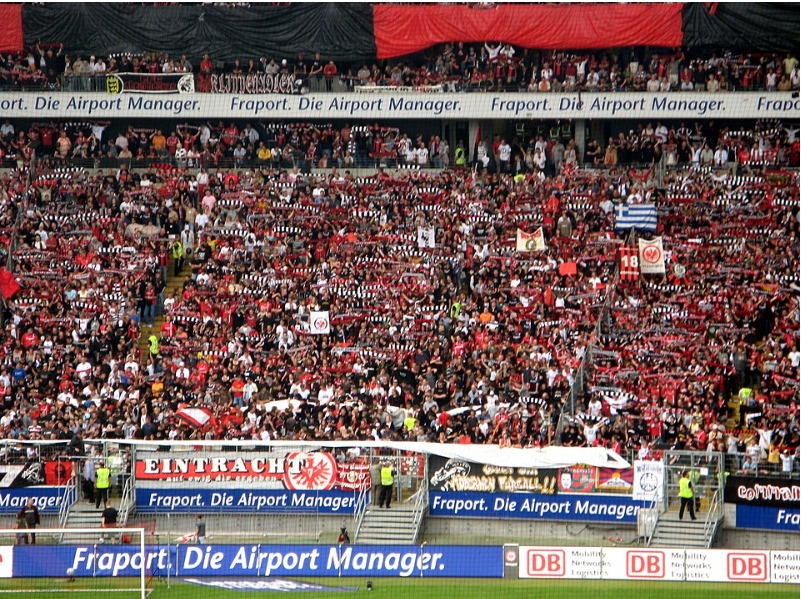
Source: Wikimedia Commons (Dirk Ingo Franke, CC BY-SA 2.0 Germany) · Frankfurt fans holding scarves aloft in the stadium’s west stand (Westkurve)
Space and F&B
Concourse food includes the Bratwurst (German sausage) and pretzels you find at any Bundesliga ground, plus an unusual number of stands selling Frankfurt’s regional apple wine, Äppelwoi.
The Hessenburger, topped with smoked pulled pork and the regional cheese spread Handkäse, also counts as a menu item unique to this stadium.
Contactless payment by phone or smartwatch is the default, and stands in the away-fan area also take cash, Google Pay, and Apple Pay.
One stadium review site rated the food as neither bad nor outstanding, just average, while noting the beer is cold and tasty, and as a marketer I read that kind of averageness as a sign the club keeps F&B turning over steadily without operational risk.
Still, the concourse gets quite crowded at halftime, so traffic flow seems to remain a challenge.
The stadium roof is a retractable structure supported by 44 radial cables and opens or closes completely in 15 to 20 minutes.
The roof itself is pure engineering, so I won’t go into detail, but it clearly has marketing value too, since it protects matchday revenue whatever the weather.
Merchandise and Advertising Inventory
On the shirt, the job platform Indeed is the main front sponsor, while the sleeve goes to DVAG (Deutsche Vermögensberatung), Germany’s largest independent financial advisory firm, for league games, and Generali Deutschland for domestic and international cup competitions.
Splitting the sleeve sponsor between league and cup is notable: one sleeve slot is sold to two advertisers by competition, which is a way of carving up the advertising inventory.
Adidas is the kit supplier, and with the Deutsche Bank logo now also going on the sleeves of the men’s and women’s teams’ training and warm-up kits, this naming-rights extension effectively includes an expansion of the shirt advertising inventory.
Beyond the store inside Deutsche Bank Park, the fan shop runs four official stores around Frankfurt, including the city-center malls MyZeil, Riederwald, and the Main-Taunus-Zentrum (MTZ), and with partner stores in Fulda and Wetzlar and an outlet store at the Isenburg-Zentrum, the retail network is fairly dense.
With a membership of 160,000, a physical store network of this size looks like a natural choice.
Naming Rights — What the Eight-Year Early Extension Means
Looking back at the history of the Deutsche Bank Park name, the ground was originally the Waldstadion, which opened in 1925.
After a 2002-2005 rebuild ahead of the 2006 World Cup, it took the name Commerzbank-Arena under a 2005 naming-rights deal with Commerzbank, and that name lasted 15 years, until 2020.
Then, from July 2020, Deutsche Bank came in as the new naming-rights partner, and the ground became today’s Deutsche Bank Park.
The Deutsche Bank deal was originally due to end with the 2026-27 season, but the two sides extended it eight years early, so it now runs through 2035.
Coincidentally, that period matches the length of the club’s lease on the stadium from the city of Frankfurt.
According to Kicker, the deal is estimated at €100 million or more, but both sides have chosen not to disclose the exact figure.
Deutsche Bank describes the partnership as an anchor investment in Frankfurt and the Rhine-Main region, stressing its contribution to the local economy and jobs.
Deutsche Bank Park does list permanent openings across hospitality, VIP services, content marketing, and event operations, which gave me the impression that a single stadium supports a real share of local employment.
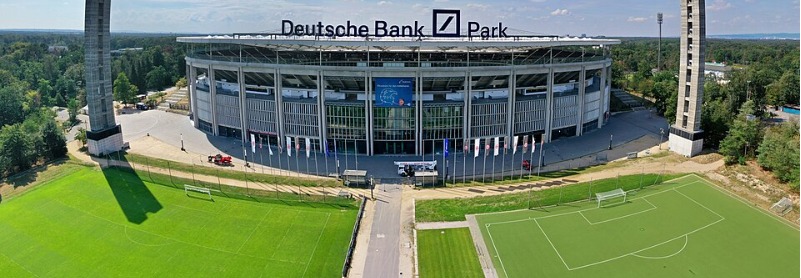
Source: Wikimedia Commons (Patrik Meyer / Deutsche Bank Marketing, free-use license) · aerial view of Deutsche Bank Park
Broadcast Rights and Local Economic Impact
The Bundesliga’s domestic rights for four seasons, 2025-26 through 2028-29, total €4.484 billion, or €1.121 billion per season, split between Sky and DAZN.
That’s about 2% more than the previous deal, with Sky taking the Friday and Saturday exclusive games (including the Saturday-evening big match) and every second-division game, and DAZN taking the Saturday-afternoon simulcast and the Sunday exclusive games.
I also read that the tender had to be reopened once because of an arbitration dispute between DAZN and the DFL, which is a reminder of how tangled the interests around a single set of broadcast rights can be.
The Stadium’s Symbol — Attila, the Live Eagle Mascot
At every Frankfurt home game, a real, live eagle flies across the pitch.
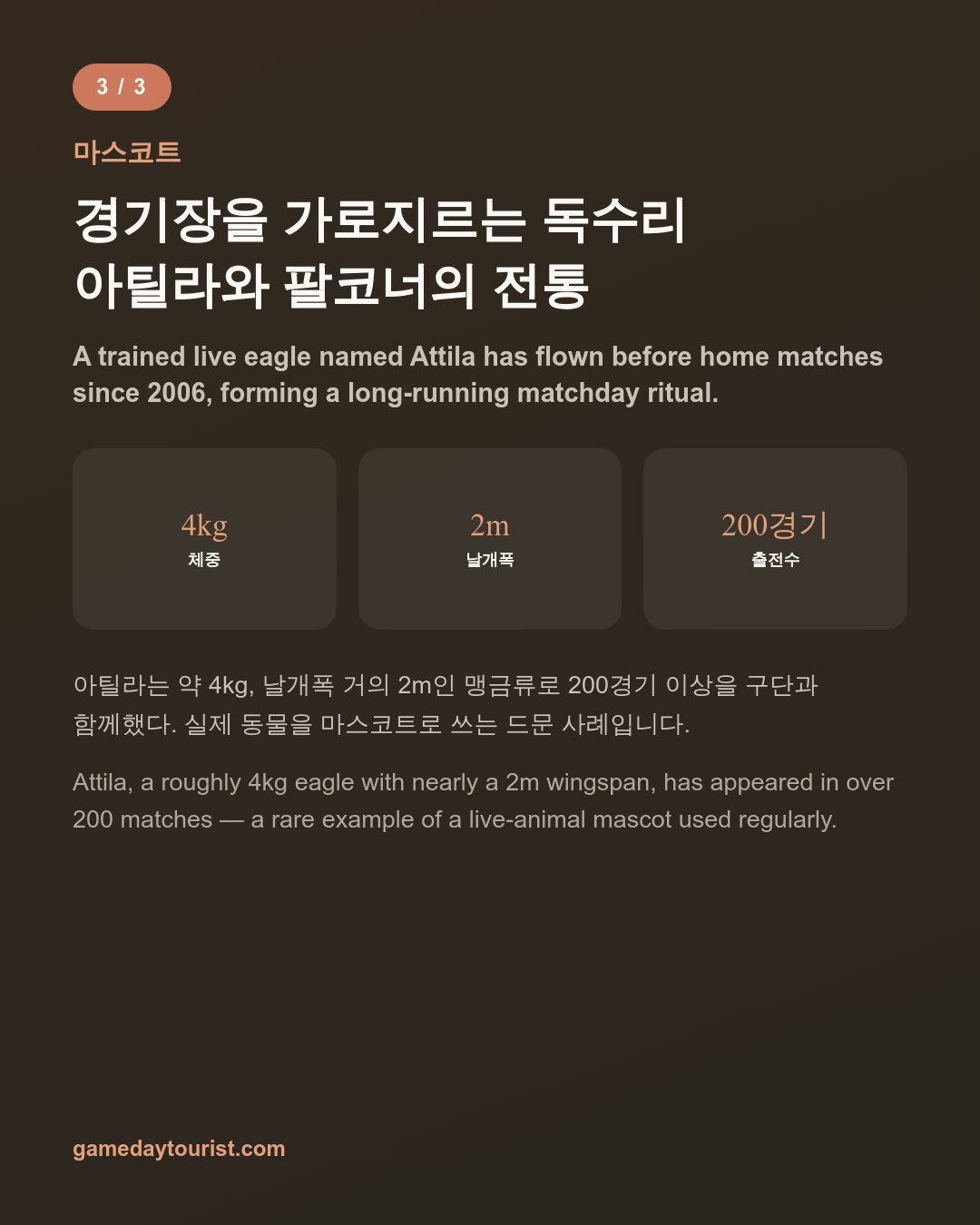
His name is Attila, and since 2006 he has performed a ritual before every home game, taking off from the glove of falconer Norbert Lawitschka and flying toward the stands.
This 4 kg bird of prey with a wingspan of nearly 2 meters is one of only two clubs in the entire Bundesliga that use a live animal as a mascot (the other is Cologne’s Hennes).
Attila and Lawitschka have appeared together in more than 200 matches so far, and they have even shared the stage at the DFB-Pokal final twice.
Most KBO and K League clubs run costumed character mascots, so the approach of training a real bird of prey and bringing it onto the pitch is hard to find in Korea, and as a marketer I found it refreshing.
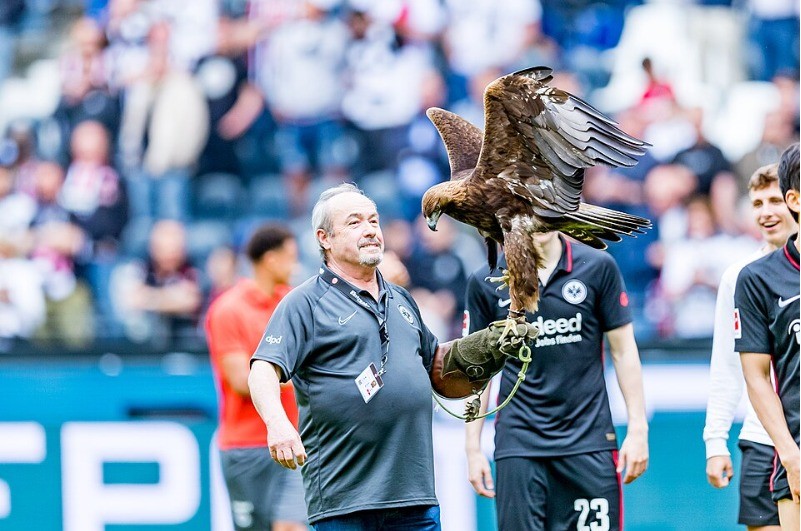
Source: Wikimedia Commons (Sven Mandel, CC BY-SA 4.0) · Attila the eagle on falconer Norbert Lawitschka’s glove before the match against Borussia Mönchengladbach in May 2022
A Look at the KBO and K League
The difference that stood out most while going through the Frankfurt material was the ticket structure.
Most Korean baseball and football grounds run reserved seating apart from open outfield seating, whereas the Bundesliga runs separate low-price standing areas like the Nordwestkurve to lower the entry barrier for newcomers.
At €18 to €24, standing is about half the cheapest seated price, which is clearly an attractive range for first-time football-goers and students.
The way mascots are run is an interesting comparison too.
Korean pro clubs all use costumed characters, and there’s no case of training a real animal for a pre-match ceremony like Attila.
Considering the animal-welfare and safety burden, it isn’t an approach that’s easy to copy, but the story of the same falconer bringing out the same eagle for nearly 20 years builds up as brand equity in itself.
All I set out to look at was one naming-rights contract, but I got a glimpse of how tightly Frankfurt manages its commercial assets: an eight-year extension matched to the stadium lease, a sponsorship scope stretched to the shirt sleeves, and a mascot tradition running for nearly 20 years.
It’s a completely different club from the one Cha Bum-kun played for, but simply finding that connection made this research a pleasure for me personally.
Leave a Reply