Contents · About 11 min read
- Pushed Out by a Tram Line, and December 30, 1928
- Who Celta Vigo Are
- Crowds and Tickets: How You Sell Seats During Construction
- Ownership and the Lease: €800,000 a Year for 50 Years
- Tours and F&B: The Museum Started Making Money First
- World Cup 2030: A Door That Is Still Open
- Comparing With Seoul’s Gocheok Sky Dome
📱 View as card news

Just over €800,000 a year. That is where the fee Celta Vigo will pay the city of Vigo, the owner of its home ground, starts, and the contract runs for a full 50 years.
When I hear stadium news, I usually go looking for new-build plans or the price of naming rights (the right to attach a company’s name to a facility), but this Celta story interested me because it reshuffles who owns the building and who earns money inside it.
As a working marketer, I wanted to understand that structure, so I lined up club announcements, local reports and a visitor guide, one after another. The ground has been called ABANCA Balaídos since 2018, but in this piece I will simply say Balaídos.
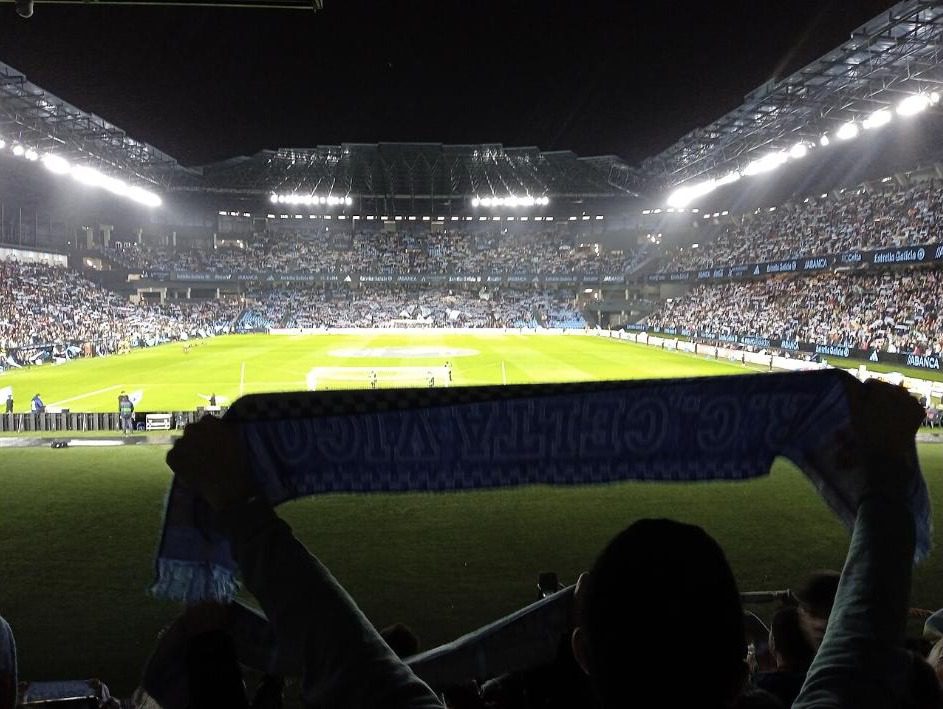
Photo: Estevoaei · Source: Wikimedia Commons · License: CC BY-SA 4.0 · Taken January 3, 2024, a fan holding up a Celta scarf in a stadium full of supporters at night
Pushed Out by a Tram Line, and December 30, 1928
Balaídos was not the move Celta wanted. According to LaLiga’s history of the ground, Coia, the ground the club had used since its founding, was due to be demolished for a new tram line in Vigo, and today’s Balaídos was built as the alternative.
The same page says the name comes from an old place name, abeladíos, meaning a place full of hazel trees, but I could confirm this etymology in that one article only, so I note it as a reference.
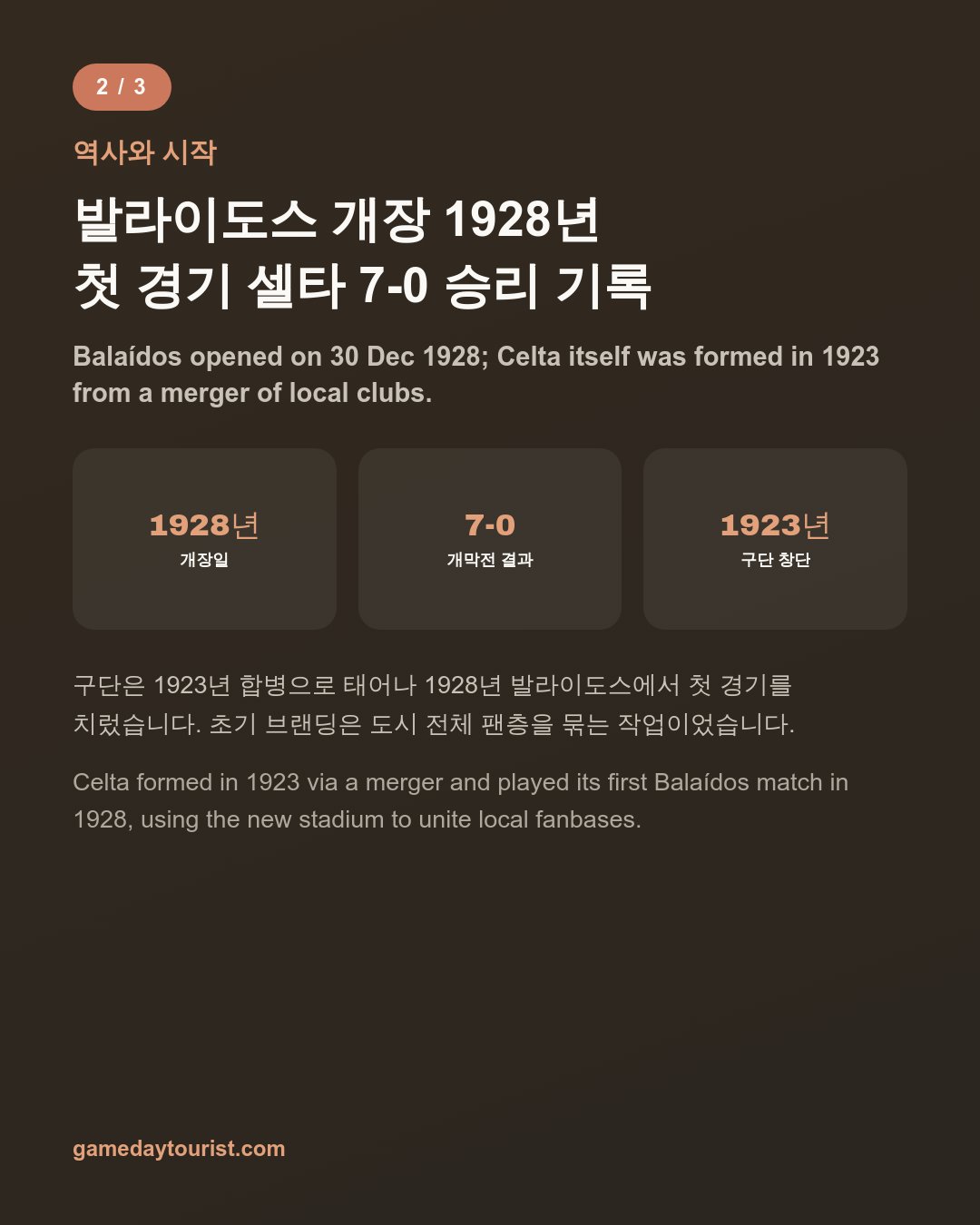
The opening date was December 30, 1928, and Celta are recorded as beating Real Unión de Irún 7-0 in the first match. Another LaLiga article says 6-0, but the history page and English Wikipedia say 7-0, so I went with 7-0.
The club’s own beginning is interesting too. English Wikipedia says Celta was born on August 23, 1923 from the merger of two clubs, Real Vigo Sporting and Real Fortuna.
The central figure behind that merger is named as the sports journalist Manuel de Castro, nicknamed Hándicap, and his Wikipedia entry says that after a first attempt failed in 1915 he brought the two clubs to an agreement in 1923.
The photo below, posted on Wikimedia Commons, dates from around 1928 and, going by the file title, shows Hándicap (second from the left) with colleagues unrolling plans on the Balaídos site before anything had been built. From a marketer’s point of view, tying two fan bases into one team and creating a rallying point for the whole city was this club’s first branding job.
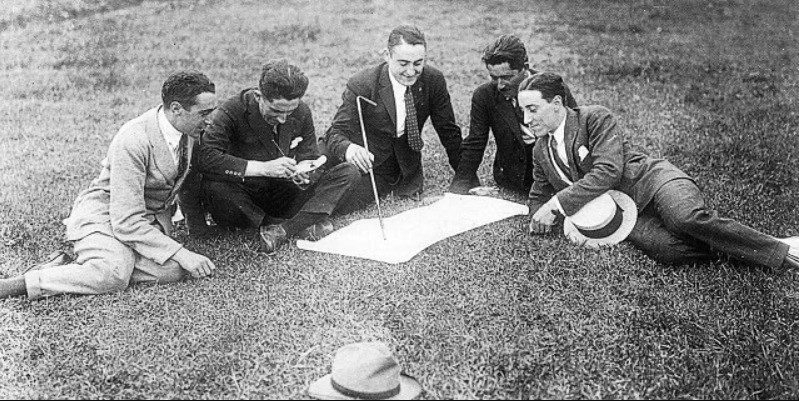
Photo: Unknown author · Source: Wikimedia Commons (original source given as Moiceleste.com) · License: Public domain · Taken around 1928, an old photo
Who Celta Vigo Are
Celta’s sky blue and white are said to stand for the Galician flag, and Wikipedia says the earliest home kit was a red shirt with black shorts and blue socks.
In 2025-26, under coach Claudio Giráldez, they finished sixth in La Liga (54 points, 14 wins, 12 draws, 12 losses). In the Europa League they came 16th in the league phase, got through the playoff, beat PAOK (3-1 on aggregate) and Lyon (3-1 on aggregate) in turn, then lost to Freiburg 6-1 on aggregate in the quarter-finals (per the season article).
Borja Iglesias was the top scorer with 14 league goals and 18 in all competitions. Thanks to that, Celta are back in the Europa League in 2026-27, as the club said in its kit collection announcement.
On October 8, when I wrote this, LaLiga’s official table had them 14th with 7 points from 7 games.
What catches the eye first in that same announcement is the kit in the photo. The Estrella Galicia 0,0 (alcohol-free) logo sits right across the front of the sky blue home shirt and the navy away shirt, and the club says it has been together with this Galician beer brand for more than 15 years (the term and amount are undisclosed).
The front of the shirt belongs to a Galician beer and the name of the ground to a Galician bank, ABANCA, which reads as a classic locally rooted model in which two regional companies share the club’s face.

Photo: RC Celta official promotional image · Source: rccelta.es · Released July 1, 2026, the 2026-27 home and away kits
What visitors should know is laid out in an English-language ground guide. The most passionate home fans sit in the Grada Gol, behind a goal, and a group of ultras called the Celtarras leads the singing.
Matches rarely sell out, so buying at the gate on the day is usually possible, and prices run from about €20 at the top end of the range up to about €110 for a VIP box. The guide also says the ground is too far to walk to and parking is very limited, so it recommends a bus or taxi.
However, the Grada Gol is being rebuilt right now, so it is safer to check the club’s guidance on seating in that area before you go.
Crowds and Tickets: How You Sell Seats During Construction
For rounds 1 to 18 of 2024-25, Balaídos saw attendance rise 28.4% on the same stretch of the previous season, the biggest increase of any top-flight ground, against 10.9% for the league as a whole (a local outlet’s report, which does not give average attendance).
With that momentum, the club was about to rebuild the Grada Gol, the last of the old stands. A May 7, 2025 report says the club told supporters it would run 4,080 fewer seats than usual next season because of the rebuild, opened a waiting list for new season tickets, and warned that very few new places would be available.
Once the rebuild is done, the stand will gain 2,400 seats, and the membership card (the carné celtista) costs €30 to €80 depending on type and includes a €10 voucher.
The construction timeline and capacity differ a little from report to report. El Español’s June 5 report says 792 seats would go into the first five rows of the lower Grada Gol from June 15, with completion targeted for early 2027, while an August report says 791 permanent seats were installed for the start of the new season, with a reopening expected within the year.
The ground’s capacity also varies by source, at 22,900 (StadiumDB, April), 24,870 (Wikipedia) and 31,800 (the ground guide), so I did not pin it to a single number in this piece.
As a marketer, I found it oddly striking that a ground where you can normally buy at the gate shuts off new sign-ups during a construction season and manages demand with a waiting list. When seats shrink, what the seller gets to decide is less the price than who gets to buy first.
Ownership and the Lease: €800,000 a Year for 50 Years
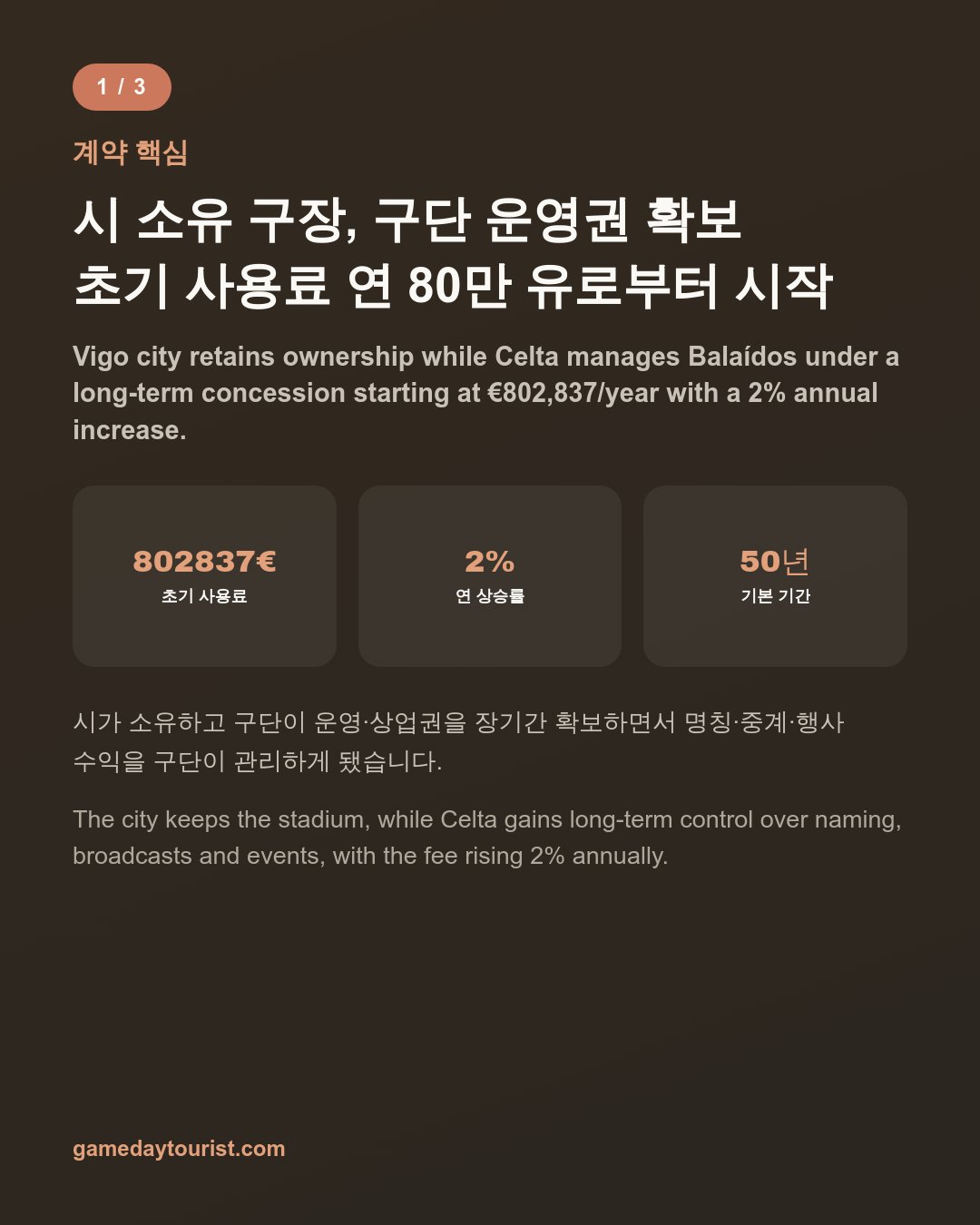
Balaídos is owned by the city of Vigo, and Celta operate it. According to the club’s official announcement, in April 2026 club president Marián Mouriño and Vigo mayor Abel Caballero formalised the process for a new usage contract.
The term is an initial 50 years, extendable to a maximum of 75, and the old contract was due to expire in 2034. The mayor explained that it would be confirmed automatically if no objections came within a month, and the club president said new generations would be able to keep enjoying Celta at Balaídos.
Football Ground Guide’s September 8 report says it received final approval, with the economic and administrative clauses passing without objection.
The money side is laid out by StadiumDB. The fee starts at €802,837 a year in the first year and rises 2% annually, reaching close to €2.2 million in 2076 and more than €3.5 million in 2101 (which matches 2% compounded over 50 and 75 years).
It can also change with European qualification, staying up or going down, investment in the ground, concerts and so on. Football Ground Guide gives the same amount as €802,800, so only the last digits differ.
Football Ground Guide sums up the contract as giving Celta the right to host non-football events, to commercialise audiovisual rights and to give the ground a commercial name, while the city keeps rights over the surrounding areas.
On the naming side, the ABANCA deal of June 2018 was the first naming-rights agreement. It ran for at least 10 years and the amount was not disclosed, and the coverage at the time also reported an expectation that new corporate hospitality areas would bring in about €6 million a year in extra income, and that the total rebuild cost had reached €40 million, above the first estimate of under €30 million.
From a marketer’s viewpoint, the heart of this 50-year contract is less the fee itself than that the club can now put the ground’s name, broadcast content and event income into one long-term plan. The fact that the fee is designed to move up and down with results also looks like a structure in which the city and the club share the risk.
Tours and F&B: The Museum Started Making Money First
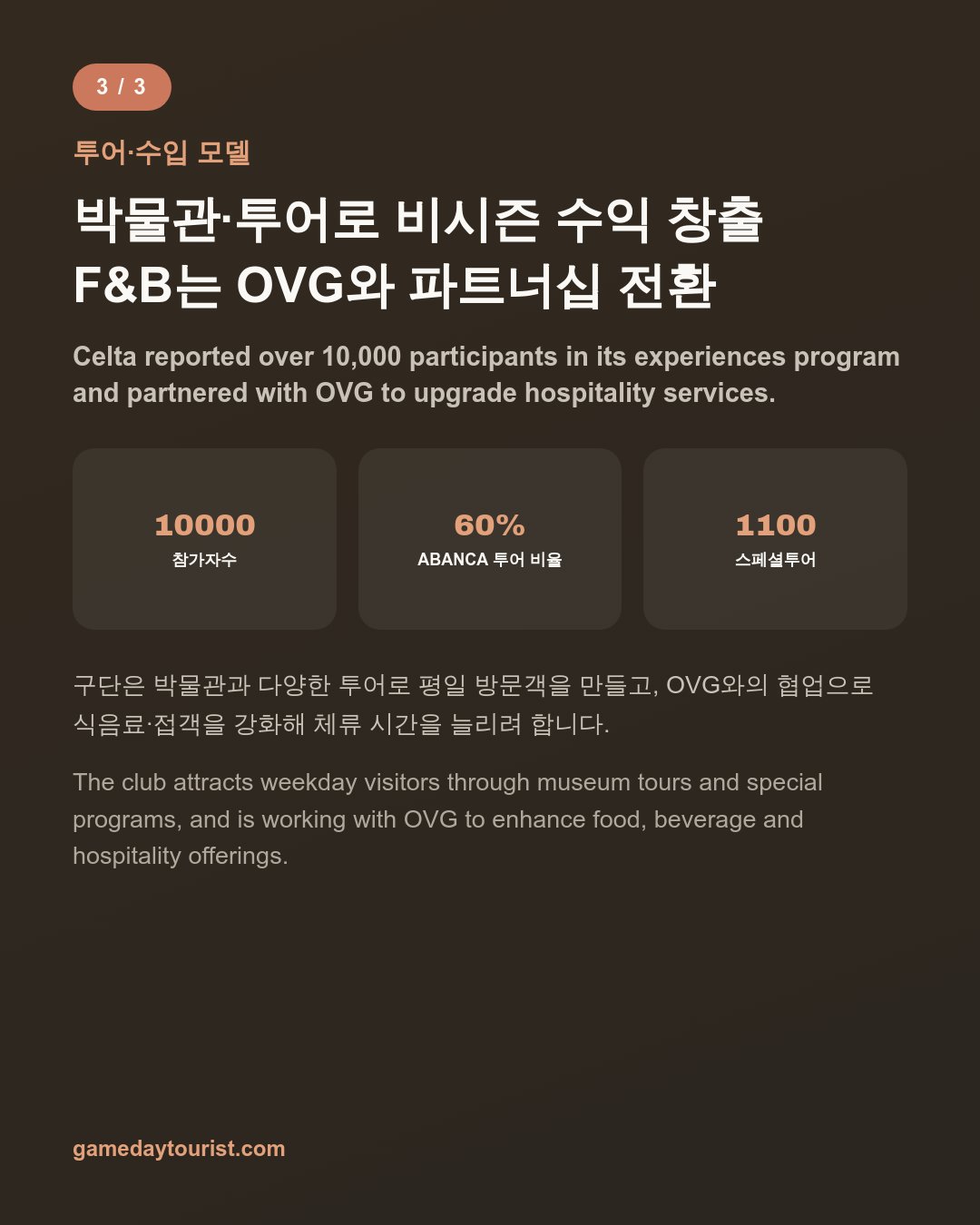
In a club announcement, Celta said more than 10,000 people took part in its ground experience programme (the Celtista Area) in its first year, 2025-26, and about 60% of them did the ABANCA Balaídos tour.
Special tours combining the night tour, the tour with club legends and the pre-European-match tour drew more than 1,100 people, matchday experiences (flag bearers, escort kids, pre-match tours, penalty shootouts on the pitch and so on) nearly 2,000, and the school programme about 1,000. These figures were compiled and published by the club itself.
On the food and drink side, the club teamed up with an outside specialist. According to an August 2026 announcement, Celta chose the hospitality arm of Oak View Group (OVG) as its partner to reshape the ground’s food, beverage and hospitality business, and it is OVG Hospitality’s first project in Spain.
The contract length and the investment were not disclosed, and the partnership could widen to the club’s training-ground project, Celta360.
Building weekday visitors through the museum and tours and stretching their stay with food and drink reads as a design meant to make the ground earn money even on days with no match, as the museum exterior in the photo seems to symbolise.
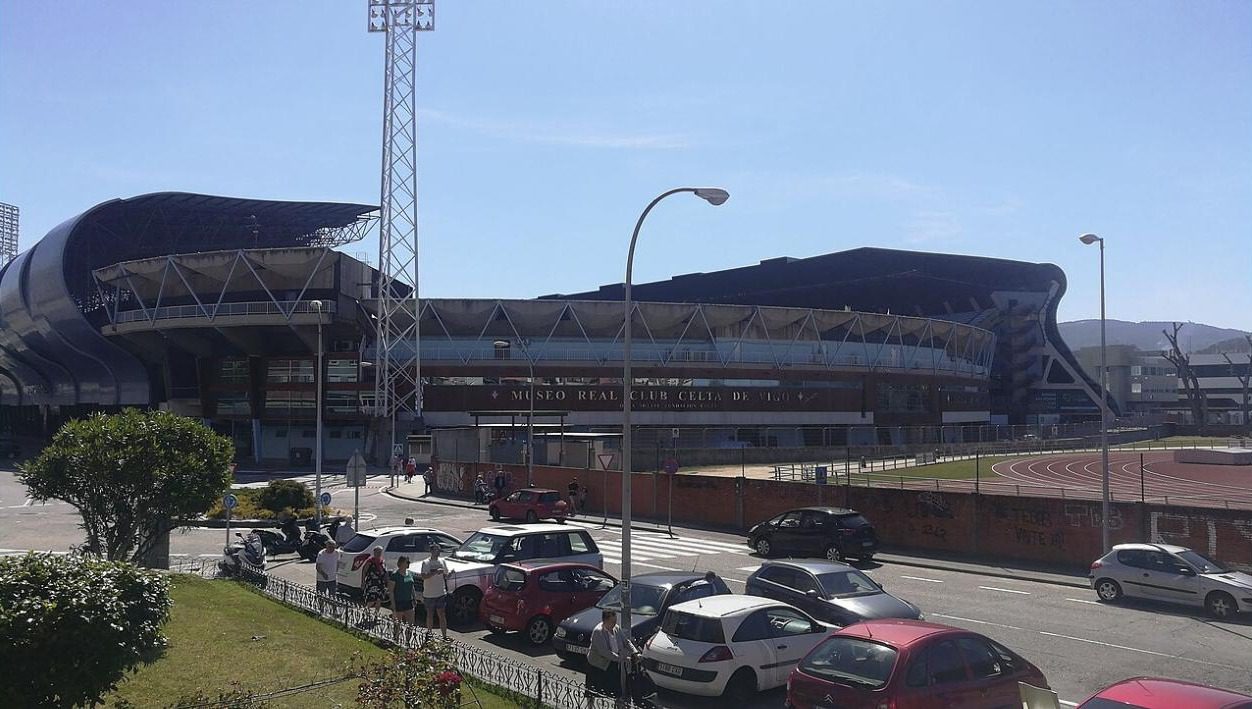
Photo: Rion Tools · Source: Wikimedia Commons · License: CC BY-SA 4.0 · Taken June 2, 2019, the exterior of Balaídos with the club museum sign
World Cup 2030: A Door That Is Still Open
Vigo has worked to get its name on the 2030 World Cup list, but it has not been smooth. In July 2024, a local report said Balaídos had been left off the list of 11 grounds Spain would submit to FIFA.
Then a March 26, 2026 report said the Spanish football federation (RFEF) planned to ask FIFA to include Vigo, and StadiumDB in January 2026 said the city had floated a plan to grow the main stand (the Tribuna) from about 5,500 to 16,000 seats, giving about 43,000 together with the Grada Gol.
Mayor Caballero’s position is that the three bodies (Vigo city, the Galician government and the Pontevedra provincial council) should each pay a third of the cost, but the opposition criticised the fact that the design, timetable and budget have not been settled.
The most recent news is the EFE report of September 30. RFEF president Rafael Louzán said Valencia and Vigo could fill the remaining places on Spain’s list of 11 grounds, and the mayor welcomed it.
Louzán put FIFA’s minimum capacity at 41,000, which differs from the 43,000 in the March report. He explained that once the first phase of the expansion is done the ground will hold just over 30,000, and a second phase adding more than 11,000 is still needed.
As of October 12, I could not find any final confirmation from FIFA. StadiumDB said the city explains that this expansion would help not only the World Cup but also big events such as concerts.
Looking at the ground’s concert history on Wikipedia (Madonna in 1990, the Rolling Stones in 1998, Muse in 2022 and others), event income is a convincing option. But Football Ground Guide also reports that the pitch was replaced for about €1 million after a Guns N’ Roses concert in 2023, so it needs to be remembered that event income comes with pitch upkeep costs.
Comparing With Seoul’s Gocheok Sky Dome
Seoul’s Gocheok Sky Dome also has a city-owned ground used by a club. According to a Seoul Shinmun report (November 28, 2024), advertising at Gocheok is run directly by the Kiwoom Heroes under a private contract (one made without competitive bidding), and the advertising facility fee in Seoul’s 2025 budget is about ₩3 billion.
In the same article a city councillor pointed out that Gocheok’s advertising revenue is about a quarter of Jamsil’s, and explained that Jamsil’s 2025 advertising fee is about ₩9.3 billion and the operator is chosen by competitive bidding. It was also raised that ₩13.5 billion of Seoul’s budget still went to Gocheok in 2024, its tenth year since opening.
According to a twig24 report of December 28, 2025, Seoul plans to start selling naming rights with Sangam World Cup Stadium and Gocheok Sky Dome. After a valuation study (₩100 million in the 2026 budget), it said it would offer Gocheok to Kiwoom first and sell to other companies if that fails.
At Balaídos, the club pays a base fee (about €800,000 a year, rising 2% annually and varying with some conditions) and in exchange holds the right to handle a commercial name and broadcast content within a long contract, whereas at Gocheok the city is still at the stage of sorting out advertising fees and naming rights.
It is hard to say which of the two structures is better, but it does seem clear that the starting line is different when it comes to whether a club can make plans on a scale of decades.
What I felt anew while writing up Balaídos is that even when names change, what lasts is the length of the contract. ABANCA’s name will come and go in ten-year steps, but Celta can now use that spot well beyond 2076.
Whether it is the World Cup or the Europa League, what kind of matches and visitors will fill those 50 years is homework for the club to work through.
Leave a Reply