Contents · About 12 min read
- The club that almost became “Osaka Jaws,” and a ¥14 billion fundraising drive that began in a one-third-full stand
- About the team: from a Matsushita company football club to two J1 titles
- How a donation-funded stadium is structured: the city owns it, Gamba runs it
- Attendance and tickets: 2025, the first season to average over 30,000
- Space use, F&B and merchandise: how a close stand becomes revenue
- Ad inventory and naming rights: ¥200 million a year, with the contract running to the end of 2027
- A comparison with the KBO and K League: ₩51.5 billion of tax money vs. ¥14 billion of donations
📱 View as card news

When a club in Korea starts talking about a new stadium, the conversation usually begins and ends with “who pays for it.” Yet in Suita, north of Osaka, there is a football-only stadium built with money from more than 34,000 individuals and some 700 companies.
It is Gamba Osaka’s home, Panasonic Stadium Suita (nicknamed “Panasta”). As a working marketer, I decided to look at how this stadium’s business is structured.
First, a disclosure. I have never been to this stadium myself.
This piece is built from reading official materials from the club and the city of Suita, Japanese media coverage and local visitors’ reviews side by side, so I’ve noted a source and a date next to each figure. Where outlets disagree on a number, I went with the club’s and public bodies’ announcements.
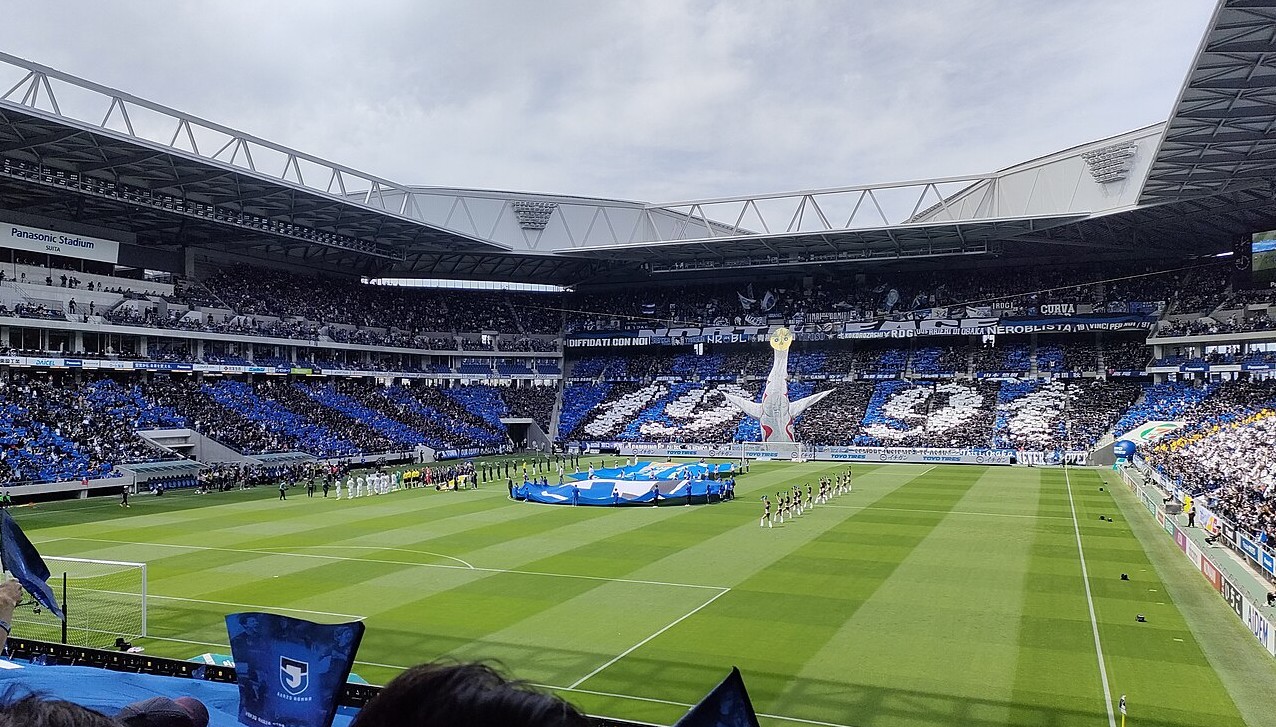
Photo: Agenasu, Wikimedia Commons (CC0, public domain dedication) · Osaka derby (Gamba vs. Cerezo), May 3, 2023
The club that almost became “Osaka Jaws,” and a ¥14 billion fundraising drive that began in a one-third-full stand
“Gamba” means “leg” in Italian and overlaps in feel with the Japanese “ganbaru” (頑張る, to do one’s best), according to the club’s official introduction.
But there’s a story that around 1992, when the club’s name was being chosen, a completely different name was the favorite. The Japanese Wikipedia says that, with the timing overlapping parent company Matsushita (now Panasonic) buying Universal Pictures, “Osaka Jaws,” combining Spielberg’s film “Jaws” with Osaka Castle, was a leading candidate until it fell through over a trademark issue.
This is not something the club has confirmed but an encyclopedia-level anecdote, so I’d take it lightly. Still, it hints at how Japanese companies saw pro football.
The stadium’s starting point was far more down to earth. According to the club’s official 10th-anniversary site, “The Story of Panasta”, the idea of a new stadium first appeared in a medium- to long-term plan around 2000, and in 2006 the Asian Football Confederation (AFC) told the club it could no longer use Expo Commemorative Stadium, then about 40 years old, as an AFC Champions League (ACL) home ground.
The decisive moment came in 2008. Kikuo Kanamori, who became president that May, went in March, just before taking office, to an ACL opener at that stadium and was shocked to find only about a third of the roughly 21,000-capacity stands filled.
It was 65 meters from behind the goal to the pitch and 45 meters even from the main stand (an athletics track ran around the field), and there were reportedly too few toilets and too little roof.
The official site says the answer came from the accounting department head, Masami Ogawa. A fundraising body would collect donations and build the stadium, donate the finished public stadium to the local government, and Gamba would run it.
The selling point was that donations made by companies are recognized as expenses (deductible losses) in corporate tax calculations. The plan was announced in July 2009 and the fundraising body was set up in March 2010, with the Kansai Economic Federation, the Japan Football Association, the J.League and Gamba taking part, according to the Suita city stadium site.
President Kanamori reportedly hoped the stadium would become something that unites people’s hearts, like Koshien does for baseball.
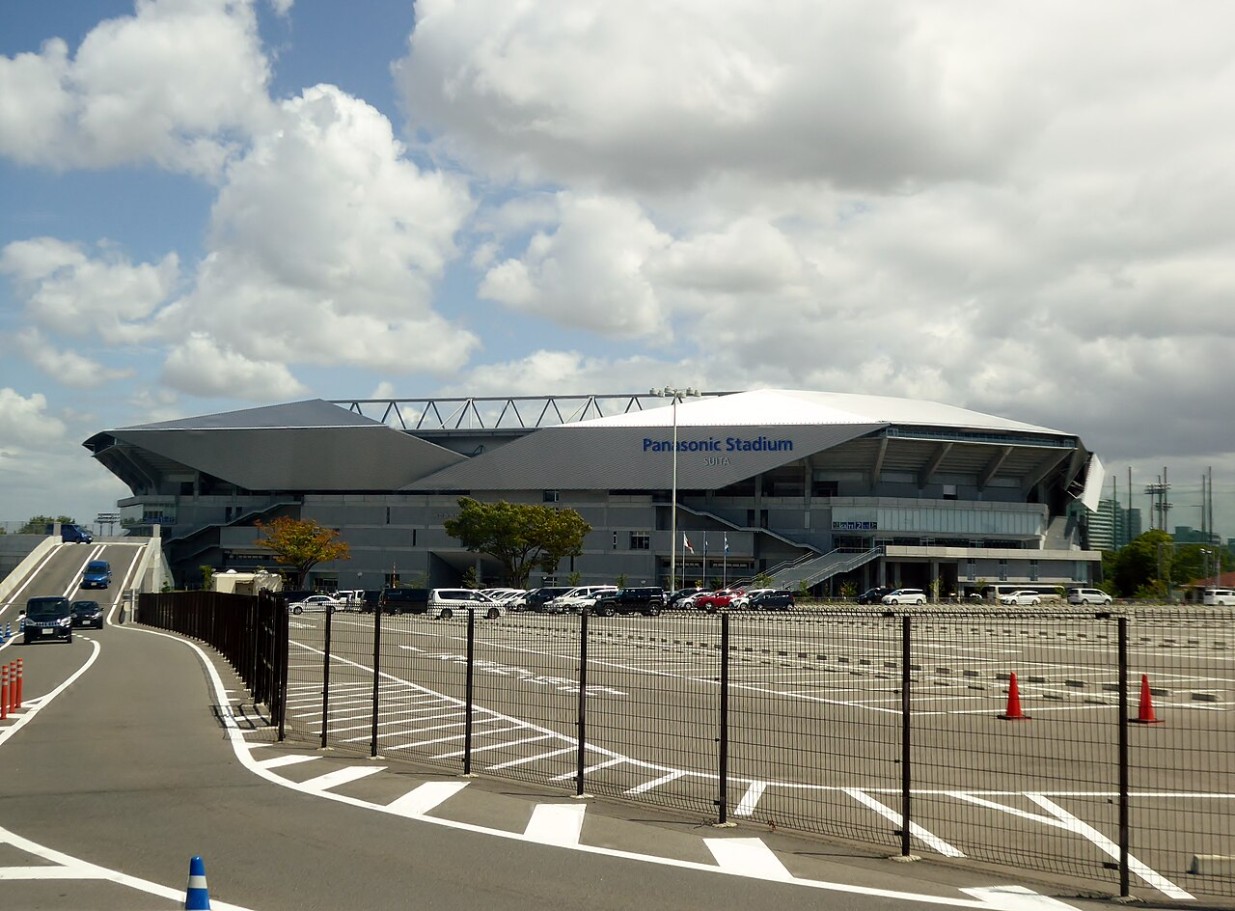
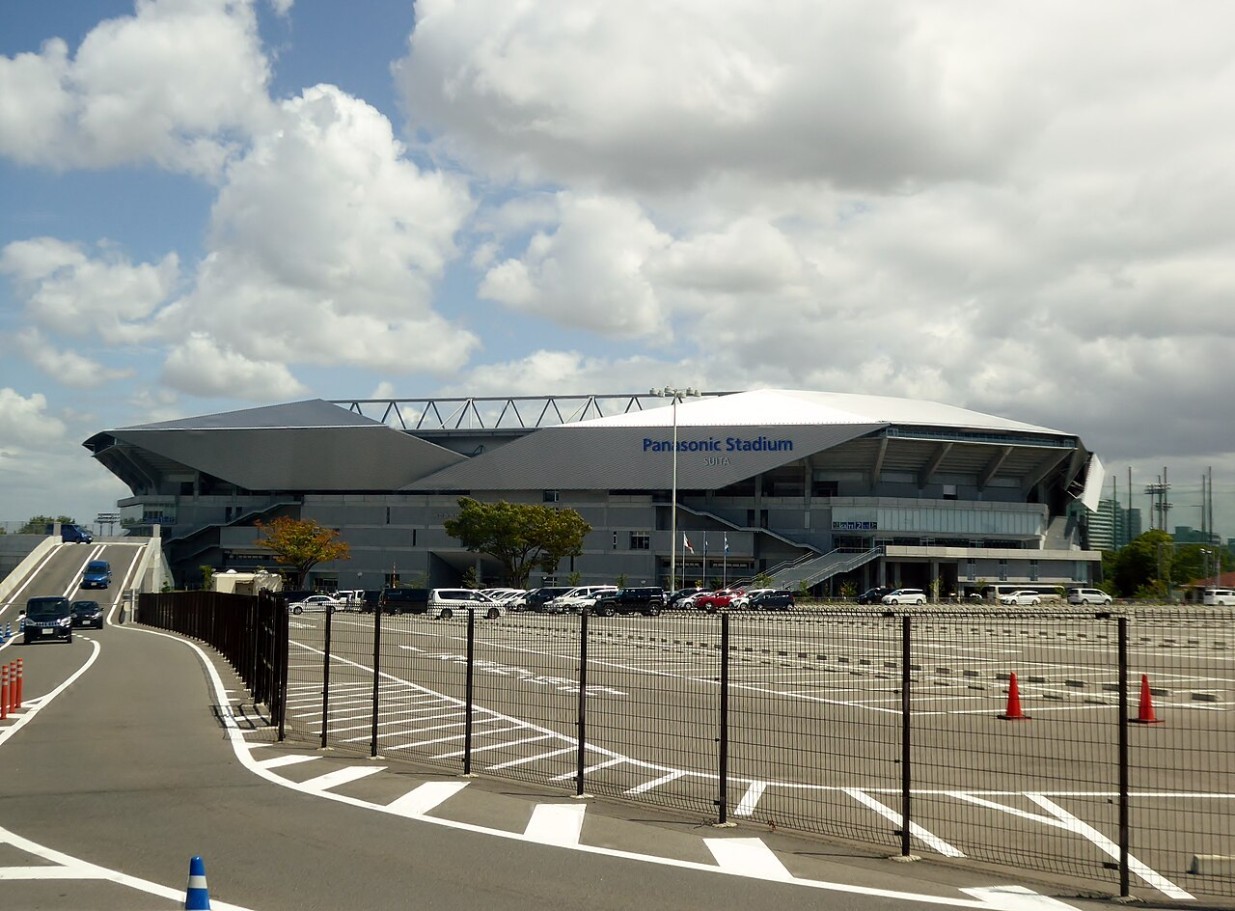
Photo: Tokumeigakarinoaoshima, Wikimedia Commons (CC BY-SA 4.0) · Taken August 25, 2018, the front exterior of the donation-funded stadium
What spoke to me most was this sequence. What first set the club in motion wasn’t an architectural spec but the discomfort of an executive facing empty stands, and that discomfort was resolved through a “donation design” rather than a request for tax money.
When we talk about building a new stadium, we reach for blueprints first, but this stadium began in front of empty seats.
About the team: from a Matsushita company football club to two J1 titles
Gamba Osaka’s roots are in the Matsushita Electric Industrial football club, founded in 1980. It moved up to the second division of the Japan Soccer League (JSL) in 1984 and the first in 1986, and when the name “Panasonic Gamba Osaka” was adopted in 1992, it became one of the ten founding clubs of the J.League, which began the following year, the so-called “Original 10.”
It won the J1 in 2005 and 2014 and the Asian Champions League in 2008, and in 2014 it took a domestic treble of the J1, League Cup and Emperor’s Cup. Its five Emperor’s Cup wins came in 1990, 2008, 2009, 2014 and 2015.
These honors are compiled based on the Japanese Wikipedia.
The ownership structure also stands out. The club’s official overview gives it as follows.
The largest shareholder of the operating company, Gamba Osaka Co., Ltd., is Panasonic Sports (70%), with Kansai Electric Power, Osaka Gas and West Japan Railway (JR West) holding 10% each. The home towns are seven cities: Suita, Toyonaka, Ibaraki, Takatsuki, Ikeda, Settsu and Minoh.
Having three companies from the Kansai region’s everyday infrastructure of electricity, gas and rail as shareholders shows how solid the base for community-rooted marketing is.
Recent form is, frankly, disappointing. The 2025 J1 season ended in 9th place (17 wins, 6 draws, 15 losses, 57 points), and in 2026, as the J.League moves to an autumn-to-spring calendar, a transitional special tournament, the “Hyakunen Kōsō League” (with no relegation), was held, and German coach Jens Wissing’s tenure began.
According to Footballista, the first official match was a penalty-shootout win over Cerezo in the Osaka derby opener on February 10. The new 2026-27 season stands at 1 win, 3 draws and 4 losses (6 points) in 8 games, 16th, as of September 21, and the team has beaten Tokushima Vortis 5-0 in the Emperor’s Cup third round on September 23 (Football Channel).
For reference, no Korean player is confirmed on the 2026 squad.
Pooling local visitor reviews, the standard way to reach the stadium is a walk of about 15 minutes from Banpaku-kinen-koen (Expo Park) Station on the Osaka Monorail. A matchday guide advises leaving early or spending time at the nearby large shopping mall EXPOCITY, because the station gets extremely crowded right after the match and entry restrictions are imposed.
The facility itself gets such strong praise that one local matchday blogger wrote that on a first visit “I wondered if this was really Japan.” Reviews say the pitch feels close even from the upper seats, and monitors on the pillars mean you never lose track of the game from anywhere.
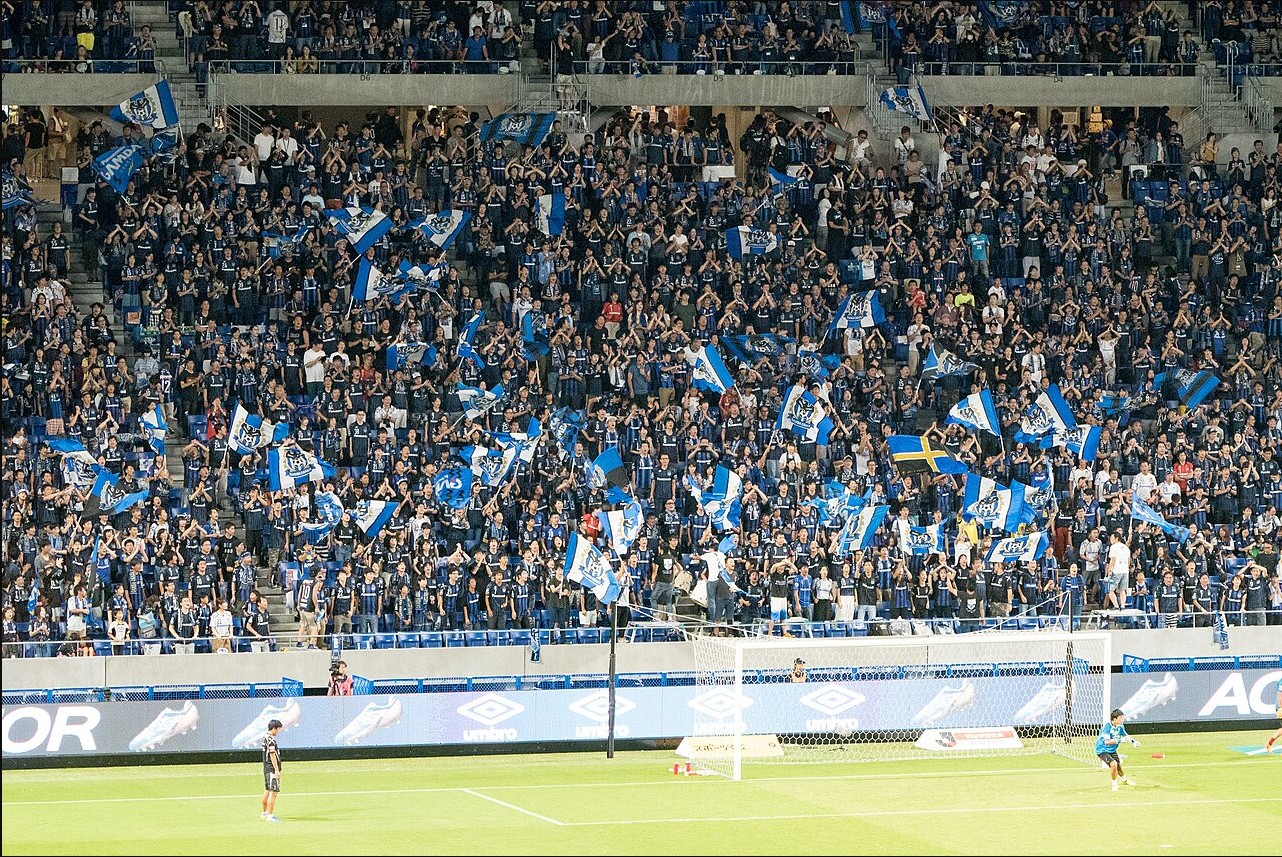
Photo: TAKA@P.P.R.S, Wikimedia Commons (CC BY-SA 2.0) · Taken at J1 Round 25 (Gamba vs. Kobe), September 9, 2017
How a donation-funded stadium is structured: the city owns it, Gamba runs it
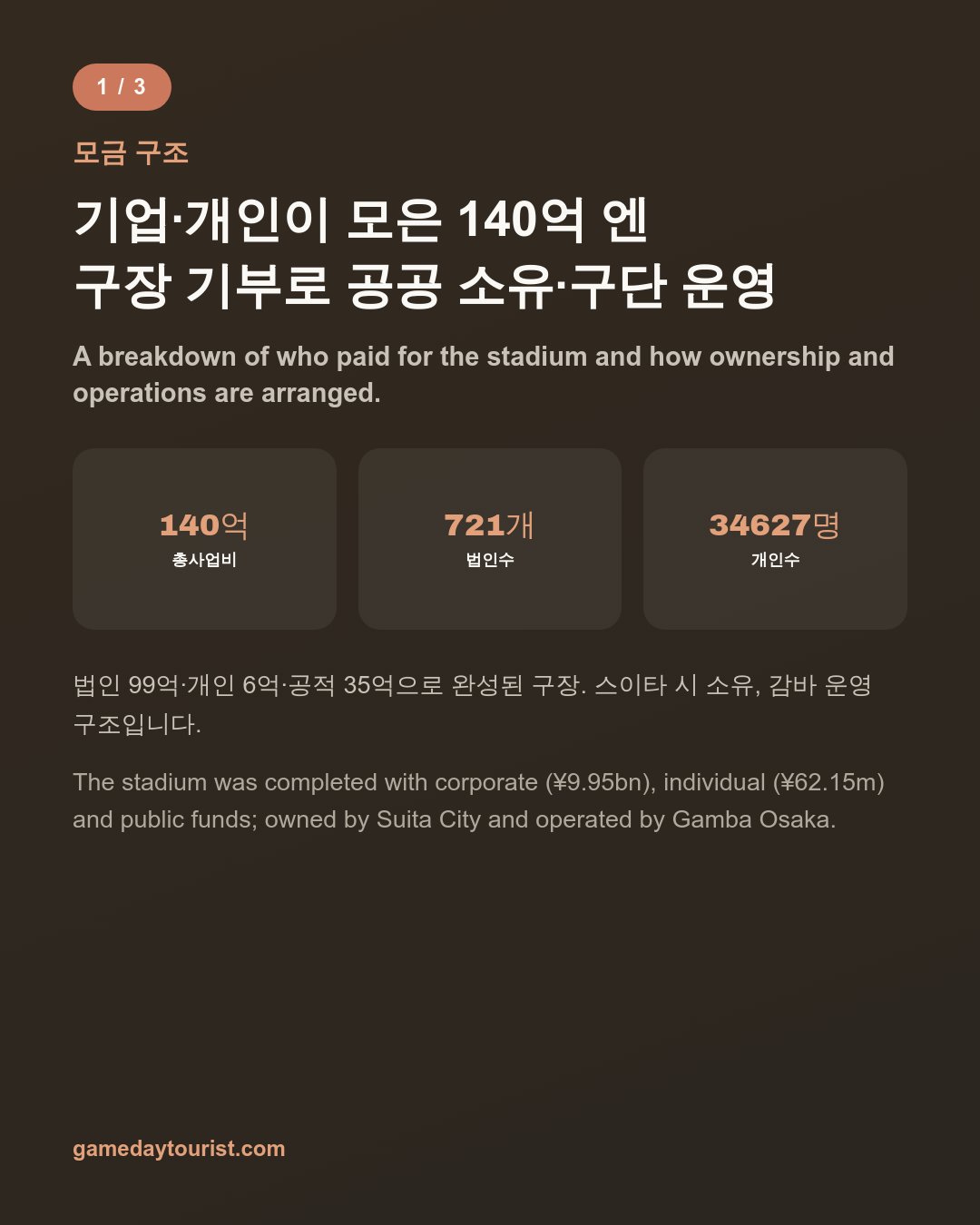
The total project cost was ¥14.0857 billion. A public-facility operations document compiled by a club employee (posted by MEXT) and the Japanese Wikipedia carry the same breakdown.
Corporate donations were ¥9.9502 billion from 721 companies, individual donations were ¥622.15 million from 34,627 people, and the remaining ¥3.5133 billion was public support such as sports lottery grants. That works out to roughly 71% from companies, 4% from individuals and 25% from public support.
Running the numbers myself, the average is about ¥13.8 million per company and about ¥18,000 per individual. The numbers confirm a structure built not on a few big donors but on a great many small contributions.
The finished stadium was donated to the city of Suita and became a public facility. The owner is the city of Suita, and the operator contracted to run the facility (the designated manager) is Gamba Osaka.
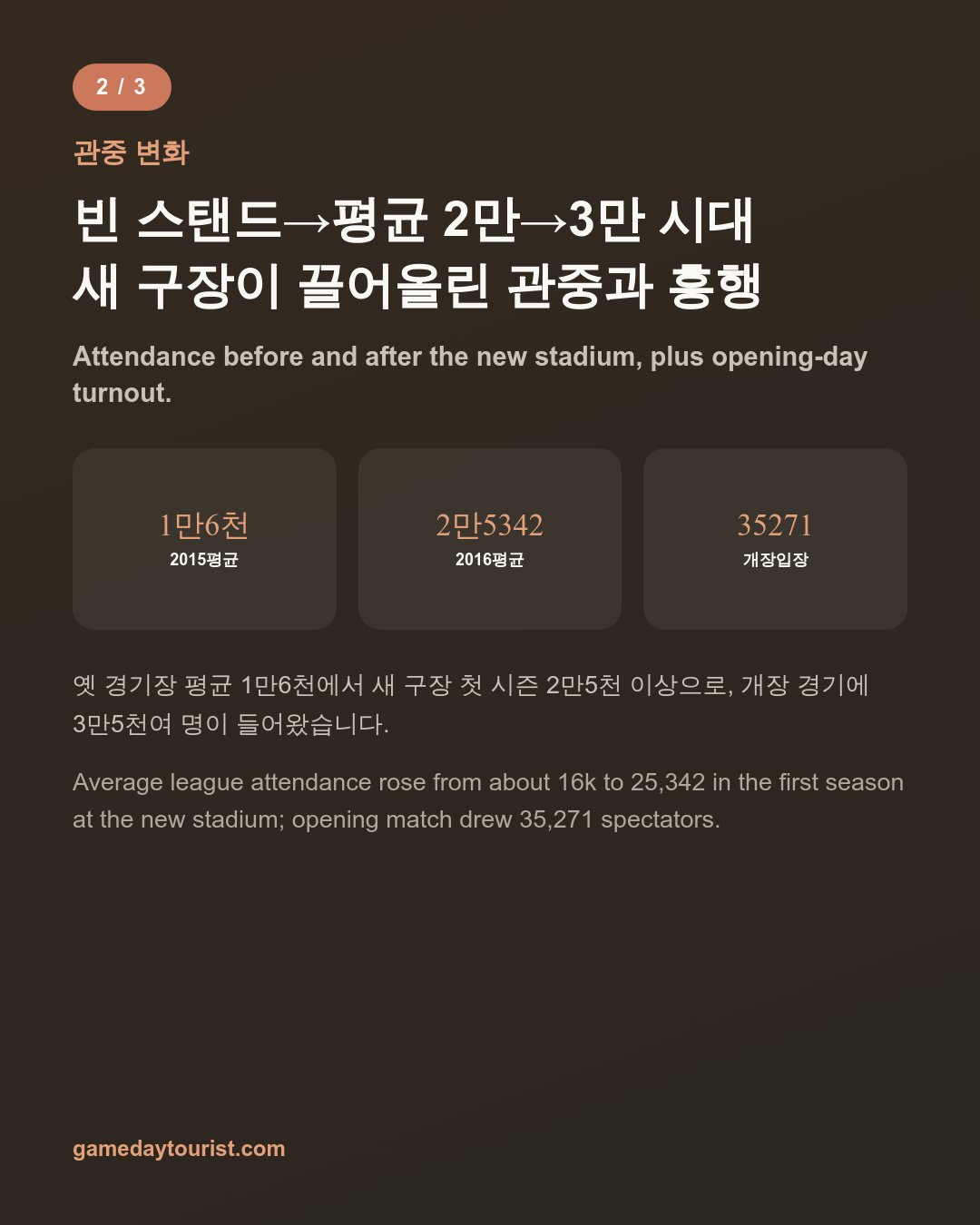
The core of this model is that it is a public facility from which the club can directly earn operating revenue. The stadium was completed in October 2015, and 35,271 people reportedly came to the opening match in February 2016 (per Japanese Wikipedia).
The club, in effect, turned local residents into both “supporters” and “customers” at once. The Suita city stadium site says 4,394 donors attended the completion ceremony, and I think the attachment of people who pay again to enter a stadium with their own name on it is probably of a different kind from that of ordinary spectators.
Attendance and tickets: 2025, the first season to average over 30,000
By the club’s announcement, 2025 J1 home attendance over 19 matches was 570,135, a club record, and the average of 30,007 topped 30,000 for the first time in club history. That’s about three-quarters occupancy of a stadium of roughly 40,000.
For reference, some articles give the average as 37,000, but dividing the club’s announced total of 570,135 by 19 matches gives 30,007, so this piece follows the club’s figure.
Matchday income moved too. Fiscal 2024 matchday income was ¥1.185 billion (Toyo Keizai), and the 2025 annual report reportedly showed an increase of about 23% year over year.
The new stadium’s effect showed up in the numbers in its very first year. In the MEXT-posted document, in 2015, the final year at the old Expo Commemorative Stadium, league average attendance was about 16,000 and matchday income ¥790 million, but in 2016, the first season at the new stadium, they jumped to an average of 25,342 (about 1.6 times) and ¥1.39 billion (about 1.7 times).
The “stand a third full” story told earlier has been overturned by the numbers.
Space use, F&B and merchandise: how a close stand becomes revenue
The stadium’s biggest product is distance. From the front row to the touchline is about 7 meters and to the goal line 10 meters, and the height difference between the front row and the pitch is 150 cm, Number reported right after the stadium opened.
Seven meters is said to be the shortest distance among Japanese stadiums able to host international A matches. Every seat is under a roof, and the mid-level of the stands has a concourse (a passage for crowd movement) running all the way around the stadium, along with free Wi-Fi.
GIGAZINE described how, in the front-row “Exciting Seats,” your eye level is almost the same as the players’ bench.
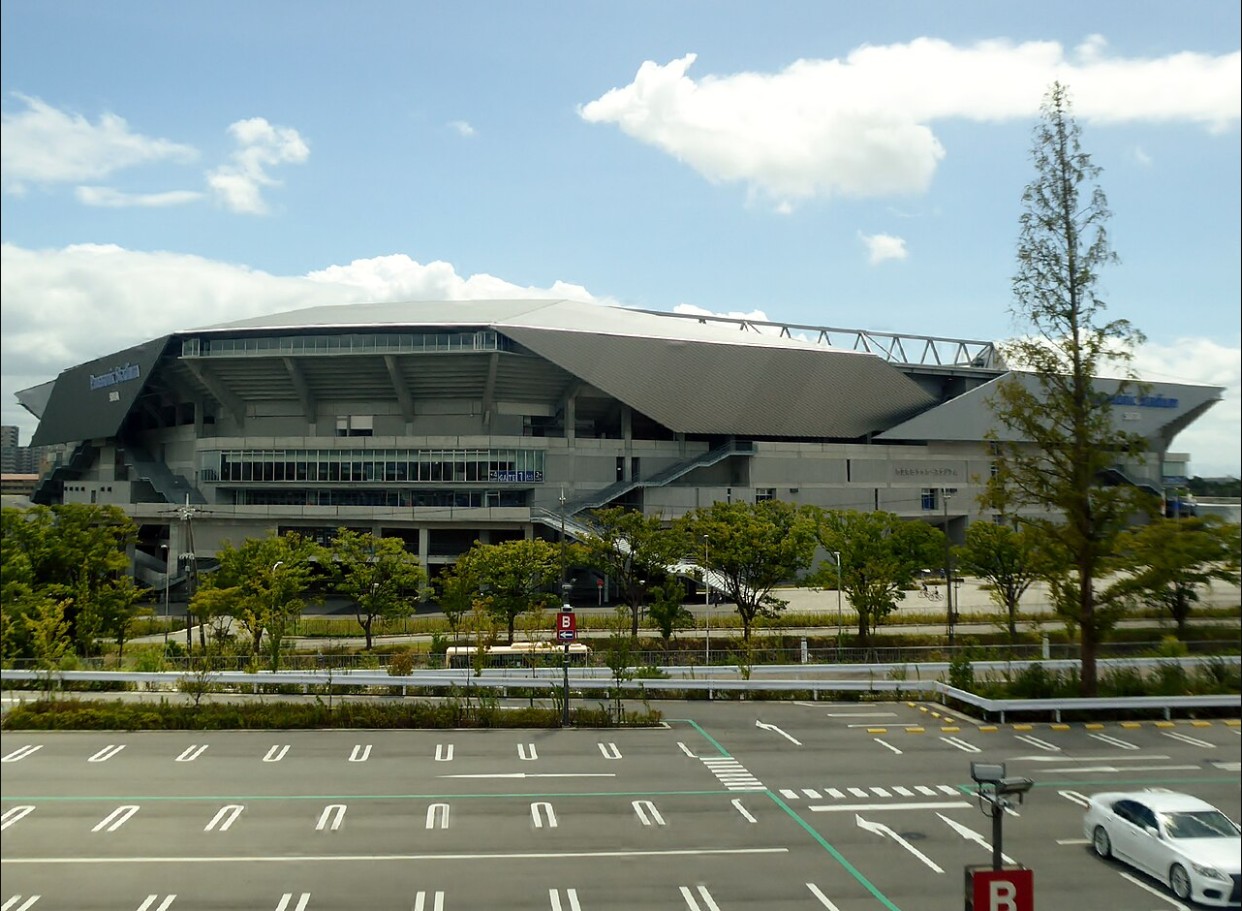
Photo: Tokumeigakarinoaoshima, Wikimedia Commons (CC BY-SA 4.0) · The stadium exterior and the roof structure over the stands, taken August 25, 2018
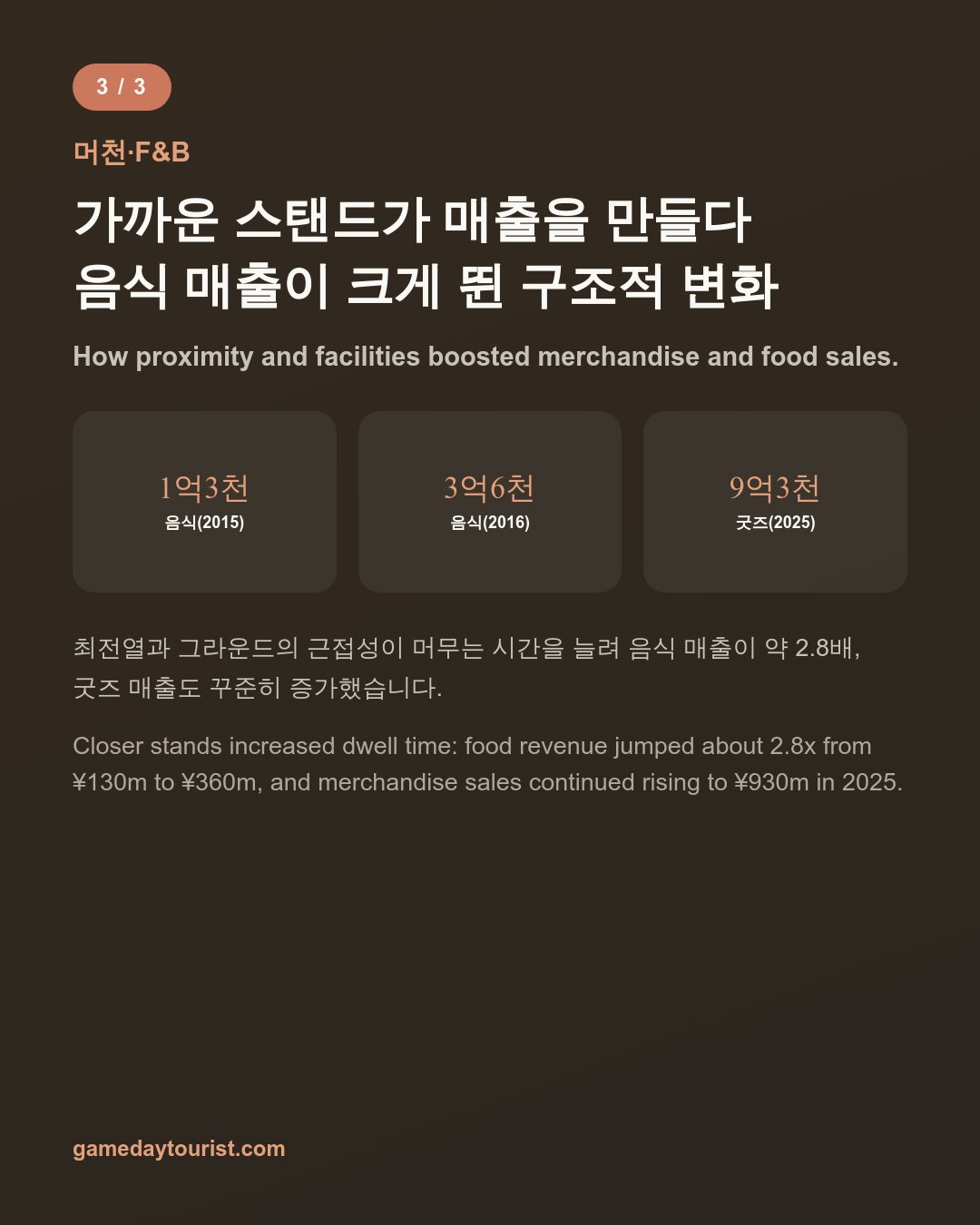
The club’s materials show circumstances suggesting this closeness turned into revenue. In the same operations document’s comparison of 2015 and 2016, merchandise sales rose from ¥490 million to ¥580 million (about 1.2 times), while food sales jumped about 2.8 times, from ¥130 million to ¥360 million.
It reads as a sign that the time people spend at the stadium grew by more than attendance did.
The most recent figures come from an article on the annual report the club issued in February 2026: in 2025, merchandise sales were ¥930 million (up 28% year over year), food sales ¥410 million (up 24%) and VIP-related sales ¥250 million (up 7%) (Sakanowa).
Since merchandise and food grew faster than attendance (15%), it means that what each visitor spends has itself grown.
As a working marketer, I welcome that blogger’s reaction, “Is this really Japan?” Saying a stadium resembles one abroad ultimately sounds like saying it is “selling an experience, not a match.”
When the stands are close, there’s a roof and screens are visible everywhere, people leave their seats less, and when they leave their seats less, food and merchandise purchases rather concentrate in the flow before and after the match. That said, it’s hard to separate from the data alone whether this revenue growth comes from the stadium effect or from results on the pitch.
Ad inventory and naming rights: ¥200 million a year, with the contract running to the end of 2027
Naming rights (the right to put a company name on a facility) are sold not by the club but by the stadium’s owner, the city of Suita. According to the city of Suita’s official page, the contract with Panasonic Sports began in January 2018, and the renewal announced on December 28, 2022 runs for five years from January 1, 2023 through December 31, 2027, for a total of ¥1 billion (¥200 million a year, excluding consumption tax).
It’s a structure in which a club shareholder, and the company whose name is on the club, also holds the stadium’s name, and with the contract expiring at the end of 2027 it will be worth watching how the next renewal negotiation turns out.
Overall club revenue sits on the same trend. According to Toyo Keizai in June 2025, fiscal 2024 revenue exceeded ¥7.2 billion, a record, and the club has set breaking ¥10 billion as its next target.
Revenue disclosed by the J.League for fiscal 2025 was ¥8.817 billion, third in J1 (first was Urawa at ¥11.31 billion, second Kawasaki at ¥10.069 billion). I couldn’t find in the public materials I checked how the ¥200 million a year is split between the city and the club.
Still, whether the company whose name is on the stadium keeps the same seat is tied to the stability of the club’s business after 2027.
A comparison with the KBO and K League: ₩51.5 billion of tax money vs. ¥14 billion of donations
The closest place in Korea to compare the relationship between a club and a local government is Daegu FC’s football-only stadium. Opened on March 9, 2019 after renovating the old Daegu Civic Stadium football ground from December 2016, it was paid for entirely by the city of Daegu at ₩51.5 billion in total, according to Hankook Ilbo, seats 12,000, and Daegu FC uses it under a free-use right from the city.
The Korean model, where the city builds and the club uses, and the Suita model, where individuals and companies build, the city owns and the club operates, differ this much even though both are “public stadiums.”
Depending on the exchange rate, ¥14 billion is somewhere over ₩100 billion, so roughly twice the cost of the Daegu stadium.
Naming rights are different in character too. The Daegu stadium’s 2019 contract with DGB Daegu Bank is known as the first case in Korean pro football, and from the 2025 season it became “Daegu iM Bank PARK.”
According to an April 2025 report, four of the stadium’s five home games that year sold out. The fan excitement is similar, but I think if the funding of construction differs, fans’ sense of “whose stadium is this” may differ too.
I find myself wondering what hints Gamba’s case, where fans’ attachment to a donation-built stadium is being confirmed in numbers, could offer for the next cooperative models our clubs will build with local governments.
To sum up, Panasta is a stadium that started from the question of how to fill empty seats rather than from the building, and answers it with an average-30,000 stand made by more than 34,000 individual donors and some 700 companies. How long this structure holds when results waver will be tested in the 2026-27 season.
Leave a Reply