Contents · About 8 min read
📱 View as card news

The fiscal 2025 results that Atlanta Braves Holdings released in February contained a striking reversal.
On the field, the Braves finished fourth in the National League East and missed the playoffs, yet revenue from The Battery Atlanta, the commercial district next to the ballpark, grew 45% over the same year.
I wanted to know how an American pro sports club had built a revenue engine that runs regardless of results, so in this piece I’ll walk through the marketing structure of Truist Park and The Battery Atlanta, mostly through the numbers.
I cross-checked the club’s filings, press coverage, fan reviews, and expert analysis, and pulled out the points most useful for KBO and K League clubs.
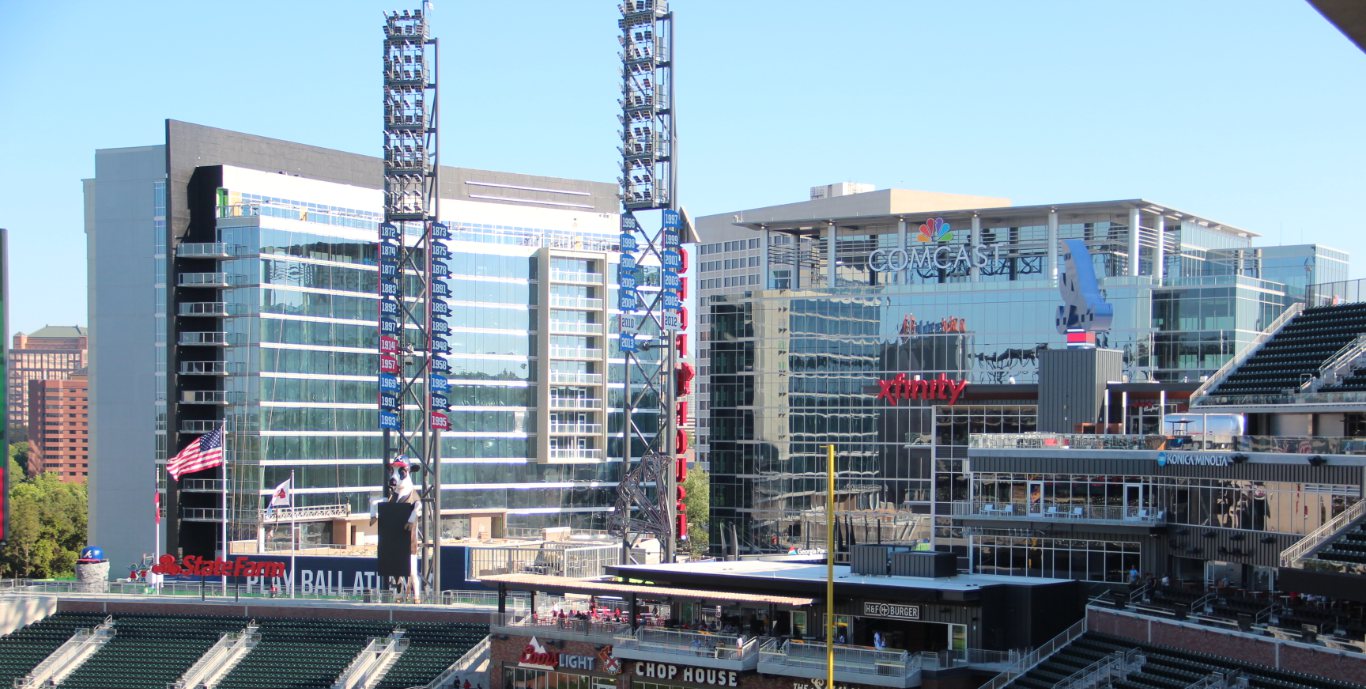
Source: Thomson200, Wikimedia Commons, CC0 1.0 public domain · the view from the Truist Park stands. The seats in front belong to the ballpark; the glass buildings behind are The Battery Atlanta’s office towers (Comcast, Xfinity) and the Chop House and other restaurants. The ballpark and the mixed-use district sit right next to each other, separated by little more than a wall (photographed 2017).
Crowds and Tickets
Truist Park had 41,149 seats when it opened in 2017, and after some upper-level seats in sections 122 and 130 were adjusted, the official capacity is now slightly lower at 41,084.
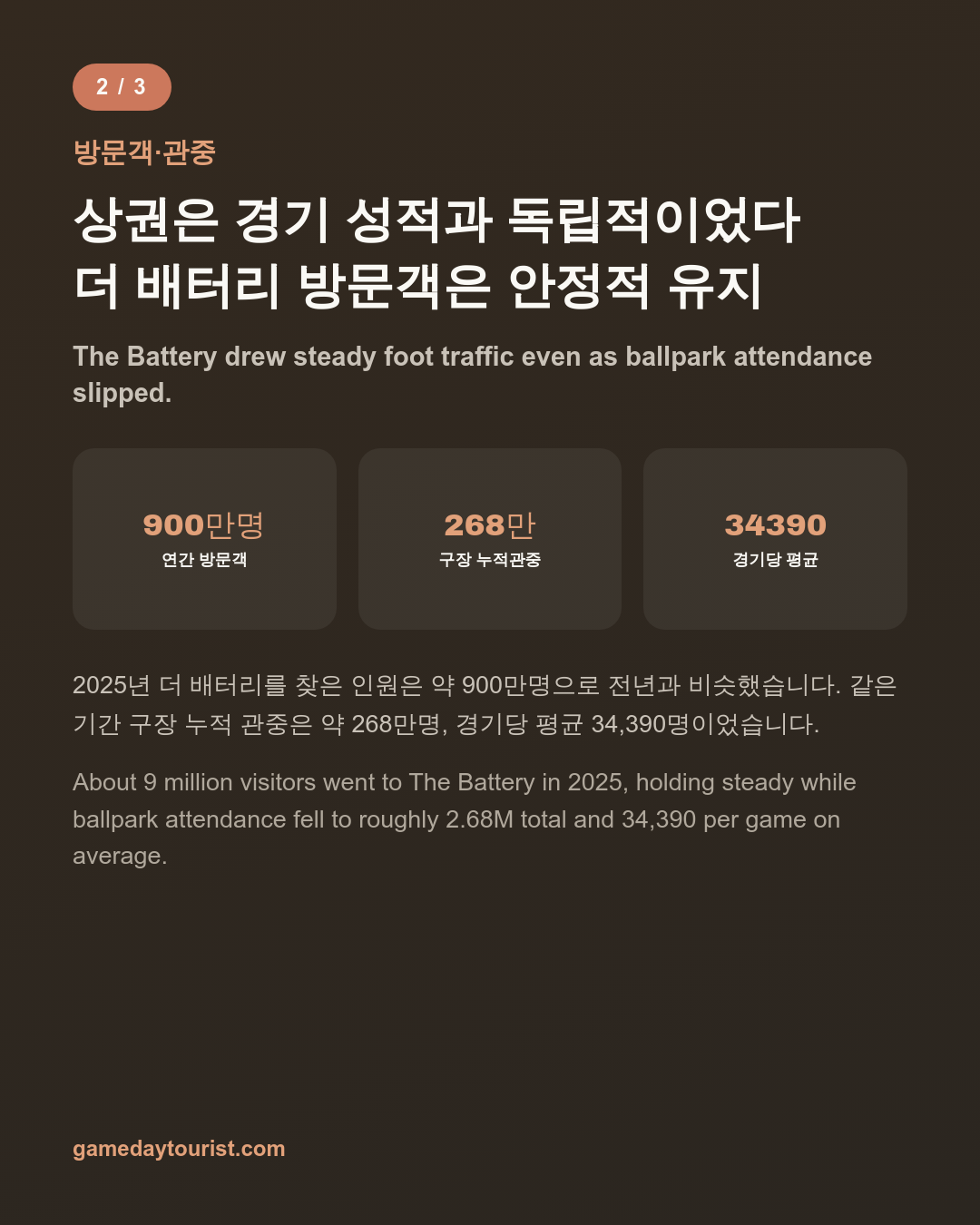
According to Baseball-Reference’s attendance data, the Braves (as of mid-September, before the regular season ends) are 89-64 and leading the NL East, with home attendance of 2,682,387 so far, an average of 34,390 per game, sixth among the National League’s 15 clubs.
The club said fiscal 2025 delivered its best-ever regular-season ticket sales and sponsorship revenue, yet attendance that year actually fell about 4% from the year before.
That reads to me as ticket prices, premium seat sales, and sponsorship renewals contributing more to revenue than raw headcount.
Indeed, the online ticket listings show a wide spread, from around ten dollars up to premium seats for popular matchups like the Dodgers and Mets.
Space and F&B — The Battery Atlanta
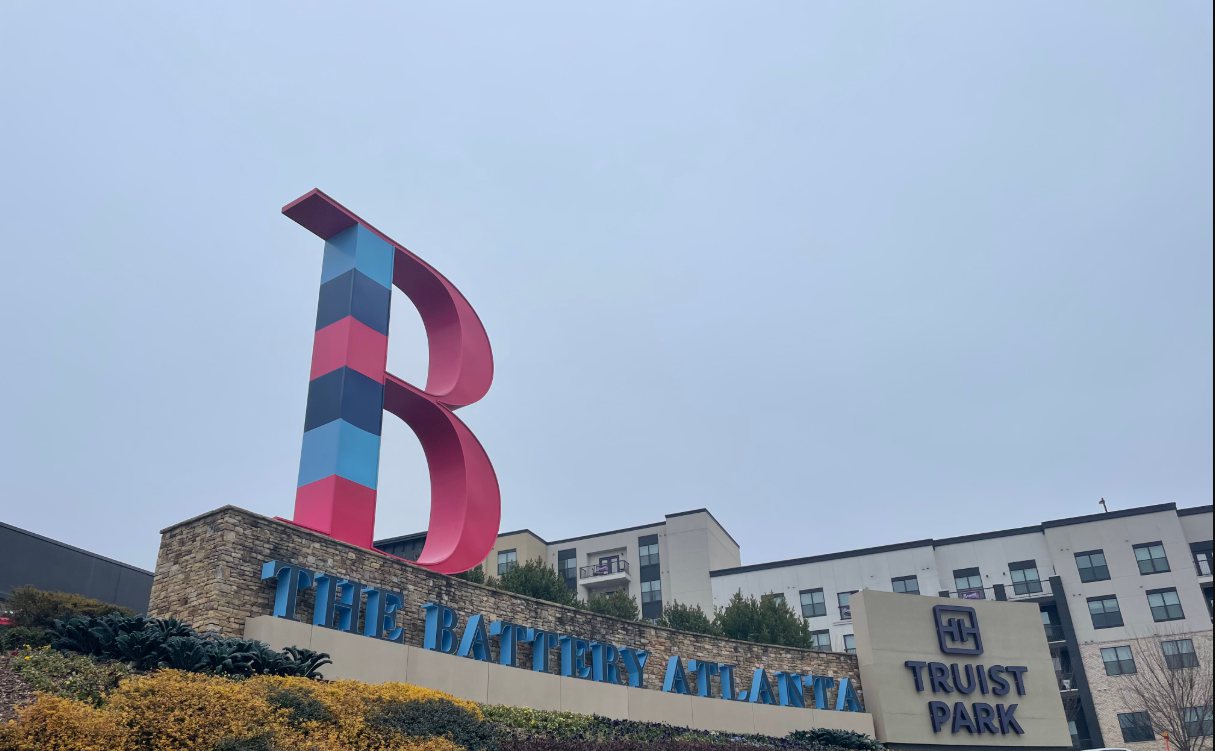
Source: Tyler Lahti, Wikimedia Commons, CC BY-SA 4.0 · the landmark sculpture at the entrance to The Battery Atlanta and the Truist Park sign (photographed 2022)
The Battery Atlanta is a mixed-use development of about 3 million square feet that opened in 2017 alongside the ballpark.
Across its five buildings, tenants include the Comcast regional headquarters office building, Papa Johns’ global headquarters, TK Elevator’s North American headquarters, Southwire, and Truist Securities, and the district also packs in a 264-room Omni hotel, a 4,000-seat concert hall called the Coca-Cola Roxy, 550 residential units, and 500,000 square feet of retail, food, and beverage space.
In April 2025 the company also acquired six office buildings in nearby Pennant Park (about $93 million), and the club says occupancy there has risen from the low 80% range at acquisition to roughly 90% recently.
By the numbers, this development now carries almost as much weight as baseball.
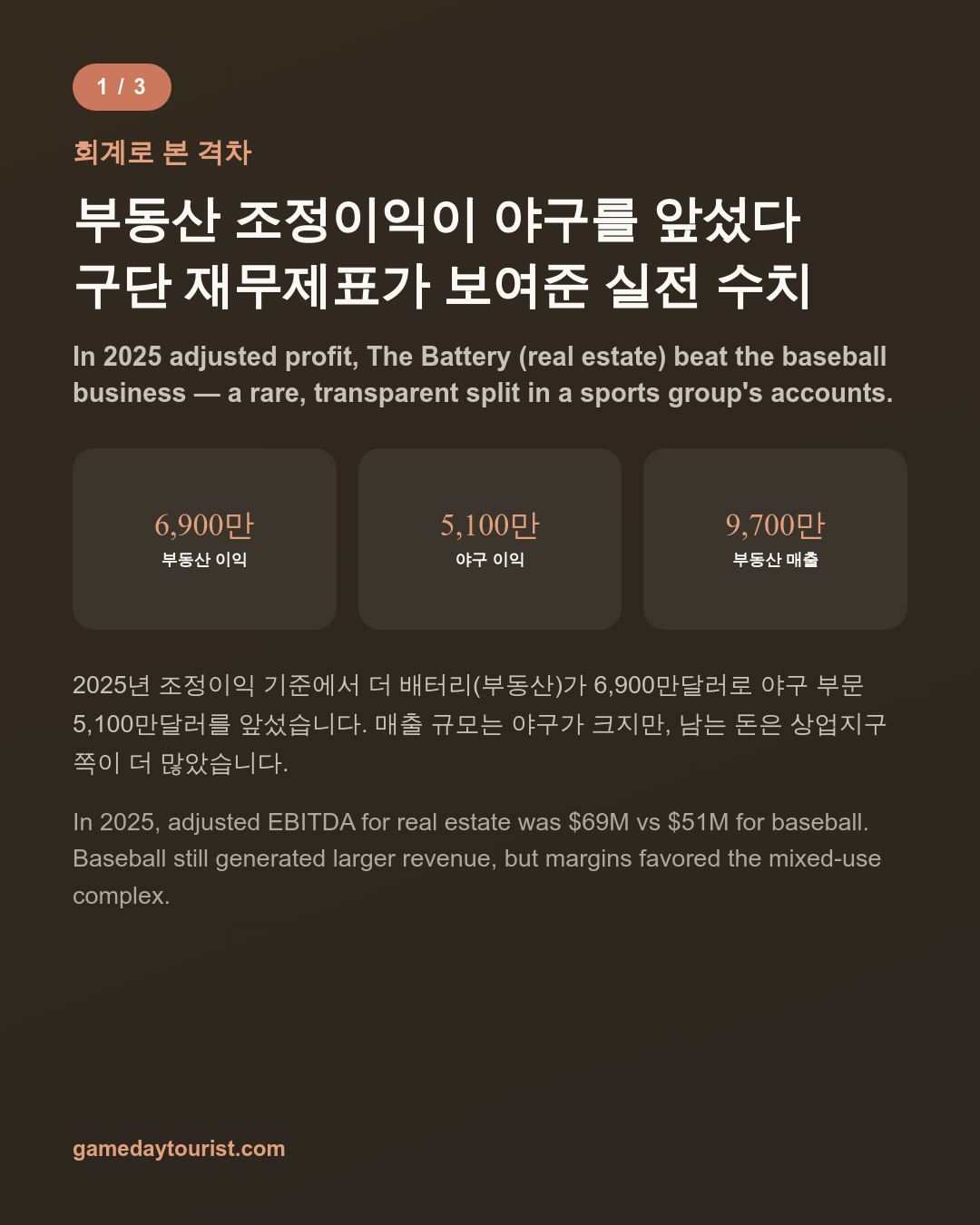
In 2025, baseball revenue was $635 million against $97 million for the real estate segment that includes The Battery, so baseball is far larger in scale.
But the picture changes on Adjusted OIBDA, a measure of underlying profitability that strips out depreciation from aging facilities, stock-based compensation, and other one-time or non-cash accounting charges.
The real estate segment’s Adjusted OIBDA was $69 million, actually higher than baseball’s $51 million.
Put simply, baseball brings in more revenue, but retail and office rentals keep a bigger share of it as profit (margin).
Foot traffic is steady too: about 9 million people visited The Battery in 2025, roughly the same as the year before, while ballpark attendance fell, which suggests the district has built its own reasons to visit, independent of game results or team performance.
The gap was even clearer in the most recent quarter.
In the second-quarter 2026 results (April to June) that Braves Holdings released in early August, baseball Adjusted OIBDA swung from $52 million a year earlier to a loss of $5.7 million, while real estate Adjusted OIBDA rose 18% over the same period to $20.6 million.
Part of that baseball loss is temporary, since there were six fewer home games than the year before and early costs from the shift to the club’s own broadcasting platform, BravesVision, overlapped, but it contrasts sharply with a real estate segment that keeps earning steadily regardless of outside variables.
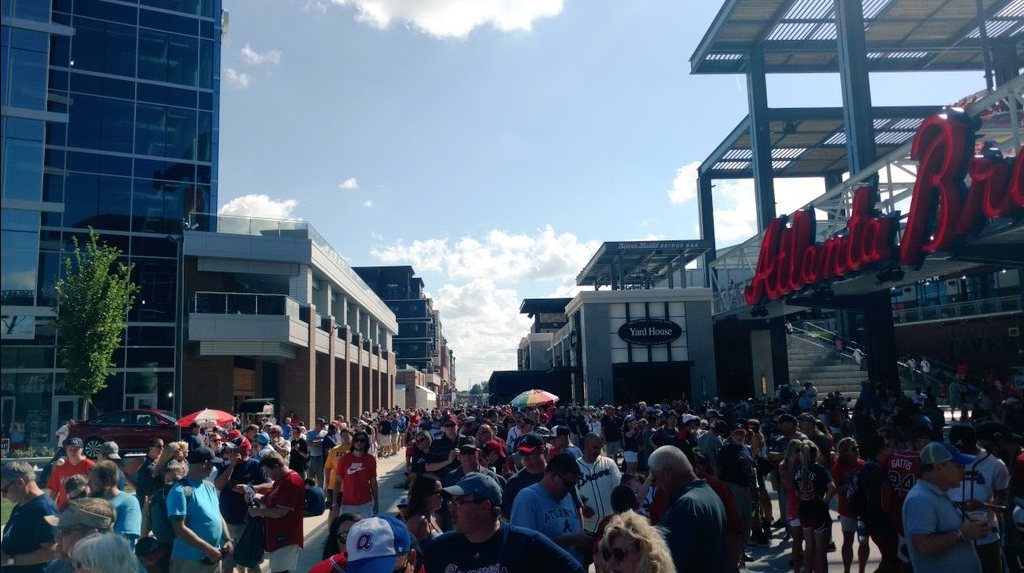
Source: Nemov, Wikimedia Commons, CC BY-SA 4.0 · fans gathered on The Battery Atlanta main street before a game
One U.S. sports travel blogger pointed out that the upper concourse at Truist Park bottlenecks on sold-out nights, but also noted that restaurants like Yard House and the open plaza act as natural waiting areas before and after games.
As a working marketer, I think that criticism actually shows what The Battery was designed to do.
The physical bottleneck inside the ballpark is absorbed by the commercial district outside it.
With a free-to-enter plaza, fountain, bowling alley, and cinema running even on non-game days, few places have proven with real revenue that the shops keep running even when the ballpark is closed, which is why this development is often cited in U.S. sports as a reference model for mixed-use projects.
Merchandise and Advertising Inventory
Truist Park has four retail stores, led by the Braves Clubhouse Store at the right-field gate in section 111, along with Threads by Braves (section 142), South End Trading Co., which sells game-used gear, and the Custom Shop for personalized jerseys.
Last March the club renovated an existing store with more floor space and a daily-refreshed product mix, and opened a dedicated memorabilia store the same month.
The club doesn’t disclose exact store sizes or sales figures, which is quite different from how KBO clubs announce post-season store renovations in press releases.
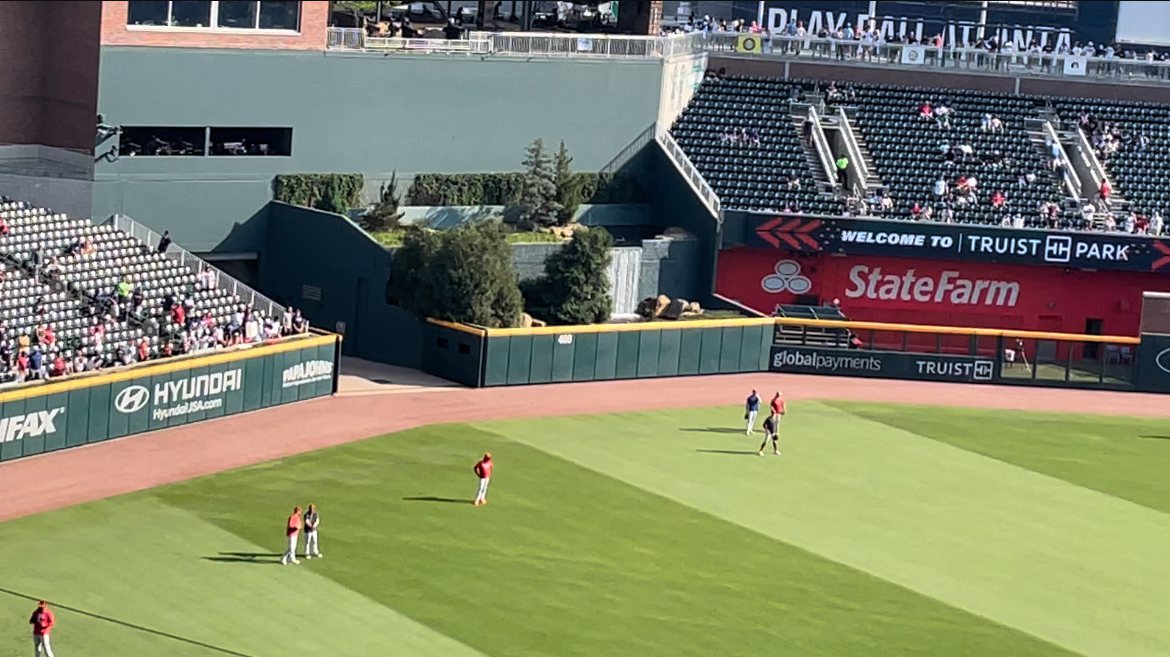
Source: BullDawg2021, Wikimedia Commons, CC BY-SA 4.0 · sponsor advertising inventory on the outfield fence and below the scoreboard at Truist Park (photographed 2023)
Advertising inventory, meaning the spaces where ads are shown inside the ballpark, is easiest to understand from a photo.
Hyundai and Papa Johns logos hang side by side on the outfield fence, while a large State Farm board and a Global Payments logo sit above the right-field wall, combined with the scoreboard structure.
The naming rights themselves came from a 25-year deal signed with SunTrust Bank in 2014, worth about $10 million a year; the name simply changed to Truist Park in 2020 after the SunTrust and BB&T merger created Truist Financial, and the terms were not renegotiated.
In Korea, naming-rights deals mostly put the parent company’s own brand on the stadium, whereas Truist Park is closer to the American model, where a third-party financial company buys the rights on a 25-year contract.
Broadcast Rights and Local Economic Impact
The broadcast structure has changed dramatically in the past year.
In January, the Braves ended their broadcast deal with Main Street Sports Group (formerly Diamond Sports Group), which ran the regional sports network.
Scheduled rights payments weren’t being made, and the Braves terminated the deal along with eight other clubs, including the Cincinnati Reds and Detroit Tigers.
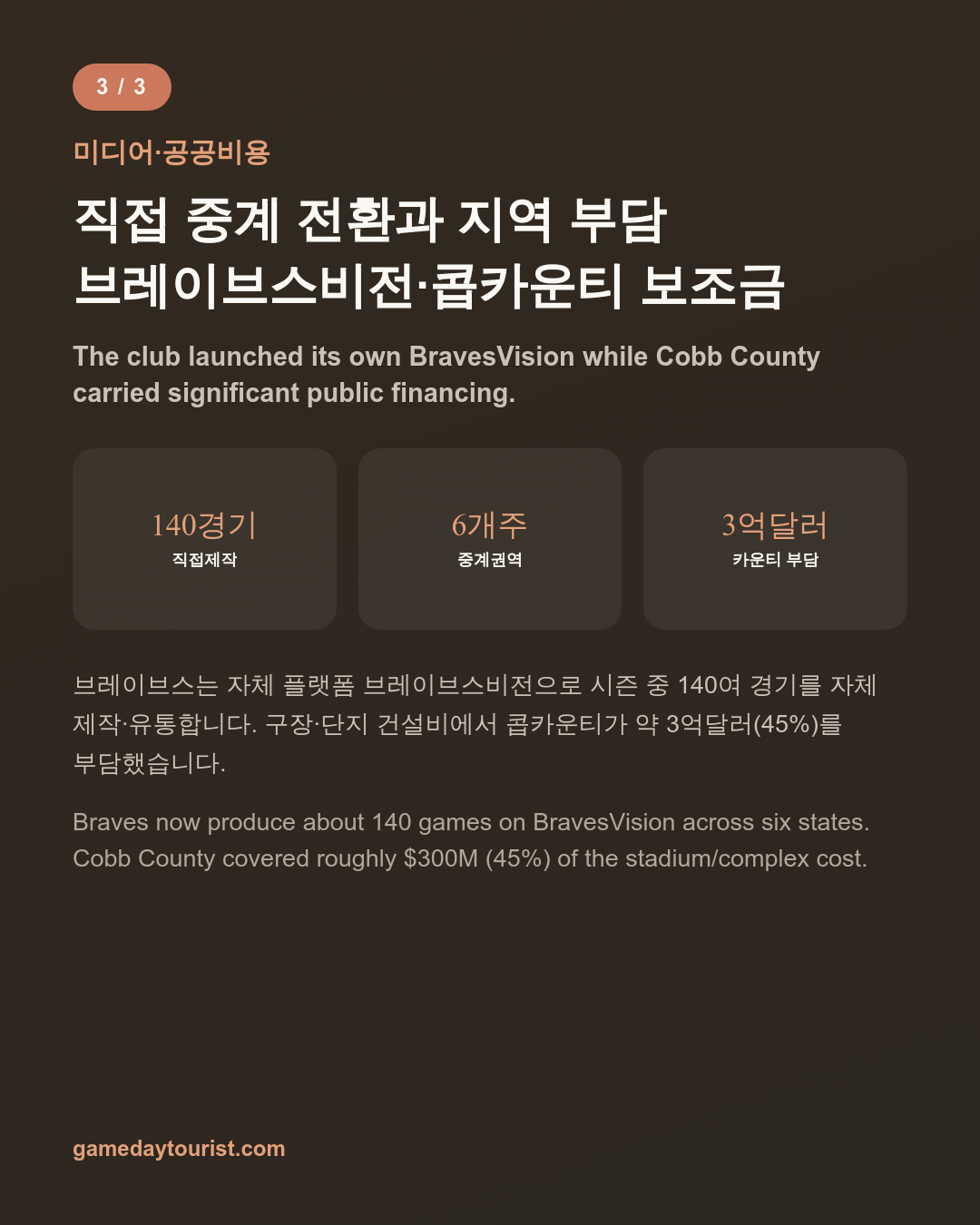
Instead of finding a new broadcaster, the Braves launched BravesVision, a media platform the club owns 100%, and this season it produces and distributes more than 140 games across six states itself.
Gray Media simulcasts some games over the air.
Whether the club can maintain profitability on its own platform, compared with regional rights revenue of about $100 million in 2024, is still unproven, but industry analysts say the steady cash flow from real estate is cushioning the transition.
The local economic impact story is hard to separate from the debate over Cobb County’s financial burden.
Of the $672 million stadium and mixed-use project, Cobb County took on about $300 million (45%), funded by 30-year bonds backed by hotel and motel taxes, a new rental-car tax, and the growth in property tax revenue within an existing tax district.
At the time of the 2015 agreement, the county expected to put $6.4 million a year in tax revenue toward the stadium debt, but recent assessments say the ballpark is now returning more than that to the county’s general fund.
Not every assessment is positive, though.
Local outlets and some economists argue that even if The Battery’s revenue is impressive, it’s small next to Cobb County’s roughly $80 billion economy, and that it’s too early to say the $300 million in public subsidy has been fully recovered.
It’s a reminder that marketing success and public-finance success have to be judged by different yardsticks.
A Look at the KBO and K League
The closest Korean attempt to the Truist Park and Battery model is Starfield Cheongna, which the SSG Landers are building with Shinsegae Property in Incheon’s Cheongna district.
The plan puts a domed stadium on top of a massive shopping mall, designed so that fans can watch games from a swimming pool or a hotel room, and once it’s finished the Landers will leave their current home, Incheon SSG Landers Field (Munhak), and move there.
Starfield Cheongna is still under construction, though, and hasn’t yet reached the point of proving with real revenue that the district can stand on its own even without games, the way The Battery has.
There are structural differences between the two projects worth noticing from a marketer’s view.
At The Battery, the club owns and operates the real estate itself and folds the revenue into its own financial statements, while at Starfield Cheongna a large retail company builds the mall and the baseball club moves in on top as something closer to a tenant.
Rather than saying one is right, the point is that whether a club becomes the developer or the tenant changes who accumulates how much of the profit over the long run, and Korean clubs should keep that in mind.
What impressed me most personally while looking at the Truist Park case was simply that Braves Holdings, as a listed company, reports revenue and profit for baseball and real estate separately every quarter.
That level of disclosure is what made it possible to see that mixed-use development has a higher margin than baseball, a comparison that’s hard to confirm in Korea.
Korean clubs don’t need to copy the U.S. listing and disclosure system right away, but the habit of managing the profitability of stadium and non-stadium businesses separately, at least internally, seems worth borrowing.
Leave a Reply