Contents · About 9 min read
📱 View as card news
In mid-May, when the Korean national football team announced its roster for the 2026 North/Central America World Cup, one name caught my eye.
FC Tokyo goalkeeper Kim Seung-gyu.
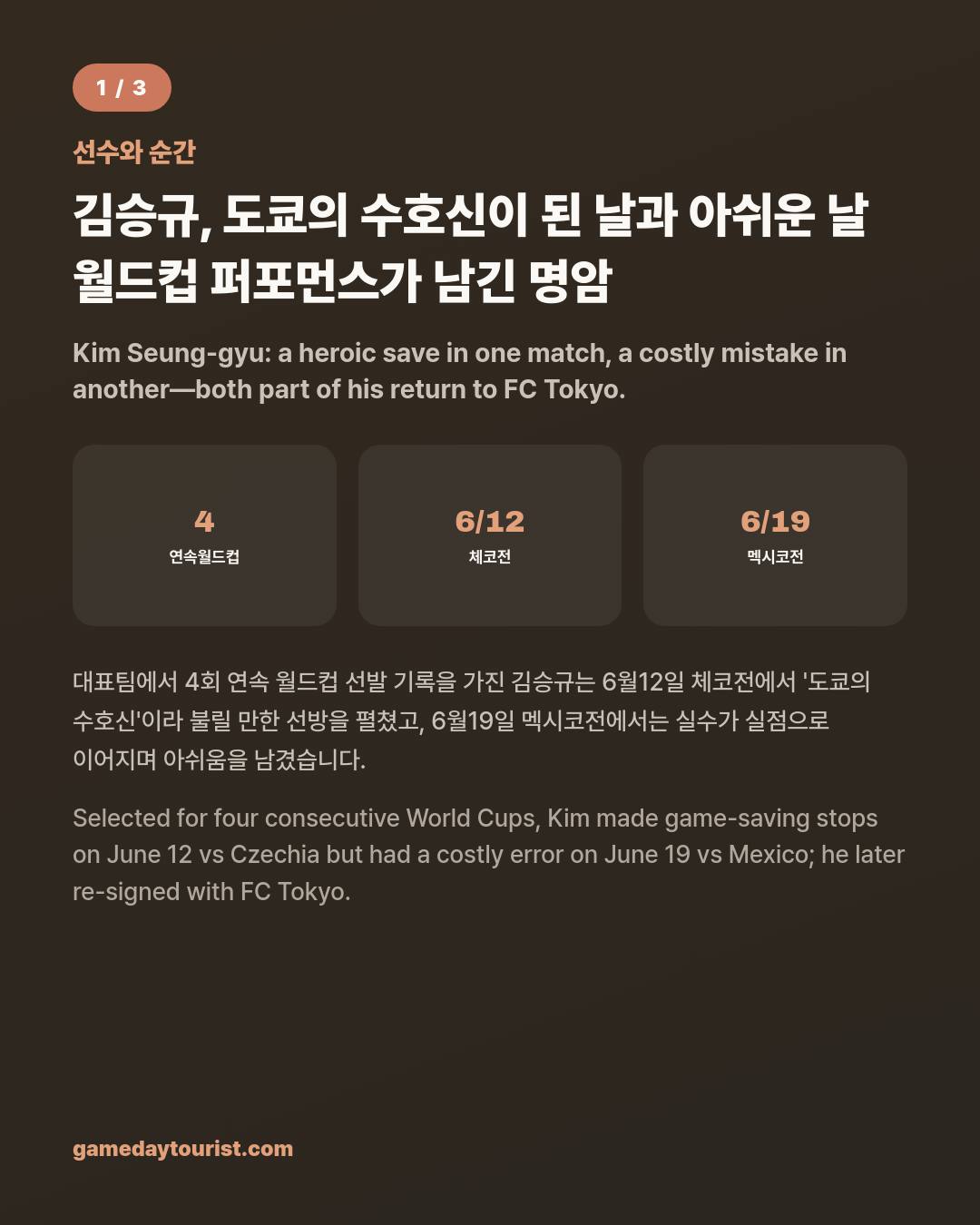
He holds the record for the most World Cup starts by a Korean goalkeeper — four in a row — but on the actual stage, he showed both extremes of what that can look like.
Against Czechia on June 12, he blocked Adam Hlozek’s decisive shot with his right arm in the 82nd minute and calmly saved a Michal Sadilek attempt in stoppage time to preserve a 2-1 win (goals from Hwang In-beom and Oh Hyeon-gyu) — earning the nickname “Guardian of Tokyo” from local media. But against Mexico on June 19, a mistake led to a goal in a 0-1 loss, and Korea was eliminated in the group stage on goal difference behind Senegal.
Having fought back onto the national team after two torn ACLs, he then re-signed with FC Tokyo for the 2026-27 season on June 30 — and once I heard that, I got curious about the business behind the club he plays for.
As a working marketer, I decided to take a closer look at FC Tokyo and its home ground, Ajinomoto Stadium.
Attendance and Tickets
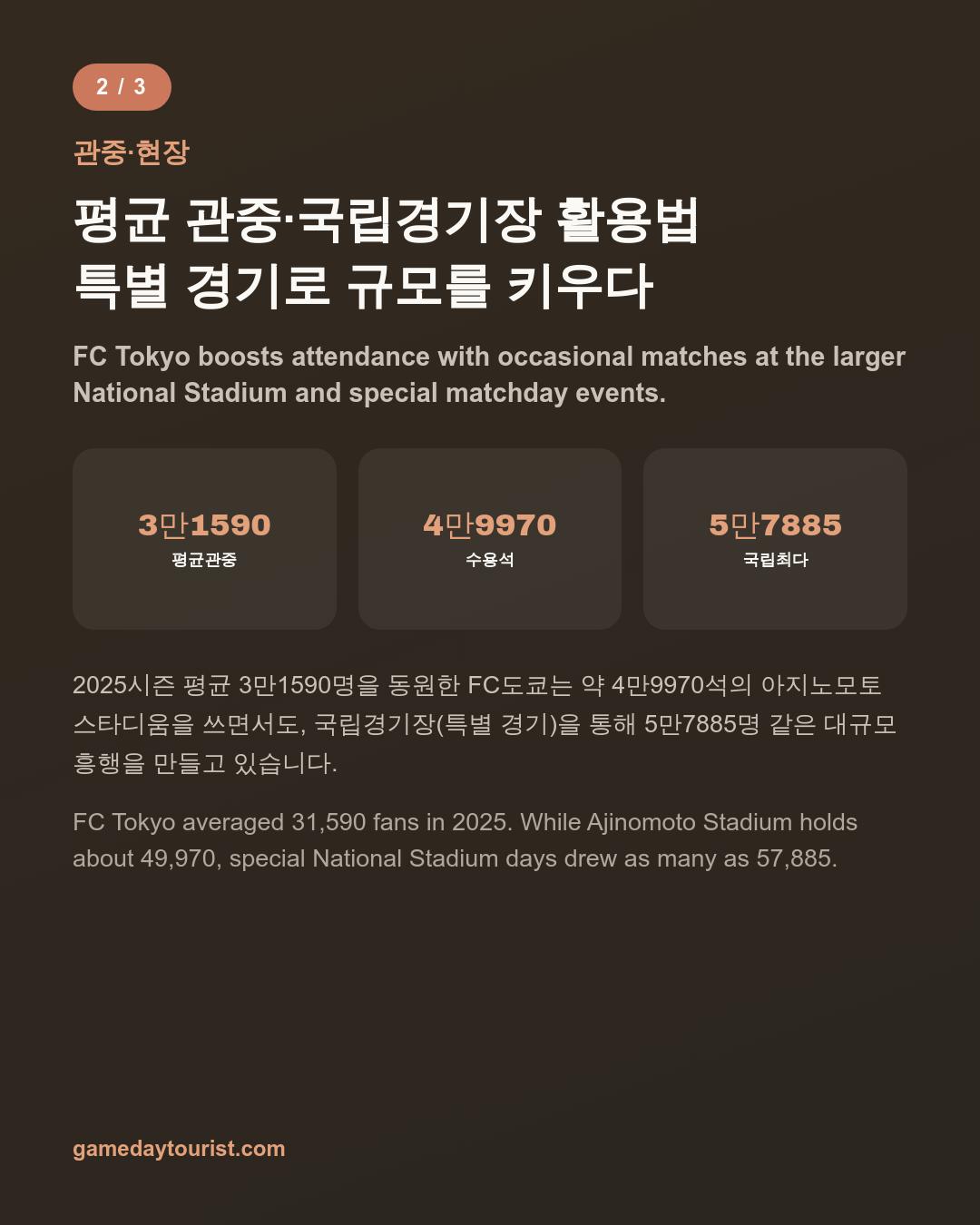
FC Tokyo averaged 31,590 fans per game in the 2025 J1 League season, third in the league.
That put them behind only Urawa Red Diamonds (37,350) and Nagoya Grampus (32,263), and nearly 10,000 above the league average of 21,246.
On March 8 this year, a J1 match against Shonan Bellmare pushed the club past 10 million cumulative home attendees — the fourth club in J.League history to hit that mark, and the second-fastest by number of matches, according to the club.
Its season-ticket program, SOCIO, bundles all 19 J1 home matches together, pricing it as a discount off the combined total of individually priced tickets rather than a flat all-you-can-attend rate — making it a more flexible structure than it might first appear.
What’s interesting is that FC Tokyo boosts its season attendance average by playing one or two special home matches a year not at its own ground, but at the roughly 68,000-seat National Stadium in central Tokyo.
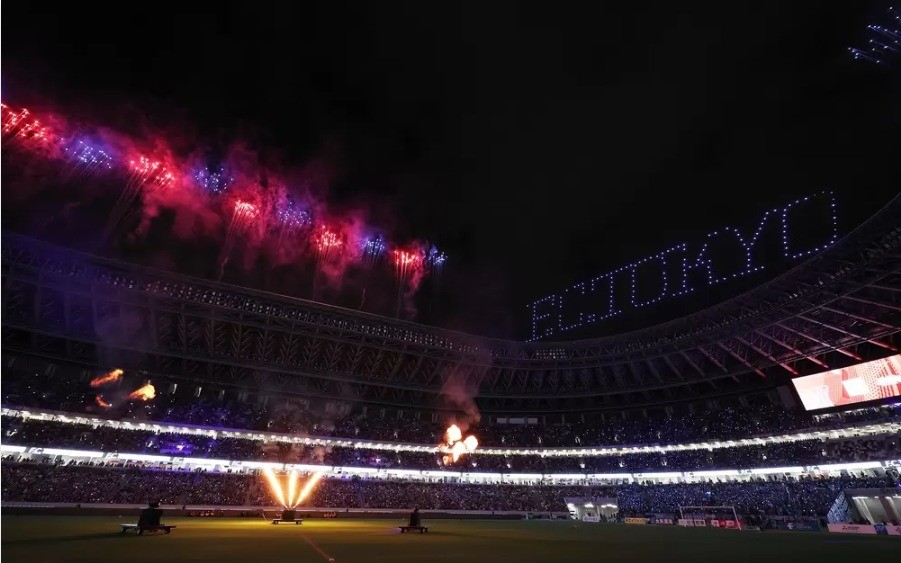
A July 13, 2024 match against Albirex Niigata drew 57,885 fans, the largest J1 crowd ever at the new National Stadium and the club’s biggest home crowd on record — and this season too, the club is timing special events like a 400-plus drone fireworks show and blue-and-red flame displays to coincide with National Stadium dates.
The J.League itself brands these National Stadium matches separately as “MUFG THE Kokuritsu DAY,” which reads as its own marketing technique: turning one or two matches at a large non-home venue into a “special day” to maximize box office.
Space and F&B
Ajinomoto Stadium is a multi-purpose venue with a capacity of roughly 49,970.
Because it’s built for both football and rugby with a running track circling the pitch, there’s a gap between the field and the stands — which some say makes it feel less immersive than a football-only stadium, while others say it lets fans enjoy the match from a wider range of angles.
One local matchday blogger carefully compared the main stand, back stand, and end-zone seating, writing that “where you sit decides 90% of how satisfying the match feels” — a line I found myself agreeing with.
Standing room behind the goal for fans who want to feel the atmosphere with their whole body, the center of the main stand for families who want a comfortable view — that kind of purpose-based seating advice made me wish domestic stadiums did more to spell out what each seating section is actually good for.
The food scene, inside and outside the stadium, is dense too.
“Seiseki Park” outside the gates is an open area you can enter without a ticket, filled with food trucks, while the concourse concession stands sell club-original items like Tokyo ramen (¥800-900) and Tokyo gyoza (¥600-700), limited menus built around the visiting team’s home region, and craft beer brewed in-house.
Weaving the visiting team’s regional food into every matchday menu was a detail that stood out — it turns the schedule itself into F&B marketing material.
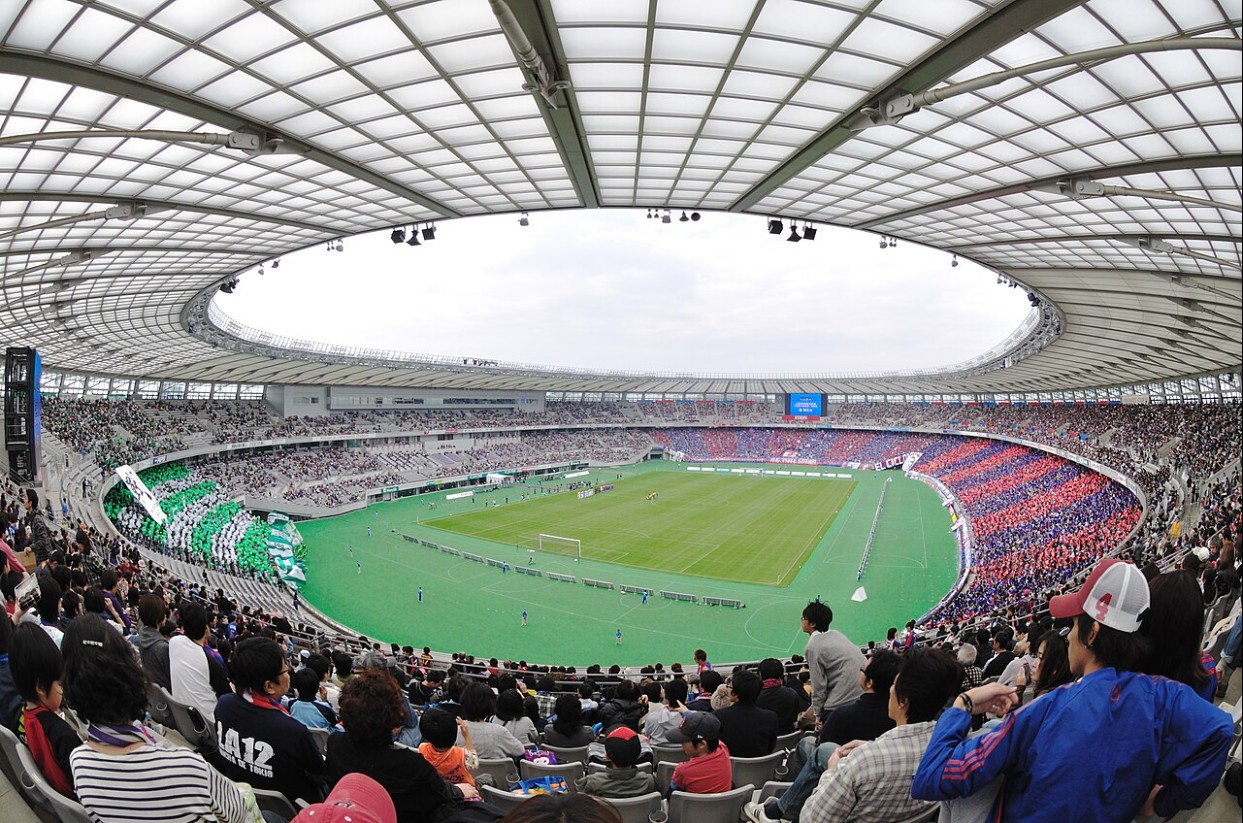
Source: Wikimedia Commons (yoppy, CC BY 2.0) — A sold-out crowd at Ajinomoto Stadium during the Tokyo derby (FC Tokyo vs Tokyo Verdy)
Merchandise and Ad Inventory
FC Tokyo is one of the rare clubs willing to admit that merchandise is a weak point for them.
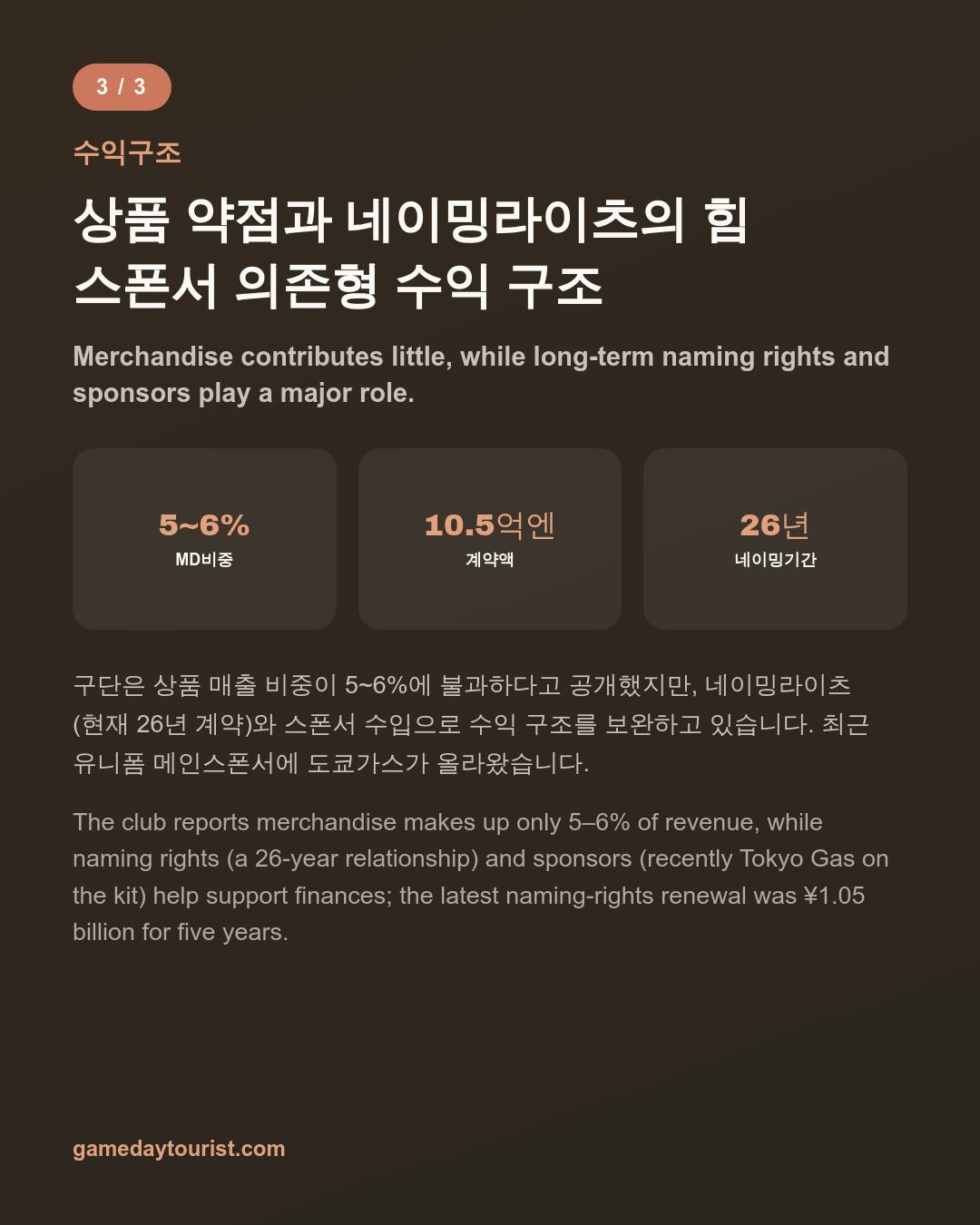
According to a staff diary published by the club’s own merchandising department, product sales make up only 5-6% of total revenue, compared to around 10% for the average club and up to 15% for the top sellers.
Even replica jersey sales, its biggest merchandise category, run only 6,000-7,000 units a year — well below the 15,000-20,000 units that strong-selling clubs move.
It struck me as unusual for a club to publicly admit a weakness like this, but from the standpoint that you have to acknowledge a problem before you can fix it, it actually read as a healthy approach.
Ad inventory — the ad space attached to the stadium, jerseys, and so on — tells a different story.
The 2026/27 season’s main jersey sponsor is Tokyo Gas — notable because FC Tokyo’s predecessor was literally the Tokyo Gas company football club, so nearly 90 years later, its old parent has returned to the front of the shirt.
Mitsui & Co. sits on the sleeve, alongside the logo of parent company MIXI, which owns the club as a subsidiary.
MIXI, an IT company known for the mobile game Monster Strike, first came on as a club sponsor in 2018, then in December 2021 raised its stake to 51.3% through a third-party share allotment (issuing new shares to a specific investor to transfer ownership), folding FC Tokyo in as a subsidiary.
Before that, FC Tokyo had operated as a consortium split among some 370-plus shareholders including Tokyo Gas, Mitsubishi Corporation, and Shimizu Corporation — meaning a club that had made a principle of avoiding any single corporate identity ended up under the umbrella of a tech company.
More recently, the club has designated one home match a season as “MIXI Day,” bundling its parent’s brand into a matchday event.
The stadium’s naming rights (the right to attach a company’s name to a facility) have a long history too.
Ajinomoto Stadium was Japan’s first public facility to adopt naming rights, back in March 2003, and has since renewed the deal five times, running for a total of 26 years through February 2029.
The most recent renewal (March 2024-February 2029) is worth ¥1.05 billion over five years (before tax) — reportedly the longest-running naming rights deal among Japan’s major public facilities.
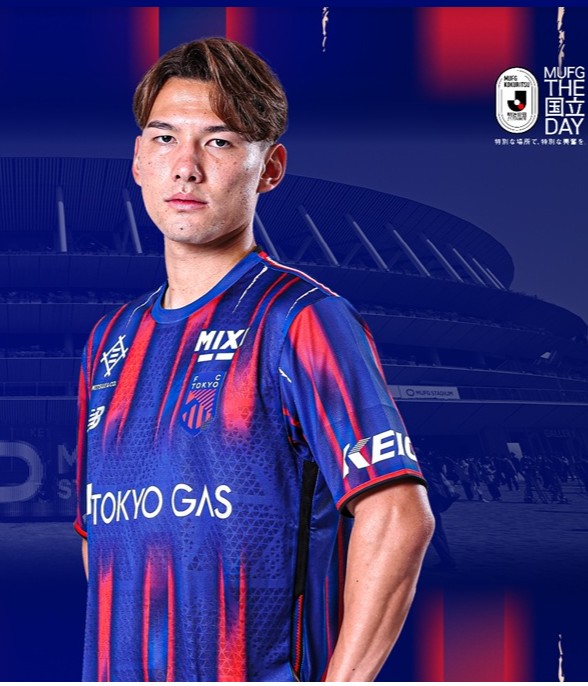
Source: Captured from the FC Tokyo official website — the 2026/27 season kit with sponsor logos (Tokyo Gas, Mitsui & Co., MIXI)
Broadcast Rights and Finances
DAZN holds the broadcast rights to the entire J.League.
In 2023 it extended that deal for 11 years (through 2033) at a total of ¥239.5 billion, the result of two extensions on the original 2017 contract (10 years, ¥210 billion).
Looking at the standalone results for Tokyo Football Club, which runs FC Tokyo, its fiscal 2024 accounts (year ending January 2025) showed operating revenue up 17.9% year over year to ¥6.989 billion, a franchise record, with net income swinging to a ¥72 million profit.
That ended a run of losses that had continued since the COVID-19 pandemic.
One football-business analysis blog pointed out that sponsorship makes up nearly half of FC Tokyo’s revenue mix, a considerably heavier reliance on sponsors than you’d typically see in European or American sports business — meaning the club leans more on ad inventory than on self-generated revenue like merchandise and tickets, which ties directly back to the merchandise weakness discussed above.
What Makes This Stadium Its Own — Mascot and Special Productions
FC Tokyo’s mascot, Tokyo Dorompa, is a fox-like character in a mix of blue and red who shows up on merchandise and F&B packaging all over the stadium.
Even the club’s own donut brand carries the mascot’s graphic, which felt like an attempt to bundle matchday food itself into the club’s brand assets.
The National Stadium productions mentioned earlier fit the same pattern.
Dressing up one or two matches a year at a big non-home venue with a drone show and fireworks to lift the season attendance average — if filling every single home game is hard, concentrating resources on one or two symbolic matches can be its own box-office strategy.
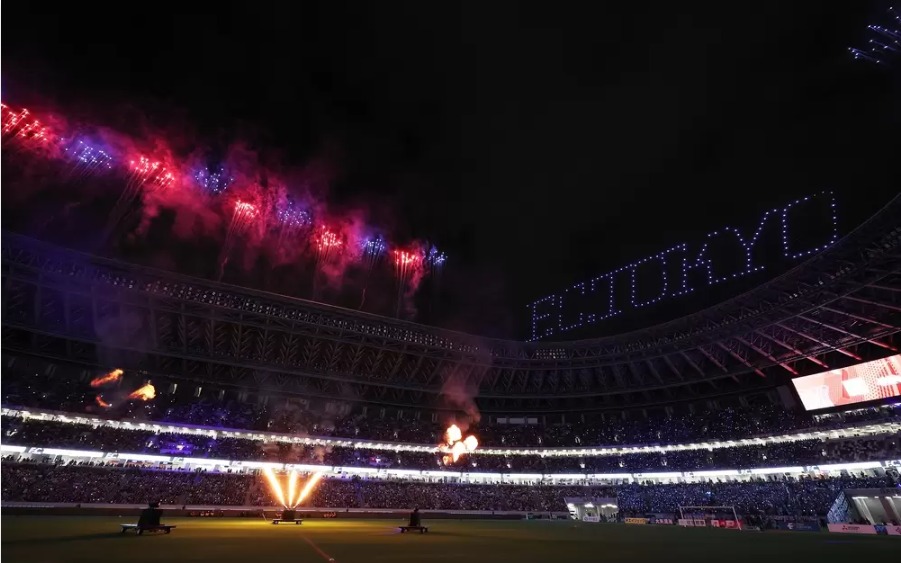
Source: White Crow Inc. (drone show production company), official case study page — the “FIREWORKS DRONE SHOW” at the FC Tokyo vs Nagoya Grampus match at National Stadium on September 14, 2024, roughly 400 drones spelling out “FC TOKYO” with special-effects fireworks
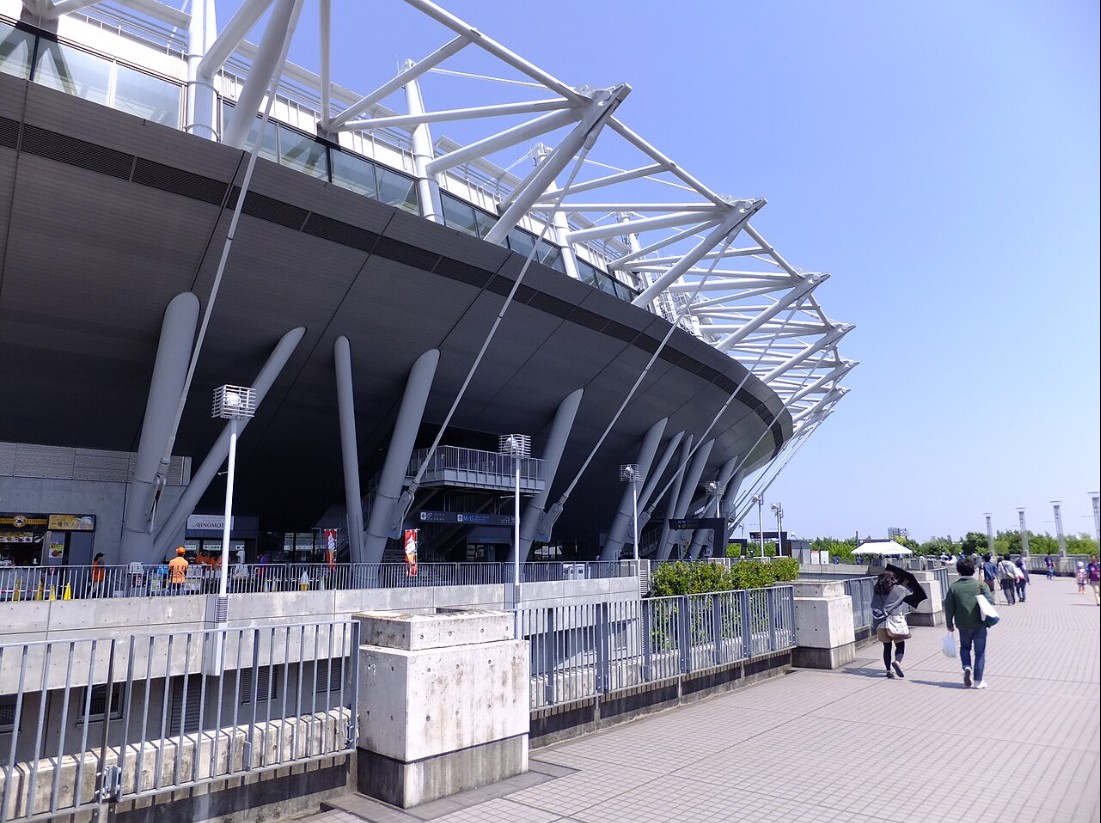
Source: Wikimedia Commons (掬茶, CC BY-SA 3.0) — Ajinomoto Stadium’s exterior and its steel-frame roof structure
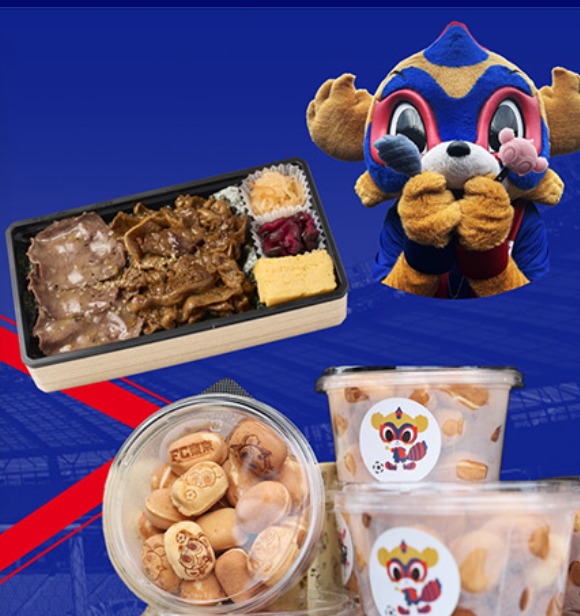
Source: Captured from the FC Tokyo official website‘s food page — mascot Tokyo Dorompa and matchday F&B products
How This Compares to the KBO and K League
A gaming company as a pro sports club’s controlling shareholder actually looks less like a K League story and more like the KBO’s NC Dinos.
The difference is that game maker NCsoft has owned the Dinos since the club’s founding, while FC Tokyo ran as a multi-company consortium for nearly 90 years before MIXI raised its stake and folded it in as a subsidiary in 2021 — but purely on the outcome of “a gaming company as controlling owner of a pro club,” it’s already a familiar picture back home.
Naming rights, though, is a different story.
Most Korean stadium names — Daegu Samsung Lions Park, Incheon SSG Landers Field, Daejeon Hanwha Life Ballpark — carry the name of the parent company that owns the club playing there.
Ajinomoto is structurally different: a third party with no ownership ties to FC Tokyo has been paying to keep its name on the building for 26 years running.
Having a running track in a multi-purpose venue also runs against Korea’s recent trend toward football-only stadiums — and yet the way this club leans on a separate, large-scale facility like National Stadium as a box-office card feels worth studying, since it shows you can expand attendance through special matches without expanding your own stadium at all.
A club that admits its own merchandise weakness. A club whose original parent company returned as a sponsor after 90 years. A club now majority-owned by a gaming company.
Looking into FC Tokyo reminded me how many layers of story can stack up inside a single club’s business structure.
Just as Kim Seung-gyu put both his “Guardian of Tokyo” moment and his rough one behind him and put the Tokyo shirt back on, Tokyo Gas has found its way back to where it started after 90 years — which makes me want to keep a closer eye on FC Tokyo this season.
Leave a Reply