Contents · About 16 min read
- Bob Uecker in the Back Row, and the Sixth-Inning Sausage Race
- The Team: A First 100-Win Season and the First World Series in 44 Years
- Getting to American Family Field and Buying Tickets — Based on Official Club Guidance (Checked Oct. 28, 2026)
- Attendance — About 34,000 a Game, 11th in the Majors
- Brats, Cheese Curds and an In-Park Brewery — Using the Space and F&B
- Naming Rights and Sponsors — From Miller to American Family
- The Regional TV Crisis and Stadium Finances — the Owner’s “$20 Million Surprise”
- Compared With the KBO — a League That Sells Its Rights in One Place
📱 View as card news
American Family Field, home of MLB’s Milwaukee Brewers, hosted Games 1 and 2 of the 2026 World Series. The Brewers beat the Tampa Bay Rays 3-2 in Game 1 on Oct. 23 and 5-4 in Game 2 on Oct. 24, then won Game 3 in Tampa Bay on the 26th by 10-1 to lead the series 3-0 (CBS Sports bracket).
It is the first World Series played in this ballpark, and for the city of Milwaukee it is the first since 1982, 44 years ago. Games 4 (Oct. 27) and 5 (Oct. 28, if needed) are in Tampa Bay, so Milwaukee only hosts again if the series reaches Game 6 (Oct. 30) and Game 7 (Oct. 31).
I have never been to this ballpark myself. I put this guide together from the club’s official pages, local news coverage and fan reviews, because I could not find a Korean-language guide to getting here and buying tickets, and that is what pushed me to write it.
Korean baseball fans will also like one link: Carlos Villanueva, who pitched for the Hanwha Eagles in 2017, now works in this front office as senior special assistant to the president of baseball operations.
This guide starts with directions, tickets and entry rules based on the club’s official guidance, then looks at the club’s attendance, food, sponsors and media rights through a working marketer’s eyes. Game results are current through Game 3 on Oct. 26, local time.
Bob Uecker in the Back Row, and the Sixth-Inning Sausage Race
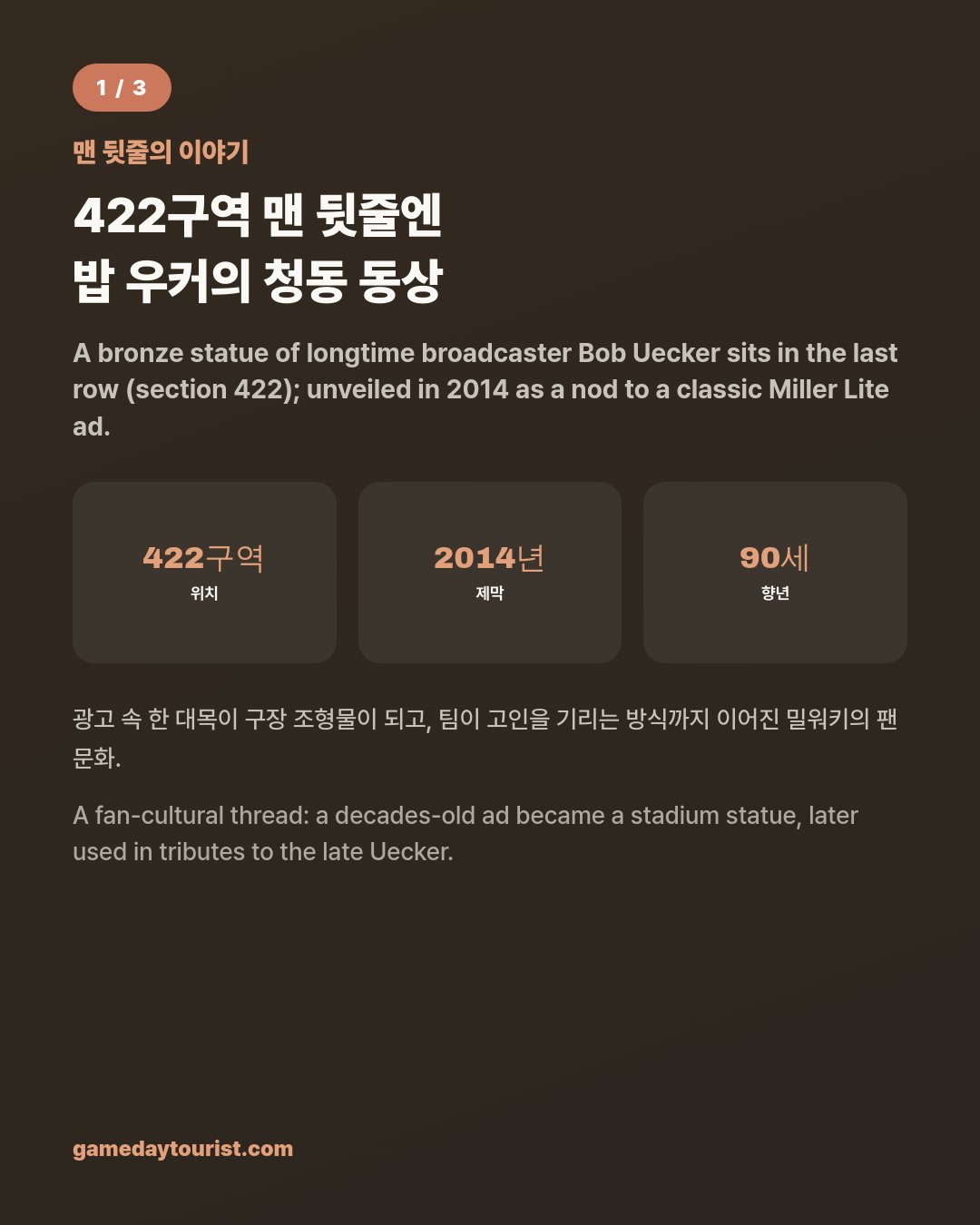
In the very last row of Section 422 in the upper deck, a bronze statue sits with one leg crossed over the other. It is Bob Uecker, who spent decades in the Brewers’ broadcast booth.
The story behind the statue, as MLB.com told it, goes back to Miller Lite ads of the 1970s and ’80s. Uecker insisted, “I must be in the front row!” and always got sent to the cheap seats, and the statue turns that joke into bronze.
The club unveiled it in 2014, and the sculptor is the same artist who made the four statues outside the ballpark. A report from the time says there is an extra seat beside it, set up so that fans who donated to the Brewers Community Foundation and other charities could pose for a photo with him.
Uecker died in January 2025 at the age of 90. At the home opener on March 31, the club spread a tarp over seats in the upper outfield reading “I must be in the front row,” with his signature.
I don’t think you can pay to manufacture a story like this: an ad line from decades ago becomes part of the building, then gets reused to honor the man who delivered it.
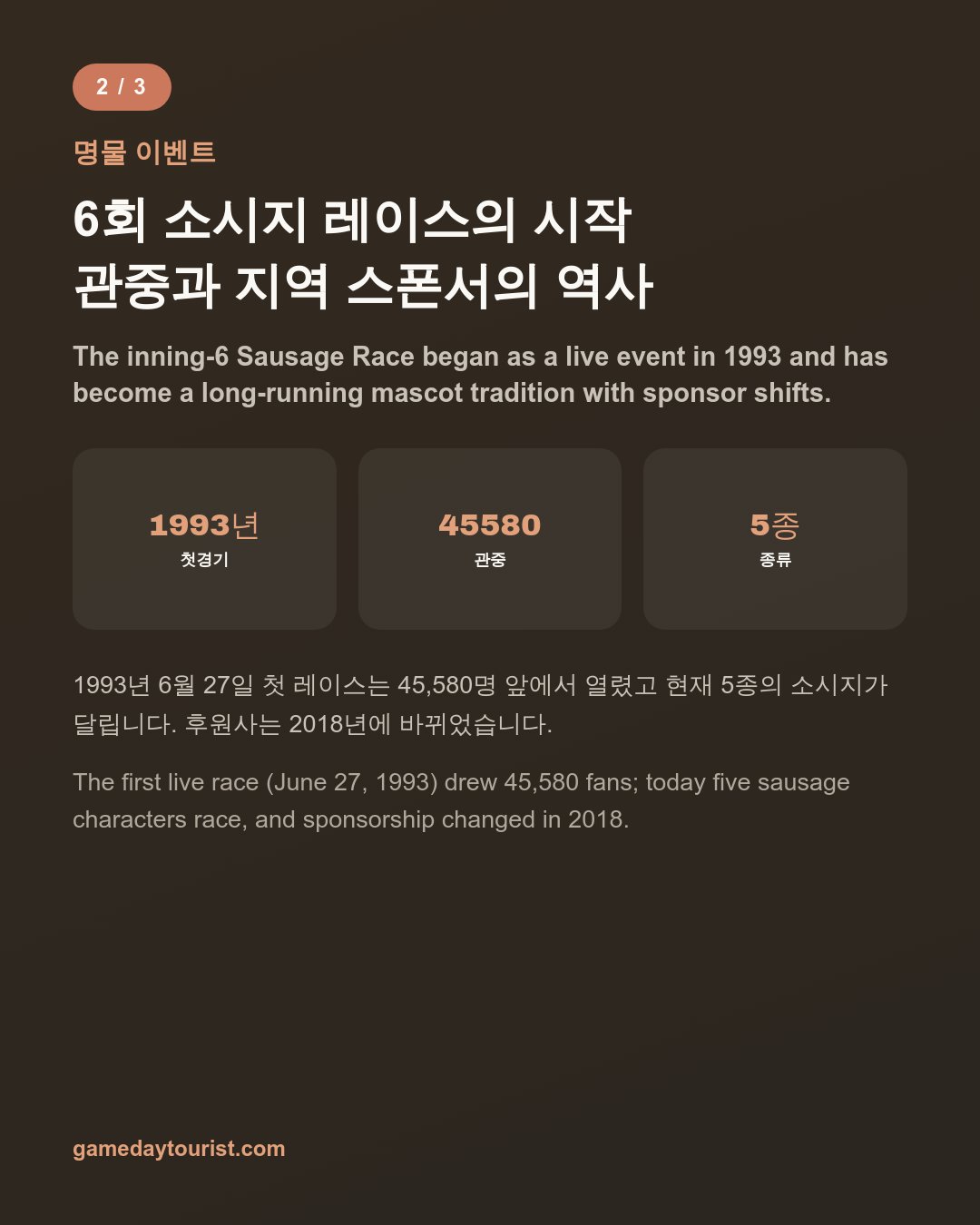
The Sausage Race in the middle of the sixth inning has an even longer history. It began as a cartoon on the County Stadium scoreboard in the early 1990s, and in the fall of 1992 Milwaukee graphic designer Michael Dillon pitched the idea of having people run it live.
The first live race came on June 27, 1993, against the Blue Jays in front of 45,580 fans, and Dillon ran in costumes he had built himself and won that first race (MLB.com). Five sausages race today: the Bratwurst, Polish, Italian, Hot Dog and Chorizo (Wikipedia).
On July 9, 2003, Pittsburgh’s Randall Simon swung a bat at the passing Italian Sausage and knocked over the 19-year-old college student inside. Simon was questioned by police but not charged, and he was fined and suspended for three games.
The student herself said she found it funny, Simon sent her a signed bat, and the tourism board of his native Curaçao gave her a vacation, all of which is still on MLB.com.
There is a sponsorship story, too. The race was sponsored for years by Klement’s Sausage, but in January 2018 the club ended a 25-year relationship and signed with Johnsonville.
Klement’s chief executive told employees the club had broken off talks without warning. A between-innings mascot event was a 25-year sponsorship asset, and watching that relationship come apart is worth chewing on for any sports marketer.
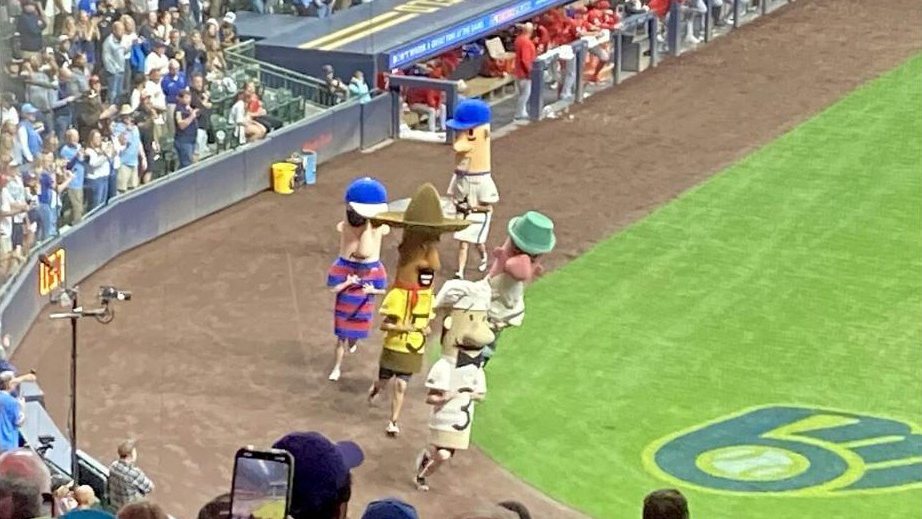
Sausage Race in the sixth inning against Cincinnati, Sept. 26, 2025 · Photo: Michael Barera · Source: Wikimedia Commons · License: CC BY-SA 4.0 · Cropped to 16:9
The Team: A First 100-Win Season and the First World Series in 44 Years
The Brewers began in 1969 as the Seattle Pilots, an American League expansion team, moved to Milwaukee in 1970, played in the American League through 1997 and have been in the National League since 1998. They reached the World Series once before, in 1982, and lost to St. Louis in seven games; they have never won a title.
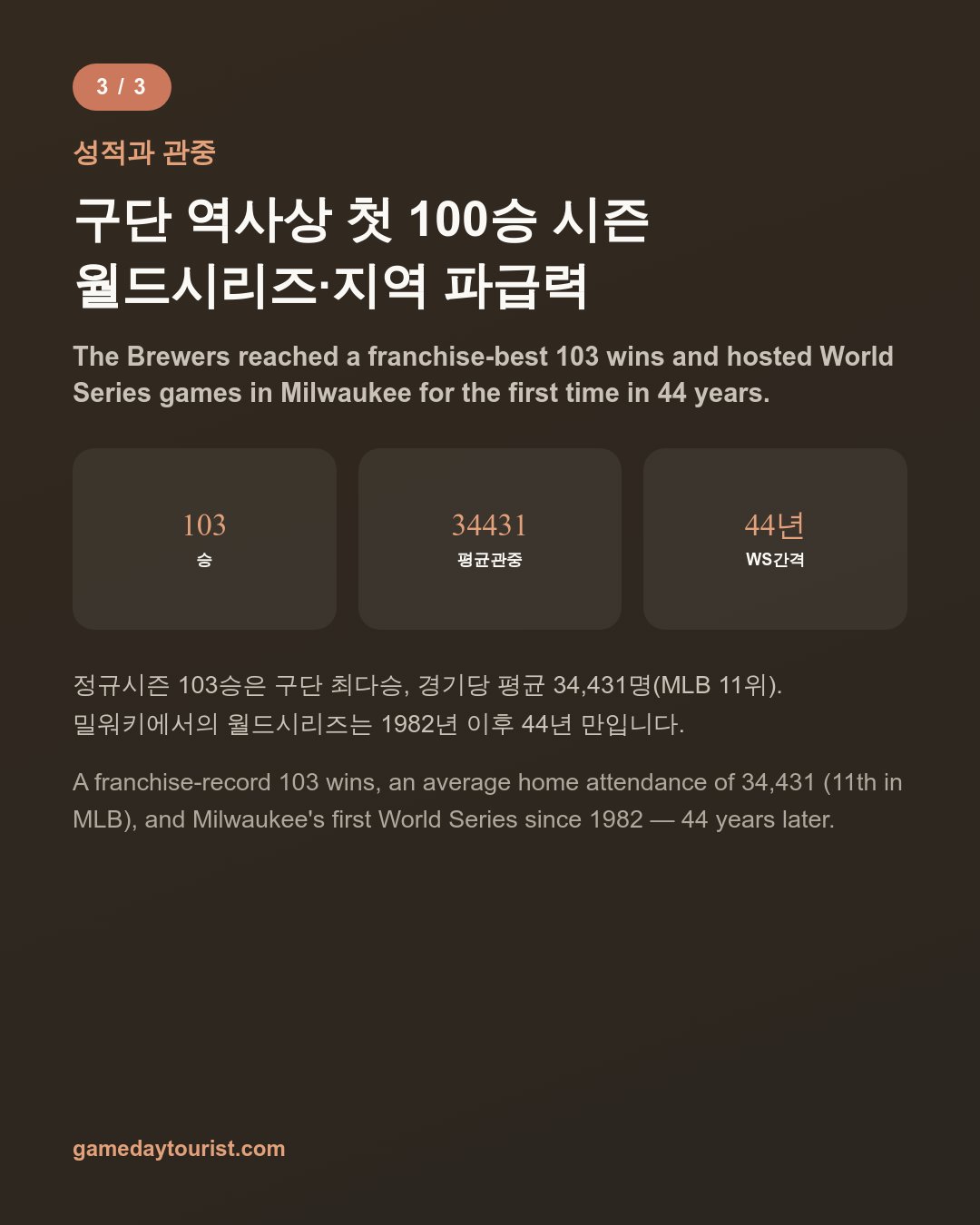
This season’s 103-59 record was the franchise’s first 100-win year and its best ever (Wikipedia), and the team has won the NL Central four years in a row. As the top seed overall, it took World Series home-field advantage, with Games 1, 2, 6 and 7 in Milwaukee.
In the postseason the Brewers beat San Diego in four games in the Division Series and swept the Los Angeles Dodgers 4-0 in the Championship Series (MLB.com). The manager is Pat Murphy, a two-time NL Manager of the Year, who agreed to a new deal in February.
The opponent is the Tampa Bay Rays, the AL’s top seed at 98-64. The two teams met in the regular season from March 30 to April 1, and the Brewers took two of three (MLB.com).
The World Series has tilted toward the Brewers so far. They won Game 1 3-2 and Game 2 5-4, both by a single run, then took Game 3 in Tampa Bay 10-1 (CBS Sports bracket).
As for the fans, a local stadium reviewer wrote in 2024 that they are “fans who support their ball club regardless of record” (Stadium Journey). Tailgating in the parking lots starts about three hours before first pitch.
The club’s rules say tailgating must end 30 minutes after the game starts and everyone has to head inside. Another guide recommends a patient exit plan after the game, since traffic moves slowly when thousands of cars leave at once (North Shore Family Adventures).
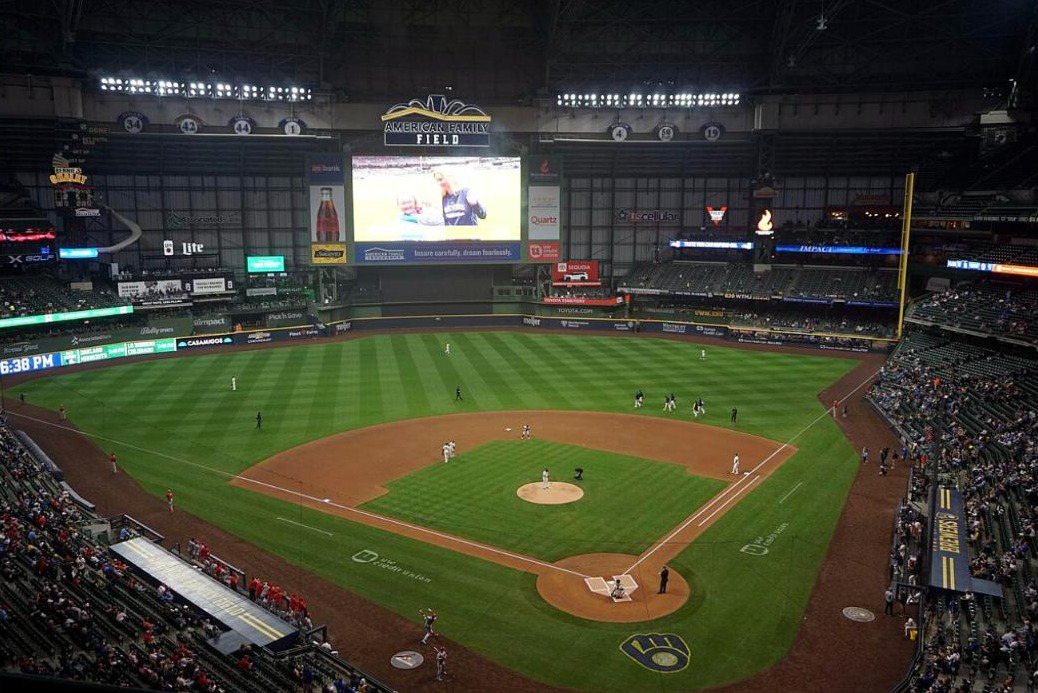
Game against St. Louis, Sept. 27, 2023 · Photo: Michael Barera · Source: Wikimedia Commons · License: CC BY-SA 4.0 · The photo is three years old
Getting to American Family Field and Buying Tickets — Based on Official Club Guidance (Checked Oct. 28, 2026)
Everything below comes from the club’s official pages on transportation, parking, fan rules, security and postseason tickets, which I opened myself on Oct. 28. Where I could not find an item on an official page, I say so.
Rules can change during the World Series, so check the club’s notices again on game day.
Milwaukee’s remaining games are Game 6 (Oct. 30) and Game 7 (Oct. 31), and both are played only if needed. First pitch is at 7 p.m. Central (8 p.m. Eastern) (club postseason ticket page, MLB.com).
The club’s page says to buy single-game tickets only through the club’s site, the MLB Ballpark app or SeatGeek, and warns that tickets from unauthorized third parties may be fake. Payment is by credit card only, and tickets are delivered digitally in the app within 96 hours of the game.
Screenshots and printouts will not get you in, and for the postseason there is no will call, no drop-off for someone else and no name change. If you arrive separately from your group, the club says to send tickets ahead with the Ticket Forward feature.
The club also asks you not to post photos of your tickets online. A barcode can be stolen that way.
The club said from the start that single-game inventory was scarce. A presale for Wisconsin residents began at 10 a.m. on Thursday, Oct. 15, and general sale at 2 p.m., and the club called single-game World Series inventory “extremely limited” (Fox 11).
The club’s page also says a new 2027 season-seat membership earns the right to buy this year’s World Series home tickets. WISN reported on Oct. 20 that Game 1 had sold out on MLB’s website.
Just before the series, the resale market looked like this. In TicketNews figures based on Ticket Club data (Oct. 20), the lowest asking price for Game 1 was $2,920 for standing room and $2,689 for Game 2, while Games 3 and 4 in Tampa Bay started at $730 and $718.
These are asking prices, not prices actually paid. WISN reported the same day that the cheapest SeatGeek listing was $2,917 standing room for Game 1 and $813 for Game 3 at Tropicana Field, so the numbers differ depending on how they are counted.
WISN also reported Milwaukee fans booking flights and hotels to go to Tampa Bay. One couple said flights, two hotel nights and tickets came to about $900 in total.
This guide does not recommend any channel other than the club’s official sellers and the SeatGeek link the club points to. The club says it will not refund tickets bought on the secondary market.
There was still a way in without a ticket. On the days of Games 3 and 4 in Tampa Bay (Oct. 26 and 27, local time), the club opened the ballpark for watch parties, and both sold out.
Watch party tickets were $15 with a limit of six, gates opened at 5 p.m., and net proceeds go to the Brewers Community Foundation. The club said it would announce a Game 5 watch party separately if one is needed.
For World Series home games themselves, the page lists parking lots opening at 3 p.m. and gates at 4 p.m.
I could not find regular-season ticket prices on the official pages I checked. A 2024 Stadium Journey review said that, according to TickPick, prices run from about $5 on weekdays to around $20 on weekends and giveaway nights, but that may not match today’s prices.
I also could not confirm on the official pages whether foreign-issued credit cards are accepted. Please ask the club’s ticket office (tickets@brewers.com, +1 414-902-4000).
Now, getting there. The address is One Brewers Way, Milwaukee, WI 53214, and a 2024 Stadium Journey review put it about 4.3 miles (about 6.9 km) from downtown and recommended driving.
For public transit, the club’s guidance lists two Milwaukee County Transit System (MCTS) routes: the CONNECT bus rapid transit line (stop at Wisconsin Avenue and 44th Street) and Route 18 (stop at National Avenue and 43rd Street). It gives no walking times.
Shuttles run by hotels and bars use a drop-off area near the Home Plate Gate, and the official guidance gives no fares or timetables. Uber and Lyft use a pickup zone at the south end of the Molitor Lot (via Bluemound Road and Yount Drive), and taxis use the transit area outside Helfaer Field.
For bikes there are racks and a Bublr Bikes station with 23 docks. The Wisconsin Department of Transportation runs a ballpark-specific page for the I-94 construction zone.
Parking uses license plate recognition, so there are no cashiers: you either pay in advance and activate on site, or pay on site by QR code. In the postseason only credit cards are accepted, and digital parking passes come through the app.
The official page lists only oversized-vehicle prices (18 to 36 feet), not the price for a regular car. You need a valid game ticket to enter, lots close within one hour after the game, and overnight parking is not allowed.
Cars parked on the street along Milwaukee Road or Wheelhouse Road on game days can be ticketed or towed.
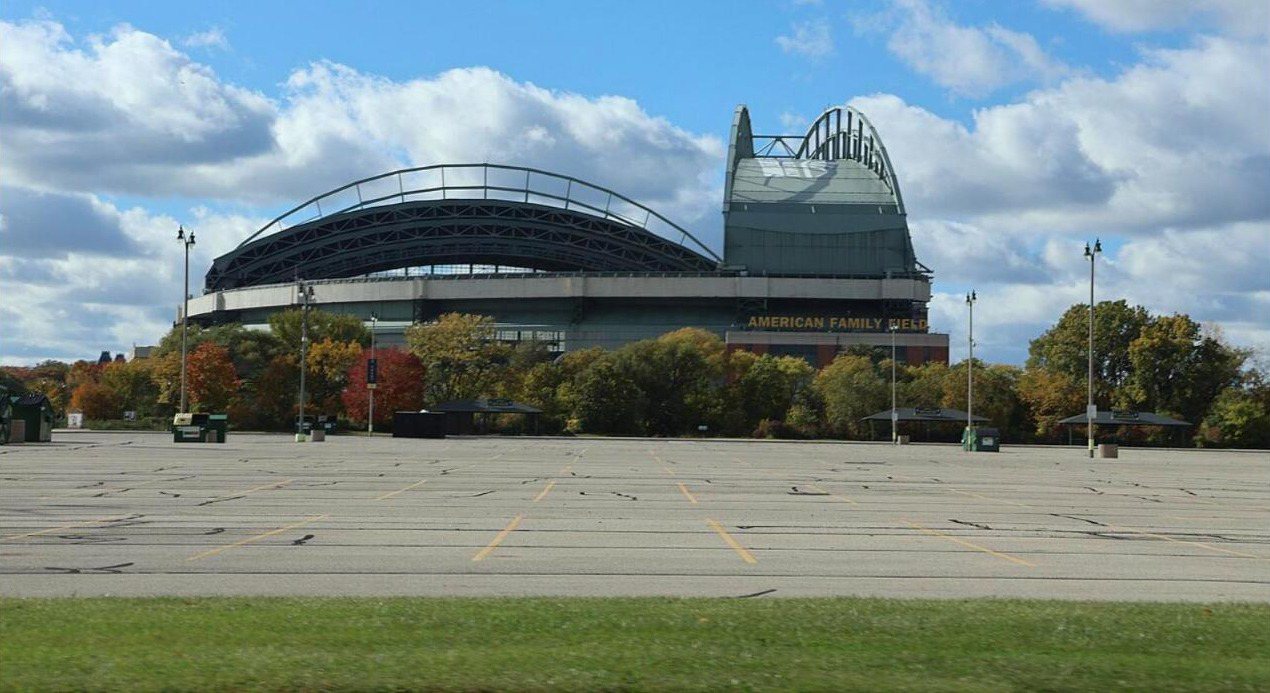
Photographed Oct. 20, 2023 · Photo: DiscoA340 · Source: Wikimedia Commons · License: CC BY-SA 4.0
For entry rules, I’m following the club’s security guidance. Regular-season gates mostly open 90 minutes before the game, and two hours before Opening Day and Saturday home games (fan guide).
For bags, non-clear bags of 9 x 5 x 2 inches (about 23 x 13 x 5 cm) or smaller, single-compartment clear bags of 12 x 12 x 6 inches (about 30 x 30 x 15 cm) or smaller, and one-gallon clear zip bags are allowed. Diaper bags are an exception, up to 16 x 16 x 8 inches.
Backpacks are not allowed at any size, and neither are coolers or multi-compartment bags. Cans, glass and metal containers (including thermoses and tumblers), noisemakers such as whistles, stainless steel straws and aerosol sunscreen are also banned.
Tripods, monopods, camera lenses longer than 8 inches (about 20 cm) and drones are out as well. Food is limited to a sealed non-alcoholic plastic bottle (32 ounces or smaller, one per person) and personal-size snacks such as a sandwich.
Everyone goes through metal detector screening, and you cannot leave and re-enter on the same ticket. Concession stands and stores inside are cashless, taking credit and debit cards, Apple Pay and Google Pay, and there are kiosks that turn cash into a prepaid card.
From a marketer’s point of view, this purchase flow is interesting. Credit cards only, app delivery only, no proxy pickup or name changes, and no refunds on the resale market.
A tightly closed ticket structure can stop counterfeits and scalping, but it raises the bar for buyers. It is also true that, with official inventory short, demand has piled into the resale market.
The club sold a $1,000 brass “Timeless Ticket” back in 2014 and began taking redemption requests for it on Oct. 14 this year (TicketNews), which reads in the same light. It gets fans to prepay a lot of money for a “postseason ticket” years ahead.
According to that report, one fan was confirmed to use his for Game 1, and a ticket redeemed this way cannot be resold.
Attendance — About 34,000 a Game, 11th in the Majors
This season’s regular-season home attendance was 2,788,934, up 5.2% from last year, an average of 34,431 per game, 11th in MLB (81 games). It is the highest regular-season total since 2019.
That trailed the division rival Chicago Cubs (2,969,583, sixth) by 6.1%, and first-place Los Angeles drew 4,034,219. With a capacity of 41,900 (Wikipedia), the regular-season average works out to about 82% full.
The crowds for World Series Games 1 and 2 were 43,250 and 43,245 (ESPN Game 1, Game 2). That is about 8,800 above the regular-season average and above the capacity Wikipedia lists, so I could not confirm whether standing room is included.
The World Series also lifts the city’s economy. Visit Milwaukee puts each postseason home game at about $5 million in economic impact and projects that the World Series could double or triple that.
The group’s chief marketing officer told TMJ4 that a single World Series home game could bring $10 million to $15 million. Both figures are projections made in advance, not actual tallies.
The Ambassador Hotel downtown was booked solid for Games 1 and 2, and local businesses are extending their hours (Spectrum News).
A local reviewer called tickets here among the cheapest in the majors (as of 2024) and said prices rise when the Cubs visit. The club’s own parking price table also puts Cubs games in the same high tier as Opening Day and weekends (based on its oversized-vehicle rates).
That the team’s best season ever still averaged fewer fans than the division rival Cubs strikes me as telling, and my impression is that the club’s pricing, which treats rivalry games as a premium product, is actually quite sophisticated.
Brats, Cheese Curds and an In-Park Brewery — Using the Space and F&B
The ballpark’s biggest structural feature is its fan-shaped roof that opens and closes. It can open or close in under 10 minutes (Wikipedia), and in a northern city that plays baseball in March, April and October, a game that goes ahead in rain or cold is a huge commercial asset.
The food has a strong local flavor. One visitor guide points to a bratwurst with mustard or sauerkraut, fried cheese curds and frozen custard as signature items.
For beer, it lists New Glarus’s Spotted Cow as the pick for out-of-staters, and describes J. Leinenkugel’s Barrel Yard, a pilot brewery inside the park. It says a game ticket is required to get in.
A 2024 Stadium Journey review pointed to four restaurants in the 3rd Street Market Hall Annex and a Local Brews bar serving 24 Wisconsin beers, and gave the food its top score of 5. The same review noted that the park placed second for food in USA Today’s 10Best readers’ poll of MLB stadiums.
It also noted that concession prices run “a tad on the high side.”
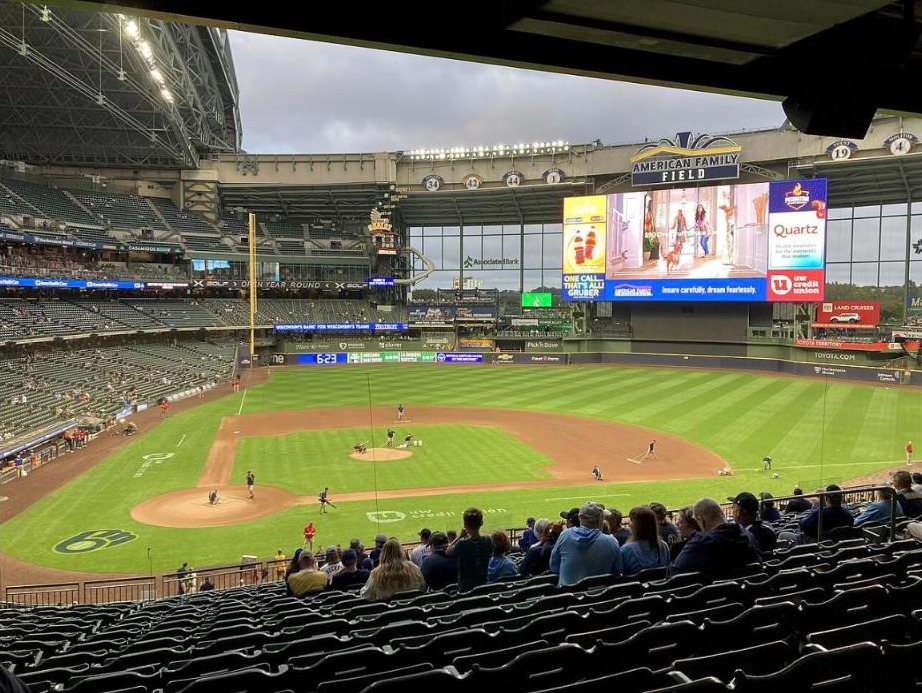
Before the game against Cincinnati, Sept. 26, 2025 · Photo: Michael Barera · Source: Wikimedia Commons · License: CC BY-SA 4.0
The space keeps getting work. Before the 2024 season it gained a larger center-field video board, a right-field board, a food hall and a new team store (Wikipedia), and planned improvements include a winterization project of about $25 million.
As the sponsor signs around the video board in the photo show, there is a lot of sponsor exposure here. A brewery, a food hall and board advertising under one roof give people reasons to eat and drink beyond baseball, which I read as a way to raise time on site and spend per head.
Naming Rights and Sponsors — From Miller to American Family
From its opening in 2001 through 2020, the park was Miller Park. The naming-rights deal with Miller Brewing (the right to put a company’s name on the stadium) ran 20 years for $40 million, or about $2 million a year if split evenly, MLB.com reported.
In January 2019 the club announced a 15-year deal with American Family Insurance, based in Madison, Wisconsin, and the new name took effect in 2021. The price was not disclosed.
The same deal covered naming of the spring training complex in Maryvale, Arizona, which became American Family Fields of Phoenix.
Two things stand out to me as a marketer. One is that a local company bought the stadium name and the camp name together, and the other is that sponsorship is also sold at the level of a single mascot event, like the Sausage Race above.
A naming right buys a big sign, while a race sponsorship buys a memory in the middle of an inning.
The Regional TV Crisis and Stadium Finances — the Owner’s “$20 Million Surprise”
The Brewers’ local broadcasts changed structure this year. Main Street Sports Group, the parent of FanDuel Sports Network Wisconsin, ran into financial trouble and missed payments to several clubs, and the Brewers renewed in November and then backed out.
On Feb. 2 the club announced that MLB would produce and distribute its 2026 games. At the season-opening press conference, owner Mark Attanasio called the change a $20 million “negative surprise” for the club (Front Office Sports, March 27).
That figure combines lost revenue and higher production costs. It reflects a shift from a regional network paying guaranteed rights fees to an MLB-run model where revenue depends on advertising and carriage fees.
The ballpark’s finances rest on public support. Under a bill signed by Wisconsin’s governor on Dec. 5, 2023, the club agreed to stay in Milwaukee through 2050, and public support is reported at around $500 million.
The split varies by outlet. The Wisconsin Examiner reported $500.8 million in total over the lease term (article), while WPR put it at about $387 million from the state and $135 million combined from the city and county.
A surcharge on tickets to non-baseball events such as concerts (mostly starting at $2 and rising to $4 in 2042) is also part of the funding (Urban Milwaukee).
Compared With the KBO — a League That Sells Its Rights in One Place
The regional broadcast shock the Brewers faced looks different in the KBO. The KBO sells its wired and wireless rights at the league level to a single operator.
The 2024-2026 contract was 135 billion won over three years (45 billion won a year on average) (Herald Business), and a report on Aug. 6 said CJ ENM would secure the exclusive five-year rights for 2027-2031. The amount was not disclosed, the contract had not yet been signed at the time of the report, and I could not confirm whether it was finalized afterward.
My reading is that bundling broadcast rights at the league level makes it less likely that one regional broadcaster’s financial trouble will shake a single club’s cash flow. But I could not confirm in this piece how that income is distributed to clubs, so it is hard to say which model is better.
What Milwaukee shows is that a single club can see $20 million swing from a change in broadcast structure alone. At the same time, the fact that the same club averages around 34,000 a game and has reached the World Series says how solid an asset local roots can be.
Leave a Reply