Contents · About 12 min read
- McCovey Cove, Where a Home Run Only Counts If It Lands in the Water
- What Kind of Team the Giants Are — From New York in 1883 to 65-97 in 2026
- Attendance and Tickets — Why the Club Was Nervous Despite 2.85 Million Fans
- Using the Space and F&B — Garlic Fries, Crab Sandwiches and a Narrow Concourse
- Naming Rights and Club Structure — The Price of a Name on a Privately Funded Ballpark
- Compared with the KBO
📱 View as card news
65 wins, 97 losses. That is the final record of Jung Hoo Lee’s team, the San Francisco Giants, for the 2026 regular season (Baseball-Reference team record).
Lee finished with a .276 average, 10 home runs and 57 RBI in 143 games. He was placed on the injured list on September 21 after taking a foul ball off the groin, and a local outlet reported that after the season he was cleared with no concerns about his return.
One piece of marketing from the final month of this season has stayed with me. It was an offer to season-ticket holders: come to a September home game in person and get a credit toward next season’s tickets, 15% to start and another 5% if the team won.
I wanted to know what card a pro club can play for its fans in a season that has fallen apart, so as a working marketer I decided to lay out the story of Oracle Park from the beginning.
I’ll go through, mostly by the numbers, how the ballpark’s name was sold, what stories its waterfront setting created, and what happened in the stands this year.
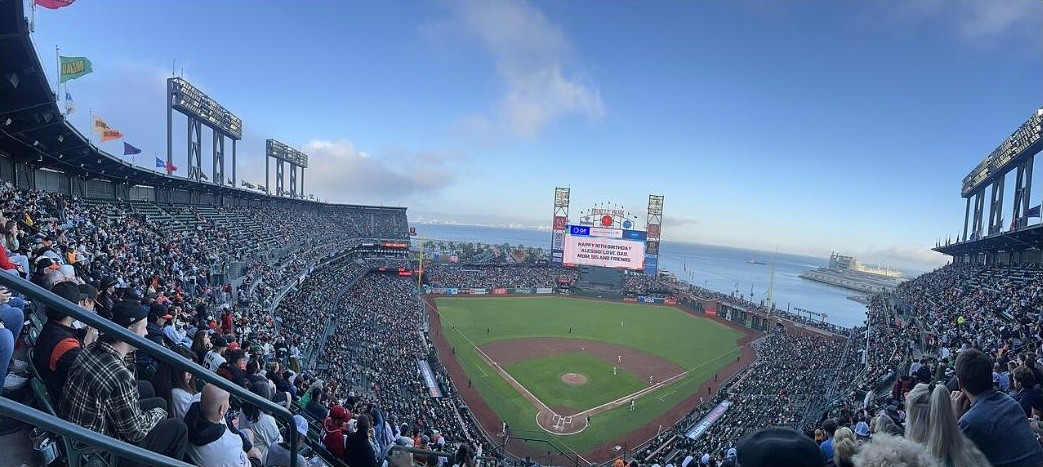
Photo: Fastily, July 26, 2023 · Source: Wikimedia Commons original file page · License: CC BY-SA 4.0 · The bay stretching out beyond the outfield
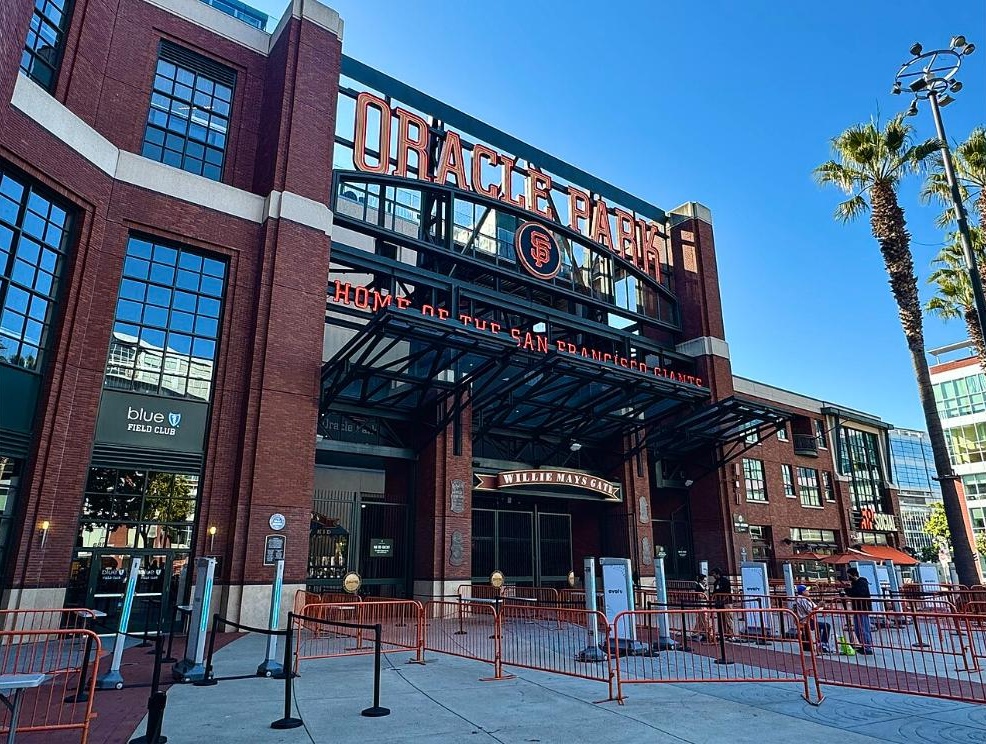
Photo: Missvain (Sarah Stierch), August 31, 2025 · Source: Wikimedia Commons original file page · License: CC0 public domain dedication · The area around the Willie Mays Gate (main entrance)
McCovey Cove, Where a Home Run Only Counts If It Lands in the Water
Beyond the right-field wall of Oracle Park lies a small bay. Its official name is China Basin, but baseball fans call it McCovey Cove, a name that didn’t come from the club but from newspaper columnists.
According to Wikipedia, Mark Purdy of the San Jose Mercury News floated names like “McCovey Channel,” and Leonard Koppett of the Oakland Tribune came up with the more lyrical “McCovey Cove,” which stuck. It has never been an official name, but the bay, named for club legend Willie McCovey, has become the face of the ballpark.
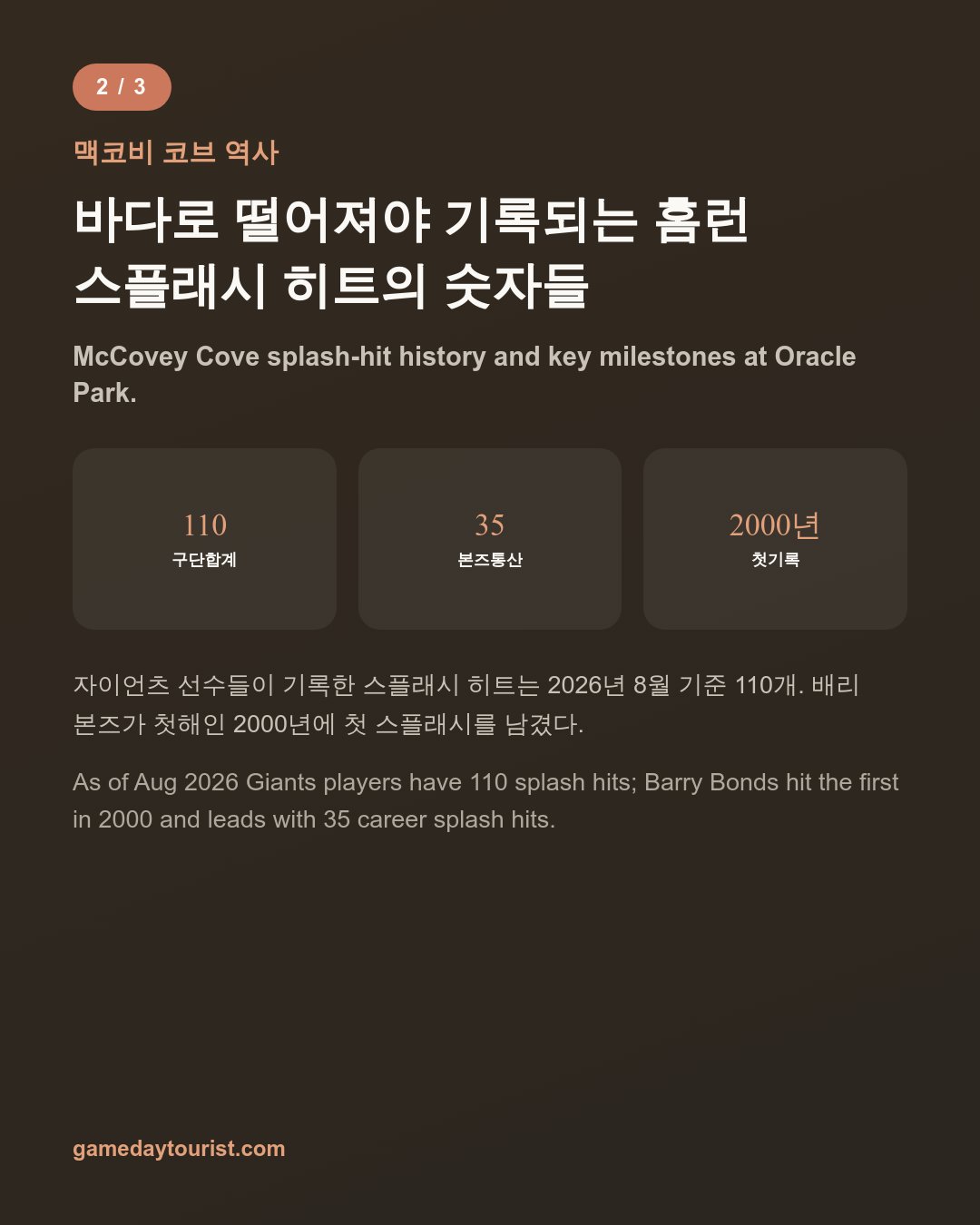
A home run that drops straight into the water there is called a splash hit. The first one came in the park’s opening year, on May 1, 2000, off the bat of Barry Bonds, and Bonds leads the category by a wide margin with 35 in his career.
Wikipedia’s Oracle Park article puts the number of splash hits by Giants players at 110 as of August 2026. The story that Bonds’s 500th career home run (April 17, 2001) was a splash hit is a famous one too.
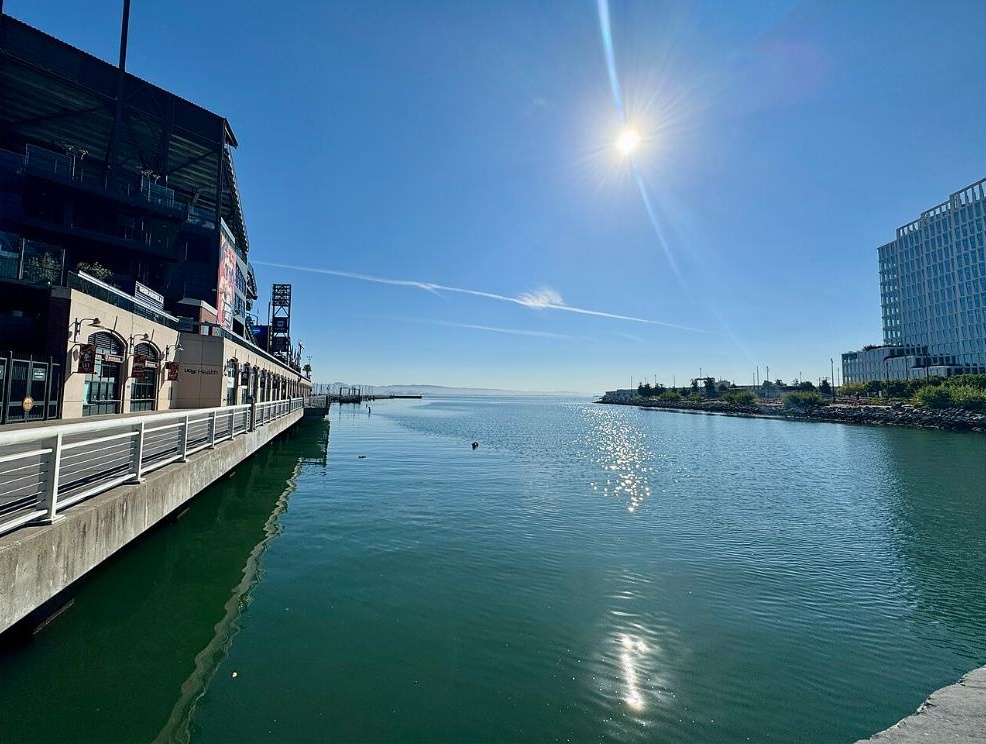
Photo: Missvain (Sarah Stierch), August 31, 2025 · Source: Wikimedia Commons original file page · License: CC0 public domain dedication · McCovey Cove beyond the right-field wall
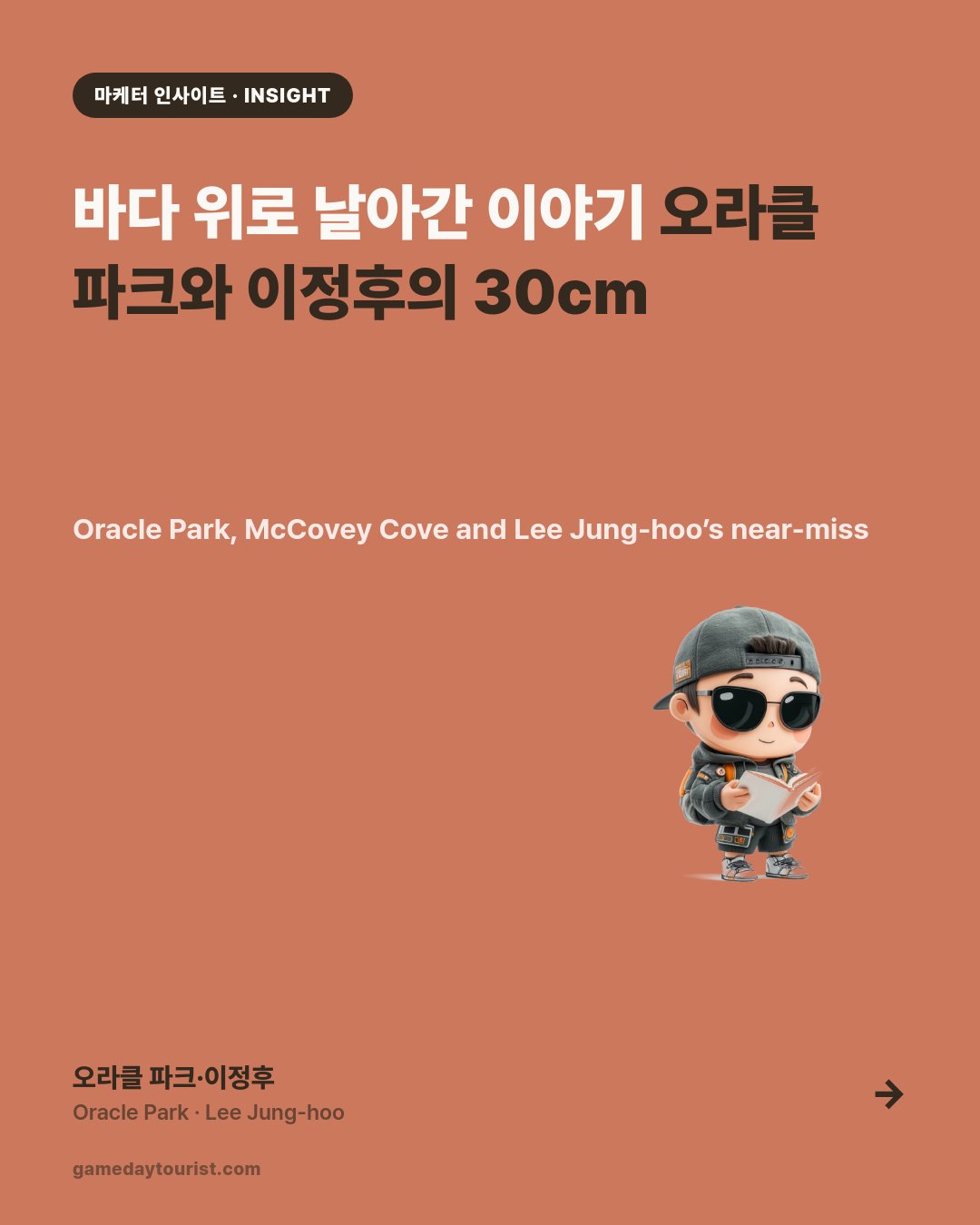
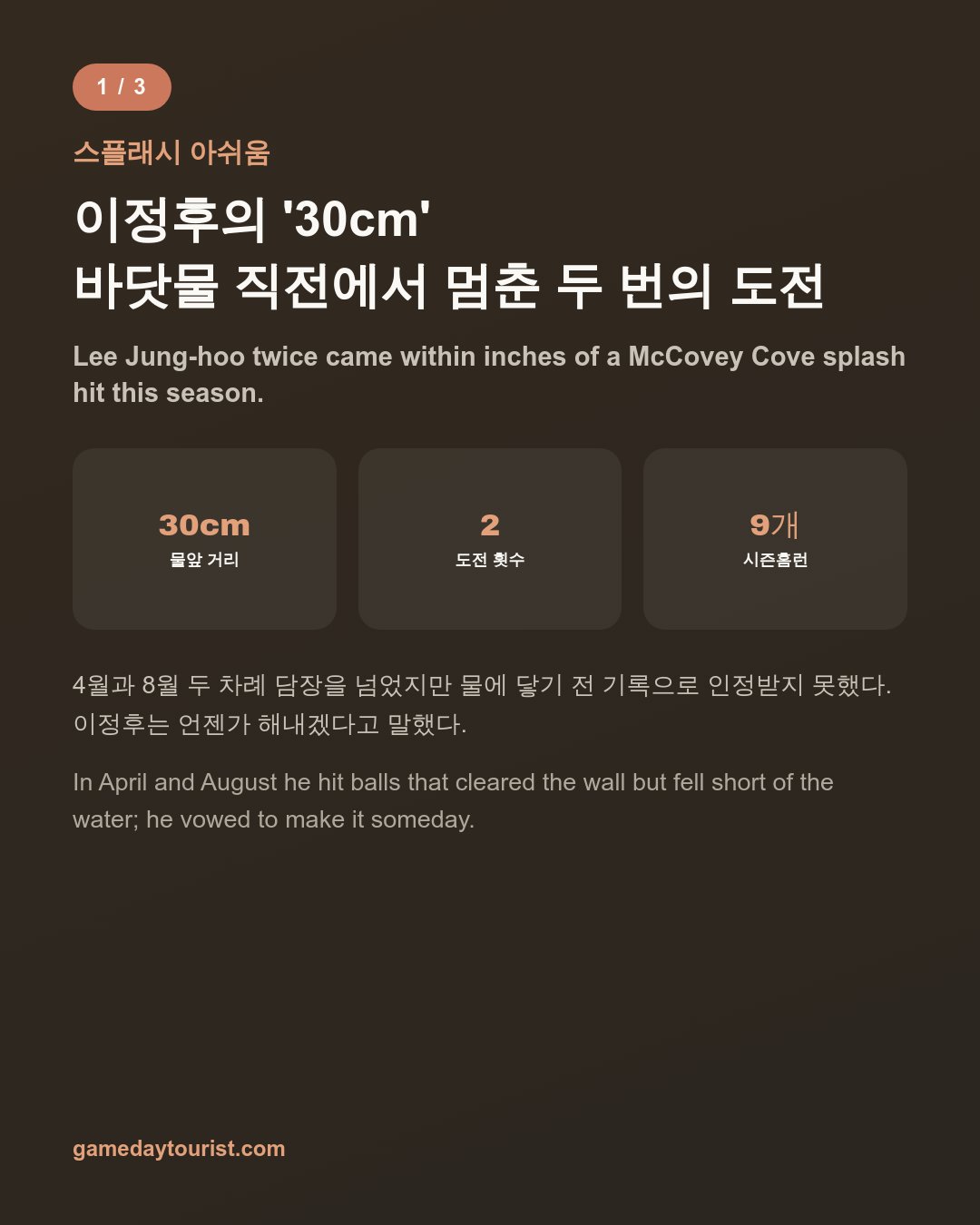
For Korean readers, this story is special because of Jung Hoo Lee. Reports kept saying he nearly became the first Korean to hit a splash hit, and this year alone he came within a whisker twice.
An April ball against Miami in the eighth inning cleared the wall but hit the walkway before reaching the water and did not count (MK Sports), and on August 10 against Houston, a solo shot in the fifth (his 9th of the season) hit the railing and bounced back 30 centimeters short of the water.
Both times, Lee didn’t hide his disappointment, but said in essence that he’d get one someday.
On game days, kayaks and boats gather on the bay. People even bring nets to scoop up home run balls, or so the story goes.
A kayak rental company near the ballpark sends customers out in 15-minute increments starting 30 minutes before first pitch, at $45 an hour for a single and $60 for a tandem, according to its guide.
And at the March 25 opener streamed on Netflix, local reporting said 73 kayaks with the Netflix logo were put on the bay to mark Bonds’s 73 home runs in a single season.
What I envied most as a marketer was this. Without selling a single seat, the sea outside the ballpark becomes an experience product, and the club’s identity gets exposure on the broadcast all on its own.
Korean outlets put “30 cm” in headlines for Lee’s second try, which shows that this story is also consumed apart from the game result. It means that even in a bottom-of-the-table season, the club already has stories to sell built into the ballpark.
What Kind of Team the Giants Are — From New York in 1883 to 65-97 in 2026
The Giants were founded in 1883 in New York as the Gothams and moved to San Francisco in 1958.
They have won eight World Series titles (1905, 1921, 1922, 1933, 1954, 2010, 2012 and 2014) and 23 National League pennants, and their rivalry with the Dodgers, which goes back to the New York years, is described as one of the oldest in team sports (Wikipedia club article).
The current team is in the middle of change. This year the Giants are managed by Tony Vitello, hired straight from a college program (Tennessee) with no professional coaching experience (Wikipedia 2026 season article), and the president of baseball operations is Buster Posey, the catcher who won three World Series as a player (SF Standard).
Lee joined in December 2023 on a six-year, $113 million contract, and this year he hit .276 with a .724 OPS (on-base plus slugging, a summary hitting measure).
Rafael Devers hit 37 home runs, but the team’s results didn’t follow, and the club was eliminated from postseason contention on September 6, its fifth straight year without October baseball. There was also Korean reporting that several regulars left the team around the trade deadline.
Tips for visiting are simple. Many guides say the evenings stay chilly even in summer at this bayside park, so I’d suggest dressing in layers.
For transport, Caltrain’s 4th and King station is within walking distance, so public transit is recommended, and parking is described as limited and expensive (Stadium Journey).
The fan group for Lee, “Hoo Lee Gans,” started in early 2025 with 51 members (Lee’s jersey number), and more than 100 showed up for Korean Heritage Night in May, when Lee hit a three-run homer (Korea Times, May 2025).
Attendance and Tickets — Why the Club Was Nervous Despite 2.85 Million Fans
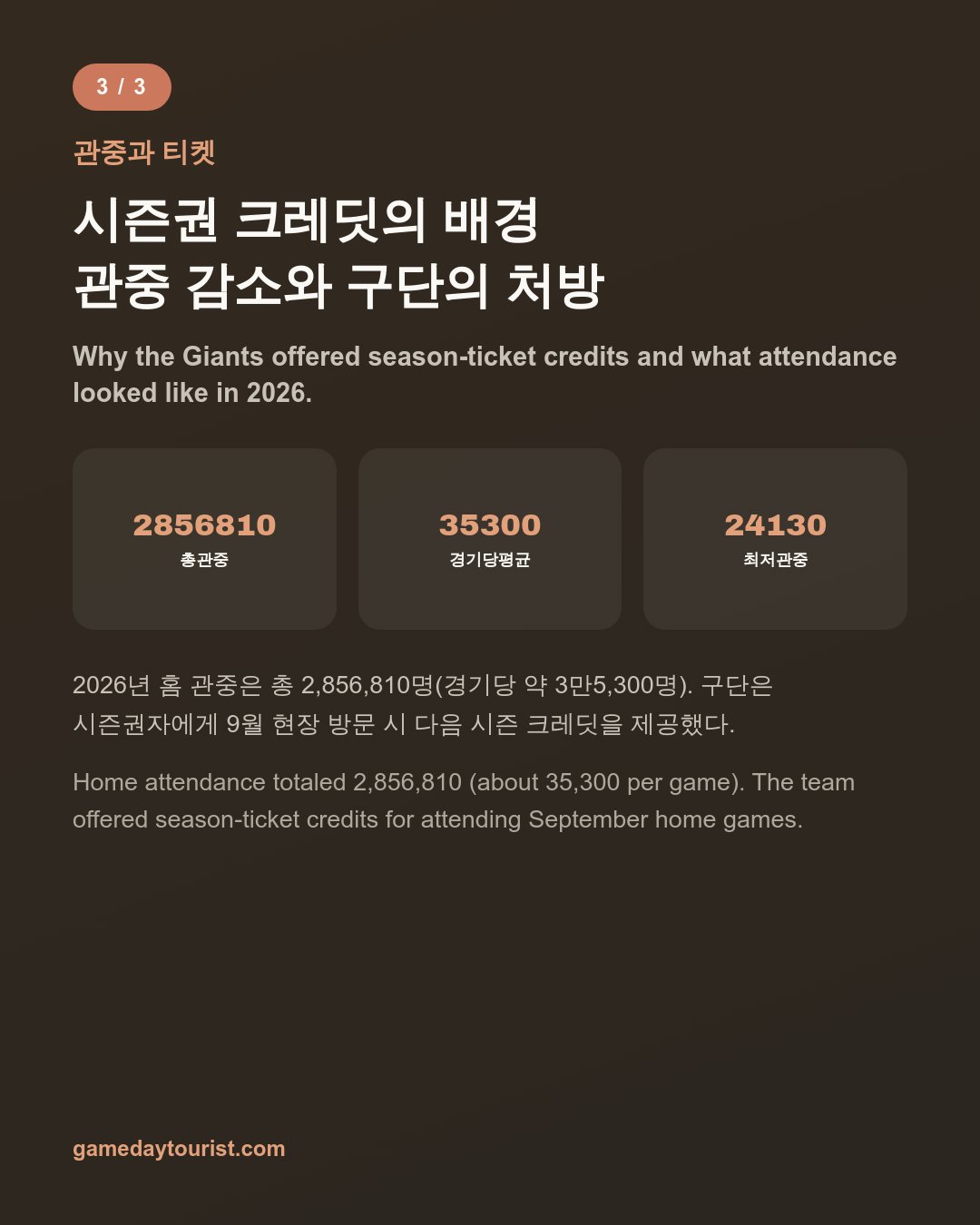
Home attendance this year totaled 2,856,810, fifth among the 15 National League teams (Baseball-Reference).
Divided by 81 games, that is about 35,300 a game, but that average is my own calculation, so it may differ slightly from the club’s official figure.
The 2025 average was about 36,100, so that is a drop of around 2%, and by month it slid from about 37,000 in April to under 32,000 in August and about 32,500 in September (Around the Foghorn).
The season low was 24,130 for a late-August weekday game. This is a ballpark that had a streak of 530 consecutive sellouts from October 2010 to July 2017 (Wikipedia, Oracle Park), which makes the drop feel bigger.
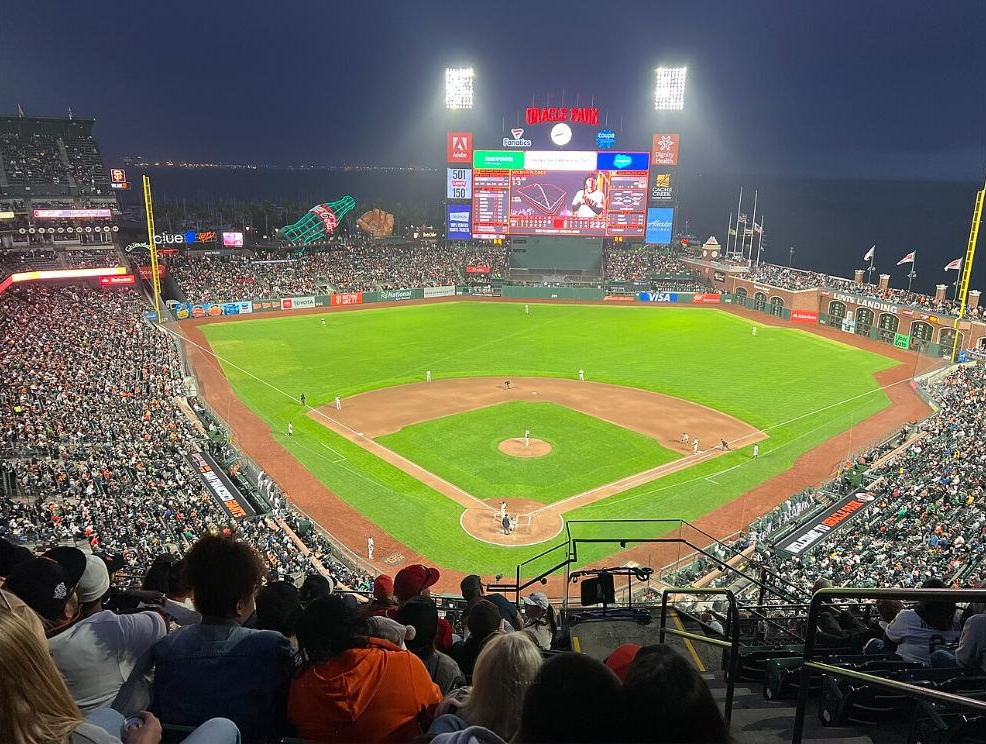
Photo: Fastily, July 26, 2023 · Source: Wikimedia Commons original file page · License: CC BY-SA 4.0 · Cropped from the original · The stands, the center-field scoreboard and the bay beyond the outfield during a night game
The signs were there from opening night. The March 25 opener against the Yankees was the first MLB opener streamed exclusively by Netflix, and its 2.97 million U.S. viewers made it the most-watched opener since 2017, excluding the shortened 2020 season (Sports Media Watch).
Even so, tickets were still available at the box office six days before the game, and reporting noted that the lowest standing-room price fell from $97 to $69 in 36 hours. Attendance that night was 40,856 (SF Standard).
The September credit was the prescription that came at the end of that trend. Here are the terms as reported by Yahoo Sports in the U.S.
A season-ticket holder who attends in person the six home games in mid-to-late September against St. Louis and Minnesota gets 15% of the ticket price back as credit, plus 5% more if the Giants win, for up to 20%. On a $100 ticket, that is $15 to $20 per game, or $90 to $120 if you attend all six.
It is account credit usable only on future purchases, not cash, and tickets resold on secondary sites are excluded (Yahoo Sports). Reports differ slightly on the series dates, so I haven’t given exact dates.
In an email to season-ticket holders, the club explained, in essence, that with school back in session it is hard to draw crowds to weekday games.
Around the same time, a device aimed at regular fans appeared on the club’s official website. If you buy a ticket to a September home game, you get a “Fan Appreciation Voucher” good for a March-May 2027 home game (official club page).
The official offers list also includes $16 “Fan Value Games” and student tickets starting at $10 (club ticket offers page).
Adding my own reading, the two programs aim at different things. The season-ticket credit looks like a device to pull already-paying loyal customers into the ballpark so they spend on beer, food and parking right there.
The baseball blog Around the Foghorn made a similar point, noting that the club is worried enough about empty seats to give credit just for showing up. The voucher, by contrast, is a kind of rebooking: it turns a ticket bought in September into demand for early games next year.
It also stands out that in both cases no cash goes out and the value can only be used on the next purchase, and from the club’s side I read it as a design that fills empty seats while locking in repeat purchases.
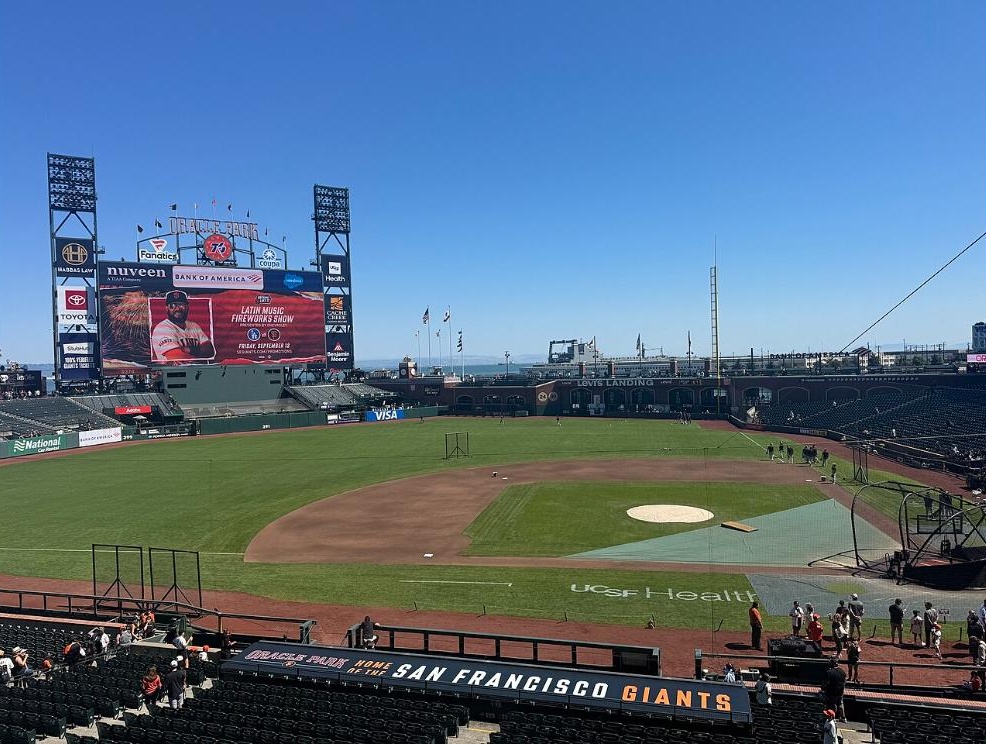
Photo: Missvain (Sarah Stierch), August 30, 2025 · Source: Wikimedia Commons original file page · License: CC0 public domain dedication · The scoreboard and outfield seen from the infield stands before a game
Using the Space and F&B — Garlic Fries, Crab Sandwiches and a Narrow Concourse
The food at Oracle Park has a clear local flavor. Garlic fries tossed with garlic from Gilroy, California, are known to have started at Giants home games and spread to other ballparks, and the Dungeness crab sandwich and the Ghirardelli ice cream sundae are signature items too.
One U.S. ballpark review site sums it up by saying most items run $12 to $18, with the signature crab sandwich costing more, and notes that lines are long at the popular stands (Stadium Journey).
Ahead of this year’s opener, new items were added, including a birria grilled cheese, a char siu hot dog and bulgogi rice bowls (ABC7 report). At Korean Heritage Night in 2025, kimchi fries and a bulgogi quesadilla were on offer (Korea Times).
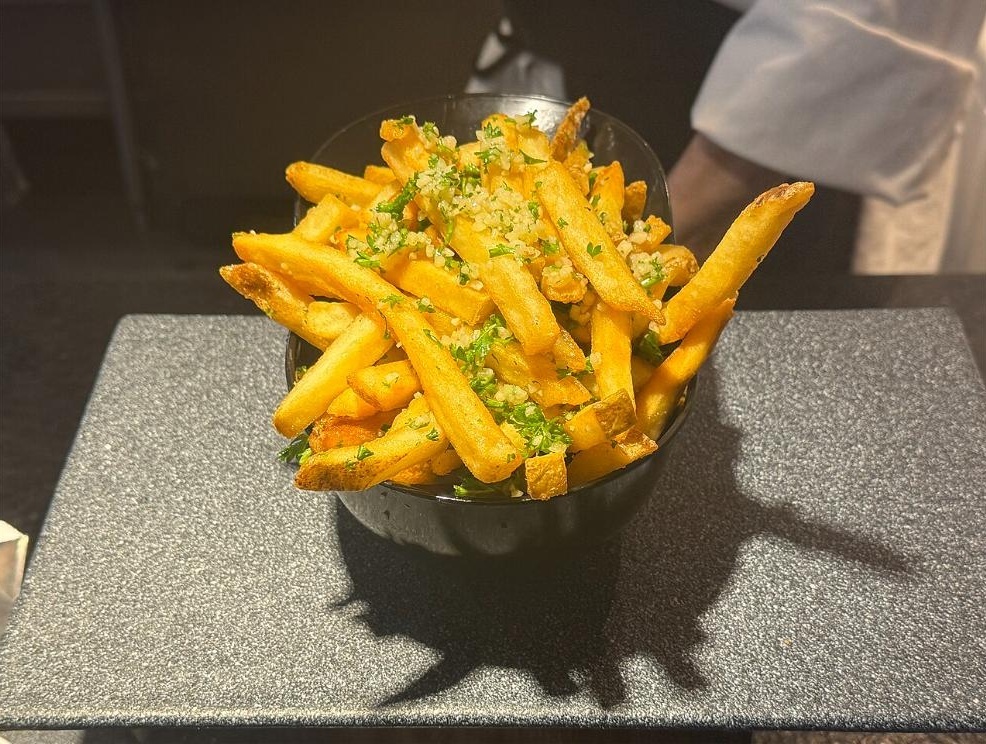
Photo: Missvain (Sarah Stierch), August 30, 2025 · Source: Wikimedia Commons original file page · License: CC0 public domain dedication · Gilroy garlic fries served at a club-level stand
The premium spaces deserve a look too. The center-field bleachers have “The 415” membership, which includes $199 of ticket credit and lets members buy standing-room and section tickets at member pricing (official club FAQ).
On the downside, ballpark reviews single out the narrow concourse (the passage under the stands) as pretty much the only flaw. So watching the strategy of filling weekday games with credits, I had this thought.
The more people come, the more food spending has to grow, but if the walkways are narrow, that spending can hit a bottleneck. I was reminded that marketing that drives spending and a layout that can absorb it have to go together.
Naming Rights and Club Structure — The Price of a Name on a Privately Funded Ballpark
Oracle Park is a place that sold its name from the construction stage. In 1996, four years before it opened, Pacific Telesis bought the naming rights (the right to put a company’s name on a facility) to raise part of the construction cost, and the park later went through SBC Park and AT&T Park.
In January 2019, with AT&T’s contract ended early, a 20-year deal with Oracle was struck (Yahoo Sports). There has been no official announcement of the amount, only media estimates, so I haven’t given a figure here.
The way it was built is unusual too. The total cost was $357 million, and it is regarded as the first MLB ballpark built without public funds since Dodger Stadium in 1962.
However, the same document notes a $10 million tax abatement and about $80 million in infrastructure support, so it is hard to call it “entirely private construction” (Wikipedia, Oracle Park).
The ownership structure began as an 18-investor group that bought the club for $100 million in 1993, and it is now an ownership group of 36 partners; in March 2025 the private equity firm Sixth Street bought a 10% stake. The club is valued at roughly $4.05 billion to $4.36 billion (SF Standard).
From this I read a structure that leaves the club little choice but to be aggressive about commercializing space. Part of the construction cost was raised in advance through the name, and the ownership has grown into a form with more investment partners, so my interpretation is that everything that can be sold in and around the ballpark is designed to be sold.
It is only my own inference, but I think it is background that explains why this season’s credits and vouchers reach for variables beyond the seats themselves.
Compared with the KBO
This year, as of October 1, the KBO has drawn 12,069,596 fans over 684 games, topping 12 million for the second straight year, averaging 17,646 a game with 319 sellouts (46.6%) and 85% seat occupancy (Ilgan Sports).
By team, Samsung led with 1,597,050 at home (23,486 a game). Dividing the Giants’ average of about 35,300 by Oracle Park’s capacity of 41,331 (Stadium Journey) gives a season average occupancy of about 85%, which on the numbers alone is the same as the KBO average.
But the meaning is completely different. The KBO’s 85% is the average of a boom of historic proportions, while the Giants’ 85% is the average of a season that slid from about 90% in April to about 77-79% in August and September.
This occupancy figure is my own calculation, dividing the monthly average attendance mentioned earlier by capacity. Depending on which direction the curve was heading when the same number came out, the marketing task is the opposite.
In a boom, the task is how to sell sellouts at higher prices; in a decline, it is how to stop seats from emptying and fans from drifting away.
As far as I have been able to find, no KBO club has officially offered season-ticket holders credit toward the next season because of poor results. The current boom won’t last forever, so I think there is value in designing tools in advance for when attendance turns down.
That said, no figures have been published yet on how much the Giants’ credit actually raised weekday attendance and in-park spending, so it is too early to call the effect.
The season is over, but Lee still has those 30 centimeters to find. The day that ball clears the railing of the walkway and drops into McCovey Cove, Oracle Park will get the most valuable marketing material of the year.
Leave a Reply