Contents · About 14 min read
- The Outfield Where Rival Light Sticks Used to Drift Over, and Now Ours Outnumber Them — One Line from Manager Lee Kang-chul
- About the Team — From a Name Meaning “Wizard” to a Second Regular-Season Title
- The Moment the Title Was Won — A 9-0 Win Over Lotte and a Samsung Loss on October 5
- Attendance and Tickets — 840,000 → 970,000 → 1 Million, with a Ceiling of 18,700 Seats
- Using the Space and F&B — Turning a 1989 Ballpark into a Place to Stay
- Water Festival, BeatBat and Mirror Ball Time — Standing Out by Trying Things First
- Merchandise and Ad Inventory — A Store Outside the Ballpark and Self-Checkout
- Local Ties and How the Ballpark Is Run — City-Owned, Free Use for 25 Years
- Compared with Other KBO Clubs and Overseas Examples
📱 View as card news
Yesterday was a day the kt wiz will remember for a long time.
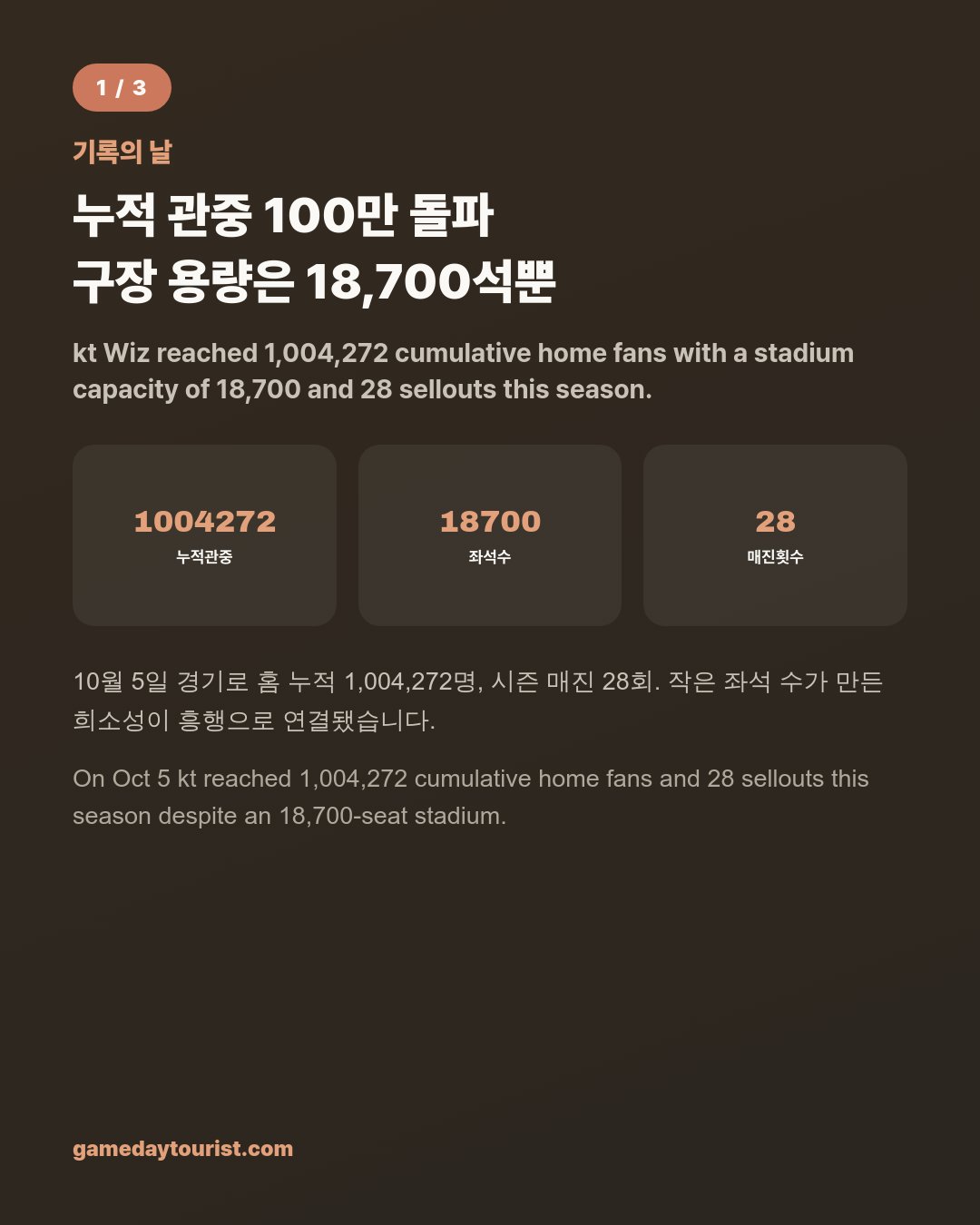
On the afternoon of October 5, all 18,700 seats at kt wiz Park in Suwon were sold. It was the 28th sellout of the season, and with that game the club’s home attendance stood at 1,004,272.
It is the first time the kt wiz, founded in 2013, have topped one million at home. The same day they also clinched the regular-season title, so a performance record and an attendance record landed in the same ballpark at once.
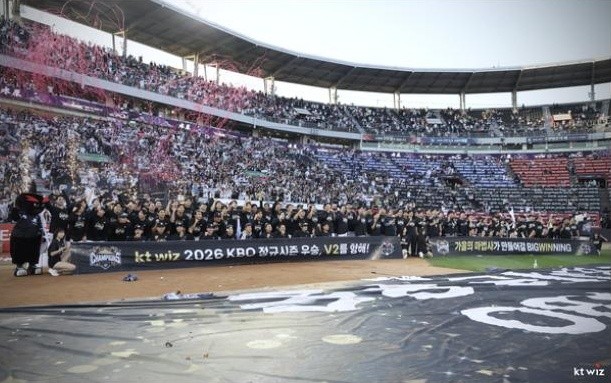
kt wiz players and club staff gathered at kt wiz Park in Suwon right after clinching the 2026 regular-season title (October 5, 2026) · Photo: courtesy of kt wiz · Source: Kyeongin Ilbo article photo
Looking at it as a club marketer, I think the attendance number will outlast the title. A title becomes a line in the record books once the season ends, but a ballpark that has welcomed its first million fans becomes a baseline for next year’s season-ticket sales and sponsor talks.
And this number came from a ballpark with only 18,700 seats. Let’s look at how that was possible, from the stadium side and the operating side.
The Outfield Where Rival Light Sticks Used to Drift Over, and Now Ours Outnumber Them — One Line from Manager Lee Kang-chul
After the October 4 game against Lotte ended 2-2 in 11 innings, Manager Lee Kang-chul said something that was captured in Money Today’s post-game report.
He said that in the past, when he looked out at the outfield, the other team’s light sticks often drifted into this section, but these days far more kt light sticks are visible.
He added that back when crowds were small, the chatter on the bench carried all the way to the stands, and the coaches had to tell people to keep it down. And the mood that once treated anyone in a baseball jersey as an oddity has flipped, so that someone not wearing one now feels out of place.
It wasn’t always like this. In 2015, the club’s first year in the top division, the home-opening exhibition game was free and more than 20,000 people filled the ballpark.
Even inside the club, some saw that as the result of free admission and curiosity about a new team, Kyeonggi Ilbo reported at the time. As of August 25 that year, cumulative attendance was 521,091, sixth among the ten clubs and ahead of Hanwha at 506,553.
The season target was 600,000. Eleven years later, the same ballpark passed one million in a single season.
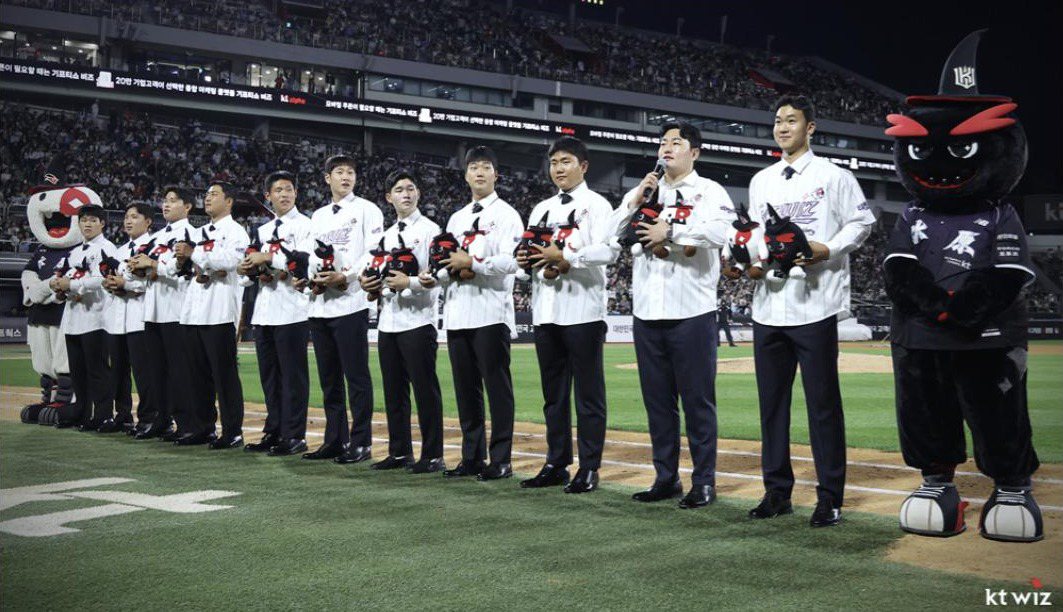
The 2027 rookie class visits kt wiz Park during the October 4, 2026 game against Lotte (the season’s 27th sellout) · Players and club mascots on the field · Source: kt wiz official website, wiz Photo (events)
About the Team — From a Name Meaning “Wizard” to a Second Regular-Season Title
Suwon Baseball Stadium opened in 1989, and from 2000 until the team folded after 2007, the Hyundai Unicorns used it as a temporary home. After that Suwon had no pro baseball team until the league’s tenth club arrived in 2013, and the name announced on May 7 that year was “KT Wiz.”
The club explained that it carries the meaning of a person of uncommon skill and extraordinary talent, a master, and about 32,000 people entered the naming contest. It can also be read as short for “Wizard.”
For a long time the results were poor. From 2015 to 2018 the club finished 10th, 10th, 10th and 9th.
Things changed after Lee Kang-chul became manager in 2019: second place and a first postseason in 2020, then in 2021 a win over Samsung in the tiebreaker for first place, followed by a four-game sweep of Doosan in the Korean Series for the club’s first championship.
In 2025 they finished sixth and missed the postseason. This year they led the standings behind a lineup that added Kim Hyun-soo, Choi Won-joon and Han Seung-taek, and as of October 4 they were 85-49 with 5 ties, 3.5 games ahead of second-place Samsung.
The October 5 game clinched the regular-season title and a direct spot in the Korean Series for the first time in five years.
A few words on visiting. The stadium sits inside the Suwon Sports Complex, and foreign visitors’ reviews mention limited subway access, along with crowded buses back to Seoul after the game.
Food orders go through a QR menu, and reviewers describe prices as similar to those outside the ballpark. One reviewer says visitors spend about four hours at the park on average.
Tickets are handled through the club’s official app, Wizzap.
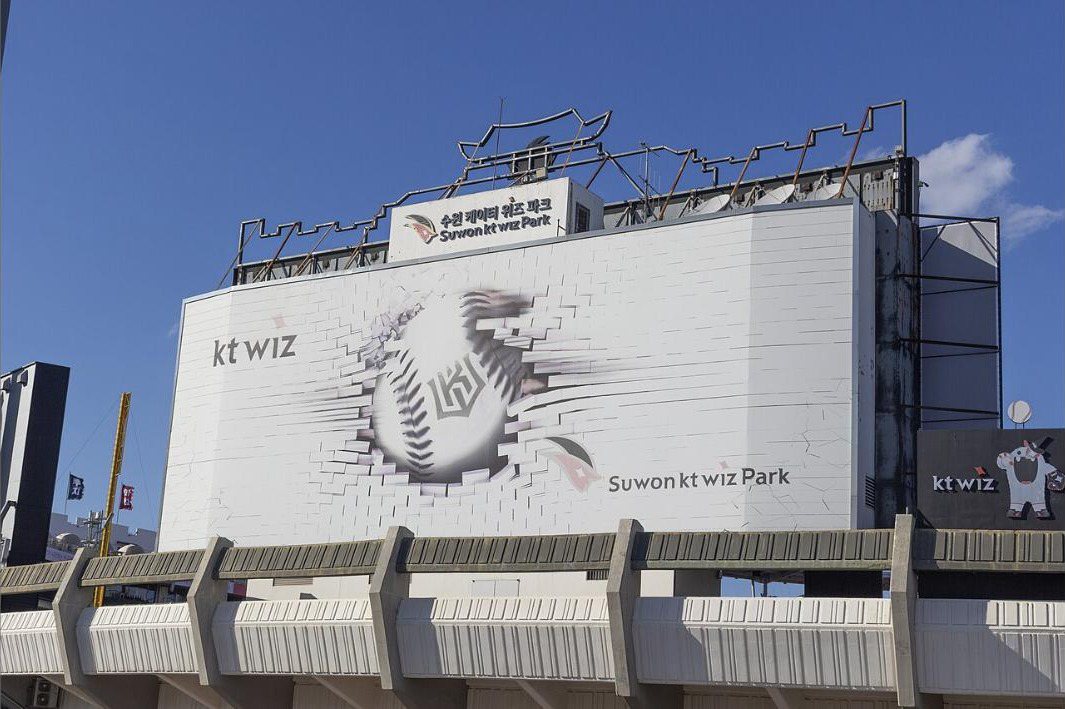
Exterior of kt wiz Park in Suwon (photographed March 29, 2025) · Photo: Nt · Source: Wikimedia Commons · License: CC BY 4.0
The Moment the Title Was Won — A 9-0 Win Over Lotte and a Samsung Loss on October 5
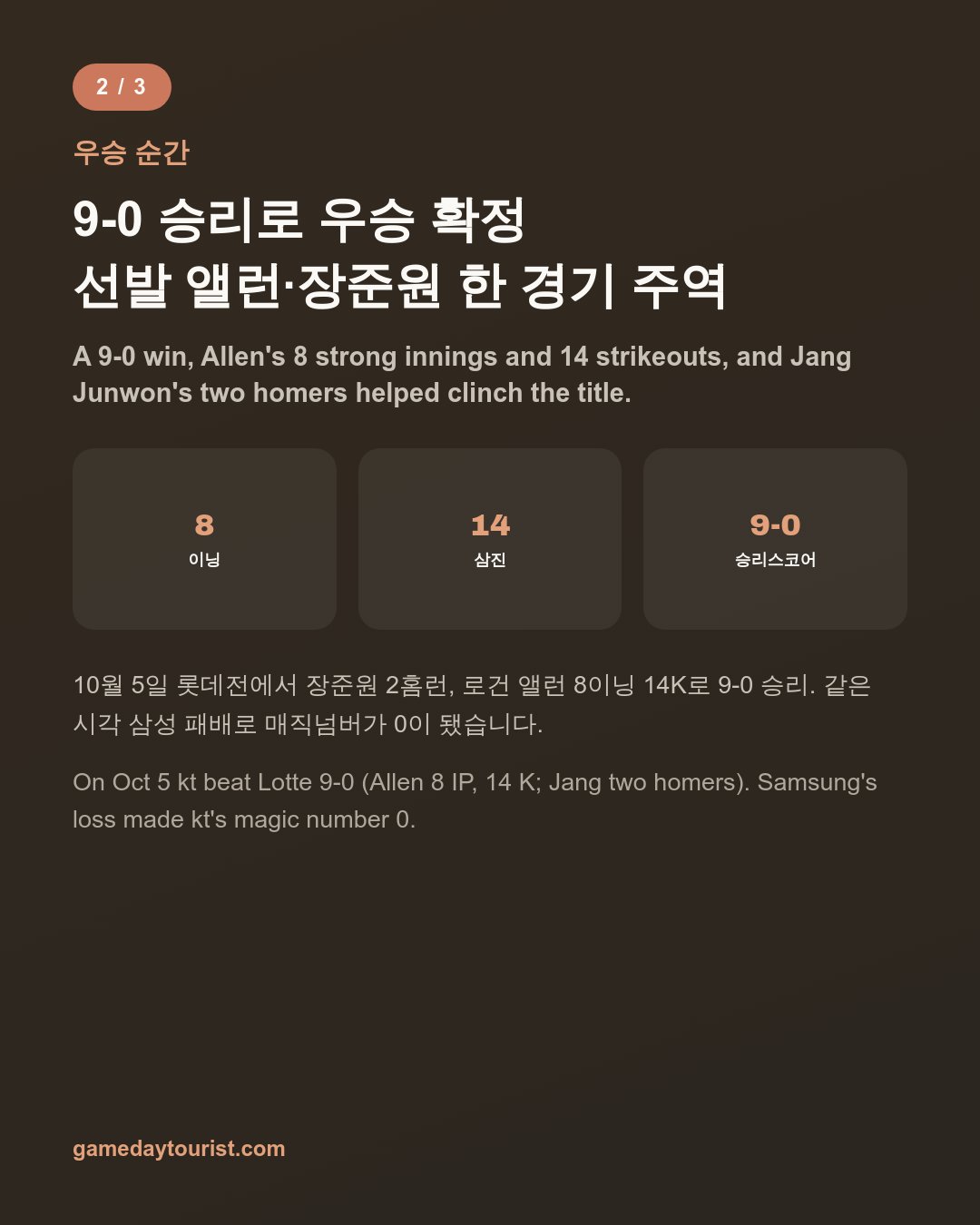
On October 5, the kt wiz beat Lotte 9-0. They scored four runs in the first inning alone, Jang Jun-won added two home runs (his 6th and 7th of the season), and starter Logan Allen threw eight scoreless innings on seven hits with 14 strikeouts.
But the title wasn’t decided by the kt game alone. At the same time in Daegu, second-place Samsung lost 7-5 to Doosan, which brought kt’s magic number to zero.
With the win the kt wiz went to 86-49 with 5 ties (.637), 4.5 games ahead of Samsung at 82-54 with 3 ties. With four games left, they would hold first place even if they lost them all.
It is their first regular-season title in five years, since 2021, and the second since joining the top division in 2015. It is also only the second time the club goes straight to the best-of-seven Korean Series.
The scene after the game was memorable too. According to MyDaily, the fans in the first-base home section stayed in their seats, and while the scoreboard showed the Samsung-Doosan game, they applauded and cheered every time Doosan recorded an out.
When Doosan won 7-5, an even bigger cheer went up at the ballpark, and the players came out of the dugout to celebrate with the home fans and say thank you. Photos provided by the club also show players popping champagne on the field.
After the game, Manager Lee said, in essence, that it felt even better to win together with the home fans. As the headline of the same article put it, this year, unlike 2021, they secured first place at their home ballpark without a tiebreaker.
From a marketer’s view, the biggest thing is that the dates overlapped. The one-million milestone and the title came in the same game at the same ballpark, so the club gets two stories at once: the “one-million-fan club” and the “regular-season champion.”
It means performance numbers and attendance numbers can sit on the same one-page deck in next year’s season-ticket sales and sponsor negotiations.
Attendance and Tickets — 840,000 → 970,000 → 1 Million, with a Ceiling of 18,700 Seats
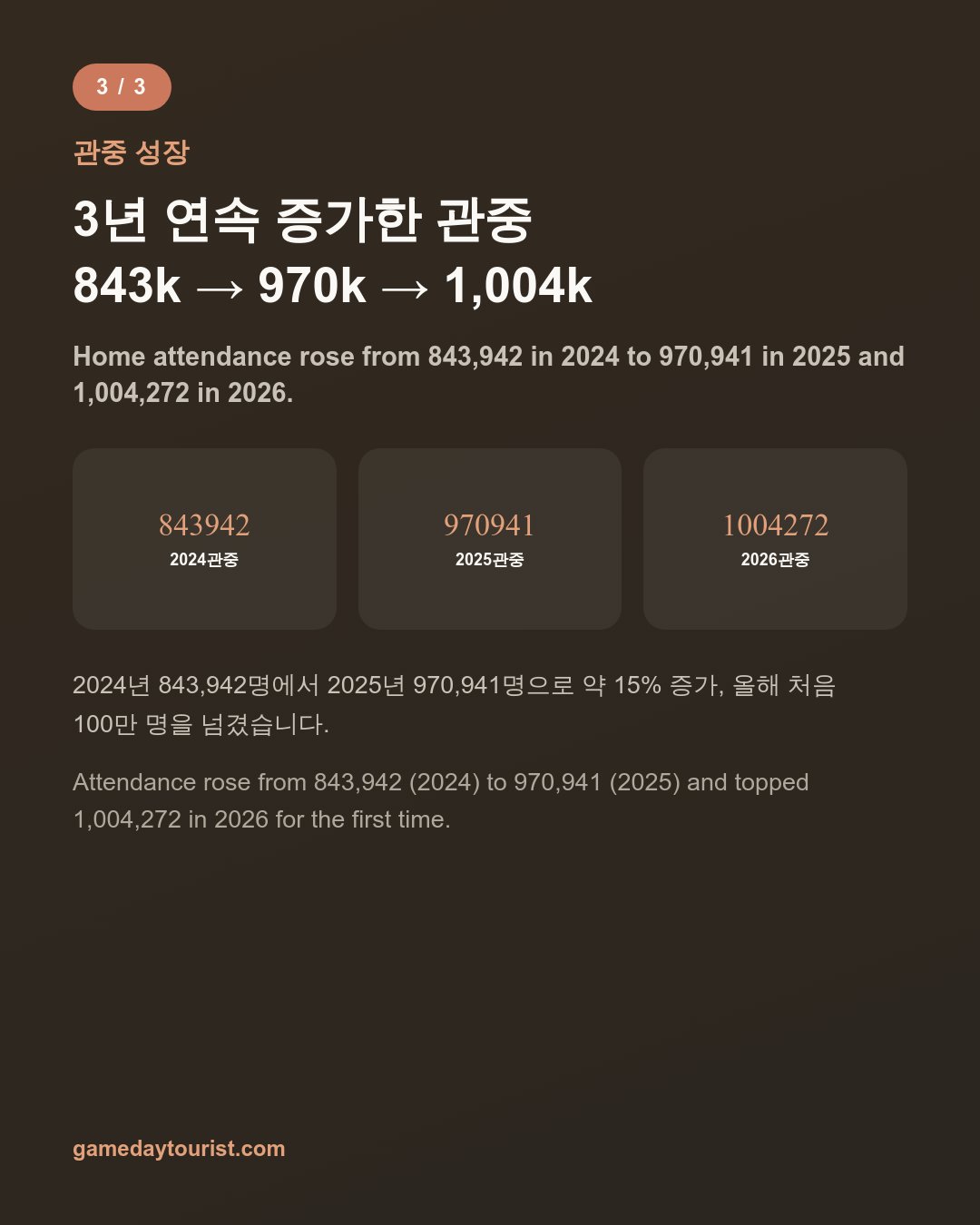
Home attendance grew about 15%, from 843,942 in 2024 to 970,941 in 2025, and this year it passed one million for the first time at 1,004,272.
That makes the kt wiz the eighth of the ten KBO clubs to reach one million. Home sellouts also rose from 24 last year to 28 this year.
They matched last year’s club-record 24th sellout on September 19, and then added four more.
In a mid-September club press release, the kt wiz reported 848,673 total over 61 home games, up 31% from the previous year. That averages about 13,900 per game (my own calculation), or roughly 74% of capacity, and 22 sellouts were stacked on top of that average.
The ceiling is clear too. Even if all 72 home games sold out at 18,700 seats, the maximum would be 1,346,400.
Last year Kyeongin Ilbo quoted an industry source saying most ballparks nationwide have more than 20,000 seats, and Samsung drew 1,640,174 that year. This year, as of October 5, LG stands at 1,574,738 (45 sellouts).
In a market where seat count is the attendance cap, it looks like kt found its way by pushing up how full the ballpark is.
What caught my eye on the ticketing side was the seating overhaul announced before this season. All seats were replaced, the central reserved seats became central table seats, and the first- and third-base table seats became cheering-section seats.
Season tickets were capped at 500, Magic memberships at 400 and Victory memberships at 10,000, on sale from February 25 on Wizzap, and season tickets came with a postseason presale benefit.
With a fixed seat count, changing seat types to raise revenue per ticket and lock in presale customers is a sensible move. However, I couldn’t confirm from official sources how prices by seat type changed after the overhaul.
The one-million promotion was interesting as well. From September 18 to October 7, over ten home games, the club offered a “Golden Ticket” to the one-millionth booking customer: a 2027 cheering-section season ticket and an invitation to an eight-person skybox.
From the 910,000th to the 990,000th booking, every 10,000th customer (nine groups) got a skybox invitation, and each game five people won postseason tickets (two per person) by lottery.
The key point seems to be that the trigger was the time of booking, not entry. It can be read as a device that attaches the reward at the booking stage rather than on game day, pulling sellouts forward.
Using the Space and F&B — Turning a 1989 Ballpark into a Place to Stay
Built in 1989, the stadium is the third oldest in the KBO. This year the club went beyond repainting the exterior, replacing all seats, and replacing the artificial turf and safety fencing, and put forward a shift from a ballpark to watch in to a ballpark to stay in.
They hung a 30-meter LED media wall in the food area, turned the outfield convenience store into a kids’ cafe, and brought in more well-known food and beverage brands.
Signage developed with Suwon city helps fans find seats, amenities and exits at a glance. No investment figure was reported.
There is also an “AI Cheerful” booth where fans write their own cheering messages and see them on the scoreboard. I liked that it doesn’t stop at using technology but connects it so that fan-made content fills the screens in the ballpark.
SPOTV News reported that fans were surprised by the changed ballpark. Since foreign visitors’ reviews praise QR ordering and food prices in line with those outside, the direction looks like making up for the inconveniences of an old structure through operations.
An older ballpark will still have its limits, but as a marketer I was impressed by an approach that acknowledges those limits head-on and works around them.
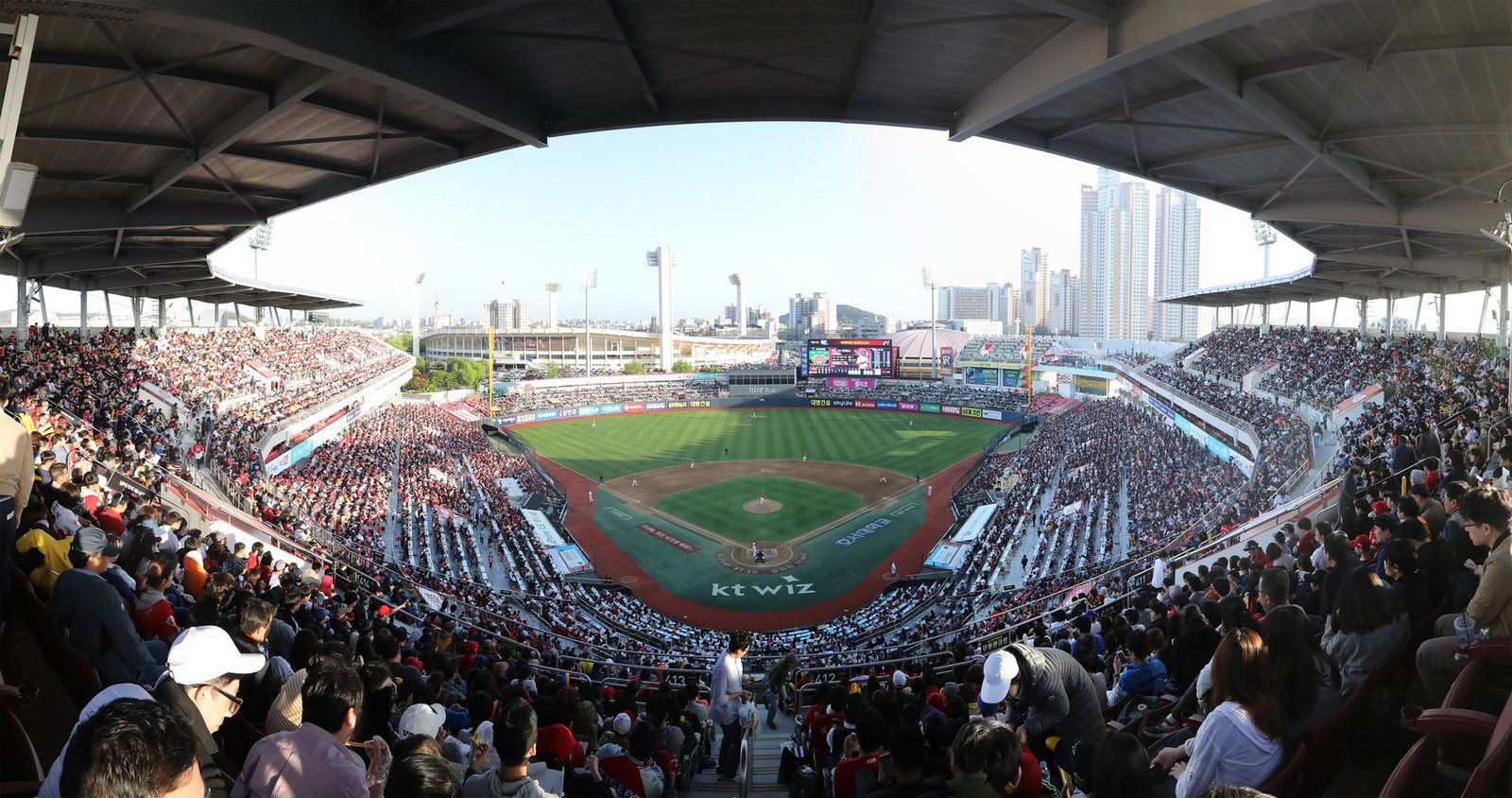
Panoramic view of a packed kt wiz Park in Suwon · Source: kt wiz
Water Festival, BeatBat and Mirror Ball Time — Standing Out by Trying Things First
If I had to sum up kt’s marketing in one line, it’s a club that tries things before others do. The Water Festival, the BeatBat cheering tool and Mirror Ball Time are three efforts the club is known for, and for this piece I checked what each one involves and when it started against news articles.
However, I couldn’t confirm from the articles whether any of them was a “first in the KBO,” so I won’t claim that.
The Water Festival is the club’s signature summer event, held every year since 2015, when the club joined the top division. This year it opened on July 21 and ran for 12 games through August 16, with 25 water cannons installed across the first-base cheering section and the outfield.
That is five more cannons than last year, and the outfield got a standing water zone while the entrances got cooling shelters. Weekend home games were followed by “Wiz Live” concerts.
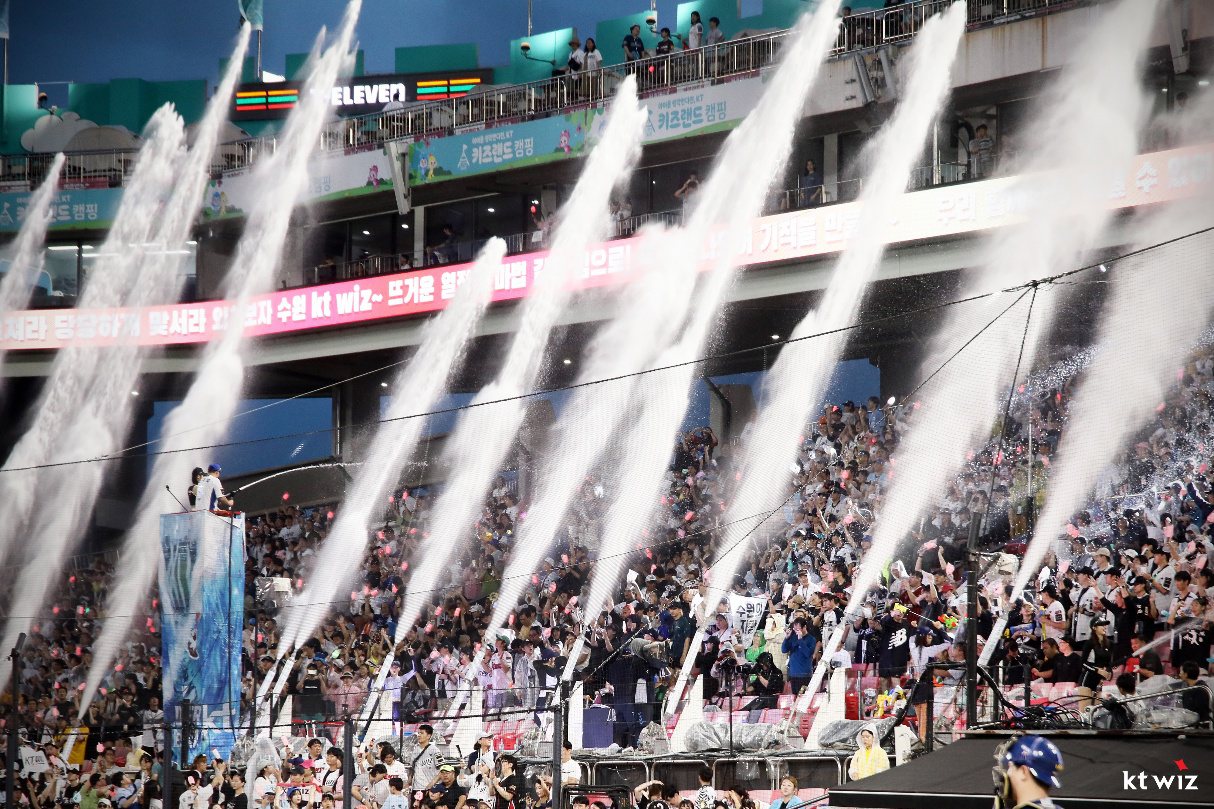
A scene from the 2026 Water Festival · Source: kt wiz website
The BeatBat is a wireless light stick released on April 5, 2021. Linked to a controller operated by the cheerleading squad, it makes the whole cheering section move in the same color and the same cheer, and through the club app and a video-conferencing service it also connects fans outside the ballpark.
It was a “contactless cheering” tool that arrived while crowd cheering was restricted, and at launch the club gave away 400 a day, 1,200 in total, to fans in the cheering section for the April 6-8 games against LG. That giveaway was a launch event; normally it is a cheering tool fans buy.
I suspect the “outfield filled with light sticks” that Manager Lee described owes something to the scenery tools like this create.
Mirror Ball Time is a cheering tradition that started in 2022, in which the club holds a K-pop dance party under a huge mirror ball whenever the home team wins. For the June 28-30, 2024 series against Samsung, it expanded into a “Mirror Ball Festival” with the cheerleaders, DJ sets and even a gayageum performance, held win or lose.
What sets it apart is that it turns the reward for winning into play inside the ballpark.
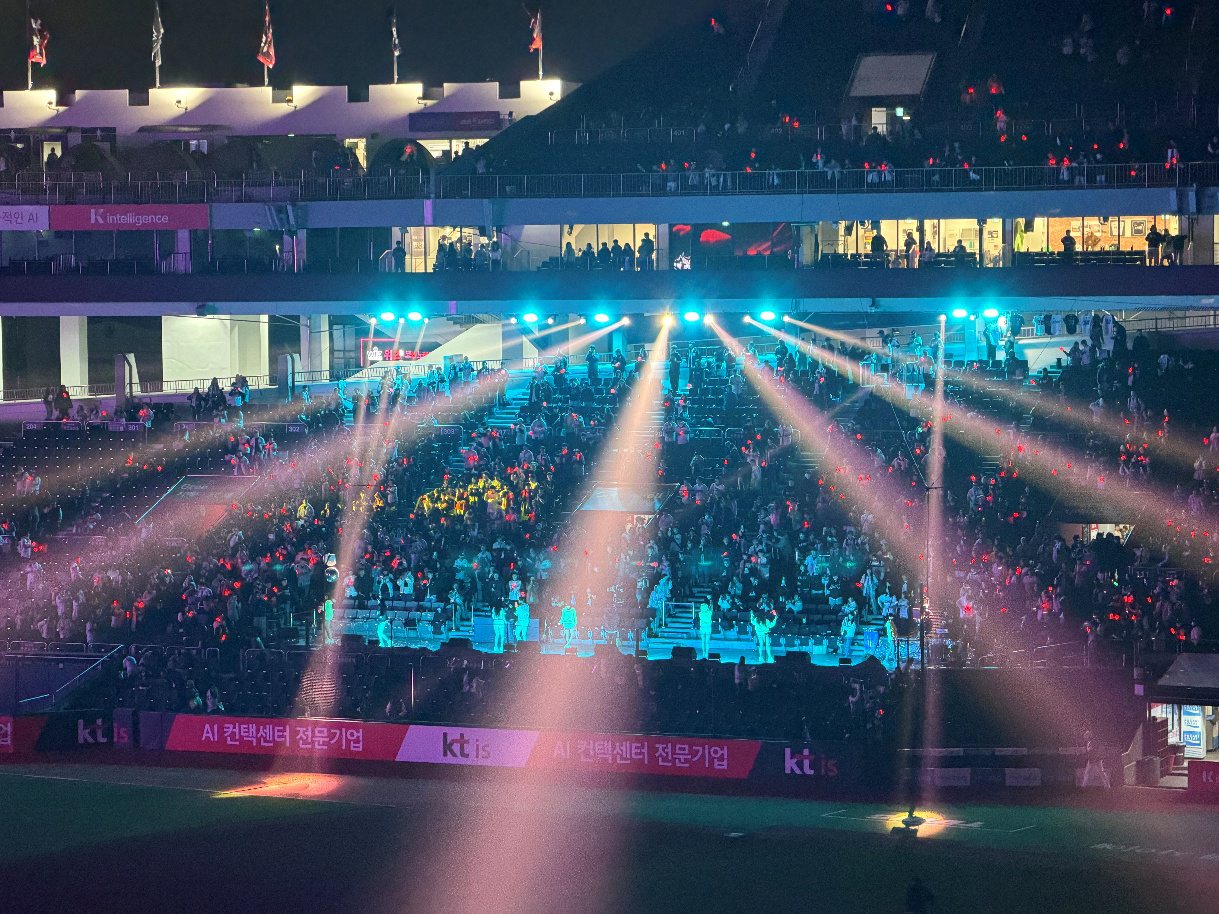
Mirror Ball Time in the cheering section at kt wiz Park in Suwon · Source: kt wiz website
These efforts have been recognized outside the club too. In 2019 the club received the Presidential Commendation at the 15th Korea Sports Industry Awards.
The judges looked at the fusion of sports and ICT: a 5G smart stadium, the Wizzap app, drone and robot first pitches, and the Water Festival.
In 2025, at the 21st awards, the club received the Prime Minister’s Commendation for its AI stadium. The reasons cited were an AI assistant that helps with ticket booking, AI CCTV that analyzes crowd density in real time, and fan experiences such as an AI sketch contest and AI cheer songs.
Merchandise and Ad Inventory — A Store Outside the Ballpark and Self-Checkout
On the merchandise side, the center of it all is the kt wiz flagship store that opened outside the ballpark on July 1 last year. It has a gallery of the players’ best moments, a memorial wall for the first championship, a zone displaying player-worn items, a photo zone and a cheerful zone.
One side is a KT sales space where customers can get telecom consultations and sign up, so the parent company’s sales channel and the fan experience are bundled into one building. This year the club’s team store also introduced RFID (wireless tag) self-checkout.
On character collaborations, there was the One Piece Brand Day in late July this year and the Snoopy Day in 2024.
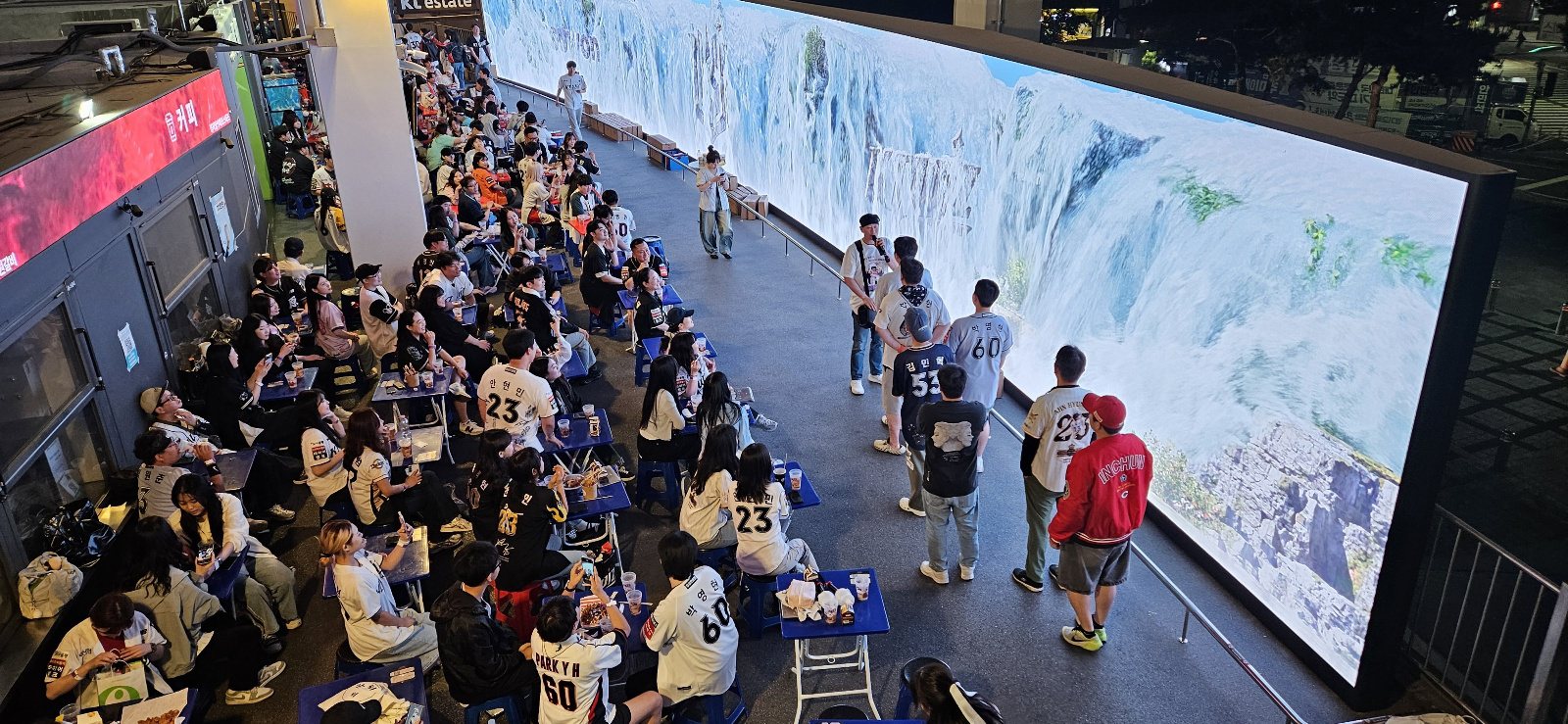
The large media wall at kt wiz Park in Suwon · Source: kt wiz website
On the ad inventory side (the spaces inside the ballpark that companies can use for advertising), a 30-meter media wall hangs in the food area, and the club’s name is built into the ballpark’s own name. Under its agreement with Suwon city, the naming rights and advertising business rights are delegated to kt.
I couldn’t find any public data on advertising revenue.
Local Ties and How the Ballpark Is Run — City-Owned, Free Use for 25 Years
The ballpark is owned by Suwon city and operated by the Suwon Facilities Management Corporation. The 2013-2015 expansion and remodeling cost about ₩30 billion, split as ₩12.7 billion from Suwon, ₩8.9 billion from Gyeonggi Province and ₩7.5 billion from the central government, according to Wikipedia.
According to a December 2024 article from Joongboo Ilbo, the agreement between Suwon city and KT gives free use for 25 years from 2013, delegates advertising, naming and ancillary facility operations entirely to KT, and has the city pay for major repairs of ₩1 billion or more and KT for anything below.
The same article compared this with Samsung, which paid Daegu about ₩50 billion, and with LG and Doosan, which pay ₩3.1 billion a year in rent at Jamsil, and pointed out that it is too generous a deal compared with other local governments.
I think now, when the one-million milestone has been reached, is a good time to lay out again, transparently, what each side takes. The bigger the success, the more a club using a municipal facility has to explain what it received and what it gives back.
The fact that a ballpark built with citizens’ taxes became a place a million people visit is, on its own, good material for that explanation.
Compared with Other KBO Clubs and Overseas Examples
In a market where ballpark size sets the ceiling, the Boston Red Sox and Fenway Park come to mind. The Red Sox hold a record of 820 consecutive sellouts (including the postseason; 794 counting only the regular season) that ended in April 2013.
It is a case where the scarcity created by a small ballpark became the basis for ticket prices and premium products. kt wiz Park, too, doesn’t treat its 18,700-seat limit only as a weakness, and is moving to turn scarcity into a product through the seating overhaul and presale benefits.
The contrast with other domestic clubs is clear. Samsung paid ₩50 billion to Daegu to secure 25 years of use and revenue rights, Kia gained operating rights in exchange for sharing the construction cost of Gwangju-Kia Champions Field, and LG and Doosan pay annual rent at Jamsil.
kt has run its commercial operations on free-use rights and ancillary revenue. Rather than one being the right answer, the point is that how much a club takes responsibility for and how much it keeps changes its marketing freedom.
To sum up, this one-million milestone is the result of performance, cheering culture and ballpark operations working together. The next task is clear.
It is how to design prices and products more precisely under a ceiling of 18,700 seats, and how to sort out the relationship with the city so this boom lasts.
As Manager Lee said, the outfield is now filled with kt light sticks. Whether this boom carries into the Korean Series remains to be seen, and as a working marketer I’m looking forward to what face this ballpark shows next.
Leave a Reply