Contents · About 6 min read
📱 View as card news
In early September, I came across the news that Mainz 05’s national team midfielder Hong Hyun-seok had gone out on a one-year loan to Denmark’s Midtjylland.
With one of the two players who’d been called the “Korean duo” for a while now leaving the club, I got curious about the fact that Lee Jae-sung is now flying the Korean flag alone at Mainz.
Digging in, I found that Lee actually chose to sign a two-year extension back in February, while the team was fighting relegation, and now, with the team revived under coach Urs Fischer, he helped drive a 4-3 comeback win away at Borussia Mönchengladbach on September 20, pushing the team up to fifth in the league.
As it happens, this club’s home stadium name also has an interesting story behind it, so as a working marketer I decided to put together a rundown of Mainz 05.
Attendance and Tickets
Mainz’s home ground, the Mewa Arena, opened in July 2011, replacing the Bruchwegstadion, which had been the team’s home for 74 years.
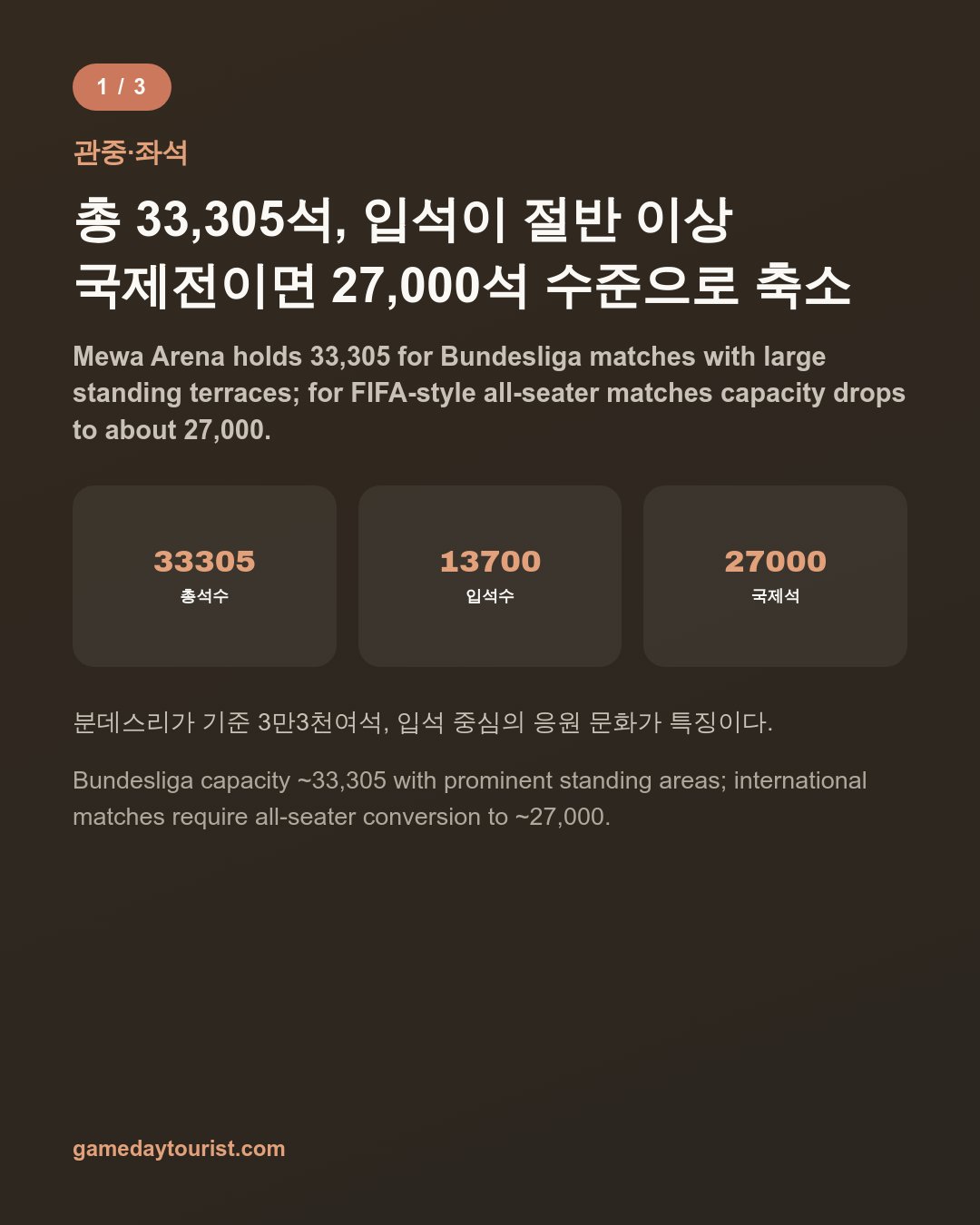
Its Bundesliga capacity is 33,305, of which standing spots account for 13,700.
For matches that require all-seater configuration under FIFA rules, such as national team games, standing areas are converted to seats, and capacity drops to around 27,000.
Home attendance in the 2025-26 season ranged from 24,500 up to a near-sellout 33,305, though most matches drew around 30,000.
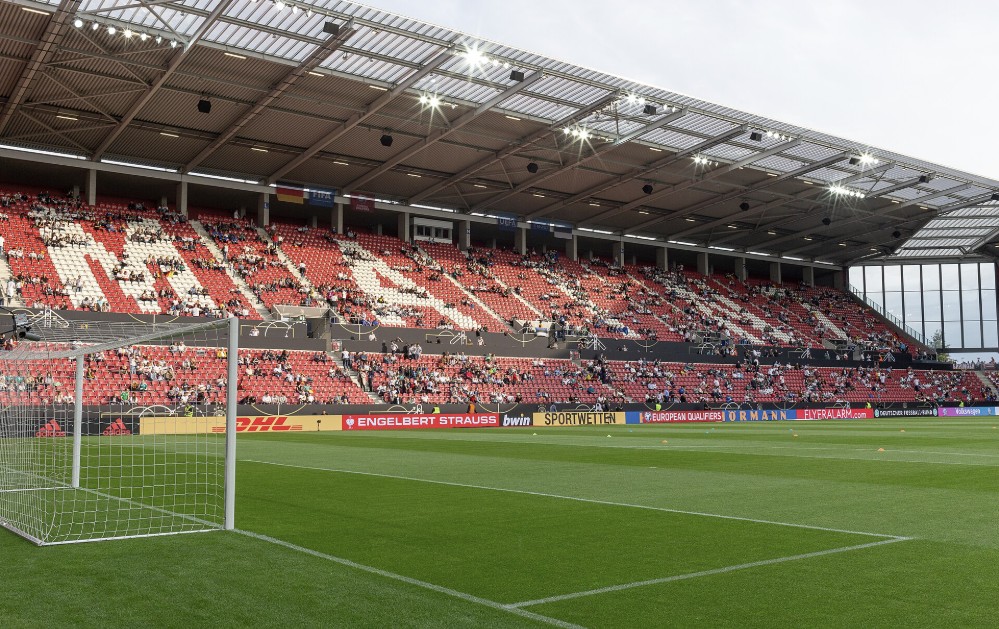
Photo: The stands during the Germany vs Estonia Euro 2020 qualifier, June 2019 · Credit: Steffen Prößdorf (Wikimedia Commons, CC BY-SA)
At the DFB-Pokal match against Borussia Dortmund in August 2023, Dortmund’s away fans in yellow filled their entire section, a scene that gives a sense of just how big Bundesliga away support can get.
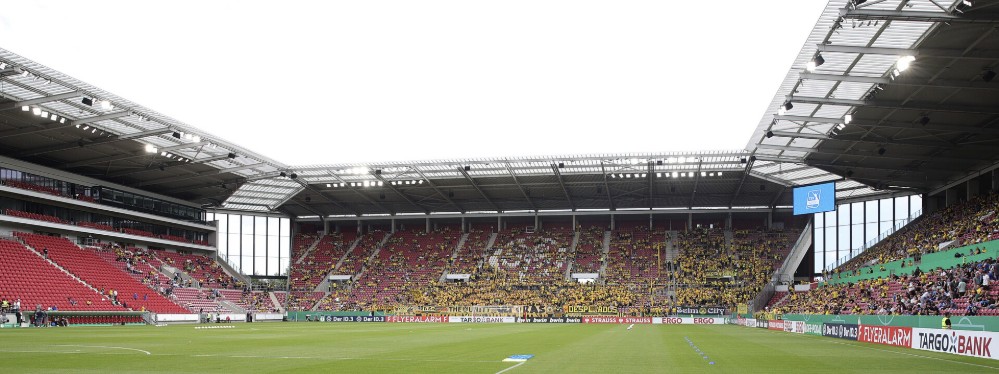
Photo: Dortmund fans filling the away section during the DFB-Pokal match against Borussia Dortmund, August 2023 · Credit: Sandro Halank (Wikimedia Commons, CC BY-SA)
The standing-heavy matchday culture is also distinctive.
A local football-travel blogger wrote that on a visit to the Mewa Arena, they watched the game standing side by side with friends on the gently terraced standing section rather than in seats, and that the energy from drums, scarves, and streamers filled in for what’s otherwise a fairly plain piece of modern architecture.
The same review noted that pre-loading money onto a card let them buy beer and bratwurst (German sausage) without waiting in line, which, as a working marketer, struck me as the same familiar tactic of cutting payment friction to lift spend per fan, applied here just as elsewhere.
Ticket prices run fairly wide, from the low teens in euros for standing up to around €40 for central seats, with an extra €5-10 added for matches against top-tier opponents (Category A).
Space and F&B
Stadium catering is handled entirely by a company called Gauls GmbH, which reportedly brings in more than 400 staff on matchday alone.
The stand layout is also worth a marketer’s look: all four stands are built as steep single-tier structures with open corners that offer views of the city and surrounding nature.
Red arched frames wrap each stand and stand out when lit at night, and Mainz itself promotes the stadium as a new landmark for the city, so it doubles as a piece of civic branding.
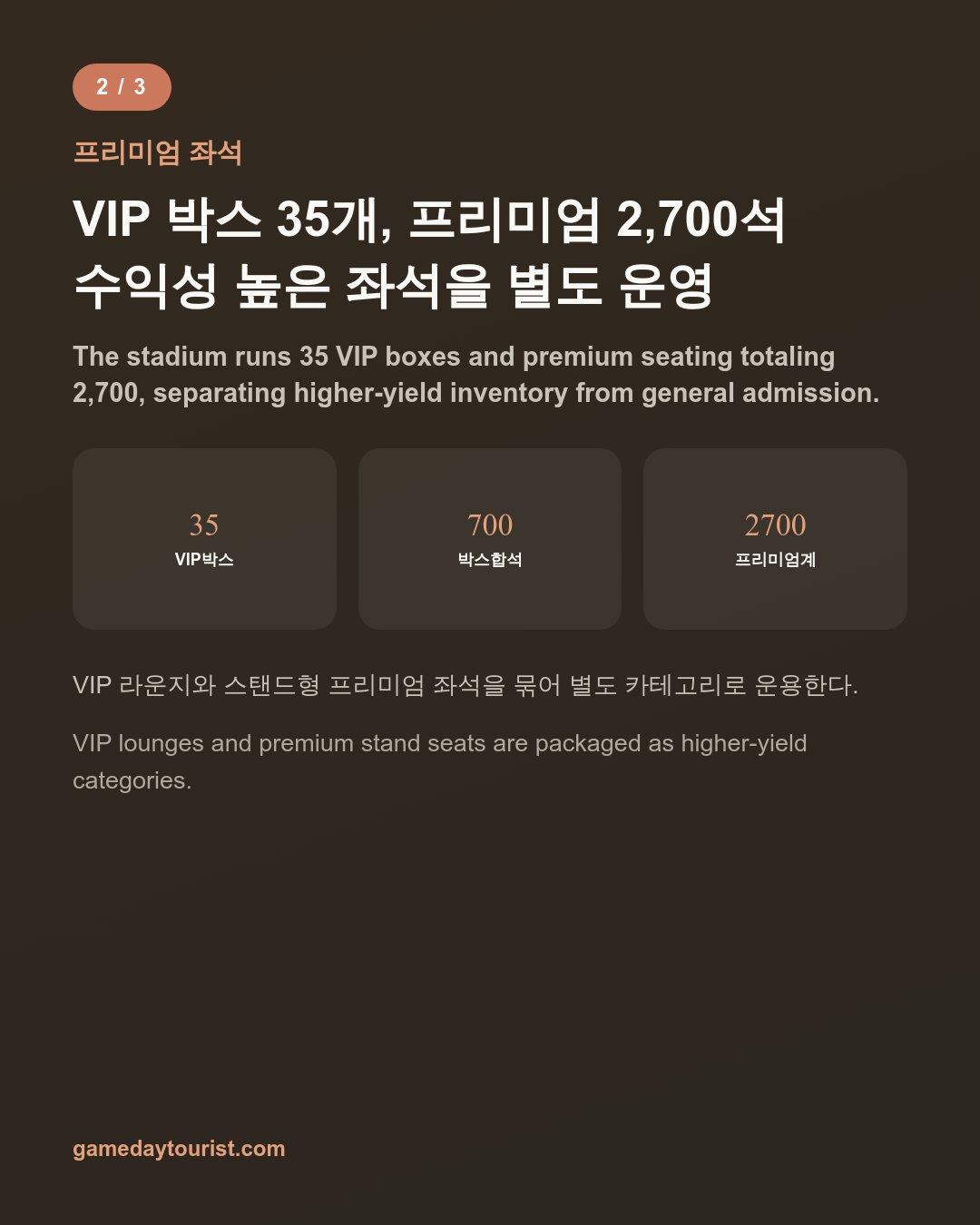
The VIP lounge runs 35 boxes with 700 seats plus 2,000 stand-style seats, for 2,700 total, keeping premium seating, which is more profitable than general admission, in its own separate category.
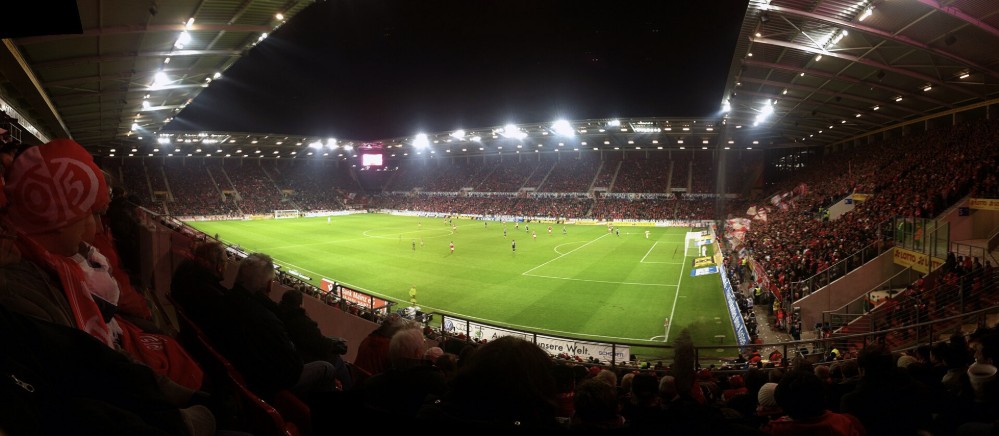
Photo: View of the pitch from the stands during a night home game · Credit: Ungry Young Man (Wikimedia Commons, CC BY-SA)
Merchandise and Ad Inventory
The name Mewa Arena is itself a case study in this club’s sponsorship strategy.
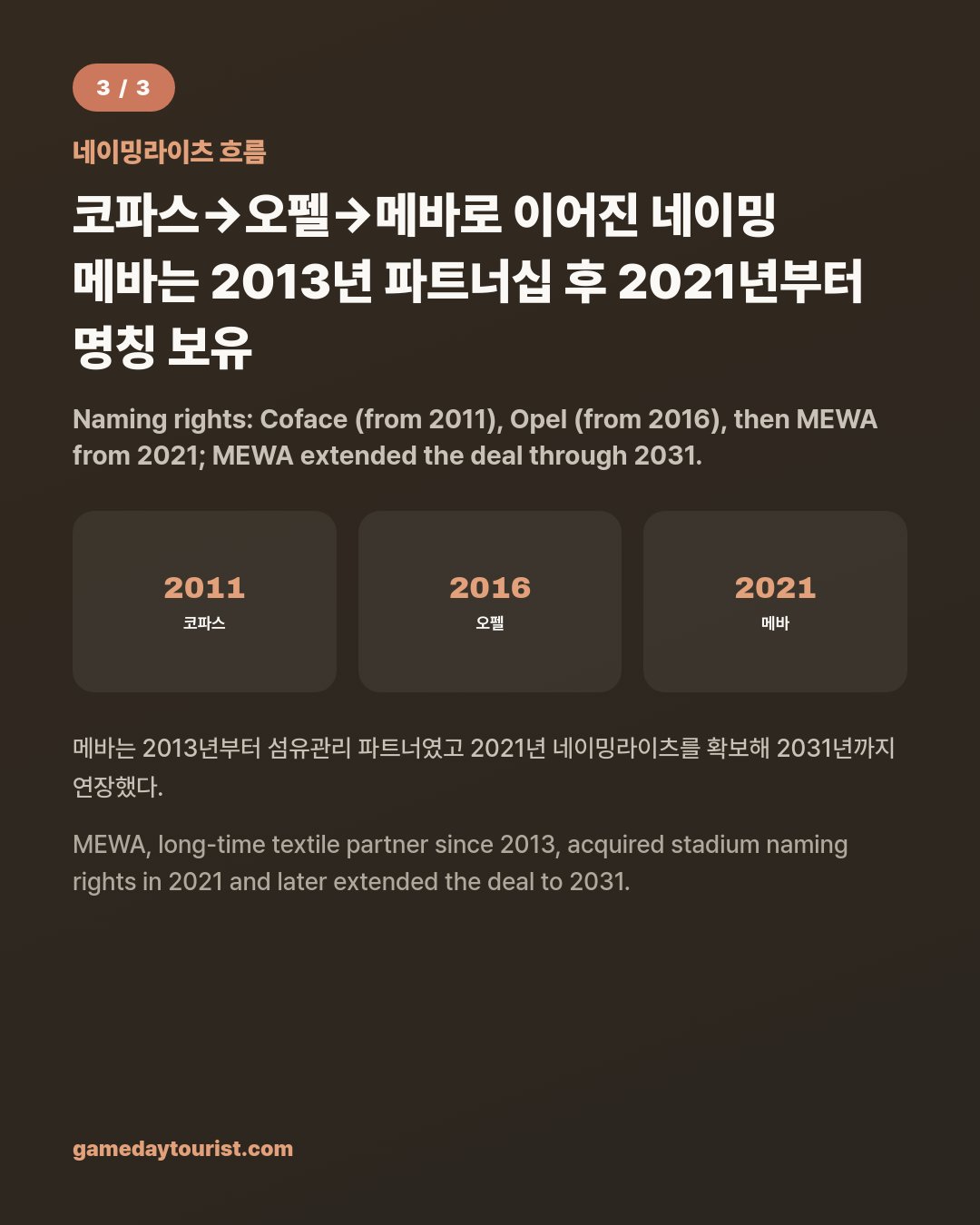
The naming rights (the right to put a company’s name on a facility) belonged to French trade insurer Coface for five years from the 2011 opening, then to automaker Opel for five years from 2016, and then passed to industrial textile-management company MEWA starting in 2021.
MEWA is a B2B rental service company that regularly leases textile products like workwear, cleaning cloths, and mats to corporate clients and handles the laundering and repairs, and it had already been the club’s textile-management partner since 2013, eight years before landing the naming rights.
The 2021 deal was reportedly worth about €2.3 million a year, and in April 2025 it was extended through 2031.
It’s unusual for a B2B industrial company, rather than a consumer or financial brand, to buy a club’s naming rights, and as a working marketer I found it striking how the relationship expanded step by step, from a small partnership tested over years to full naming rights.
The jersey sponsor structure is also worth noting.
The main sponsor and chest sponsor is German window and building-materials brand Kömmerling, under a deal extended through 2027.
The kit supplier switched in summer 2023 from Italian brand Kappa to Jako, a family-owned company from southern Germany, with both companies’ emphasis on sustainable production cited as the reason for the switch; that deal runs through 2028.
Beyond those, the club ran a total of 35 sponsorship deals as of the 2022-23 season, including Bitburger (beer) and the Rhineland-Palatinate state lottery, with the top five partners accounting for 59% of total sponsorship revenue.
Broadcast Rights and Local Economic Impact
The Bundesliga secured €1.121 billion per season in its 2025-2029 domestic broadcast rights deal, up 2% from the previous contract.
That came at a time when broadcast revenue at other European leagues was stagnating or declining, which drew attention across the industry.
Mainz’s way of staying close to its region is distinctive.
When the club moved to the Mewa Arena in 2011, it staged its entry into the new stadium as a parade evoking Rosenmontag (the carnival procession), led by the Meenzer Schwellköpp, the leading group of the Mainz carnival (Fassenacht).
A jab that rival fans once used to mock Mainz as “just a carnival club” was instead adopted by the club and its fans as a point of pride, and 225 fan clubs, many named in Mainz dialect, keep that identity alive today.
The Mainz carnival held every February and March is one of Germany’s leading carnival events, and the youth costume parade pictured below has run every year since, reaching its 66th edition in 2024.
The club has, in effect, layered itself over this local festival.
For Mainz, which has to hold its own next to the much bigger neighboring city of Frankfurt, it’s a case of pulling a genuinely local cultural asset into the club’s brand identity.
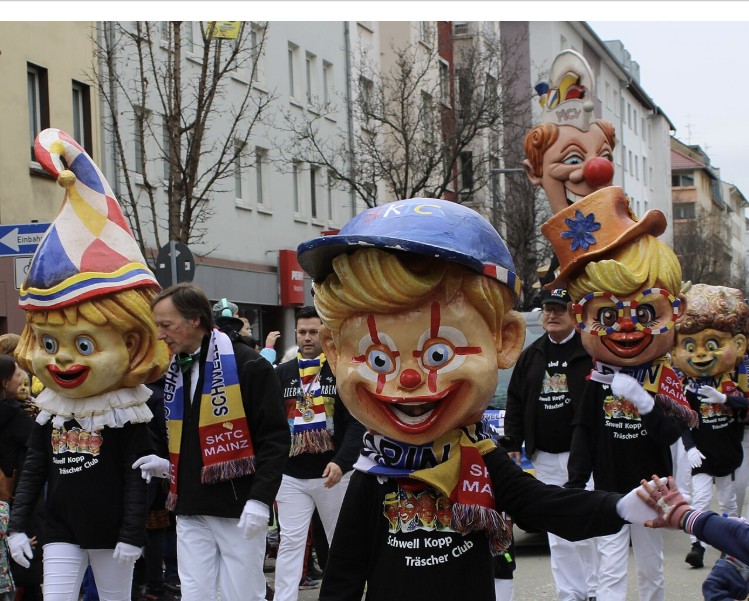
Photo: Schwellkopp figures at the 66th Mainz Jugendmaskenzug (youth costume parade), February 2024 · Credit: Schiplagerheide (Wikimedia Commons, CC BY-SA)
A Comparison With the KBO and K League
A case like MEWA’s, where a small-scale sponsor spends more than a decade building the relationship before expanding step by step into naming rights, is still not common in Korean pro sports as far as I know.
Naming rights at Korean stadiums have mostly gone the route of the parent company that owns the club putting its own name on the venue, and this kind of staged expansion, where a long sponsor relationship grows into naming rights, seems like a model worth keeping in mind.
On tying in with a local festival, there’s a comparable case in Korea too.
The “K League Trip Day” program, launched this year by the Korea Professional Football League and the Korea Tourism Organization, packages away support together with regional tourism, though it has a different texture from Mainz’s carnival-club identity, which grew organically over more than a century, since it’s a recent initiative designed at the league level.
Both approaches share the idea of a club or league weaving a region’s own content into the fan experience, so it’s worth watching how Korean clubs go on to build relationships with their own local festivals and culture.
Leave a Reply