Contents · About 7 min read
📱 View as card news
Back in June, I came across the news that South Korean national team striker Oh Se-hun had made a permanent move to Shimizu S-Pulse.
The name of the club he’d been with until a few months earlier was unfamiliar, so I looked it up and found FC Machida Zelvia, based in Machida, Tokyo.
A team that finished 15th in J2 in 2022 had, in just a few years, turned into a club bouncing between the top of J1 and the final of Asia’s continental competition, and at the center of that change was a rather unexpected name: the internet advertising company CyberAgent.
I’ve never been to the club, but as a working marketer I was curious how it had grown so fast, so I started digging through the material one piece at a time.
Fans and Tickets
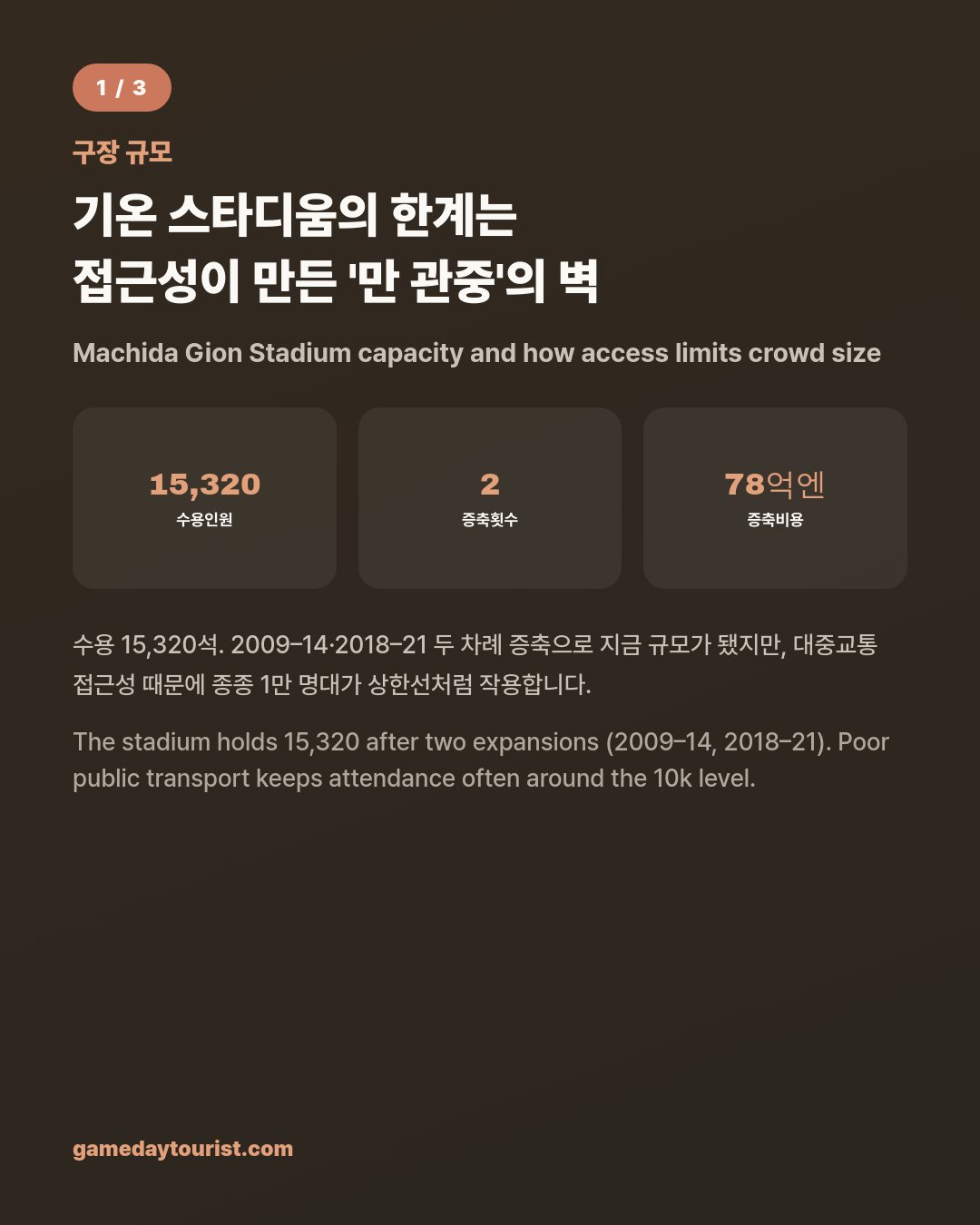
The home ground, Machida GION Stadium, has a J.League capacity of 15,320.
It got to its current size through two major expansions: 2009-2014 (about 1,700 seats added, construction cost roughly ¥3 billion) and 2018-2021 (about 5,000 seats added, roughly ¥4.8 billion).
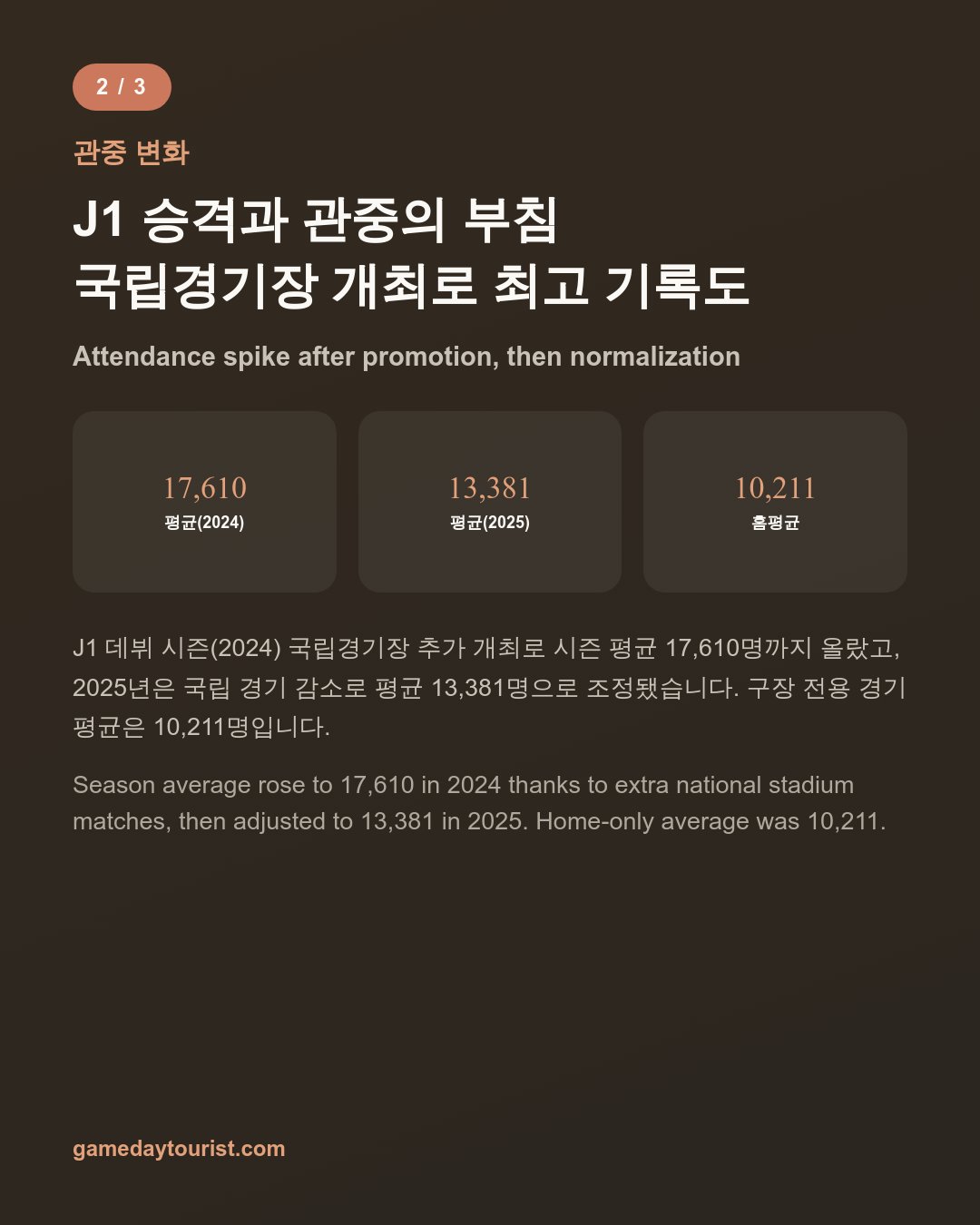
In 2024, their first year in J1, the team climbed to third and played four extra matches at the National Stadium, which lifted that season’s average attendance to a club-record 17,610 (a figure that includes the National Stadium games).
In 2025, with fewer National Stadium bookings, the full-season average dropped 24.0% from the year before to 13,381, but that’s closer to a natural adjustment.
In fact, according to what club COO Musashi Ueda said in a September 2025 interview with Soccer Digest Web, matches played only at the home ground (GION Stadium) averaged 10,211, steadily filling about two-thirds of capacity.
The problem is access.
Even from the nearest station, Tsurukawa on the Odakyu Line, it’s more than 20 minutes by bus, and walking is effectively out of the question.
Given the club’s own survey finding that around 65% of all visitors come from outside Machida, a crowd in the 10,000s effectively works like a ceiling.
For league matches, the club runs free shuttle buses from five stations (Tsurukawa, Machida, Tama Center, Fuchinobe, and Minami-Machida Granberry Park) to make up for the access problem as far as it can, and away fans seem to notice the effort.
One away supporter following Kashima Antlers wrote in a personal match report that even on a weekday evening game there was almost no waiting for buses and no worry about missing the last train home, adding that the operation felt pretty tight for a stadium with poor public transit.
Tickets get dynamic pricing starting with the 2026/27 season, but season ticket holders are designed to be unaffected by the fluctuating prices and can always buy at the lowest price.
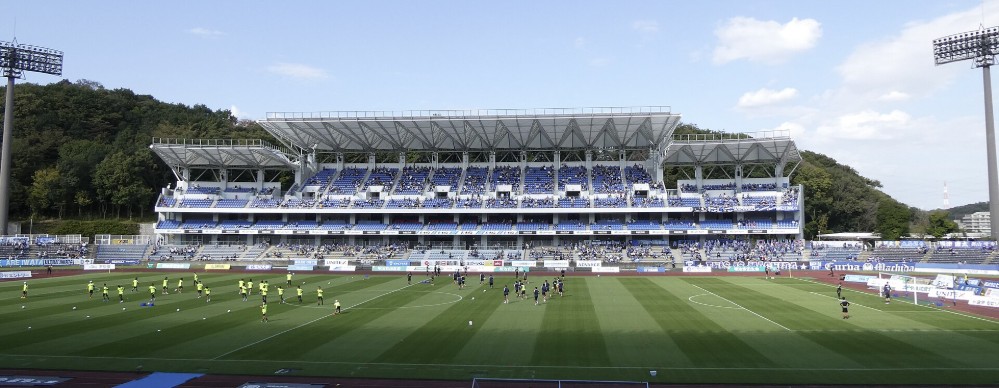
Photo: Wikimedia Commons (by TSUBAME98) · CC0 (public domain) — taken October 3, 2021, after the back stand was completed.
Space and Stadium Gourmet
Machida GION Stadium’s concourse isn’t wide compared with other J.League grounds, but the club lifts the fan experience by packing that tight space with stadium gourmet (food sold at the ground).
The signature bacon skewer has racked up close to 150,000 sold, and the smoked chicken sold at a shop called “Kitchen in the Sky” is said to be branded with the club emblem using a hot iron.
One FC Tokyo supporter wrote in an away report that the smoked chicken was crisp outside and juicy inside, on par with a theme park, so word has evidently spread among opposing fans too.
A draft beer is ¥800 and a canned beer ¥500, which is about the J.League average, but one away report said there are no drink holders, making it a bit awkward to drink at your seat, and that kind of detail stood out because you only find it by actually sitting there.
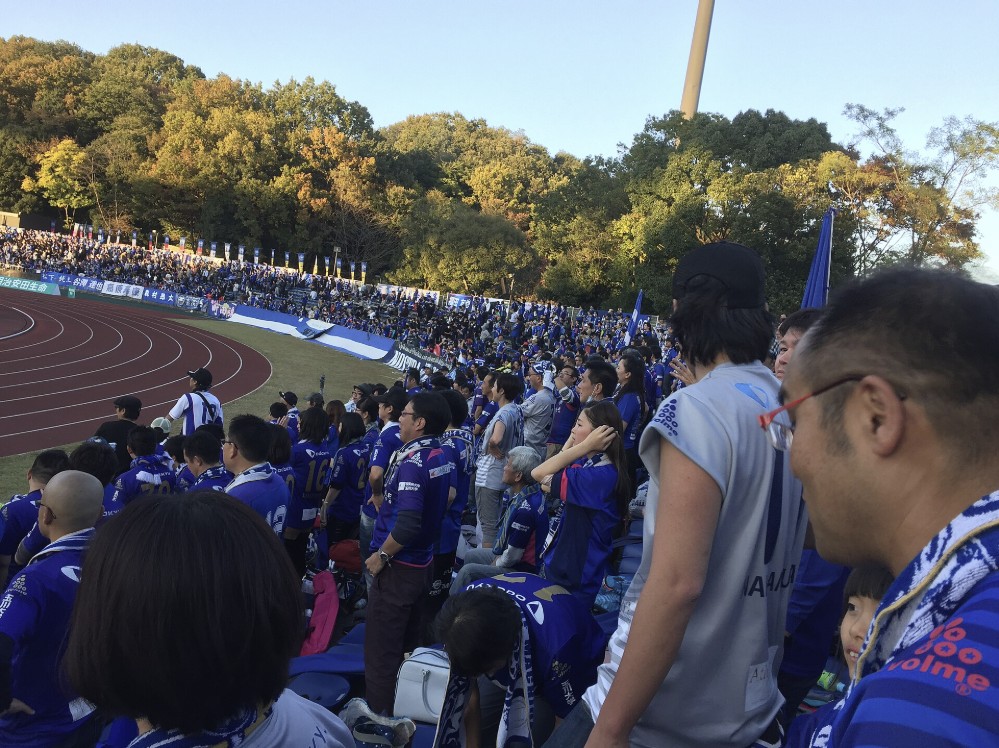
Photo: Wikimedia Commons (by Mitti0606) · CC BY-SA 4.0 — taken November 12, 2016
Merchandise and Ad Inventory
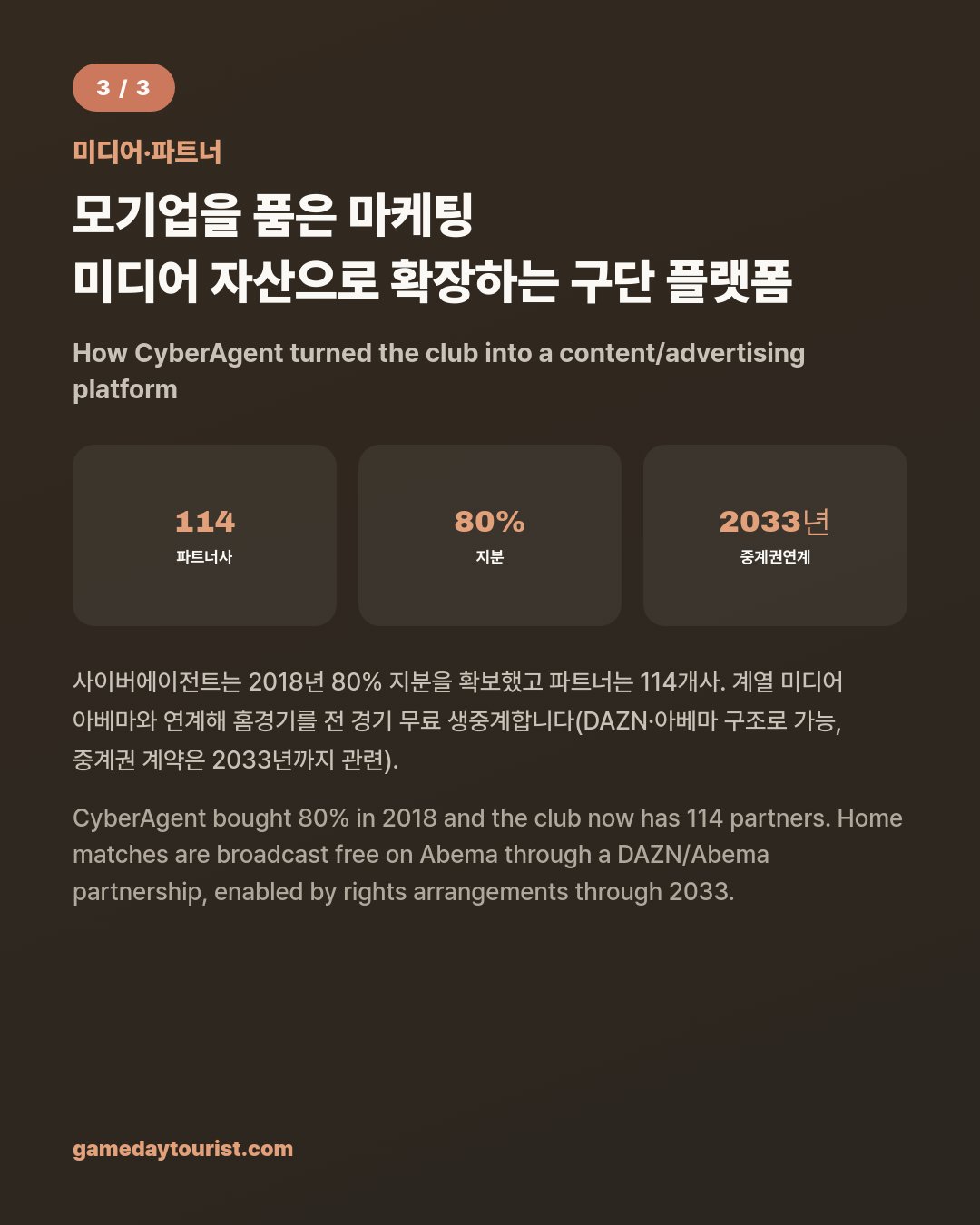
In October 2018, CyberAgent invested ¥1.148 billion through a third-party allotment to take an 80% stake in Zelvia, and since December 2022 its founder, Susumu Fujita, has served as the club’s president himself.
With an internet advertising and media company as parent, that expertise carries straight into the club’s partnership sales.
As of September 2026 there are 114 partner companies, a number that has grown sharply over the last few years as results climbed to the point of contending at the top of J1.
The most striking part of how the ad inventory is run is the tie-in with the group’s internet TV service, ABEMA.
ABEMA streams every Zelvia home match for free, which is possible through a partnership between ABEMA and DAZN, which holds the rights to the entire J.League (an exclusive deal running through 2033).
By plugging the parent company’s media assets straight into club exposure, it reads as treating a sports club as a kind of content and advertising platform.
Image: Wikimedia Commons (provided by FC Machida Zelvia) · public domain
Results and What Makes the Stadium Unique
The growth in partners and crowds over such a short span of course rests on results.
In 2023, the year former high school coach Go Kuroda took over, the team won J2 without giving up first place once after Round 10, and in 2024, their J1 debut season, they climbed to third.
In 2025 they finished only sixth in the league, but instead took the club’s first-ever Emperor’s Cup (Japan’s FA Cup) title, and riding that momentum, in the 2025-26 AFC Champions League Elite they topped their group and then kept four straight clean sheets in the knockout rounds on the way to the final.
In the final in Jeddah, Saudi Arabia on April 26, they lost 1-0 to Saudi side Al Ahli after a tight match that went to extra time, but simply reaching a final in a fully away setting stands as the best result in club history.
The stadium nickname “GION” isn’t actually taken from Kyoto’s famous Gion Festival but from the name of the logistics company “Gion” (ギオン), which bought the stadium’s naming rights in January 2020.
This general logistics company, headquartered in Sagamihara, took its name from its chairman’s surname, “Gion” (祇園), and since the same Gion group already holds naming rights to the home ground of J3’s Sagamihara, they apparently chose to use the Roman-letter “GION” as the brand to tell the two grounds apart.
Because it sits on a hillside, supporters also call the stadium “the castle in the sky,” and before home kickoffs performers dressed as cavemen reportedly appear to play up that world, which oddly matches the name of the “Kitchen in the Sky” shop I mentioned earlier.
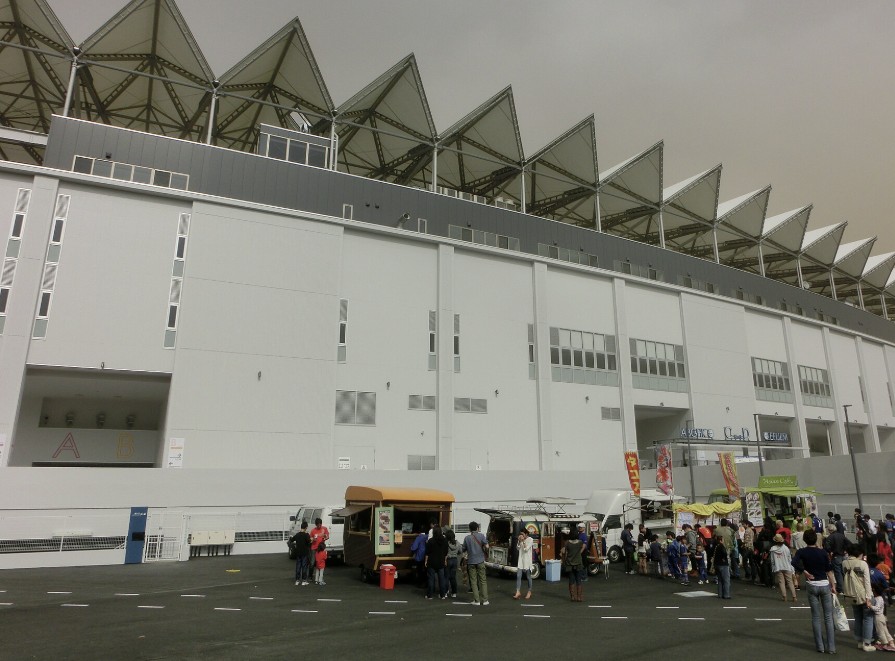
Photo: Wikimedia Commons (by Waka77) · CC0 (public domain) — taken March 2013, before the 2018-2021 expansion.
Broadcast Rights and Local Economic Impact
Machida City has kept up administrative support since the club’s promotion to J1, including subsidies for extra shuttle buses, and in the long run it’s also considering extending the Tama Toshi Monorail to near the stadium.
The route plan was finalized in January 2022, but it would detour 3 km from the existing path and add about seven minutes of travel time, so the debate over cost versus benefit is still ongoing.
Some people are even floating a “station-adjacent stadium” idea of building a new ground near Machida Station, on the logic that it could maximize the ripple effect on downtown businesses before and after matches.
While struggling with the access problem, the club is also using it as leverage to speed up the discussion of transport infrastructure itself, which is worth noting as a case of a sports club driving a regional development agenda.
A Comparison With the KBO and K League
Having an IT or gaming company own a pro club and link it with group-level content and marketing assets already happens in Korea too.
NC Dinos, owned by game company NCSOFT, is the prime example, and the way it has brought a game-IP sensibility into its mascot and branding is quite similar to the CyberAgent-Zelvia relationship.
On the access problem, Gangwon FC comes to mind.
Gangwon FC has the unusual setup of playing home matches in both Gangneung and Chuncheon, and many say that for away fans coming from the Seoul area, the transport is as tricky as a trip to Machida.
In that a hard-to-reach ground creates its own ceiling on crowd size, both leagues are left with a similar homework assignment.
The case of a small regional-city club backed by its parent company’s media strength and reaching the final of Asia’s continental competition in a short time has plenty for Korean club marketers to learn from.
In particular, the attitude of not hiding the fundamental weakness of access but working with local government to tackle it head-on carries a message for Korean grounds, where facility improvements are slow.
Leave a Reply