Contents · About 10 min read
📱 View as card news

A number caught my eye while I was scanning international sports business news the other day.
The NBA’s Minnesota Timberwolves had tripled in value in under a year and a half.
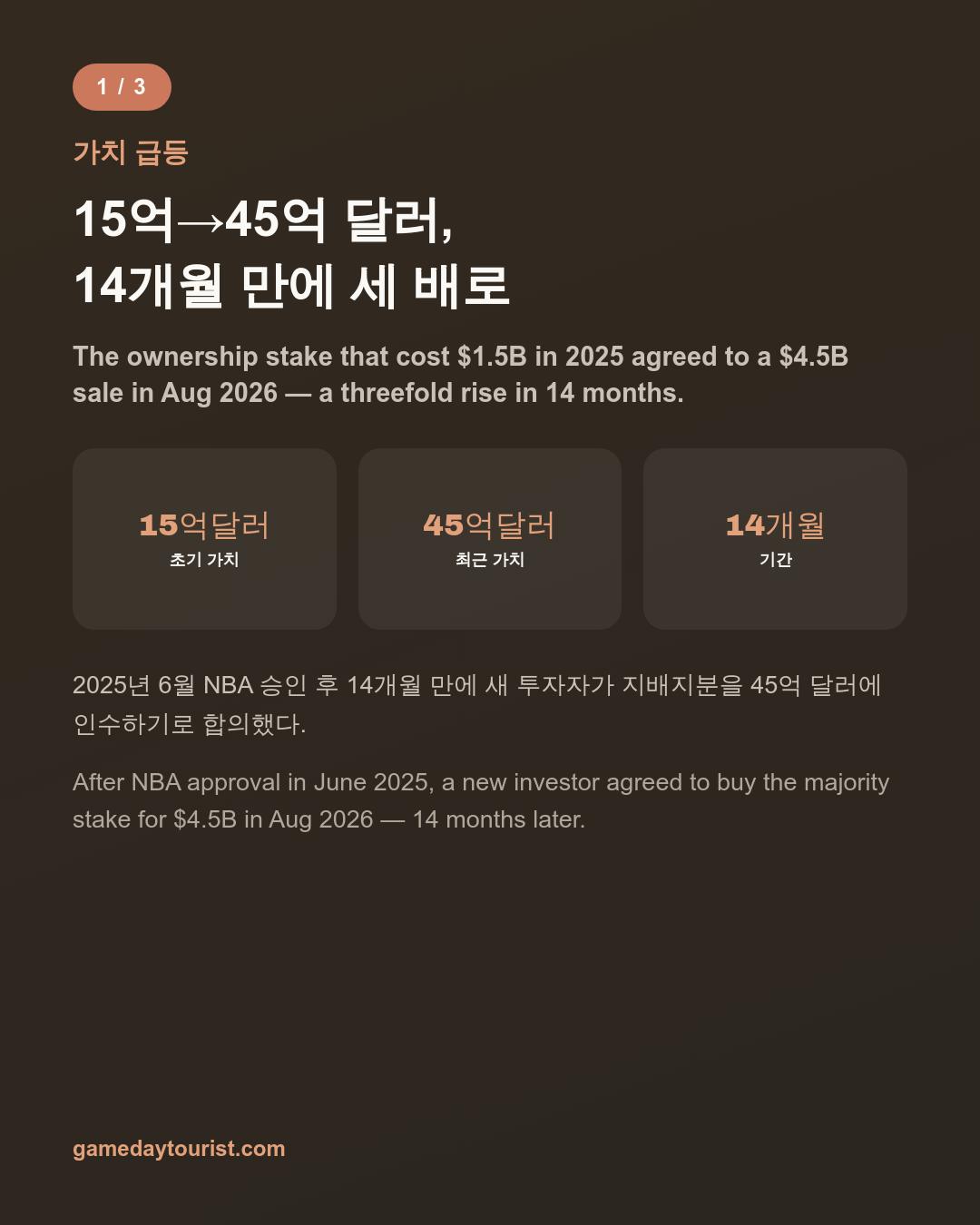
To be exact: the club, which got a new owner for $1.5 billion in June 2025, agreed to be sold again in August 2026 for $4.5 billion (about ₩6.2325 trillion at the August 27, 2026 exchange rate of ₩1,385 per dollar).
That’s a strikingly steep curve for a single franchise, so I dug into what actually happened.
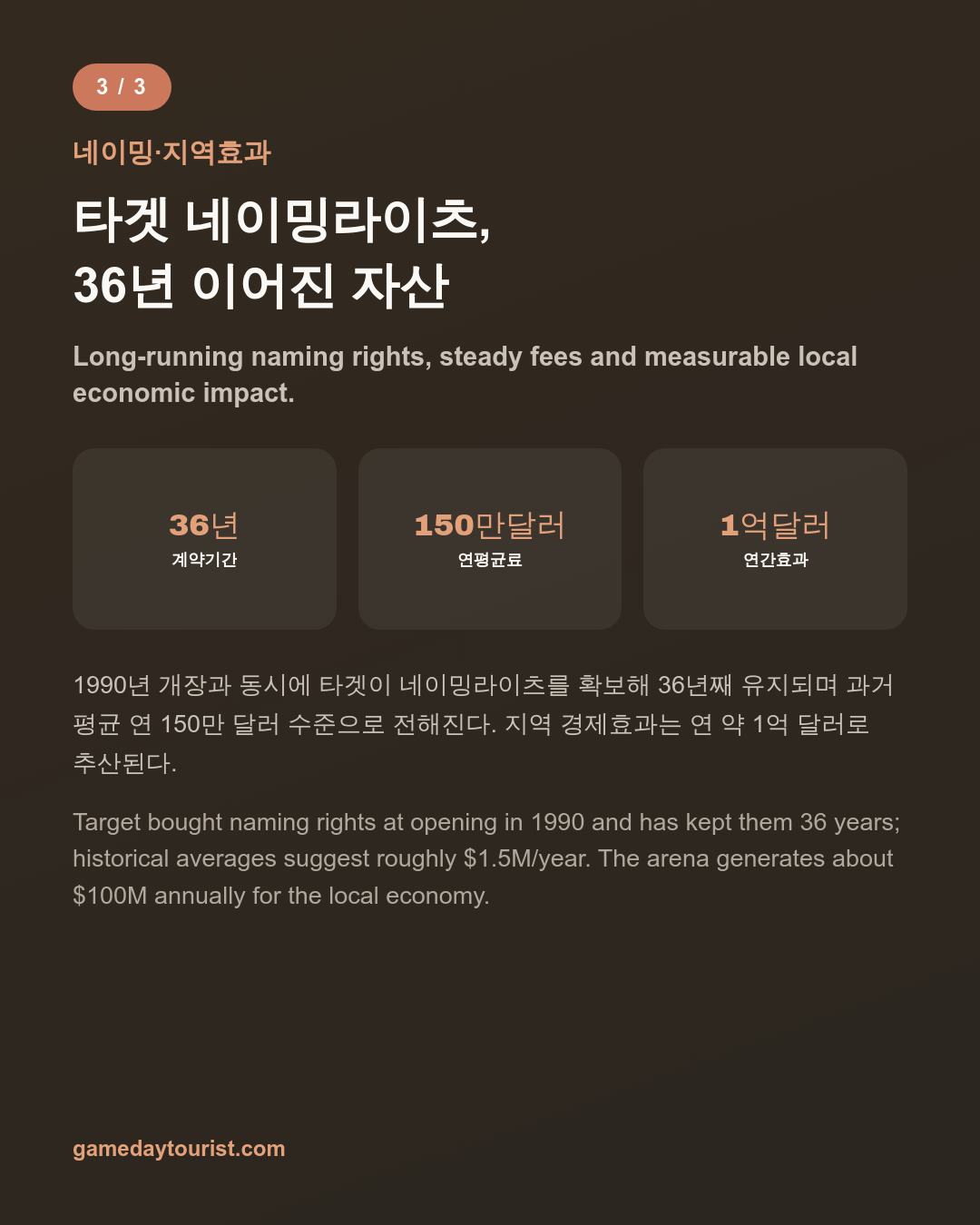
Interior of Target Center, a sold-out crowd looking down on the home court. Source: Wikimedia Commons (Andrew3935, CC BY-SA 4.0)
Attendance and Tickets
The Timberwolves reached the Western Conference Finals two years running, in 2023-24 and 2024-25.
It was the franchise’s first-ever back-to-back trip, and the 2023-24 run was its first Finals appearance since 2004 (a sweep of the Phoenix Suns in round one, then a seven-game slog past the defending champion Denver Nuggets in round two).
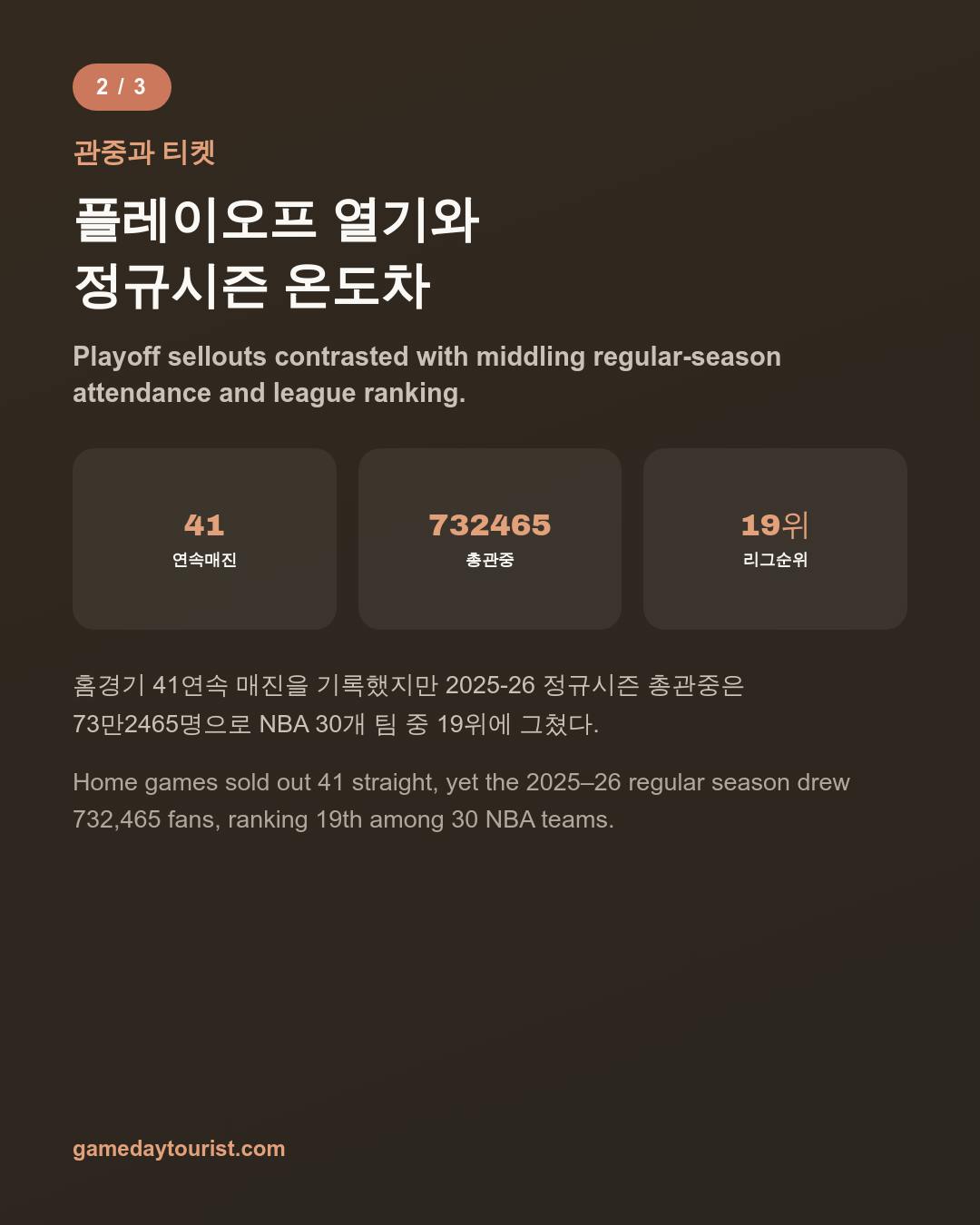
The run produced 41 consecutive home sellouts, the most since the franchise’s inaugural 1990 season, and full-season ticket holders topped 10,000 for the first time in roughly 30 years.
Game 1 of the May 2025 Western Conference Finals against the Oklahoma City Thunder sold upper-bowl tickets for $268–$319 before fees, and even the cheapest resale tickets ran close to $200 with fees — yet the game sold out within minutes.
By contrast, total 2025-26 regular-season attendance came to 732,465, 19th among the NBA’s 30 teams (roughly 17,865 per game) — a reminder that playoff fever and regular-season box office still run on different temperatures.
The club says that as of the start of the 2023-24 season, 270 U.S. counties named the Timberwolves as their home team, the widest fan footprint in the NBA — stretching into Iowa, North Dakota, South Dakota, and western Wisconsin, which likely isn’t unrelated to the team also running a G League affiliate, the Iowa Wolves, in Des Moines.
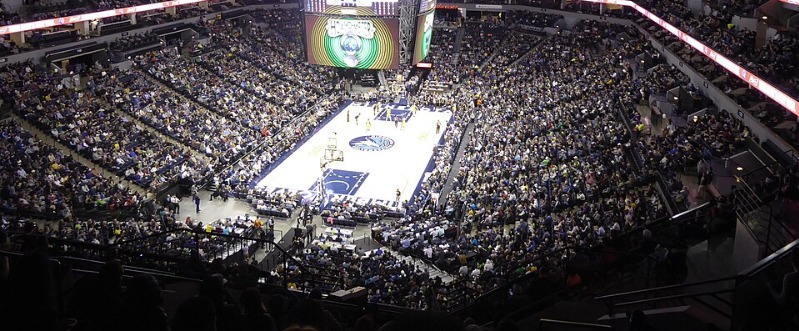
The away section at Ball Arena in Denver for Game 7 of the 2024 Western Conference Semifinals on May 4, 2024. That win sent the Timberwolves to their first Western Conference Finals since 2004. Source: Wikimedia Commons (Grunn050, CC0)
Space and F&B
Target Center opened in 1990. After its early owners ran into financial trouble and a move to New Orleans was floated, the City of Minneapolis bought the arena in 1995 and has owned it ever since.
A $140 million (about ₩193.9 billion) renovation ran from 2015 to 2017, financed by $74 million (about ₩102.5 billion) in city bonds, with then-owner Glen Taylor covering $60 million (about ₩83.1 billion) and operator AEG putting in $5.9 million (about ₩8.2 billion).
Since then, the Timberwolves have kept spending — eight figures more, in the hundreds of millions of dollars — including converting the old Cargill Foods Authority restaurant space into the 500-seat “Backcourt Club” premium section.
Chef Pimo and Levy Restaurants have run the food and beverage program for five seasons now, with local favorites like Parlour (burgers), Sotol (sushi and Asian bowls), and Lord Fletcher’s (walleye sandwiches) anchoring the “100 Level” concourse, alongside draft beer from Minnesota breweries Surly, Summit, and Lift Bridge.
Even so, the arena itself is the second-oldest in the NBA after Madison Square Garden, and its footprint — under four acres (about 16,200 m², or roughly 4,900 pyeong) — runs about 30% smaller than the league average.
That’s why the building draws criticism for having one of the league’s lowest shares of premium seating and too little storage and logistics space.
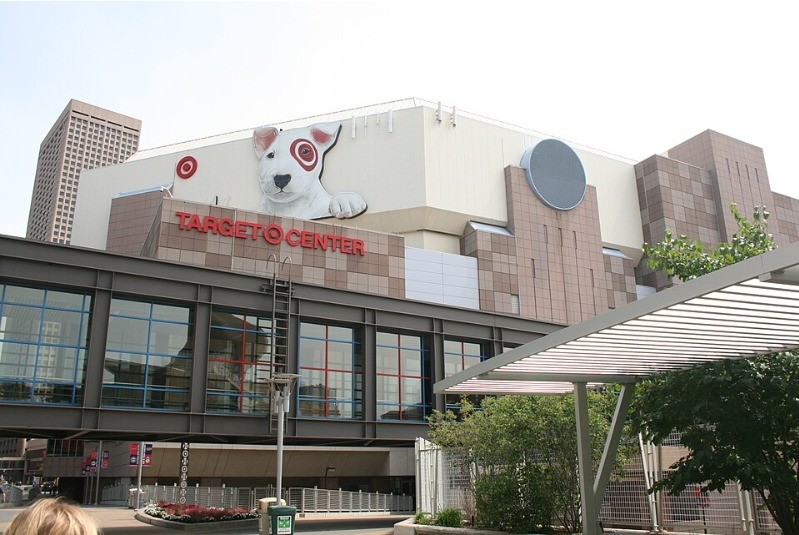
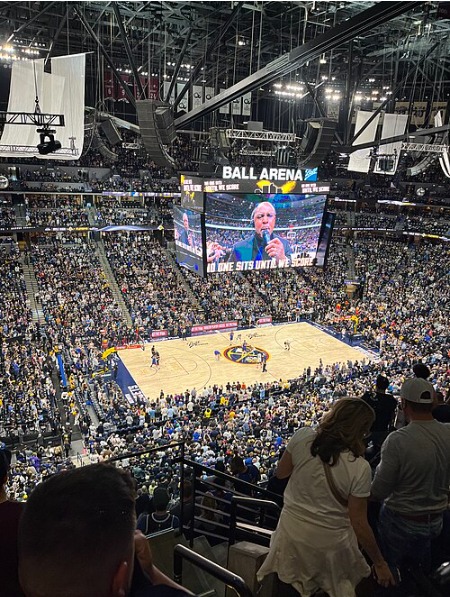
Target Center’s exterior, with Target Corp’s naming rights on full display and its trademark bullseye mascot mural. Source: Wikimedia Commons (Jeramey Jannene, CC BY 2.0)
Merchandise and Ad Inventory
Following the 2023-24 Western Conference Finals run, franchise value jumped 87% from $1.57 billion in 2021 to $2.9 billion in 2024, with merchandise, ticketing, and sponsorship revenue all hitting franchise records over the same span, according to team COO Ryan Tanke.
The jersey patch sponsor switched to buy-now-pay-later fintech company Sezzle starting in 2024-25, after three years with identity-protection firm Aura in that spot.
The exact terms of the Timberwolves-Sezzle deal weren’t disclosed, but as of 2024-25 the going rate for NBA jersey patches was reported at $5–20 million a year (about ₩6.9–27.7 billion), averaging around $10 million (about ₩13.9 billion).
On the ground, one local sports-travel blogger noted that Target Center’s food lineup has real Minnesota character and is genuinely good, but the concourse feels noticeably cramped at sellouts.
No matter how steep the revenue curve gets, this was a good reminder that a building’s physical footprint is its own, separate problem.
Broadcast Rights and Local Economic Impact
Target Center’s naming rights were bought by Minneapolis-based retailer Target the moment the arena opened in August 1990.
The deal has been renewed every five years since, most recently in October 2015 on undisclosed terms — the 25-year average is reported at around $1.5 million a year (about ₩2.1 billion).
Now in its 36th year, it’s considered the longest-running naming rights deal in American pro sports.
The arena’s local economic impact is estimated at roughly $100 million a year (about ₩138.5 billion), with $10–15 million (about ₩13.9–20.8 billion) flowing into state and city tax revenue annually.
Broadcast rights, meanwhile, are going through an upheaval.
The regional sports channel that’s carried Timberwolves games, FanDuel Sports Network North (formerly Fox Sports North), has reportedly seen its parent company, Main Street Sports Group, run into financial trouble — laying off 20 people at its Minneapolis headquarters and falling behind on payments to local broadcasters.
As a result, the Timberwolves signed a five-year deal (with a mutual opt-out after year one) with London-based streaming platform DAZN starting in 2026-27, with 15 games a season set to stream for free.
It’s a move made against the backdrop of a regional sports broadcast market that’s shaking on its own.
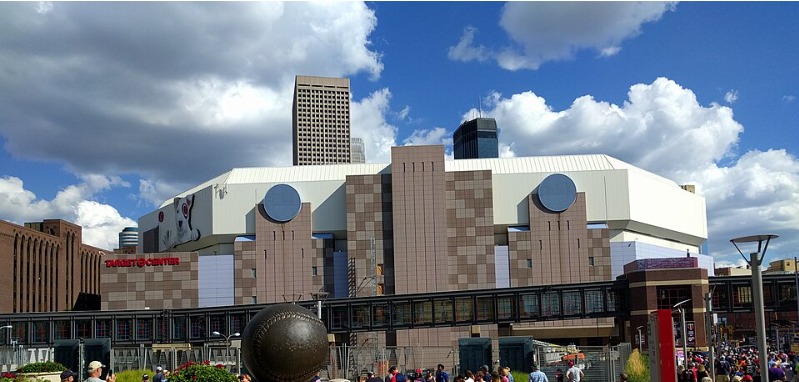
Target Center as seen from a plaza in downtown Minneapolis. At under four acres, its footprint runs about 30% smaller than the NBA average. Source: Wikimedia Commons (Runner1928, CC BY-SA 4.0)
$4.5 Billion, Tripled in 14 Months
The roots of this sale trace back to April 2021.
E-commerce entrepreneur Marc Lore and former MLB player Alex Rodriguez agreed to buy the Timberwolves and the WNBA’s Minnesota Lynx from then-owner Glen Taylor for $1.5 billion, structured as four separate installment payments.
The first two installments (36% of the team, about $500 million) went smoothly, but in March 2024 Taylor declared he was pulling out of the sale entirely over the third payment — roughly $600 million meant to lift their stake to 80% — claiming Lore and Rodriguez had missed the deadline.
Lore and Rodriguez countered that they’d filed six days ahead of the deadline and that any delay came from the NBA’s own approval process. The dispute went to arbitration, and in February 2025 a panel ruled 2-1 in their favor.
The NBA’s Board of Governors gave final sign-off on the $1.5 billion sale in June 2025.
So just 14 months after Lore and Rodriguez officially became owners, on August 21, 2026, Marc Stad — founder of Dragoneer Investment Group, with roughly $37 billion in assets under management and a net worth above $5 billion, and a backer of OpenAI, Anthropic, Uber, Airbnb, DoorDash, and Spotify — agreed to buy the controlling stake for $4.5 billion.
Stad had already been a minority investor in the Lore-Rodriguez consortium since 2021, and his wife, Elisa Stad, will become the new team governor.
Rodriguez is increasing his stake to remain the No. 2 owner and governor of the Lynx, while Lore is stepping back to a minority stake to focus on taking his grocery-delivery startup, Wonder, public.
The NBA Board of Governors vote is scheduled for September 15-16.
This deal sits against a broader wave of capital flowing into the NBA.
The 11-year, $76 billion media rights deal signed with Amazon, NBC, and ESPN in 2024 (about ₩105.26 trillion, roughly 2.6 times the prior deal’s annual average) lifted every team’s revenue base at once, and in the 14 months since, controlling stakes have changed hands at the Boston Celtics ($6.1 billion, August 2025), the LA Lakers ($10 billion in June 2025, then $12.5 billion in August 2026 — resetting the all-time pro sports sale record twice), and the Portland Trail Blazers ($4.25 billion, March 2026), among six teams in all.
A publication that tracks team sales pointed out that even traditional “small-market” franchises like the Timberwolves and Trail Blazers have now cleared the $4 billion mark — a sign, it argued, that market size is no longer the primary driver of team value.
Blue Owl Capital’s private equity fund, Homecourt Partners, also picked up a minority Timberwolves stake in 2024 after Carlyle Group exited over NBA rule issues, and appears to still be holding that stake as of July 2026.
What the New Owner Wants: A New Arena
Lore and Rodriguez signaled interest in building a new arena as far back as their 2021 acquisition talks.
In a June 2025 Star Tribune interview, they said they were even considering sites outside downtown, citing mixed-use entertainment districts like the New England Patriots’ Patriot Place, the Atlanta Braves’ The Battery, and LA Live near the LA Lakers’ Crypto.com Arena as possible models.
Minneapolis Mayor Jacob Frey’s office has said it would prefer the team stay downtown, provided construction doesn’t rely on public tax support.
The city’s share of the 2015-2017 renovation bonds still had about $49 million (about ₩67.9 billion) outstanding as of June 2025, and breaking the lease before 2035 would trigger a $50 million (about ₩69.3 billion) penalty.
Whether incoming owner Marc Stad will pick up this conversation is still unclear — worth noting, none of the coverage of this acquisition has mentioned relocating the arena at all.
How This Compares to the KBO and K League
Less than ten days after this sale broke (on August 17, 2026), I noticed a domestic business outlet had asked almost the exact same question using the Lotte Giants as its case study, in an article.
The gist: “While the Lakers sell for ₩18 trillion, why don’t Korean pro baseball clubs change hands the same way?” — and the reasons it gave were interesting.
What stood out to me: a JPMorgan report from October 2025 found private equity capital already inside roughly a fifth of America’s four major pro leagues (NFL, NBA, MLB, NHL), with the four leagues’ combined franchise value nearing $500 billion — and even the once-conservative NFL changed its rules in August 2024 to let private equity firms hold up to 10% of an individual team.
Korea has had a full club sale before, too.
In 2021, Shinsegae Group bought the SK Wyverns (now the SSG Landers) from SK Telecom for ₩135.2 billion (₩100 billion for the club itself plus ₩35.2 billion for land and buildings) — but the buyer there was, again, another large conglomerate.
For clubs like the Samsung Lions, LG Twins, or Lotte Giants, whose very names are tied to a parent company, the cash flow the team generates and the advertising value the parent gets are hard to untangle — which makes it difficult for private equity to isolate pure investment returns.
KBO’s 10 clubs posted combined revenue of ₩779.6 billion in 2025 (up 14% year over year), with half turning an operating profit (Lotte Giants’ operating profit came to about ₩16.56 billion) — so it isn’t that the clubs can’t make money. The article’s real conclusion was that Korea simply hasn’t built up enough club-sale transactions to establish a market benchmark for “how many times revenue” a fair price should be.
That’s a contrast with the U.S., where Forbes’ 2025 figures put average NBA franchise value at 12.9 times revenue, and MLB at roughly 7 times as of 2026.
As a working marketer, this makes me think that as Korean clubs keep growing the share of revenue fans pay directly (tickets, merchandise, premium seating), someone will eventually try to value that revenue stream as its own standalone investment asset.
But that would require a track record of repeat sales like the Timberwolves’, building an actual pricing benchmark over time — and Korea doesn’t appear to be there yet.
If the NBA Board of Governors vote on September 15-16 goes as planned, the Timberwolves will get their third controlling owner in the franchise’s 37-year history.
Watching the club’s value climb from $1.5 billion to $4.5 billion in that span, it’s striking how quickly the gap can close between how much a sports team is loved and how much it sells for.
Leave a Reply