Contents · About 8 min read
📱 View as card news
What sent me back to the San Diego Padres was, honestly, a transfer story.
I heard that Song Sung-mun, a former Kiwoom Heroes infielder, had signed a four-year, $15 million guaranteed deal with the Padres this past winter (worth up to $22 million over five years with the option), so I went digging back through the club’s files — and while I was at it, a much bigger story broke.
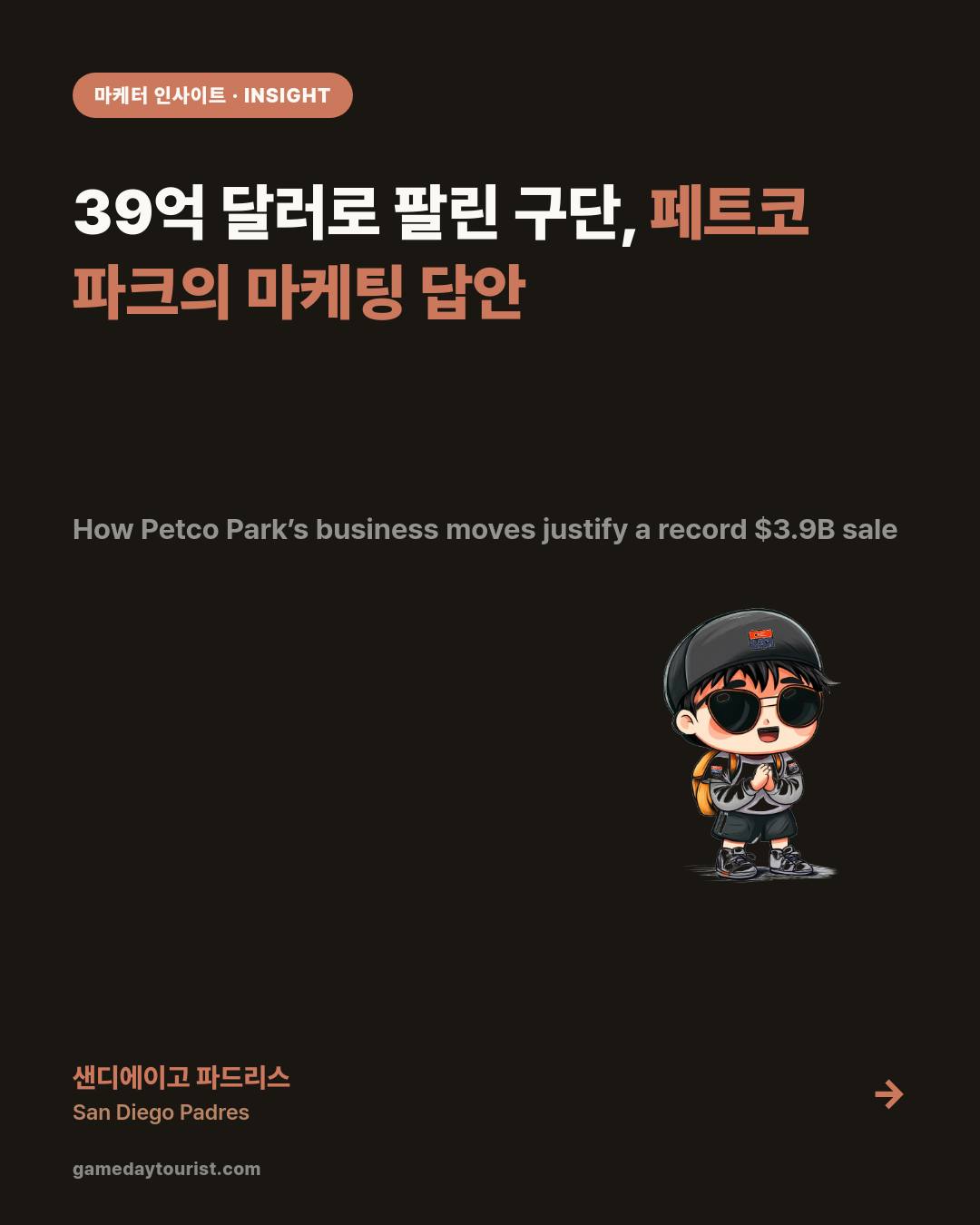
On August 4, Bloomberg reported the Padres had sold for $3.9 billion.
Considering Steve Cohen paid $2.42 billion for the New York Mets back in 2020, this rewrote the record for the most expensive team sale in MLB history by a wide margin.
The new owners are Clearlake Capital co-founder José Feliciano and his wife Kwanza Jones, and watching the deal move from announcement to actual approval made me want to go back and take a fresh look at this club’s marketing numbers from the ground up.
Looking back, the Padres also happen to be the club Park Chan-ho joined in a 2005 trade from the Texas Rangers, helping them win the NL West that season.
Maybe that history is why the Padres never feel quite as unfamiliar to me as most small-market clubs do.
Attendance and Tickets
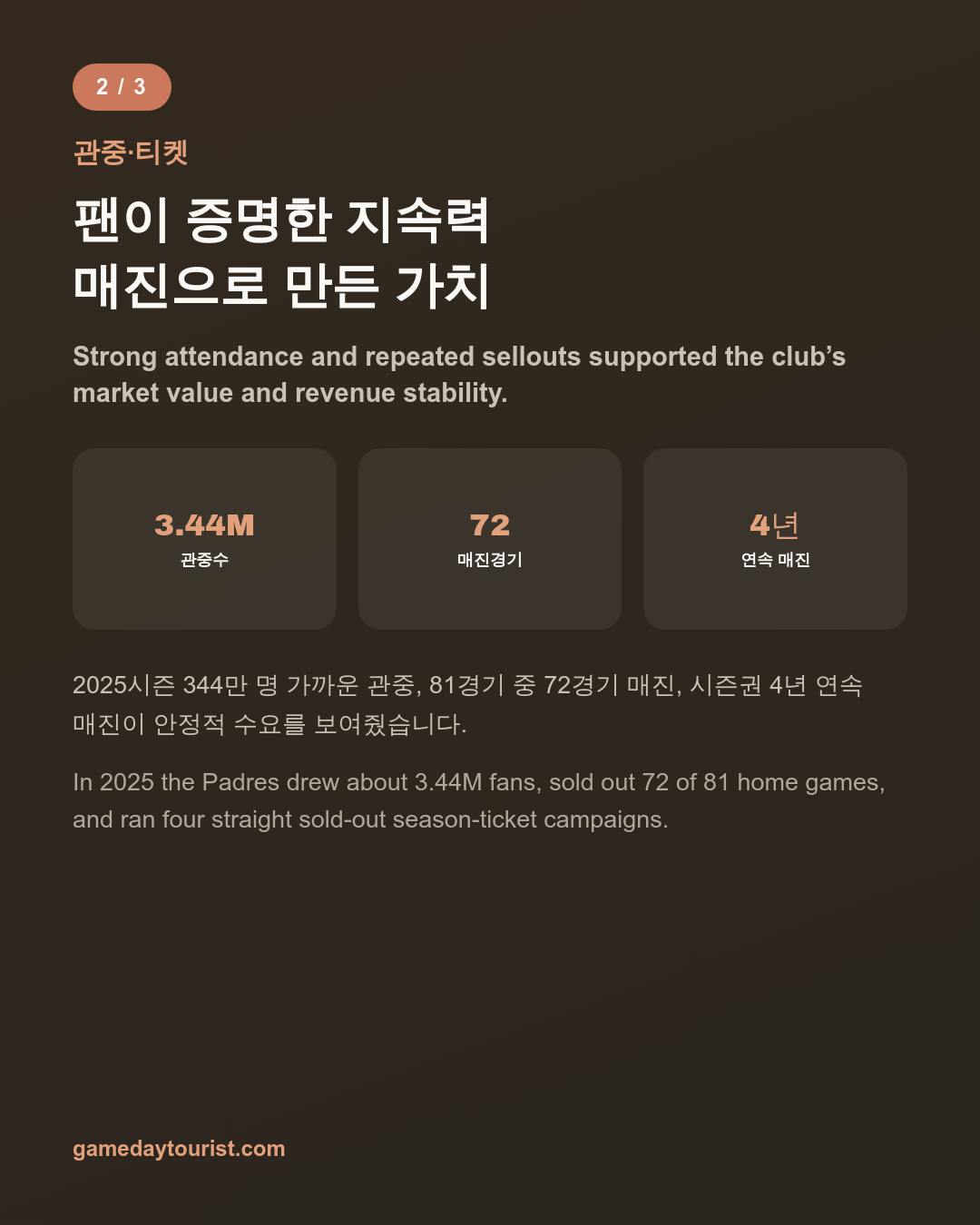
The Padres drew close to 3.44 million fans to home games in the 2025 season, second in all of MLB behind only the Dodgers.
72 of their 81 home games sold out, and season tickets sold out for a fourth straight year running from 2023 through 2026 (per a January 2026 announcement).
With sellouts piling up, getting a shot at a new season ticket now means putting your name on the On-Deck Waitlist first.
Single-game ticket prices are reported anywhere from an average of $32 to $89 depending on when you check and who’s on the schedule, with marquee matchups like Dodgers games pushing prices sharply higher.
Song Sung-mun started at shortstop again on August 11 against the Milwaukee Brewers.
He went hitless, but the team came back to win 3-2 — and having followed him since his Kiwoom days, keeping tabs on these small updates is honestly part of the fun of following the league.
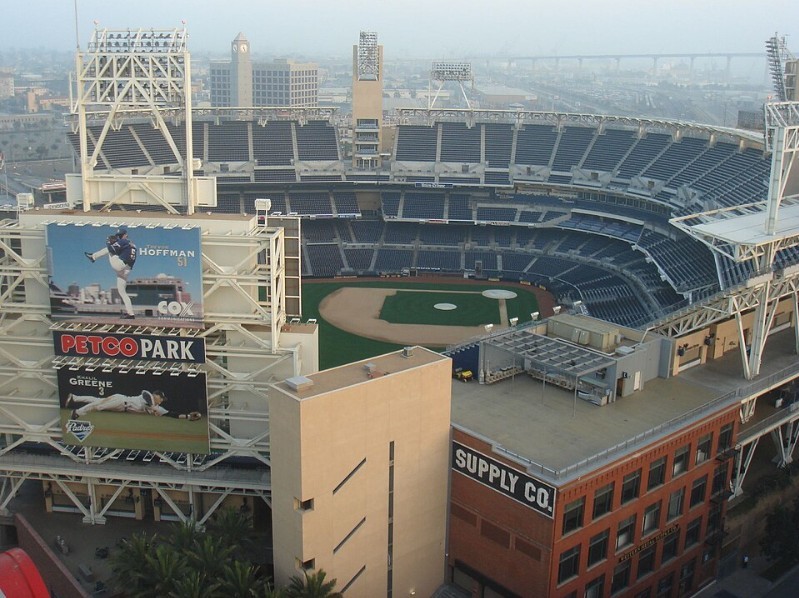
Aerial view of Petco Park, taken November 2007 · Source: Wikimedia Commons (photo by Kevin Tostado), CC BY 2.0
Space Utilization and F&B
The most iconic space at Petco Park is the Western Metal Supply Co. building, which sits right where the left field foul pole would otherwise be.
It’s a four-story brick building from 1909 that the team chose to build the ballpark around instead of tearing down, and it now houses the team store, suites, and a rooftop lounge.
Ahead of the 2025 season, Forbes reported the team store expanded by roughly 1,000 square feet and doubled its checkout counters, with Padres CEO Erik Greupner explaining the thinking behind it: “the lines just kept getting longer every game day, and we didn’t want to keep making fans wait.”
That’s a genuinely nice way to put it.
The grass lawn beyond the outfield, Gallagher Square (formerly known as “the Park at the Park”), is another space worth a closer look.
It’s a spot where a cheap ticket gets you a blanket on the grass and a view of the game, and a $20 million renovation in 2024 added pickleball courts, a giant climbable bat sculpture, and a dog-friendly area.
On non-game days it doubles as a public park open to the city, and the ballpark as a whole hosts more than 150 non-baseball concerts and events a year.
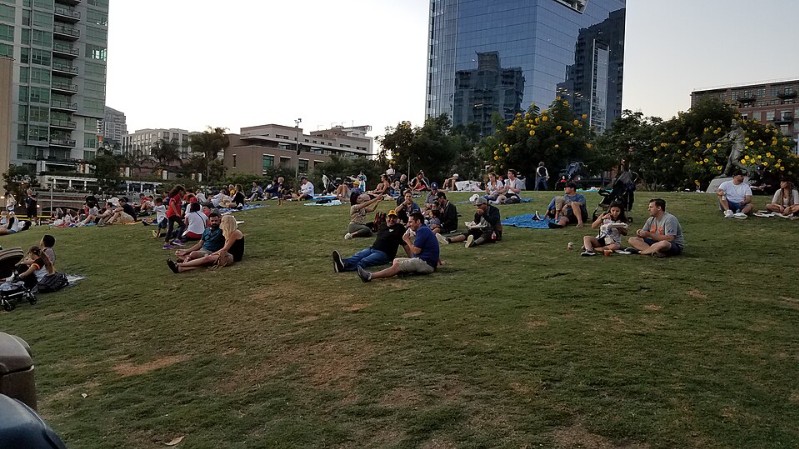
Fans watching the game from Gallagher Square, taken August 2018 · Source: Wikimedia Commons (photo by RightCowLeftCoast), CC BY-SA 4.0
One American sports-travel blogger described Petco Park by saying it’s hard to find another ballpark this packed with bars, social spaces, and restaurants — and the 2026 menu backs that up, with Japanese curry chain CoCo Ichibanya and San Diego’s own Pop Pie Co. joining the lineup alongside taps from local breweries like Stone Brewing, Ballast Point, and Karl Strauss.
You also can’t skip “.394,” the tribute beer named for legendary hitter Tony Gwynn.
As a working marketer, what struck me was the sheer pace of turning over the F&B lineup almost every season — an operating rhythm well worth studying.
Merchandise and Advertising Inventory
The naming rights partner (the right to put a company’s name on a facility) is pet-supply retailer Petco.
The original deal, signed at the ballpark’s 2004 opening, ran 22 years at a reported total of roughly $60 million (about $3 million a year), and a March 2021 announcement extended it two more years through the 2027 season.
Neither side has disclosed the specific terms of the extension.
On the merchandise side, the new 2026 City Connect 2.0 jersey set a franchise record by topping $1.1 million in sales in a single day.
That nearly doubled the previous record of $550,000, set on Juan Soto’s 2023 opening-day debut.
The timing overlapped with the Western Metal Supply building renovation where the team store sits, which suggests a deliberate merchandising strategy pairing the store expansion with the jersey launch.
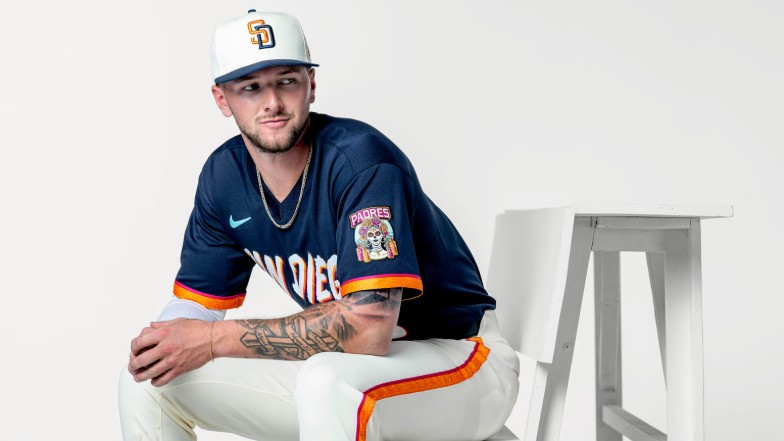
The City Connect 2.0 jersey, unveiled April 2026, featuring a sleeve patch honoring Día de los Muertos (the traditional Mexican Day of the Dead) · Source: MLB.com/Padres official news
Broadcast Rights and Local Economic Impact
The Padres’ broadcast-rights history hasn’t been smooth.
They had a 20-year, $1.2 billion deal with Diamond Sports Group (formerly Bally Sports, now FanDuel Sports Network), but when Diamond fell behind on rights payments in May 2023, MLB’s league office took the unprecedented step of directly producing a club’s broadcasts for the first time in its history.
Today the league-produced broadcast airs through cable providers like DirecTV, Cox, and Spectrum, and for 2026 the club signed a new distribution deal putting 10 Saturday home games on local broadcasters CBS8 and CW for free.
The local economic impact numbers come from a report commissioned by the Padres themselves and analyzed by the San Diego Economic Development Corporation (EDC).
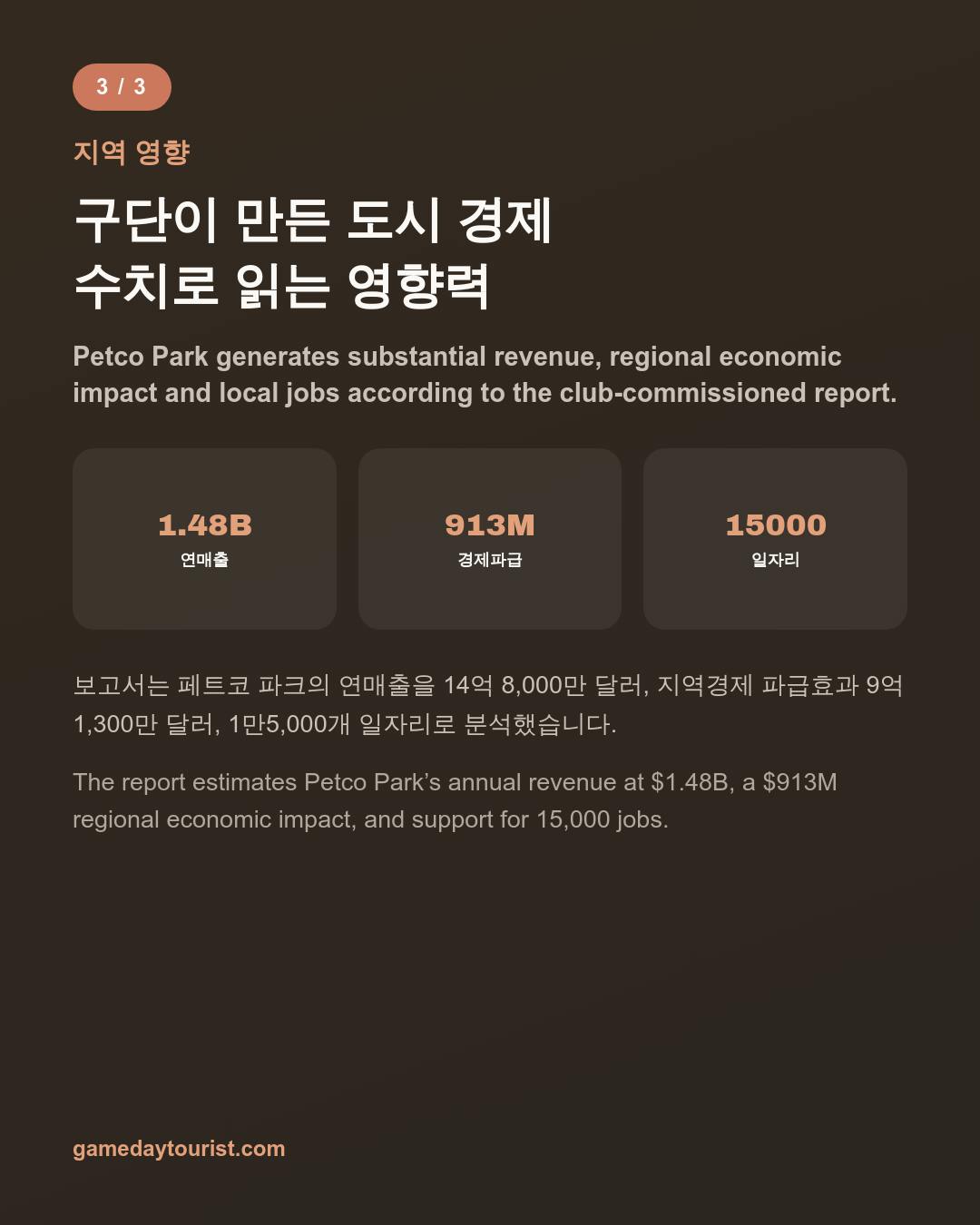
As of 2024, Petco Park generated $1.48 billion in revenue, a $913 million local economic impact, and supported 15,000 jobs, according to the analysis.
Of that, $789 million came from home games alone, with the remaining $123 million from concerts and other events.
City finances saw $16.4 million into the general fund and up to $12.4 million in hotel tax revenue.
CEO Erik Greupner said in the report that “the Padres take pride in being stewards of a public trust.”
The $3.9 Billion Sale and the 70-30 Ownership Split
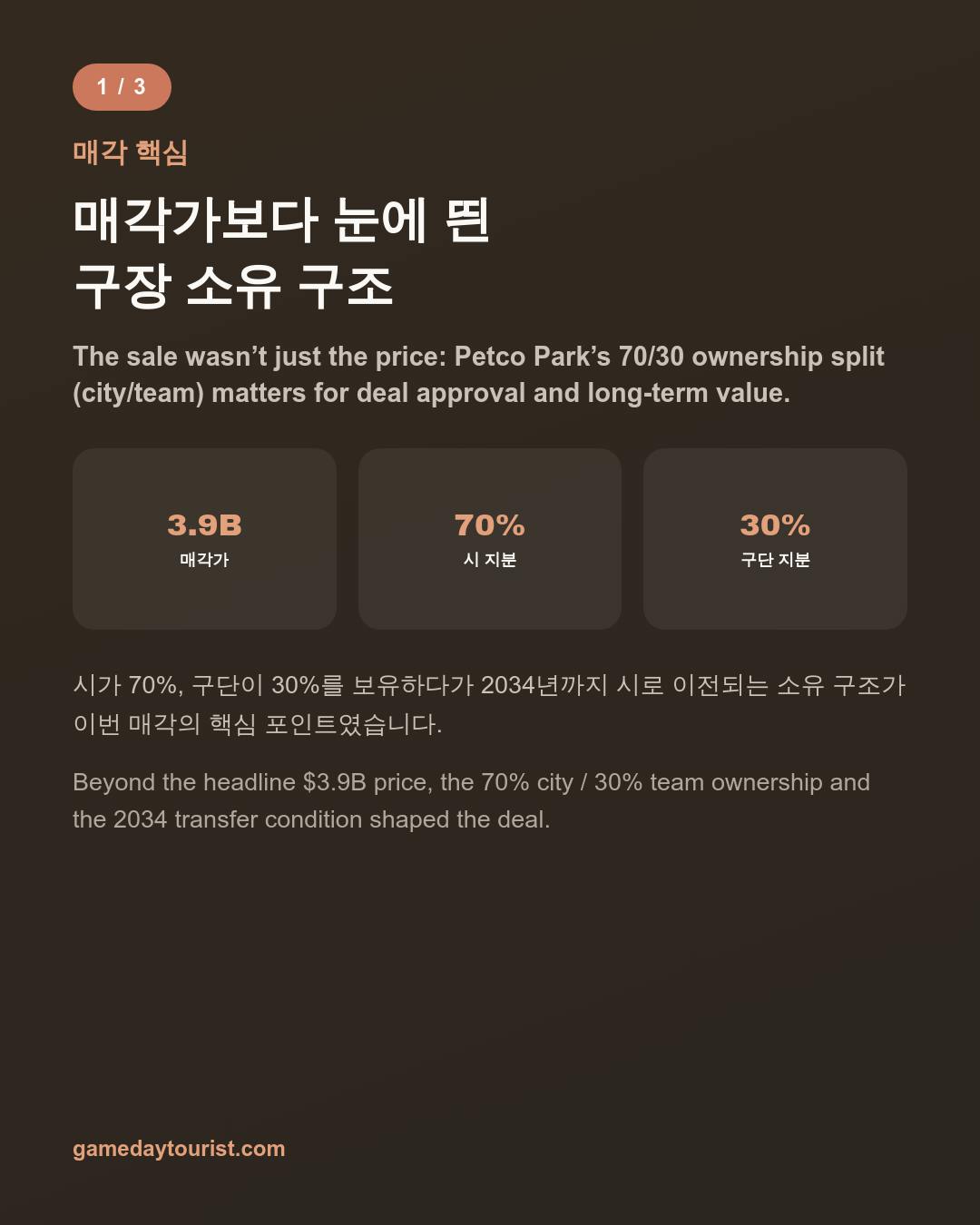
What caught my eye as a marketer, more than the sale price itself, was Petco Park’s ownership structure.
Since it was built, the ballpark has been owned 70% by the City of San Diego and 30% by the Padres, with that 30% fully transferring to the city by 2034.
That means when the club changes hands, that 30% stake goes with it — and just like the Mets and Tampa Bay Rays sales, that piece alone needs separate approval from the San Diego City Council before the deal can close.
Considering that public funding from the city, county, and port authority made up more than $300 million of the $474 million total construction cost, that history is still baked directly into the ownership structure.
According to Sportico‘s analysis, the Padres posted $530 million in 2025 revenue (11th in the league) and $20 million in EBITDA (earnings before interest, taxes, depreciation, and amortization — a standard gauge of a club’s profitability).
Unlike the Angels, Nationals, and Twins, all of which hit the market recently without finding a buyer, the Padres sold at a record price — largely credited to reliable attendance and the year-round event revenue Gallagher Square generates.
A Comparison With the KBO and K League
Most KBO clubs play in stadiums owned by local governments, operating under long-term management agreements that let them keep advertising and concession revenue in exchange for minimal, management-cost-level rent.
Some, like Samsung Lions Park in Daegu, SSG Landers Field in Incheon, and Hanwha Life Ballpark in Daejeon, bundle naming rights together with operating rights, but even in those cases the club doesn’t actually own a stake in the stadium itself.
Petco Park, by contrast, has the club holding an actual 30% ownership stake that transfers to the city by 2034 — confirming that the American model, where a club sale and stadium ownership move together, is fundamentally different from how things work here.
Structurally, a KBO club sale can never carry a stadium stake along with it — which, from the perspective of an investor evaluating a domestic club acquisition, might actually be an argument that the risk profile here is simpler.
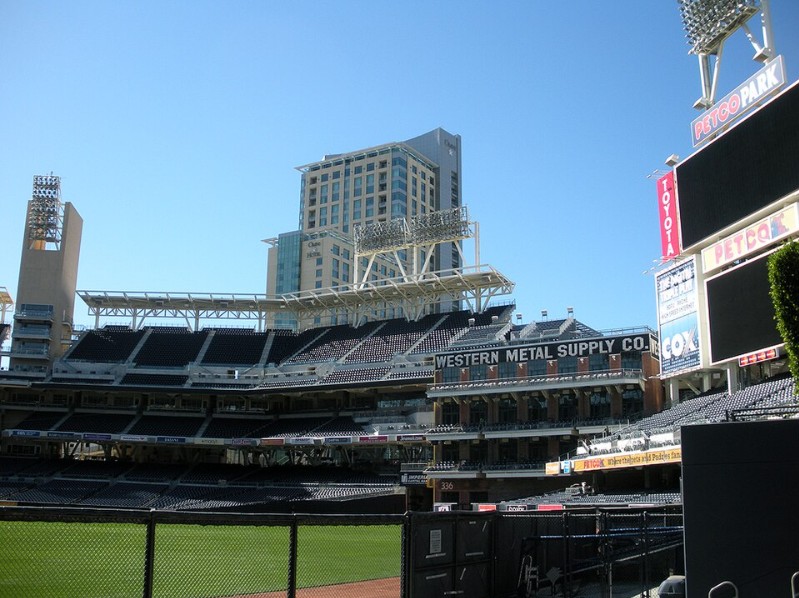
The Western Metal Supply Co. building, taken February 2009 · Source: Wikimedia Commons (photo by XF Law), CC BY-SA 3.0
$3.9 billion sounds like an abstract, dizzying number on its own, but underneath it are four straight years of season-ticket sellouts and roughly $900 million in local economic impact — steady marketing results that back up the price.
Every time I see a club this woven into a city’s economy, it makes me think KBO clubs could stand to put out a regular report of their own, proving their local ties with real numbers.
Leave a Reply