Contents · About 8 min read
📱 View as card news
In November 2022, the same week FTX — then ranked among the world’s three largest cryptocurrency exchanges — filed for bankruptcy, the exact opposite kind of commotion was unfolding on the exterior wall of a basketball arena in downtown Miami.
Just a year and a half earlier, the sponsor that had paid $135 million (about ₩189 billion) for a 19-year naming deal had collapsed overnight, leaving the Miami Heat’s home arena without a name on its facade for months.
I found myself revisiting this story recently while watching new ballparks branded with a team’s parent-company name go up one after another back home in Korea — Daegu Samsung Lions Park, Incheon SSG Landers Field, Daejeon Hanwha Life Ballpark — which made me wonder: what happens to a venue if an outside company with no ownership stake in the team signs a naming rights (the right to attach a corporate name to a facility) deal and then suddenly collapses?
As a working marketer, I thought it was rare to find a case this textbook for sponsorship risk management, so I put together, in numbers, how today’s Kaseya Center got its name back and what it has changed since.
Naming Rights and Ad Inventory
Naming rights are the most iconic form of arena sponsorship, and among ad inventory (the total advertising space and exposure a team can sell) — which also includes courtside signage and scoreboard exposure — it’s the product with the largest exposure and the longest contract term.
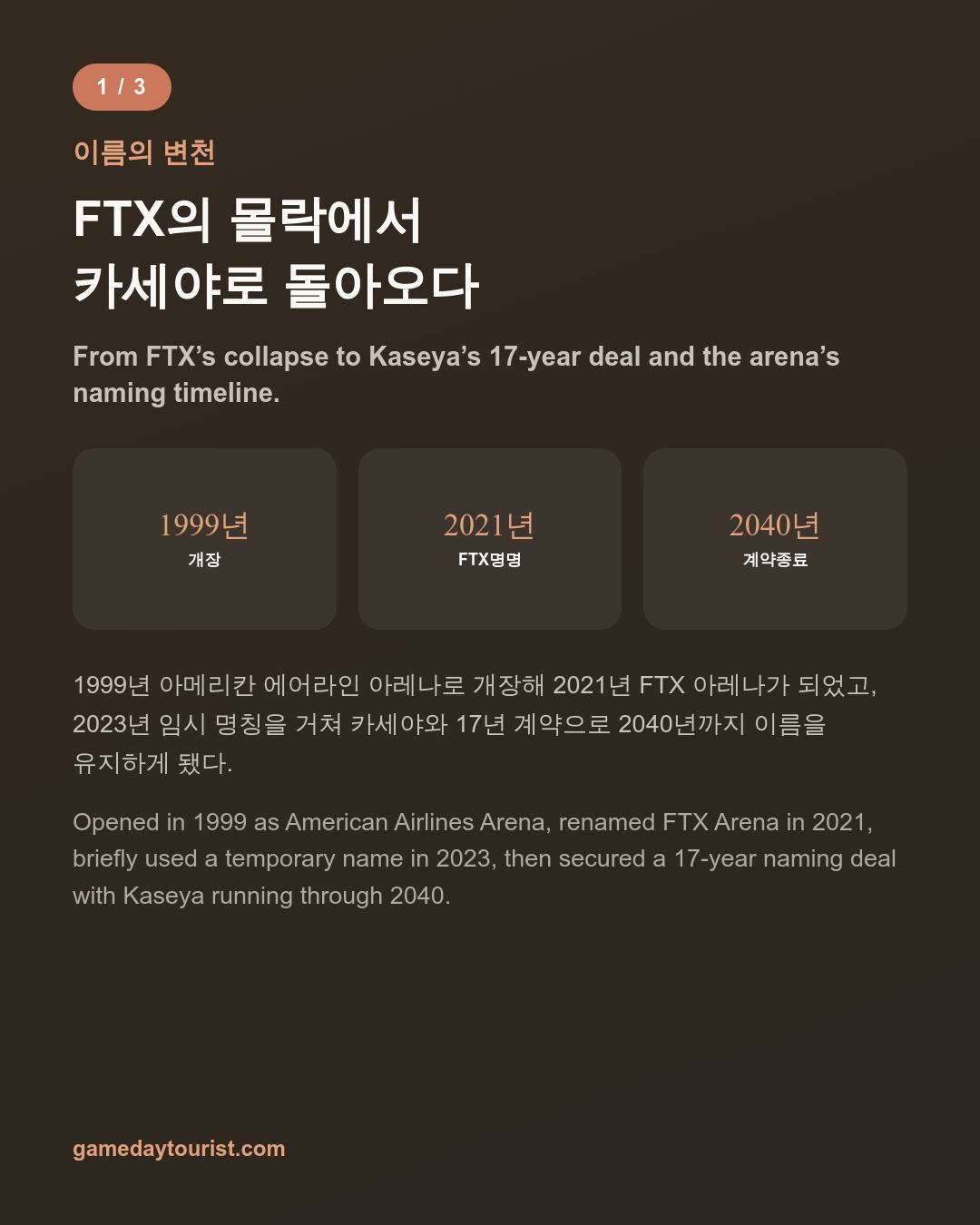
The arena opened as American Airlines Arena on December 31, 1999, was renamed FTX Arena in 2021, then briefly went by the placeholder name “Miami-Dade Arena” in early 2023 after FTX’s bankruptcy, before IT security and management software company Kaseya bought the naming rights that April for 17 years and $117.37 million (about ₩164.3 billion), making it today’s Kaseya Center (through 2040).
According to ESPN and Forbes, most of that contract fee goes to Miami-Dade County, which owns the arena, while the team’s operating company receives $2 million a year (about ₩2.8 billion).
One point worth noting here is that the LA Lakers’ home arena, Crypto.com Arena — which we’ve already covered — is different from this case.
Crypto.com, like FTX, is a cryptocurrency exchange, but it has never gone bankrupt, and even during periods when reports surfaced about the business struggling after signing a 20-year, $700 million deal in 2021 (the largest naming rights deal at the time), it kept the naming rights intact, and the name remains unchanged as of 2026 (Athletic Business).
Even among cryptocurrency exchanges, outcomes can diverge sharply depending on a company’s financial standing, which seems to underscore even more clearly the importance of the sponsor financial-health review mentioned earlier.
Another point worth noting here is the ownership structure.
American professional sports venues are often owned directly by the team, but Kaseya Center follows a publicly owned model in which Miami-Dade County owns the land and building while the team only handles operations.
Because of that, part of the naming rights fee is designed to flow into a local gun-violence-prevention fund — and the idea that “sponsorship money funds public safety” struck me as something worth referencing back home, where many venues are municipally owned.
Having gone through the FTX ordeal once already, it’s reasonable to assume the review of sponsor financial health built into the Kaseya deal was far more thorough than before.
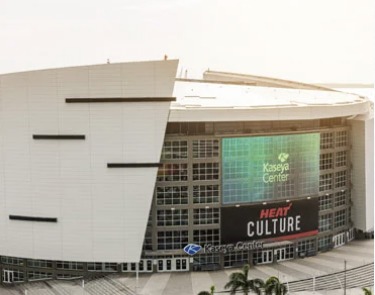
Source: Kaseya Center’s official website, “About” page screenshot · Official team/facility promotional image, used for editorial/reference purposes
Attendance and Ticketing
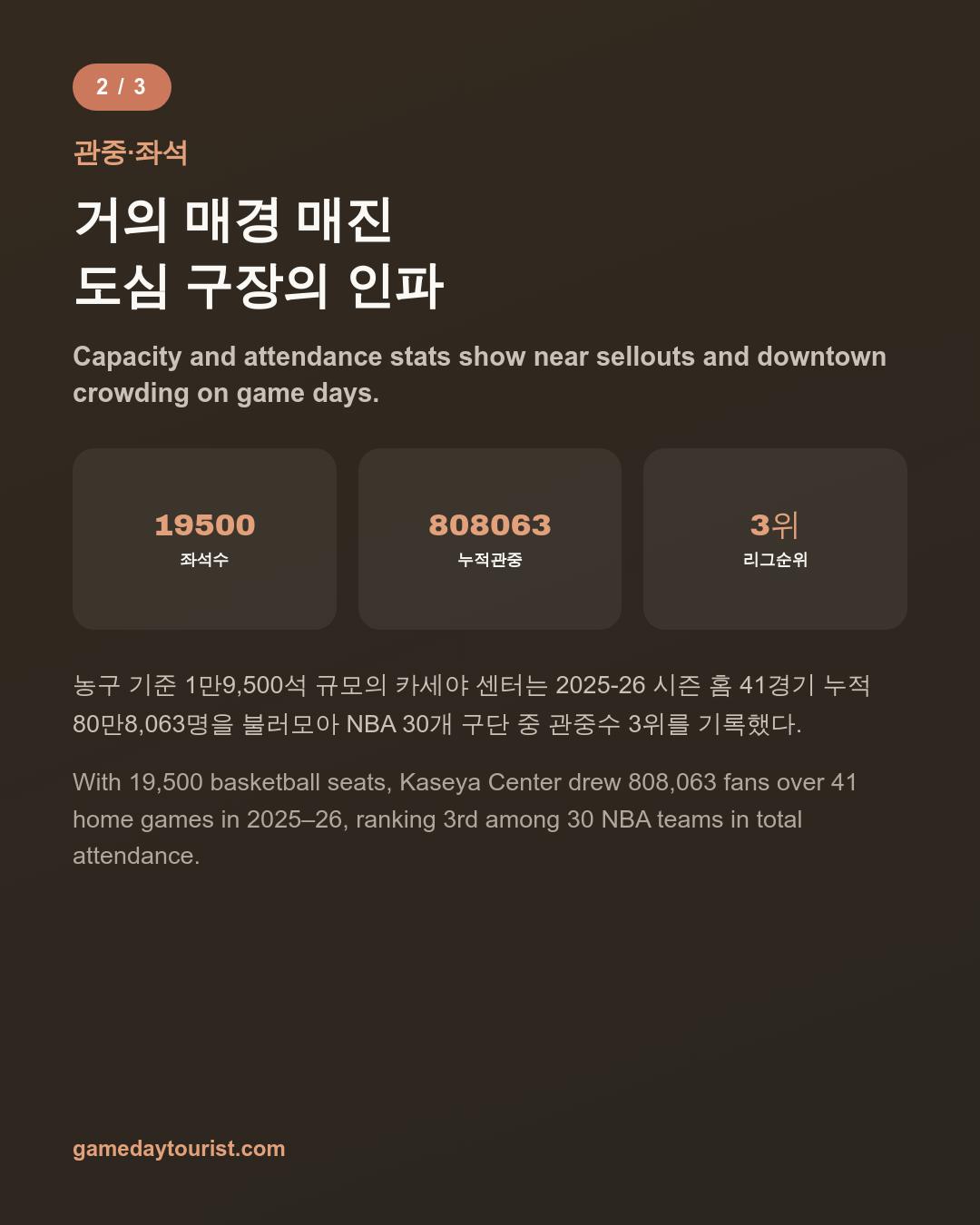
Kaseya Center’s basketball seating capacity totals 19,500, including 2,105 club seats, 80 suites, and 76 private boxes (per Wikipedia).
In the 2025-26 season, the Miami Heat drew a cumulative 808,063 fans across 41 home games, ranking 3rd among the NBA’s 30 teams — a figure that, given the arena’s seating capacity, comes close to a sellout nearly every game.
It’s also worth noting that upper 300-level seats are priced at roughly a third of the lower-level center-line seats, offering a tightly tiered range of price points.
One American sports-travel blogger noted that, in exchange for its prime downtown location, Kaseya Center sees considerable traffic congestion and parking difficulty on game days.
Concession reviews, on the other hand, are mixed — some complain about high prices and long lines, while others praise specific menu items.
From a marketer’s perspective, this kind of inconvenience doesn’t look like something the team is simply ignoring; rather, it seems to be a trade-off they’ve judged worth accepting, since downtown accessibility translates directly into sponsor exposure value.
Space Utilization and Reinvestment
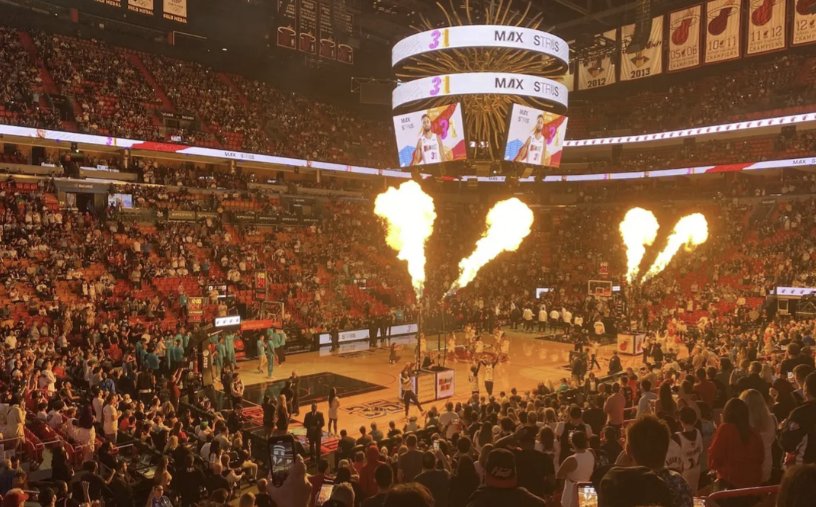
Inside the arena is the Waterfront Theater, Florida’s largest indoor theater, which can be reconfigured from 3,000 to 5,800 seats for concerts and performances.
The team states through Kaseya Center’s official site that it hosts more than 80 non-basketball events a year — enough to make the venue function as a year-round draw for downtown Miami even on non-game days.
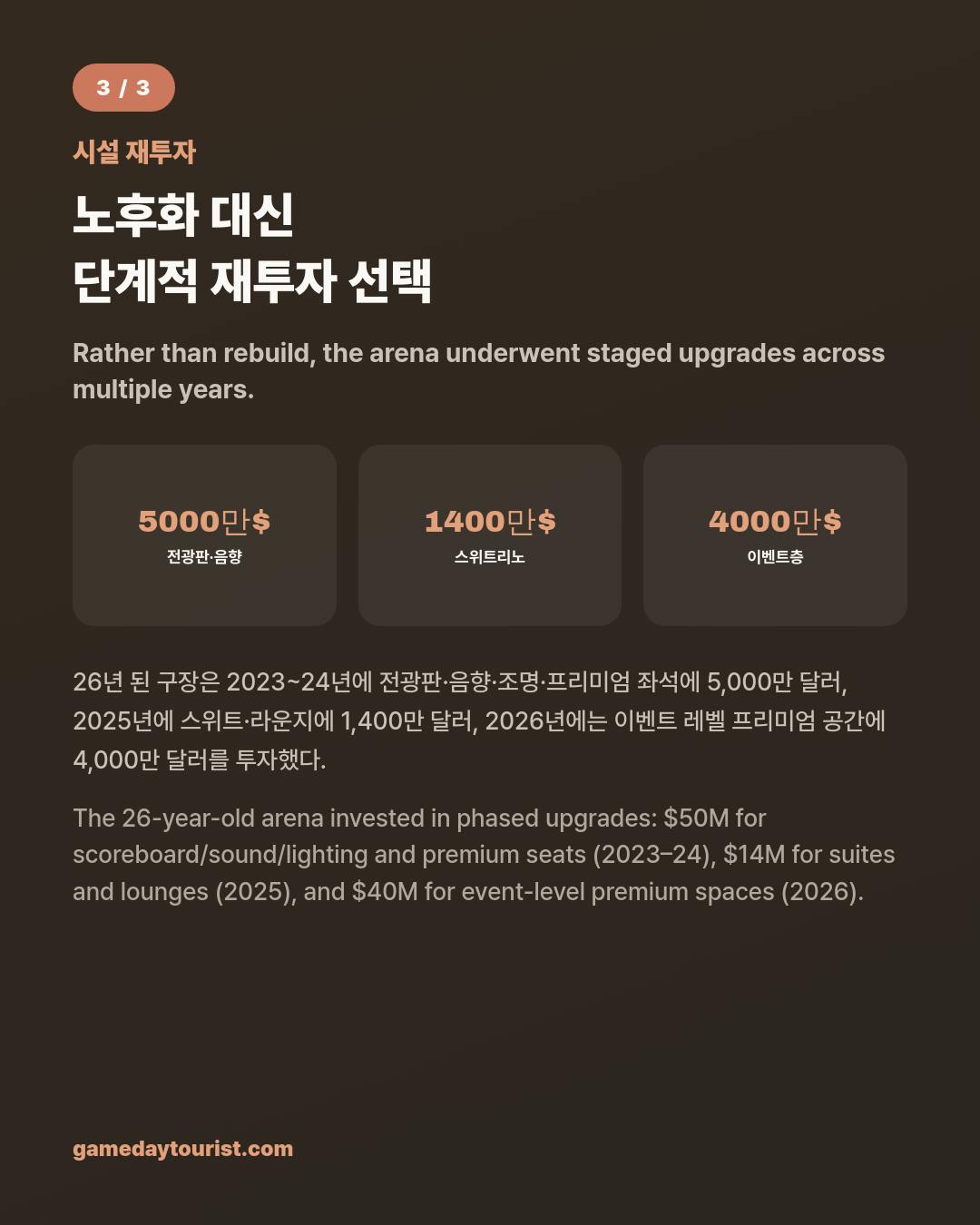
This 26-year-old arena has been reinvested in three separate times in recent years, totaling $104 million (about ₩145.6 billion).
In the summer of 2023-2024, $50 million (about ₩70 billion) went into scoreboards, sound, lighting, and premium seating; in 2025, $14 million (about ₩19.6 billion) went into suite and lounge renovations; and in the summer of 2026, $40 million (about ₩56 billion) went into event-level premium spaces (per Sports Business Journal and Local10).
Rather than building a brand-new arena all at once, this approach of gradually overhauling the facility year by year looks similar to the pattern we’ve already covered with the Boston Celtics’ TD Garden, and it felt like it holds a lesson for Korean teams with aging venues too.
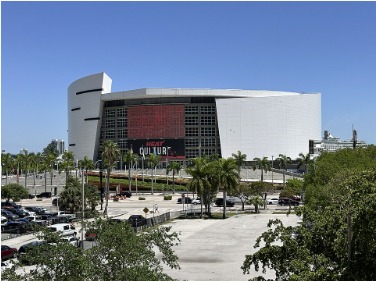
Source: Photographed by Phillip Pessar, Flickr (CC BY 2.0) · Taken April 2024, published via Wikimedia Commons
Merchandise and Brand
The symbol most associated with the Miami Heat is the “Vice Nights” jersey, with its pastel-toned logo on a black background.
Drawing its motif from 1980s Miami urban culture, this jersey is — according to Yahoo Sports — the best-selling jersey in the team’s 38-season history and the all-time best-selling NBA City Edition jersey, with more than 90,000 units sold across 96 countries.
That same sensibility carries over into the arena’s branding, where the slogan “HEAT CULTURE” is permanently displayed on the exterior walls and the court.
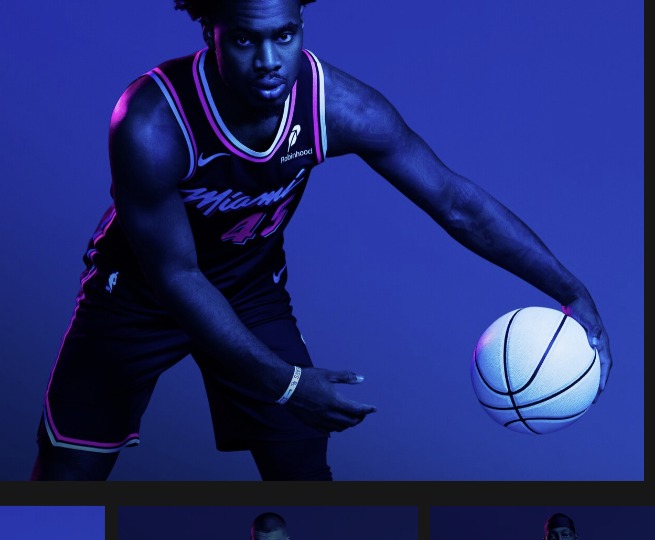
Source: Miami Heat’s official website (nba.com/heat), 2025-26 season Vice Nights reveal shoot · Official team promotional image, used for editorial/reference purposes
The jersey patch sponsor moved from cruise line Carnival in the 2023-24 season to fintech company Robinhood starting in 2024-25.
Even after stepping down as patch sponsor, Carnival continues to support the team’s after-school education program, the HEAT Academy, under the Carnival Foundation’s name (per Hot Hot Hoops’ analysis) — and I found it striking that a community-support relationship kept going separately even after the patch deal ended.
The Heat Store has also expanded its touchpoints beyond the arena, operating locations in shopping malls and at Miami International Airport.
Broadcast Rights and Local Economic Impact
With FanDuel Sports Network Florida, which had handled local broadcasts, shutting down its business after the 2025-26 season, the Heat’s local broadcasts move to free over-the-air channel WPLG Local 10 starting in 2026-27.
Hoops Rumors reported that the broadcast rights fee for this deal comfortably exceeds the typical going rate of $10 million for over-the-air deals, and since fans will now be able to watch games without a paid subscription, the viewership base could actually broaden.
As of October 2025, Forbes valued the Miami Heat at $5.7 billion (about ₩8 trillion), ranking 8th among the NBA’s 30 teams (per Forbes’ team valuations).
Kaseya, the naming rights partner, has also stated — according to the Miami-Dade Beacon Council — that around the time the deal was signed, it planned to create 3,400 new jobs and invest more than $16 million in the Miami-Dade area, making this a case where arena sponsorship connects not just to team revenue but to local employment as well.
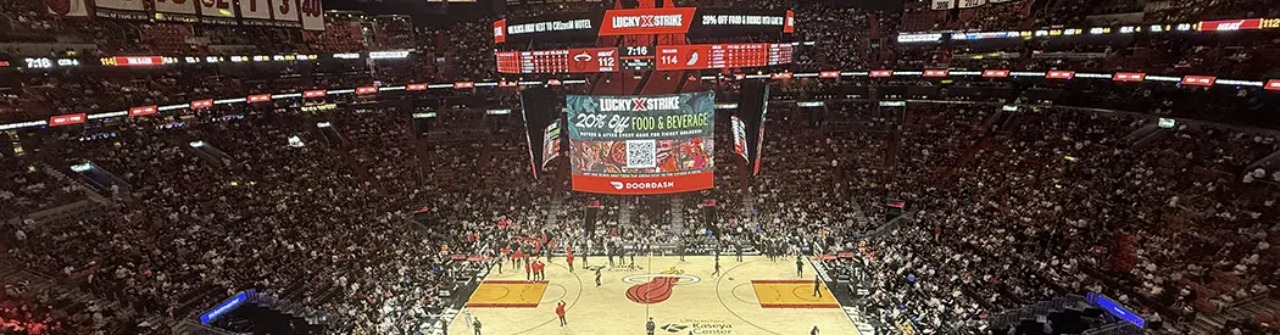
Source: Photo published by overseas stadium review site Itinerant Fan · Used for editorial/reference purposes
Compared to the KBO and K League
This is where I started to draw a direct comparison to the situation back home, then had to rethink it.
The corporate names attached to KBO ballparks in Korea — Daegu Samsung Lions Park, Incheon SSG Landers Field, Daejeon Hanwha Life Ballpark, and so on — are actually different in nature from Kaseya Center.
All of these are cases where the parent company that owns the team built or remodeled its own ballpark together with the local government and attached its own name — a different structure from arrangements like FTX’s or Kaseya’s, where a third-party company with no ownership stake pays market price purely for naming rights.
In Korea, the risk structure that actually resembles the Kaseya Center case more closely isn’t the ballpark — it’s the team name itself.
Kiwoom Heroes, the only team without a parent company, has had its team name sponsored first by Nexen Tire (2010-2018) and now by Kiwoom Securities — and since this involves an outside company with no ownership stake paying to attach its name, the structure is similar to American-style naming rights.
If a team-name sponsor like this were to run into financial trouble, confusion similar to what Kaseya Center went through could play out in Korea as well — which made me feel that the lesson from this case applies more precisely to structuring these kinds of team-name sponsorship deals than to Korean ballparks themselves.
That said, regardless of ownership structure, I think two things are worth Korean teams’ attention either way: the public-ownership approach of tying part of sponsorship revenue to community reinvestment when a local government owns the venue, and the reinvestment approach of upgrading facilities gradually over several years instead of building a brand-new arena.
Looking at the mere fact that an arena’s name changed three times within a few years, it might look like a confusing series of mishaps, but underneath it was a tightly interwoven web of sponsorship-deal design and risk management handled by the team and local government.
The more I dug into this backstory, the more I was reminded that even a single arena name carries a surprising amount of negotiation and calculation behind it.
Leave a Reply