Contents · About 8 min read
📱 View as card news
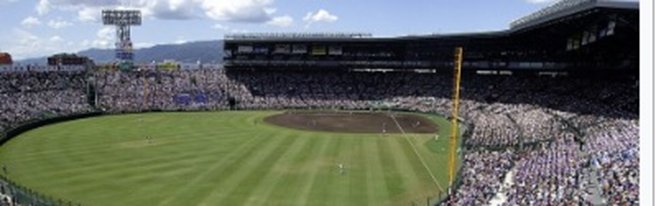
Today, it’s not professional players running on the Koshien ground but high school students gathered from across the country.
Coincidentally, the second day of the 108th National High School Baseball Championship is in full swing, while the professional team that actually calls this stadium home, the Hanshin Tigers, are away on the road.
When I checked the tournament schedule on the club’s official website, I thought it was rare in professional sports at home for a pro club to give up its home stadium for several weeks each year for amateur competitions, so this time I decided to take a closer look at the Hanshin Tigers and Koshien Stadium.
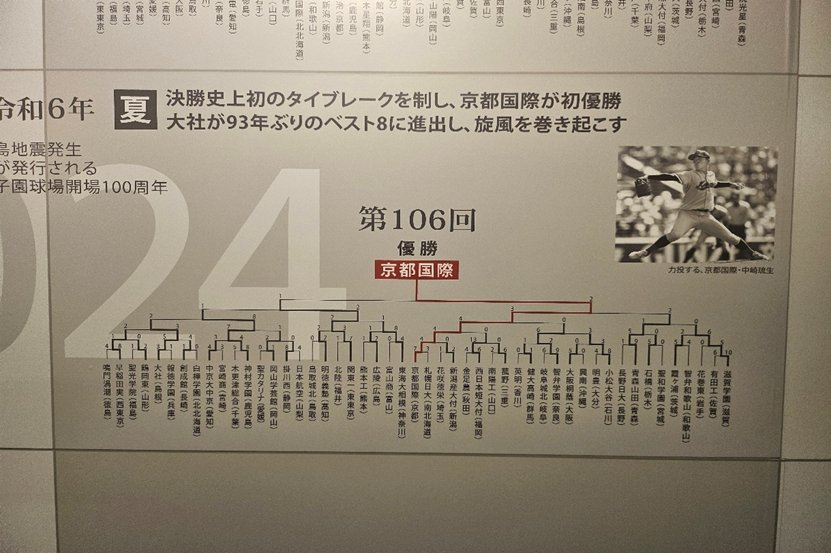
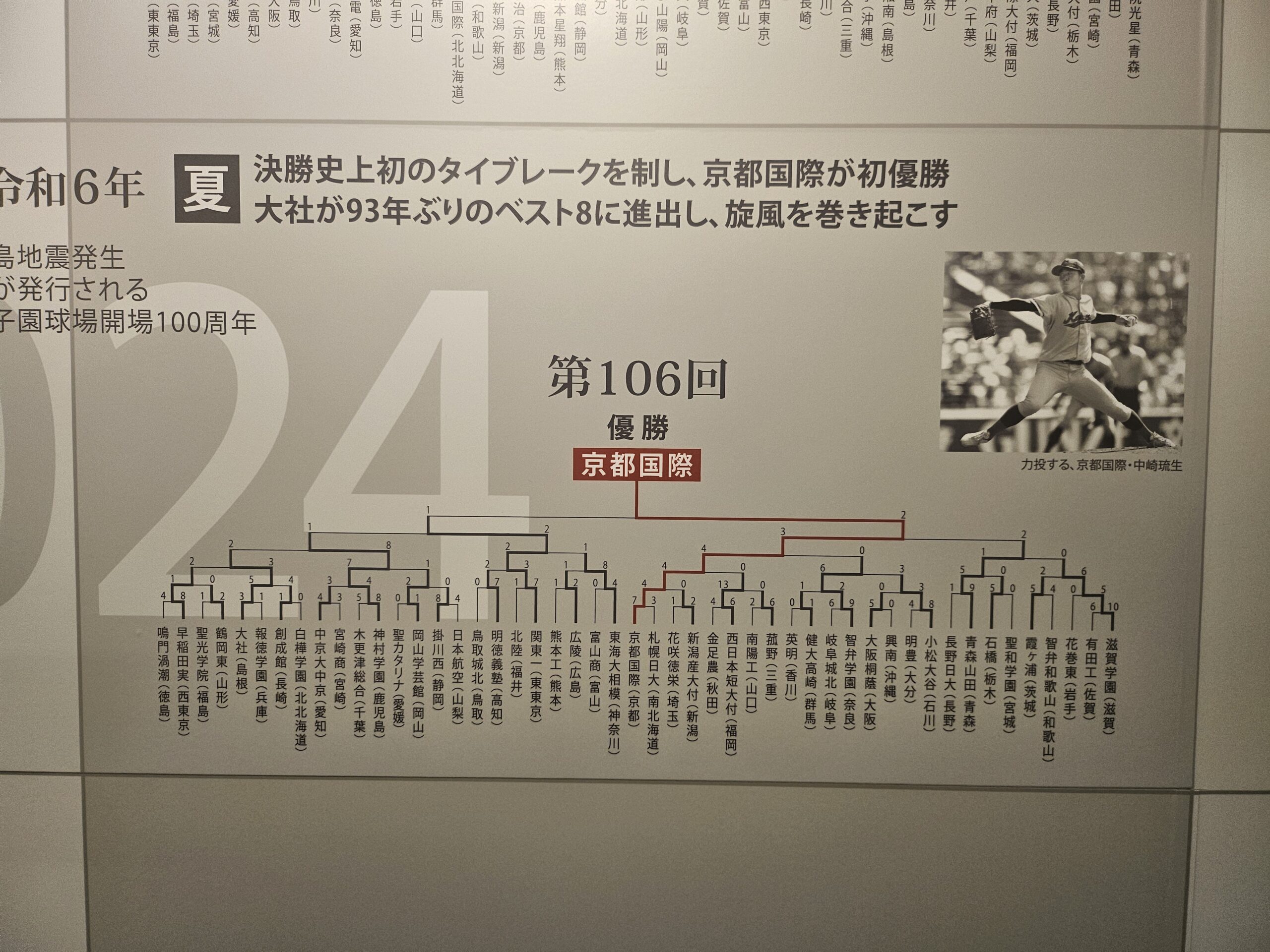
This was the first photo that caught my eye at the Koshien Museum.
It’s from the 2024 Summer (Natsu) 106th National High School Baseball Championship corner, with captions like “First-ever tiebreaker in a final decides the title as Kyoto Kokusai wins its first championship” and “Oyashiro (Shimane) reaches the best eight for the first time in 93 years, creating an upset.”
The photo on the right showed the winning team’s pitcher, Ryusei Nakazaki, pitching a gem. Kyoto Kokusai High School won its first title in 25 years since the baseball club was founded in 1999; the final against Kanto Daiichi remained 0-0 through the ninth, and for the first time ever a tiebreaker (extra innings shootout) was used in the final, with Kyoto Kokusai winning 2-1 in the 10th.
It was the first championship for a Kyoto-area school in 68 years since Heian High in 1956. Right after they won, Kyoto Kokusai’s school song—including Korean lyrics—echoed through Koshien, making the tournament a big story in both Japan and Korea at the time.
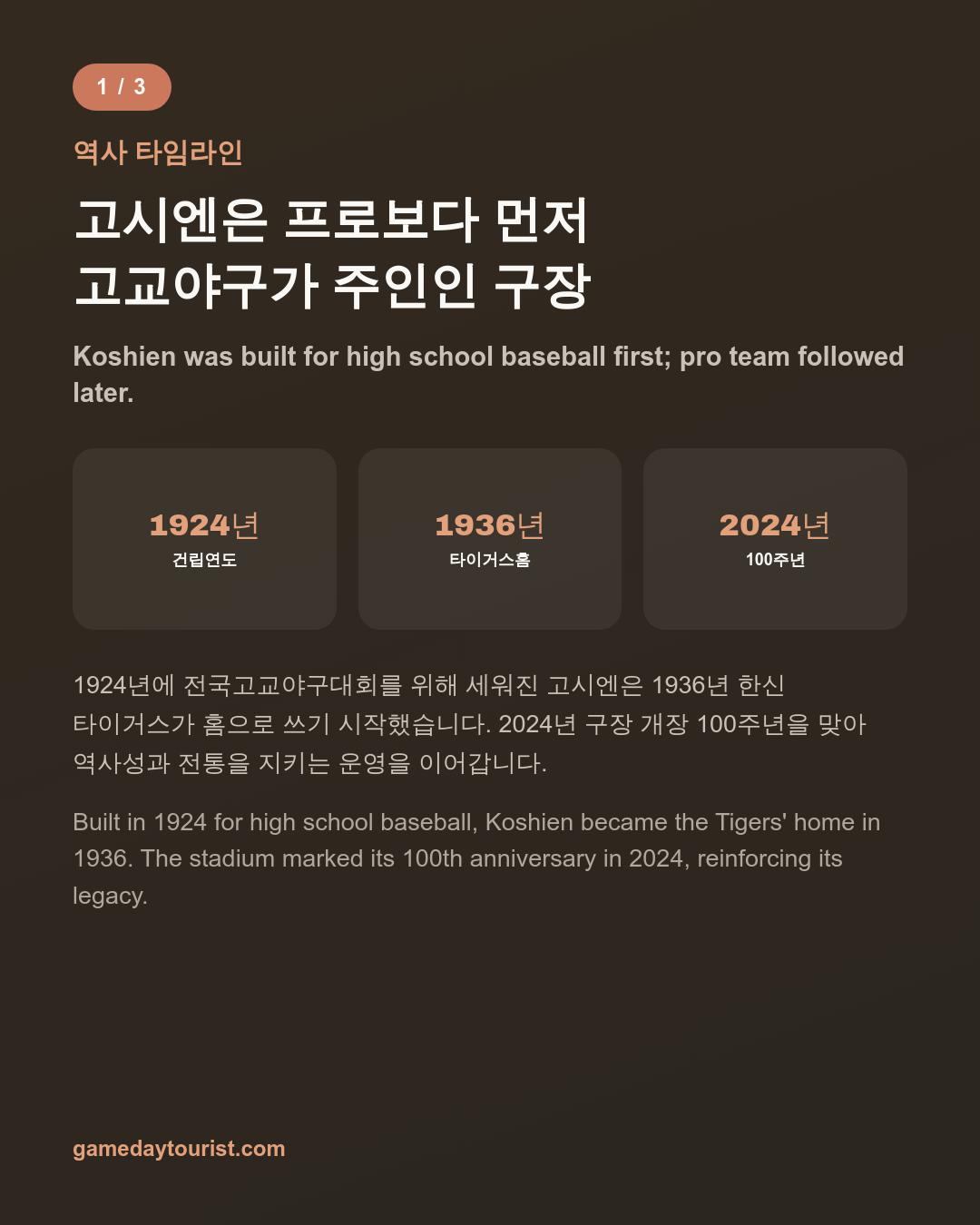
Koshien Stadium was originally built in 1924 to host the national high school baseball tournament, and the Hanshin Tigers (then the Osaka Tigers) only began using it as their home ground in 1936.
In order of events, high school baseball came first and professional baseball came later, and because of that origin, every March during the spring invitational and in August for the summer championship the Tigers play their home games at venues like Kyocera Dome Osaka instead.
Locals even call this period the “road of death” because the schedule is so tight, but both the club and the fans tend to accept this practice as a price paid to preserve the symbolic name “Koshien” rather than complain about it.
Fans and Attendance
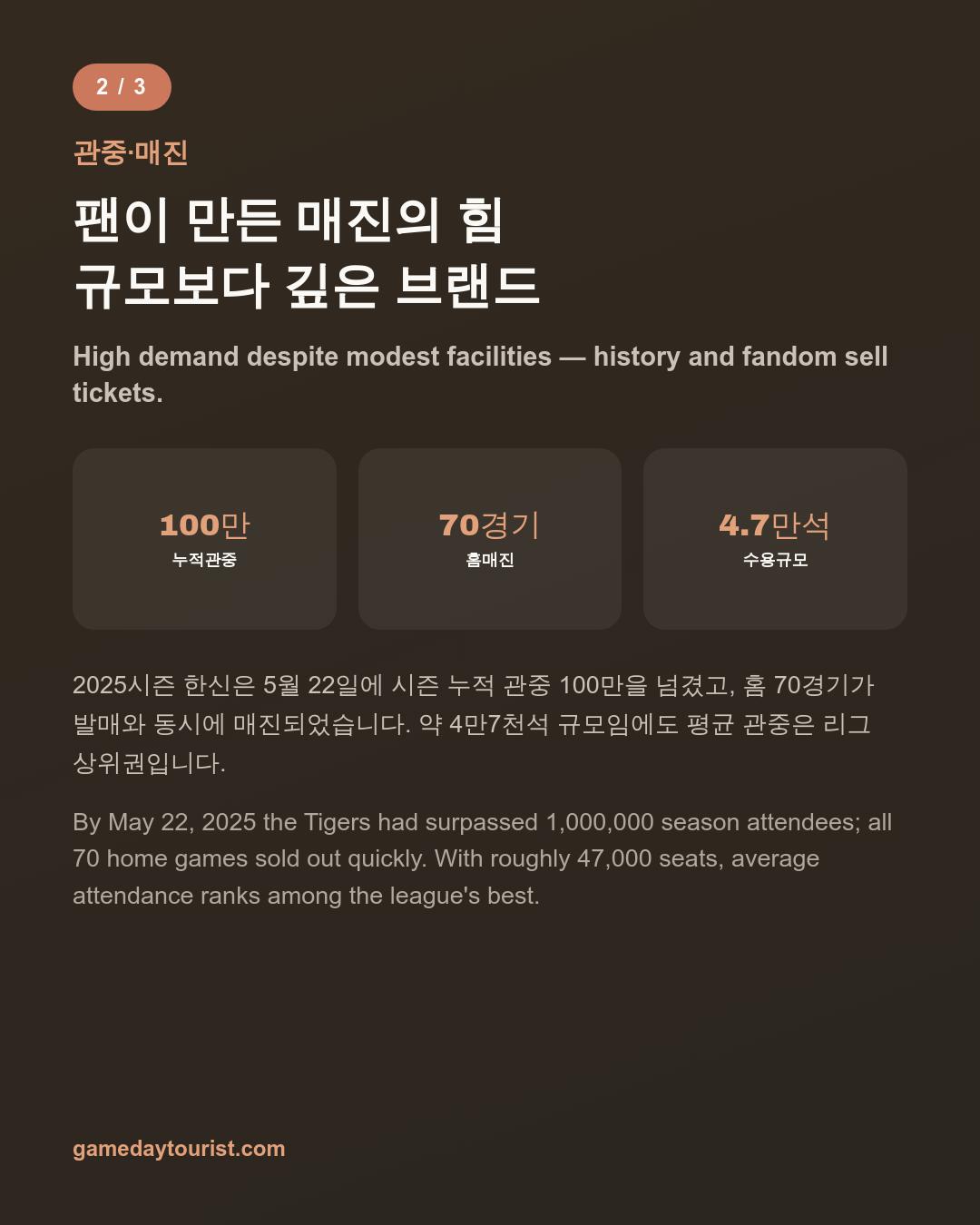
In the 2025 season, Hanshin surpassed one million cumulative spectators on May 22, and all 70 home-game tickets sold out almost immediately after going on sale.
When meeting with Hanshin Tigers officials, they said that even though the stadium’s facilities aren’t particularly modern, sellouts happen because of the stadium’s history and legitimacy.
Given the stadium’s capacity of around 47,000, the average attendance ranks among the top in NPB. As a result, in the 2025 season Hanshin clinched its seventh Central League title overall—the first in two years—yet they finished runner-up in the Japan Series, losing 1-4 to the Fukuoka SoftBank Hawks.
Advertising Inventory and Naming Rights
These days in Korea, when a new stadium is built it’s common to sell the naming rights outright to a company, but Koshien has not sold the stadium’s name for over 100 years.
Instead, since 2008 they have sold naming rights only for specific seats or areas within the stadium, giving names like SMBC Seats or Mitsuya Cider Box.
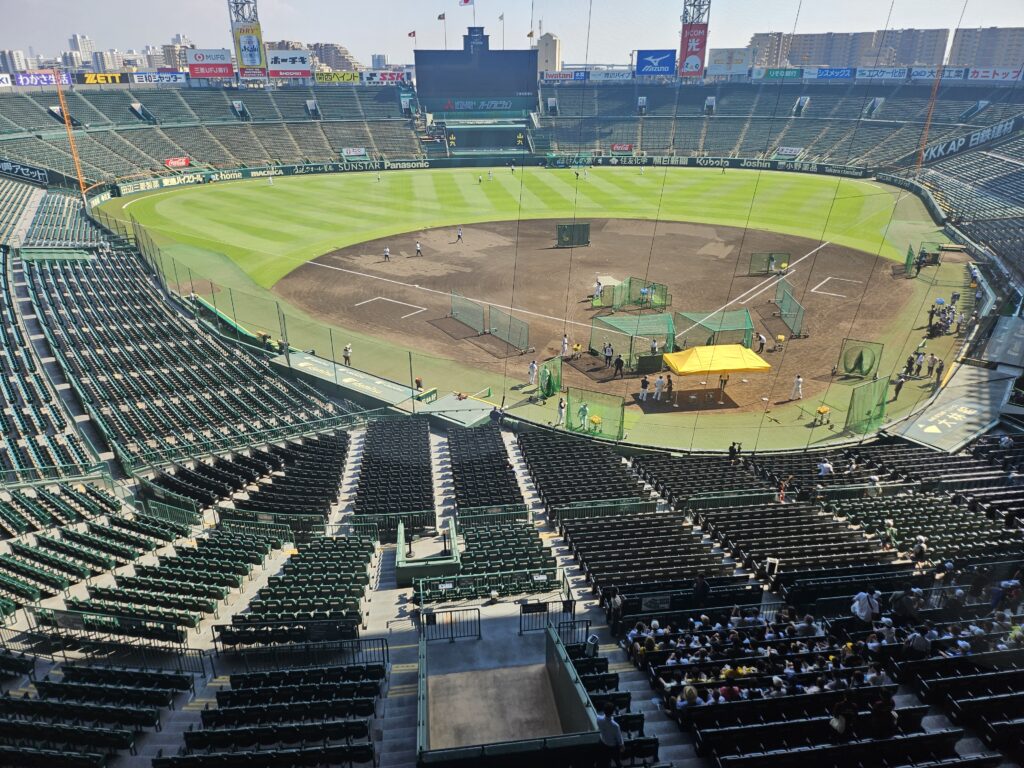
Advertisements from Kansai-based corporations and sports brands like Mitsubishi Electric, Asahi, and Mizuno fill the outfield scoreboard area and sideboards densely, so my impression was that while they protect the stadium’s name they densely fill the advertising inventory visible during games.
The word “Koshien” itself already symbolizes Japanese baseball, so instead of selling the name they chose to preserve its brand value.
Tickets
Ticket prices are clearly divided by seat location.
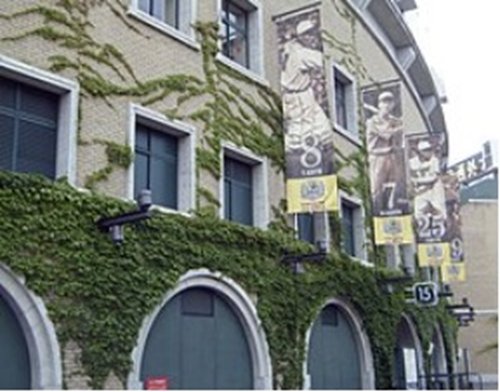
Infield premium seats like the Ivy and Breeze seats are 4,500–4,800 yen (about 41,000–44,000 KRW), the Alps seats along the outfield line are 2,500 yen (about 23,000 KRW), and the cheapest outfield seats are around 1,900–2,200 yen (about 17,000–20,000 KRW).
Notably, the cheaper outfield sections are often the most passionately cheering areas.
Space Usage and F&B
In 2024 they renovated the outfield seats to widen seat width and add cup holders, and the concourses are lined with shops mixing Osaka-style food and American-style menus.
A characteristic is selling collaborative menu items named after active and retired players, and the tradition of “beer girls,” who carry mini draft beer kegs on their backs and deliver drinks to seats, is considered a symbolic part of Koshien’s spectator culture.
The concourse is divided into three levels and can feel a bit narrow, but the wayfinding was clear, and I would note that seats can feel a little tight for larger-bodied spectators.
This reinforced that minor details in circulation design and thoughtful touches often determine actual satisfaction more than visible facility specs.
Merchandise (MD)
On the 8th floor of the Hanshin Department Store there is a large team shop with about 2,000 items, and to mark the stadium’s 100th anniversary in 2024 they relaunched their online store as “Koshien e-Mall,” releasing several commemorative items.
Like tickets, commemorative goods during a championship season are often sold out immediately after release.
Local Integration and Economic Impact
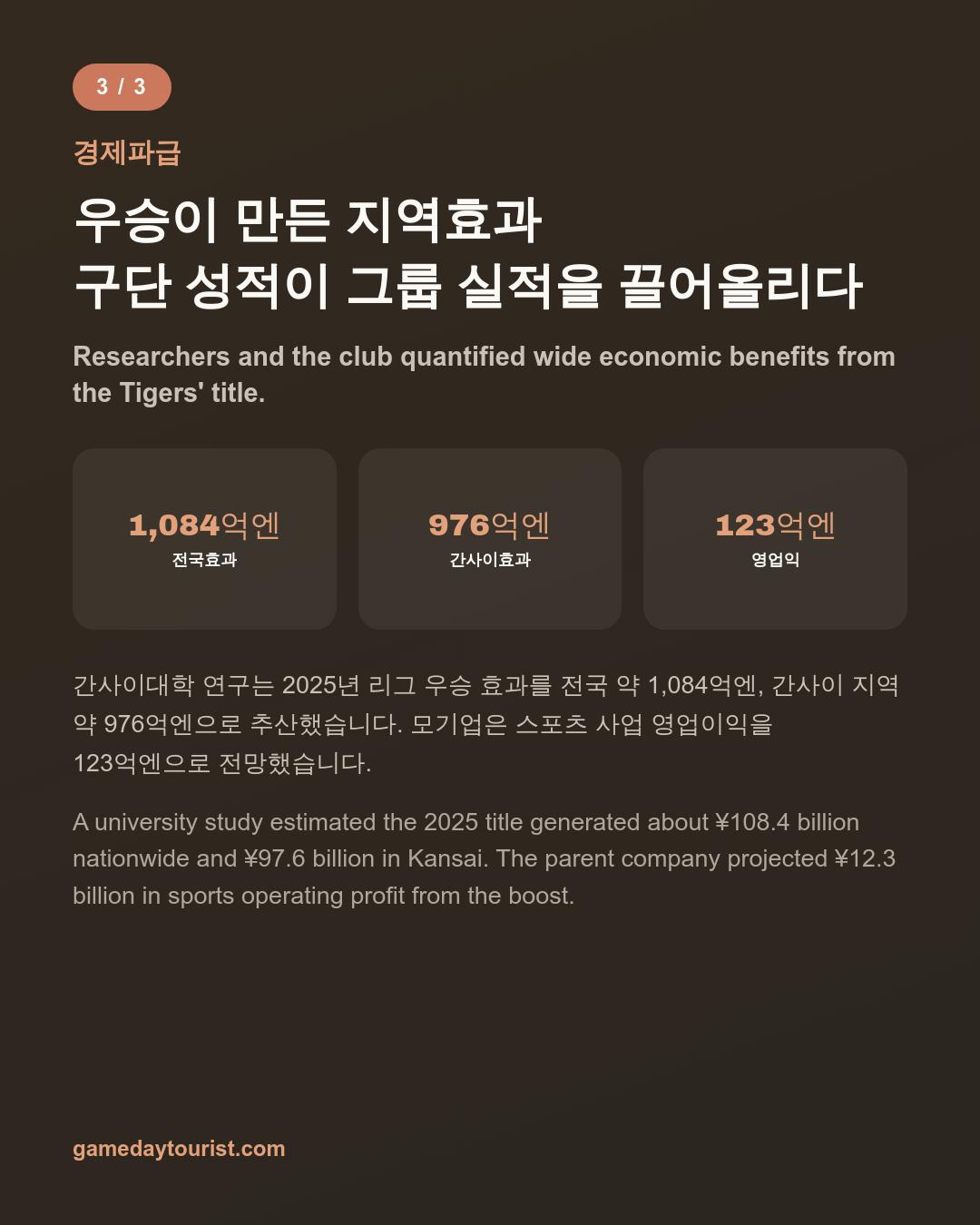
The economic ripple effects from the league title were also significant.
According to estimates published by Kansai University’s Professor Emeritus Katsuhiko Miyamoto, the nationwide economic effect of Hanshin’s 2025 league title was about 108.444513 billion yen (roughly 980 billion KRW), and for the Kansai region alone it was about 97.6 billion yen (roughly 890 billion KRW).
Parent company Hankyu Hanshin Holdings also announced its earnings forecast for the fiscal year ending March 2026, saying that thanks to the championship the entertainment revenue and hotel business performed well and that operating profit in the sports business would reach 12.3 billion yen (about 11.2 billion KRW), exceeding the results from the previous championship year (fiscal 2024).
The group’s consolidated operating profit outlook was also raised to 127.4 billion yen (about 1.16 trillion KRW), up 15% year-on-year—an impressive example of how the performance of a single baseball team can lift the outlook of a conglomerate involved in railways, real estate, and retail.
Koshien’s Specialties — Jet Balloons and Rokko-oroshi
The mass release of “jet balloons” by fans right after the top of the seventh inning is a symbolic Koshien tradition.
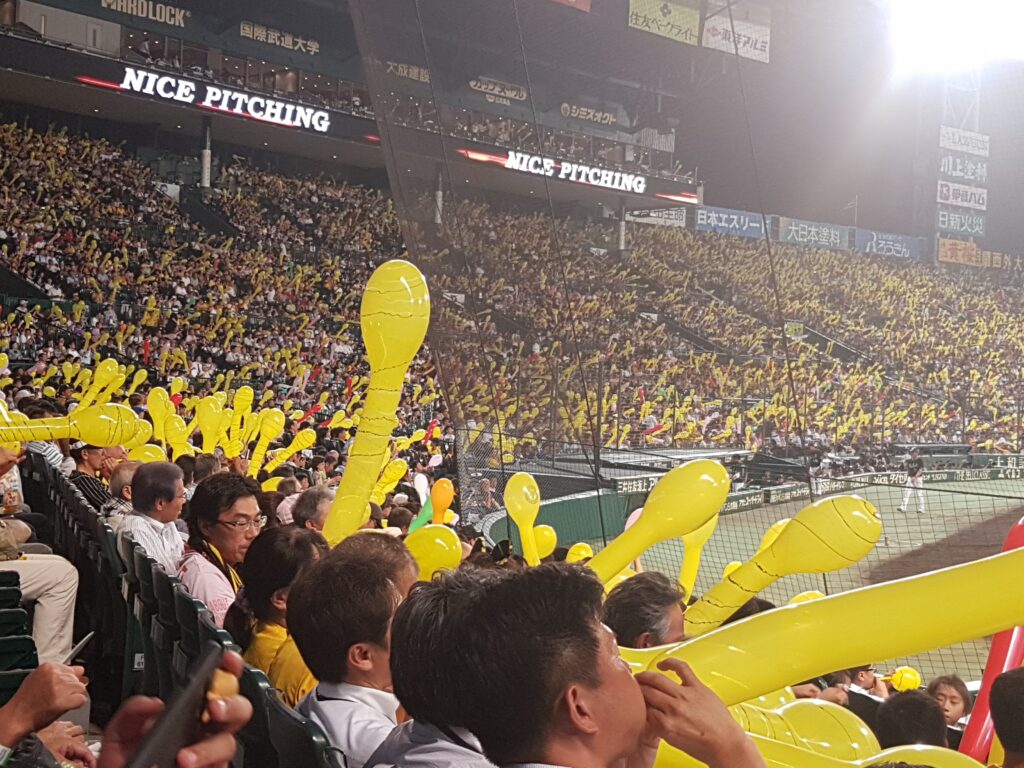
Started in 1978 by traveling Hiroshima fans and adopted by Hanshin fans, it’s now a spectacle where over 30,000 yellow balloons soar into the sky in sync with the climax of the cheering song “Rokko-oroshi.”
It was paused during COVID-19 due to concerns about droplet infection, but it officially resumed on April 7, 2026, at the game against Hiroshima, marking a return after seven seasons—another recent topic of interest.
When I attended, I immediately felt comfortable the moment a neighbor fan silently handed me an extra balloon and a printed cheer sheet.
Koshien History Museum — Passing a Century of Drama to the Next Generation
Personally, the space that impressed me most during this research was the “Koshien History Museum,” located right next to the stadium which I’ve visited twice.
This museum, which brings together the history of high school baseball, the Hanshin Tigers, and the stadium itself, moved and expanded its exhibition space to the second floor of the new multi-purpose facility “Koshien Plus” on the south side of the stadium in March 2022, increasing its exhibition area by 1.25 times.
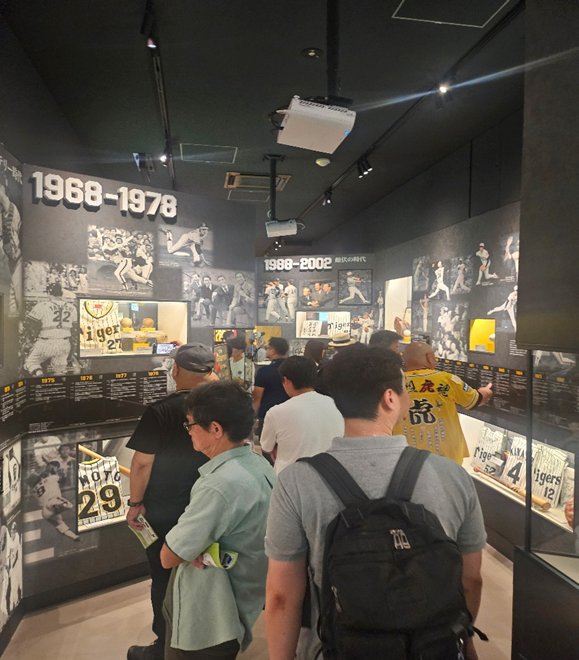
It houses memorabilia like uniforms, balls, hats, and championship pennants, along with videos of historic matches and VR/AR experiences. It also highlights that players who later became more famous as major leaguers—Shohei Ohtani, Hideki Matsui, Daisuke Matsuzaka—once stood on this same ground during their high school days.
Bringing the pre-legend stories of pro players into the museum content naturally links the identity of Koshien as a high school baseball shrine with the professional club’s brand.
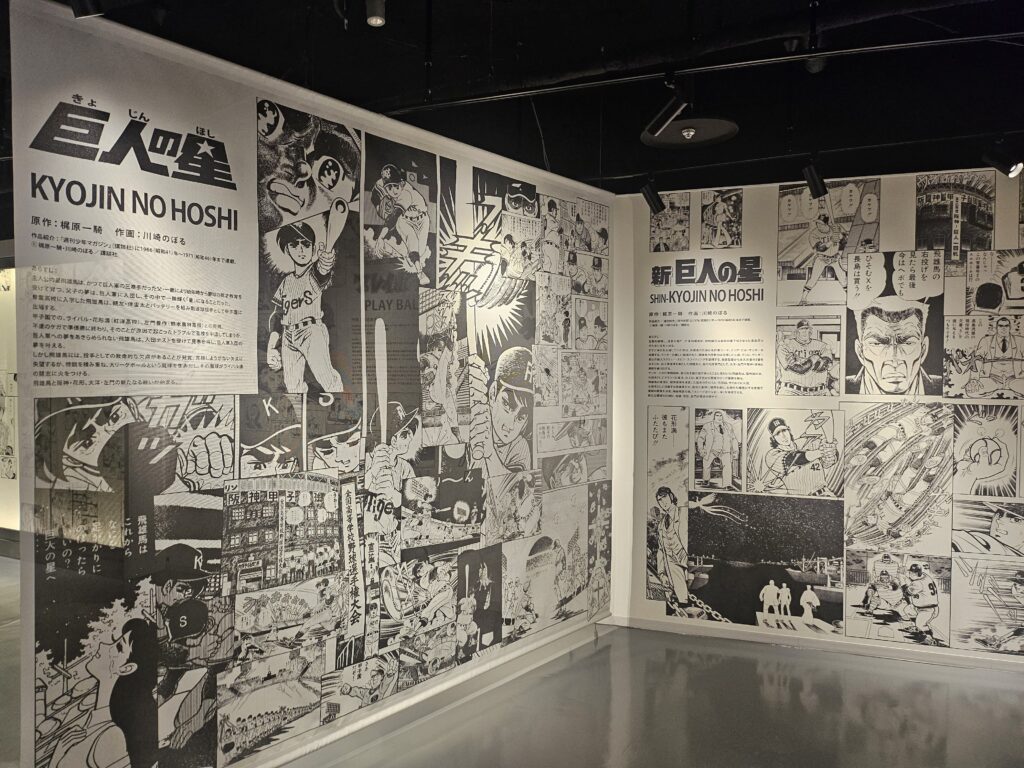
Admission is 900 yen for general adults (about 8,200 KRW), 700 yen for high school students, and 500 yen for children (ages 4 through junior high). Combined with the stadium tour that visits the bullpen, locker rooms, and dugouts, the adult price is 2,000 yen (about 18,200 KRW).
On this tour you can walk through the third-base-side bullpen, locker room, and dugout, see the infield being prepared for that night’s game, then move to the stands to take photos—by far the best stadium tour I’ve experienced.
After the tour I received a player card and a souvenir.
I noticed a corner where visitors can try on a Tigers uniform and take a commemorative photo after viewing memorabilia, video displays, and VR experiences, and the museum shop at the exit sold not only Tigers goods but also merchandise from other NPB clubs.
Putting a museum next to the stadium that charges a separate admission fee in addition to ticket and goods sales, and selling amateur high school baseball content together, struck me as a noteworthy example of revenue diversification that domestic clubs could consider.
Compared with the KBO and K League
In Korea, selling naming rights for new stadiums is a common trend spreading across the K League and KBO, whereas Koshien chose to preserve the brand it accumulated over more than 100 years.
If a brand has already accumulated enough value, one takeaway is that preserving the name rather than selling it can be a viable strategy.
Also, in Korea professional stadiums are often strictly separated from amateur and youth facilities, often citing reasons like turf damage or maintenance difficulty. The Koshien approach—handing the stadium over entirely to amateur tournaments for a set period each year and packaging that history into museum content—can actually help preserve a stadium’s symbolism, secure multigenerational fan bases, and create additional revenue streams beyond ticket sales, so it’s worth noting.
Making public the economic impact of sellout streaks with figures from a university researcher is also an approach domestic clubs could reference when explaining club performance persuasively to local communities.
Of course it’s difficult to directly transplant Koshien’s situation—which combines a 100-year history with the unique content of high school baseball—into domestic contexts, but the principle that the power to create sellouts ultimately comes from a stadium’s history and the small experiences shared with fans seems universal across leagues.
Leave a Reply