Contents · About 17 min read
- What Murakami Saw from the Jingu Outfield — Opening Day 1978 and Dave Hilton’s Double
- Why Do Plastic Umbrellas Sway to “Tokyo Ondo”? — A 1980s Idea to Fill Empty Seats
- What Kind of Team Are the Tokyo Yakult Swallows?
- How to Get to Meiji Jingu Stadium and Buy Tickets — Based on Official Club and Stadium Pages
- Attendance and Tickets — 1.98 Million Fans in 71 Games, and Why the Average Held in a Fifth-Place Year
- Food and Merchandise — Jingu Gourmet and Payment Methods for Visitors
- Redevelopment — What Happens to a 100-Year-Old Ballpark?
- Compared with Jamsil Stadium — A Two-Team Park and a Tenant Park
- Where You Can Go Now That the Season Is Over
📱 View as card news
October 22, 1926 is the completion date the Yakult club gives for Meiji Jingu Stadium in its own announcement. Wikipedia lists the opening as October 23, a one-day difference, but either way the ballpark turns 100 in four days.
The club is running a Meiji Jingu Gaien 100th-anniversary auction in three rounds starting October 12 (Oct. 12–18, Oct. 19–25, and Oct. 26–Nov. 1).
The 2026 regular season is already over, but college baseball is still being played here and a commemorative game is on the calendar for November, so I thought this was a good moment to lay out what you need to know about the park.
This guide starts with the stories behind the stadium, its cheering culture and the team, then covers the club’s official directions, how to buy tickets on the English site, prices and the entry rules.
After that I look at the team’s attendance numbers, the food and merchandise, the redevelopment plan, a comparison with Seoul’s Jamsil Stadium, and what you can still see right now, all from a marketer’s point of view.
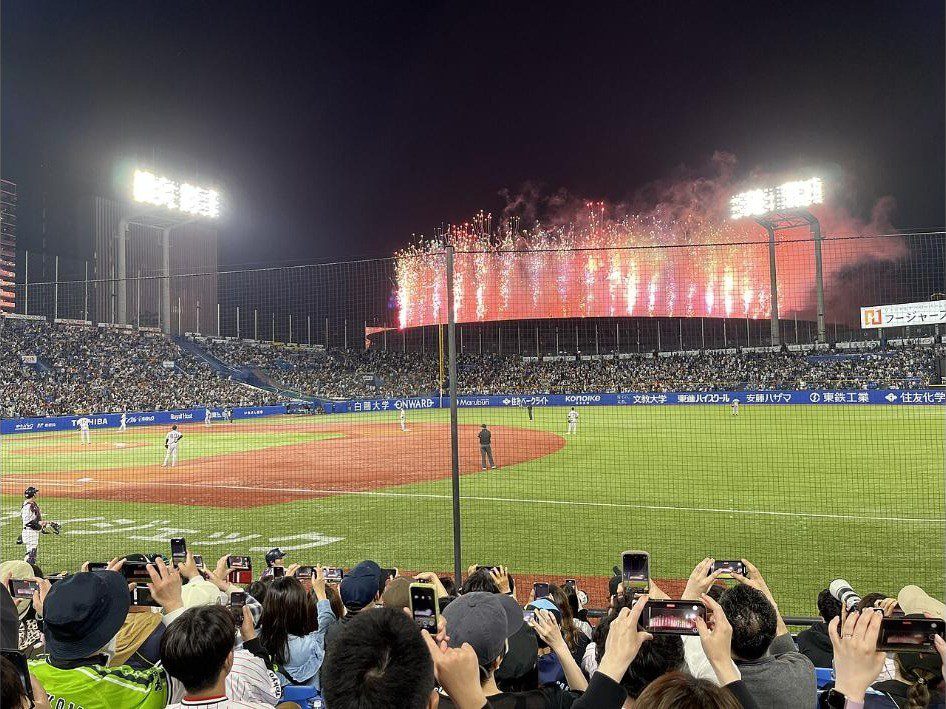
Photo: Adc95 · Source: Wikimedia Commons · License: CC BY-SA 4.0 · During a Yakult vs. Yomiuri game on April 20, 2025
What Murakami Saw from the Jingu Outfield — Opening Day 1978 and Dave Hilton’s Double
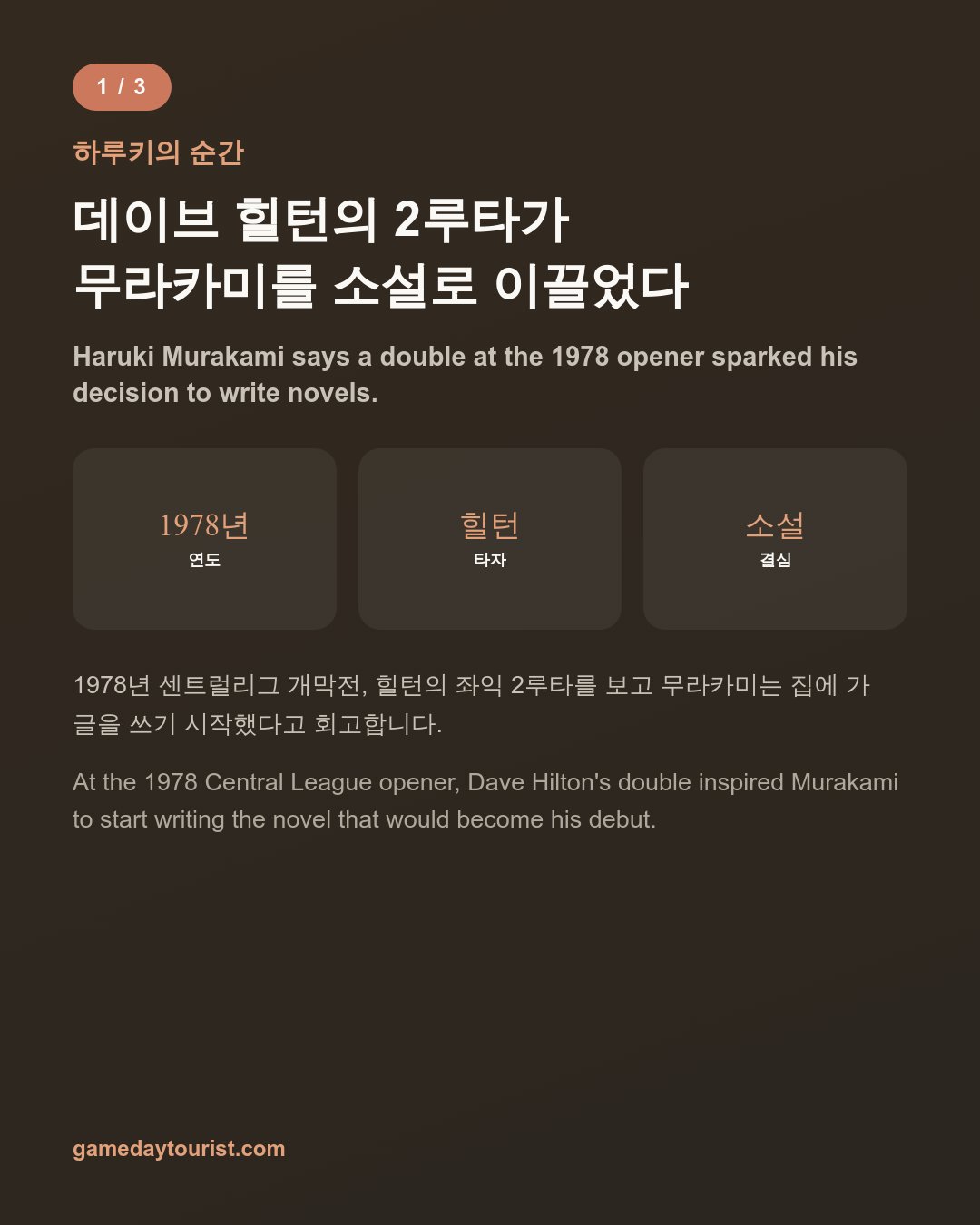
Haruki Murakami has written about watching the 1978 Central League opener as a Yakult fan, lying on the grassy slope beyond the outfield fence with a beer.
The opponent was the Hiroshima Carp, and when leadoff man Dave Hilton lined a double to left in the bottom of the first, the thought “I think I can write a novel” came down, in Murakami’s words, like something fluttering down from the sky into open hands.
This comes from the essay reprinted by Literary Hub, and a WBEZ report describes the same opener and Hilton’s double.
After the game Murakami bought writing paper and a fountain pen in Shinjuku and started writing at the kitchen table after work, and that manuscript became the debut novel “Hear the Wind Sing.”
The stadium also appears in Murakami’s short story “The Yakult Swallows Poetry Collection” (published in a 2020 collection, according to Wikipedia), and in June 2023 an AP report covered Murakami speaking out on the radio against the Jingu Gaien redevelopment.
I could not confirm whether the grassy slope where Murakami sat still looks the same today.
As a working marketer, what I envy about this story is that the club never created it, yet it is attached to the ballpark.
One opening-day game became the starting point of a world-famous writer, and that kind of narrative cannot be bought with an ad budget.
That said, I did not find any of the club’s official guide pages that put this story front and center.
Why Do Plastic Umbrellas Sway to “Tokyo Ondo”? — A 1980s Idea to Fill Empty Seats
The umbrella cheer that defines Jingu started in a very modest way.
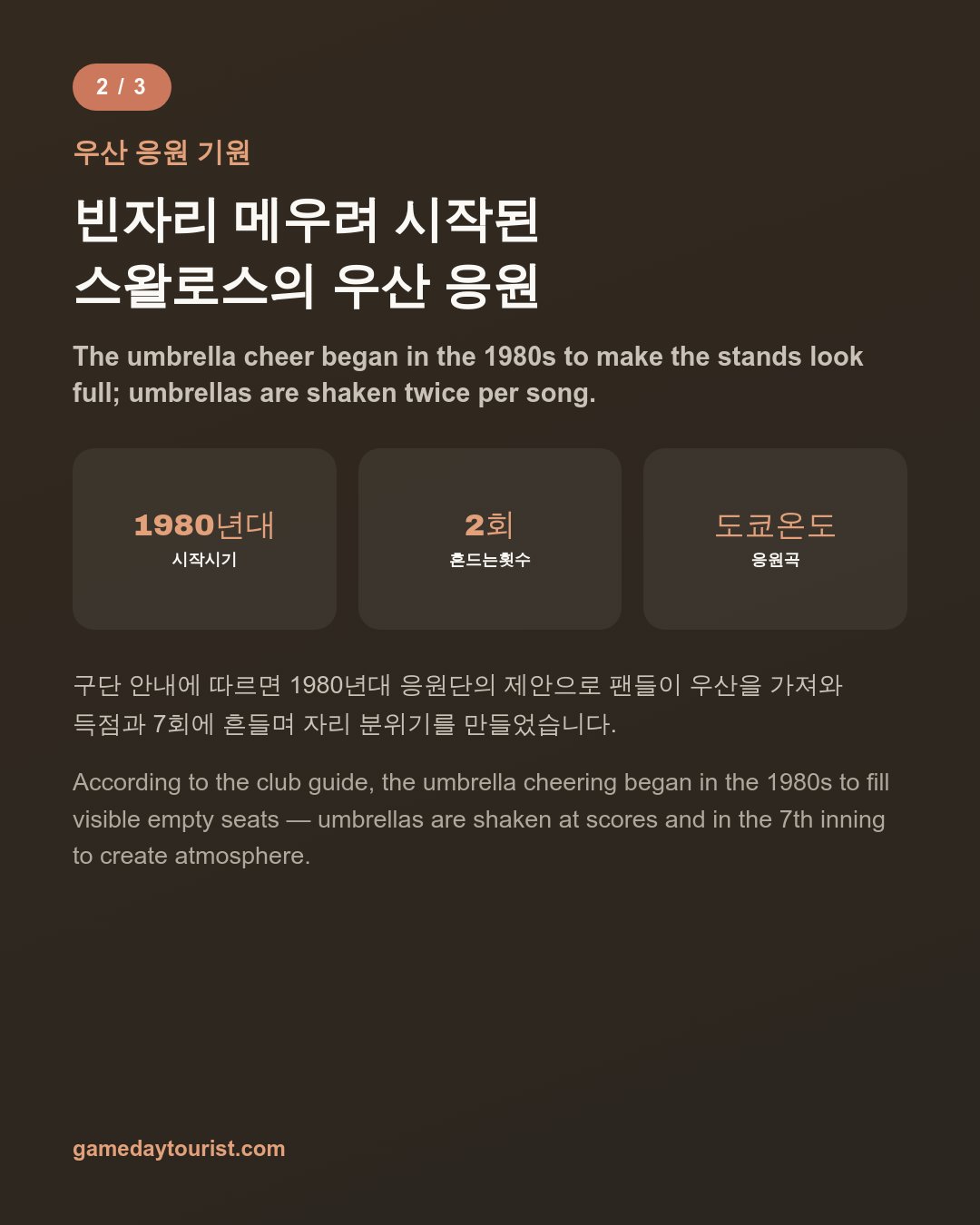
The club’s official spectator guide says that in the 1980s, when empty seats were conspicuous, a member of the cheering group named Okada asked fans to bring umbrellas so the park would look fuller.
There are two moments when the umbrellas go up. One is when the Swallows score, and the other is the seventh inning, the “lucky seven.”
The guide adds that the more runs the team scores, the more the stands bloom with umbrellas.
The song that goes with it, “Tokyo Ondo,” was released under that title in 1933 and was not originally a Yakult song.
An article in Number says it was first a cheering song for the Tokyo Orions, the predecessor of today’s Chiba Lotte Marines, and quotes a former cheering-squad member who says they waved big flags instead of umbrellas back then.
So the umbrella cheer is a culture formed when a song and a prop from different eras came together.
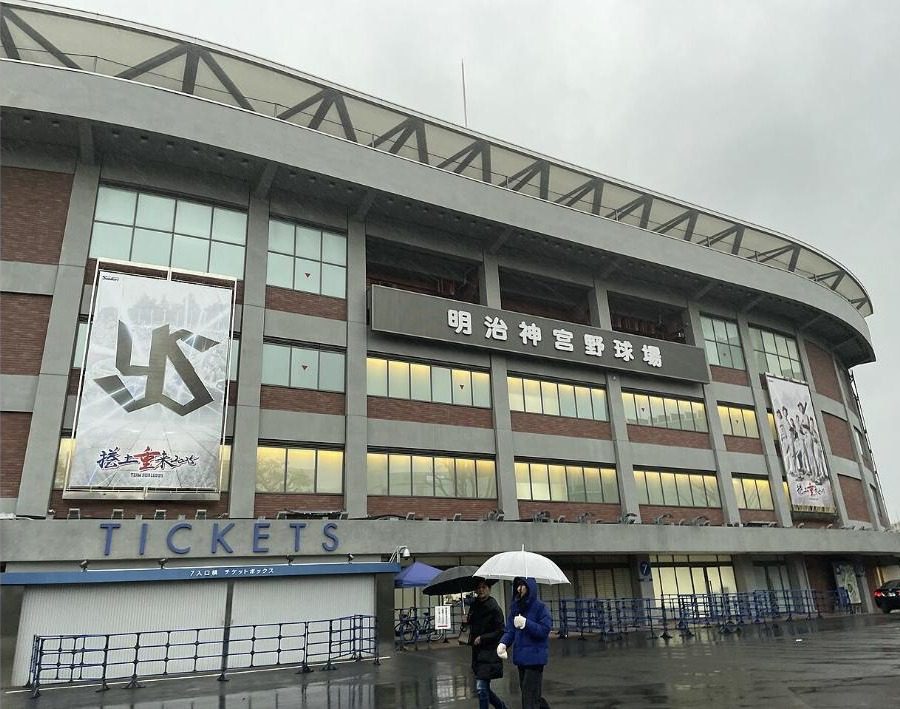
Photo: ウィ貴公子 · Source: Wikimedia Commons · License: CC BY-SA 4.0 · April 1, 2025, in front of the Gate 7 ticket box on a rainy day
There is one practical caution.
The club’s spectator rules ask you to wear a raincoat or poncho when it rains, to be considerate of those around you if you use an umbrella, and warn that you may be asked to refrain from using one depending on the situation.
The same guide also recommends raincoats because they block the view of the people behind you less.
In other words, the cheering umbrella and the rainy-day umbrella are two different things.
What Kind of Team Are the Tokyo Yakult Swallows?
According to Wikipedia, the team started on January 12, 1950 as the Kokutetsu Swallows owned by Japanese National Railways, passed through Sankei Shimbun ownership from 1965 to 1968, and was taken over by Yakult Honsha in 1970 to become the Yakult Atoms.
The name Yakult Swallows dates from 1974 and the current Tokyo Yakult Swallows name from 2006, and the team has used Jingu as its home since 1964.
The Swallows have won nine Central League pennants (1978, 1992, 1993, 1995, 1997, 2001, 2015, 2021 and 2022) and six Japan Series titles (1978, 1993, 1995, 1997, 2001 and 2021).
In 2022, Munetaka Murakami hit 56 home runs, passing Sadaharu Oh’s 55 to set the single-season record for a Japanese-born hitter.
Korean fans will know it as the team Lim Chang-yong played for.
This season was Takahiro Ikeyama’s first as manager, and according to NPB’s official records the Swallows finished fifth in the Central League at 61–80–2.
The cheering sections are separated from the moment you buy a ticket.
According to the seating guide on the club’s ticket site, the home-side outfield seats and the first-base “Oen” (応燕) seats are Swallows-only cheering sections, where cheering for another team or wearing that team’s uniform or fan goods is prohibited.
The outfield is sold in home and visitor sections, with the visitor side toward left field. For some games part of left field is sold as home seating, so first-time visitors should check the home or visitor label when choosing seats.
How to Get to Meiji Jingu Stadium and Buy Tickets — Based on Official Club and Stadium Pages
This section reflects what I confirmed by opening the club and stadium official pages directly as of October 18, 2026.
I did not use blog reviews, and where I could not find something on an official page, I say so.
First, directions. According to the club’s stadium access page, the nearest station is Gaiemmae on the Tokyo Metro Ginza Line, Exit 3, about a 5-minute walk.
Shinanomachi on the JR Chuo-Sobu Line is about 12 minutes, Kokuritsu-Kyogijo on the Toei Oedo Line (Exit A2) is also about 12 minutes, and JR Sendagaya and Aoyama-itchome (Exit 1) are each about 15 minutes.
There is no dedicated parking lot, and for drivers the page points to the Seitoku Memorial Picture Gallery parking lot (絵画館駐車場).
It also notes that on Sundays and holidays the loop road around Jingu Gaien becomes a cycling course from 9:00 to 17:00, so traffic restrictions may apply.
The stadium’s address is 3-1 Kasumigaoka-cho, Shinjuku-ku, Tokyo, and game schedules and rain cancellations can also be checked on the stadium’s automated phone line (0570-03-5589, 24 hours), according to the stadium’s official site.
There are two ways to buy tickets.
The Japanese official site, Swachike (スワチケ), holds your seats for up to 9 minutes 30 seconds after you pick a game, a seat and a quantity, and you pay by credit card (3-D Secure 2.0 registration required) or at a 7-Eleven or FamilyMart.
You can receive tickets as a QR ticket, at a convenience store or by delivery, and paying by card with a QR ticket carries no fee. Convenience-store issuing costs ¥165 per ticket, delivery costs ¥990 per order, and purchases cannot be canceled once payment is complete.
I could not confirm on the official page whether cards issued overseas work on this site.
For visitors from abroad, the club’s separate English ticket site is the realistic option.
According to the club’s English page, the site sells reserved-seat e-tickets, accepts only Apple Pay and Google Pay, sends a confirmation email after purchase, and on game day you bring a device that can show the ticket or a printout.
The site’s own description says you can buy without registering as a member and enter with a QR ticket.
For the 2026 season, sales for each block of games opened at 11 a.m. on a Saturday, and I could not yet confirm the 2027 schedule or sales plan.
If advance sales sell out there is no over-the-counter sale, but otherwise you can buy on game day at the ticket boxes at Gate 7 (from 16:00) and Gate 9 (from 14:00).
For day games the boxes are open from 10:00 to 16:00, or until the end of the game.
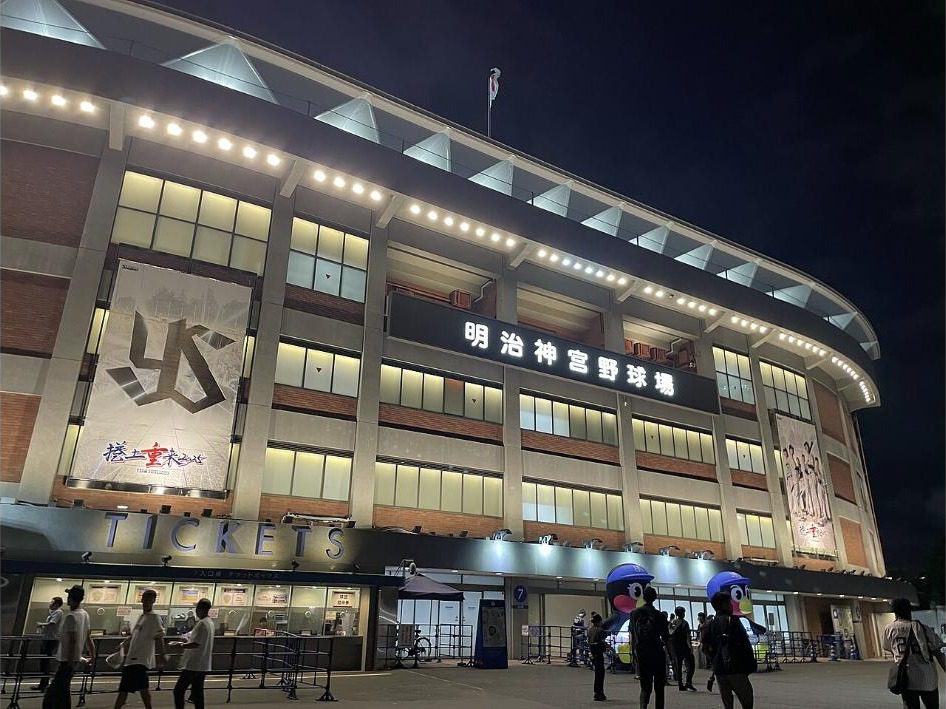
Photo: ウィ貴公子 · Source: Wikimedia Commons · License: CC BY-SA 4.0 · September 18, 2025
Prices are not a fixed table.
The club’s pricing page explains that for the 2026 season there are no price categories, and tickets are sold with dynamic pricing that moves with demand from an initial price for each seat type.
Dynamic pricing applies from the third advance sale, prices are fixed at the initial price before that, and as a rule prices change daily. Individual seats can carry their own price, such as aisle seats.
Here are the 2026 initial price ranges listed on the club’s seat and price page.
Behind-the-net SS reserved seats run ¥5,700–6,700, S reserved seats on the first- and third-base sides ¥4,700–5,900, A reserved ¥4,900–5,800, and B reserved ¥3,900–4,700.
In the outfield, A reserved seats are ¥2,600–3,400, B reserved (adult) ¥2,100–2,900, and the cheapest, C3 reserved (adult), ¥1,900–2,700, while child tickets in the outfield run about ¥800–1,700.
Company-named sponsor seats vary widely, from ¥5,700 for the Itochu SDGs seat (counter type) to ¥9,900 and up for the Itochu premium seat.
The page says initial prices differ by game within these ranges and can fall outside them depending on seat location, so treat them as a rough guide only. The price shown on the screen for the seat you choose is the real answer for that day, and I have not yet confirmed 2027 prices.
A few more things are worth knowing when you choose seats.
Panorama Roof B reserved seats and outfield A and B reserved seats include “obstructed-view” seats where part of the field is hidden, which carry a ¥200 discount on the initial price and are sold only on Swachike and at the stadium windows. The discount does not apply when you buy at the window.
Children need a ticket from age 4, and the child price covers ages 4 through junior high school.
In the infield seats and the “Swatte Oen” seats, standing to cheer is not allowed once the pitcher starts the delivery.
The entry rules are also worth knowing before you go.
Under the club’s spectator rules, you may bring plastic bottles and thermoses but not glass bottles, cans or coolers, and strollers must be left at the entrance and cannot be taken to your seat.
Paid coin lockers are at Gate 5 on the first-base side, next to Gate 10 on the third-base side and at center Gate 16, but the number and size are limited, so the club asks you to store large bags before you arrive.
Re-entry is allowed by showing your ticket, though your bag may be checked again.
Cheering flags must be within 65 cm including the pole, cheering boards within 60 cm by 60 cm, and instruments such as whistles, drums and trumpets are banned except for the authorized cheering squad. Flash photography during play is also not allowed.
Reviews still circulate about a service that poured canned drinks into paper cups at the gate, but the club states that it ended the pour-over service and paper cups after the 2020 season, so those reviews are out of date.
From a marketer’s view, the highest hurdle in this purchase flow is the payment method.
Dropping membership registration on the English site was a smart move, but limiting payment to Apple Pay and Google Pay pushes anyone who uses neither over to the Japanese site.
The club has opened a door for international demand, but where the threshold of that door sits is worth checking at least once.
Attendance and Tickets — 1.98 Million Fans in 71 Games, and Why the Average Held in a Fifth-Place Year
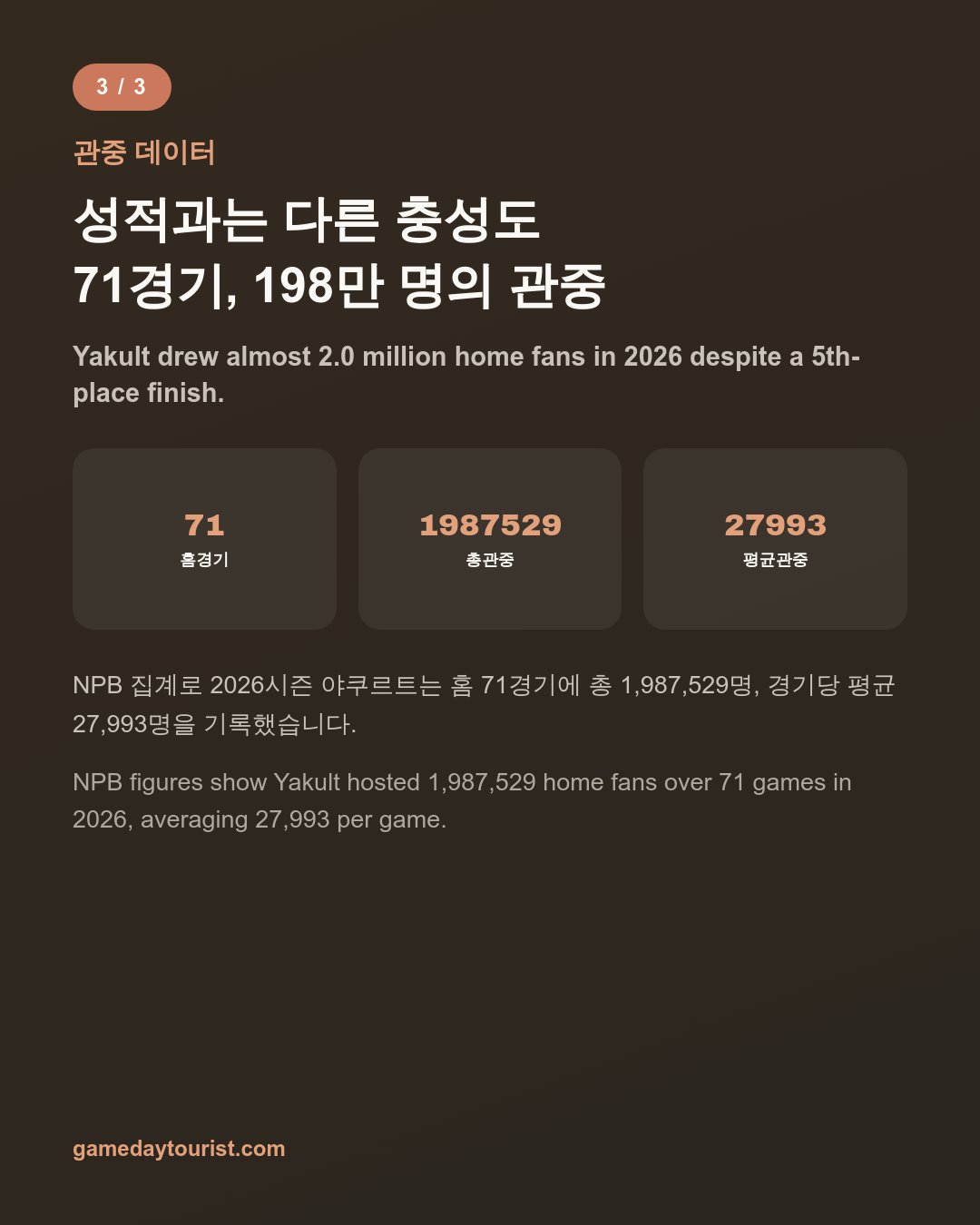
In the 2026 attendance figures NPB published by club, Yakult drew 1,987,529 fans over 71 home games, an average of 27,993.
The 2025 season was 2,011,972 over 72 games, an average of 27,944, so total attendance fell by 24,443, largely because there was one fewer home game, while the average rose by 49.
Among the six Central League clubs, Yakult’s average ranked fifth behind Hanshin (41,644), Yomiuri (39,762), Chunichi (35,687) and DeNA (32,383), with Hiroshima (26,899) just behind.
Over the same period, total NPB attendance reached 27,177,247, a record for the third straight year, but the Central League total fell to 14,623,953 from 14,720,171 a year earlier.
In a year when NPB as a whole set an attendance record, a club that went 61–80 held its average, which may mean some fans come for reasons other than the standings.
My guess is that the umbrella cheer and the downtown location are those reasons, but I could not find any club survey to test that.
On the ad inventory side, the seat list on the club’s ticket site stands out.
Company-named seats such as the Itochu Premium and Pair seats, the Mynavi seat, the Paramount Bed seat and the FamilyMart Box seat line up one after another (checked October 18, 2026).
The stadium’s own name is simply the shrine’s name, so I found no naming-rights deal in my search, and the club appears to slice sponsorships finely by seat instead.
Wikipedia describes the stadium as the property of Meiji Shrine, and the idea that seat sponsorship is the alternative to a name that is hard to sell is my own conjecture.
Food and Merchandise — Jingu Gourmet and Payment Methods for Visitors
On the Jingu Gourmet site that collects the stadium’s food, the original stadium items include “Jinkara” fried chicken at ¥800, “Jinkoro” tuna croquette at ¥800 and “Jinkatsu” pork cutlet sandwich at ¥900.
The “Jinremo” lemon sour is ¥800 and the original coffee ¥500, and the stalls are split by area: infield, outfield, outside the stadium and food trucks.
There are also player-produced dishes, such as Masanori Ishikawa’s charcoal-grilled teriyaki chicken rice bowl at ¥1,300, Santana’s cheese kebab “long potato” at ¥1,400 and Kazufumi Maruyama’s spinach chicken curry at ¥1,300 (all checked October 18, 2026).
A September 2025 photo record shows a wagyu burger named after the mascot at ¥1,100.
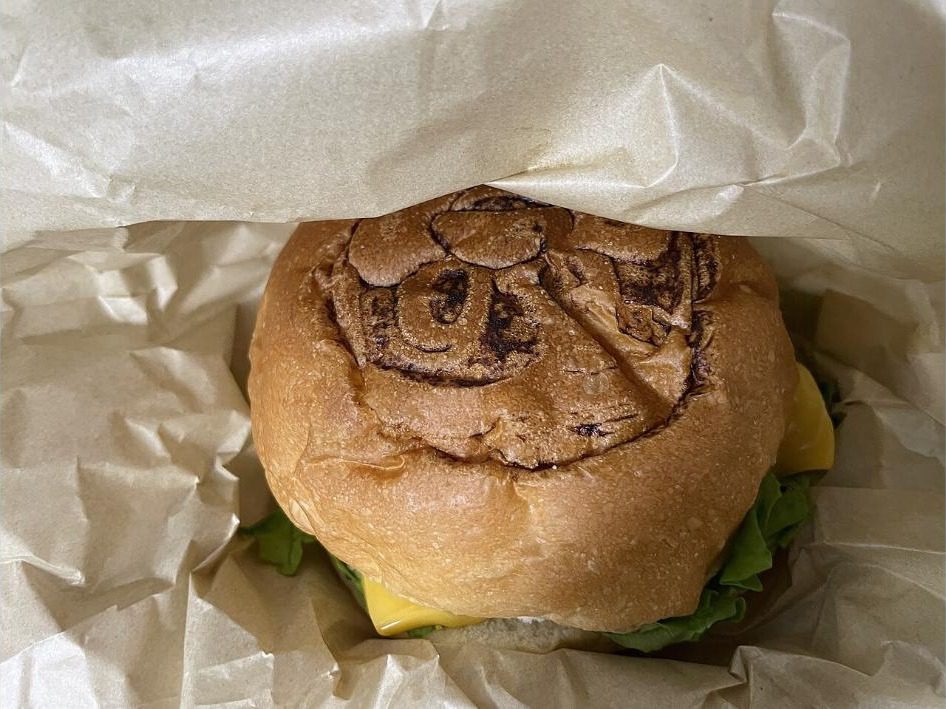
Photo: ウィ貴公子 · Source: Wikimedia Commons · License: CC BY-SA 4.0 · September 22, 2025, the ¥1,100 price comes from the same photo description and may differ from current menu prices
There is mobile ordering for when the lines are long. But according to the August 25, 2026 notice, seat delivery is limited to designated seats (company sponsor seats, Panorama Roof seats and others) and to food-truck menus outside the stadium.
Pickup, where you collect the order yourself, is available at one pop-up shop at Outfield Gate 15, and the page warns that service can be slow when it is crowded.
The club’s English page introduces four directly managed goods shops.
They are the Stadium Street Store on the street linking Gaiemmae Station to the stadium, the Tsubakuro Store on the grounds of the Jingu secondary field on the way from Shinanomachi Station, the Jingu Stadium Store next to Gate 6, and the Outfield Store inside Gate 16.
The last two open only on days when the Swallows play at home.
They accept cash, credit cards and electronic money, plus QR payments such as PayPay, WeChat Pay and Taiwan Pay.
I raised the payment hurdle on the ticket side, and the contrast is that the shops are already open to a wide range of Asian visitors’ payment methods.
Redevelopment — What Happens to a 100-Year-Old Ballpark?
The redevelopment plan is one more reason to go now.
The planning page of the official redevelopment site lists the completion of the whole project, run jointly by Mitsui Fudosan, Meiji Jingu, the Japan Sport Council and Itochu, as 2038 (planned), and explains that the new ballpark will be built where the rugby stadium stands now.
Asked how long the current stadium can be used, the site’s FAQ answers that a new ballpark with a hotel attached is planned for completion in 2033, and that the usage period of the current stadium will be set with continuity of play in mind so it can be used as long as possible until then.
The same FAQ gives the total project cost as ¥344.5 billion and the number of trees 3 meters or taller to be felled as 619.
The felling count was 743 when it was announced in August 2022, and in September 2024 the gap between the new ballpark and the ginkgo avenue was set to widen from about 8 m to about 18.3 m.
The ¥349 billion total cost and the fiscal 2035 completion outlook that Nippon.com reported in 2023 differ from the current official figures. The official FAQ says the September 2025 revision of the business plan reflected costs and schedule.
According to Nippon.com, the order of work is to demolish the second field, build a new rugby stadium, demolish the current Chichibunomiya rugby stadium, build the new ballpark, and finally demolish the current Jingu Stadium, with a central plaza and a cultural exchange facility planned for the current stadium site.
I could not confirm from public materials how the Swallows will use the new stadium or when exactly the current one will see its last games.
There is also strong opposition.
The Nippon.com article reports concerns over the felling of tall trees and root damage to the ginkgo avenue, plus a lawsuit by residents seeking to cancel the project approval, the official FAQ acknowledges that a suit has been filed, and Murakami’s opposition is in the AP report cited above.
By the official explanation the current stadium will stay in use as long as possible until the new one is completed in 2033, but no end date has been confirmed, so I recommend that visitors who want a taste of a 100-year-old ballpark not put the trip off.
Compared with Jamsil Stadium — A Two-Team Park and a Tenant Park
In Korea, Seoul’s Jamsil is the place where a similar dilemma is becoming reality first.
In September 2023 the Seoul city government announced plans to dismantle Jamsil Stadium after the 2025 season and build a 30,000-seat dome targeted to open in 2032, and a dispute followed because LG and Doosan had no obvious temporary home for that period.
The schedule has since changed.
According to a report dated October 12, 2026, demolition of Jamsil Stadium begins in December 2026, right after this season, and LG and Doosan will play home games for five seasons from 2027 to 2031 in a converted Seoul Olympic Stadium before moving into the new dome in 2032.
Newsis also reported the same schedule in its July All-Star Game article.
Under the shared banner of redevelopment, the two parks have different weak points.
Jamsil is shared by two teams, so the problem was where to put two teams’ home crowds during construction, while Jingu is a shrine-owned park with Yakult as a tenant, so the team’s status in the new stadium is still not visible in public materials.
Yakult drew 1.98 million fans in 71 home games on top of that uncertainty.
Whether in Seoul or Tokyo, the side that designs in advance a way to hold on to fans during the redevelopment years wins.
Where You Can Go Now That the Season Is Over
The season is over, so you cannot watch a Yakult game at Jingu right now.
Instead, on the stadium’s official schedule page, Tokyo Big6 autumn league games were scheduled for October 18, the day I wrote this.
For the Waseda–Keio games on November 7–8, the stadium’s official notice says reserved infield seats and family and pair seats go on sale from 10:00 on October 24 through three ticket agencies until 14:00 on game day, with no day-of sales at the stadium.
General infield seats and outfield seats are sold on the day at the stadium, about 4,500 general infield seats and about 2,000 outfield seats for each game.
On Saturday, November 14 at 13:00, the Meiji Jingu Gaien 100th-anniversary dedication game pits a Tokyo Big6 all-star team against the Yakult players.
General sales started on September 12 and day-of tickets are listed as “undecided,” and I could not confirm the current sales status.
From November 19 to 24, the 57th Meiji Jingu Baseball Tournament is held, with day-of tickets at ¥2,000 general and ¥800 for students (junior high and up, student ID required), and apart from family and pair seats all seats are listed as general admission.
At the Baseball Hall of Fame and Museum next to Tokyo Dome, the special exhibition “100 Years of Meiji Jingu Stadium” runs from September 5 to November 24, 2026.
Admission is ¥800 for adults, ¥500 for ages 65 and over and high school and university students, and ¥200 for elementary and junior high students, and it is closed on Mondays (with exceptions such as holidays; 10:00–17:00, last entry 30 minutes before closing).
The exhibition is also said to include the stadium’s original exterior wall and an LED module from the current scoreboard.
Leave a Reply