Contents · About 10 min read
📱 View as card news

There’s a story catching my eye ahead of this season’s La Liga kickoff.
Sevilla-based Real Betis Balompié is returning to the UEFA Champions League for the first time since 2005-06 — 21 years later — but the club will play those Champions League nights not at home, but in a borrowed Olympic stadium across town.
That’s because its longtime home, Estadio Benito Villamarín, has become a full-blown construction site.
As a marketer, this detail is what really caught my attention.
New-stadium or renovation stories usually only cover the rosy “after it’s done” picture, but Betis has been stuck with the far more realistic challenge of keeping marketing and revenue running out of a temporary home for the entire construction period.
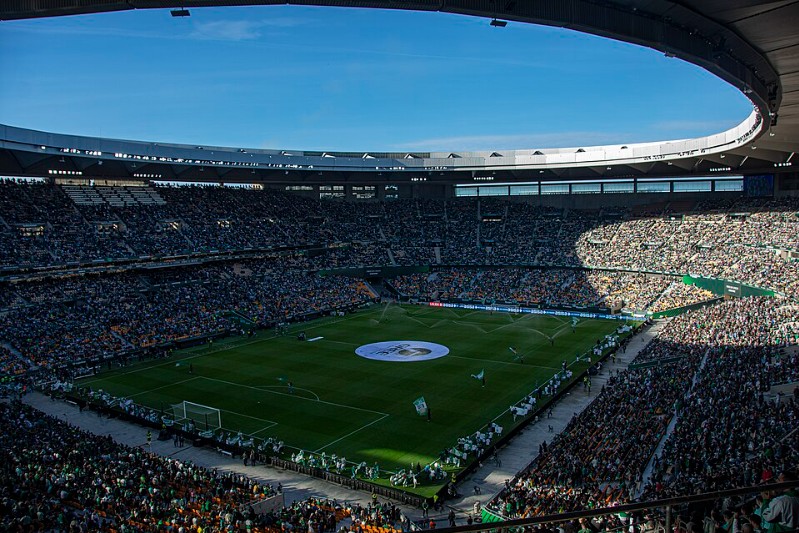
Source: Betis Girona 23 nov 2025 003.jpg, by Anual · Wikimedia Commons · CC BY-SA 4.0
Attendance and Tickets
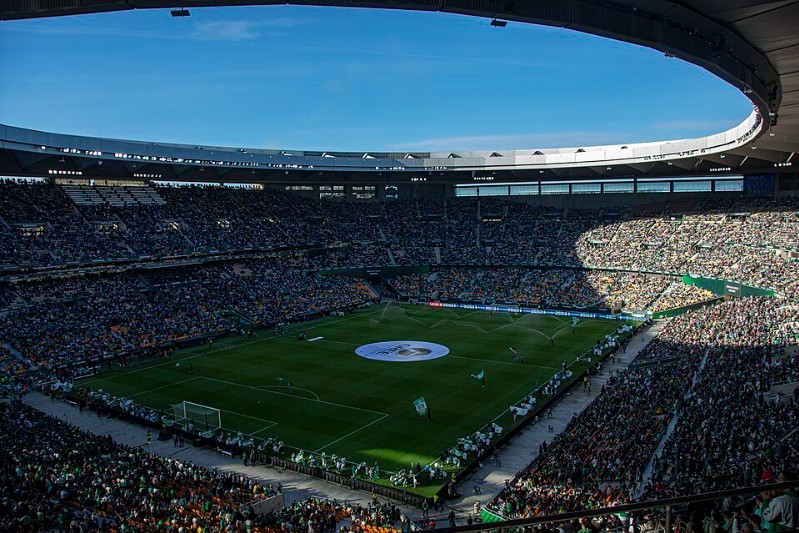
Since the 2025-26 season, Real Betis has been playing its home games at Estadio Olímpico (commonly known as La Cartuja), located on the Isla de la Cartuja north of Sevilla.
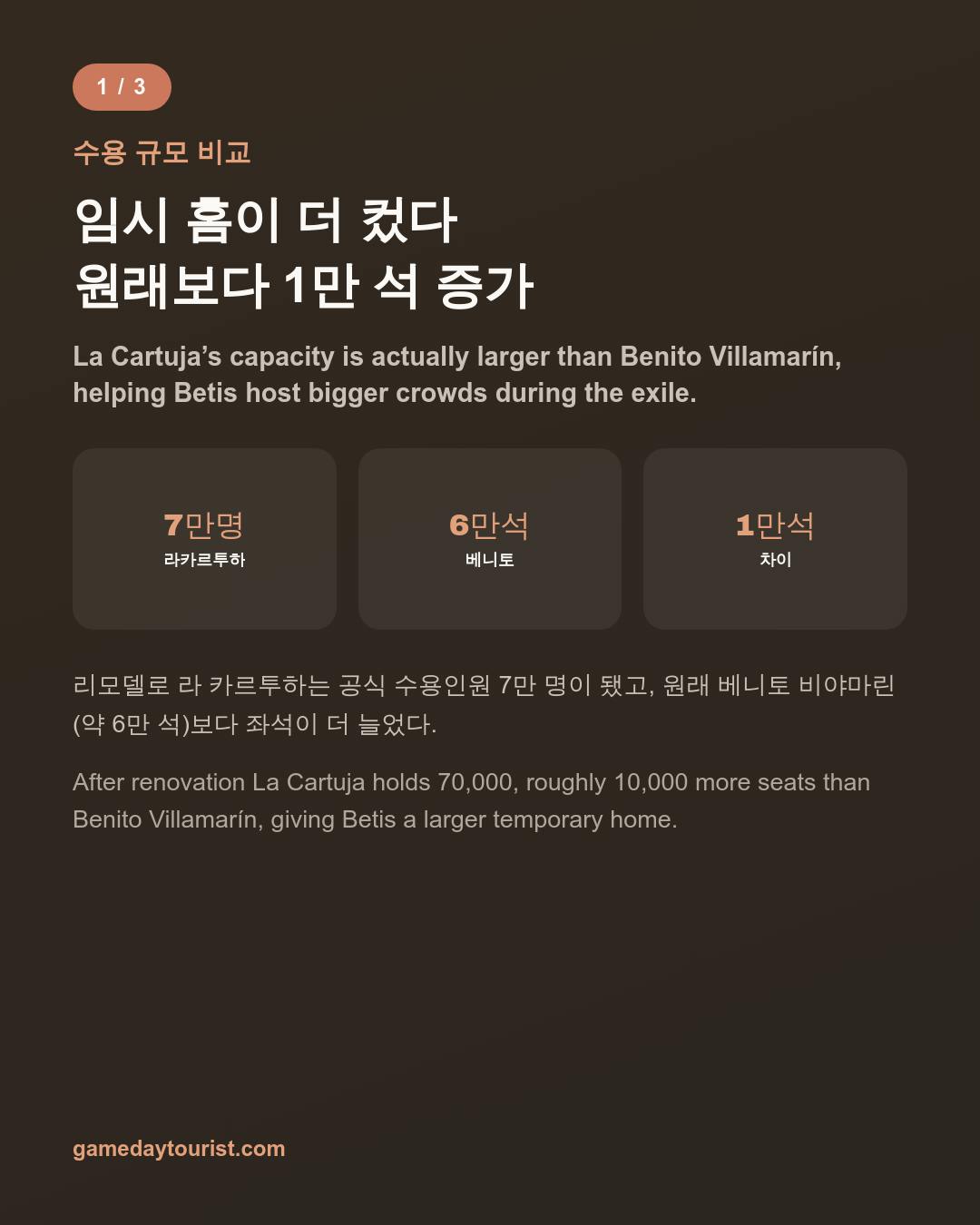
Originally built for the 1999 World Athletics Championships as a multi-purpose venue with a running track, the stadium was renovated in 2025, adding stands over the track to make it nearly football-only — capacity is now 70,000, per the club’s official figures.
Considering the old Benito Villamarín held around 60,000, this “temporary home” is actually nearly 10,000 seats bigger than the real one.
The numbers on the ground back that up.
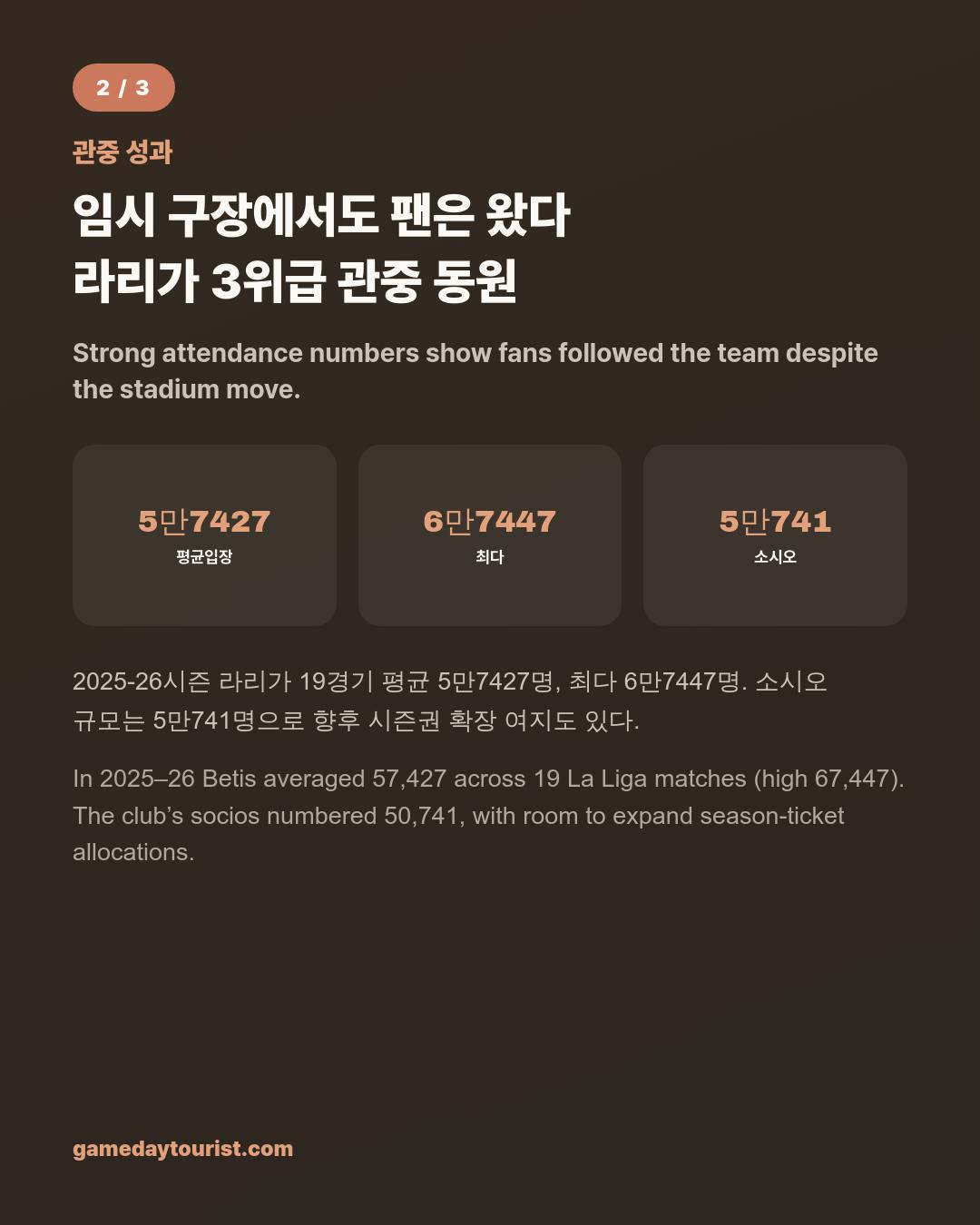
Across 19 La Liga fixtures in 2025-26, average attendance was 57,427 — the third-highest in all of La Liga — with a high of 67,447 and a low of 45,318, adding up to 1,091,110 fans over the season.
There are 50,741 socios (members) holding season passes, and with the bigger stadium, the club says there’s now room to grow socio season-pass numbers to as many as 55,000.
It’s not all good news, though.
Consumer group FACUA has been raising complaints since last October that the seating for visitors with mobility issues is arranged so that standing fans in front block their view, and the club has stuck to its line that “we don’t own the stadium, so this isn’t something we can fix” — leaving the issue unresolved.
It’s a case that shows how being a tenant can help with marketing flexibility while tying your hands on facility improvements.
Ticket sales still follow the usual tiered structure — member priority window, then general sale — but with the Champions League back, it’s hard to imagine tickets for marquee matches like the Sevilla derby, Real Madrid, or Barcelona lasting into the general sale phase anymore.
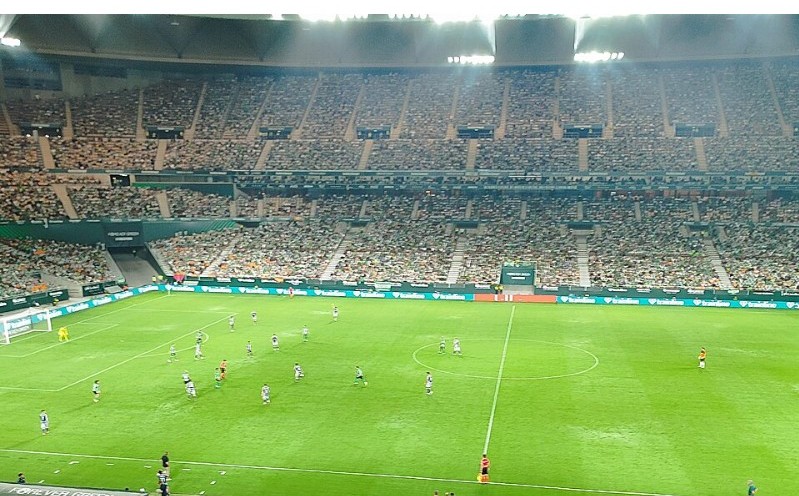
Space and F&B
La Cartuja wasn’t built as a football ground but as a general-purpose sports complex, so unlike Heliópolis, the neighborhood around the old home stadium, there aren’t really any local bars to duck into before or after a match.
What’s filled that gap is Parque del Alamillo, a large park right next to the stadium.
The club has set up an official fan zone with food trucks and live music, plus pop-up stores, near the park’s south goal end, and fans have built a whole new pre-match culture of gathering there hours before kickoff.
Once inside the stadium, Spanish law only allows the sale of alcohol-free beer (0.0%), so anyone wanting an actual beer has to grab one beforehand, either in the park or at a bar along nearby Alameda de Hércules.
A local Sevilla travel guide site notes that while La Cartuja sits a bit outside the city center with few businesses nearby, the moment just before kickoff when 70,000 fans sing the club anthem a cappella, with the speakers cut, is “a spine-tingling moment that holds up against any stadium in Europe.”
What struck me most as a marketer is that instead of trying to hide the weakness of a temporary stadium short on amenities, the club leaned into the park — a public urban space — and turned it into a stage for the fan experience.
Whether this outdoor fan-zone culture disappears once Betis moves back to Villamarín, or sticks around as a new tradition, is worth watching.
Merchandise and Ad Inventory
The main shirt sponsor is Chinese appliance maker GREE.
The three-season deal runs from July 31, 2024 to June 30, 2027, and the logo appears not just on the senior men’s kit but on the futsal and women’s team kits too.
As for the shirt-front spot itself, betting company Betway’s old slot moved to telecom brand Finetwork once Spain banned betting-company shirt ads starting in 2021, before shifting again to the current sponsor, GREE, in 2024.
For reference, the back-of-shirt spot over that same stretch passed through blockchain company Bit.com and trading platform LegacyFX — a sign of just how often high-risk categories like gambling and crypto rotate through Spanish football’s sponsorship market.
Worth noting: the Premier League only started banning that same kind of betting-company shirt ad from this 2026-27 season, meaning Spain went through this shift about five years earlier.
Beyond GREE, more than ten partners spanning different categories appear on the sponsor list — sports news platform Meritking (signed in October 2024, right after its deal with Turkey’s Galatasaray ended), beer brand Cruzcampo, bank CaixaBank, car brand Volvo, Coca-Cola, oil company Repsol, watch brand Maurice Lacroix, and NFT platform Sorare — making for a fairly diverse ad-inventory lineup.
On the merchandise side, what stands out is a special edition of the third kit (₩141,000) with a dedicated UCL patch, timed to the Champions League return.
In Korea, a genuine third-party company paying to attach its name — without any ownership tie to the club — tends to show up more around the club’s name than the stadium (Kiwoom Securities and the Kiwoom Heroes being the classic example), and GREE’s relationship with Betis has a similar flavor.
It’s an outside company that bought the front of the shirt purely for marketing purposes, with no connection to the ownership family or its affiliates.
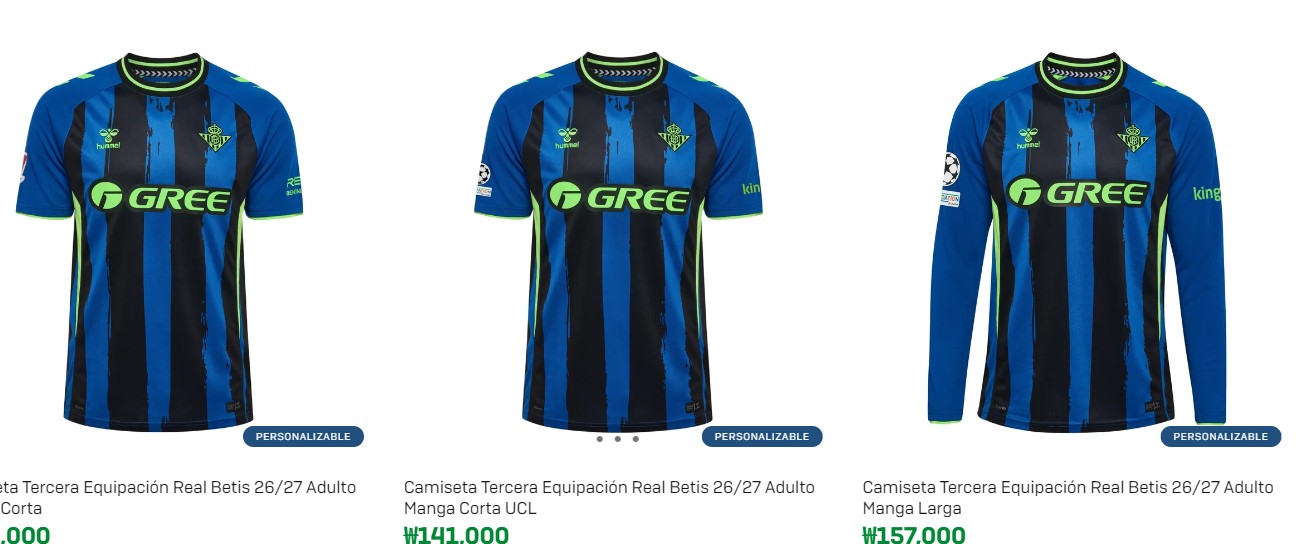
Source: shop.realbetisbalompie.es official online store screenshot · Official club merchandise image
Broadcast Rights and Local Economic Impact
Betis’s return to the Champions League came via the extra European Performance Spot Spain earned by ranking near the top of UEFA’s association coefficient standings, after finishing fifth in La Liga.
That extra slot — split between England and Spain, with Liverpool also benefiting — meant Betis reached the Champions League group stage after 21 years without even needing to finish in the top four domestically.
The Champions League operates on a completely different scale of broadcast rights and prize money than the Europa League or Conference League, so while the exact payout will depend on how the season goes, broadcast and prize revenue is expected to take up a noticeably bigger share of the club’s total revenue.
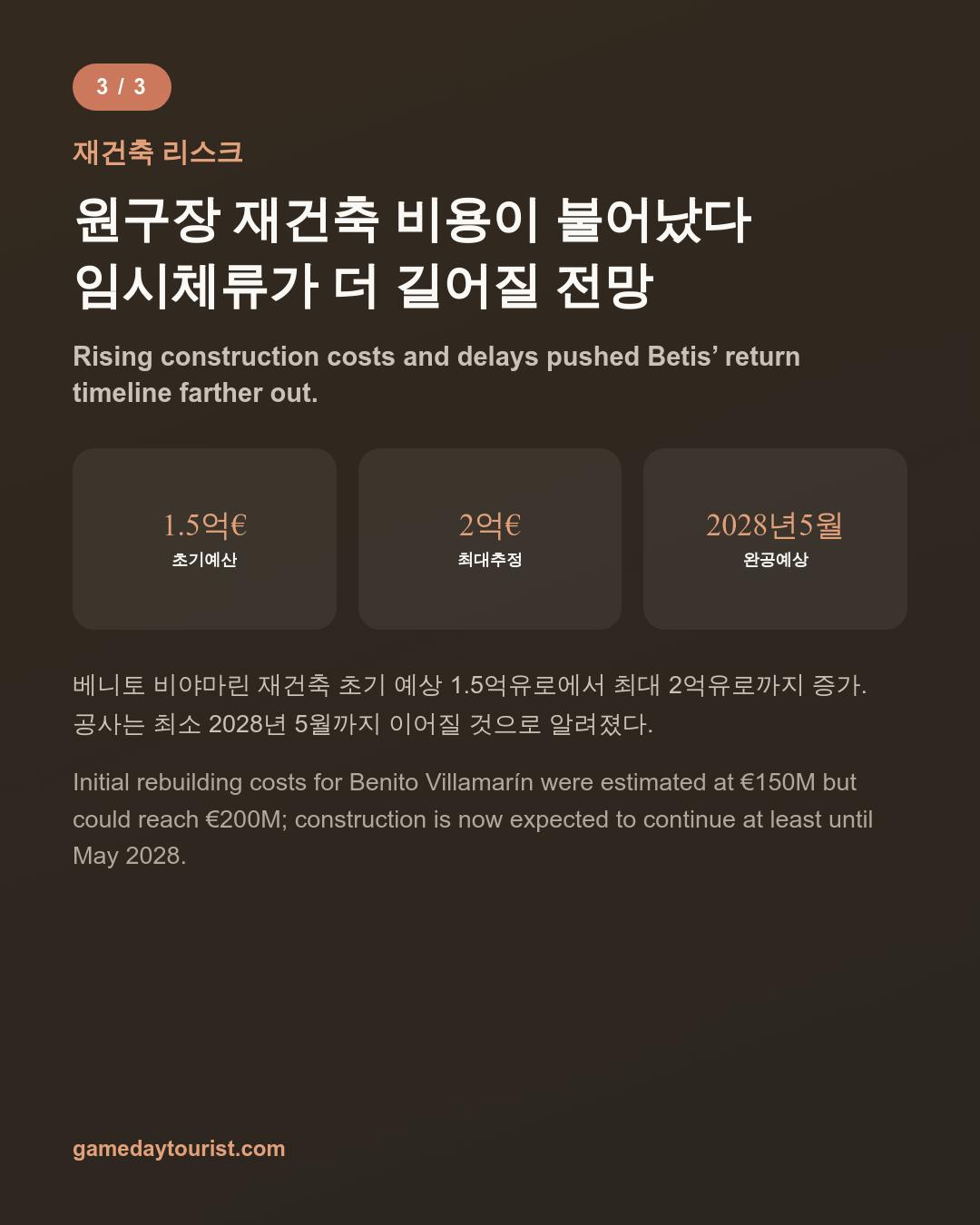
Meanwhile, the budget for rebuilding the old home stadium, Benito Villamarín, keeps climbing.
When construction began in summer 2025, the club projected costs around €150 million (about ₩245 billion), but rising material costs and labor shortages pushed that estimate up to as much as €200 million (about ₩326 billion) as of last November.
Once finished, the main stand — the Preferencia — will be rebuilt at 13,500 seats (10,000 general plus 3,500 premium), alongside a mixed-use complex with a hotel, clinic, and convention hall; the club expects that complex alone to generate more than €20 million (about ₩32.6 billion) a year in additional commercial revenue once it opens.
In the process, the City of Seville is handing over 8,800 square meters of land and 470 square meters of road to the club, and in exchange will retain ownership of about 4,300 square meters (valued at roughly €9.5 million, about ₩15.5 billion) inside the finished complex, offsetting the project cost.
The club originally planned to spend just two seasons at La Cartuja before returning to a new stadium in 2027-28, but after a failed construction-contractor tender and other setbacks, the club itself admitted last November that a stay of at least three seasons was likely, and as of this past August, construction is now expected to run until at least May 2028.
The temporary stay has ended up running far longer than anyone expected.
For reference, La Cartuja isn’t Betis’s property at all — it’s owned by a layered public consortium: the Andalusian regional government (40%), Spain’s national government (25%), the City of Seville (19%), and the Province of Seville (13%), with Betis and Sevilla FC splitting the remaining 3%.
It’s also already confirmed as a venue for the 2030 World Cup, co-hosted by Spain, Portugal, and Morocco, which means Betis’s temporary stay happens to line up with the stadium’s own World Cup preparation schedule.
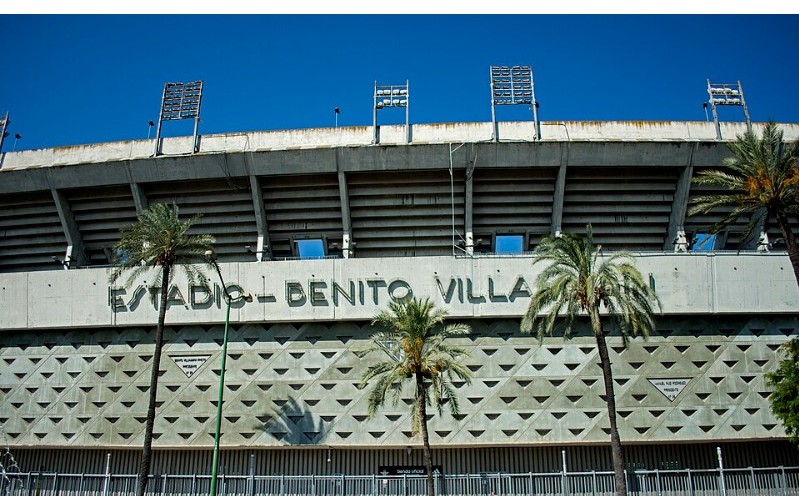
Source: Estadio Benito Villamarin 2016001.jpg · Wikimedia Commons · CC BY-SA 4.0
The Stadium’s Own Signature — An Anthem Sung Without Speakers
The nickname “Bético,” used for Betis fans, carries a long history.
Unlike rival Sevilla FC, whose support base leaned toward the city’s middle class, Betis grew on working-class support, and out of that grew the rallying cry “Viva el Betis manque pierda” (“Long live Betis, even if we lose”).
It dates back to the 1950s, when the club was going through its worst days, and it’s still the phrase most associated with being Bético today.
That spirit hasn’t changed with the move to La Cartuja.
In particular, the moment right before kickoff when the stadium cuts the speakers and the entire crowd sings the club anthem a cappella is considered the single most iconic moment even at the temporary ground.
A local matchday information site described the moment as holding up, chill-factor-wise, against any anthem at any stadium in Europe — and even reading through it as reference material for this post, that one passage carried a sense of the atmosphere that jumped off the page.
How This Compares to the KBO and K League
A stadium owned by a layered public consortium of regional, national, and local government, like La Cartuja, isn’t an unfamiliar structure in Korea either.
But most Korean stadiums owned by local governments are designed around the assumption that the resident club will stay put indefinitely, whereas Betis’s solution — vacating its own stadium entirely and borrowing a public venue in a neighboring district for close to three years — is a solution rarely seen in Korea.
For Korean clubs that need to protect their fan base and revenue through a renovation period, this is a useful reference case for where and how to play home games during construction.
The socio (member) system has some resemblance to the membership models of certain K League citizen-owned clubs, but having more than 50,000 socios holding season passes shows a depth of fan base no Korean club has reached yet.
On the ad-inventory side, it’s also worth noting that GREE’s structure — an outside company with no ownership ties buying the main shirt-sponsor spot — resembles the Kiwoom Heroes model in Korea, where a third-party sponsor attaches its name to the club itself rather than the stadium.
As it happens, a strikingly similar case is about to unfold in Korea, too.
Under Seoul’s Jamsil Sports-MICE mixed-use development project, Jamsil Baseball Stadium will be demolished after the 2026 season, and the LG Twins and Doosan Bears will use the adjacent Seoul Olympic Stadium as their substitute ballpark for five seasons, from 2027 through 2031.
At the end of 2031, it’s set to reopen as a 35,000-seat domed stadium.
The direction, though, is nearly the opposite of Betis’s approach.
The Olympic Stadium, confirmed as the substitute venue, will open with around 18,000 seats concentrated on the lower two tiers for safety reasons, then gradually expand to the third tier and beyond 30,000 seats as viewing safety is confirmed.
That means it will actually start out smaller than Jamsil Baseball Stadium’s current capacity of 23,750.
La Cartuja, by contrast, opened from day one at 70,000 — bigger than the stadium it replaced.
Put side by side, the two cases reveal two different approaches to risk management: opening a temporary home at maximum capacity right away, versus scaling up gradually as safety gets verified.
With a temporary-stadium arrangement set to run five seasons, how you design crowd capacity ends up shaping revenue and fan experience for that entire stretch — which makes this a comparison worth watching for Korean clubs and local governments alike.
Betis probably never expected the season of squatting in someone else’s house while its own place got renovated to drag on this long.
And yet attendance actually grew, fans built a whole new culture in the park, and the club made it back to the biggest stage in club football.
Betis’s past year is proof that a brand and its fanbase can keep growing even without their own stadium — just through a different set of tools.
Leave a Reply