Contents · About 14 min read
- 5,000 bottles of Jamsil soil and the “Goodbye Jamsil” glass bottle: what sold before the stadium disappeared
- Two families under one roof: who are the LG Twins and the Doosan Bears?
- To watch baseball in Jamsil in 2027: where the temporary ballpark is, the seats and tickets, what is confirmed and what is not
- Crowds and tickets: 3.12 million fans in Jamsil’s final year
- Seats and food, as fans saw them: a great location, but inconvenient
- Advertising rights and merchandise: the Seoul city advertising fee and the last products
- A 30,000-seat new dome in 2032: figures that differ from report to report
- Compared with abroad: temporary home ballparks were always smaller
📱 View as card news
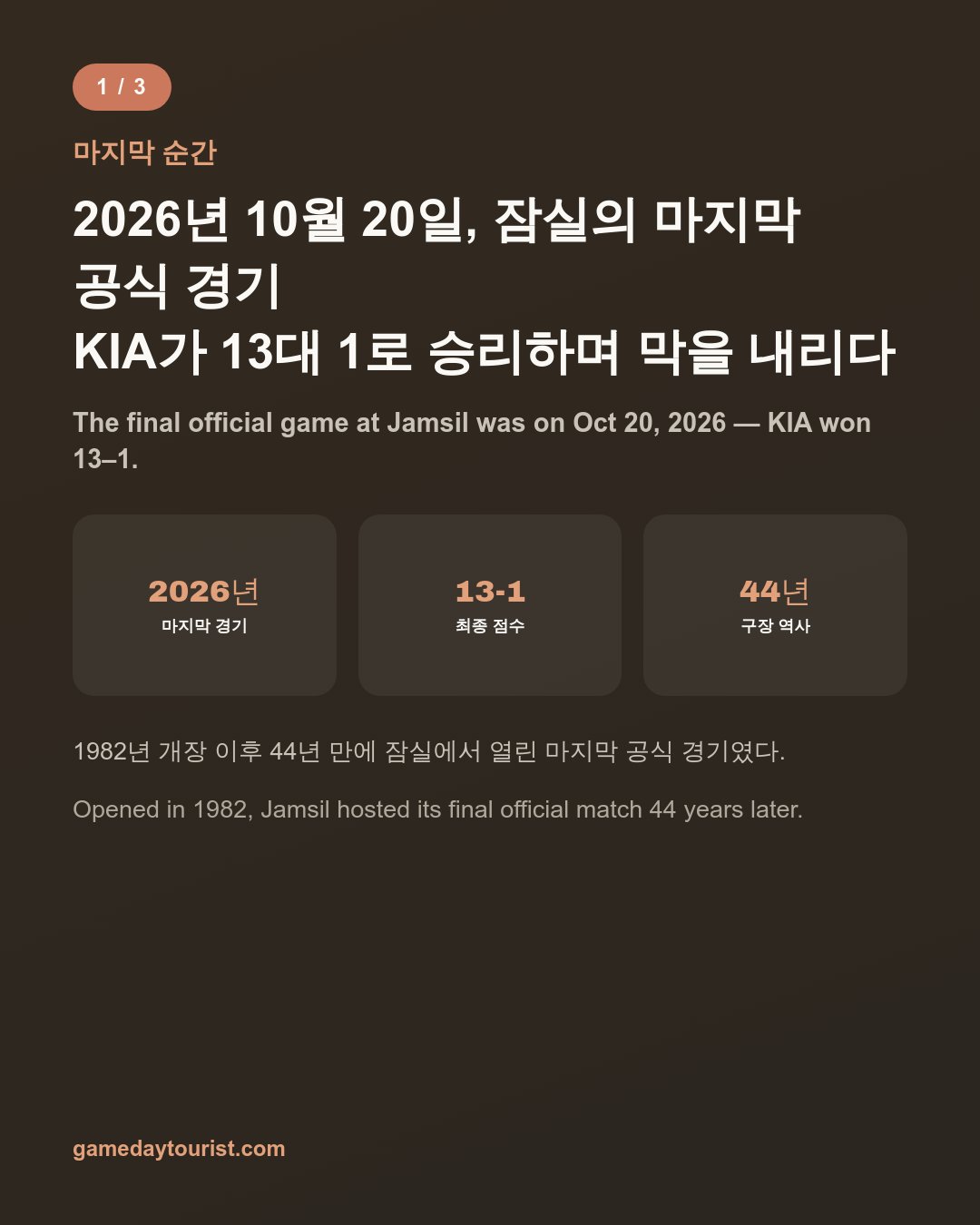
For fans of the LG Twins and Doosan Bears, the last chance to see a game at Jamsil came on the night of Tuesday, October 20. The stadium’s final official game ended in a 13-1 win for the KIA Tigers.
The Korea Times reported that LG fans went quiet once KIA scored seven runs in the second inning, and the crowd grew quieter with every inning after that. That Game 3 of the semi-playoff, the first round of the playoffs, was the last official game at the stadium in 44 years, since it opened in 1982.
The YTN report also recorded it as the final game at the stadium that is being demolished.
According to Financial News, KIA’s Kim Do-young hit a second-inning grand slam, the last one in Jamsil’s 44-year history, and KIA’s Yang Hyun-jong filled a plastic bottle with soil from the mound after the game.
As a marketer, the scene stayed with me because the stadium was so heated in its final season before demolition. Two clubs under one roof topped three million fans, the stadium’s soil was bottled and sold, and now both clubs have to spend five seasons in the Olympic Stadium next door, turned into a ballpark.
This piece collects the last numbers and stories from Jamsil. It also separates what fans who want to watch baseball in Jamsil from 2027 can know now from what is still unknown.
The old stadium goes down starting in December, so this is less a how-to-get-there guide than a record of the last season and a fact-check note on the next ballpark.
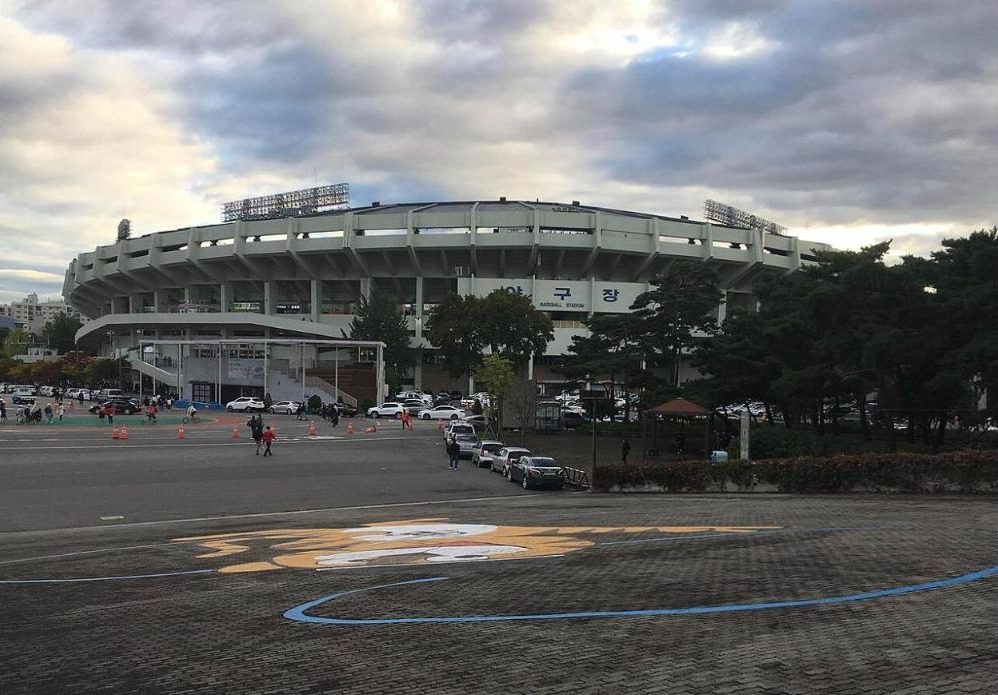
Photographed on October 6, 2018. Exterior of Jamsil Baseball Stadium · Source: Wikimedia Commons, Christophe95 (CC BY-SA 4.0)
5,000 bottles of Jamsil soil and the “Goodbye Jamsil” glass bottle: what sold before the stadium disappeared
Once demolition was confirmed, the first thing to get a price was not the stadium itself but the soil on the field.
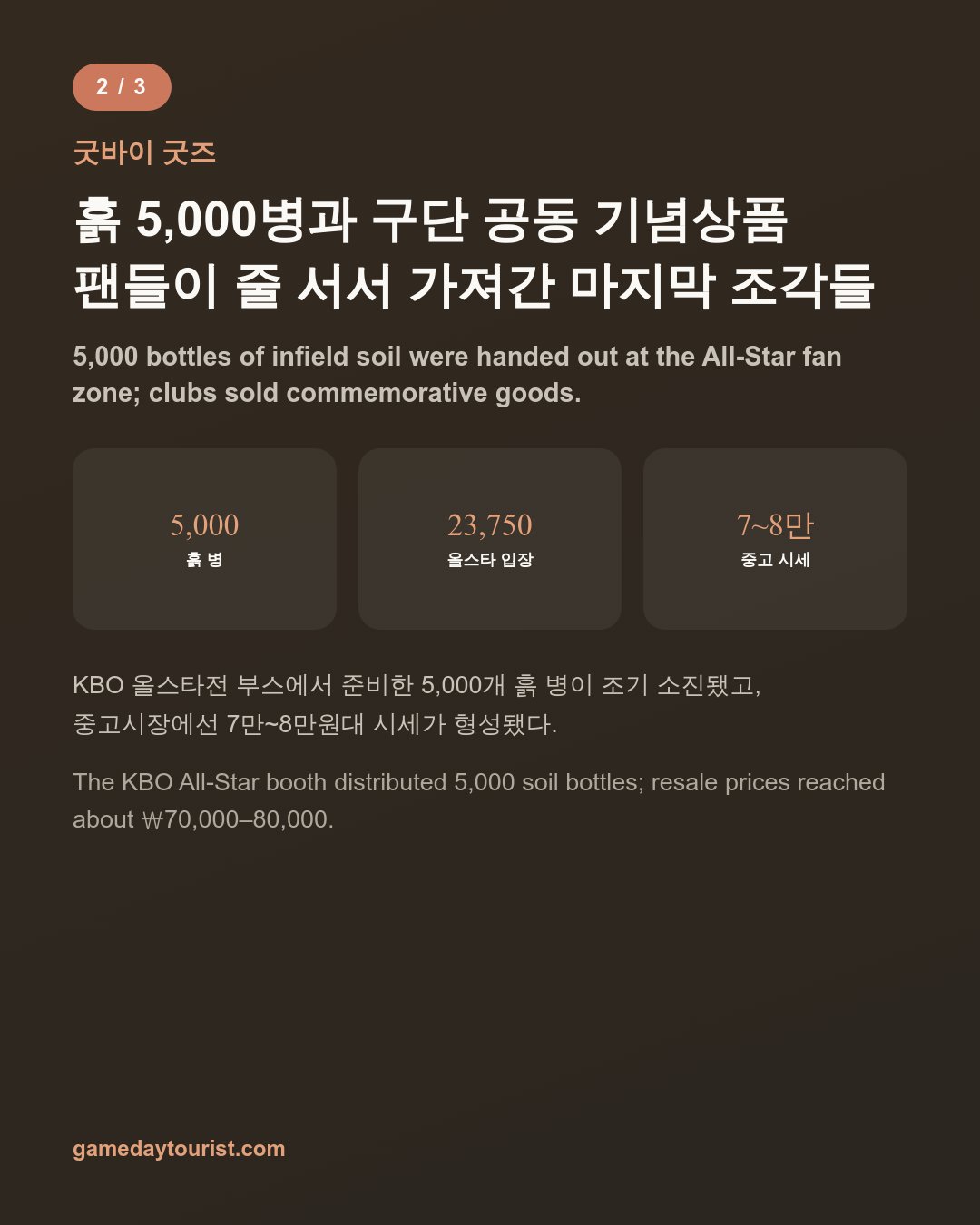
Asia Economy reported on July 13 that as more fans sought the soil as a keepsake, most listings on secondhand marketplaces switched to sold or reserved, and the going price rose to ₩70,000–80,000. The same article even quotes buyers posting that they would pay any price.
At the fan festival zone for the last Jamsil All-Star Game on July 10–11, KBO set up a “Re:member Jamsil” booth where fans could scoop real infield soil into an empty bottle. The 5,000 bottles prepared for the two days ran out early in the heat, and fans reportedly waited more than an hour in line, with the All-Star Game itself drawing a full house of 23,750.
The clubs did not miss this demand either. According to a press release LG issued on September 28, LG and Doosan made joint keepsakes using real Jamsil turf and soil: the “Goodbye Jamsil Ground Stadium” (a stadium model) and the “Goodbye Jamsil Ground Glass Bottle” (soil in a glass bottle shaped like the mascot Lucky or a star).
They went on sale in limited quantities at the LG goods shop from 4 p.m. on October 7, LG’s last regular-season home game. The release gave neither the price nor how the proceeds would be used.
To a marketer, this reads like a textbook case. Items from a space that is closing become scarce assets that cannot be copied, and it was the secondhand market, not the club, that first confirmed their value with a price.
It is also rare for two rival clubs sharing a stadium to release a joint product. Because soil is a finite resource, how well the product answered fans’ feelings can only be judged once sales volume and price are disclosed.
Beyond soil, Jamsil has an unwritten rule that works only here. The Kyunghyang Shinmun wrote that the winner of a Jamsil derby walks across the field to leave, while the loser goes back through the stadium’s inner tunnel, and told the story of Park Chan-ho, who did not know this, went into the tunnel after a win and then ran back out onto the field.
Two families under one roof: who are the LG Twins and the Doosan Bears?
Jamsil Baseball Stadium was completed in July 1982, and on August 1 that year Lotte played MBC Chungyong (now LG) in the first pro baseball game held there.
Hankyung Magazine summarizes that MBC used it as its home from 1983, and when the OB Bears (now Doosan) joined three years later, the era of “two families under one roof” began.
The Korea JoongAng Daily lists LG’s titles as 1990, 1994, 2023 and 2025, and Doosan’s as 1995, 2001, 2015, 2016 and 2019. It also notes that Doosan fans call themselves the tenth batter in a nine-man lineup.
This year’s results are as follows. The two teams met in the wild-card series as the fourth seed (LG) and the fifth seed (Doosan), and after LG won Game 1 on October 14 by 4-1, Doosan’s postseason ended after a single game.
LG then lost the following semi-playoff series to KIA in a three-game sweep (Ilgan Sports). The managers are LG’s Yeom Kyung-youp and Doosan’s Kim Won-hyung (as of an October 7 game report).
Accounts of the seating sections for each team’s cheering fans differ by outlet, so this piece does not list them; it is safer to check the exact locations in the clubs’ official guidance before a game.
To watch baseball in Jamsil in 2027: where the temporary ballpark is, the seats and tickets, what is confirmed and what is not
The checking date is November 1, 2026. The first thing to make clear is that you cannot watch a baseball game at Jamsil Baseball Stadium right now.
The old stadium comes down from December, after the 2026 season. So this section gathers only what the Seoul city government and the press have said about the temporary ballpark that will be used from the 2027 season, and where I could not find an item in official sources I say so.
One place to stand in front of the stadium before it goes remains, though. On October 23, LG announced a 10 km marathon, “2026 The Last Run: Goodbye Jamsil,” around Jamsil Baseball Stadium on November 22.
The course starts at 7:30 a.m. from the stadium’s east gate, passes Jamsil and Seokchon stations, turns at Garak Market station and returns to the east gate, with about 10,000 runners. Registration is through Ticketlink, and finishers get a commemorative medal and other items.
In its July 9, 2024 announcement, the Seoul city government said it had finalized using the Jamsil Main Stadium as the replacement ballpark for five seasons, 2027 to 2031.
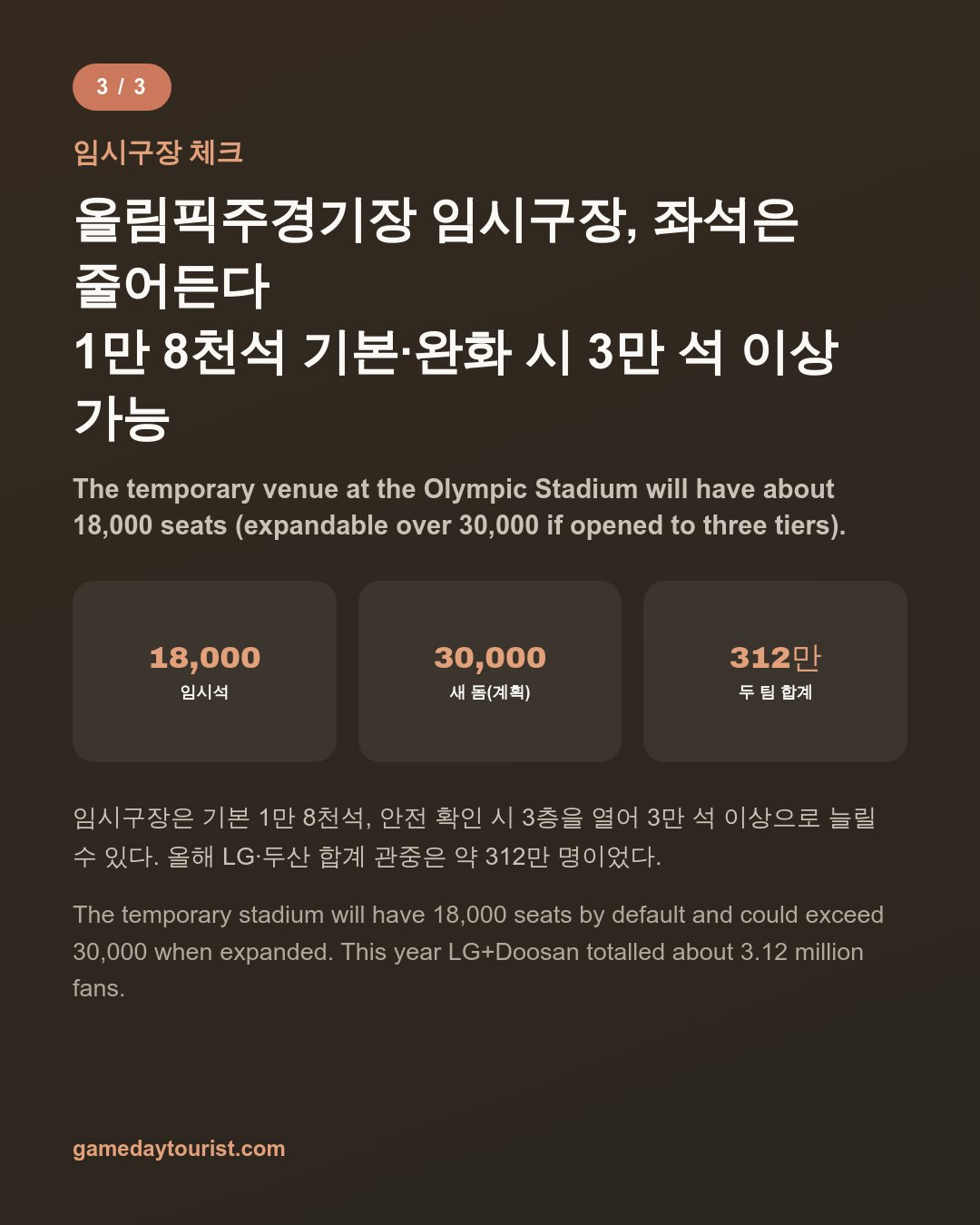
The soccer pitch and running track will be turned into a baseball field that meets KBO rules, with about 18,000 seats on the first and second levels, and the third level can open for key games and the postseason once safety is confirmed, raising capacity to 30,000 or more. It also promised an additional entrance on the east side toward Baekjegobun-ro, besides the west side toward Bongeun Bridge.
More recent reports add detail. According to the Seoul Shinmun (July 15), the temporary park’s fences are 95 m down the lines and 124 m to center, shorter than the old stadium’s 100 m and 125 m, and seats go only behind home plate and along the first- and third-base lines, with the third level and outfield seats unused in the basic plan.
Its safety simulation reportedly found about 13,000 seats the best fit, and judged that crowd flow works without strain up to 18,000.
The article also said that only two roads lead into the temporary ballpark, toward Bongeunsa and toward Sincheon Middle School, so the number of admitted fans was cut to spread crowds after games. It mentions closing off the Sports Complex station side but does not say how far the closure reaches, so I could not confirm that.
Money Today (October 17) put the construction completion target at February 2027 and the progress rate (the share of work done) at 40% as of the end of September.
By contrast, here are the items I could not confirm from official sources this time. They are the temporary ballpark’s official name, ticket outlets and prices, seat grades, whether cards issued abroad work and whether foreign-language booking is supported, entry rules (bags, food and so on) and parking policy.
Since two clubs share the stadium, nothing is known yet about how sales will be organized. Please recheck these items on the official LG Twins and Doosan Bears websites and in Seoul city announcements when the season schedule comes out.
The point that worries me most as a marketer is seat count. Compared with the old stadium’s 23,750 seats, sold out on the last day of the regular season, an 18,000-seat ballpark is about 5,750 fewer, and given the demand the two clubs built this year, tickets could get harder to find than now.
The flip side is that publishing official sales channels and pricing policy early keeps foreign and new fans from drifting to unofficial channels. This is my own estimate; the actual policy has to wait for the clubs’ announcements.
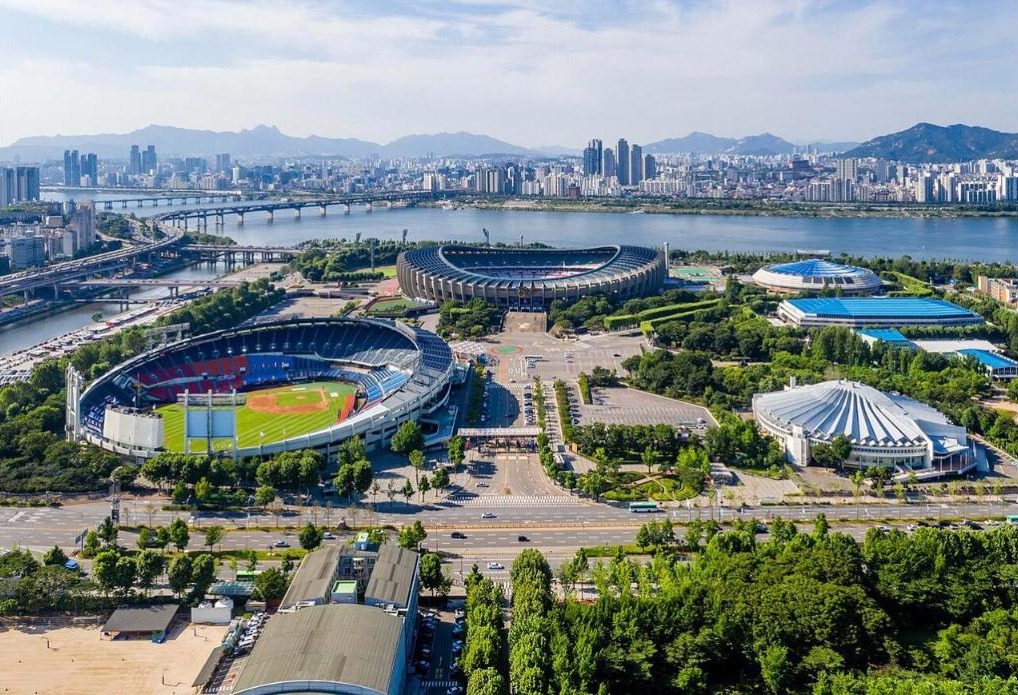
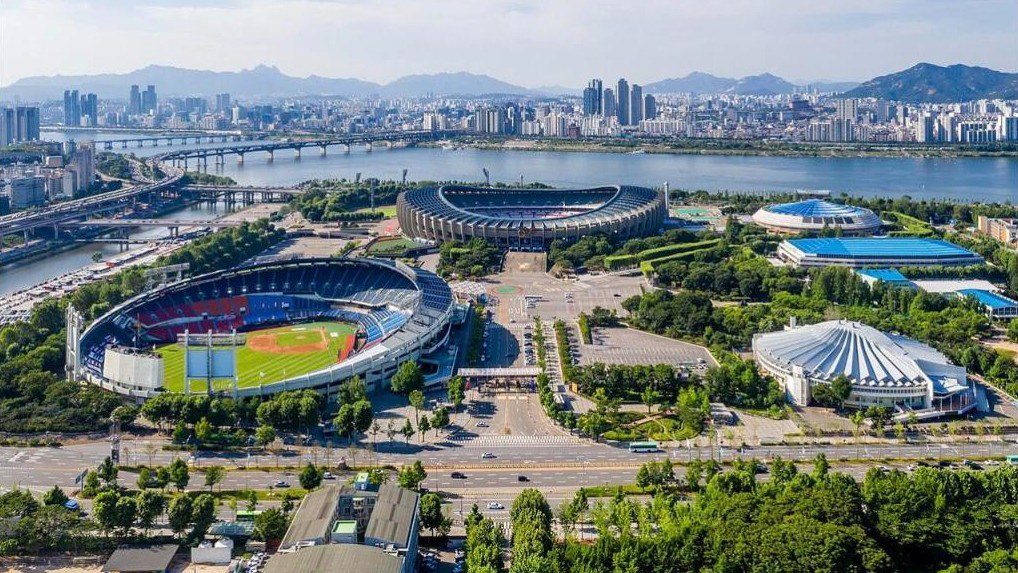
Photographed on June 11, 2020. Aerial photo of the Jamsil Sports Complex area. Jamsil Baseball Stadium is on the left and the Olympic Main Stadium at upper center · Source: Wikimedia Commons, Seoul Institute (CC BY 4.0)
Crowds and tickets: 3.12 million fans in Jamsil’s final year
This year’s total KBO regular-season attendance was 12,770,551, beating last year’s 12,312,519 for an all-time record.
According to the article, LG drew 1,622,238 and Doosan 1,507,522, and Doosan topped 1.5 million for the first time in club history. Added together, that is 3,129,760.
I did a simple calculation over 72 regular-season home games each, and the average crowd was about 22,500 for LG and about 20,900 for Doosan, roughly 95% and 88% of the 23,750 capacity. Please keep in mind that this is a simple calculation that does not check whether some home games were played elsewhere.
The limit both clubs shared was supply. The last Jamsil rivalry game on October 7 sold out 75 minutes before first pitch (Korea JoongAng Daily), and the Doosan-Lotte game on the last day of the regular season, October 12, also filled all 23,750 seats (Hankook Ilbo).
The Kyunghyang Shinmun’s report on the LG and Doosan sellout streaks said Doosan’s 12 straight home sellouts through May 10 passed LG’s 10, the previous Jamsil record.
Looking back ten years offers something interesting. In 2016 Doosan drew 1,165,020 and LG 1,157,646, a combined 2,322,666, and a column in OSEN predicted that if LG got stronger, a three-million-fan era for the two clubs combined was possible.
This year’s combined 3,129,760 is about 35% higher than then. According to the Kyunghyang Shinmun, Jamsil’s seat count fell from 27,000 in 2010 to 23,750 from 2022.
That demand has grown this much in a stadium whose capacity shrank reads to me as a sign that this market has been waiting for a bigger ballpark.
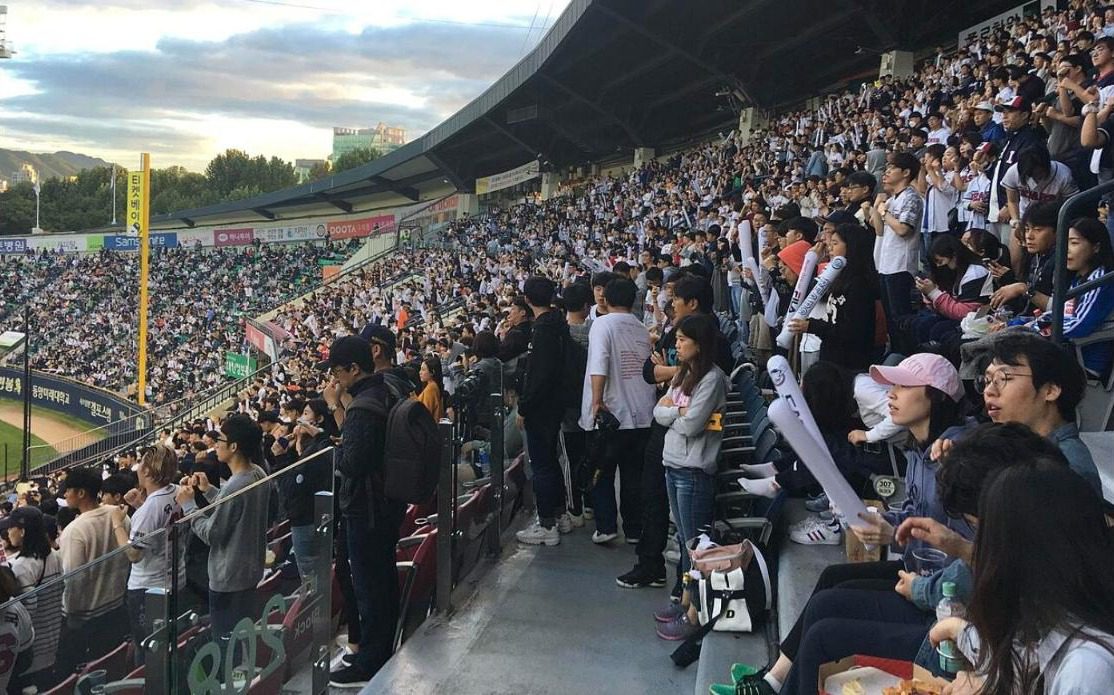
Photographed on October 6, 2018. Spectators in the stands of Jamsil Baseball Stadium, some holding cheering sticks · Source: Wikimedia Commons, Christophe95 (CC BY-SA 4.0)
Seats and food, as fans saw them: a great location, but inconvenient
The strengths and weaknesses fans point to are fairly consistent. Among the fans the Kyunghyang Shinmun interviewed, one man in his 40s said the sunsets and breeze are lovely but insects are bad in the hot season.
A fan in his 20s praised the location and the view of the opposing fans’ cheering, but said some areas have narrow seats and no cup holders, and that the food lags behind. A Korea JoongAng Daily column called the stadium a concrete building designed in an era without hospital suites or corporate boxes, which is the writer’s opinion alone.
One fan-review blogger laid out the food floor by floor. According to that post, the first floor has few stands and long lines, the second has the widest range of franchises, and the third has convenience stores and chicken and burger shops, so it is the easiest place to avoid lines.
Outside food is allowed, but not glass containers or alcohol, and since the post was written in 2025 things may have changed. Reading it, I thought the structure that makes fans move between floors to buy what they want and miss the game is the first problem a new stadium has to solve.
Money Today reported that the new dome will include skyboxes, event seats, a viewing café, and viewing areas in some hotel rooms and a lounge. That creates premium inventory that can raise per-seat prices for the first time.
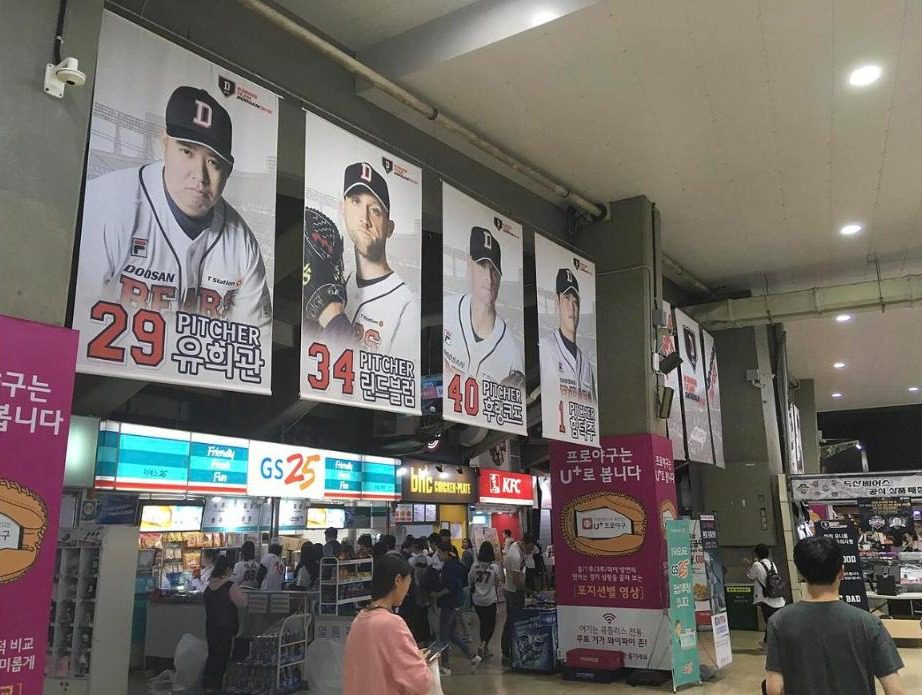
Photographed on October 6, 2018. Concourse of Jamsil Baseball Stadium, with a Doosan pitcher banner and convenience-store and franchise stands · Source: Wikimedia Commons, Christophe95 (CC BY-SA 4.0)
Advertising rights and merchandise: the Seoul city advertising fee and the last products
Jamsil’s advertising structure ties together the clubs, the Seoul city government and an ad operator. According to a Seoul Shinmun report (November 2024) on materials from the city council, the 2025 advertising facility fee for Jamsil Baseball Stadium is ₩9.304 billion (an appraised value of ₩6.77 billion plus an additional revenue amount of ₩2.534 billion).
The appraised value is the assessed amount that serves as the basis for setting public-facility fees. The city permits Doosan and LG to use and earn from the advertising facilities, and separately signs a 2023–2025 operating contract with a third-party operator chosen by open competitive bidding.
In the same article, Gocheok Sky Dome comes to ₩3 billion, a negotiated contract with Kiwoom, and ad sales there are about a quarter of Jamsil’s.
The city said it would revise how advertising rights are contracted to raise its own revenue, so this structure may change at the 2027 temporary ballpark and the 2032 dome. Naming rights for the new dome (the right to put a company’s name on the facility) and the operating terms did not appear in the reports I checked.
Merchandise moved club by club. Besides the joint products, LG released on its own a uniform, T-shirt, cap, stadium patch, muffler, towel, canvas bag, seat keyring and commemorative ball, and the keyring was made by 3D-modeling a real stadium seat (LG press release).
Pre-orders run from September 29 until Doosan’s last home game, with shipping in order from late November. The pop-up exhibit near the central ticket office ran from September 29 to October 7.
The impression that remains is that the clubs were quite quick to turn the fact that the stadium is disappearing into products.
A 30,000-seat new dome in 2032: figures that differ from report to report
A dome will rise on the old stadium’s site under the Seoul city government’s private-investment “Jamsil Sports and MICE Complex” project. MICE refers to business events such as corporate meetings, exhibitions and conventions.
MTN reported on July 29 that the city had signed the implementation agreement (the final contract between the city and the operator in a private-investment project). It gave the total project cost as ₩2.6955 trillion and the preferred bidder as “Seoul Smart MICE Park” (lead firm Hanwha’s construction division), and said the private sector will fund all of it with no public money, with completion targeted for 2032.
The figures differ by date. When negotiations finished in March, a Dailian report put the total cost at ₩3.3 trillion, and that article includes a 30,000-seat dome, an 11,000-seat gym built to international basketball specifications and 841 hotel rooms.
Hankyung Magazine gave the dome’s seats as 35,000 in January, while other reports said 30,000. The target for completion is a 2032 opening, but some reports describe it as finished at the end of 2031 (Dailian’s “Adieu Jamsil”).
Hankyung Magazine said a memorial hall would be preserved inside the dome, but the Dailian reports do not mention it, so I could not confirm whether it is final. If you quote the project cost or seat count, I suggest checking which date’s report it comes from.
Compared with abroad: temporary home ballparks were always smaller
Teams abroad have lived through temporary home seasons too. The Tampa Bay Rays of MLB, covered earlier, played the 2025 season at Steinbrenner Field, the New York Yankees’ spring-training park, after a hurricane wrecked the Tropicana Field roof.
According to CBS Sports, that ballpark holds 11,000, about 5,500 fewer than the Rays’ 2024 home average paid attendance of roughly 16,500. The point it shares with Jamsil is that the temporary park cannot hold the usual demand.
The differences are clear too. The Rays moved suddenly because of a disaster, while Jamsil’s move was fixed in July 2024 and prepared for, and two clubs rather than one share the stadium.
So over Jamsil’s five seasons, how the schedule, the ticket sales method and sponsor exposure are divided will shape the fan experience as much as the seat count. Whether the demand that 3.12 million fans showed this year can be held at the temporary ballpark is something I see first tested by the sales policy released before the 2027 season opens.
The last traces of Jamsil Baseball Stadium will remain as bottles of soil, keyrings and a few photographs. Fans who visit Jamsil in 2027 should at least remember in advance that the direction changes first, toward the Olympic Main Stadium.
See the LG Twins’ food guide and team page, and the Doosan Bears’ food guide and team page, too.
Leave a Reply