Contents · About 8 min read
📱 View as card news
While researching this piece, I came across news that Nagoya Railroad — usually shortened to Meitetsu — had just partnered with a pro baseball club again after 70 years apart.
It turned out Meitetsu had actually run this club’s predecessor directly at one point.
The phrase “reunited after 70 years” carried enough weight that I wanted to dig into the business behind the Chunichi Dragons and their home, Vantelin Dome Nagoya.
What actually stood out once I got into it was something else entirely.
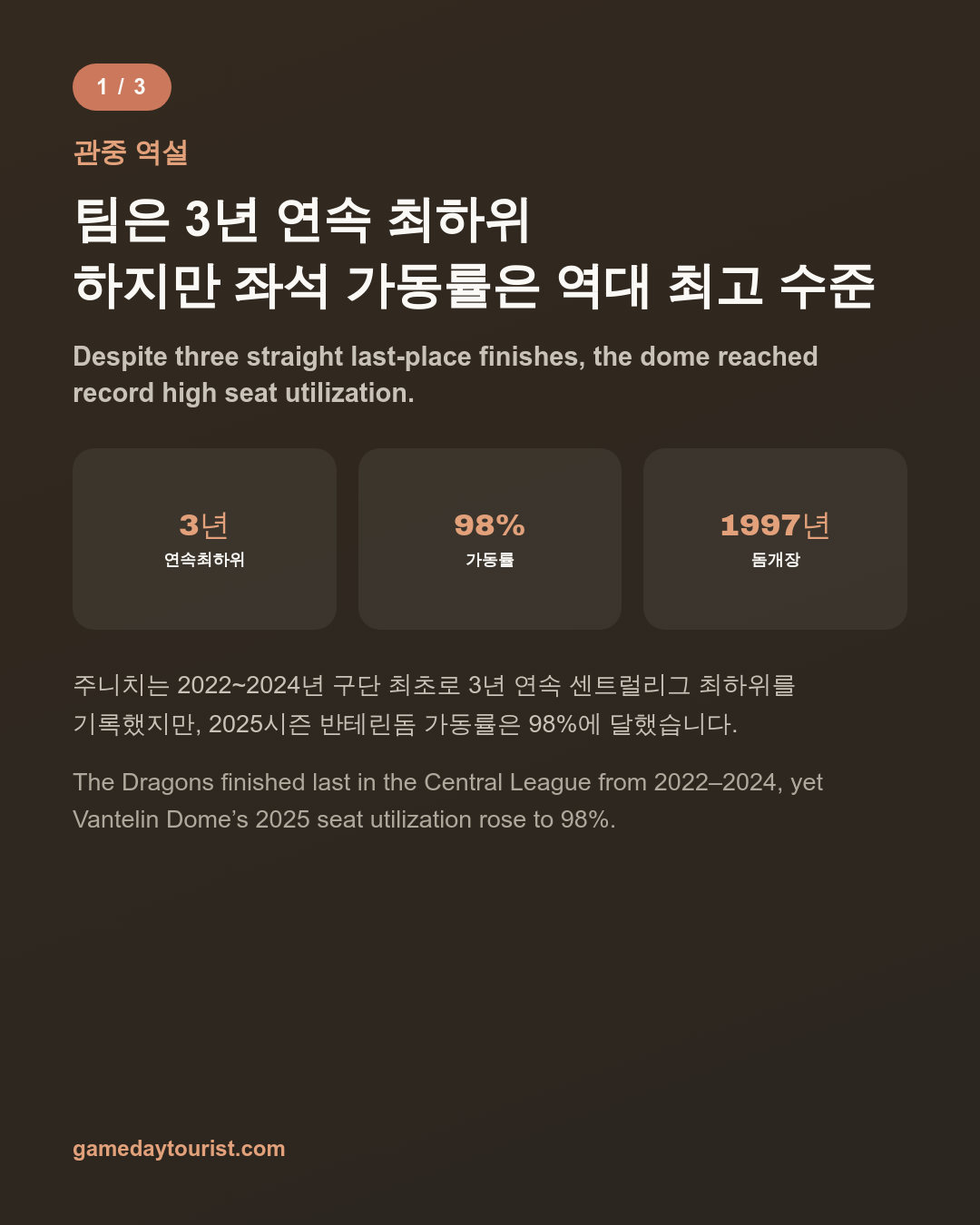
Chunichi finished last in the Central League for three straight seasons from 2022 to 2024, the first time that had ever happened in club history, and as of mid-September 2026 they’re still sitting fifth out of six teams.
And yet Vantelin Dome Nagoya’s seats are anything but empty — attendance rate hit 98% in the 2025 season.
I wanted to work through how a team’s results and its attendance ended up moving in completely different directions.
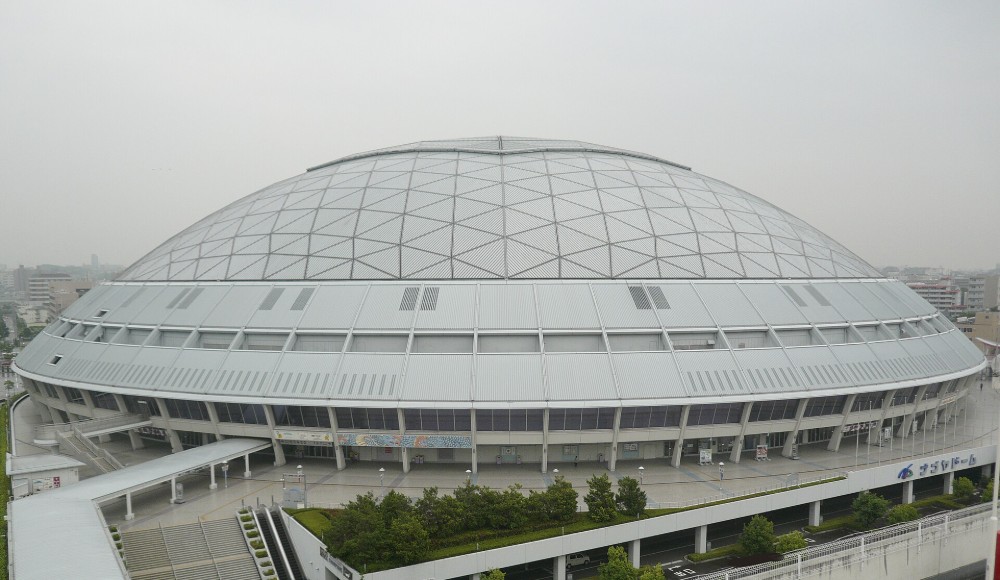
Source: Wikimedia Commons (photo by Gnsin, 2007) · CC BY-SA 3.0 · Exterior of Vantelin Dome Nagoya
Crowds and Tickets
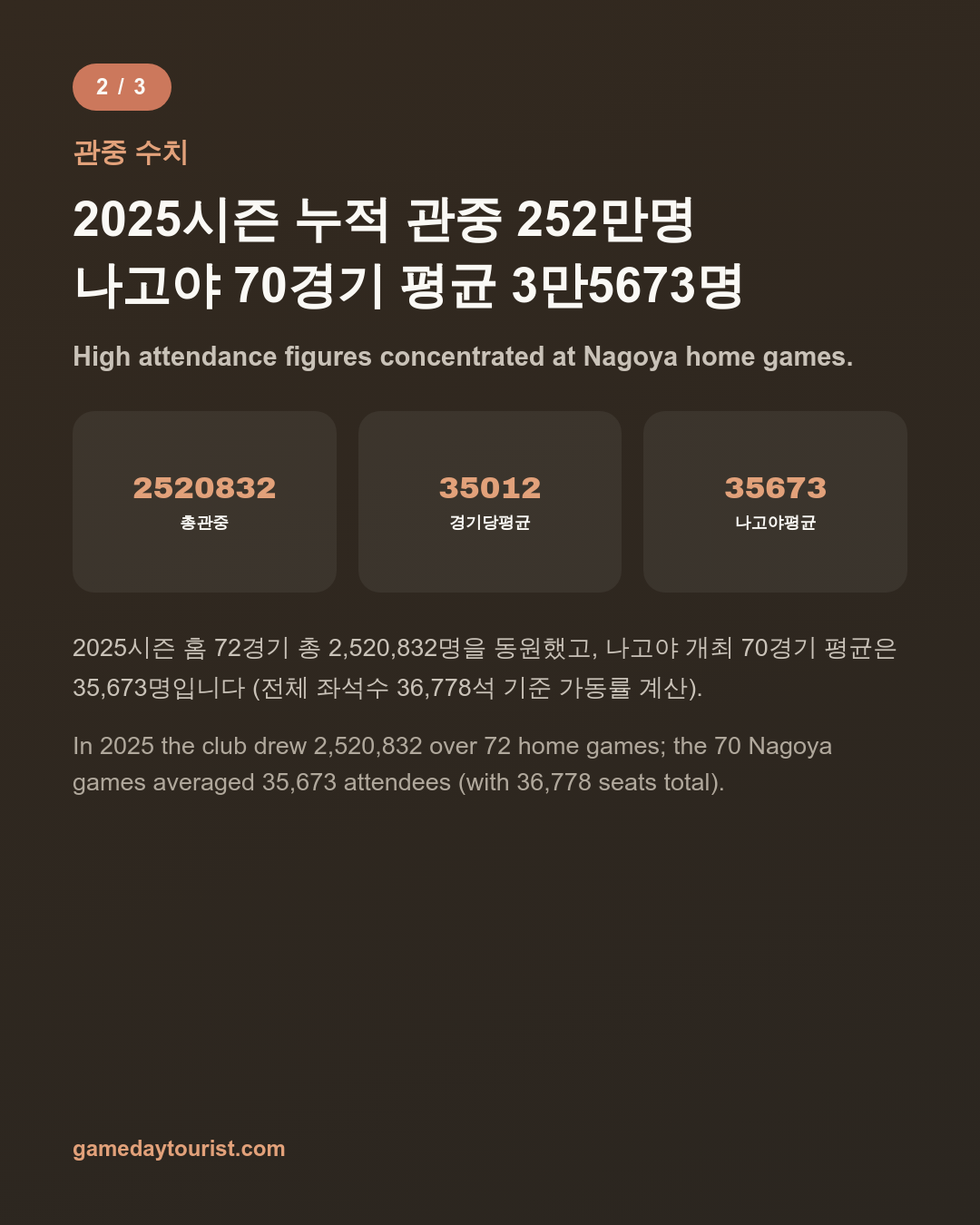
Chunichi drew a total of 2,520,832 fans across 72 home games in the 2025 season (70 in Nagoya plus 2 regional games).
That’s an average of 35,012 per game — a club record since 2005, when actual attendance figures started being counted instead of estimates.
Looking only at the 70 games held at Nagoya Dome, the per-game average climbs to 35,673.
After a seat expansion in February 2026 brought total capacity to 36,778, dividing that figure out gives an attendance rate of 98%.
That’s the third-highest rate among all 12 NPB clubs, and reportedly the highest the dome has ever seen since it opened in 1997.
The trend has continued into 2026.
According to a report picked up by Yahoo News Japan, cumulative attendance at home games had already topped 2 million by August 14.
A Tokyo Sports report from late April, based on the first 10 home games of the season, found that 7 of those 10 were sellouts (35,000-plus), and that even after 366 seats were added, average attendance rose by an even bigger 1,841 per game.
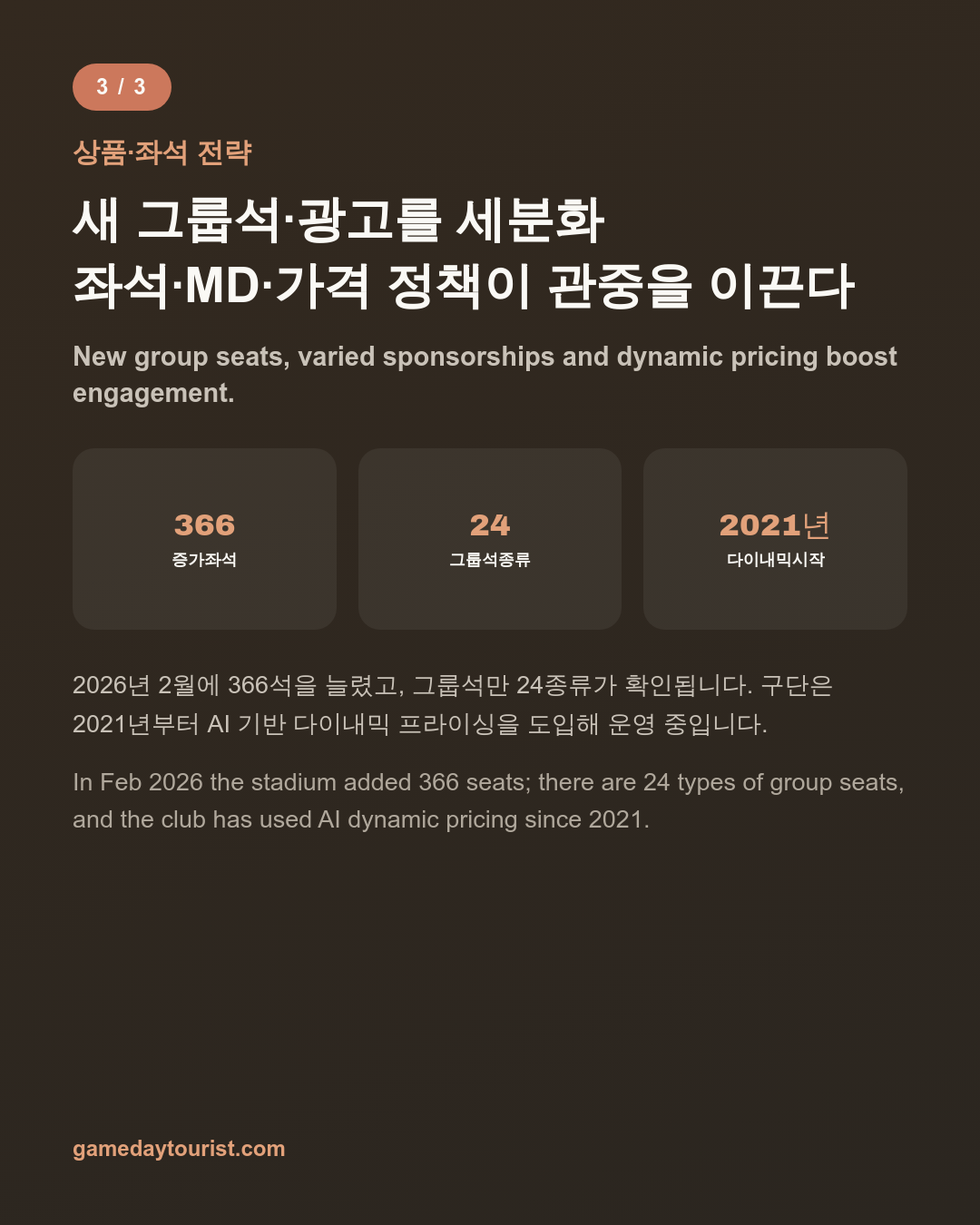
Ticket pricing has also run on AI-based dynamic pricing since 2021.
For 2026, all 69 home games are split into Premium, Standard, and Value tiers, with 20 of those games layering on a separate dynamic pricing rate that shifts in real time based on demand.
Paid fan club membership also hit a record high in 2026, which suggests the fan base keeps growing regardless of results on the field.
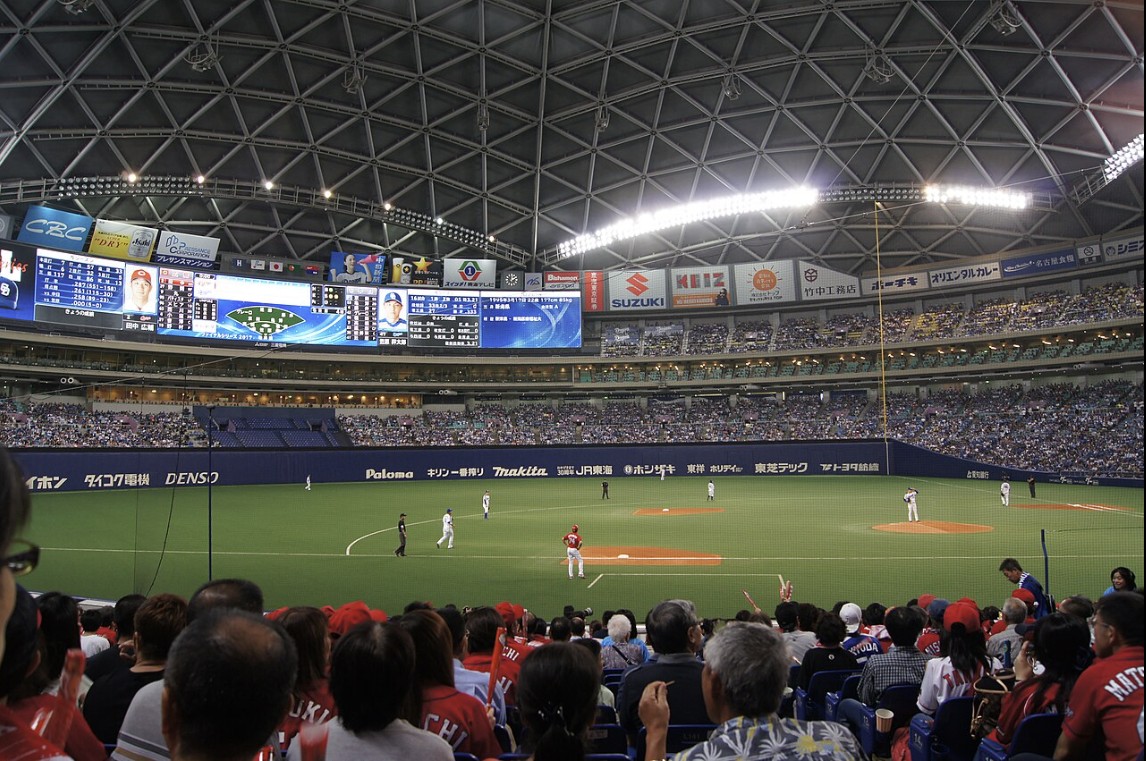
Source: Wikimedia Commons (photo by shiori.k from Japan, 2017) · CC BY-SA 2.0 · Sold-out crowd inside Vantelin Dome Nagoya during a Chunichi game
Space and F&B
In February 2026, marking the club’s 90th anniversary, Vantelin Dome Nagoya completed new seating in front of the outfield fences called the Homerun Wing and Arena Seats.
On the right-field side, the “Meitetsu x WAO! Homerun Wing” added 104 counter seats, three 6-person group sets (18 seats), and 6 wheelchair seats, while the left-field “Toho Gas Mirai no Mannaka Homerun Wing” added 116 counter seats and two more 6-person group sets (12 seats).
The Arena Seats down the first- and third-base lines added 55 seats each, for 110 more. All told, that’s 366 new seats.
Official club images show these as group seating with tables and dedicated chairs — designed for watching the action up close while still having room for a group to hang out together.
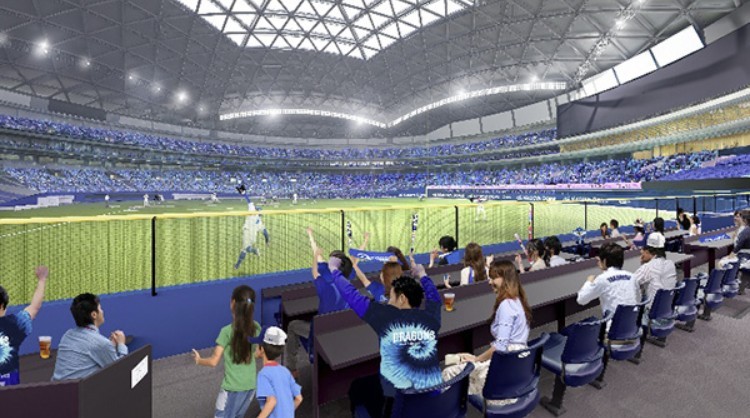
Source: Chunichi Dragons official site · rendering of the new Homerun Wing table seats (an official club promotional image that may differ from the finished product)
This isn’t the first time the club has expanded group seating.
One data-driven analysis I came across while researching this put the dome’s total group-seating options — including table boxes, counter seats, and terrace seats — at 24 distinct types.
Fan-participation events keep running too, from “Doala Day,” built around the team mascot, to the “Girls Series,” aimed at female fans.
One local visitor review I found noted that even the upper-concourse seats hold up surprisingly well — the protective netting doesn’t block much of the view, and there’s plenty of room to stash bags.
Combined with a subway station that connects directly to the stadium, so weather is never really a factor, it left me with the impression of a stadium that’s put real thought into visitor convenience.
Merchandise and Advertising Inventory
There’s an old photo that captures just how popular the team shop can get.
Taken in 2011, it shows a staff member holding up a sign reading “Entry Restricted — Store Is Crowded, Please Wait.”
Nearly 15 years later, merchandise sales are still very much a talked-about part of this club.
An annual “Oshimen” (推しメン, favorite player) contest — a fan-voting event — keeps feeding right back into merchandise spending.
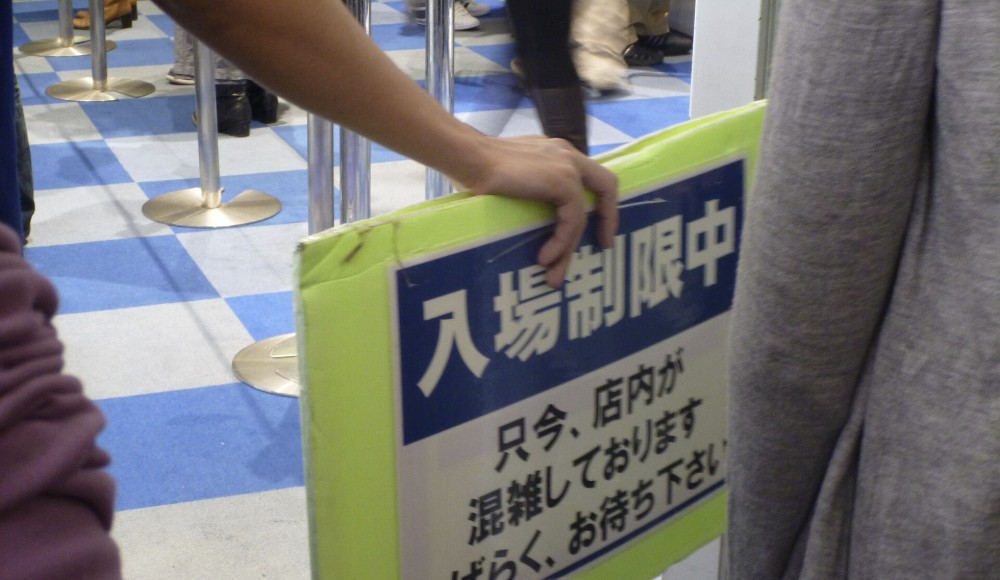
Source: Wikimedia Commons (photo by shiori.k from Japan) · CC BY-SA 2.0 · team goods shop with entry restricted due to crowding (2011)
On the advertising side, the Meitetsu story was what caught my eye most.
Nagoya Railroad signed an official partnership with the Chunichi Dragons on March 1, 2026, and according to a Nikkei report, that includes a blue “MEITETSU” logo on the players’ pants.
What makes this interesting is that the relationship isn’t entirely new.
Nagoya Railroad directly ran the club (then called the Nagoya Army) from 1951 to 1953, and the relationship cooled once the club moved to what’s now Vantelin Dome in 1997 and the nearest station was no longer as convenient — so this partnership is, in effect, a reunion 70 years in the making.
The two companies even created a joint slogan, “Dodododo” (ドドド), said to be shorthand for a phrase that roughly translates to “Hearts racing for the Dragons, right down the middle!”
The new Homerun Wing and Arena Seats sections each carry a different sponsor name as well.
As noted earlier, the right-field section is “Meitetsu x WAO!,” the left-field section is “Toho Gas,” the first-base Arena Seats are “EVERYFOOD,” and the third-base side is “Nomi Bosai.”
Separate from the stadium’s overall naming rights (Vantelin), this is an advertising inventory structure that’s sliced up and sold section by section — and as a marketer, I found the idea of carving out sponsorship assets this granular genuinely clever.
Beyond that, Asics, Edion, Suzuki, and the Chunichi Shimbun are official partners, with Aeon Retail and Konami Digital Entertainment listed as gold sponsors.
The Stadium’s Identity and a 90th Anniversary
The name Vantelin Dome Nagoya is itself a naming-rights product.
Pharmaceutical company Kowa first bought the naming rights to Nagoya Dome in December 2020, and the current name took effect in 2021; that five-year deal was set to expire at the end of 2025 but was extended, so the same name is still in use today (the extension amount wasn’t disclosed).
Given that this was the stadium’s first naming-rights deal since it opened in 1997, it sold its name relatively late compared to other NPB stadiums.
2026 also marks the club’s 90th anniversary.
Founded in 1936 as the “Nagoya Army,” the club created an anniversary logo combining a dragon-shaped “9” with a baseball-shaped “0,” and Ichiro Yamaguchi, vocalist of the band Sakanaction, is serving as the anniversary’s promotional ambassador, working on a commemorative song among other projects.
The Meitetsu reunion mentioned earlier should probably be read as tied to this 90th-anniversary moment as well.
Broadcast Rights and Local Economic Impact
On the broadcast side, local terrestrial station CBC TV has aired games under the banner “Moeyo Doragonzu” (燃えよドラゴンズ, “Burn, Dragons”), while pay channel J Sports carries every home game live.
Starting in 2026, CBC also regained broadcast rights to Yakult’s home games, meaning essentially every Chunichi game can now be watched locally.
I approached the local economic-impact angle a bit carefully.
According to a Chunichi Shimbun report, manager Kazuki Inoue told a local business gathering that winning the Japan Series could generate an economic impact in the range of 50 billion, 100 billion, or even 120 billion yen.
I want to be clear that this isn’t an effect that has actually happened — it’s a projection based on a hypothetical championship.
Still, the fact that numbers like these get raised at local business gatherings at all says something about how much symbolic weight Chunichi carries as Nagoya’s only professional sports team.
A Look at the KBO and K League
What I found most interesting in this research was that a similar pattern is showing up in the KBO.
According to a Hankyung report from September 12, cumulative KBO attendance for the 2026 season passed 11 million fans in just 626 games.
That’s 17 games faster than last year’s record pace (643 games).
Women in their 20s and 30s are credited as the core fan group driving this surge — a card-company analysis cited in the same report found that women made up 71% of ballpark-related card payments in the first month of the season, split evenly between women in their 20s and 30s at 17% each.
That tracks closely with what’s happening at Vantelin Dome, where attendance among women aged 25 to 34 has reportedly grown 2.7x compared to 2019.
In both countries, attendance is climbing regardless of how the team is actually performing, and the common thread seems to be a growing base of young female fans alongside a broader shift from “watching baseball” to “participating in baseball.”
On ticket pricing, the NC Dinos make for a good comparison.
NC became the first KBO club to adopt AI-based dynamic pricing back in 2022, and ticket revenue reportedly jumped 53.3%, from 6 billion won in the first year to 9.2 billion won the year after.
Starting in August 2025, they took it a step further, pricing seats within the same block differently based on exact position.
Compared to Chunichi, which has run dynamic pricing across the entire dome since 2021, it looks like both clubs arrived at a similar technical approach around the same time, each on their own path.
The standings alone tell a story of a team stuck in the lower half of the table, but attendance and revenue are tracing a completely different curve — and that gap was really the heart of this research.
Winning and drawing a crowd don’t always move in the same direction, and the numbers coming out of Vantelin Dome Nagoya make that case pretty clearly.
Leave a Reply