Contents · About 9 min read
- Where the Name “Jeonju Castle” Comes From, and the Day the U.S. Beat Mexico on June 17, 2002
- What Kind of Team Jeonbuk Is: This Year’s Report Card for the Club with 10 Titles
- Attendance and Tickets: Inside the Number 18,237
- Using the Space and Merchandise: A Stadium That Opens Even on Non-Match Days
- The Role Shared with Jeonju City: How to Fix Up an Old Stadium and Keep Using It
- Compared with Overseas Examples: A Stadium Owned by the City, a Stadium Built by Fans
📱 View as card news
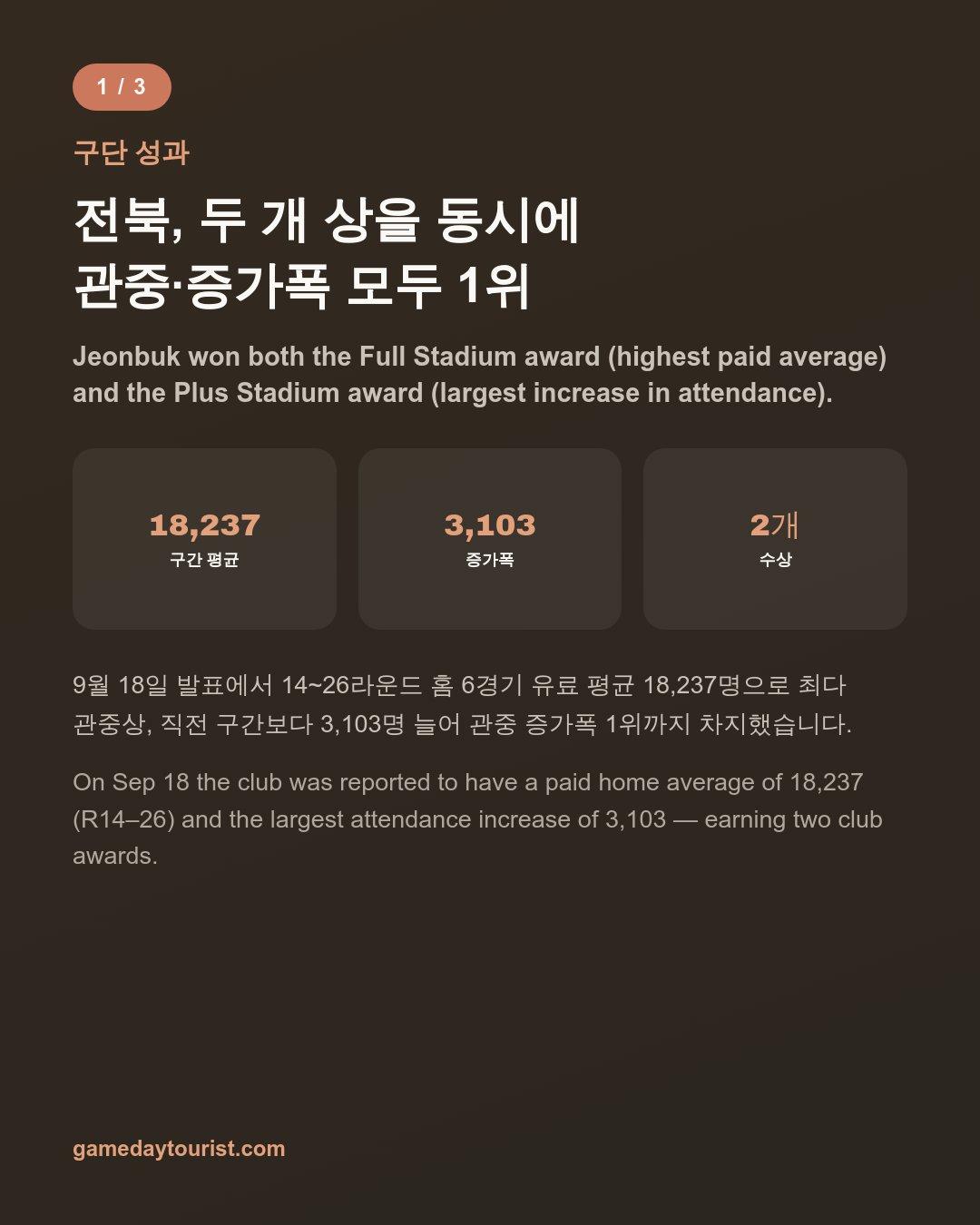
On September 18, the K League’s list of club awards had Jeonbuk Hyundai’s name on it twice. Averaging 18,237 paid fans over six home games in Rounds 14-26, the club took the Full Stadium Award for the highest attendance, and with 3,103 more than the previous stretch it also took the Plus Stadium Award for the biggest increase, according to the announcement.
In a season when the results have slipped a step from the top, only the attendance numbers moved forward, so as a working marketer I first wanted to ask what pulled people to the ballpark.
To find the answer I went through, in order, the history of the stadium itself, this year’s product lineup at the club, and the roles it shares with the city of Jeonju. Most of the rankings and figures in this piece come from data through Round 30 on September 20, so please note up front that results after that are not reflected.
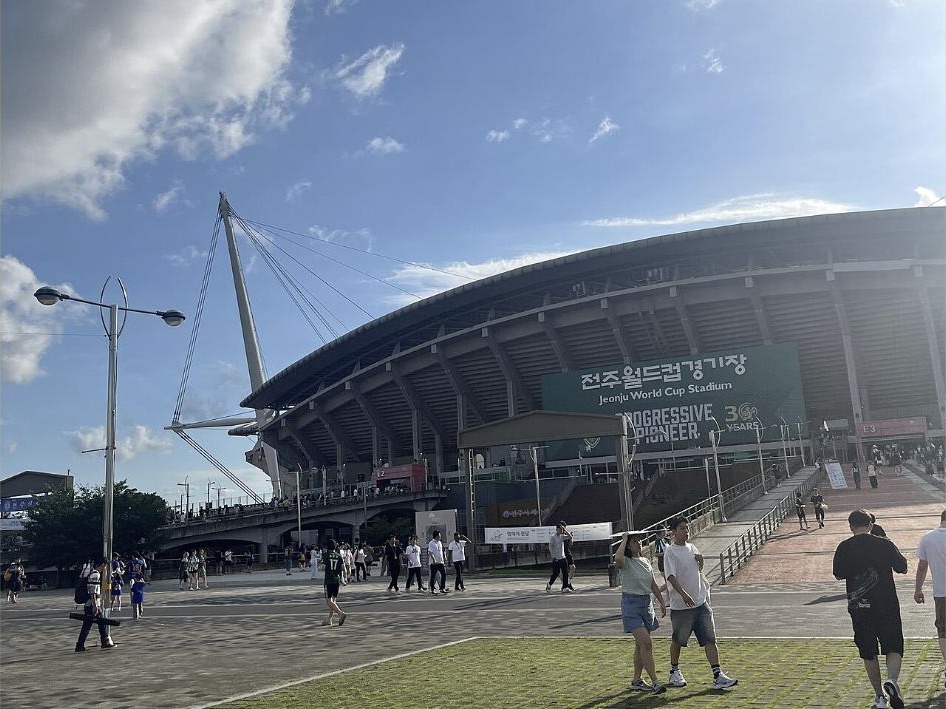
Photo: Haena96 · Source: Wikimedia Commons · License: CC0 1.0 · Taken July 20, 2024
Where the Name “Jeonju Castle” Comes From, and the Day the U.S. Beat Mexico on June 17, 2002
Jeonju World Cup Stadium opened on November 8, 2001, and is a facility owned by the city of Jeonju and operated by the Jeonju Facilities Management Corporation (English Wikipedia). Fans call it “Jeonjuseong” (Jeonju Castle), and that nickname did not begin with the new stadium.
It was inherited from the old Jeonju Sports Complex stadium the club used before, and Korean Wikipedia says the name came from a large brick archway entrance topped with a traditional roof, which looked like a fortress. When Jeonbuk moved into the new stadium in 2002, the name moved house with them (NamuWiki’s “Jeonjuseong” entry).
Korean Wikipedia also explains that the roof represents a folding fan, the columns represent sotdae (traditional village poles), and the cables holding up the roof represent the twelve strings of a gayageum.
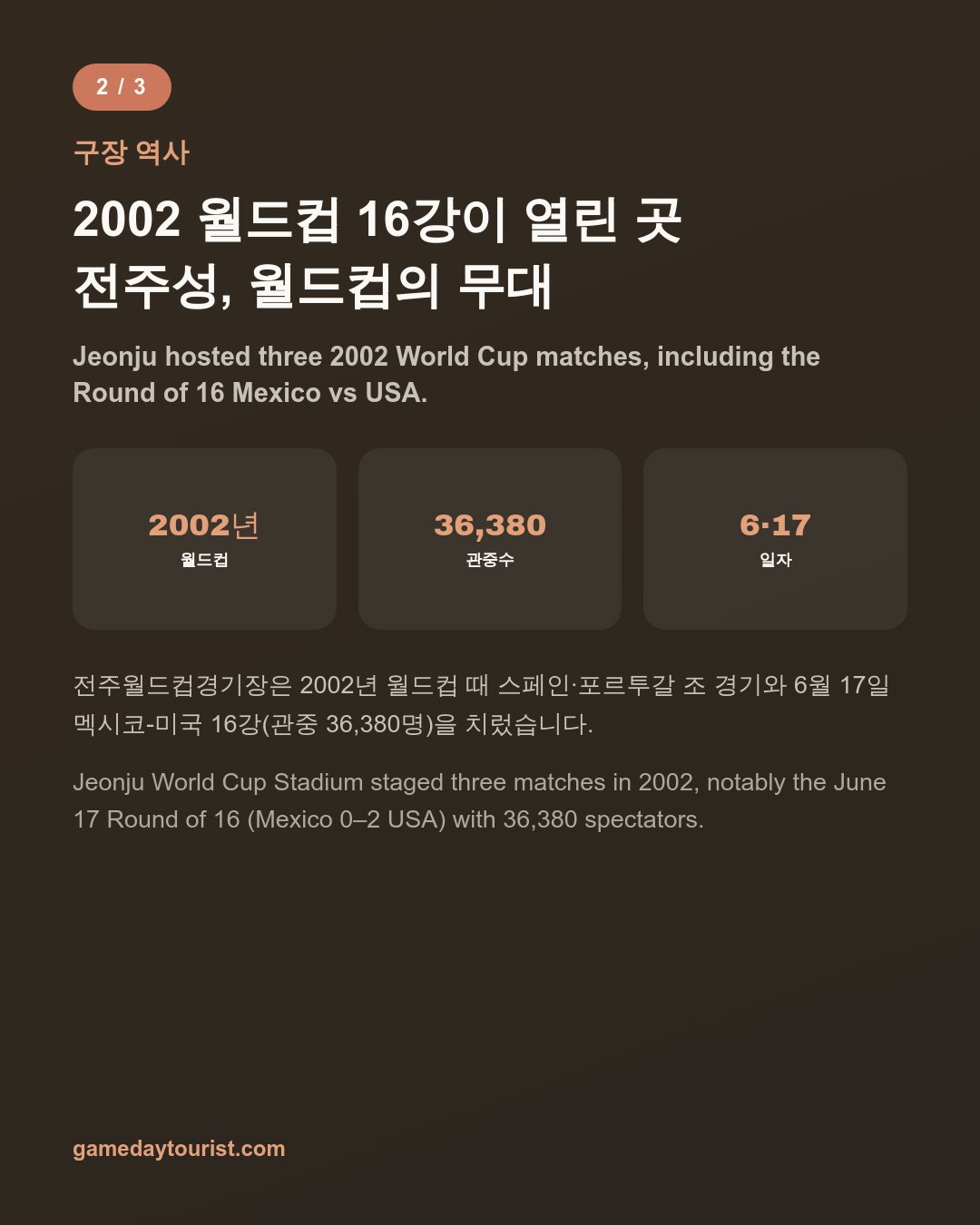
The stadium hosted three games at the 2002 World Cup. They were Spain vs. Paraguay (3-1) on June 7, Portugal vs. Poland (4-0) on June 10, and the round-of-16 game on June 17 between Mexico and the United States (0-2, attendance 36,380).
The Korean team won Group D and met Italy in Daejeon on June 18, and NamuWiki summarizes the schedule as having the Group D runner-up play its round-of-16 game in Jeonju. The United States, the actual Group D runner-up, beat Mexico 2-0 in Jeonju, so the explanation and the result line up.
That means Korea’s round-of-16 game could have been played in Jeonju, and whether the locals felt that fork in the road as a pity is only my guess, not a confirmed fact. Still, I think the fact that a K League club has used a stadium that hosted a World Cup round-of-16 game as its home for 24 years is itself the raw material for a story the club can sell.
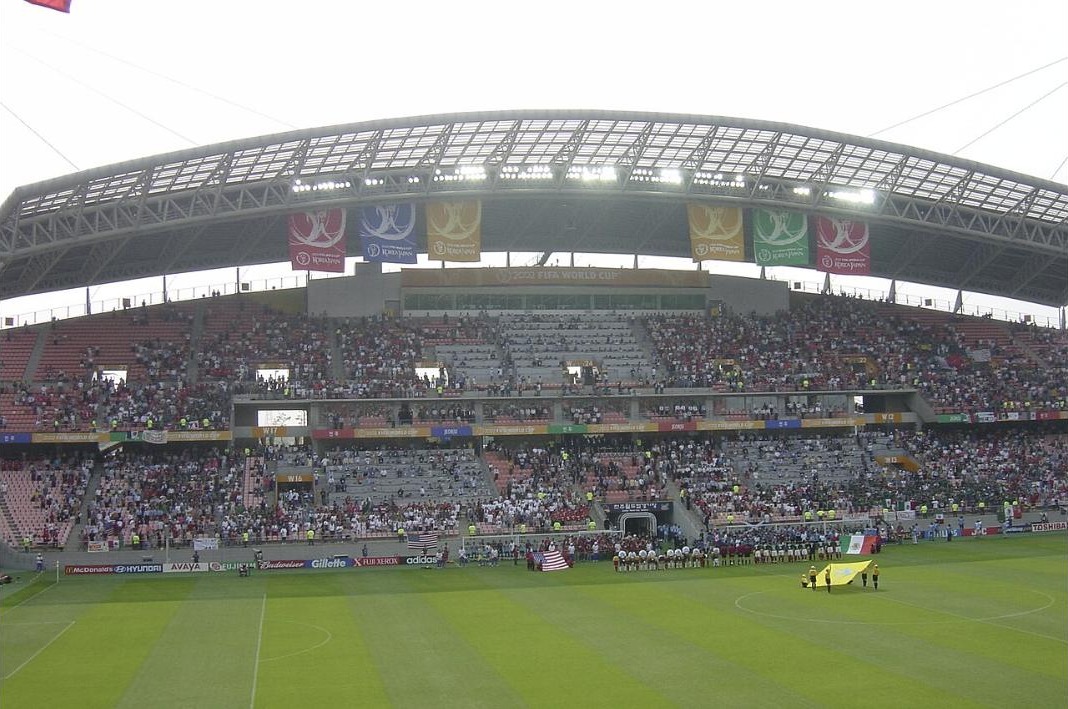
Photo: PaoPao1985 · Source: Wikimedia Commons · License: CC BY-SA 4.0 · Taken June 17, 2002
What Kind of Team Jeonbuk Is: This Year’s Report Card for the Club with 10 Titles
Jeonbuk was founded in December 1994 when Hyundai Motor took over the players of its predecessor club (English Wikipedia), and it holds a record 10 K League 1 titles (five straight from 2017 to 2021, and the 10th in 2025) along with two AFC Champions League titles (2006 and 2016).
It has won the Korea Cup six times counting 2025, and in the final on December 6, 2025 it beat Gwangju 2-1 after extra time. In 2025 it took the league and the Korea Cup together as a double, and also set a 22-game unbeaten run.
After the season, manager Gus Poyet left the club, and Jung Jung-yong, who had managed Gimcheon Sangmu, was appointed as the new manager on December 24.
This season has not gone as smoothly. On September 20 at home they drew 2-2 with last-place Gwangju (Thiago scored twice, and an equalizer was conceded in stoppage time) and dropped to fourth (Jeonbuk Ilbo).
The team’s top scorer is listed as Lee Seung-woo with eight goals (NamuWiki tally). The league splits into upper and lower groups after Round 33, so the remaining three games are the decisive stretch of the regular rounds.
One viewing tip: the official supporters’ group, the Mad Green Boys (MGB), is known to sit in the north stand (according to English Wikipedia).
On a travel review site there is a review saying that “access is good since it is close to the Jeonju IC, but it’s 20 minutes from downtown and there’s nowhere decent to eat nearby” (Tripadvisor review). Reviews were written at different times and things may have changed.
Attendance and Tickets: Inside the Number 18,237
First, this year’s figures. In the first stretch (Rounds 1-13), FC Seoul took the Full Stadium Award with a home average of 24,836 over six games (Star News), and Jeonbuk’s average for that stretch was 15,134.
In the second stretch it rose to 18,237, an increase of 3,103 (Star News). The K League’s official attendance page shows Jeonbuk with 242,002 cumulative over 15 home games in 2026, an average of 16,133, second behind FC Seoul (285,903) (K League data).
In 2025, by contrast, league home attendance was 368,505, and Jeonbuk Ilbo reported a per-game average of 18,425. This year’s average of 16,133 is lower than last year’s.
It is only fair to read alongside the award that the rebound in the awarded stretch did not lift the average for the whole season.
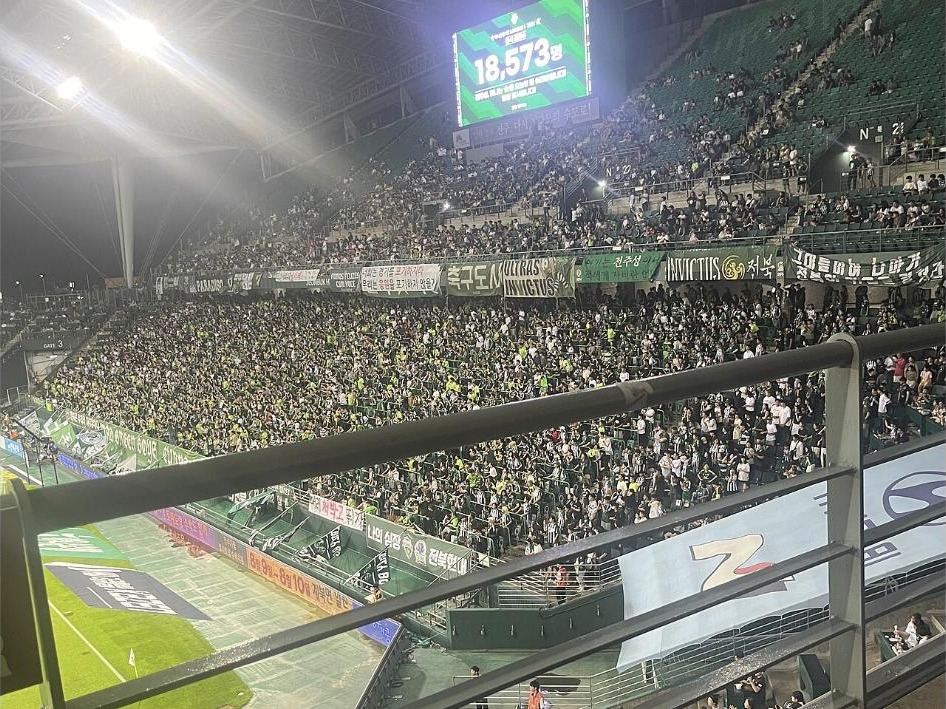
Photo: Haena96 · Source: Wikimedia Commons · License: CC0 1.0 · Taken July 20, 2024
The 2025 numbers have more texture. By the club’s count, the league’s 368,505 plus 10,863 in the AFC Champions League and 6,048 in the Korea Cup came to 385,416 in all, of which 72,681 were season-ticket entries and 312,735 were general paid entries.
Of the 27,766 members who bought tickets, 72% lived in the Jeonbuk region, and the number of family purchases rose from 6,355 in 2023 to 10,670 in 2025, up about 68% in three years, according to a report.
The season-ticket share of total attendance, about 19% (72,681 ÷ 385,416, my own calculation), felt surprisingly low. For a club, a higher share usually means steadier cash flow, so a structure with a large share of general bookings is both a strength and a homework assignment.
At the October 18, 2025 game against Suwon FC, 21,899 came, bringing cumulative home attendance at that point to 315,105 (close to the 2015 record of 330,856) (Hyundai Motor Group Newsroom), and the season’s final league total of 368,505 goes past that number.
The ticket structure changed this year. Seat names were simplified by combining a compass direction, E, W, S or N, with a type (E General, W Value and so on), and tickets booked through the club’s app and web cost ₩3,000 less than through outside sellers, with on-site purchase the most expensive.
Priority booking opens five days before a match and general booking four days before, and 168 new W Table seats were created by converting a restricted-view section in the west stand, while the skybox grew from 12 to 15 people (Jeonbuk Ilbo). For exact prices by seat, you’ll need to check the club’s booking page.
Even so, as a fellow marketer I can see clearly that the one-line pitch “it’s cheaper if you buy on the app” is a device for building member data.
Using the Space and Merchandise: A Stadium That Opens Even on Non-Match Days
If one complaint left in travel reviews is that “there’s nowhere to eat nearby,” the club’s answer this year was to bring places to linger inside the stadium.
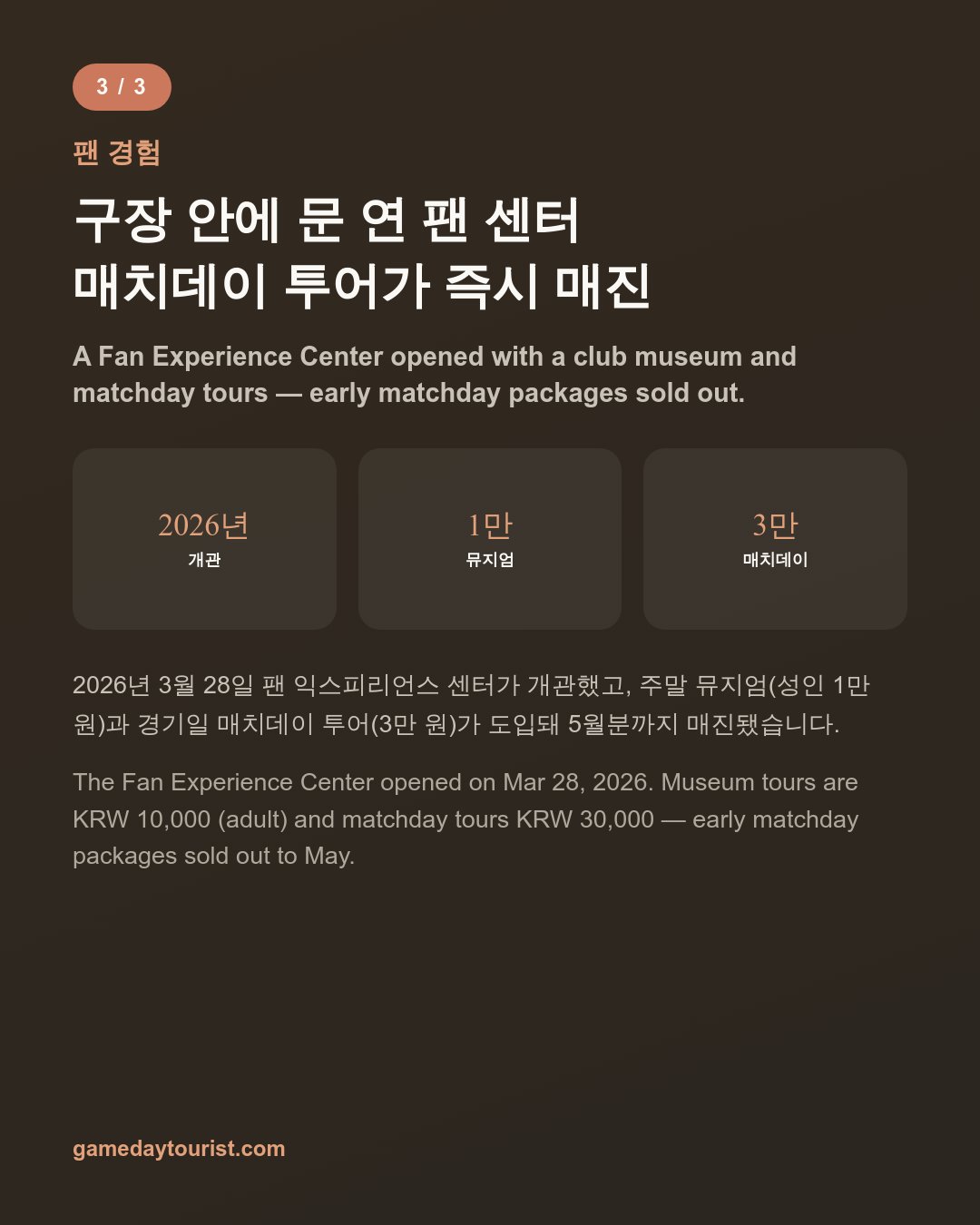
The Fan Experience Center, formally opened on March 28, 2026, consists of the first paid permanent club museum in Korean pro sports, an event hall and an official store. The museum tour runs about six times a day on weekends at ₩10,000 for adults, and the matchday tour, held only on match days, costs ₩30,000 and includes a high-five with the players (Hyundai Motor Group Newsroom).
A report says the matchday tour package that began on April 4 sold out immediately through May.
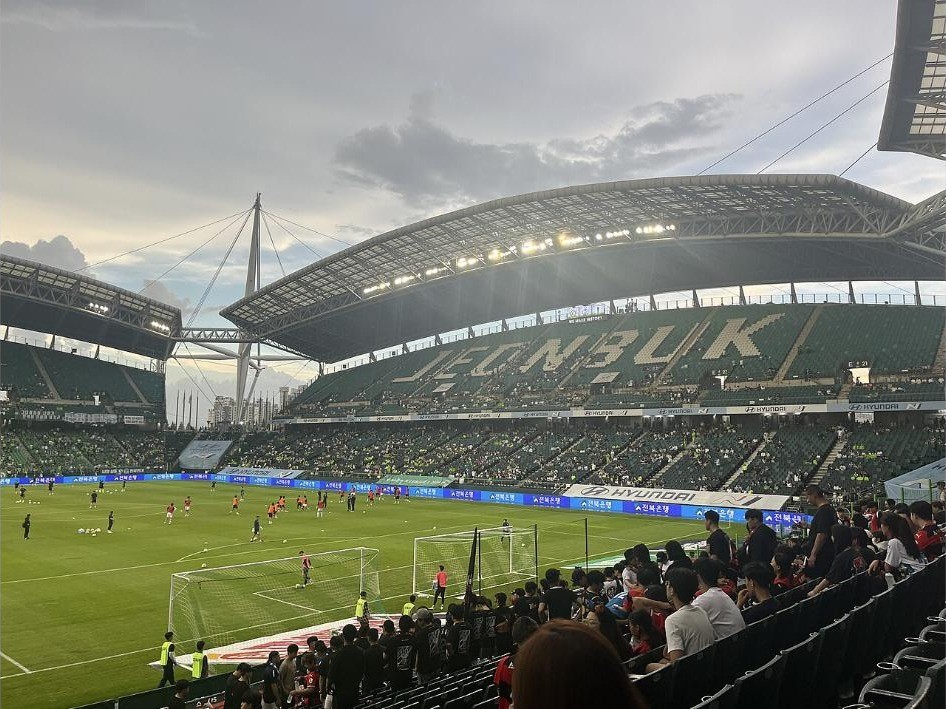
Photo: Haena96 · Source: Wikimedia Commons · License: CC0 1.0 · Taken August 17, 2024
Merchandise follows the same line. The official store, which opened on October 17, 2025 in part of an idle space on the first floor of the east stand, runs from 1 p.m. to 7 p.m., Wednesday to Sunday, and sold more than 20 new products and offline-only items, while the “Chorogine” shop used until then would be used only for a marking booth and some budget items through that season, according to the notice.
The “Musinsa Standard Room,” opened on April 26 by converting one skybox, is booked through the club’s app or website from seven days before a match, and the two sides have a history of working together on a 2023 uniform and goods raffle and are reportedly planning a co-branded beauty product in the second half of this year (Football Asian).
In the photo, the Hyundai Motor and Jeonbuk Bank logos show large on the pitch-side advertising boards, and apart from board advertising, I think selling a skybox as a brand experience space is a good example of widening ad inventory.
The Role Shared with Jeonju City: How to Fix Up an Old Stadium and Keep Using It
As the background to its 2025 results, the club pointed to the fact that Jeonbuk Hyundai, the city of Jeonju and the Jeonju Facilities Management Corporation divided up roles under a shared goal of “promoting citizens’ leisure and maximizing the use of public sports facilities.”
The facility improvements were also not a single full renovation, but were ordered by fixing what visitors notice right away first. Repainting the gates, replacing the LED lighting and laying artificial turf outside the touchlines are the examples (Footballist, news on the artificial turf).
In turf maintenance, the stadium was rated second behind Daejeon World Cup Stadium for the second-stretch Green Stadium Award (Maxports), and in the first stretch Jeonbuk took the Fan Friendly Club Award and the Green Stadium Award together (Star News).
However, in the second-stretch Fan Friendly scores, Jeonbuk was third at 84.5 points, behind Ulsan at 95.7 and Jeju at 85.7. I read that as meaning the club is near the top in both facilities and fan service but is not yet number one.
Compared with Overseas Examples: A Stadium Owned by the City, a Stadium Built by Fans
The Panasonic Stadium Suita of Japan’s Gamba Osaka that I covered earlier was a “citizens’ fund stadium” built with about ¥14 billion raised by 721 corporations and 34,627 individuals, and its 2025 home average over 19 games was 30,007.
Jeonju Castle is on the opposite side. The city handles ownership and operation, and the club layers fan experiences on top of that.
What stayed with me most from this research is that, because the club doesn’t hold ownership, how it shares facility renovations with the city determines the speed of its marketing.
I wasn’t able to confirm specific terms such as the usage fee the club pays the city. So I won’t write generalities such as “city-owned stadiums are bad for clubs.”
Still, I think the fact that attendance rebounded in the second stretch while a stadium opened in 2001 kept getting touched up for 25 years can be seen as one example that there are options for changing the fan experience without a big new build.
Leave a Reply