Contents · About 10 min read
📱 View as card news
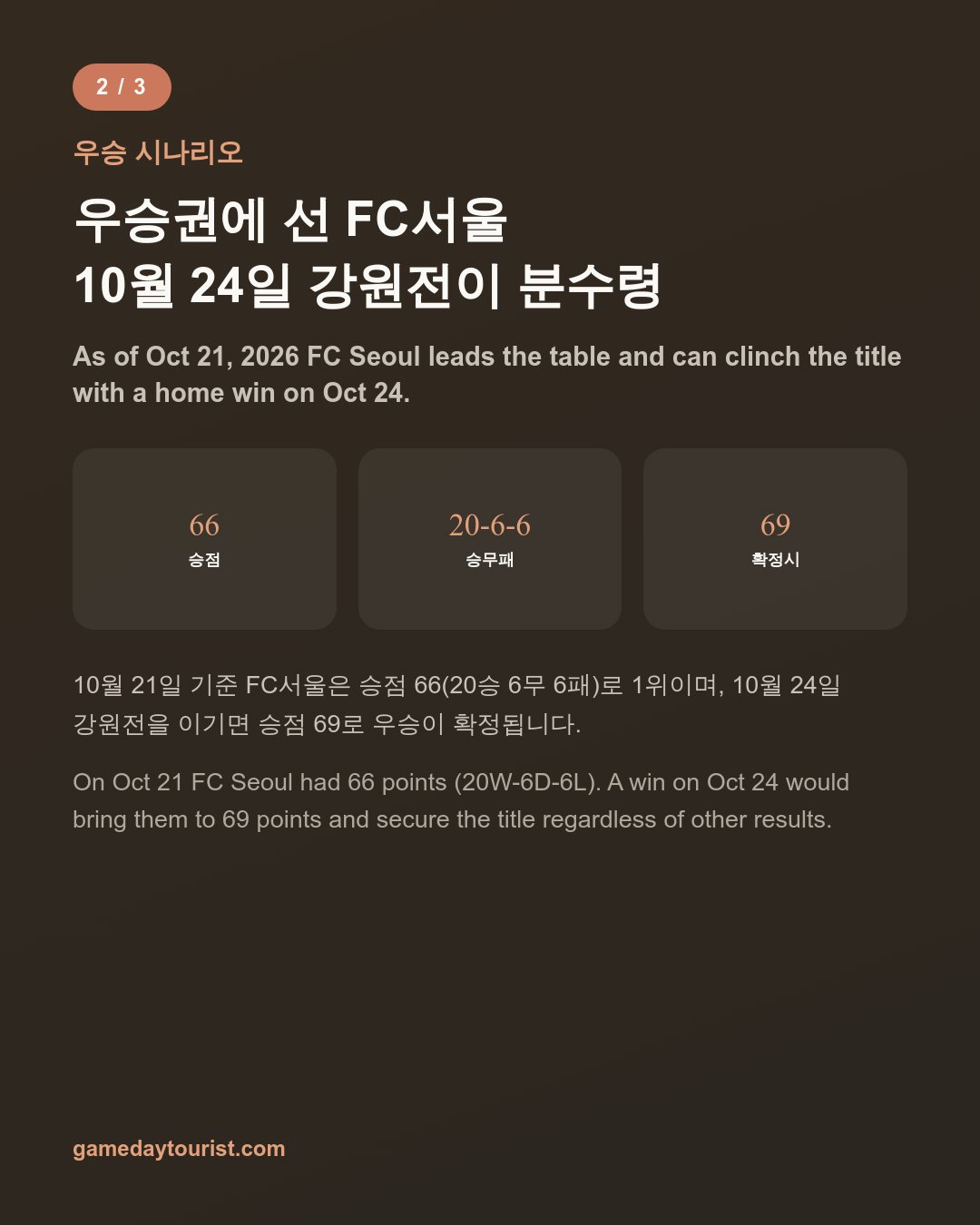
FC Seoul is on the verge of the K League 1 title. A 2–2 draw with Gimcheon on October 18 kept them on top with 66 points (20 wins, 6 draws, 6 losses), 16 points clear of second-placed Ulsan (50), and a home win over Gangwon at 14:00 on Saturday, October 24 would clinch the title regardless of the remaining games.
Whether they win it depends on the results, so please read this guide as of October 21, 2026.
It covers how to get to Seoul World Cup Stadium (Sangam) and how to buy tickets, based on the club’s official information, followed by a marketer’s view of attendance, space use and merchandise.
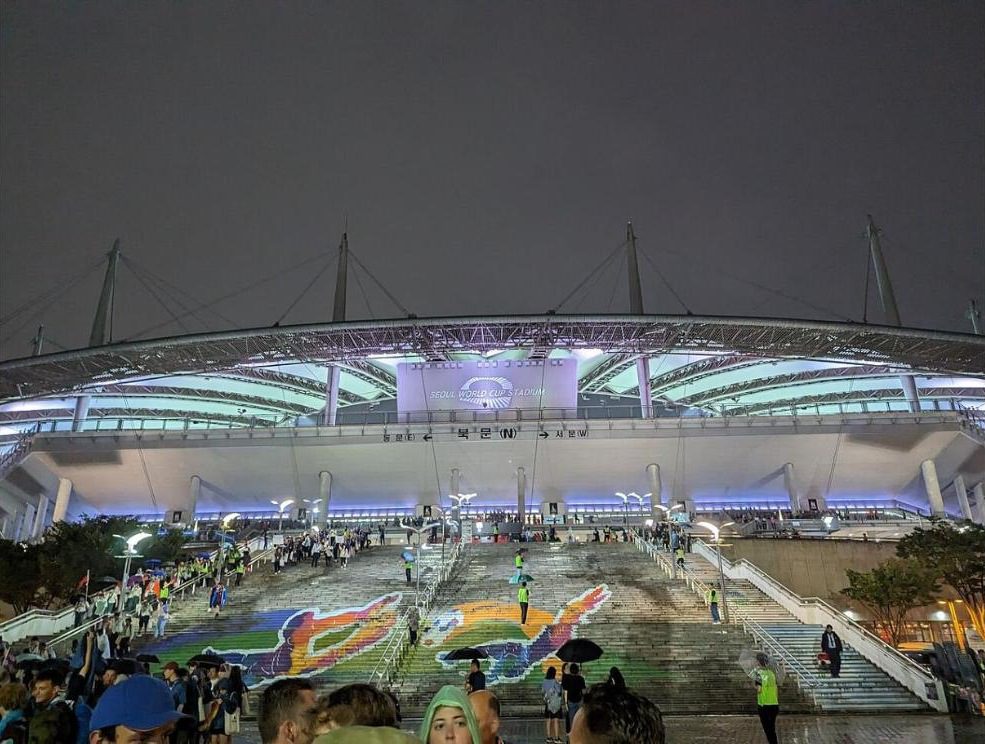
Photo: Wvdp · Source: Wikimedia Commons · License: CC0 · Night of August 11, 2023, the stairs toward the north gate (N) just after the closing K-pop Super Live of the World Scout Jamboree
The Day 45,000 Packed Into Sangam
On April 8, 2023, a match against Daegu FC with singer Lim Young-woong announced for the ceremonial first kick drew a paid attendance of 45,007, and a club official said that counting free admissions it came to more than 47,000.
The same report says it was the highest in the K League since the league began counting paid attendance in 2018.
The 51,670 at the March 10, 2024 match against Incheon was reported as the largest single-match crowd in K League 1 since the introduction of promotion and relegation, and that game ended 0–0.
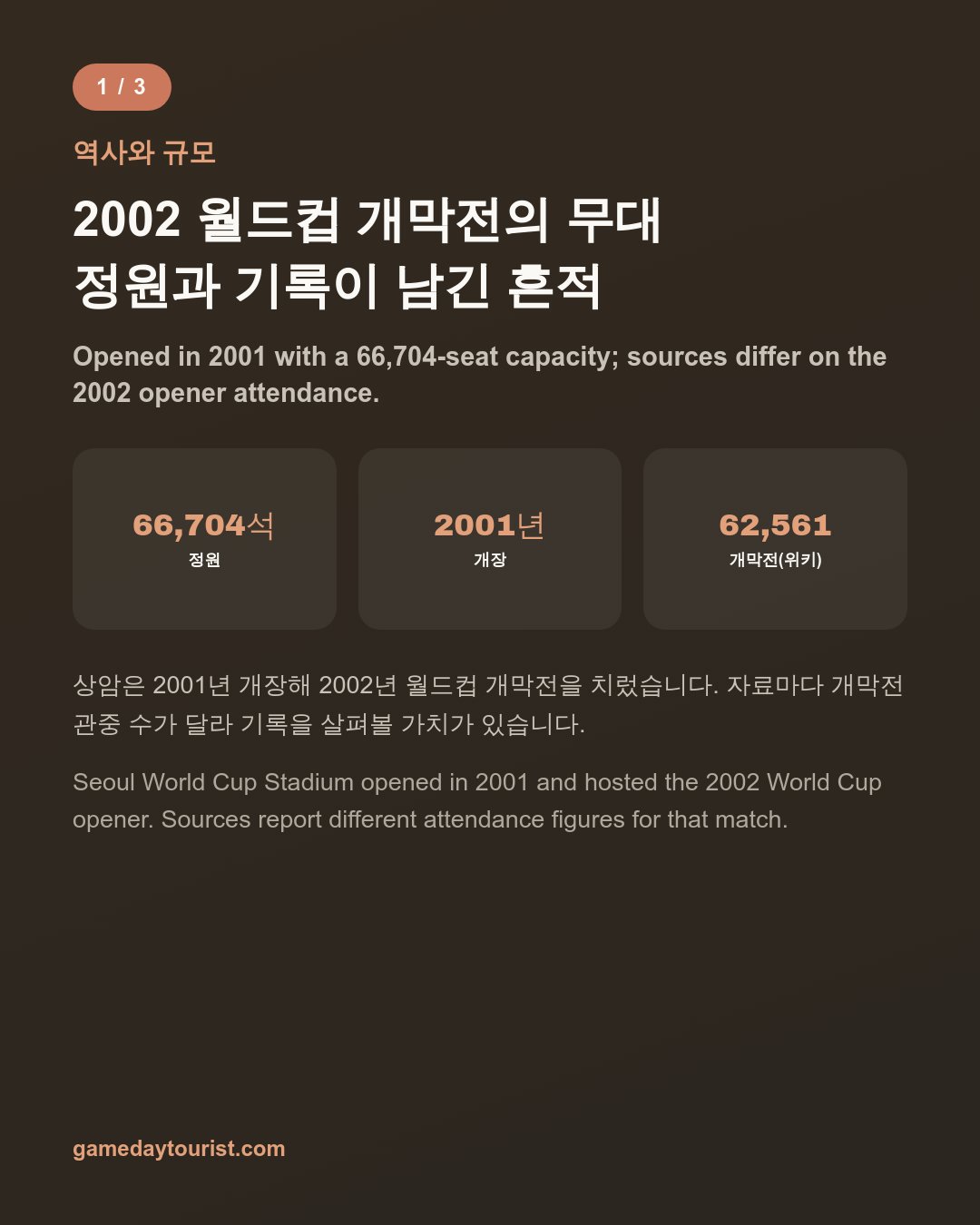
The stadium opened on November 10, 2001, has a capacity of 66,704, and is where the opening match of the 2002 World Cup (Senegal 1–0 France) was played.
Wikipedia gives the attendance of that opener as 62,561, while the Seoul Shinmun at the time reported more than 66,000 in the stands.
What I as a marketer look at is not the number itself but the structure that produced it.
For an event like a ceremonial first kick not to end as a one-off hit, you have to design the visitor’s path so that a first-time spectator goes on to buy a ticket for the next match.
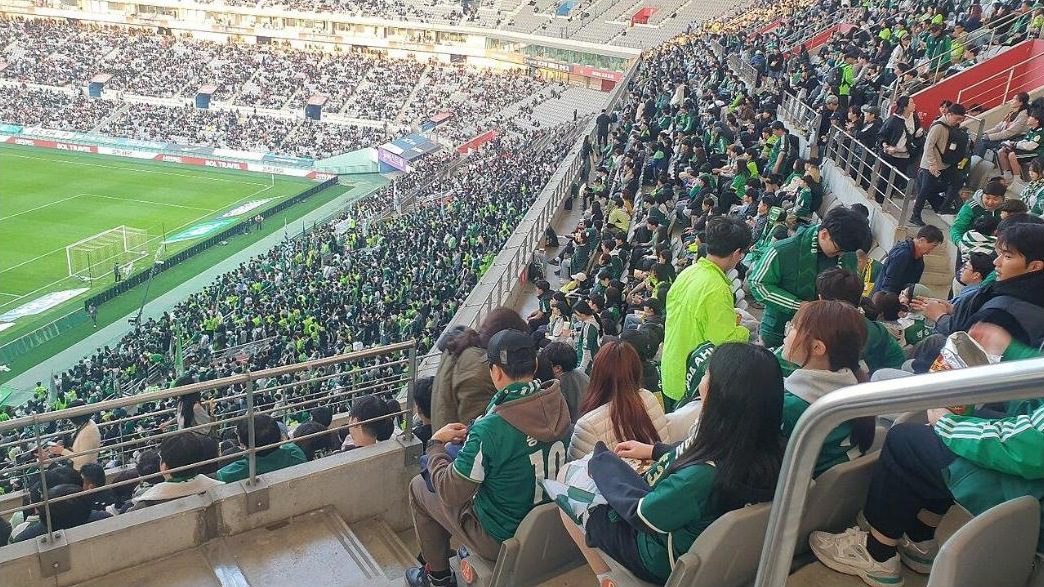
Photo: Korece · Source: Wikimedia Commons · License: CC BY-SA 4.0 · The stands seen from the Jeonbuk away supporters’ section during the May 4, 2025 FC Seoul vs. Jeonbuk match
What Kind of Club Is FC Seoul?
According to Wikipedia, FC Seoul was founded on December 22, 1983 as the Lucky-Goldstar Hwangso football club, passed through the Anyang LG Cheetahs years, and moved its base to Seoul in 2004.
It has won the K League 1 six times, in 1985, 1990, 2000, 2010, 2012 and 2016, and a title this year would be its first in ten years, since 2016.
This season’s home opener (the March 22 match against Gwangju) was a 5–0 win that gave the club its first-ever four straight wins to open a season.
As of October 21, 2026, FC Seoul is first with 66 points (20 wins, 6 draws, 6 losses) and second-placed Ulsan has 50.
I confirmed on the club’s official match schedule that they beat Jeju 2–1 at home on October 10 and lost 0–3 away to Melbourne Victory in the AFC Champions League Two on October 14.
In the October 18 match against Gimcheon, Klimala scored twice to reach 16 goals for the season and join Ulsan’s Yago as the joint top scorer, but Seoul conceded an equalizing penalty in the 21st minute of the second half and pushed the title clincher to the next round.
The October 24 match against Gangwon is at home, and a win would take Seoul to 69 points, which Ulsan cannot catch even by winning all six remaining games (68 at most).
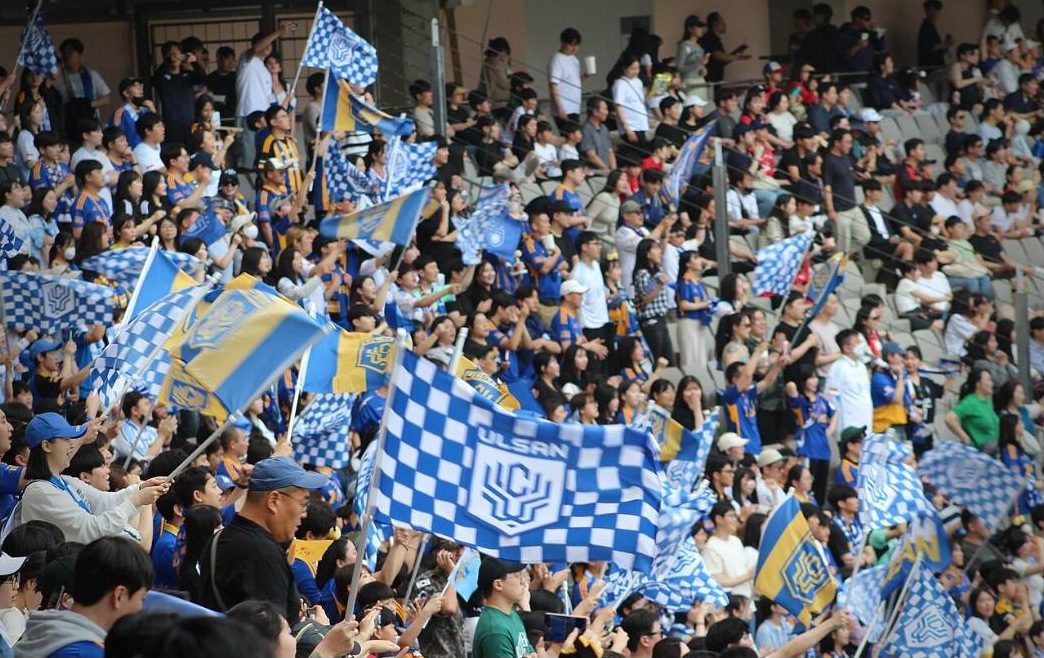
Photo: OttoSilver · Source: Wikimedia Commons · License: CC BY-SA 4.0 · Ulsan HD supporters in the away section of Seoul World Cup Stadium, May 4, 2024
How to Get to Seoul World Cup Stadium and How to Buy Tickets — Based on Official Club and Stadium Information
I checked this on October 21, 2026 by opening the ticket information and the FAQ on FC Seoul’s official site directly.
I did not use blog reviews, and where I could not find something on an official page, I say so.
The nearest subway station is World Cup Stadium Station on Line 6, and the club FAQ says that if you leave by Exit 2 and take the escalator you arrive straight at the North Plaza.
It lists nearby bus stops too: buses such as 571, 710, 7019, 7715 and 9711A at the west-side stop (Culture Depot, 문화비축기지), and 730, 733, 271A, 571 and 710 at the south-side stop (World Cup Park).
That FAQ item carries no date, so it is safer to check the routes once more on a map app.
Gates open two hours before kickoff, and the FAQ says a match takes roughly two hours.
Parking guidance is contradictory.
The club’s ticket page says general vehicle parking inside the stadium is restricted on home match days and asks you to use public transport or, if unavoidable, outside lots such as nearby parks, whereas the FAQ still describes parking inside and at Peace Park on the south side (₩5,000 for four hours).
So I do not state parking as settled in this guide, and I recommend public transport where possible.
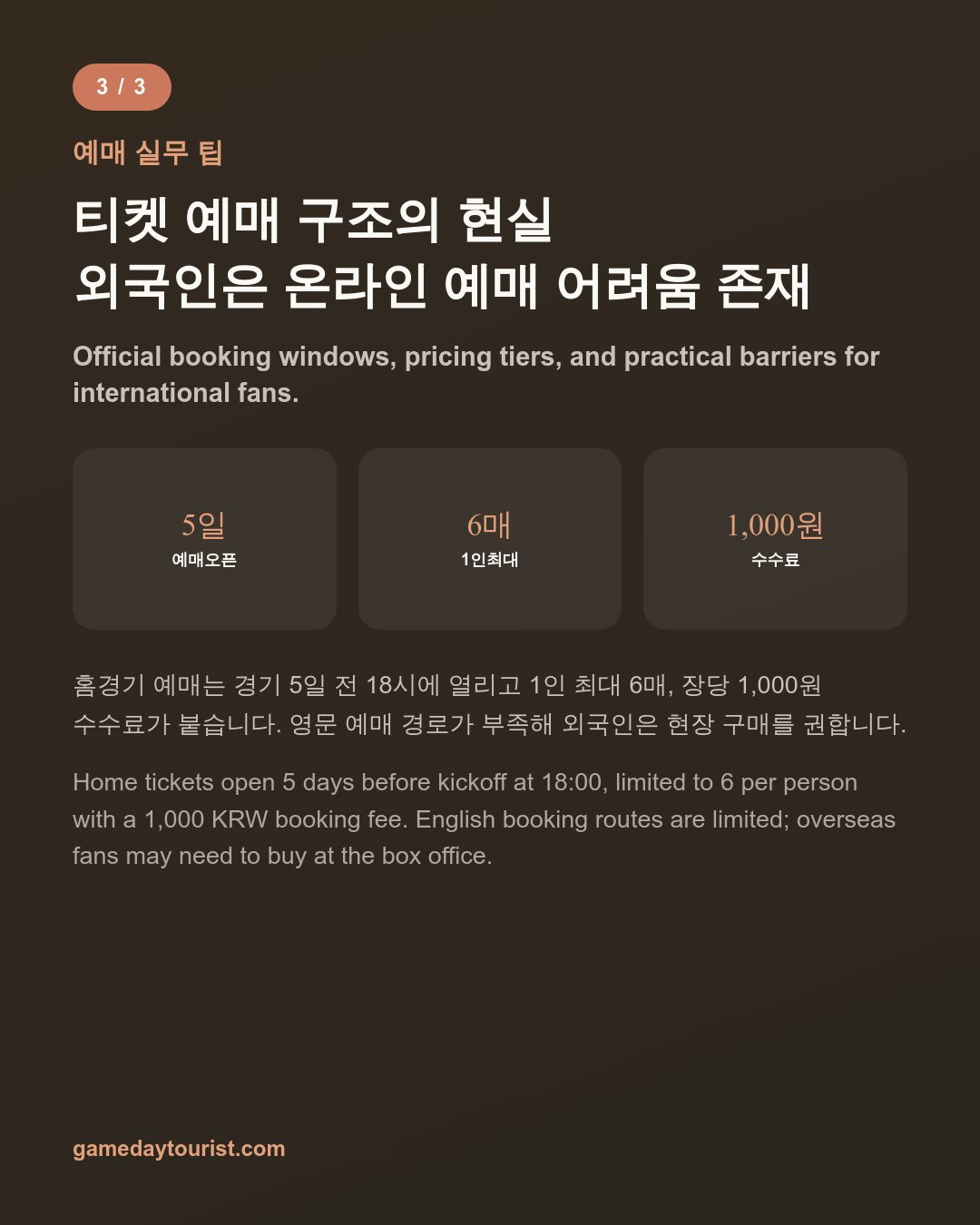
Tickets are booked on the club’s website or app, the Ticketlink website or app, or the K League website or app, and sales for home matches open at 18:00 five days before the match, with a limit of six tickets per person and a ₩1,000 booking fee per ticket (official club ticket information).
The club’s price list gives a member booking price and a non-member booking price (which is also the on-site price). For adults, W Center seats are ₩37,000 and ₩40,000, W Pitch seats ₩32,000 and ₩35,000, and W seats ₩25,000 and ₩28,000.
Shinhan Card E-Pitch seats are ₩22,000 and ₩25,000 for adults, E and N seats are ₩17,000 and ₩20,000 for adults (₩12,000 and ₩15,000 for teenagers, ₩6,000 and ₩9,000 for children), and away seats are ₩17,000 and ₩20,000 for adults.
Big matches (the opener, Jeonbuk, Daejeon and Ulsan) add ₩3,000 to the base price, children are aged 36 months through elementary school and teenagers middle through high school, and every seat, N seats included, is reserved.
The member price applies when you log in with an FC Seoul ID on the club site or app, or choose “club member login” on Ticketlink, while the non-member price applies with PAYCO login on Ticketlink or on the K League site or app.
For visitors from abroad this structure is the biggest barrier. The ticket menu on the club’s English site simply links to the Korean Ticketlink site, and I could not find any English booking guide.
The independent fan site K League United, in a January 2026 guide, says Ticketlink and Interpark effectively require a Korean mobile number and Korean language skills, which makes booking online in advance hard.
The same guide says you can instead buy at the ticket booths outside the stadium, which have English signs and a seating map so that you can point to a section.
In the club’s price list the on-site price is the same as the non-member booking price, and I could not confirm whether foreign-issued cards work at the on-site booths.
There has also been a case aimed at foreign visitors. The Seoul Foreign Resident Center ran an “International Fans’ Day” for the September 5, 2026 match against Incheon, selling a supporters-section ticket with a draft beer coupon for ₩11,000.
According to the Korea Herald, from 17:30 on matchday a “foreigners-only ticket booth” near the third-floor ticket box at the North Gate checked a passport, residence card or international driving permit, and it was an event run by the center, not the club, and is already in the past.
Under the club FAQ, prohibited items include alcohol (allowed only when sold inside by official vendors), glass bottles, cans and PET bottles over 600 ml, items that obstruct viewing such as large balloons, and pets.
Food may be brought in and eaten, re-entry follows the instructions of the gate staff, and the FAQ says matches are not cancelled in the rain and that the edges of the stadium are roofed, so unless you sit in the very front rows you get less wet.
The FAQ says you can buy jerseys and cheering goods at the fan park you see when leaving Exit 2 of World Cup Stadium Station or at stands inside the stadium.
From a marketer’s view, the biggest barrier to entry is the lack of an English booking route.
However good the matchday culture is, if foreign visitors are stopped at the first step of buying a ticket, they never get into the stadium.
Attendance and Tickets — Sangam in Numbers
The 2026 home opener (the March 22 match against Gwangju) drew 24,122, the largest single-match crowd in the K League that season at the time.
In the K League’s first club awards (rounds 1–13), Seoul won the Full Stadium award with an average paid attendance of 24,836 over six home matches.
In 2023 the club had 430,029 spectators over 19 home matches, an average of 22,633, and by the club’s count women were about 47.4% of the crowd, family groups 49.0% and children 16.2% (14.1% in 2019) (OSEN).
What matters is whether the crowd carried over into the season average rather than being a one-event spike, and I read the 2023 average of 22,633 and the early-2026 average of 24,836 as showing that trend.
Space Use, Food, Merchandise and Sponsors
The seat names themselves are sponsor products.
The club’s price list includes the “E-Pitch” seat named by Shinhan Card (it can also be bought with other payment methods), some seats come with one can of Terra beer, and the Sky Pub and terrace seats include unlimited Heineken beer (two 400 ml drafts, then cans), Korean pork snacks and popcorn.
The club says the FC Seoul GS&POINT membership discount applies to up to two tickets per purchase, on both online and on-site purchases, at ₩2,000 per ticket (₩1,000 for the regular GS&POINT).
Outside the stadium, GS25 reopened its Yeonnam Hanyang branch near Hongik University Station on April 17, 2025 as an FC Seoul-themed specialty store, and says it sells more than 80 kinds of FC Seoul goods, including jerseys, clothing and cheering items, in 43 pyeong of space.
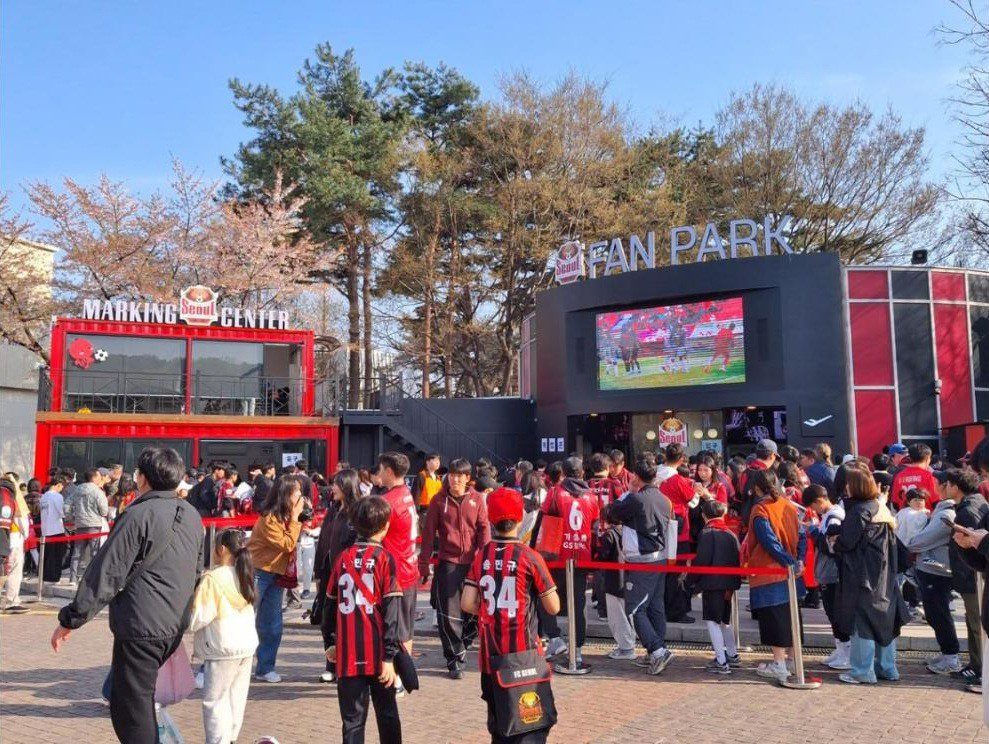
Photo: Korece · Source: Wikimedia Commons · License: CC BY-SA 4.0 · Taken on April 12, 2026, spectators lining up in front of the fan park and MARKING CENTER area at Seoul World Cup Stadium (the Commons description reads “FC Seoul MD store”)
Running the seat and beer sponsor products used inside the stadium together with a convenience store outside, aimed at the same fan base, is worth a look as a structure that keeps the club brand visible even on days without a match.
Operating Structure and the Turf Problem
Seoul World Cup Stadium is owned by the Seoul Metropolitan Government and operated by the Seoul Facilities Management Corporation, and FC Seoul has used it as its home since 2004.
The turf has been a repeated source of controversy. In March 2025 the Seoul city government and the corporation announced an emergency recovery and said they would put ₩3.3 billion into the turf, three times the previous year’s ₩1.1 billion.
In February 2026, frozen turf led the city to move FC Seoul’s ACLE home match (against Sanfrecce Hiroshima on February 17) to Mokdong Stadium.
In the K League’s first club awards around the same time, the “Green Stadium” award for turf went to Jeonju World Cup Stadium.
A club that rents a public stadium has limited control over the facility, and I think that can also affect marketing investment decisions.
To sum up, Sangam has good access and large crowds, but it is a stadium with homework to do on a booking route for foreigners and on turf management.
Before you go, please check the club’s official channels again for the latest information.
Leave a Reply