Contents · About 14 min read
- One dollar a helmet: the story behind the Rams’ horns
- What kind of club are the Rams? A two-time Super Bowl champion that took 21 years to come home
- What kind of club are the Chargers? Powder blue jerseys, and home games with more away fans than home fans
- What to know before watching a Rams or Chargers game
- Attendance and tickets
- Space usage and F&B
- Naming rights and Kroenke’s sports empire
- Local economic impact
- A comparison with the KBO and K League
📱 View as card news
On September 2, I came across the news that Stan Kroenke had agreed to buy the LA Angels for $4 billion (about ₩5.4364 trillion). What struck me wasn’t just that this is the biggest sale price in MLB history, but that two clubs I’d already covered on this blog — Arsenal (Emirates Stadium) and the Angels (Angel Stadium) — were about to end up under the same sports empire.
That’s what made me want to take a closer look at SoFi Stadium, home of the LA Rams, the other club Kroenke owns.
The stadium opened in September 2020, and the very setup — the Rams and the LA Chargers coexisting under one roof while each keeping their own team identity — is unusual even among America’s four major sports leagues. With a construction cost of $5.5 billion (about ₩7.37 trillion), there was a lot here worth picking apart from a marketing angle (figures per Wikipedia).
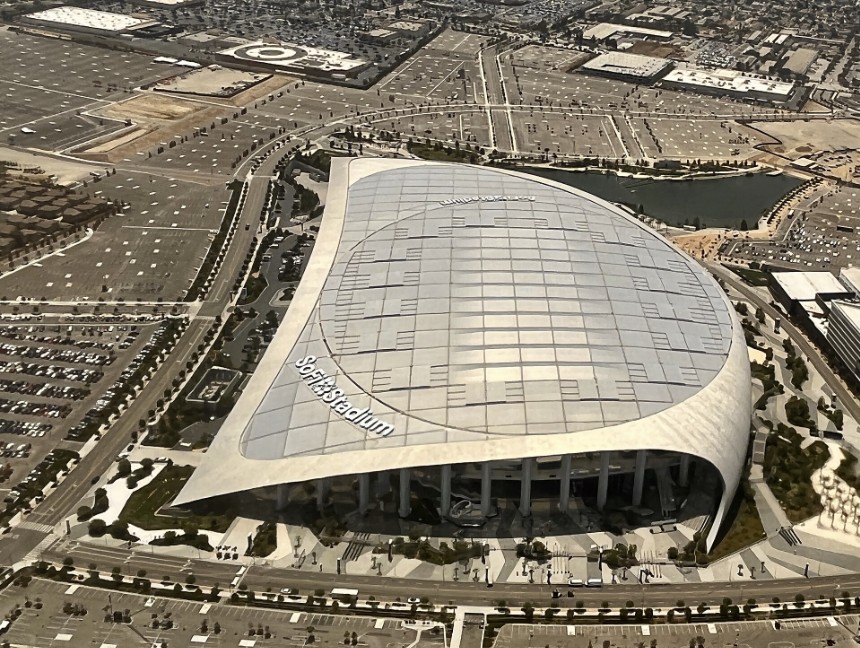
Wikimedia Commons, photo by Benoît Prieur (July 2022, CC0 license) · aerial view of SoFi Stadium
One dollar a helmet: the story behind the Rams’ horns
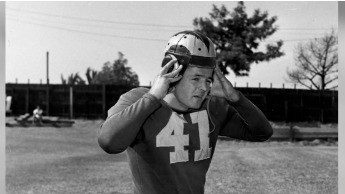
Rams players running onto the SoFi Stadium field today still have horns painted on both sides of their helmets, and this logo has an origin story that’s remarkably modest compared to the stadium’s blockbuster contracts.
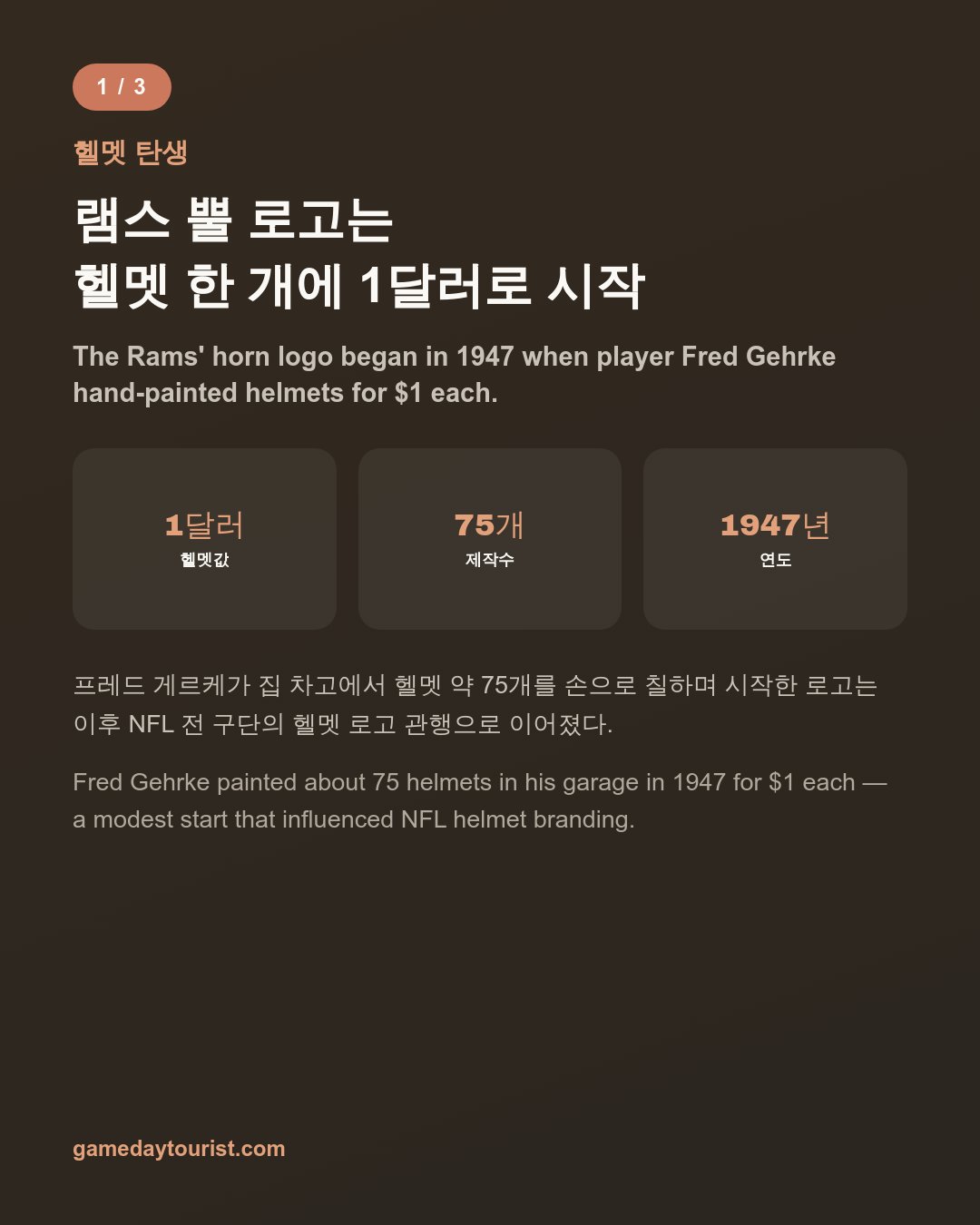
In 1947, Fred Gehrke, a Rams player who had studied art, kept suggesting to his coach that they paint the team’s logo onto the helmets, and kept getting turned down — until the coach finally handed him a helmet and said, “Go home and paint it.”
Gehrke hand-painted about 75 helmets in his own garage that summer, for a dollar a helmet. He reportedly carried a paint can around during the season to touch up scratches after games — by today’s standards, this was basically a one-man cottage-industry operation.
That helmet is considered the first logo ever painted on an NFL helmet, and every other team in the league eventually followed suit. It’s easy to lose sight of that origin while covering nine-figure sponsorship deals, but seeing today’s multi-billion-dollar branding business trace back to a single hand-painted horn really drives home how much power one logo can carry.
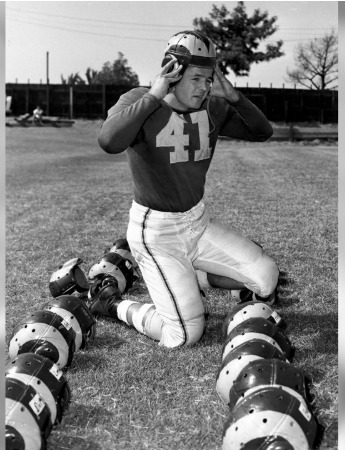
Source: Los Angeles Rams’ official website archive photo (taken 1948)
What kind of club are the Rams? A two-time Super Bowl champion that took 21 years to come home
The Rams started out as an NFL club in Cleveland in 1937, and moved to LA in 1946, the year after winning the league championship in 1945.
After stops at the LA Memorial Coliseum (1946-1979) and Anaheim Stadium (1980-1994), the club left for St. Louis in 1995 and didn’t return until 2016 (team history) — meaning the country’s second-largest market went 21 straight seasons, from 1995 to 2015, without an NFL team at all, which is still a striking gap to look back on.
Their championship history consists of two pre-Super Bowl-era NFL titles (1945, 1951) and two Super Bowl wins.
The first came in St. Louis, Super Bowl XXXIV for the 1999 season (a 23-16 win over the Tennessee Titans), and the second was Super Bowl LVI for the 2021 season (a 23-20 win over the Cincinnati Bengals).
That LVI happened to be played at SoFi Stadium itself, making the Rams one of the rare teams to lift the Super Bowl trophy on their own home field.
The year they moved to LA, 1946, also produced a moment that shaped NFL history. Under pressure from Black journalists who argued that a team excluding Black players shouldn’t be allowed to rent the publicly funded Coliseum, the Rams signed UCLA running back Kenny Washington on March 21 of that year, followed by Woody Strode (LA Public Library archives).
That contract revived Black players’ presence in the NFL after a long gap, and it actually predates Jackie Robinson’s MLB debut in April 1947. The terms of using a stadium ended up changing league history, which is the kind of detail that sticks with you when you’re writing about the relationship between a venue and its community.
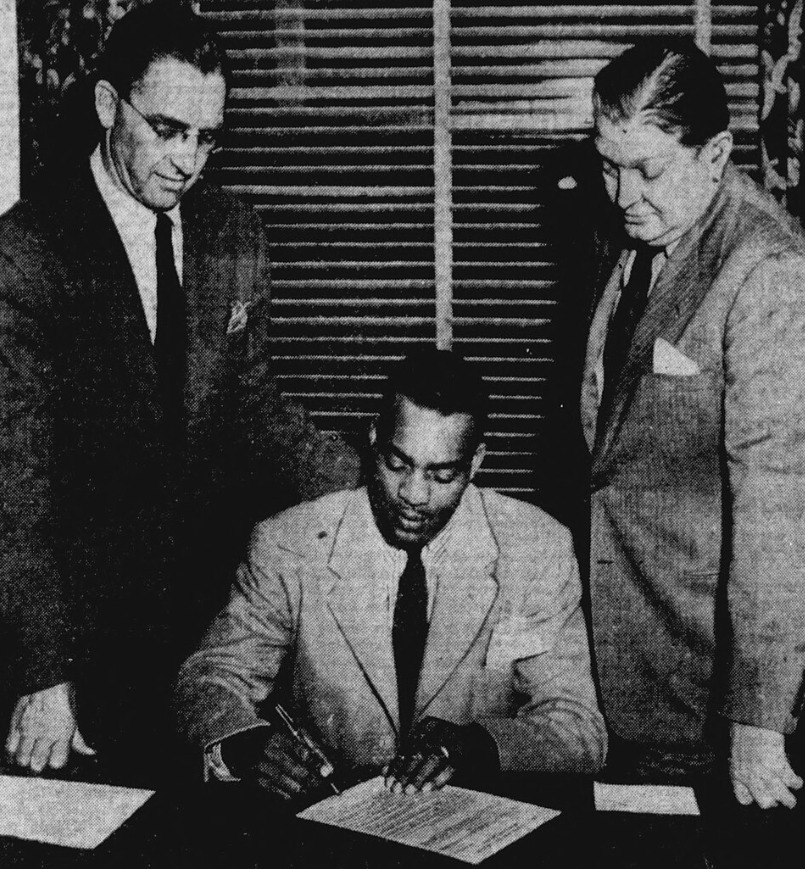
Photo: Kenny Washington (center) signing his contract with the Rams, March 21, 1946 · Los Angeles Daily News · Wikimedia Commons · Public domain
The Rams’ current faces are head coach Sean McVay, who took the job in 2017 at age 30, and quarterback Matthew Stafford. Stafford led the league in both passing yards (4,707) and touchdowns (a franchise-record 46) in the 2025 season, earning his first MVP award after 17 years in the league — he beat out runner-up Drake Maye of New England by a razor-thin 366-to-361 vote margin.
Receiver Puka Nacua led the league with 129 receptions and finished second with 1,715 yards, earning a unanimous First-Team All-Pro selection, and veteran receiver Davante Adams joined the team in March 2025. The team went 12-5 in 2025 and reached the NFC Championship before losing 31-27 to Seattle, one step short of the Super Bowl.
The 2026 season opened at 1-2 (as of September 29) after a 27-7 loss to San Francisco, a 28-6 win over the New York Giants, and a 30-26 loss to Denver.
Local reports have speculated that this could be Stafford’s last season, and from a marketer’s perspective, few storylines drive ticket and jersey demand quite like a franchise star’s “last dance.” How the club chooses to tell that story over the course of the season looks to be just as interesting to watch as the standings.
What kind of club are the Chargers? Powder blue jerseys, and home games with more away fans than home fans
The Chargers were a founding member of the AFL (a rival league that merged with the NFL in 1970) and played their first season in LA in 1960, but relocated to San Diego the very next year and spent 56 seasons there through 2016.
Even after returning to LA in 2017, the team spent three seasons (2017-2019) playing at a soccer-specific stadium in Carson (then called the StubHub Center) while waiting for SoFi to be completed (team history). Their only title came in the 1963 AFL Championship, and their only Super Bowl appearance was a 49-26 loss to the San Francisco 49ers in Super Bowl XXIX for the 1994 season.
What the Chargers do have is the “Air Coryell” offense, led by quarterback Dan Fouts in the late 1970s and 1980s, which is still cited today as the forerunner of pass-heavy offensive systems — and the powder-blue jerseys that recall that 1960 debut season in LA have been reclaimed as the team’s signature color.
The club is currently led by head coach Jim Harbaugh, who returned to the NFL in 2024 after taking Michigan to a national championship, and quarterback Justin Herbert, the sixth overall pick in the 2020 draft. Herbert signed a five-year, $262.5 million extension in 2023.
Since Harbaugh’s arrival, the team has gone 11-6 in both 2024 and 2025, making the playoffs each time but losing in the wild card round both years. The 2026 season opened 0-3 after dropping both home openers (14-26 to Arizona, 14-26 to Las Vegas) and a road loss to Buffalo (16-24).
One distinctive feature of Chargers home games is the color of the crowd. Reports that “Raider Nation” takes over SoFi whenever the team faces its longtime rival surfaced again this September, as they do every year, and one American matchday review site noted an unusually large number of empty seats and opposing fans at Chargers games.
Another local matchday guide puts it this way: Rams games clearly feel like a home game, while Chargers games feel closer to a neutral-site game. It struck me that this crowd makeup is a pretty direct illustration of how much longer it takes to transplant a fanbase rooted in San Diego for 56 years than it does to build a new stadium.
What to know before watching a Rams or Chargers game
As the Attendance and Tickets section below shows, Chargers tickets tend to run cheaper than Rams tickets at the same venue, and there are reports that resale prices for Chargers games often drop as the date approaches even after an official sellout. Picking a game with a heavy away-fan turnout can actually make for a more entertaining atmosphere, with both sides’ chants clashing.
Parking lots open four hours before kickoff, and the “Pink Zone,” where tailgating (the pregame tradition of parking and sharing food in the lot) is permitted, opens five hours before kickoff — tailgating itself is restricted to that zone (LA Tourism guide).
For public transit, there’s a free SoFi shuttle running from the LAX/Metro Transit Center. Tickets are mobile-only, payment is card or mobile only, and a clear-bag policy is enforced.
Even the farther lots start at $60, and visitor accounts frequently mention it taking 45 to 60 minutes just to get out of the parking lot after the game — international visitors are probably better off using the shuttle or parking a bit further away at the Kia Forum.
Attendance and tickets
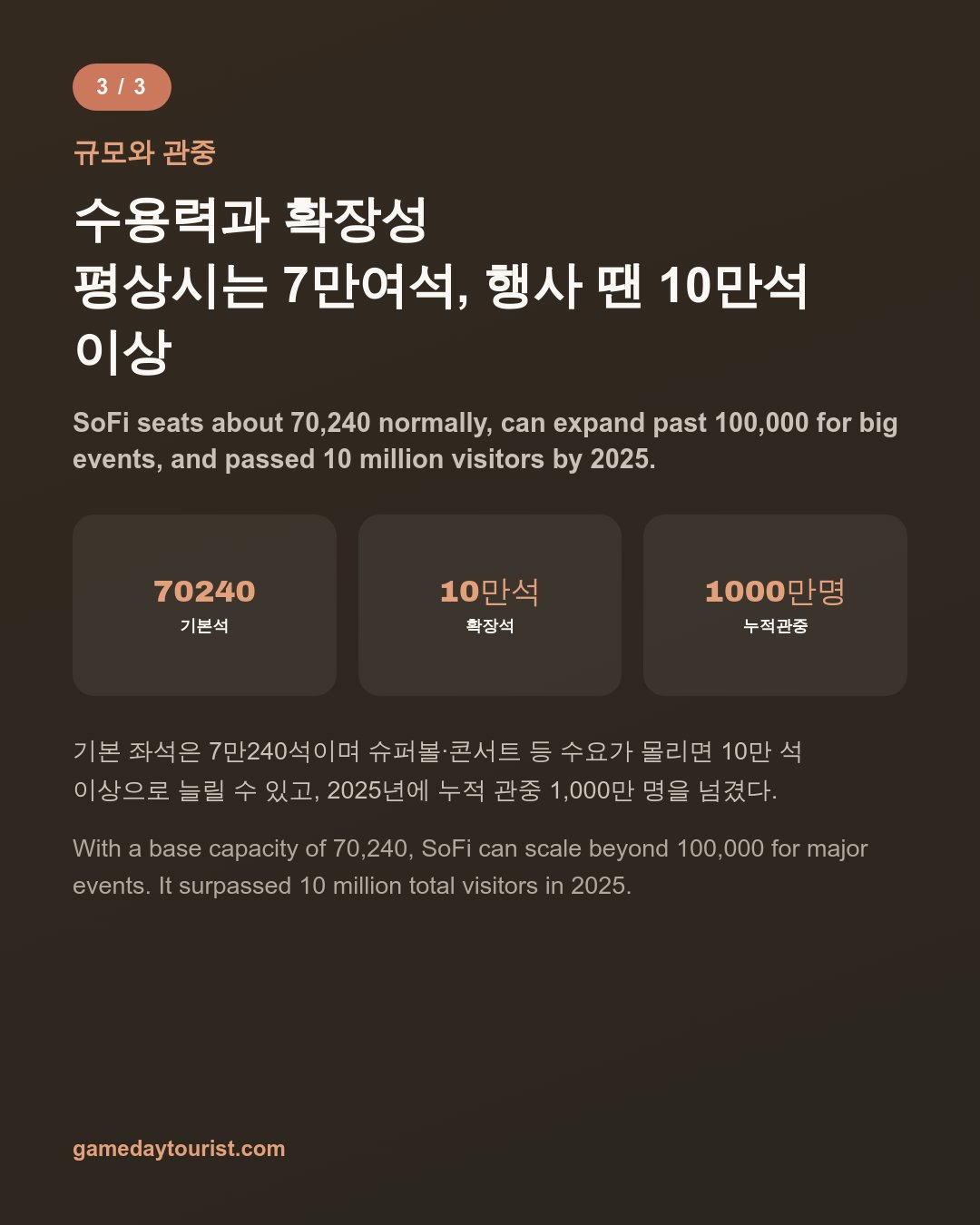
SoFi Stadium’s base seating capacity is 70,240, but it’s designed to expand temporarily to over 100,000 for high-demand events like the Super Bowl or major concerts.
It’s already hosted Super Bowl LVI in 2022, and this past summer’s 2026 FIFA World Cup saw 8 matches played at this single venue (NBC Los Angeles). The 2028 LA Olympics plans to use the stadium not just for the opening and closing ceremonies but even for swimming events (in a 38,000-seat configuration) — making the phrase “football-only stadium” feel almost beside the point.
It was interesting to learn that sharing one roof doesn’t mean the two teams charge the same for seats. According to a cost survey compiled by Yahoo Sports, the total cost for a family of four to attend a Rams game comes to $1,627.71 (about ₩2.18 million), versus $1,205.83 (about ₩1.62 million) for a Chargers game — a gap of $421.88 (about ₩570,000).
Food and parking costs are identical for both teams, so that entire gap comes down to ticket prices alone — a pretty direct illustration of how much brand power translates straight into price, even on the exact same facility and seats. Year-over-year price increases were steeper for the Rams too, at 37.3% versus the Chargers’ 29.5%.
One American matchday review site noted that while the seats themselves have ergonomic, high-back designs, even an average-sized person can find them a bit narrow, and quite a few people complained that getting from the 300 level down to the 100 level means switching escalators multiple times across the venue’s nine-tier concourse structure (Stadium Journey).
Even a $5.5 billion state-of-the-art facility, it turns out, still has circulation design as homework left to finish.
The venue also passed 10 million cumulative visitors during a Shakira concert on August 4, 2025, and in 2023 it set the record for largest attendance at a single event anywhere, drawing 161,892 fans over two nights of WrestleMania 39 (SoFi Stadium’s official announcement).
Considering those numbers come from 80 football games and roughly 90 concerts, it really sank in that this venue has become a city landmark in its own right, well beyond being a sports facility.
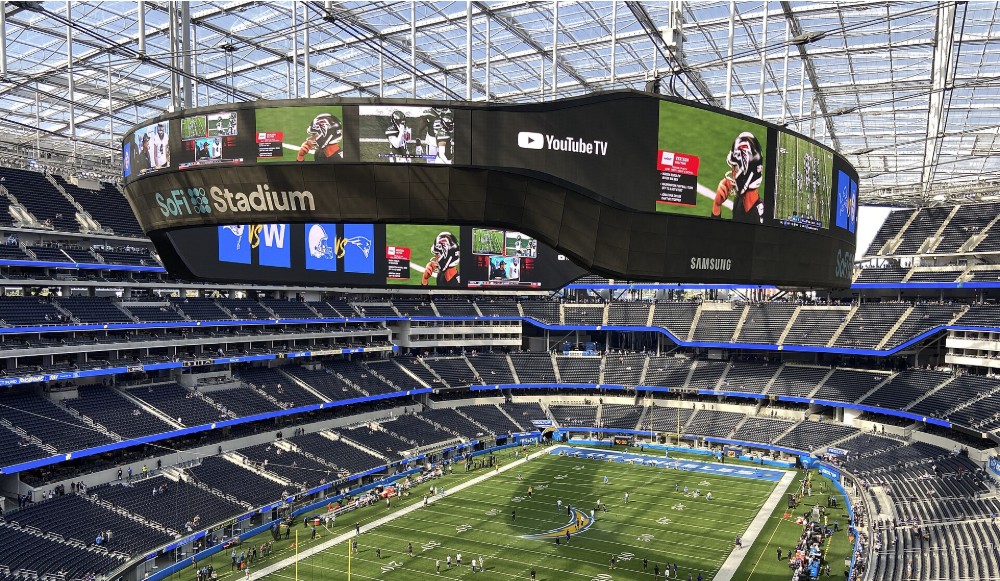
Wikimedia Commons, photo by Troutfarm27 (November 2021, Chargers vs. Vikings game, CC BY-SA 4.0) · the Oculus videoboard inside the stadium
Space usage and F&B
SoFi Stadium isn’t a standalone building — it sits at the center of Hollywood Park, an 8.5-million-square-foot mixed-use development (roughly the size of 111 soccer fields).
A 6,000-seat venue, YouTube Theater, sits right next door, so even outside football season the site keeps running non-stop with concerts, award shows, and more.
Ahead of the 2026 season, the F&B lineup got an overhaul too. Operator Legends Global introduced a new fries dish called “Frites,” topped with butter chicken, short rib, or pastrami; opened an additional barbecue stand near the north entrance; and expanded dessert offerings — brookies, chocolate cake, gelato — on the 400 and 500 levels.
On the merchandise side, a new team store opened on the “Pepsi Overlook” at the 300 level, with the Rams unveiling a new “Fierce White” jersey and the Chargers launching collaborations with streetwear brands (SoFi Stadium’s official announcement). Refreshing the F&B and merch lineup every season looks like an investment aimed at lifting not just gameday revenue but concert and event revenue as well.
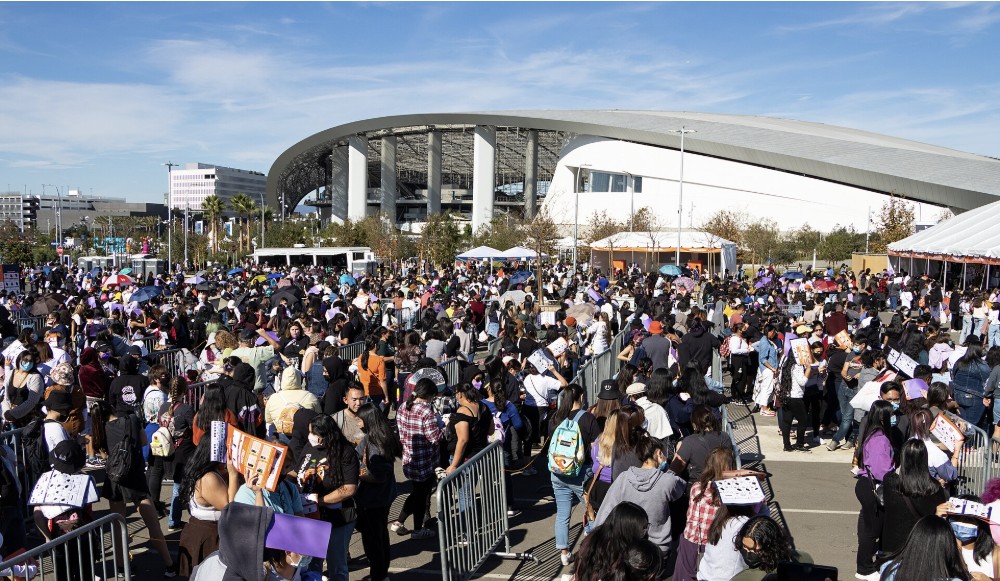
Wikimedia Commons, photo by Ganbaruby (November 2021, CC BY-SA 4.0) · fans lining up to buy concert merchandise
The stadium’s parking lot can see long lines even on days with no football at all. A photo taken in November 2021 during a K-pop group’s world tour stop shows fans packing the parking lot in line for merchandise — a clear illustration of how this venue keeps its retail infrastructure running year-round through dozens of major concerts a year, on top of football.
Naming rights and Kroenke’s sports empire
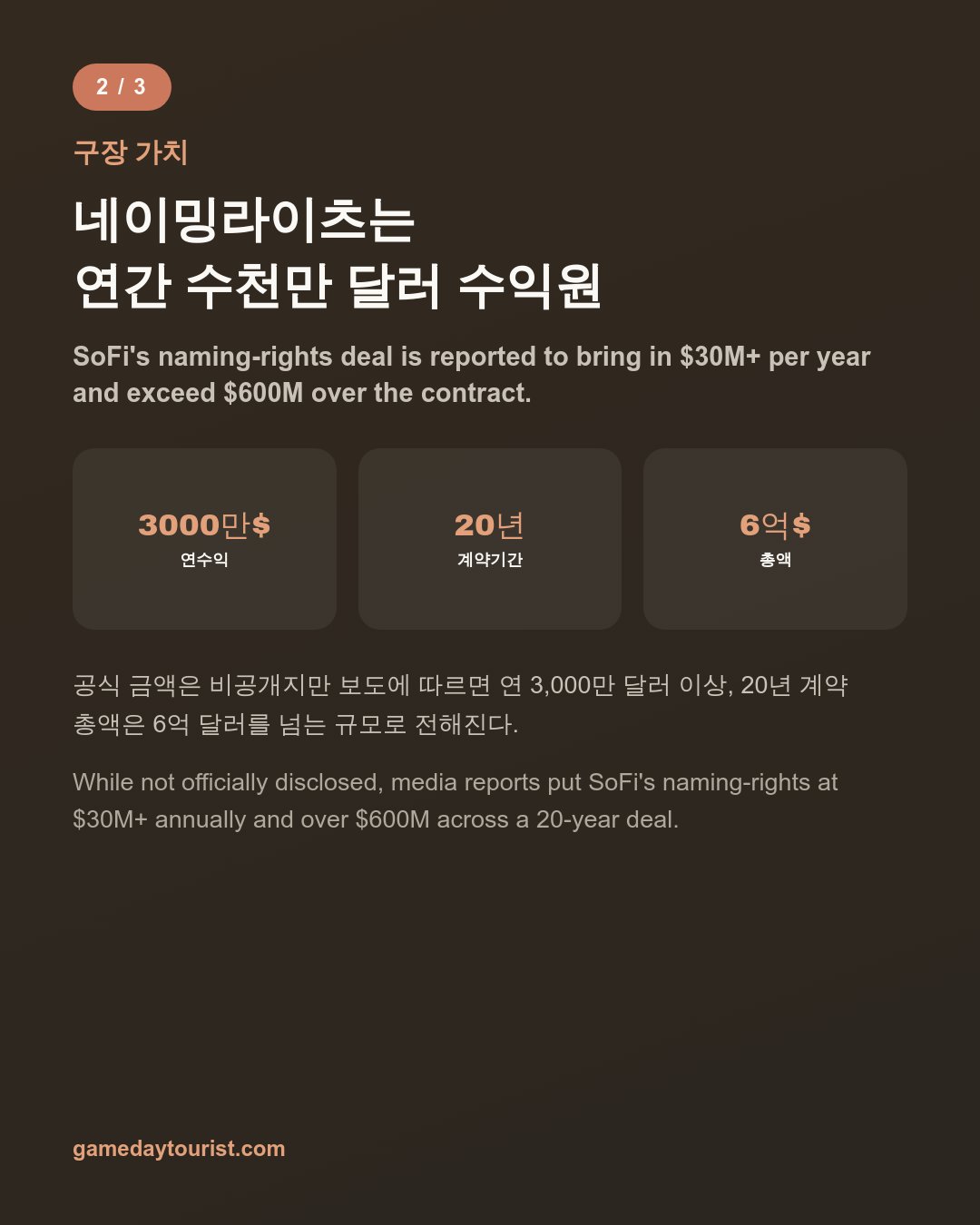
The exact figure for this stadium’s naming rights deal (the right to put a company’s name on a venue) has never been officially announced. Still, according to several sports-business outlets citing Bloomberg reporting — including SportsPro and Sportico — it’s believed to run over $30 million a year, with the 20-year total exceeding $600 million (about ₩804 billion), and CBS Sports called it the largest naming-rights deal in NFL history at the time it was announced.
Add to that the “Oculus” videoboard, a roughly 998-ton, 80-megapixel display that Samsung built and installed separately, and it’s hard to shake the impression that the venue itself functions as one giant billboard.
SoFi’s CEO Anthony Noto has said the fintech company pursued this deal for the automatic brand exposure it gets every year at marquee events like the Super Bowl and the College Football Playoff — his logic being that getting that kind of exposure through sports sponsorship takes reaching 10-15 million people over a full year, while a single nationally televised game night can deliver comparable exposure in one evening, making the latter far more efficient marketing (Athletic Business).
This past summer’s 2026 FIFA World Cup, though, forced that brand name to disappear entirely. To protect its official sponsors, FIFA applied a “clean stadium policy” that temporarily stripped commercial names from venues during the tournament (June 11 to July 3), and SoFi Stadium had to go by the temporary name “Los Angeles Stadium” for the entire event.
MetLife Stadium in New Jersey and Levi’s Stadium in San Francisco were in the same position.
The result, though, was ironic. A count of unofficial brand mentions during the tournament found that SoFi’s original name actually led the pack at 12.94% of unofficial sponsor mentions, with MetLife (12.17%) and AT&T (9.61%) rounding out the top three, together accounting for roughly 35% of all unofficial mentions (per an Onclusive analysis).
It’s a case that shows a few weeks of erasing a name doesn’t erase years of built-up brand association — a reminder that the real value of naming rights isn’t the sign itself, but the accumulated recognition behind it.
It’s also worth noting that the stadium’s owner is strictly the Rams’ ownership group, Kroenke Sports & Entertainment, while the Chargers (owned by the Spanos family) are effectively tenants at this venue.
Beyond the Rams, Kroenke also owns the Denver Nuggets (NBA), the Colorado Avalanche (NHL), the Colorado Rapids (MLS), and Arsenal (EPL), which we’ve already covered on this blog — and adding the Angels (MLB) to that list makes him the only owner spanning all four major US sports leagues plus a European football club. His net worth of $24.3 billion (about ₩33 trillion) also stood out, making him currently the wealthiest owner in MLB (Ilgan Sports).
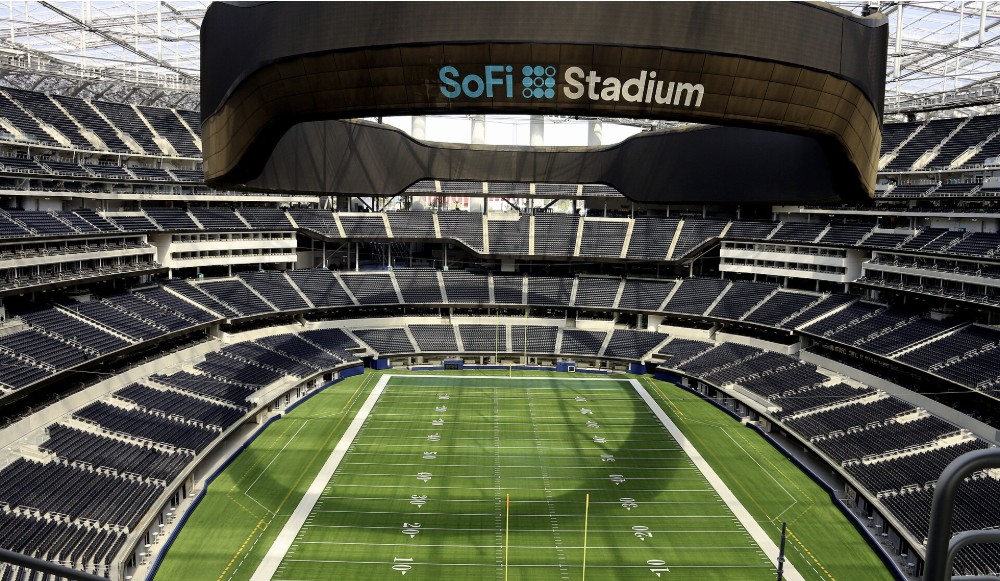
Wikimedia Commons (Flickr, photo by prayitnophotography), March 2021, CC BY 2.0 · the SoFi Stadium logo and seating, viewed from inside the venue
Local economic impact
Inglewood, the city where the stadium sits, once saw its credit rating drop to BBB- in 2011, with unemployment at 17%, putting it on the brink of a cash bankruptcy.
According to the Urban Land Institute’s LA chapter, this project is projected to generate about $100 million in tax revenue over five years and over $1 billion over 25 years, while property values in the project district have jumped 88%, from $9 billion before the project was announced to $17 billion now.
Unemployment also fell to a pre-pandemic rate of 4.7%, a drop of 12.3 percentage points, and roughly 4,000 housing units were built between 2018 and 2021 alone — nine times the 448 units built over the entire 17-year span from 2000 to 2017.
Watching a single venue reshape an entire city’s finances this way was a reminder that sports marketing isn’t just about selling tickets and merchandise.
A comparison with the KBO and K League
Two pro clubs sharing one stadium isn’t actually unfamiliar territory in Korea. The city of Seoul has confirmed that LG Twins and Doosan Bears will temporarily share the neighboring Jamsil Olympic Stadium (formerly the Seoul Olympic Stadium) as a joint home venue for five seasons, from 2027 to 2031, while a new domed stadium is being built on the site of Jamsil Baseball Stadium (Kyunghyang Shinmun).
It’s a major construction project that converts what used to be a track-and-field and soccer venue into baseball dimensions, with seating for 18,000 (expandable to 34,000) — and in the sense that two teams are physically sharing one facility, it resembles the SoFi Stadium setup.
The decisive difference, though, is naming rights. Jamsil Olympic Stadium is a public sports facility with no room for a corporate name, while SoFi Stadium generates hundreds of billions of won a year from naming rights alone.
Even two teams sharing the exact same roof can end up with completely different revenue structures depending on whose name is on that roof — and SoFi Stadium’s case makes that point clearly.
Leave a Reply