Contents · About 12 min read
- Six Guitar Strings on the Helmet Stripe — Houston’s Light Blue Is Back
- What Kind of Team the Titans Are — Four Straight Seasons Without the Playoffs, and 0-4
- Attendance and Tickets — The Personal Seat License (PSL) Structure and the Mosh Pit
- Using the Space and F&B — The Current Stadium’s Shortcomings and the New Design
- Naming Rights and the Local Economy — A Stadium Renamed Four Times Moves to a 20-Year Deal
- Construction Financing and a Comparison with Korean Ballparks — 60% Public, 40% the Club
📱 View as card news
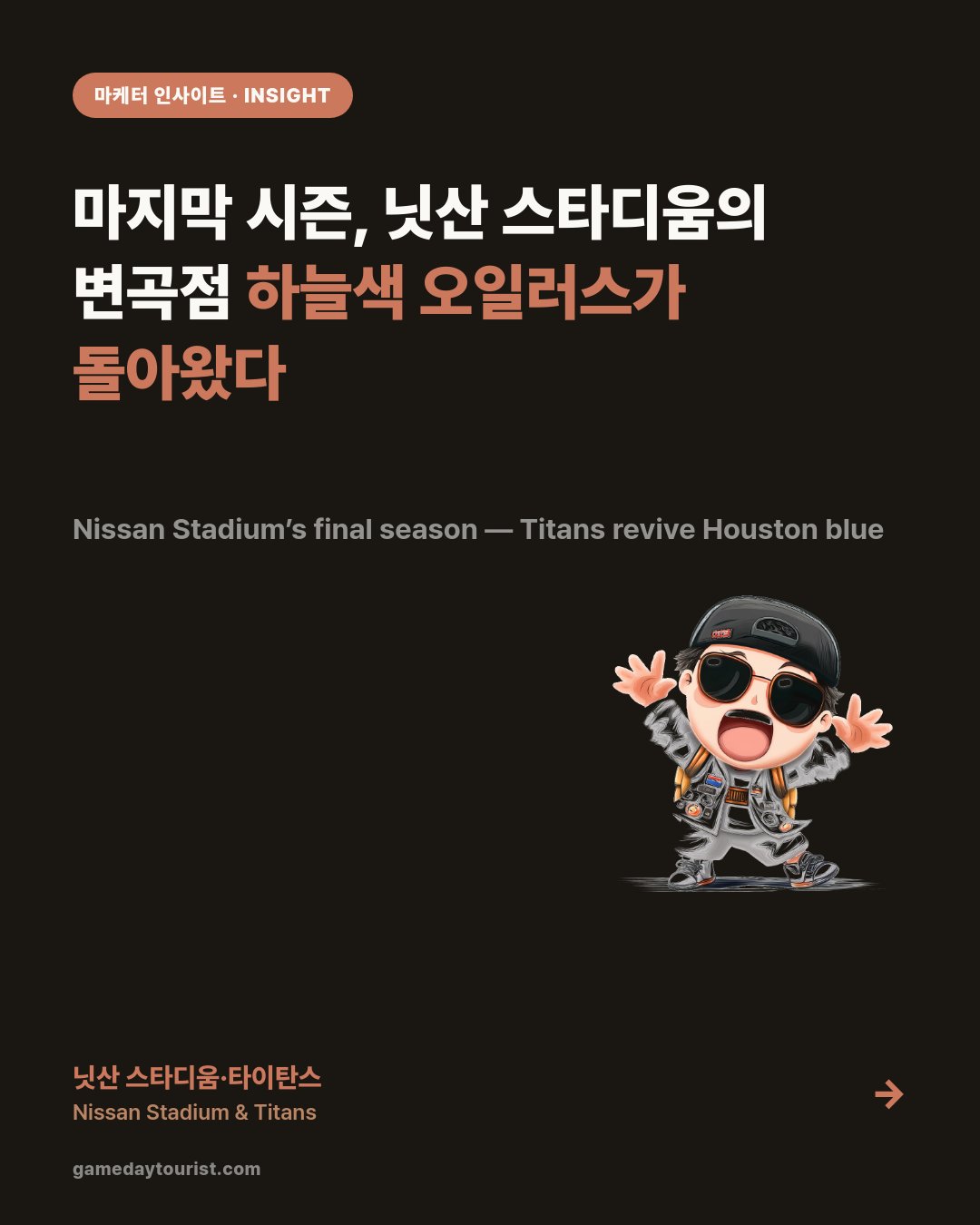

The Tennessee Titans’ new uniforms, unveiled on March 12, looked oddly familiar. Light blue and red filled the space left by the flaming-thumbtack logo, a combination that belongs to the days when the team was the Houston Oilers.
SportsLogos.Net reported that this light blue is closer to the Oilers’ “Luv Ya Blue” than anything the Titans have worn before.
This is also the last season the Titans will play in the current Nissan Stadium. Right next door, a $2.1 billion covered stadium is going up, and the club has said it will move there starting with the 2027 season.
With a uniform change and a stadium move landing in the same year, I decided to sort out, element by element, what this club is selling and changing right now. For the record, this has nothing to do with the Nissan Stadium of Yokohama F. Marinos that I covered on August 14; the two share only a name.
On Sunday, October 11, at noon local time, the Houston Texans come to town. Why that game is special comes up right below.
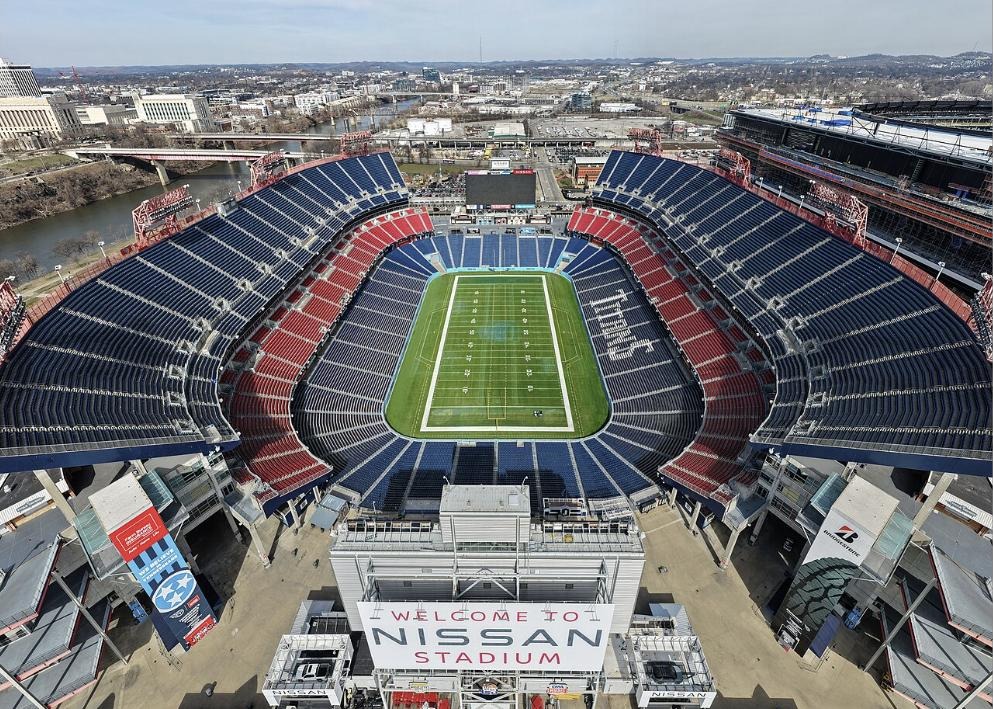
Photo: Quintin Soloviev · Source: Wikimedia Commons · License: CC BY 4.0 · Taken February 24, 2026. The new stadium can be seen rising at the upper right of the current Nissan Stadium.
Six Guitar Strings on the Helmet Stripe — Houston’s Light Blue Is Back
The reason this club’s identity got complicated is its history of moves. It began in 1960 as the Houston Oilers, a founding member of the AFL (American Football League), and won the league’s first two titles.
After announcing a move in the mid-1990s, it spent 1997 and 1998 as the Tennessee Oilers, using Memphis’s Liberty Bowl and Vanderbilt Stadium as temporary homes. The current name, Titans, was settled on November 14, 1998.
In the meantime Houston became a city with no NFL team, and when the Texans were founded in 2002, the two clubs were placed in the same division, the AFC South. Their first meeting was on November 10, 2002, and the Titans won 17-10.
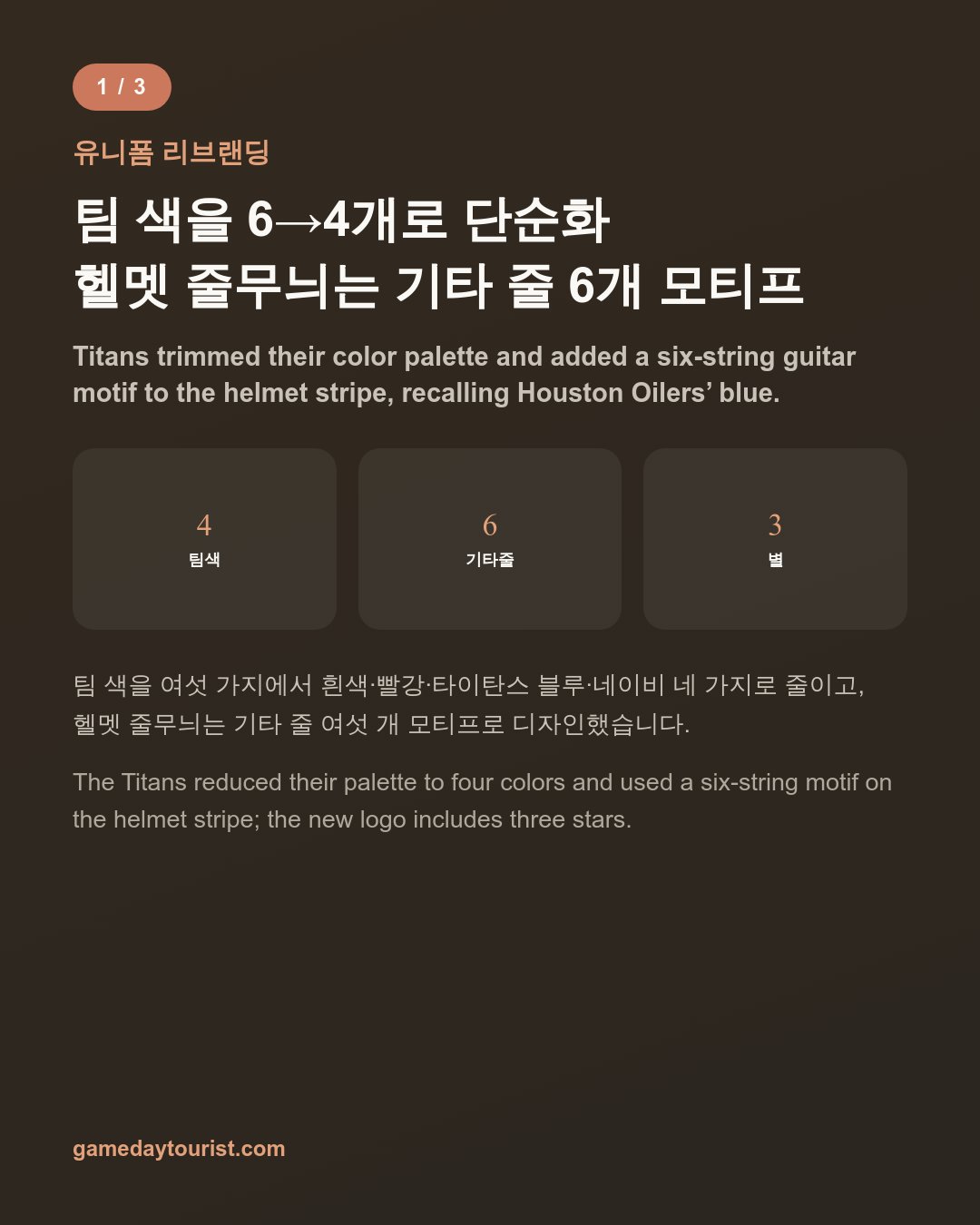
That is why the light blue in this rebrand reads as more meaningful. According to ESPN, the team colors were cut from six to four (white, red, Titans blue and navy), and the flaming thumbtack logo was replaced by a block T inside a red circle with three stars.
The stripe on the white helmet represents six guitar strings, a nod to Nashville’s identity as a music city, and the motif carries onto the jerseys and pants. The home jersey reads TITANS on the chest and the road jersey reads TENNESSEE, with a “WE” tag inside the collar.
According to WSMV, limited merchandise went on sale first, online and at Nissan Stadium, starting March 13, the day after the reveal.
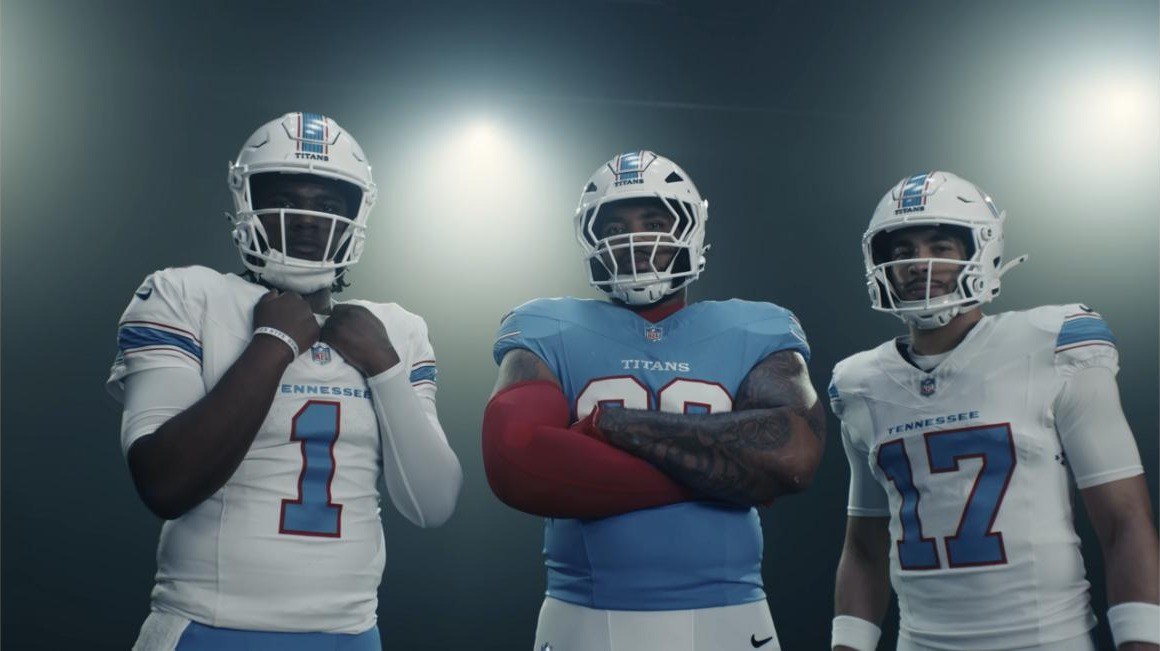
Photo: Tennessee Titans (screenshot from the official YouTube video) · Source: Wikimedia Commons · License: CC BY 4.0 · Photo from the March 2026 uniform reveal. Cam Ward, Jeffery Simmons and Chimere Dike appear from left to right, showing the white helmet stripe (the six-guitar-string motif) and the home and road jerseys.
Adding my own reading as a working marketer, reviving the team’s oldest color in the year before a new stadium opens looks like a move to retune fan sentiment once. It is rare for a team that moved cities to pull the old city’s colors back out, and the club seems to have chosen to take on that awkwardness in order to carry nostalgia and local identity (guitar strings, Tennessee stars) at the same time.
Whether that call was right will show up in next season’s merchandise sales, but it can’t be confirmed from the information released so far.
What Kind of Team the Titans Are — Four Straight Seasons Without the Playoffs, and 0-4
In Super Bowl XXXIV (January 30, 2000), reached through the “Music City Miracle” in the 1999 wild-card round, they lost 23-16 to the St. Louis Rams, and the final scene, in which Kevin Dyson was tackled one yard short of the goal line, has remained a symbol of the club’s history.
Steve McNair (No. 9) and Eddie George (No. 27) have their numbers retired. The current owner is Amy Adams Strunk.
The roster is in a rebuild. According to Wikipedia’s 2025 season article, the Titans finished 2025 at 3-14, and after head coach Brian Callahan was fired on October 13 with the team at 1-5, Mike McCoy took over as interim coach.
They have missed the playoffs four seasons in a row since 2022, and quarterback Cam Ward, the No. 1 overall pick in 2025, is effectively the face of the team. On January 22 this year, the hiring of head coach Robert Saleh was announced.
Saleh went 20-36 with the New York Jets from 2021 to 2024 and was the San Francisco 49ers’ defensive coordinator in 2025.
The 2026 season has not started easily. They lost back-to-back home games, 23-10 to the Jets in the opener and 24-20 to Philadelphia in Week 2.
In Week 3 at the New York Giants, Ward threw an interception at the opponent’s 7-yard line with 24 seconds left, and they lost 12-7. In Week 4 at Baltimore they lost again, 24-18, so they are 0-4 through four weeks.
The remaining home games are the Texans on October 11, the Browns on October 25, the Jaguars on November 15, the Washington Commanders on December 6 and the Colts on December 20, and the last game at this stadium is the January 3 game against the Pittsburgh Steelers.
One tip for visiting. Visitor reviews on the travel site Tripadvisor mention that parking is expensive and a hassle, along with the option of parking downtown and walking across the pedestrian bridge, and a well-run rideshare drop-off area.
Reviews were written at different times and things may have changed, so I recommend checking the club’s notices again before you go. The club’s official guidance says that the new stadium will cut on-site parking and point fans to partner lots, public transit and rideshare instead.
Attendance and Tickets — The Personal Seat License (PSL) Structure and the Mosh Pit
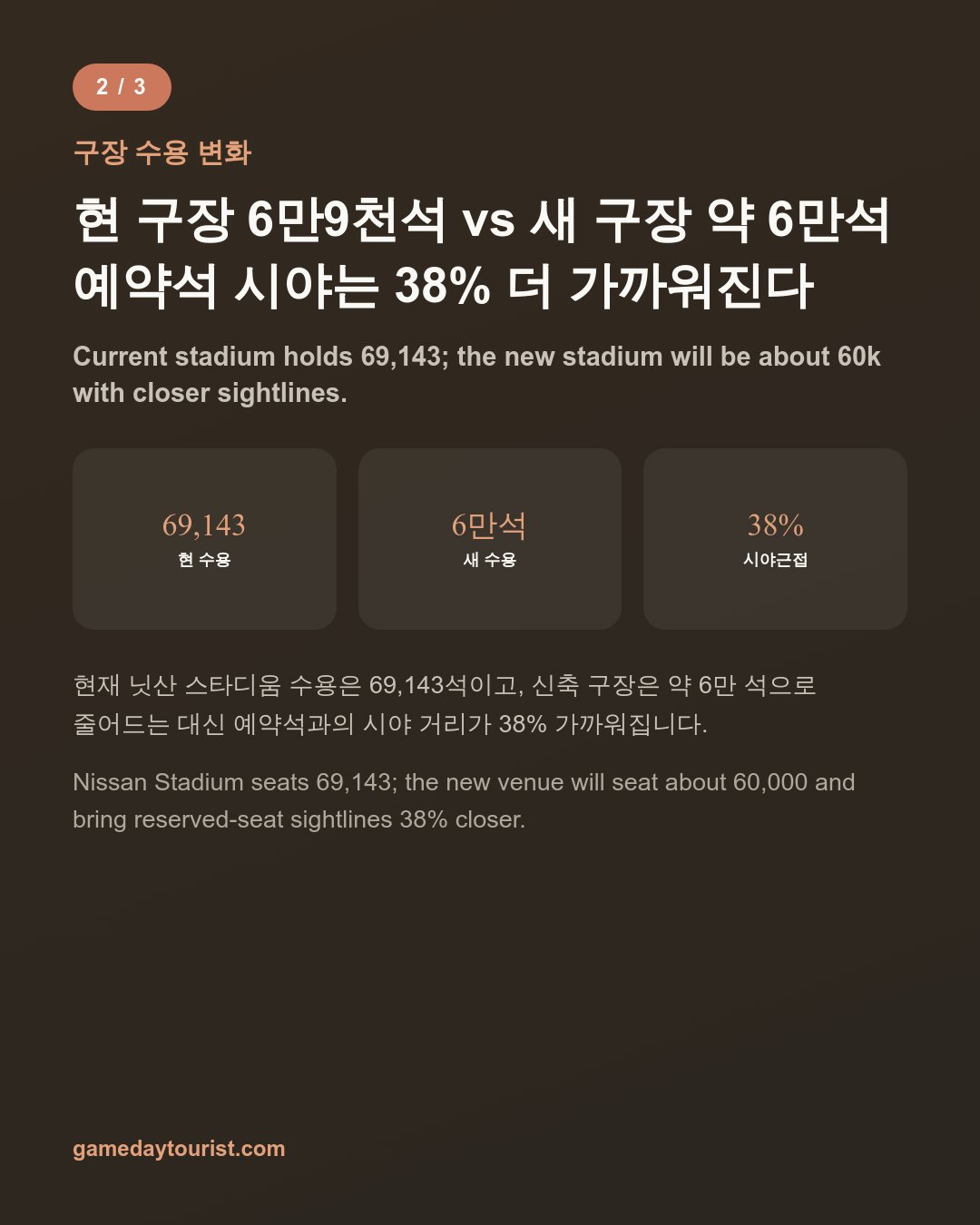
The current stadium’s capacity is 69,143, and the new stadium shrinks to about 60,000. The reason for the shrinking is in the numbers.
In a 2025 tally cited by Titans Wire, the Titans’ attendance fell 9.1% from the year before, the biggest drop among the NFL’s 32 clubs, against a league-wide average decline of 0.8%. That figure is based on tickets distributed, so it can differ from actual turnstile attendance, and the same article put the share of tickets sold at over 85%.
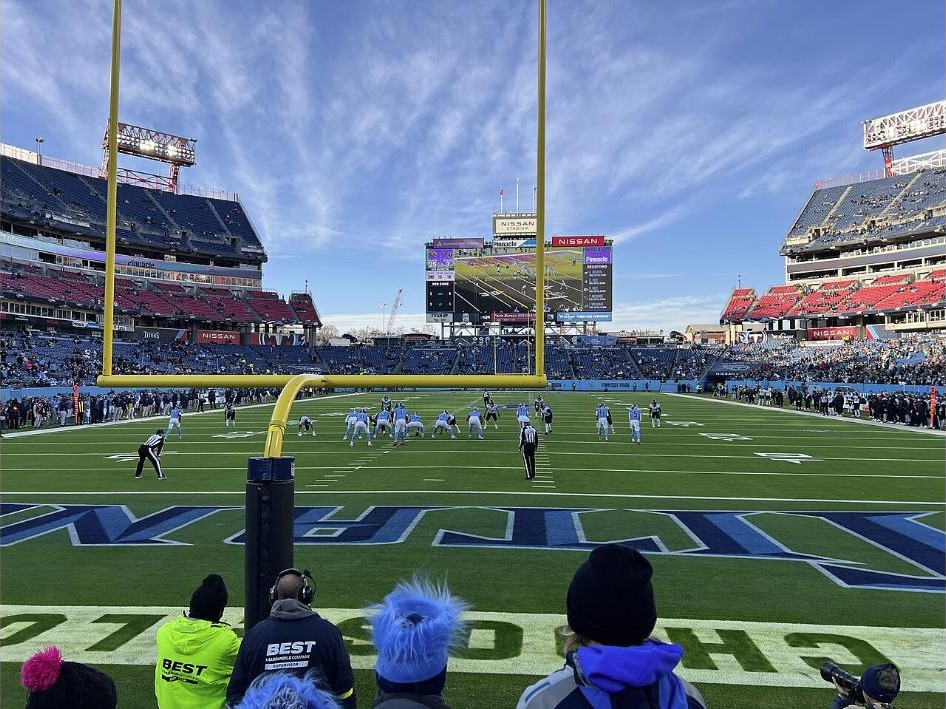
Photo: Walker Kinsler · Source: Wikimedia Commons · License: CC BY-SA 4.0 · The November 30, 2025 game against the Jaguars (Jaguars won 25-3). The crowd and the players are both in the shot.
The personal seat license (PSL) is the core of the new stadium’s funding. According to the club, a PSL is a 30-year seat membership, each account can buy up to eight seats, about 40% of them are priced at $3,500 or less, and there are more than 30 price points.
Paying in full earns a 10% discount, and existing PSL holders get a credit equal to what they paid before, taken off the new stadium’s PSL price (for example, four $2,000 PSLs equal an $8,000 credit). The club said that giving existing season-ticket holders a credit toward new-stadium PSLs was a first in the NFL.
Sales went in stages. According to Paul Kuharsky, premium seating sold out in mid-August 2024, about six months ahead of the club’s February 2025 projection, and in October 2024 a second wave began covering the remaining lower bowl, the 200 level and other sections, 50% of all PSLs.
There are voices on the other side too. According to The Center Square, a longtime fan who bought his seat rights when the stadium first opened said a PSL that was originally $750 would be $10,000 for his seat at the new stadium, and that the teachers and blue-collar workers sitting next to him couldn’t afford it.
The club’s “40% at $3,500 or less” and this fan’s experience may not conflict, since they involve different seating zones, but it is clear that there is a gap between the club’s explanation that the credit policy offsets the burden and how an individual fan feels.
From a marketer’s standpoint, selling a 30-year seat right during a stretch when the team goes from 3-14 to 0-4 is the hardest scene. If it were me, I would see the product’s biggest risk not as the results but as “the perception that seat choice has shrunk relative to the price.”
The product that stands out most in the middle of all this is the Mosh Pit. It is lower-bowl seating around a performance stage in Section 124 of the east end zone, where would-be buyers apply by video explaining “why I should sit here” and, if selected, buy at Titans House (the experience center).
It sold out on February 4, 2025, and the club presented the area as its most exclusive fan section. Layering a selection step on top of a PSL that anyone with money can buy, so that the club picks its most loyal fans itself, is a smart design in my view, whatever the pricing controversy.
Using the Space and F&B — The Current Stadium’s Shortcomings and the New Design
The current stadium doesn’t get only praise in visitor reviews on Tripadvisor. One review says long food lines made someone miss an entire quarter, and others call the concrete walls bleak or say it feels more like a college stadium than an NFL one.
Some reviews say the mood wasn’t lively, with the team’s poor results given as part of the reason. Reviews were written at different times, so it’s hard to generalize, but it was striking how much the club’s promises for the new stadium overlap with this list of complaints.
The new stadium will be covered by a fixed, translucent ETFE (fluoropolymer film) roof and have an artificial turf field, and by the club’s account the sightline distance from reserved seats will be 38% closer than now.
Local reporting says it is designed with twice as many bathroom stalls per person and a 35-second target for concession checkout, but that is Paul Kuharsky’s reporting and I haven’t been able to get official confirmation from the club.
On construction, WSMV reported on August 12 that the ETFE cable structure is fully installed and the exterior is due to be fully closed in the next couple of months, with completion given as February 2027. And the club has already begun taking event bookings.
The club has talked about landing major events such as the Super Bowl, the Final Four, the College Football Playoff and WrestleMania, and it has built a community center of about 12,000 square feet (roughly 1,100 square meters) into the plan.
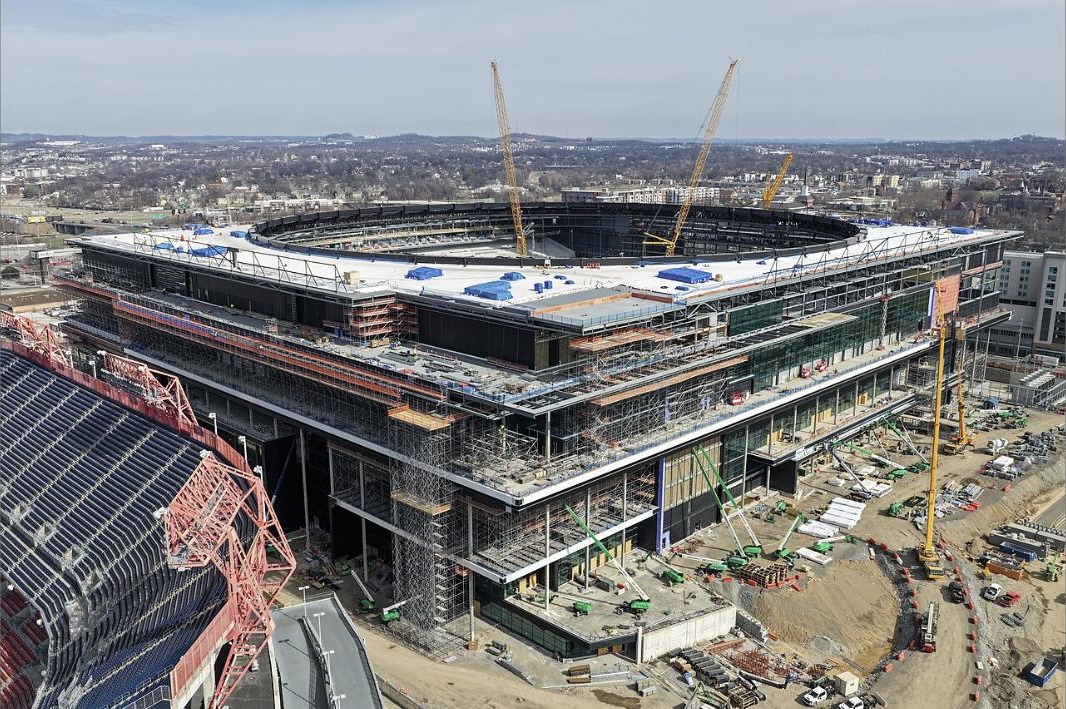
Photo: Quintin Soloviev · Source: Wikimedia Commons · License: CC BY 4.0 · Taken February 24, 2026. At lower left are the seats of the existing Nissan Stadium.
Naming Rights and the Local Economy — A Stadium Renamed Four Times Moves to a 20-Year Deal
From its opening in 1999 until now, the stadium’s name has gone from Adelphia Coliseum (1999-2002) to The Coliseum (2002-2006) to LP Field (2006-2015) to Nissan Stadium (2015-).
On November 17, 2023, the club and Nissan announced that they would continue the naming rights (the right to put a company’s name on a facility) for the new stadium under a 20-year deal, though they did not disclose the amount.
In the same announcement, Nissan said it has a Smyrna vehicle plant, a Decherd powertrain plant and its North American headquarters in Franklin in Tennessee, employs more than 11,000 people and has invested more than $10.5 billion over 40 years.
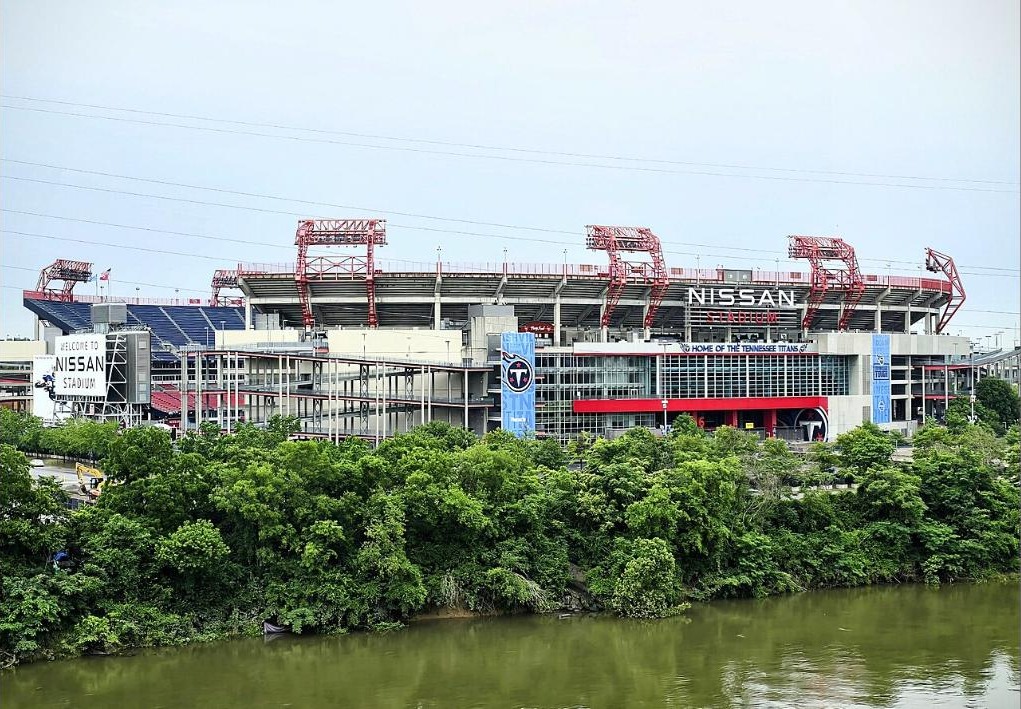
Photo: Praneeth Thalla · Source: Wikimedia Commons · License: CC0 · Taken May 24, 2024 (a cropped version of the original).
I’d guess Nissan figured that keeping a brand tied to local employment on the stadium beat building up name value from scratch, and the club cut uncertainty by locking in a long-term sponsor before the new stadium opens.
But because the amount is undisclosed, I can’t assess how this deal compares with market value.
For the local economic impact we have to rely on the club’s own material. In its official guidance the club estimates $20.9 billion in direct spending over 30 years, $33.7 billion in total economic impact and 4,927 jobs a year, and for the construction phase it cites more than 19,000 jobs.
All of these are the club’s own estimates and not independently verified figures, so please read them with that in mind.
Construction Financing and a Comparison with Korean Ballparks — 60% Public, 40% the Club
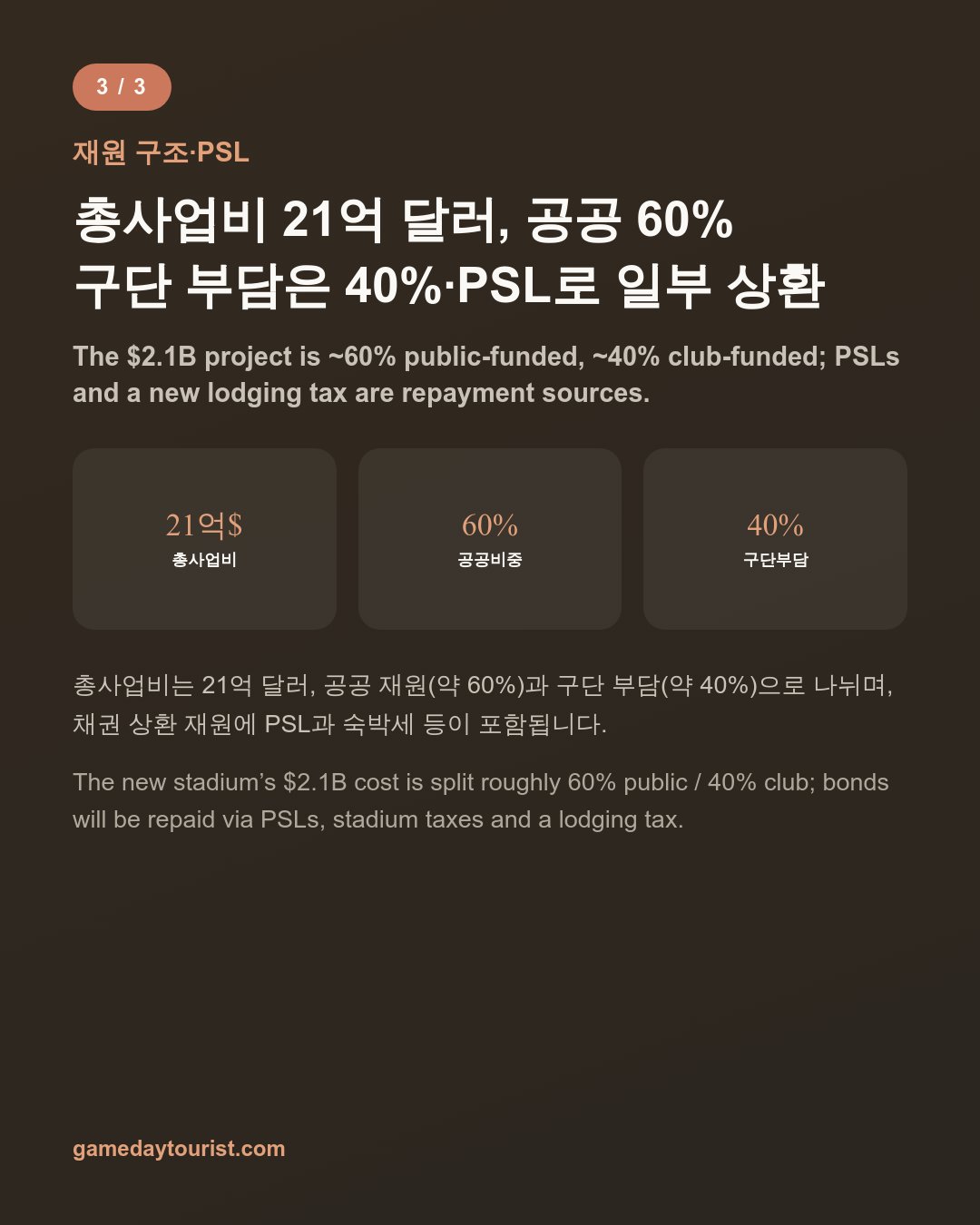
The new stadium’s total project cost is $2.1 billion according to Wikipedia, of which $1.26 billion (about 60%), made up of $500 million from the State of Tennessee and $760 million in Nashville Metro Sports Authority bonds, is public money, and the remaining $840 million (about 40%) falls on the club.
Repayment of the bonds is described as coming from PSLs, stadium-related taxes and a newly introduced 1% hotel and motel tax. The $760 million city bond is also confirmed in the ESPN headline.
The city of Nashville owns the stadium, the club operates it, and the lease runs 30 years.
The closest Korean comparison is Daejeon Hanwha Life Ballpark, which opened in 2025. Korean Wikipedia gives the initial-plan total project cost as ₩157.9 billion (₩20 billion from the national government, ₩94.9 billion from Daejeon city and ₩43 billion from the Hanwha Eagles), which puts the club’s share at about 27%, but some reports at the opening gave a different total of ₩207.4 billion, so the final tally differs by source.
Even allowing for that difference, the structure is clearly different. The Titans’ share of public money is 60%, but the bond repayment sources include burdens on users and tourists, such as PSLs and the new hotel tax, while Hanwha’s approach is to add a club contribution on top of mainly national and city funds.
Whether a Korean club could bring in an American-style long-term seat membership as is, is a separate question, but the direction of cutting capacity while raising revenue through premium seating and pricing structure is worth a look for any club preparing a new ballpark.
To sum up, in a year when results are at rock bottom, the Titans are rolling out light blue uniforms, a selection-based fan section and a long-term membership with a credit attached, all at once. Whether this combination works will be shown by the season-ticket renewal rate and merchandise sales in the first season after completion in February 2027.
Leave a Reply