Contents · About 13 min read
- The Numbers of a Fan-Owned Team
- Attendance and Tickets: Resellers’ Accounts Aren’t Renewed
- They Don’t Sell the Name, but They Sell the Gates and the Plaza
- Merchandise and F&B: The Stock Certificate Becomes a Uniform
- Broadcast Rights and the Local Economy: Lambeau Field on Non-Game Days
- A Comparison With the KBO and K League
📱 View as card news
“It seems like other teams have an ATM that we don’t have.”
That’s what Green Bay Packers president and CEO Ed Policy said this past July at the annual financial report.
On the numbers alone, it sounds like whining.
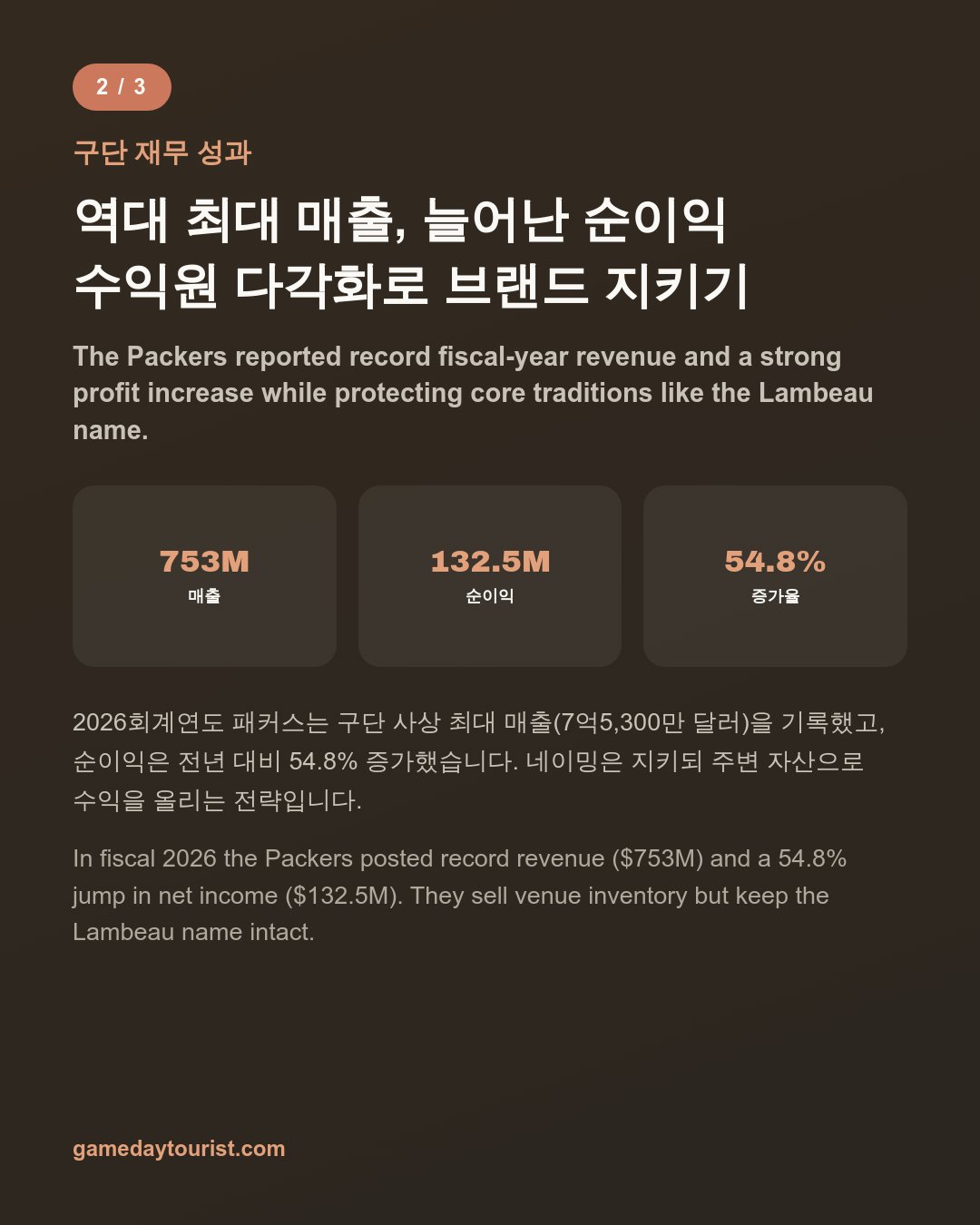
In fiscal 2026 (April 2025 to March 2026) the Packers posted record revenue of $753 million, and net income rose 54.8% from the year before to $132.5 million.
But there’s a circumstance behind that remark that’s specific to this team.
The Packers are the only NFL team without an owner, or more precisely, a team whose shares are split among more than 530,000 fans.
While other clubs sell minority stakes to private equity and raise a lump sum in a few months, that door was never open to the Packers in the first place.
On Thursday night, September 24, local time, the Packers hosted the Atlanta Falcons in this season’s home opener.
It was also Lambeau Field’s 70th season since opening.
Gathering this team’s numbers together ahead of the opener, I kept running into things a working marketer finds interesting.
It’s a structure where the club deliberately earns less in places where it could earn more, and that choice comes back around as brand value.
This post is about those choices.
The Numbers of a Fan-Owned Team
The figures on the club’s official shareholder page are 538,967 shareholders and about 5.2 million shares.
Starting as a nonprofit in 1923, it has sold stock six times so far, in 1923, 1935, 1950, 1997, 2011, and 2022.
The most recent offering ran from November 2021 to February 2022 at $300 a share, and the money went toward renovating Lambeau Field.
The shares pay no dividends and carry no perks like season ticket priority.
The bylaws also bar any one person from holding more than 200,000 shares, which closes off the route of someone buying up stock to seize control of the club.
It’s less an investment than a certificate of belonging you frame and hang in the living room.
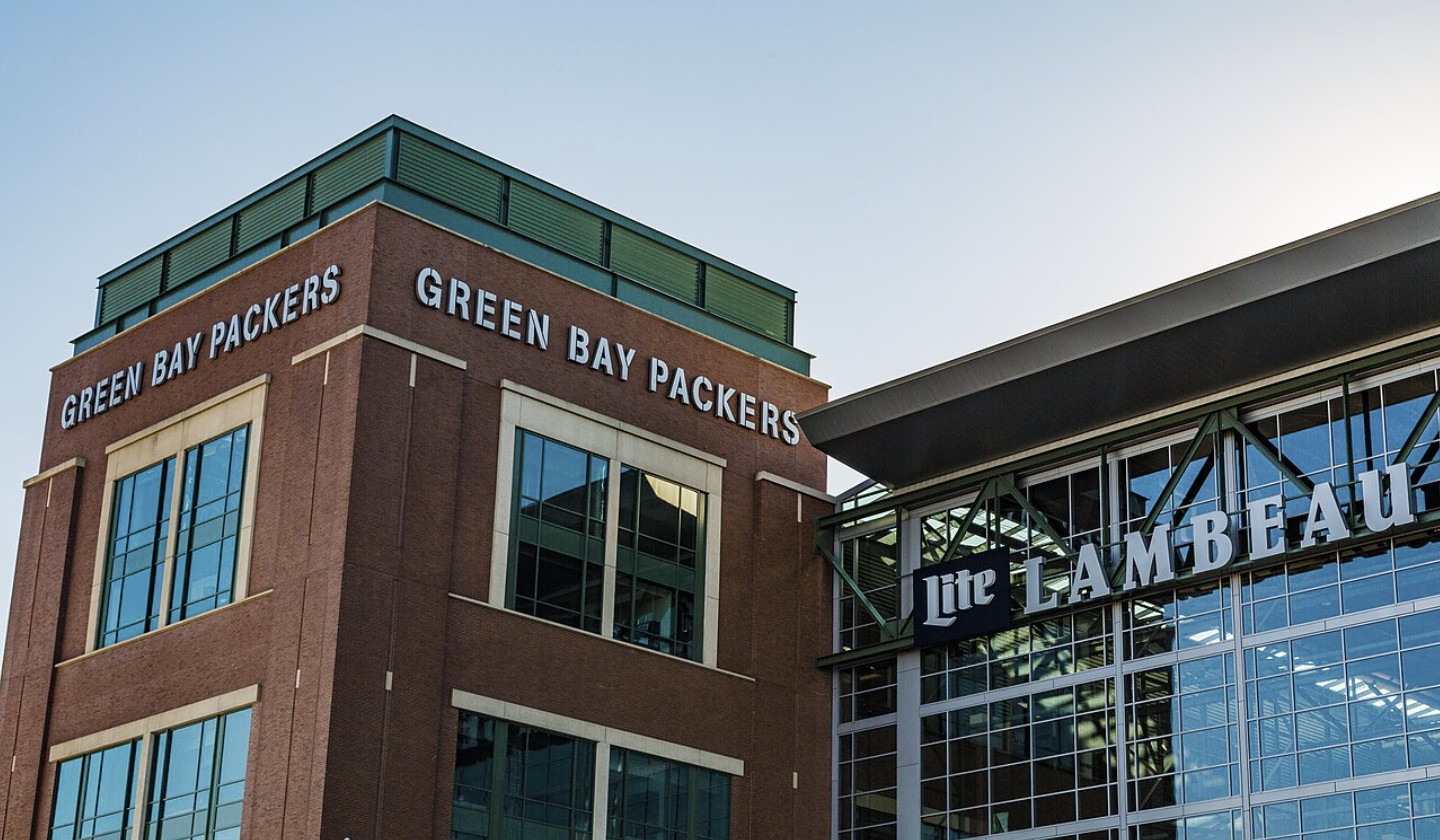
Exterior of the Lambeau Field atrium, photographed in January 2017. A beer brand logo and the LAMBEAU lettering hang together on the glass wall at right · Source: Wikimedia Commons (Tony Webster, CC BY-SA 2.0)
The catch is that this structure becomes a weakness when it comes to raising money.
The Packers’ rainy-day reserve, built up over more than 30 years, stands at $701 million, and Policy pointed out that other teams raise that kind of money in a few months by selling minority stakes.
The gap shows up in valuation too.
In the NFL franchise values Forbes released on September 9, the Packers came in 20th of 32 teams at $8.6 billion.
Set next to the Seattle Seahawks I covered last time, who sold this year for $9.612 billion and rank 14th on the same list, it shows that fan love and market value rankings don’t necessarily move in the same direction.
So the Packers work hard to earn wherever they can.
Of total revenue, national income the league distributes, such as broadcast rights and sponsorships, was $453.2 million, and local income from tickets, sponsors, merchandise, and events was $299.8 million.
Even though the 2025 regular season had one fewer home game than the year before, at eight, local income rose $13.4 million.
In a local TV interview, Policy put the secret down to “the effort of the employees selling tickets, T-shirts, and hot dogs.”
He also said the club plans to grow local income more aggressively going forward.
Attendance and Tickets: Resellers’ Accounts Aren’t Renewed
Lambeau Field is a big stadium of more than 80,000 seats, and it has sold out on season tickets alone since the early 1960s.
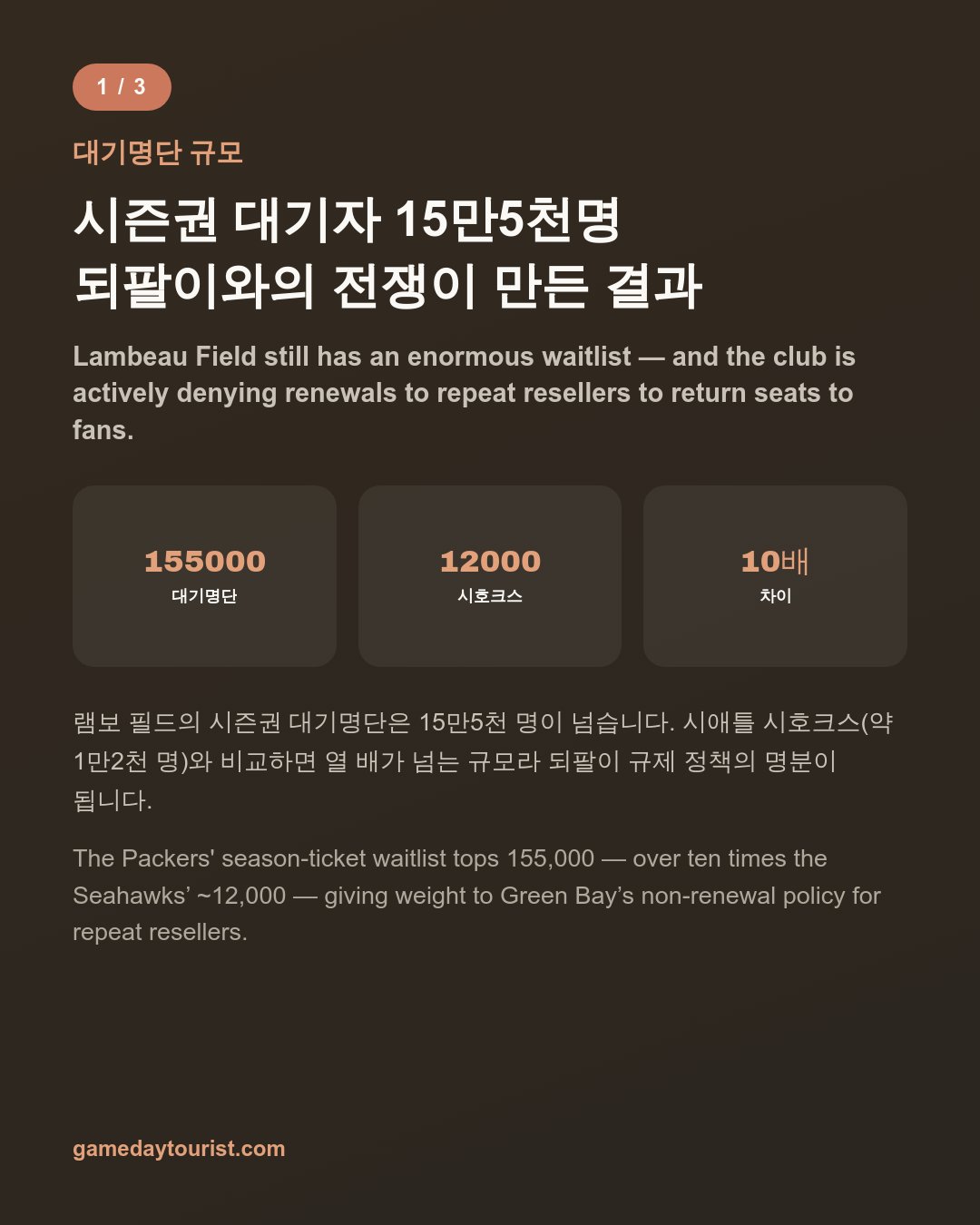
More than 155,000 people are on the season ticket waiting list.
That’s more than ten times the Seahawks waiting list I mentioned earlier, which closed out at around 12,000.
With season tickets this scarce, reselling them pays.
The non-renewal policy the Packers have kept up for several years is aimed squarely at that.
Accounts that had resold 100% of their regular-season tickets over multiple years were not offered season ticket renewals this year.
Craig Benzel, the vice president in charge of sales, put it bluntly: “someone who buys season tickets only to resell them shouldn’t be a Packers season ticket holder.”
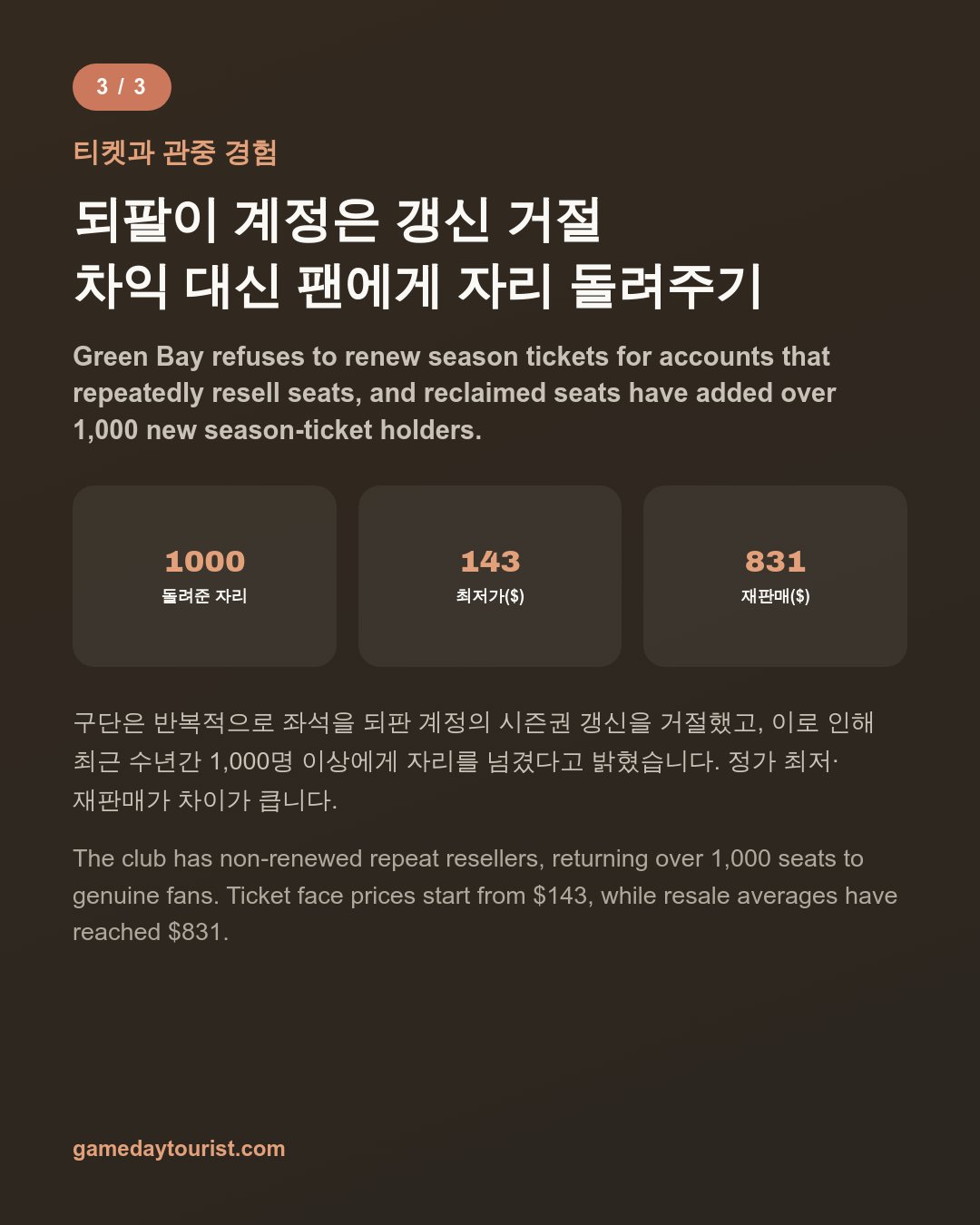
A club spokesperson told local TV that the seats recovered this way have let the club bring in more than 1,000 new season ticket holders over the past few years.
People who had waited decades filled those seats.
Prices, if anything, are restrained.
2026 regular-season ticket prices run from $143 in the south end zone 700 level to $218 between the 20-yard lines, up $4 to $22 per game from last year.
Preseason prices are roughly half the regular season’s.
In a letter to season ticket holders, Policy said the goal is to keep the average ticket price at the middle of the NFL.
Demand is among the league’s best.
In the 12 hours after the schedule release in May, the Packers were the top-selling team on the ticket marketplace SeatGeek, and the average resale price for the October 11 home game against the Chicago Bears stood at $831 at the time.
With a market pricing tickets at several times face value right next door, the club chose to block a structure where season ticket holders pocket that spread.
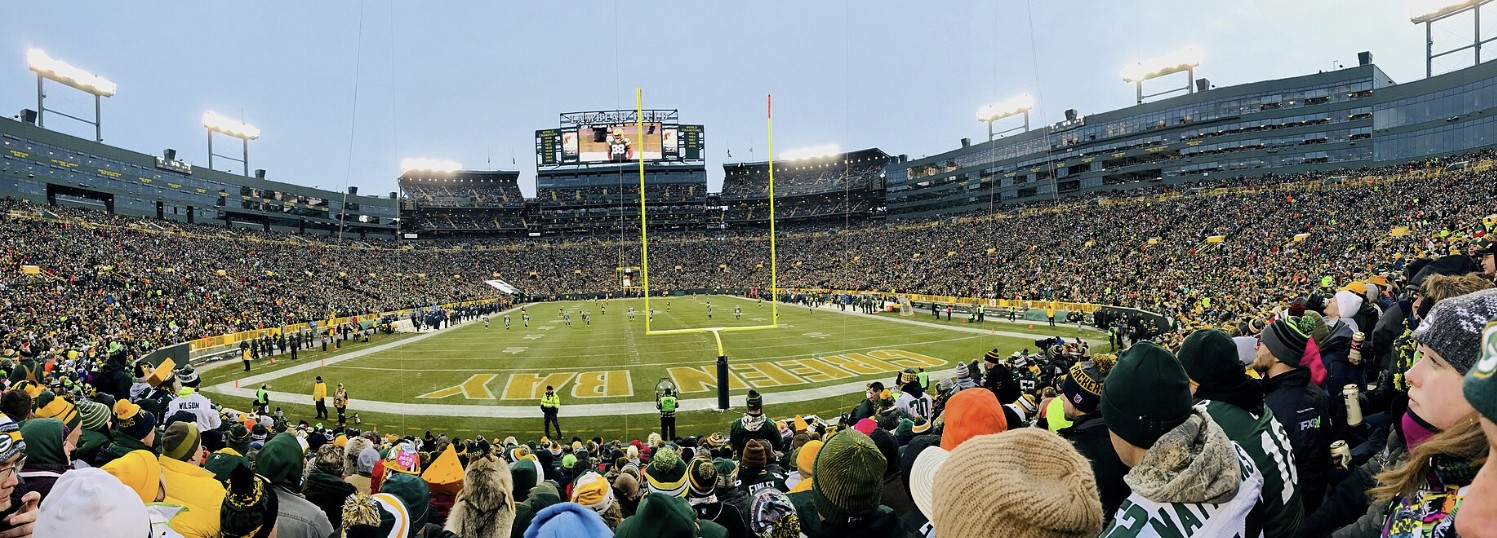
Panorama of the Lambeau Field stands during the game against the Seattle Seahawks in December 2016. Spectators appear in the photo · Source: Wikimedia Commons (Mtyson84, CC0)
The experience in the stands reflects this club’s character just as well.
The lower-bowl seating is still backless aluminum benches.
One local game-day blogger wrote that the moment you sit on a metal bench on a cold day you feel this is an old stadium, calling it like a high school stadium that holds 80,000.
Travel review sites never leave out the advice to pay $10 to rent a seat cushion with a back.
Another visiting-fan blogger recalled that corporate clients sit up in the suites and the lower bowl is filled with real fans who came to watch the game, and that the local fans in the next seats started chatting first by asking where he was from.
As a working marketer, this was the part I envied most.
The power to make even uncomfortable seats feel like “proof you were here” isn’t something an ad budget can buy.
The non-renewal policy that filters out resellers also reads as a device for protecting this stadium atmosphere.
There’s also a tradition tied to the stands.
It’s the “Lambeau Leap,” in which a player who has scored a touchdown jumps up to the wall of the stands behind the end zone and is caught in the fans’ arms.
On December 26, 1993, against the Los Angeles Raiders, defensive back LeRoy Butler picked up a fumble and scored a touchdown, then jumped up for the first time; when his body didn’t clear the wall, the fans reportedly pulled him up and hugged him.
That a ceremony of players going into the stands has remained a symbol of the stadium for more than 30 years also shows whose stadium this is.
They Don’t Sell the Name, but They Sell the Gates and the Plaza
The Lambeau Field name was given in 1965, after Curly Lambeau, the club’s co-founder and first head coach.
When it opened, it was called Green Bay City Stadium.
At the financial report, Policy said the club would look at selling naming rights (the right to put a company’s name on a facility) as a revenue source, while drawing the line that the name Lambeau Field itself won’t change.
Madison Square Garden, which I covered a few days ago, also doesn’t sell its name, but where that’s a case of the name being such a huge brand that there’s no reason to sell, Lambeau Field is closer to a name that can’t be sold because it is the founder and the club’s history.
Instead, the ad inventory around the stadium (the ad space and rights that can be sold inside and outside the stadium) is sold off closely.
The atrium’s main entrance long carried the name “Miller Lite Gate,” and on the stands side there are branded spaces like the Miller Lite Deck and the Miller Lite Lounge.
The pregame tailgate space carries the name of a sausage brand, “Johnsonville Tailgate Village.”
In April this year, the central plaza lawn of Titletown, the complex west of the stadium, gained “Emplify Health Field,” named for a local healthcare organization.
Policy also mentioned that practice facility names could be up for sale.
It’s an approach of protecting the symbol and earning from the surrounding assets, and while it takes more legwork than landing one big deal on the stadium name, it leaves that much less room for a fan backlash.
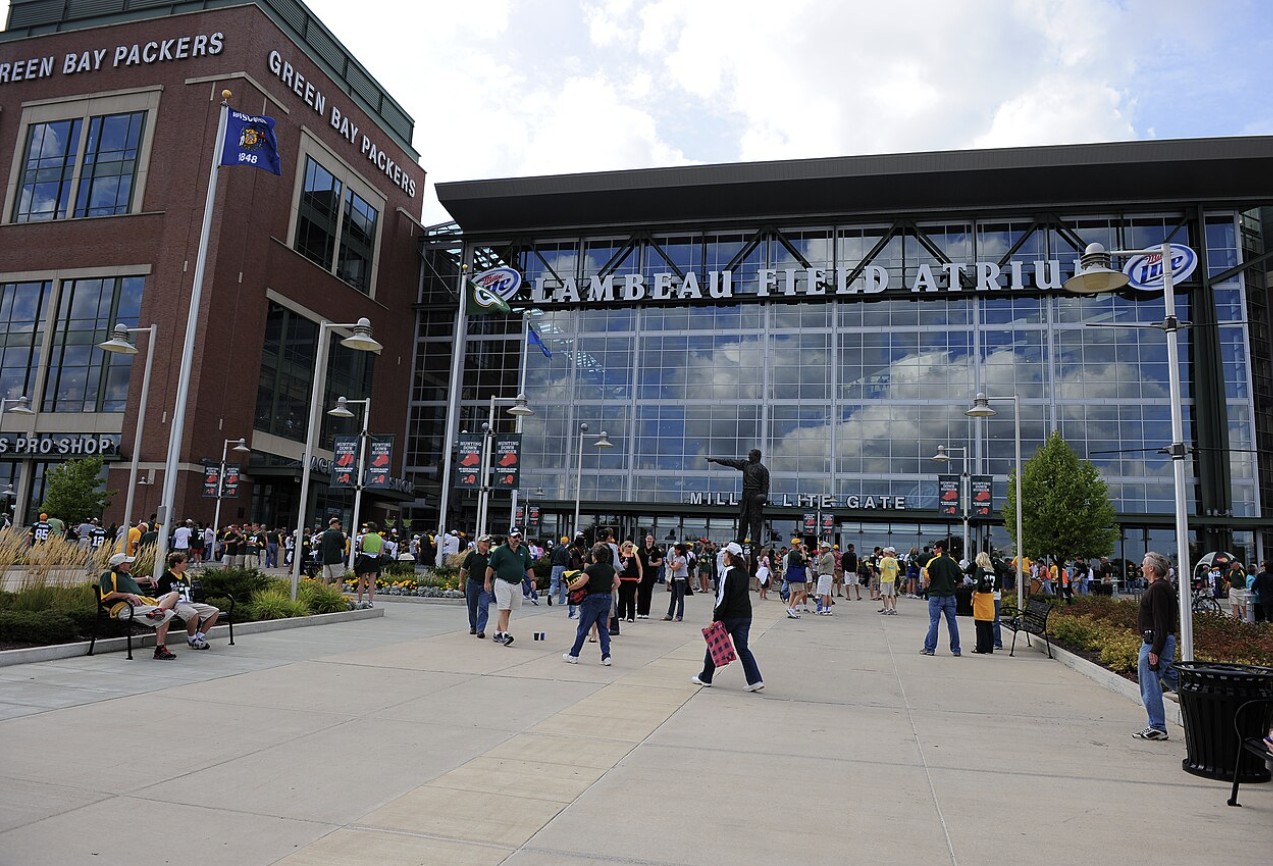
The front of the Lambeau Field atrium. The MILLER LITE GATE sign and the Vince Lombardi statue are visible above the entrance, with passing fans in the shot (photographed September 2009) · Source: Wikimedia Commons (CdbgLaurie, CC BY-SA 4.0)
Merchandise and F&B: The Stock Certificate Becomes a Uniform
The most eye-catching item on the merchandise side this year is the NFL Rivalries alternate uniform.
Nike and the NFL make these special uniforms for divisional rivalry games, and the Packers picked “fan ownership” as their theme.
The club explains that the alabaster (pale ivory) used on the pants and helmet mimics the yellowed paper of an old stock certificate, and that the engraving-like pattern on the jersey numbers is modeled on banknote designs.
In other words, the stock certificates framed in more than 500,000 households were the starting point of the design.
The uniform debuts against the Bears on October 11, and related merchandise went on sale September 1 at pro shop stores and online.
It’s a case of turning the club’s ownership structure directly into a merchandise story, and as a working marketer, I enjoyed just imagining how that proposal got approved.
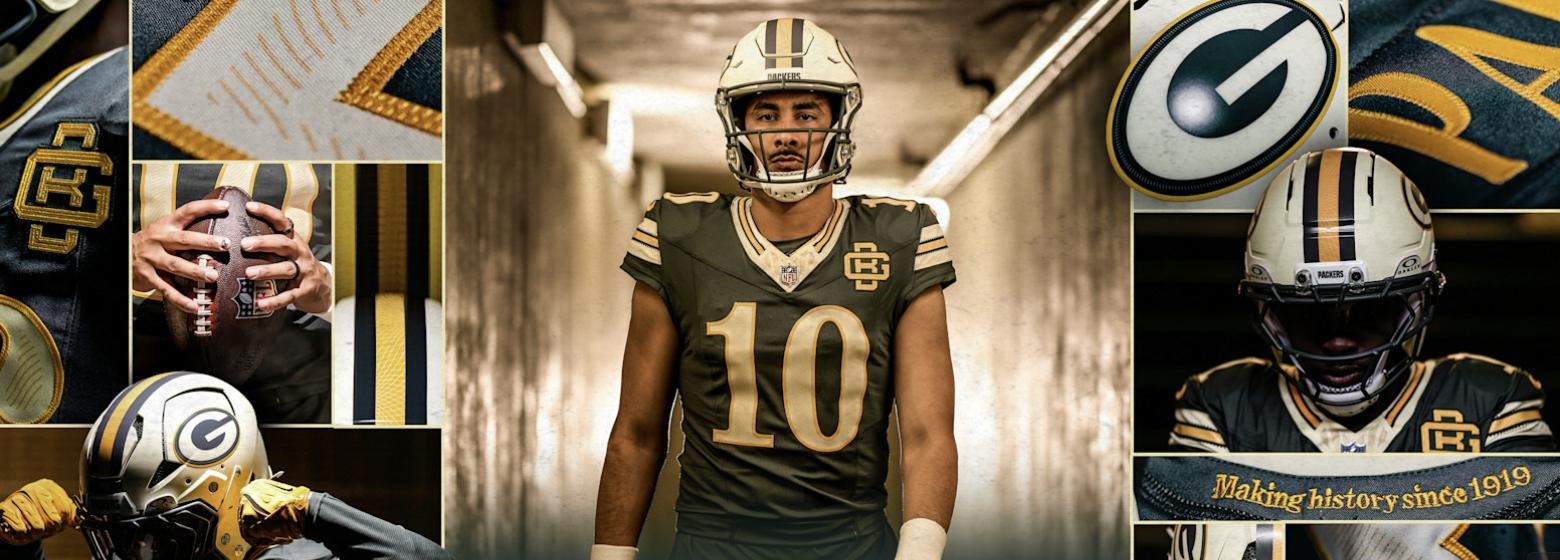
Official promotional image of the Green Bay Packers NFL Rivalries alternate uniform. Quarterback Jordan Love (No. 10) is in the center. Source: screenshot from the packers.com rivalries page
The store itself is big too.
One visiting-fan blogger described the atrium pro shop as the size of a department store floor, adding that it was so crowded he couldn’t even tell how large it was.
The atrium also holds the Hall of Fame and a restaurant, so it works as a tourist stop that’s open even on non-game days.
Merchandise sales go overseas as well.
Timed to the NFL game in Munich, Germany in November, the Packers will open a three-day pop-up store with the Kansas City Chiefs and release limited items with an Oktoberfest design.
A club from a city of just over 100,000 people is selling merchandise in the middle of Munich.
The food is thoroughly Wisconsin.
Bratwurst and fried cheese curds are the signature items, and many of the beers are from Wisconsin regional breweries.
One sports-travel blogger pointed out that beer prices are high even by NFL standards, but the effect of selling local brands inside the stadium, leaving visitors with the impression that “you’re in Wisconsin,” looks clear.
Lambeau Field and every store inside the stadium, parking lots included, run on cashless payment.
Broadcast Rights and the Local Economy: Lambeau Field on Non-Game Days
About 60% of Packers revenue is the national income the league pools from broadcast rights and other sources and splits among the 32 clubs.
Beyond broadcast rights growth, this year’s financial statements had one unusual item: the stake in ESPN that the 32 clubs received equally when the NFL handed its own channel, NFL Network, over to ESPN was booked as non-operating income (profit generated outside the core business of running games).
This home opener, too, was a Thursday night game, so it was broadcast on Amazon Prime Video and also aired on an NBC channel in the Green Bay area.
The foundation that lets a club in a small city compete with big-city clubs is exactly this league-wide revenue-sharing structure.
The push to grow local income stands out on non-game days.
Country singer Luke Combs’ concert in May drew 51,981 people on Saturday alone, a record for a single-artist concert, and adding Friday’s 40,559 the night before, 92,540 people came to the stadium over the two-day weekend.
It was also the first time the same artist had played two nights in a row at Lambeau Field.
Earlier this month, the “Frozen Tundra Faceoff,” in which the University of Wisconsin men’s and women’s hockey teams will play back-to-back games at Lambeau Field against Michigan (men) and Ohio State (women) on February 20 next year, was announced.
The Wisconsin tourism department bought the event’s name and is sponsoring it, and it’s the first time in 20 years that college hockey has been played at Lambeau Field.
It turns the stadium’s nickname, “Frozen Tundra,” earned from its famously cold weather, into a product.
The area around the stadium is a commercial district in its own right.
The Titletown complex, into which the Packers led roughly $300 million in investment, drew nearly a million visitors over the past year, and the club’s local giving and community spending came to $15 million, up $2 million from the year before.
On game days, the residential streets across from the stadium become one big parking lot.
One visiting-fan blogger reported that homeowners rent out their driveways and front lawns as parking spaces, and that nearly every house within about 800 meters turns into its own tailgate party venue.
It’s the scene you get because the stadium isn’t an island on the edge of downtown but sits in the middle of the neighborhood.
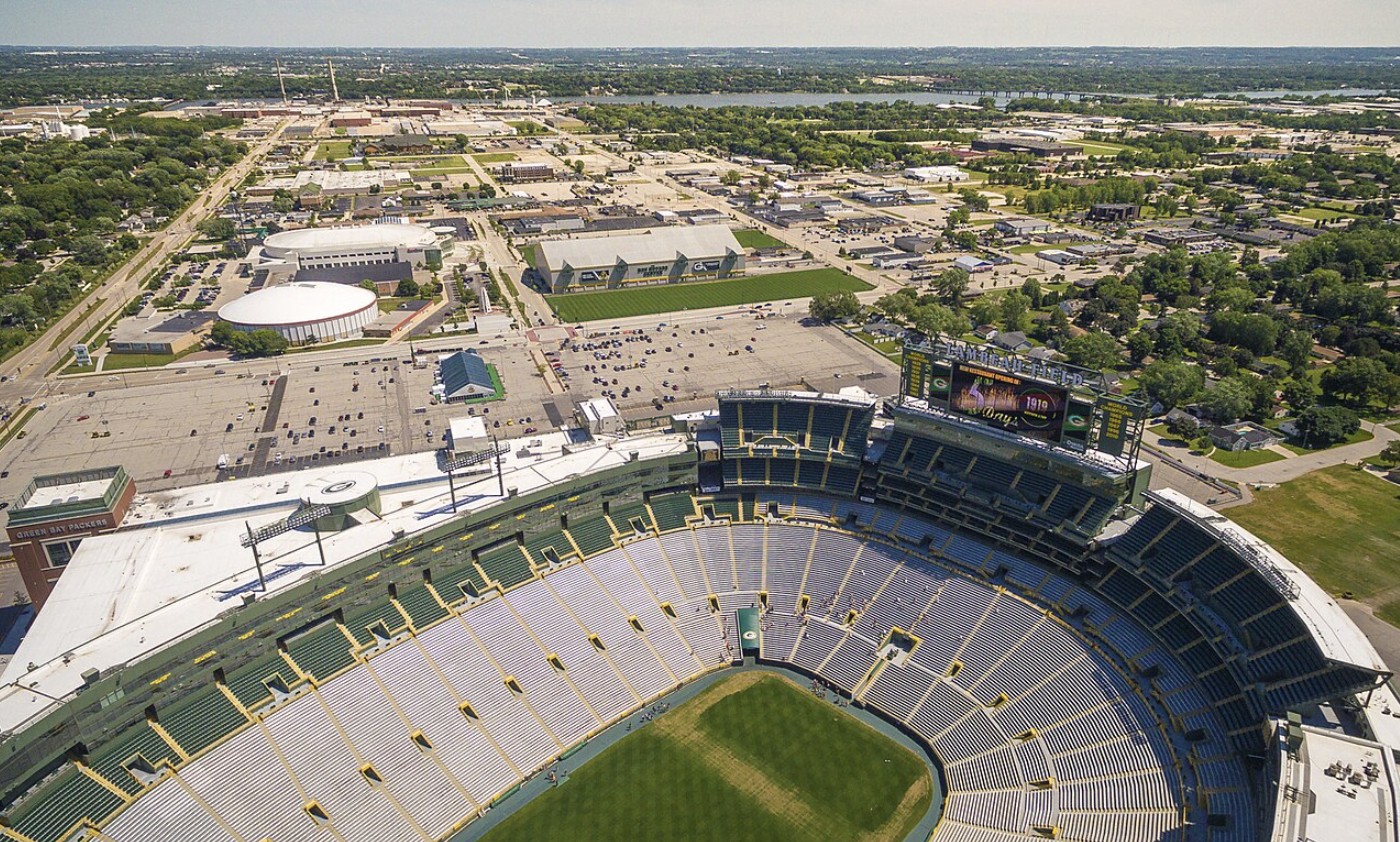
Aerial view of Lambeau Field and the surrounding residential neighborhood, photographed July 2015 (before the Titletown complex opened in 2017) · Source: Wikimedia Commons (relux., CC BY-SA 2.0)
A Comparison With the KBO and K League
A structure where fans become shareholders exists in Korea too.
In the first citizen-share offering at the end of 2002, while Daegu FC was being founded, 33,600 local residents subscribed for shares.
Several citizen- and provincial-owned clubs have appeared since, but it’s hard to think of one where the shareholder register is actively used for the club’s stories and merchandise.
Just as the Packers turned the stock certificate into a uniform design, a club with citizen shares has plenty of room to turn the shareholder list itself into club-history content and into limited merchandise for founding shareholders.
It’s also worth noting that the Packers keep a separate shareholder-only merchandise section in their online store.
On tickets, the difference in approach is interesting.
In Korea, illegal ticket resale using macro programs has started to be punished by law, and the government has said it would push for an amendment widening the scope of punishment.
That’s the law chasing after scalpers.
The Packers filter out the problem earlier than the law, at the contract stage between the club and season ticket holders.
Declining to renew based on resale records is something the club can do on its own, and it even comes with a justification of returning the seats to people on the waiting list.
For a Korean club with lots of sellouts, if it wrote a clause like “renewal restricted for repeated resale” into its season ticket or membership terms and explained the reason transparently to fans, I wonder whether it could protect the stadium atmosphere from a different direction than enforcement.
The thought that kept coming back as I put Lambeau Field’s numbers together was that what this club sells most of all is, in the end, “belonging.”
It’s possible because there are fans who bought stock that pays no dividends, more than 500,000 of them, and use season tickets they waited decades for on cold metal benches.
I plan to follow up separately on the result and the scene from the 70th season’s first home game on the night of the 24th, local time, and on what kind of roar filled those benches.
Leave a Reply