📱 View as card news

Catching an American sports broadcast or two on weekend nights via streaming has become something of a habit lately.
Looking into the Washington Commanders ahead of their upcoming regular-season opener (September 13, on the road at Philadelphia), the name of their home stadium struck me as unfamiliar, so I looked it up — turns out the name had only been in place for two years.
This blog has covered a number of leagues so far, but this is the first time for the NFL.
I picked the Commanders as the league’s first subject mainly because the timing lined up.
On September 1, the club announced a multi-year deal with sports and entertainment agency Elevate for its new stadium project, and just two days later, on September 3, it unveiled a new pregame entertainment program, “The Show,” debuting at the home opener on September 27.
Since Washington as a city is also approaching a new stadium opening in 2030, it felt like a good moment to look at both the stadium in use now and the one being built.
One thing worth flagging first.
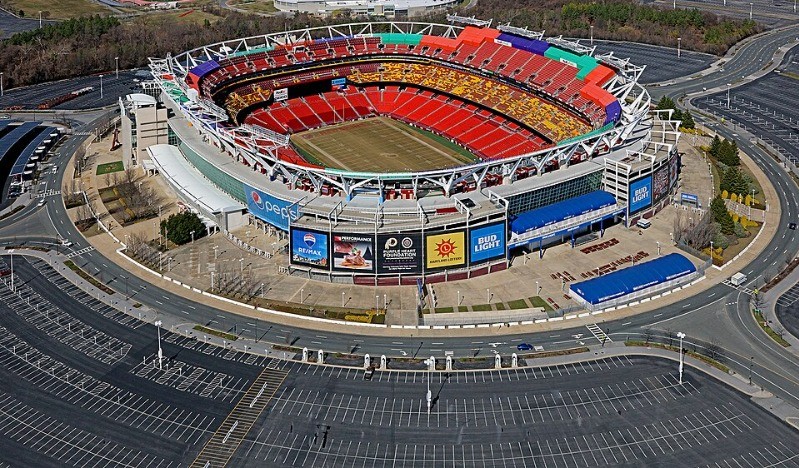
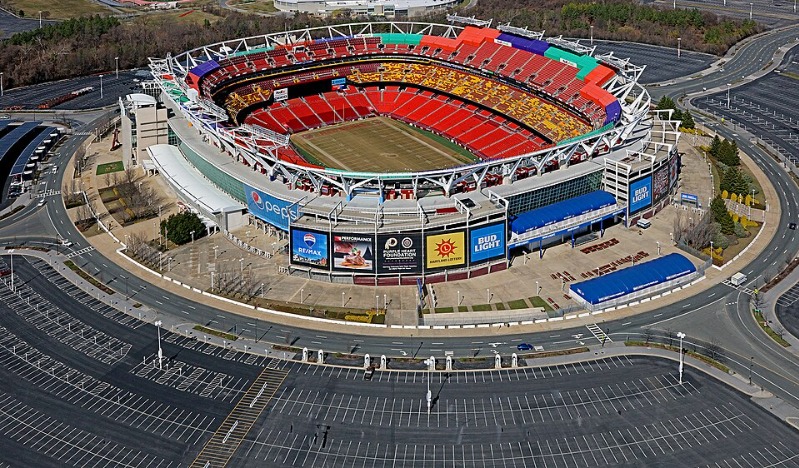
Despite being the “Washington” Commanders, their home ground, Northwest Stadium, isn’t actually in Washington D.C. — it’s in Landover, Maryland.
That’s because Jack Kent Cooke, the team’s owner when the stadium was built in 1997, chose a suburban site over one downtown, a decision that turns out to be the starting point for several of the stories that follow.
Attendance and Tickets
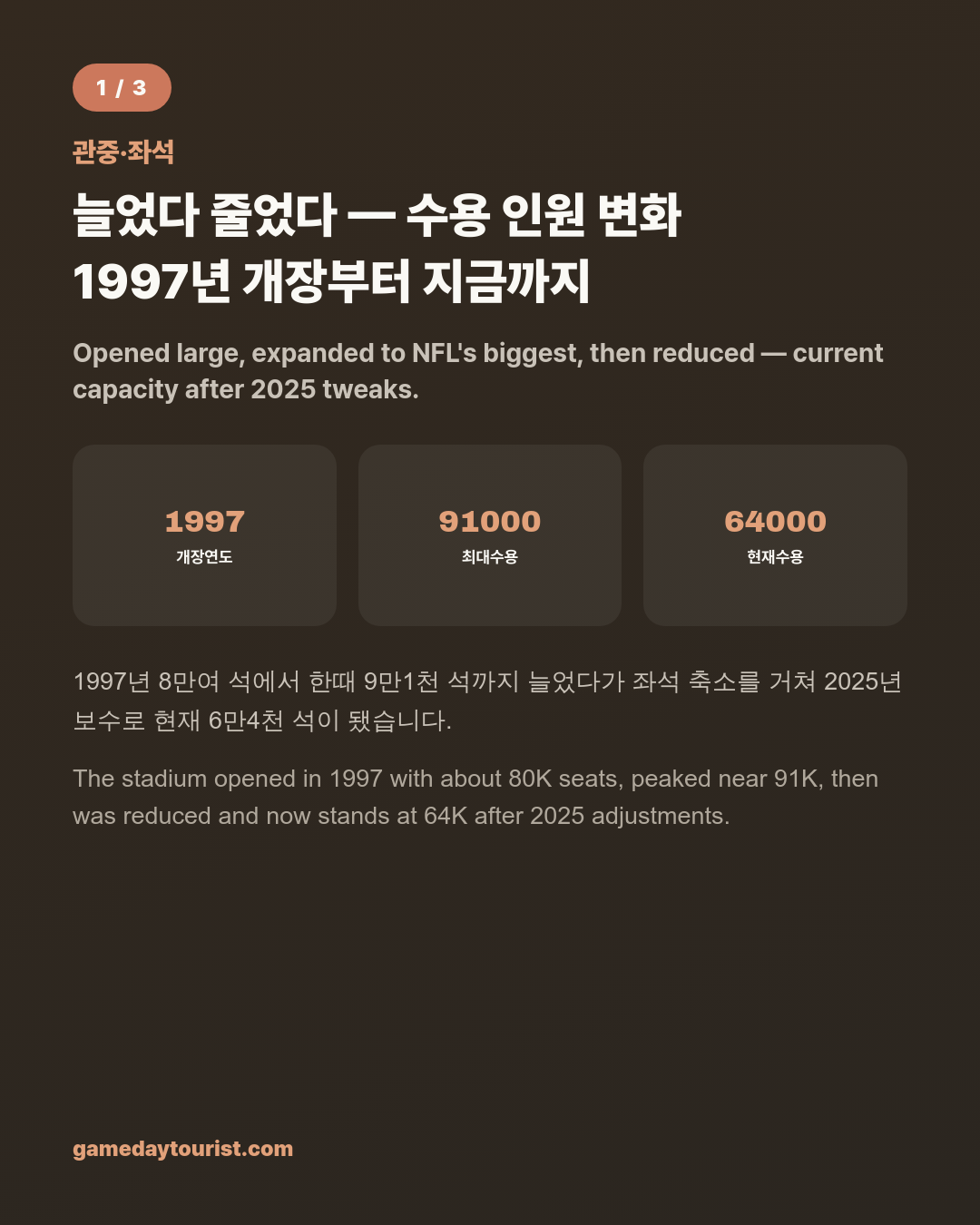
Northwest Stadium opened in 1997 with 80,116 seats, then grew to around 91,000 between 2004 and 2010, briefly making it the largest stadium in the NFL.
Since then, it’s shrunk repeatedly through seat removals, down to 62,000 by 2022, before adding back 1,500 seats in 2025 to reach its current capacity of 64,000.
Average attendance in the 2025 season came to 514,362 across eight home games, or 64,295 per game, ranking 28th out of 32 teams (per Yahoo Sports figures).
Considering this came at a point when the afterglow of a 12-5 winning season in 2024 — the club’s first winning season since 2016 — and a run through the wild card and divisional rounds to its first NFC Championship appearance since 1991 (a 23-55 loss to the Philadelphia Eagles) should still have been fresh, it struck me as a clear example of how directly a rough 2025 season — starting quarterback Jayden Daniels started only seven games due to injury, and the team lost 10 of its last 12 — can affect attendance.
A local sports travel blog described the stadium along the lines of “nothing particularly special, you just go because it’s there,” and a stadium review outlet offered a similar assessment.
Reviews noted that the upper deck’s steep pitch makes sightlines feel precarious even from the 50-yard line seats, and that awkward seating-section layout means climbing stairs up only to have to come back down to reach certain sections.
What stood out to me as a marketer is that, despite these complaints coming up repeatedly, the club chose to build an entirely new stadium rather than renovate this one.
The call was likely that designing a new fan experience from scratch pays off more in the long run than patching up an aging facility.
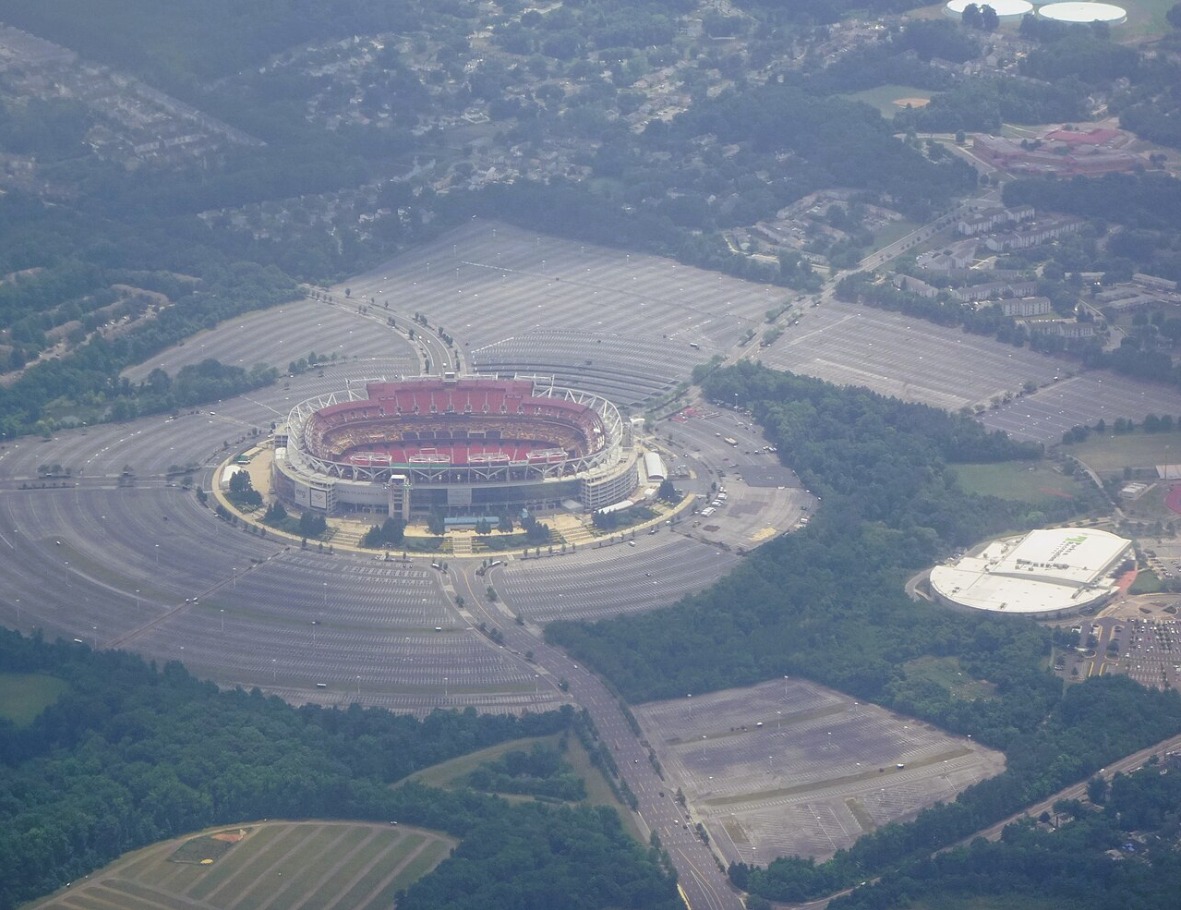
Source: Charles from Port Chester, New York (Flickr → Wikimedia Commons), CC BY 2.0 — view original
Space and F&B
The stadium’s parking lots are split across multiple entrances, and the “Red Zone” lot opens five hours before kickoff specifically to handle tailgating demand — the American sports tradition of grilling and partying right in the parking lot before a game.
The F&B lineup in the concourses has gotten noticeably more varied in recent years — Ben’s Chili Bowl, a longtime D.C. institution, sells its “half-smoke” (a split sausage topped with chili), and a chicken tenders stand carrying celebrity chef Guy Fieri’s name has also landed on the main concourse.
Many reviews say the club level and main concourse have noticeably better food options after recent renovations, while the upper deck still gets described as having comparatively limited choices.
On accessibility, a recurring complaint is the roughly one-mile walk from the Morgan Boulevard Metro station, and without that, there’s little option besides driving and paying for parking.
Local review sites have generally scored accessibility low, and it doesn’t seem unrelated to the club’s choice, mentioned earlier, to build new rather than renovate.
A problem that’s structurally hard to fix at the current site is effectively being solved by changing the location and design altogether.
Merchandise and Ad Inventory
The club partners listed on the official site are Bank of America and Pepsi.
On the merchandise side, I found an interesting case: according to a Daily Caller report from last month (August 2026), the club is still selling merchandise bearing its old team name on its online store.
A replica jersey for retired player Sean Taylor (priced at $114.99, roughly ₩155,000) still carries the old team name alongside a patch marking the club’s 75th anniversary, and a club representative reportedly explained this is because continued commercial use of a trademark is what keeps the rights under the club’s ownership.
Even years after the 2022 name change, trademark law is apparently still keeping the club from fully retiring old-name merchandise — a case I found notable for showing that a brand transition doesn’t wrap up neatly just because the marketing team wills it.
For reference, new jerseys with stitched limited-edition detailing sell for around $199, roughly ₩268,000.
The New Stadium and Regional Economic Impact
Let’s start with what prompted this piece in the first place.
On September 1, the club announced a multi-year deal with Elevate, whose role spans three areas: premium seating and hospitality sales strategy, content production for the new stadium’s experience center and sales center, and support for data-driven decision-making.
The new stadium is being built with a roof on the site of the old RFK Stadium (along the Anacostia River in Washington D.C.), and is set to open in time for the 2030 season.
Behind the ability to fund investment on this scale is a club valuation that’s climbed sharply in recent years.
In Forbes’ August 2025 ranking of all 32 NFL franchise values, the Commanders ranked 10th at $7.6 billion, roughly ₩10.24 trillion — a sharp jump from the $6.05 billion, roughly ₩8.15 trillion, Josh Harris paid to acquire the team in 2023.
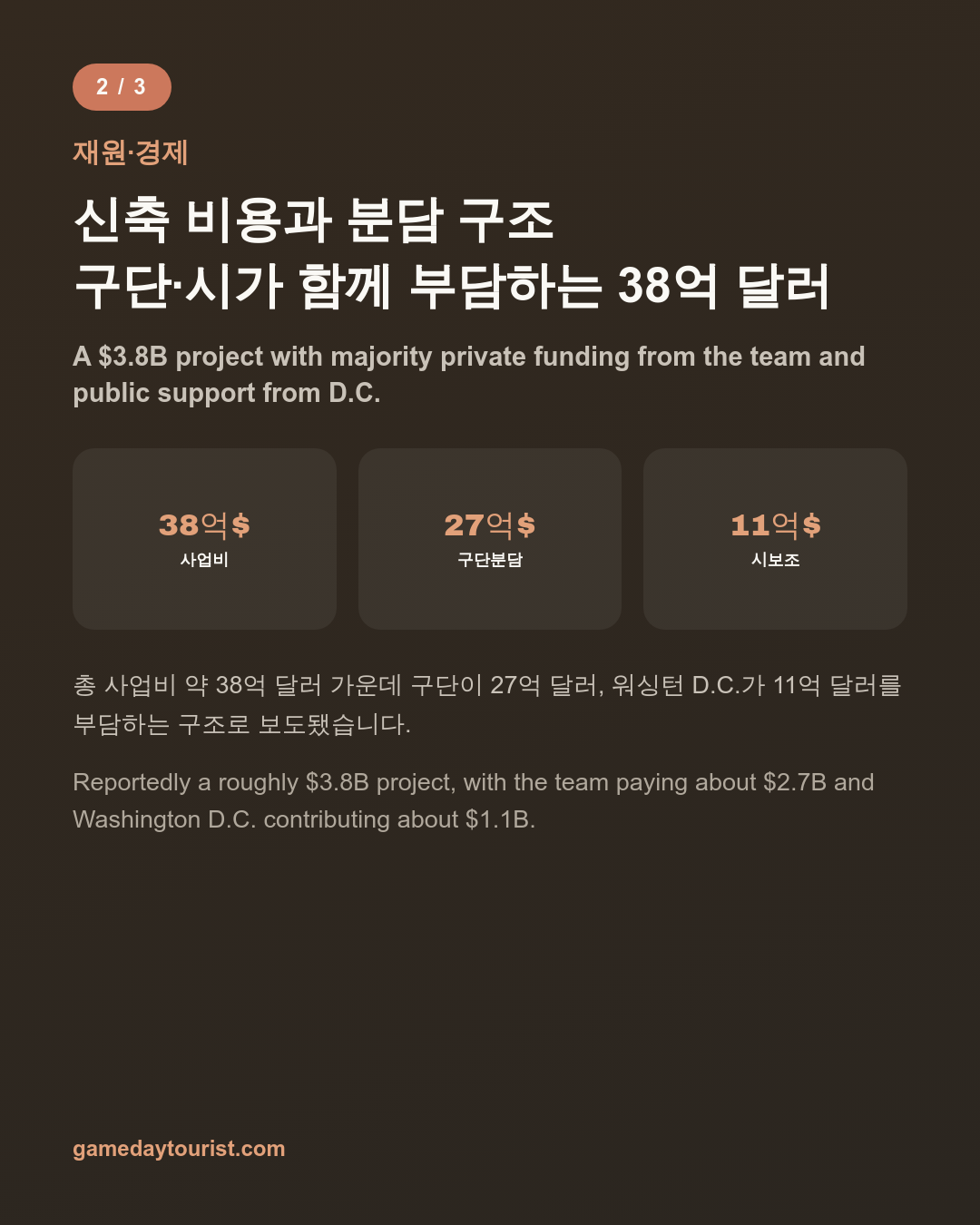
The project’s total cost is reported at around $3.8 billion, roughly ₩5.12 trillion, with the club covering $2.7 billion, roughly ₩3.64 trillion, and Washington D.C. contributing $1.1 billion, roughly ₩1.48 trillion.
The D.C. Council approved the deal in September 2025 by a vote of 11 to 2, locking in the project.
That said, a public subsidy of this size hasn’t gone without criticism.
Urban-planning advocacy outlet Greater Greater Washington published its own analysis arguing that, beyond the roughly $856 million the city has officially announced for stadium and parking construction subsidies, once you add the opportunity cost of leasing the 90-acre site for a nominal $5 a year, roughly ₩808 billion, property tax exemptions on the stadium and parking, roughly ₩577.9 billion, a provision diverting ticket and merchandise sales tax away from the city’s general fund into a stadium maintenance fund, roughly ₩404.1 billion, interest costs on bonds the city will issue, roughly ₩839.2 billion, and the tax revenue the city forgoes by not building housing on the same site instead, roughly ₩4.45 quadrillion — the real cost to residents comes to about $6.1 billion, roughly ₩8.22 trillion.
That’s just one advocacy outlet’s estimate, not the club’s or the city’s official position, but it illustrates how stadium-subsidy debates everywhere tend to play out between the “visible number” and the “hidden costs.”
Another piece of news tied to the new stadium announcement is that Washington D.C. landed the 2027 NFL Draft.
Set on the National Mall — the space of national monuments including the Washington Monument — over three days, the league expects more than a million visitors for the event.
A single club’s new stadium issue turned into the whole city landing a major sports event, and as a marketer I found it interesting that a new-stadium project can function as a tourism and event-marketing asset for the city regardless of how the team itself performs.
For what it’s worth, the club has also reworked its pregame presentation starting this season.
Debuting at the September 27 game against Seattle, “The Show” reportedly features narration from actor Jon Bernthal (known for roles including “The Punisher”), along with a marching band performance, a large flag display, and a game-ball presentation involving special-forces members.
With four years to go before the new stadium opens, it looked like an attempt to squeeze as much value as possible out of the current stadium experience in the meantime.
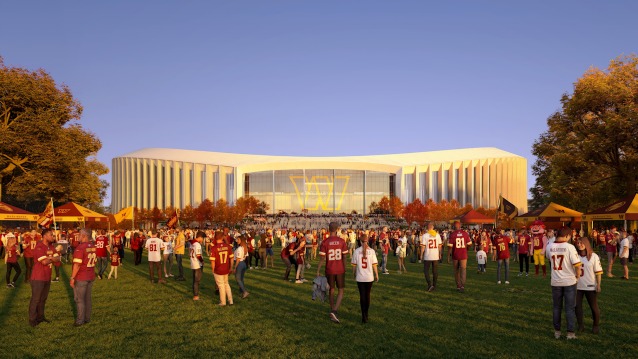
Source: Washington Commanders official site — early rendering of the new stadium opening in 2030 (official club-released image)
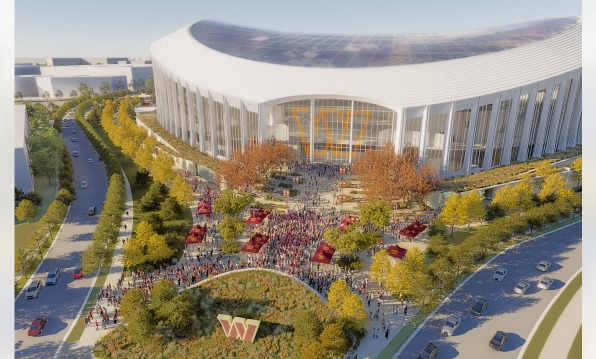
Source: Washington Commanders official site — rendering of the plaza and landscaping around the new stadium (official club-released image)
The Stadium’s Signature Feature
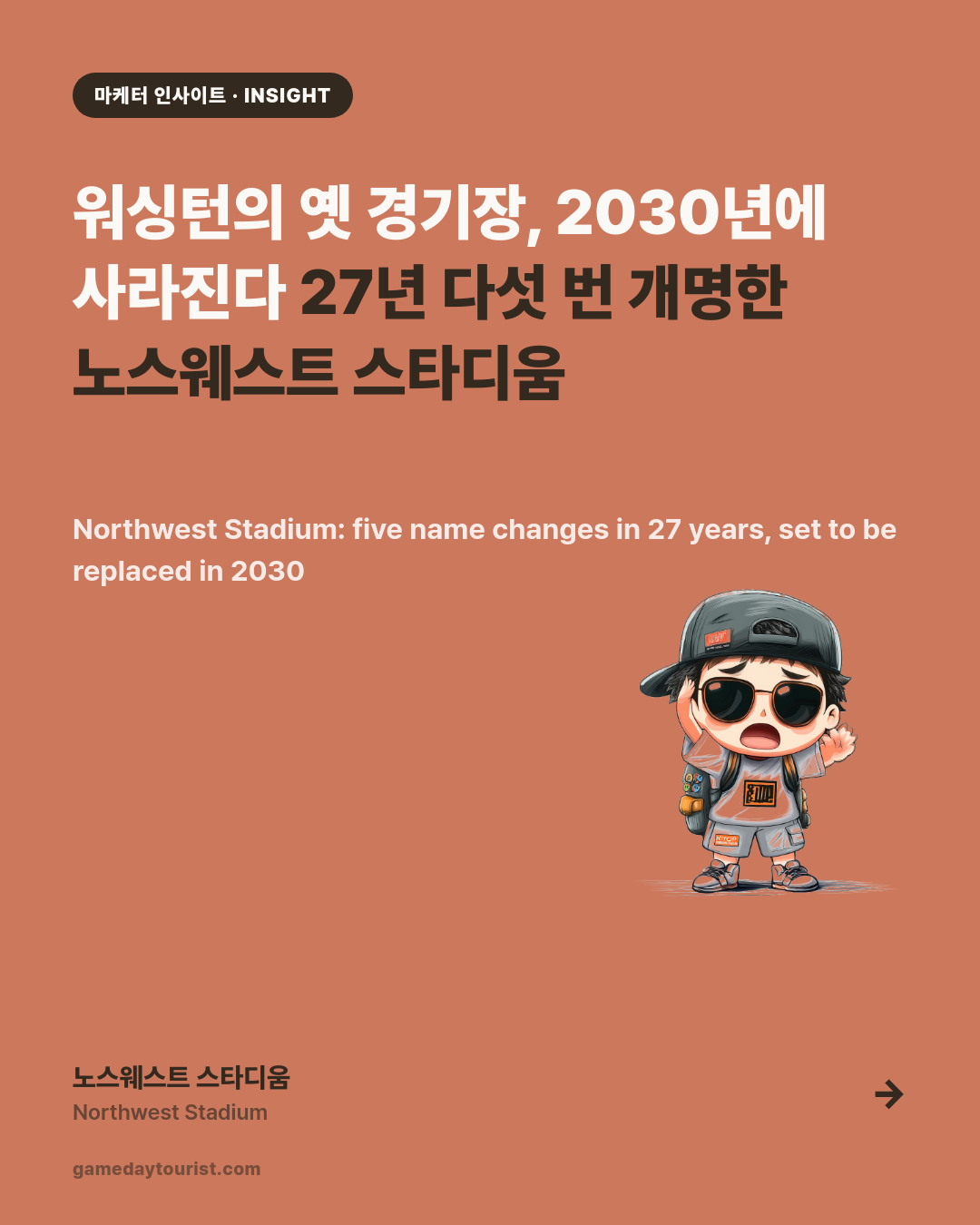
What personally struck me as the most entertaining detail is that this stadium has already changed names five times since opening in 1997.
It started as “Jack Kent Cooke Stadium” (1997-99), named for the owner, then briefly became “Redskins Stadium” (1999) under a new owner after Cooke’s death, before FedEx signed a 27-year deal and it became “FedExField.”
That name stuck for nearly 25 years, until 2024 — a single year in which the name changed twice more.
FedEx announced an early exit two years before its contract was due to expire, leaving the venue known informally as “Commanders Field” for roughly half a year, before a new naming-rights deal with Northwest Federal Credit Union that August made it today’s “Northwest Stadium.”
One stadium has gone through five names in under 30 years, and even that will disappear entirely by 2030 when it’s replaced by the new stadium — so the name itself was never going to be a long-lasting brand.
Something else has actually lasted a long time in the club’s history, though.
The marching band, formed when the club was founded in 1937, is still one of the few team-affiliated marching bands left in the NFL, performing before every game.
The cheerleading squad has also been active since 1962, one of the longest-running cheerleader traditions in the NFL.
There’s an interesting story behind the fight song too — the original 1937 anthem, “Hail to the Redskins,” was retired along with the old team name, but the new fight song chosen by fan vote in 2022, “Fight for our Commanders,” largely kept the old song’s melody and lyrical structure.
The name has changed again and again, but the melody echoing through the stadium has stayed largely the same for close to 90 years.
Source: Duane Lempke Photography (Wikimedia Commons), CC0 — view original
A Comparison With the KBO and K League
What stood out most to me about the financing structure behind this new stadium project is who’s actually paying for it.
The club is covering $2.7 billion and the city subsidizing $1.1 billion, meaning private money (the club) carries the majority share — that’s close to the opposite of how things tend to work in Korea.
Most Korean stadiums, like Gwangju-Kia Champions Field, are fully funded and owned by local governments, with clubs operating under management contracts or leases, so the question of “how much is the club paying” rarely even comes up as a debate to begin with.
In exchange, Korean clubs face a tradeoff where facility ownership sitting with local government makes it harder for them to independently decide on ad inventory or naming rights — whereas in this Washington case, private money buys the freedom to design the facility exactly as the club wants (whether it has a roof, how premium seating is configured, and so on).
Another thing that caught my attention is how a new-stadium issue gets tied to a single flagship event for city marketing, as with landing the 2027 NFL Draft.
The K League and KBO have their own cases of a particular city hosting an All-Star Game or season opener to promote local economic impact, but it’s rare to see something on the scale of this case, which expects visitors in the millions.
It’s worth noting as an example of how a single new-stadium project can become a lever for landing a citywide event, well beyond just branding for the club itself.
The strangest part of covering the NFL for the first time on this blog is that I ended up talking more about a stadium that’s about to disappear than the one currently in use.
Even so, digging into the new-stadium project confirmed there’s plenty worth looking at from a marketing angle — financing structure, the tax debate, and landing a citywide event.
If I get the chance to cover another NFL club next time, I’d like to put a bit more weight on the actual in-stadium experience rather than a new-stadium story like this one.
Leave a Reply